
Overview of Romans Chapters 1 through 16 1
- Slides: 5
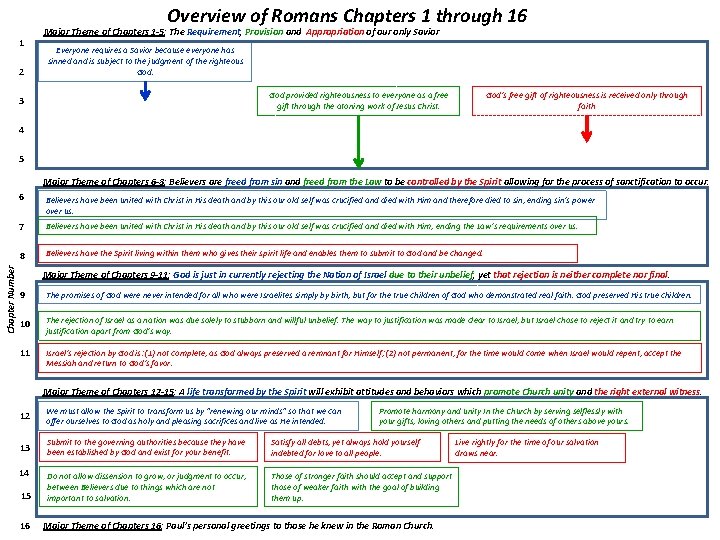
Overview of Romans Chapters 1 through 16 1 2 Major Theme of Chapters 1 -5: The Requirement, Provision and Appropriation of our only Savior Everyone requires a Savior because everyone has sinned and is subject to the judgment of the righteous God’s free gift of righteousness is received only through faith God provided righteousness to everyone as a free gift through the atoning work of Jesus Christ. 3 4 5 Chapter Number Major Theme of Chapters 6 -8: Believers are freed from sin and freed from the Law to be controlled by the Spirit allowing for the process of sanctification to occur. 6 Believers have been united with Christ in His death and by this our old self was crucified and died with Him and therefore died to sin, ending sin’s power over us. 7 Believers have been united with Christ in His death and by this our old self was crucified and died with Him, ending the Law’s requirements over us. 8 Believers have the Spirit living within them who gives their spirit life and enables them to submit to God and be changed. Major Theme of Chapters 9 -11: God is just in currently rejecting the Nation of Israel due to their unbelief, yet that rejection is neither complete nor final. 9 The promises of God were never intended for all who were Israelites simply by birth, but for the true children of God who demonstrated real faith. God preserved His true children. 10 The rejection of Israel as a nation was due solely to stubborn and willful unbelief. The way to justification was made clear to Israel, but Israel chose to reject it and try to earn justification apart from God’s way. 11 Israel’s rejection by God is: (1) not complete, as God always preserved a remnant for Himself; (2) not permanent, for the time would come when Israel would repent, accept the Messiah and return to God’s favor. Major Theme of Chapters 12 -15: A life transformed by the Spirit will exhibit attitudes and behaviors which promote Church unity and the right external witness. 12 We must allow the Spirit to transform us by “renewing our minds” so that we can offer ourselves to God as holy and pleasing sacrifices and live as He intended. 13 Submit to the governing authorities because they have been established by God and exist for your benefit. Satisfy all debts, yet always hold yourself indebted for love to all people. Do not allow dissension to grow, or judgment to occur, between Believers due to things which are not important to salvation. Those of stronger faith should accept and support those of weaker faith with the goal of building them up. 14 15 16 Promote harmony and unity In the Church by serving selflessly with your gifts, loving others and putting the needs of others above yours. Major Theme of Chapters 16: Paul’s personal greetings to those he knew in the Roman Church. Live rightly for the time of our salvation draws near.
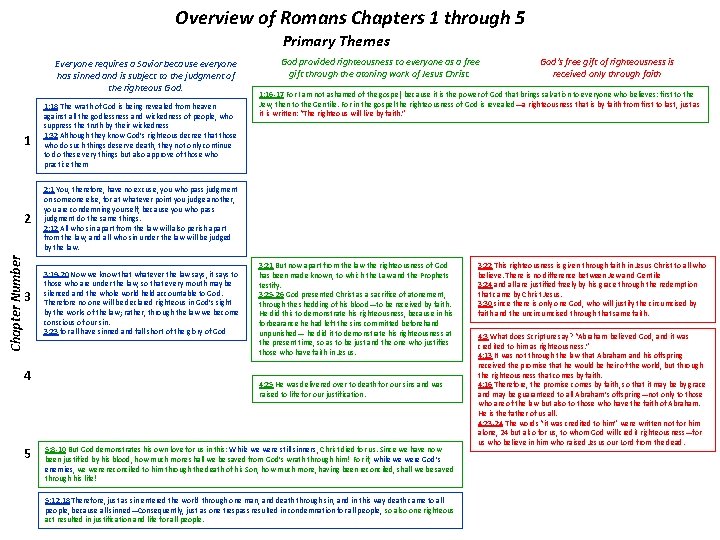
Overview of Romans Chapters 1 through 5 Primary Themes Everyone requires a Savior because everyone has sinned and is subject to the judgment of the righteous God. 1 Chapter Number 2 3 4 5 1: 18 The wrath of God is being revealed from heaven against all the godlessness and wickedness of people, who suppress the truth by their wickedness 1: 32 Although they know God’s righteous decree that those who do such things deserve death, they not only continue to do these very things but also approve of those who practice them God provided righteousness to everyone as a free gift through the atoning work of Jesus Christ. God’s free gift of righteousness is received only through faith 1: 16 -17 For I am not ashamed of the gospel, because it is the power of God that brings salvation to everyone who believes: first to the Jew, then to the Gentile. For in the gospel the righteousness of God is revealed—a righteousness that is by faith from first to last, just as it is written: “The righteous will live by faith. ” 2: 1 You, therefore, have no excuse, you who pass judgment on someone else, for at whatever point you judge another, you are condemning yourself, because you who pass judgment do the same things. 2: 12 All who sin apart from the law will also perish apart from the law, and all who sin under the law will be judged by the law. 3: 19 -20 Now we know that whatever the law says, it says to those who are under the law, so that every mouth may be silenced and the whole world held accountable to God. Therefore no one will be declared righteous in God’s sight by the works of the law; rather, through the law we become conscious of our sin. 3: 23 for all have sinned and fall short of the glory of God 3: 21 But now apart from the law the righteousness of God has been made known, to which the Law and the Prophets testify. 3: 25 -26 God presented Christ as a sacrifice of atonement, through the shedding of his blood—to be received by faith. He did this to demonstrate his righteousness, because in his forbearance he had left the sins committed beforehand unpunished— he did it to demonstrate his righteousness at the present time, so as to be just and the one who justifies those who have faith in Jesus. 4: 25 He was delivered over to death for our sins and was raised to life for our justification. 5: 8 -10 But God demonstrates his own love for us in this: While we were still sinners, Christ died for us. Since we have now been justified by his blood, how much more shall we be saved from God’s wrath through him! For if, while we were God’s enemies, we were reconciled to him through the death of his Son, how much more, having been reconciled, shall we be saved through his life! 5: 12, 18 Therefore, just as sin entered the world through one man, and death through sin, and in this way death came to all people, because all sinned—Consequently, just as one trespass resulted in condemnation for all people, so also one righteous act resulted in justification and life for all people. 3: 22 This righteousness is given through faith in Jesus Christ to all who believe. There is no difference between Jew and Gentile 3: 24 and all are justified freely by his grace through the redemption that came by Christ Jesus. 3: 30 since there is only one God, who will justify the circumcised by faith and the uncircumcised through that same faith. 4: 3 What does Scripture say? “Abraham believed God, and it was credited to him as righteousness. ” 4: 13 It was not through the law that Abraham and his offspring received the promise that he would be heir of the world, but through the righteousness that comes by faith. 4: 16 Therefore, the promise comes by faith, so that it may be by grace and may be guaranteed to all Abraham’s offspring—not only to those who are of the law but also to those who have the faith of Abraham. He is the father of us all. 4: 23 -24 The words “it was credited to him” were written not for him alone, 24 but also for us, to whom God will credit righteousness—for us who believe in him who raised Jesus our Lord from the dead.
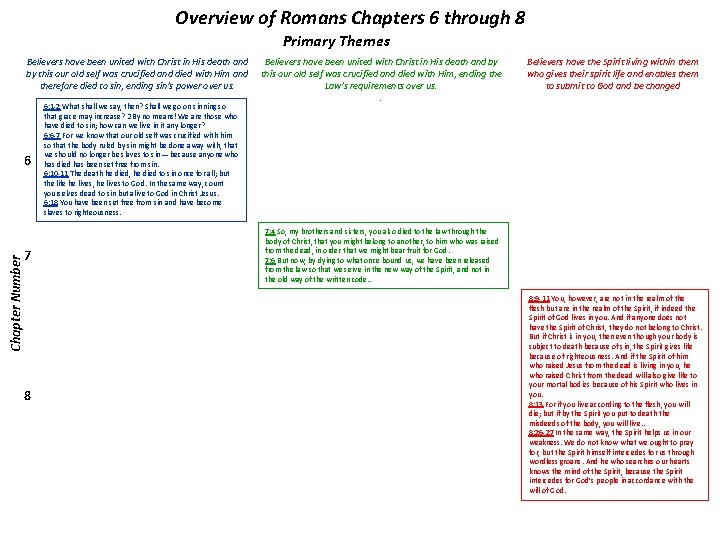
Overview of Romans Chapters 6 through 8 Primary Themes Believers have been united with Christ in His death and by this our old self was crucified and died with Him and therefore died to sin, ending sin’s power over us. Chapter Number 6 7 8 6: 1 -2 What shall we say, then? Shall we go on sinning so that grace may increase? 2 By no means! We are those who have died to sin; how can we live in it any longer? 6: 6 -7 For we know that our old self was crucified with him so that the body ruled by sin might be done away with, that we should no longer be slaves to sin— because anyone who has died has been set free from sin. 6: 10 -11 The death he died, he died to sin once for all; but the life he lives, he lives to God. In the same way, count yourselves dead to sin but alive to God in Christ Jesus. 6: 18 You have been set free from sin and have become slaves to righteousness. Believers have been united with Christ in His death and by this our old self was crucified and died with Him, ending the Law’s requirements over us. . Believers have the Spirit living within them who gives their spirit life and enables them to submit to God and be changed 7: 4 So, my brothers and sisters, you also died to the law through the body of Christ, that you might belong to another, to him who was raised from the dead, in order that we might bear fruit for God. 7: 6 But now, by dying to what once bound us, we have been released from the law so that we serve in the new way of the Spirit, and not in the old way of the written code. . 8: 9 -11 You, however, are not in the realm of the flesh but are in the realm of the Spirit, if indeed the Spirit of God lives in you. And if anyone does not have the Spirit of Christ, they do not belong to Christ. But if Christ is in you, then even though your body is subject to death because of sin, the Spirit gives life because of righteousness. And if the Spirit of him who raised Jesus from the dead is living in you, he who raised Christ from the dead will also give life to your mortal bodies because of his Spirit who lives in you. 8: 13 For if you live according to the flesh, you will die; but if by the Spirit you put to death the misdeeds of the body, you will live. . 8: 26 -27 In the same way, the Spirit helps us in our weakness. We do not know what we ought to pray for, but the Spirit himself intercedes for us through wordless groans. And he who searches our hearts knows the mind of the Spirit, because the Spirit intercedes for God’s people in accordance with the will of God.
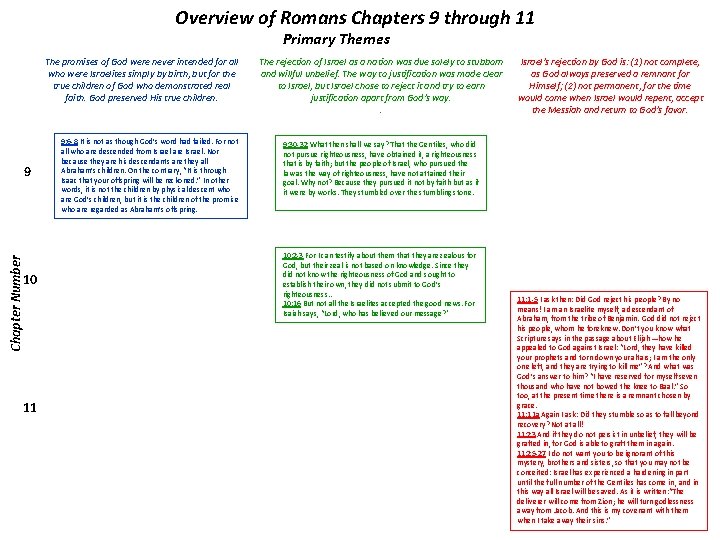
Overview of Romans Chapters 9 through 11 Primary Themes The promises of God were never intended for all who were Israelites simply by birth, but for the true children of God who demonstrated real faith. God preserved His true children. Chapter Number 9 10 11 9: 6 -8 It is not as though God’s word had failed. For not all who are descended from Israel are Israel. Nor because they are his descendants are they all Abraham’s children. On the contrary, “It is through Isaac that your offspring will be reckoned. ” In other words, it is not the children by physical descent who are God’s children, but it is the children of the promise who are regarded as Abraham’s offspring. The rejection of Israel as a nation was due solely to stubborn and willful unbelief. The way to justification was made clear to Israel, but Israel chose to reject it and try to earn justification apart from God’s way. . Israel’s rejection by God is: (1) not complete, as God always preserved a remnant for Himself; (2) not permanent, for the time would come when Israel would repent, accept the Messiah and return to God’s favor. 9: 30 -32 What then shall we say? That the Gentiles, who did not pursue righteousness, have obtained it, a righteousness that is by faith; but the people of Israel, who pursued the law as the way of righteousness, have not attained their goal. Why not? Because they pursued it not by faith but as if it were by works. They stumbled over the stumbling stone. 10: 2 -3 For I can testify about them that they are zealous for God, but their zeal is not based on knowledge. Since they did not know the righteousness of God and sought to establish their own, they did not submit to God’s righteousness. . 10: 16 But not all the Israelites accepted the good news. For Isaiah says, “Lord, who has believed our message? ” 11: 1 -5 I ask then: Did God reject his people? By no means! I am an Israelite myself, a descendant of Abraham, from the tribe of Benjamin. God did not reject his people, whom he foreknew. Don’t you know what Scripture says in the passage about Elijah—how he appealed to God against Israel: “Lord, they have killed your prophets and torn down your altars; I am the only one left, and they are trying to kill me”? And what was God’s answer to him? “I have reserved for myself seven thousand who have not bowed the knee to Baal. ” So too, at the present time there is a remnant chosen by grace. 11: 11 a Again I ask: Did they stumble so as to fall beyond recovery? Not at all! 11: 23 And if they do not persist in unbelief, they will be grafted in, for God is able to graft them in again. 11: 25 -27 I do not want you to be ignorant of this mystery, brothers and sisters, so that you may not be conceited: Israel has experienced a hardening in part until the full number of the Gentiles has come in, and in this way all Israel will be saved. As it is written: “The deliverer will come from Zion; he will turn godlessness away from Jacob. And this is my covenant with them when I take away their sins. ”
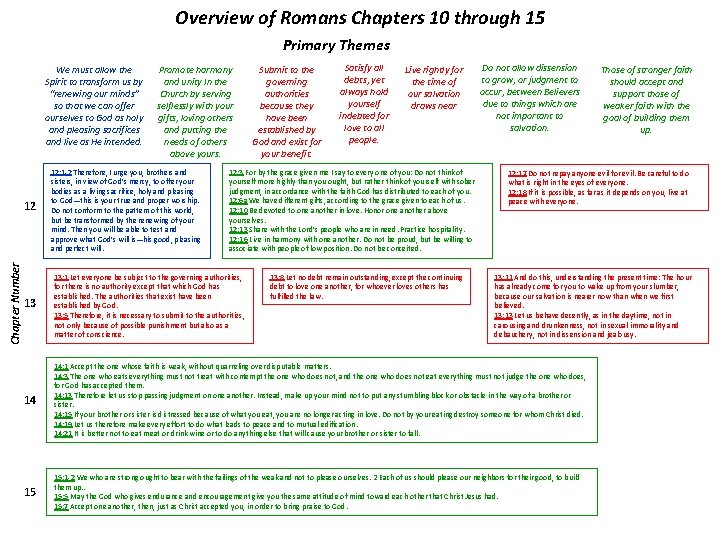
Overview of Romans Chapters 10 through 15 Primary Themes We must allow the Spirit to transform us by “renewing our minds” so that we can offer ourselves to God as holy and pleasing sacrifices and live as He intended. Chapter Number 12 Promote harmony and unity In the Church by serving selflessly with your gifts, loving others and putting the needs of others above yours. 12: 1 -2 Therefore, I urge you, brothers and sisters, in view of God’s mercy, to offer your bodies as a living sacrifice, holy and pleasing to God—this is your true and proper worship. Do not conform to the pattern of this world, but be transformed by the renewing of your mind. Then you will be able to test and approve what God’s will is—his good, pleasing and perfect will. Submit to the governing authorities because they have been established by God and exist for your benefit. Satisfy all debts, yet always hold yourself indebted for love to all people. Live rightly for the time of our salvation draws near 12: 3 For by the grace given me I say to every one of you: Do not think of yourself more highly than you ought, but rather think of yourself with sober judgment, in accordance with the faith God has distributed to each of you. 12: 6 a We have different gifts, according to the grace given to each of us. 12: 10 Be devoted to one another in love. Honor one another above yourselves. 12: 13 Share with the Lord’s people who are in need. Practice hospitality. 12: 16 Live in harmony with one another. Do not be proud, but be willing to associate with people of low position. Do not be conceited. 13: 8 Let no debt remain outstanding, except the continuing debt to love one another, for whoever loves others has fulfilled the law. Do not allow dissension to grow, or judgment to occur, between Believers due to things which are not important to salvation. Those of stronger faith should accept and support those of weaker faith with the goal of building them up. 12: 17 Do not repay anyone evil for evil. Be careful to do what is right in the eyes of everyone. 12: 18 If it is possible, as far as it depends on you, live at peace with everyone. 13 13: 1 Let everyone be subject to the governing authorities, for there is no authority except that which God has established. The authorities that exist have been established by God. 13: 5 Therefore, it is necessary to submit to the authorities, not only because of possible punishment but also as a matter of conscience. 13: 11 And do this, understanding the present time: The hour has already come for you to wake up from your slumber, because our salvation is nearer now than when we first believed. 13: 13 Let us behave decently, as in the daytime, not in carousing and drunkenness, not in sexual immorality and debauchery, not in dissension and jealousy. 14 14: 1 Accept the one whose faith is weak, without quarreling over disputable matters. 14: 3 The one who eats everything must not treat with contempt the one who does not, and the one who does not eat everything must not judge the one who does, for God has accepted them. 14: 13 Therefore let us stop passing judgment on one another. Instead, make up your mind not to put any stumbling block or obstacle in the way of a brother or sister. 14: 15 If your brother or sister is distressed because of what you eat, you are no longer acting in love. Do not by your eating destroy someone for whom Christ died. 14: 19 Let us therefore make every effort to do what leads to peace and to mutual edification. 14: 21 It is better not to eat meat or drink wine or to do anything else that will cause your brother or sister to fall. 15 15: 1 -2 We who are strong ought to bear with the failings of the weak and not to please ourselves. 2 Each of us should please our neighbors for their good, to build them up. . 15: 5 May the God who gives endurance and encouragement give you the same attitude of mind toward each other that Christ Jesus had. 15: 7 Accept one another, then, just as Christ accepted you, in order to bring praise to God.