
Overview of Robotic Path Planning Rahul Kala Department

Overview of Robotic Path Planning Rahul Kala, Department of Information Technology Indian Institute of Information Technology and Management Gwalior http: //students. iiitm. ac. in/~ipg_200545/ rahulkalaiiitm@yahoo. co. in, rkala@students. iiitm. ac. in Department of Information Communication Technology Indian Institute of Information Technology and Management Gwalior Rahul Kala
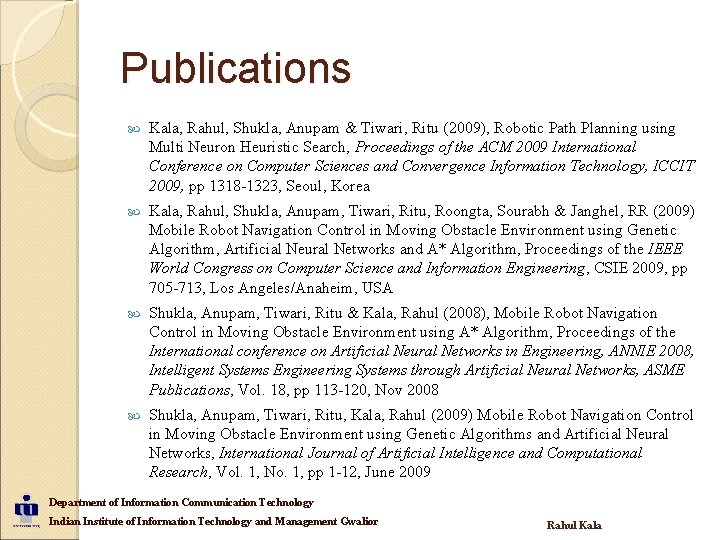
Publications Kala, Rahul, Shukla, Anupam & Tiwari, Ritu (2009), Robotic Path Planning using Multi Neuron Heuristic Search, Proceedings of the ACM 2009 International Conference on Computer Sciences and Convergence Information Technology, ICCIT 2009, pp 1318 -1323, Seoul, Korea Kala, Rahul, Shukla, Anupam, Tiwari, Ritu, Roongta, Sourabh & Janghel, RR (2009) Mobile Robot Navigation Control in Moving Obstacle Environment using Genetic Algorithm, Artificial Neural Networks and A* Algorithm, Proceedings of the IEEE World Congress on Computer Science and Information Engineering, CSIE 2009, pp 705 -713, Los Angeles/Anaheim, USA Shukla, Anupam, Tiwari, Ritu & Kala, Rahul (2008), Mobile Robot Navigation Control in Moving Obstacle Environment using A* Algorithm, Proceedings of the International conference on Artificial Neural Networks in Engineering, ANNIE 2008, Intelligent Systems Engineering Systems through Artificial Neural Networks, ASME Publications, Vol. 18, pp 113 -120, Nov 2008 Shukla, Anupam, Tiwari, Ritu, Kala, Rahul (2009) Mobile Robot Navigation Control in Moving Obstacle Environment using Genetic Algorithms and Artificial Neural Networks, International Journal of Artificial Intelligence and Computational Research, Vol. 1, No. 1, pp 1 -12, June 2009 Department of Information Communication Technology Indian Institute of Information Technology and Management Gwalior Rahul Kala
Research in MOBILE ROBOT PATH PLANNING
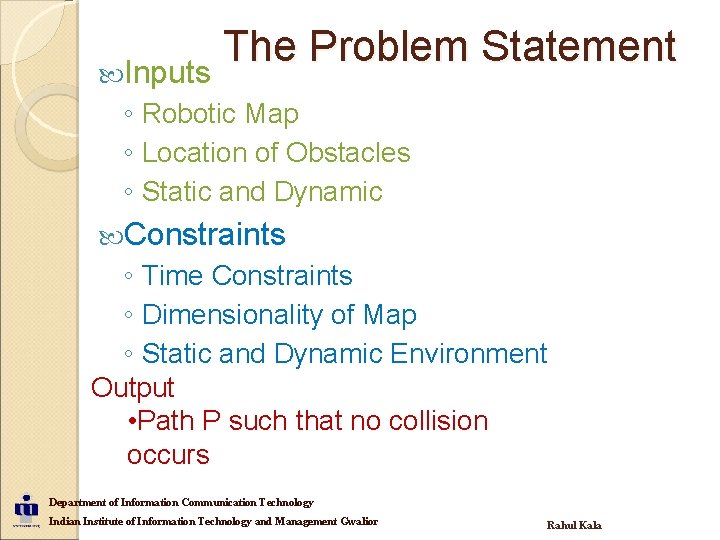
The Problem Statement Inputs ◦ Robotic Map ◦ Location of Obstacles ◦ Static and Dynamic Constraints ◦ Time Constraints ◦ Dimensionality of Map ◦ Static and Dynamic Environment Output • Path P such that no collision occurs Department of Information Communication Technology Indian Institute of Information Technology and Management Gwalior Rahul Kala
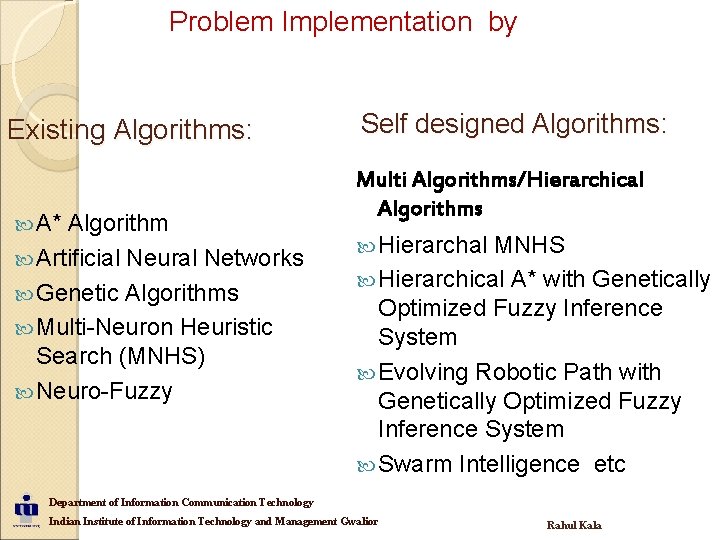
Problem Implementation by Existing Algorithms: A* Algorithm Artificial Neural Networks Genetic Algorithms Multi-Neuron Heuristic Search (MNHS) Neuro-Fuzzy Self designed Algorithms: Multi Algorithms/Hierarchical Algorithms Hierarchal MNHS Hierarchical A* with Genetically Optimized Fuzzy Inference System Evolving Robotic Path with Genetically Optimized Fuzzy Inference System Swarm Intelligence etc Department of Information Communication Technology Indian Institute of Information Technology and Management Gwalior Rahul Kala
A* Algorithm “I believe this is this way takes me shortest to the destination…. Lets give it a try” “Hey I got struck… I’ll choose another path” Add all possible moves in an open list. Make the best move as per open list status Department of Information Communication Technology Indian Institute of Information Technology and Management Gwalior Rahul Kala
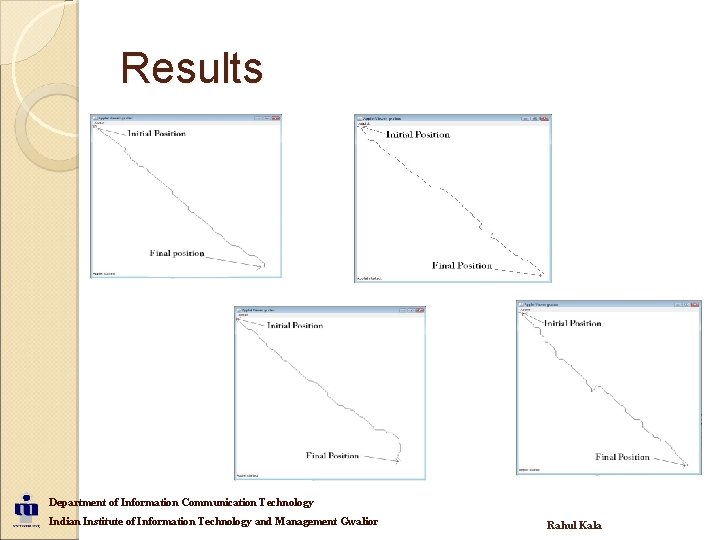
Results Department of Information Communication Technology Indian Institute of Information Technology and Management Gwalior Rahul Kala
ANN with Back Propagation Algorithm “Whenever this type of situation arrives… Always make this move” “Hey rules failed… I’m struck… OK make random moves till you are out” Frame input/output pairs for every situation comprising of robot position, goal position and environment Learn these and use them in decision making Make random moves when position Department of Information Communication Technology Indian Institute of Information Technology and Management Gwalior Rahul Kala
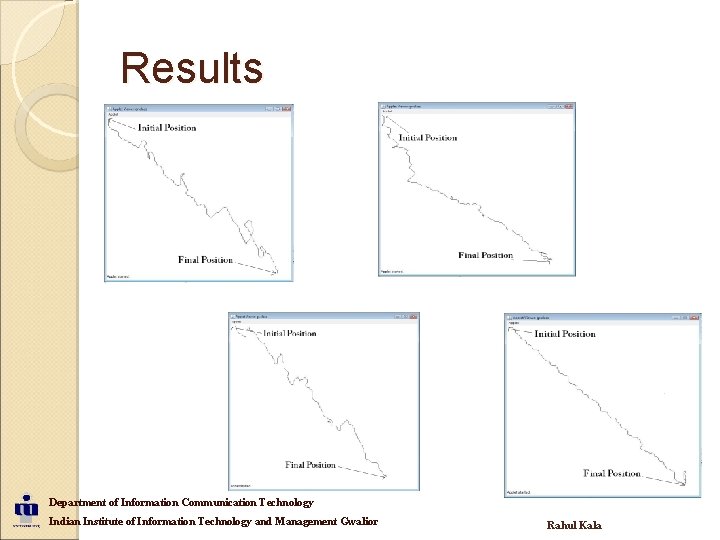
Results Department of Information Communication Technology Indian Institute of Information Technology and Management Gwalior Rahul Kala
Genetic Algorithms “Show me some random paths so that I may decide” “OK this path is the best to go till a point and this path the best for the other part of the journey… Let me mix them both…” Generate random complete and incomplete solutions: source to nowhere, nowhere to goal and source to goal Try to mix paths to attain optimality Generate random paths between needed Department of Information Communication Technology Indian Institute of Information Technology and Management Gwalior Rahul Kala
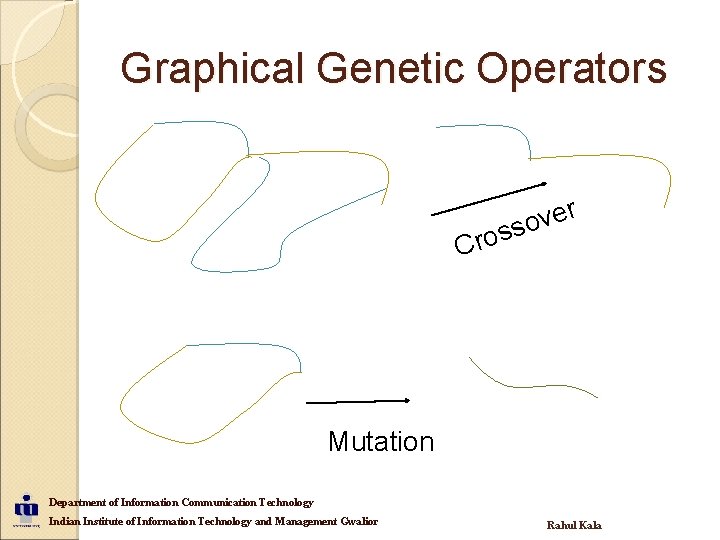
Graphical Genetic Operators r e v so s o r C Mutation Department of Information Communication Technology Indian Institute of Information Technology and Management Gwalior Rahul Kala
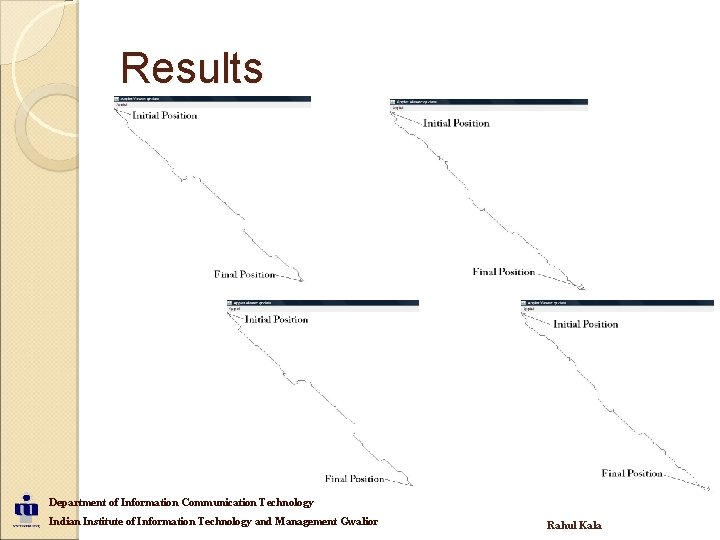
Results Department of Information Communication Technology Indian Institute of Information Technology and Management Gwalior Rahul Kala
MNHS Algorithm “I believe this is this way takes me shortest to the destination…. Lets give it a try” “But in the process I may get struck… Lets walk a few steps on bad paths as well” Add all possible moves in an open list. Make the a range of moves best to worst as per open list status Add all executed moves in the closed Department of Information Communication Technology Indian Institute of Information Technology and Management Gwalior Rahul Kala
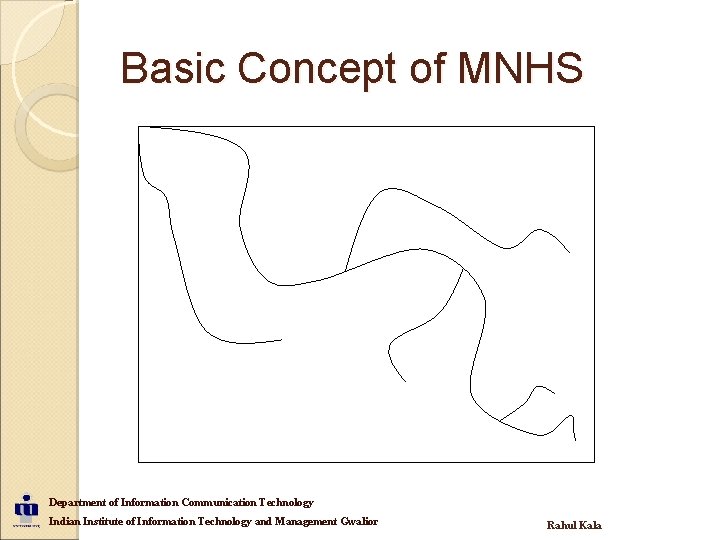
Basic Concept of MNHS Department of Information Communication Technology Indian Institute of Information Technology and Management Gwalior Rahul Kala
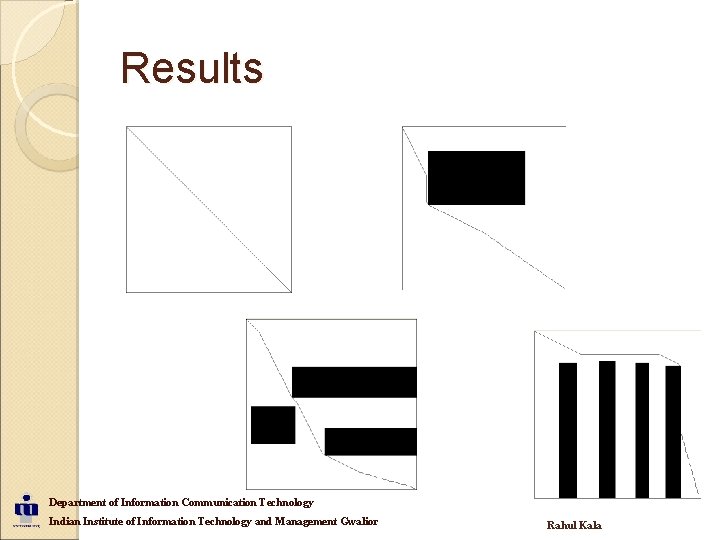
Results Department of Information Communication Technology Indian Institute of Information Technology and Management Gwalior Rahul Kala
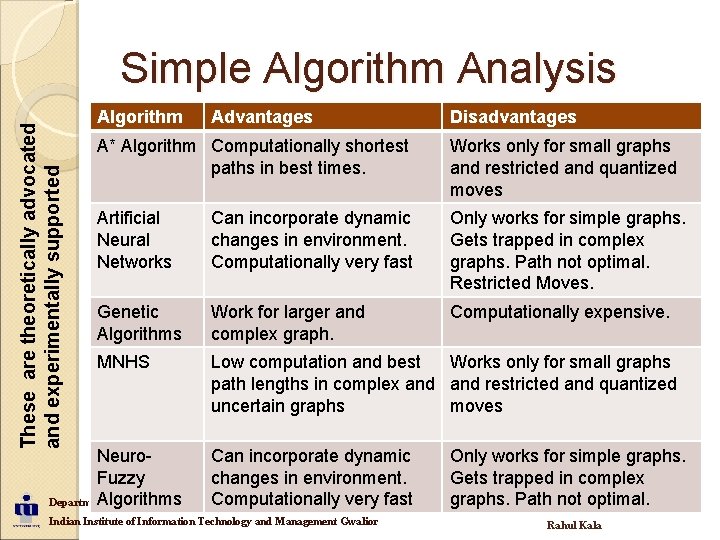
These are theoretically advocated and experimentally supported Simple Algorithm Analysis Algorithm Advantages Disadvantages A* Algorithm Computationally shortest paths in best times. Works only for small graphs and restricted and quantized moves Artificial Neural Networks Can incorporate dynamic changes in environment. Computationally very fast Only works for simple graphs. Gets trapped in complex graphs. Path not optimal. Restricted Moves. Genetic Algorithms Work for larger and complex graph. Computationally expensive. MNHS Low computation and best Works only for small graphs path lengths in complex and restricted and quantized uncertain graphs moves Neuro. Can incorporate dynamic Fuzzy changes in environment. Algorithms Computationally very fast Department of Information Communication Technology Indian Institute of Information Technology and Management Gwalior Only works for simple graphs. Gets trapped in complex graphs. Path not optimal. Rahul Kala
The Big Observation Individual Simple Algorithms have disadvantages … They’re too simple for many complex situations and hence the game starts… Department of Information Communication Technology Indian Institute of Information Technology and Management Gwalior Rahul Kala

Thank You Department of Information Communication Technology Indian Institute of Information Technology and Management Gwalior Rahul Kala
- Slides: 18