
Overview of Risk Assessment Principles and Methodologies Risk
- Slides: 39
Overview of Risk Assessment Principles and Methodologies
Risk or Hazard? Hazard is: An intrinsic property of a chemical substance a given plant certain phenomenon, that can have an adverse effect on the human life and health, on the environment or on anything else you consider important. n
Risk or Hazard? Risk is: n the likelihood of a specific effect occurring within a specified period or in specified circumstances /Seveso II Directive/
Risk or Hazard? Risk is: n a two-dimensional indicator, which gives the probability of an adverse effect to occur and the consequences it may have on the human life and health, on the environment or on anything else you consider important.
Why Risk Assessment in Seveso Important element of Safety Report Often included in SMS Provides input to: n Land-Use Planning n Emergency Plans n Information to the public
Purpose To ensure that the level of risk on which the population is exposed is not high (“is tolerable”) To identify weak points and to contribute to the rational management of risk To evaluate risk reduction measures
Purpose To compare establishments and/or other hazardous activities in order to decide which ones are the most hazardous (and therefore deserve more attention/higher priority) To help better understanding the risk
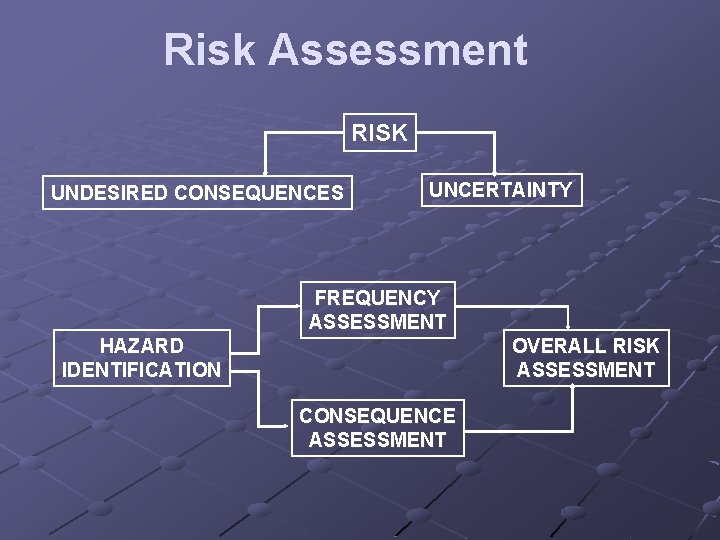
Risk Assessment RISK UNDESIRED CONSEQUENCES UNCERTAINTY FREQUENCY ASSESSMENT HAZARD IDENTIFICATION OVERALL RISK ASSESSMENT CONSEQUENCE ASSESSMENT
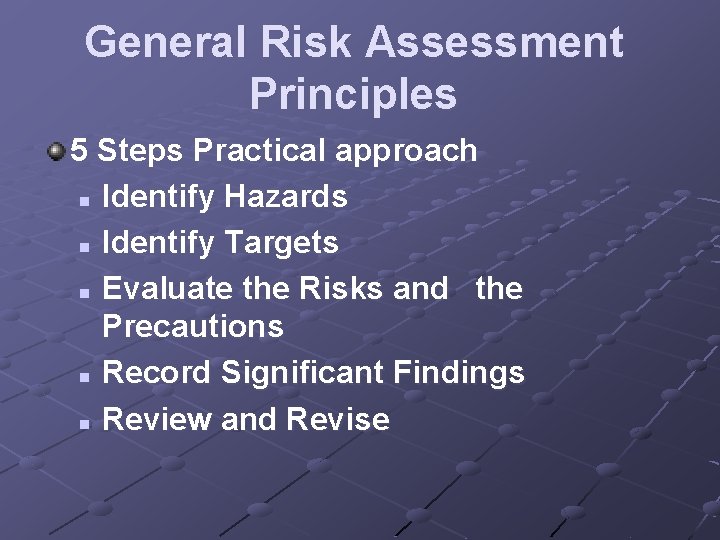
General Risk Assessment Principles 5 Steps Practical approach n Identify Hazards n Identify Targets n Evaluate the Risks and the Precautions n Record Significant Findings n Review and Revise
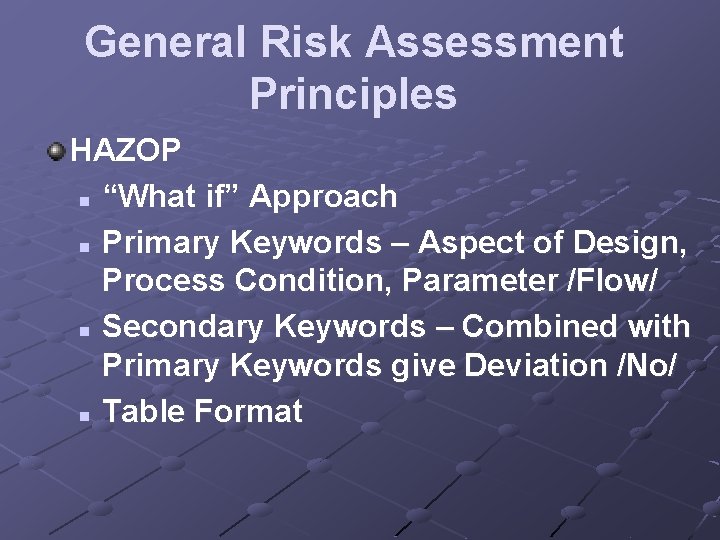
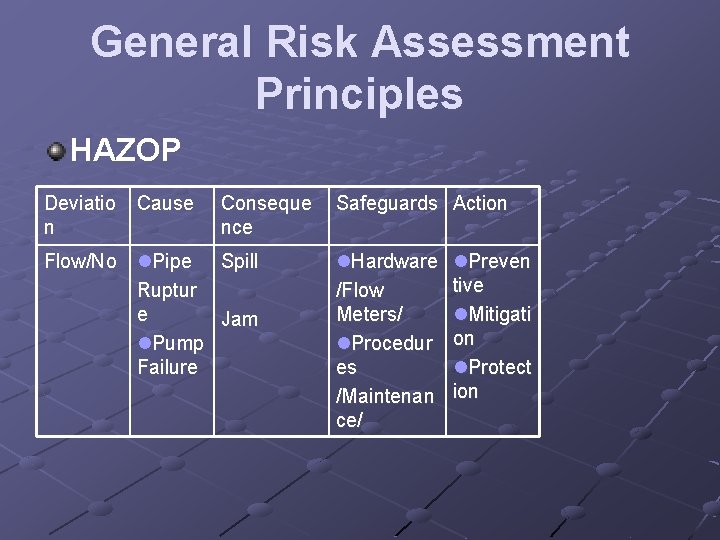
General Risk Assessment Principles HAZOP n “What if” Approach n Primary Keywords – Aspect of Design, Process Condition, Parameter /Flow/ n Secondary Keywords – Combined with Primary Keywords give Deviation /No/ n Table Format
General Risk Assessment Principles HAZOP Deviatio n Cause Conseque nce Flow/No l. Pipe Spill Ruptur e Jam l. Pump Failure Safeguards Action l. Hardware /Flow Meters/ l. Procedur es /Maintenan ce/ l. Preven tive l. Mitigati on l. Protect ion
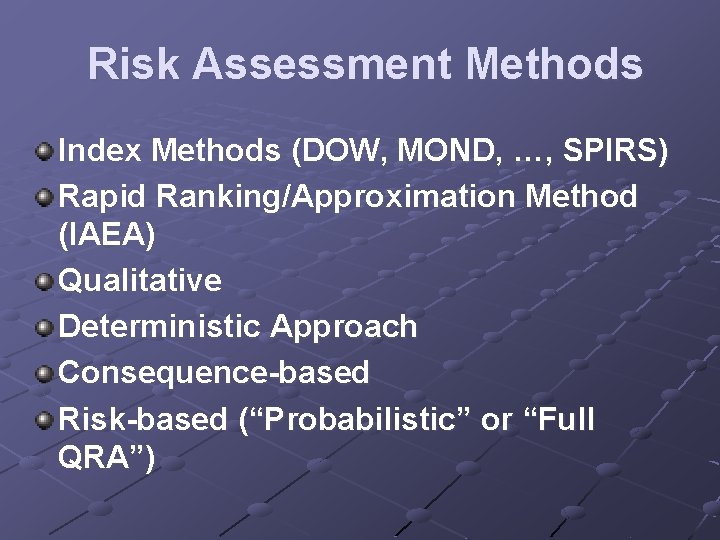
Risk Assessment Methods Index Methods (DOW, MOND, …, SPIRS) Rapid Ranking/Approximation Method (IAEA) Qualitative Deterministic Approach Consequence-based Risk-based (“Probabilistic” or “Full QRA”)
Risk Screening Methods Purpose: n Screening of Various Risk Sources (e. g. Hazardous Activities) n Identification of Points Deserving a Further Detailed Evaluation n Getting a Broad Estimation of the Overall Level of Risk (Whether it is Generally Acceptable or Not) n Prioritization of Actions / Interventions
Risk Screening methods Characteristics: n “quick-and-dirty” n based on simplified calculations n small requirements in data (may further need to be completed) n outcome always in a relative context, not absolute
Risk Screening Methods Two Categories: n n Development of an Index Rough Estimation of a Physical Magnitude Characterizing the Risk (e. g. Risk, Extent of Consequences, Maximum Distance of Effect)
Indexed Methods Strengths: n Simplicity in Definition And in Application Weaknesses: n Arbitrary Definition of the Measurement Scales of the Parameters n Arbitrary Definition of the Weights (Relative Importance) n Validation n Difficult Interpretation n Difficulty in Cost/Benefit Considerations
Indexed Methods Principle: n Define an Index, N, for which a Higher Value Corresponds to Higher Level of Risk (More Hazardous Activity) Steps: n Determine Most Important Parameters n Determine Measurement Scales for All Selected Parameters n Define Aggregation Rule(s) of The Parameters into the Index n Define Relevant Weights
DOW Index Purpose: n Screening of the Various Units within an Establishment (for Prioritization Reasons) n Rough Estimation of the Probable Property Damage
DOW Index Principles: n Only Fire and Explosion Hazards n Depends on the Process (Unit Hazard Factor) n Depends on the Characteristics of the Substances (Material Factor) n Takes into Consideration Safety Systems (Credit Factors) n Provides a Hazard Index (F&E Index) and an Estimation Of The Property Damage (Percentage of the Unit Likely to be Damaged)
DOW Index Other Indices: n n n MOND Index (ICI) Italian Indexed Method (Metodo Indicizzato - ISPESL) Chemical Exposure Index (CEI)
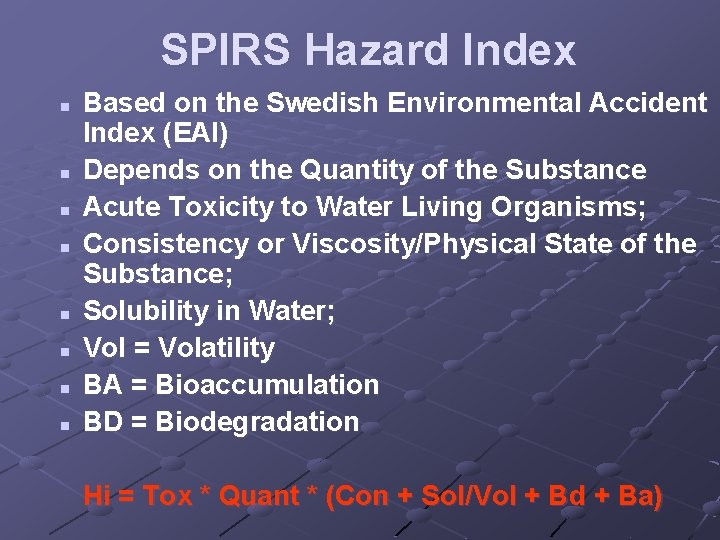
SPIRS Hazard Index n n n n Based on the Swedish Environmental Accident Index (EAI) Depends on the Quantity of the Substance Acute Toxicity to Water Living Organisms; Consistency or Viscosity/Physical State of the Substance; Solubility in Water; Vol = Volatility BA = Bioaccumulation BD = Biodegradation Hi = Tox * Quant * (Con + Sol/Vol + Bd + Ba)
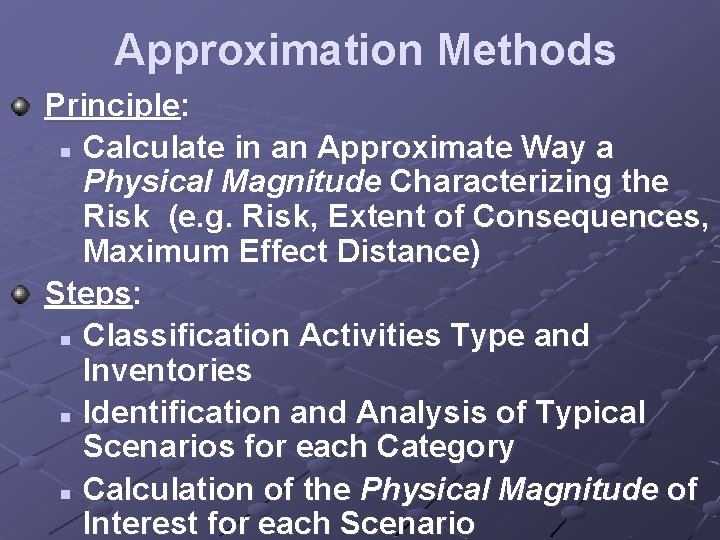
Approximation Methods Principle: n Calculate in an Approximate Way a Physical Magnitude Characterizing the Risk (e. g. Risk, Extent of Consequences, Maximum Effect Distance) Steps: n Classification Activities Type and Inventories n Identification and Analysis of Typical Scenarios for each Category n Calculation of the Physical Magnitude of Interest for each Scenario
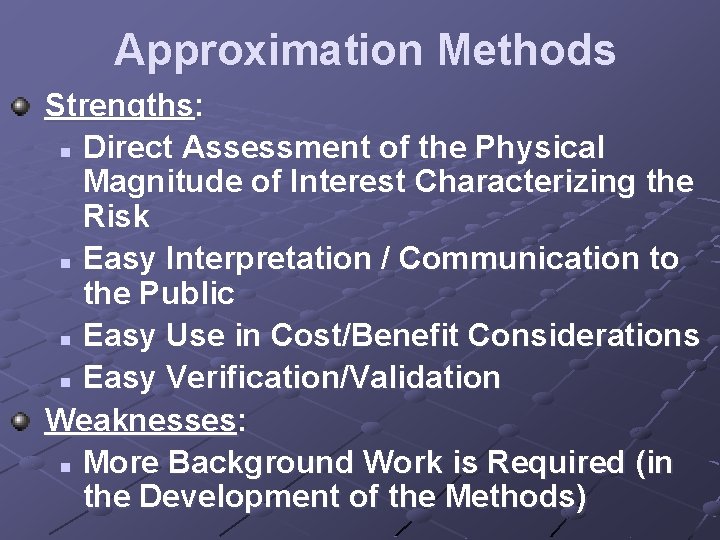
Approximation Methods Strengths: n Direct Assessment of the Physical Magnitude of Interest Characterizing the Risk n Easy Interpretation / Communication to the Public n Easy Use in Cost/Benefit Considerations n Easy Verification/Validation Weaknesses: n More Background Work is Required (in the Development of the Methods)
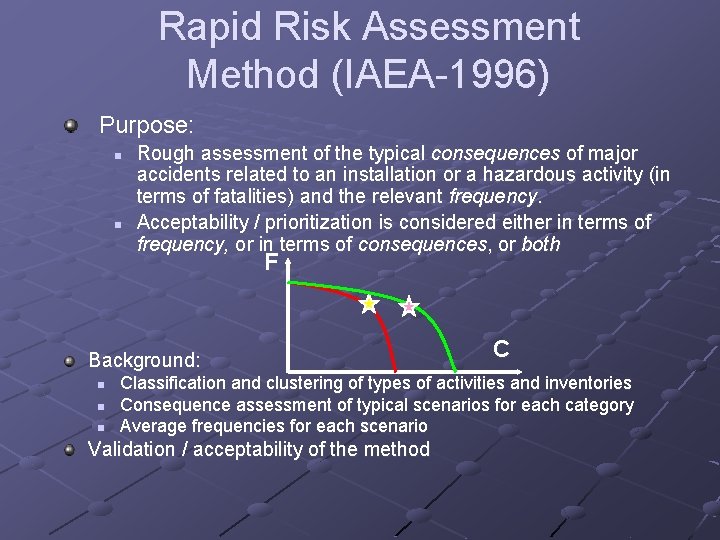
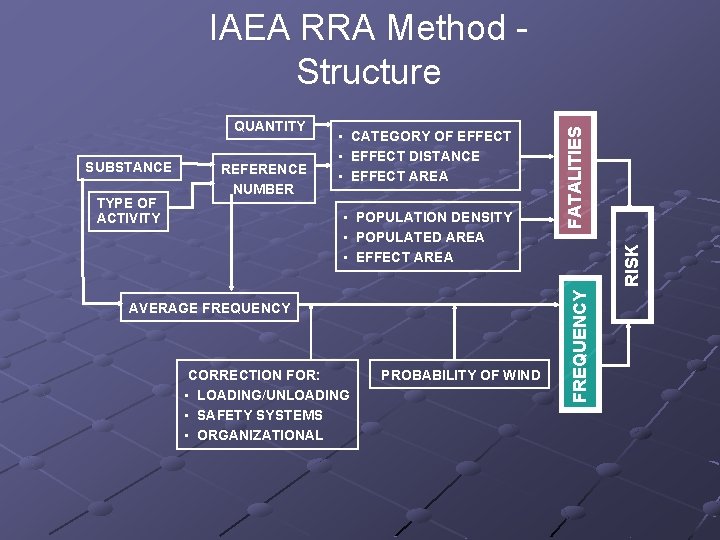
Rapid Risk Assessment Method (IAEA-1996) Purpose: n n Rough assessment of the typical consequences of major accidents related to an installation or a hazardous activity (in terms of fatalities) and the relevant frequency. Acceptability / prioritization is considered either in terms of frequency, or in terms of consequences, or both F Background: n n n C Classification and clustering of types of activities and inventories Consequence assessment of typical scenarios for each category Average frequencies for each scenario Validation / acceptability of the method
TYPE OF ACTIVITY REFERENCE NUMBER • POPULATION DENSITY • POPULATED AREA • EFFECT AREA AVERAGE FREQUENCY CORRECTION FOR: • LOADING/UNLOADING • SAFETY SYSTEMS • ORGANIZATIONAL PROBABILITY OF WIND RISK SUBSTANCE • CATEGORY OF EFFECT • EFFECT DISTANCE • EFFECT AREA FREQUENCY QUANTITY FATALITIES IAEA RRA Method Structure
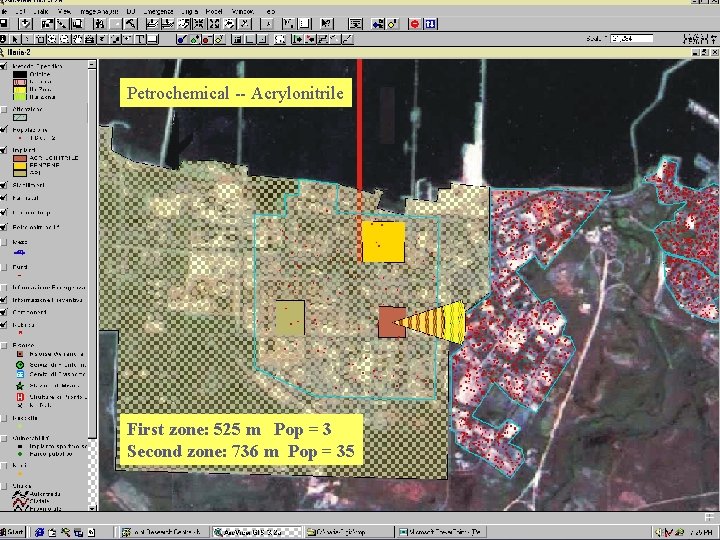
Petrochemical -- Acrylonitrile First zone: 525 m Pop = 3 Second zone: 736 m Pop = 35
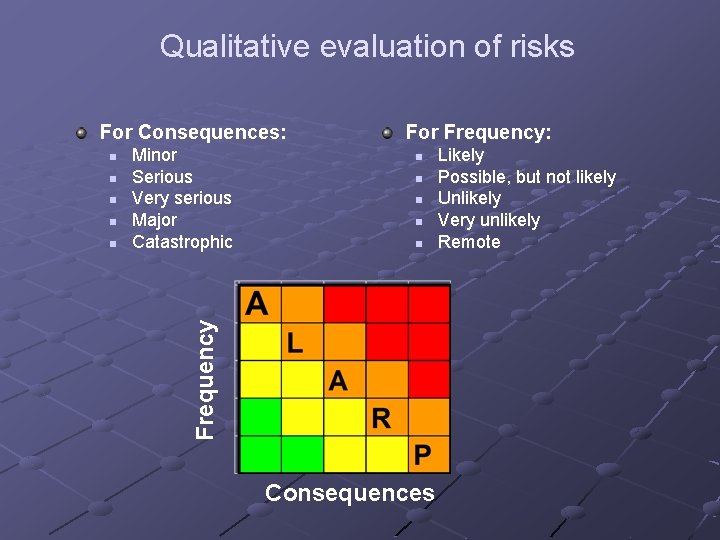
Qualitative evaluation of risks For Consequences: n n Minor Serious Very serious Major Catastrophic n n n Frequency n For Frequency: Consequences Likely Possible, but not likely Unlikely Very unlikely Remote
“Deterministic” approach Steps: n Prescribe technical details n Prescribe procedures n Check that all prescriptions have been followed Advantage: “clear” and “easy” in application Disadvantage: n Cost usually increased n “absolute” results (I. e. safe / unsafe)
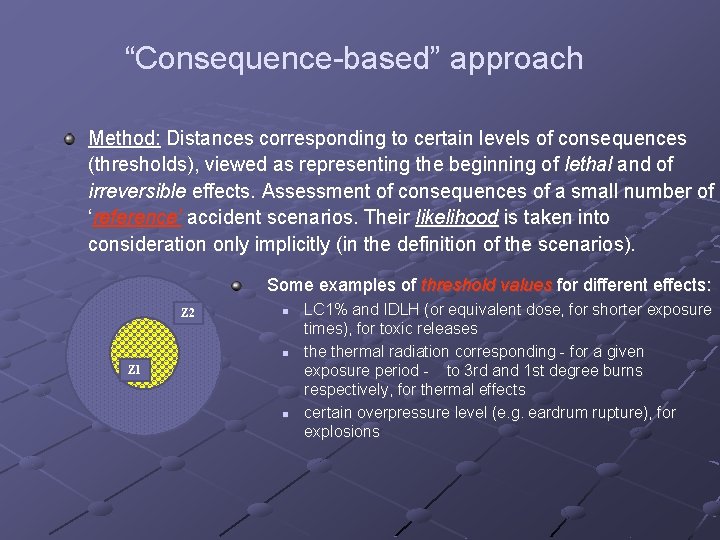
“Consequence-based” approach Method: Distances corresponding to certain levels of consequences (thresholds), viewed as representing the beginning of lethal and of irreversible effects. Assessment of consequences of a small number of ‘reference’ accident scenarios. Their likelihood is taken into consideration only implicitly (in the definition of the scenarios). Some examples of threshold values for different effects: Z 2 n n Z 1 n LC 1% and IDLH (or equivalent dose, for shorter exposure times), for toxic releases thermal radiation corresponding - for a given exposure period - to 3 rd and 1 st degree burns respectively, for thermal effects certain overpressure level (e. g. eardrum rupture), for explosions
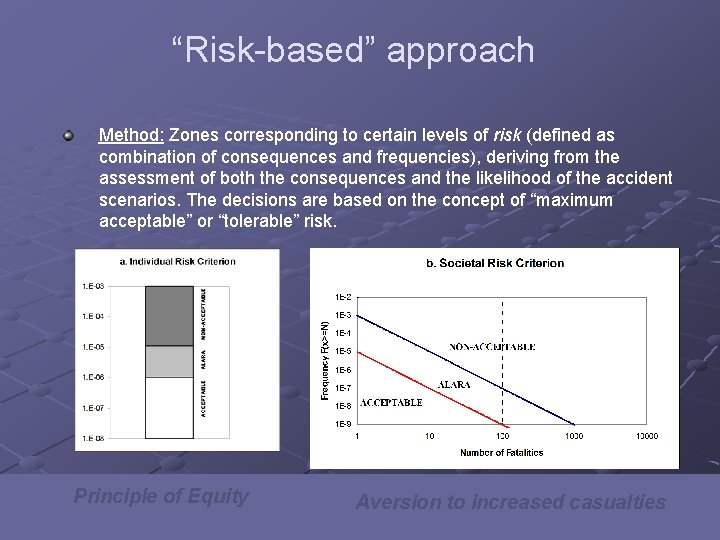
“Risk-based” approach Method: Zones corresponding to certain levels of risk (defined as combination of consequences and frequencies), deriving from the assessment of both the consequences and the likelihood of the accident scenarios. The decisions are based on the concept of “maximum acceptable” or “tolerable” risk. Principle of Equity Aversion to increased casualties
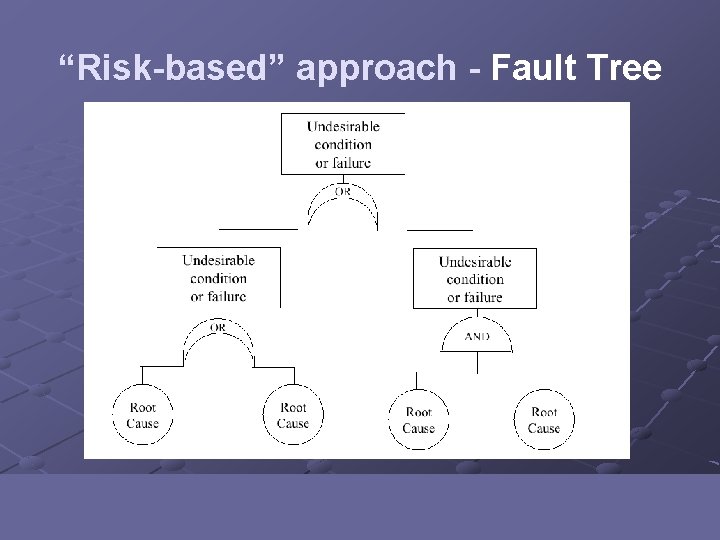
“Risk-based” approach - Fault Tree
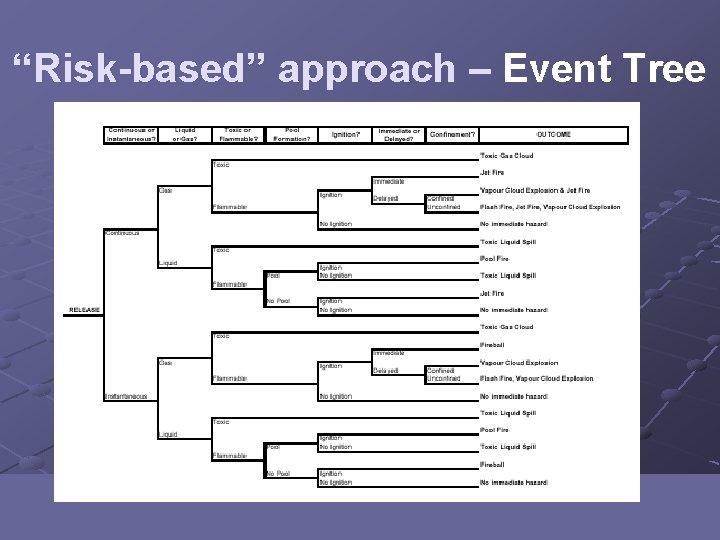
“Risk-based” approach – Event Tree
“Risk-based” approach 1. Identification of the hazards. 2. Summarising the findings of the hazard identification study as a set of scenarios to be modelled. 3. Estimation of the rates and duration of releases, and the quantities of material involved. 4. Estimation of the consequences of each release in terms of an area (as defined by an isopleth) inside which, for a given weather condition, a specified level of harm (toxic load, explosion overpressure, thermal radiation flux) will be met or exceeded.
“Risk-based” approach 5. Consideration of the effects of mitigation (for instance by people going away or staying indoors). 6. Translation of the release isopleth, by way of a model of human impact, into a measure of harm (e. g. injury or fatality) to the specified individual or population. 7. Estimation of the frequencies with which events (usually releases of hazardous material from their containment) are expected to occur. 8. Combination of various probabilities and frequencies to calculate numerical estimates of risk.
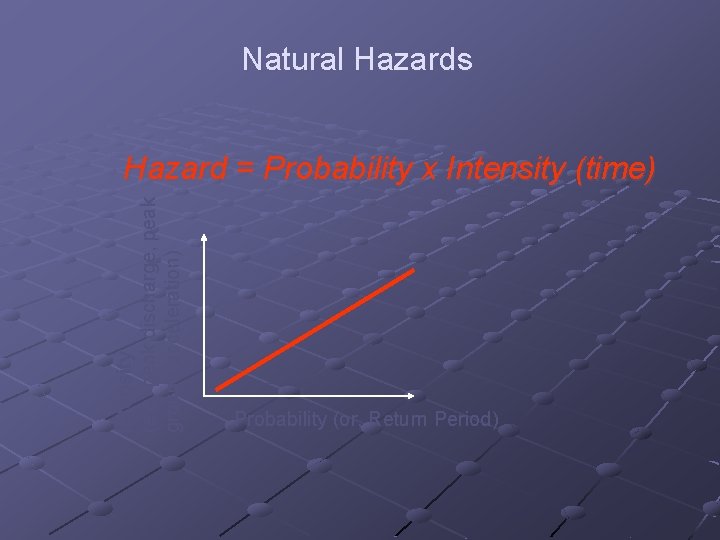
Natural Hazards Intensity (e. g. peak discharge, peak ground acceleration) Hazard = Probability x Intensity (time) Probability (or, Return Period)
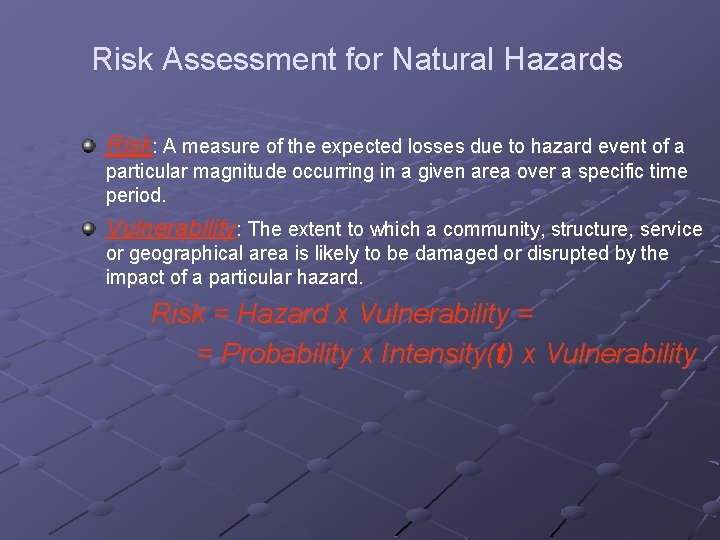
Risk Assessment for Natural Hazards Risk: A measure of the expected losses due to hazard event of a particular magnitude occurring in a given area over a specific time period. Vulnerability: The extent to which a community, structure, service or geographical area is likely to be damaged or disrupted by the impact of a particular hazard. Risk = Hazard x Vulnerability = = Probability x Intensity(t) x Vulnerability
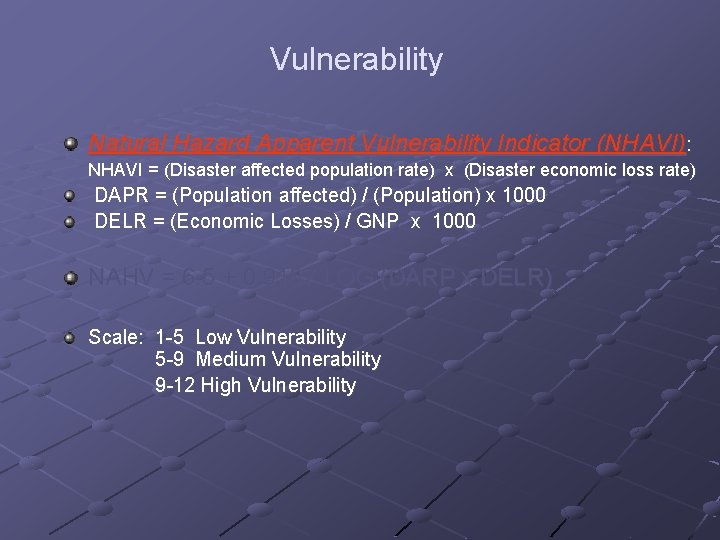
Vulnerability Natural Hazard Apparent Vulnerability Indicator (NHAVI): NHAVI = (Disaster affected population rate) x (Disaster economic loss rate) DAPR = (Population affected) / (Population) x 1000 DELR = (Economic Losses) / GNP x 1000 NAHV = 6. 5 + 0. 9167 LOG (DARP x DELR) Scale: 1 -5 Low Vulnerability 5 -9 Medium Vulnerability 9 -12 High Vulnerability
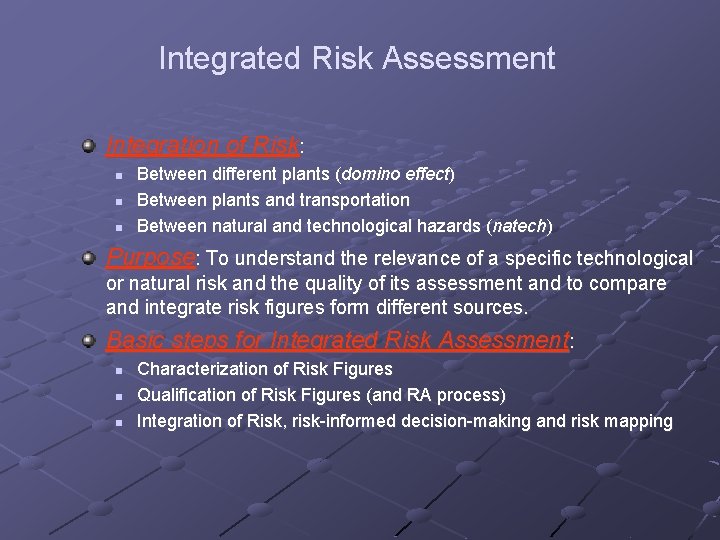
Integrated Risk Assessment Integration of Risk: n n n Between different plants (domino effect) Between plants and transportation Between natural and technological hazards (natech) Purpose: To understand the relevance of a specific technological or natural risk and the quality of its assessment and to compare and integrate risk figures form different sources. Basic steps for Integrated Risk Assessment: n n n Characterization of Risk Figures Qualification of Risk Figures (and RA process) Integration of Risk, risk-informed decision-making and risk mapping