
OVERVIEW OF REGULATION 242022 Slides prepared by Deborah
OVERVIEW OF REGULATION 2/4/2022 Slides prepared by Deborah Adu-Twumwaah, UPSA Banking and Finance Dept. 1
DEFINATION OF REGULATION • Regulation is the sustained and focused attempt to alter the behavior of others according to defined standards or purposes with the intention of producing a broadly identified outcome or outcomes, which may involve mechanisms of standard-setting, information gathering and behavior modifications (Black, 2002). • A rule designed to control the conduct of those to whom it applies. Regulations are official rules, and have to be followed. • A rule of order having the force of law, prescribed by a superior or competent authority, relating to the actions of those under the authority's control. 2/4/2022 Slides prepared by Deborah Adu-Twumwaah, UPSA Banking and Finance Dept. 2
APPROACHES/TYPES/ FORMS OF REGULATIONS • Regulations may take different forms or approaches. Notable among them are as follows: • Command Control • Self regulation • Incentive-based regulation • Market-based mechanisms 2/4/2022 Slides prepared by Deborah Adu-Twumwaah, UPSA Banking and Finance Dept. 3

Command Control (C&C) • Command control regulation (C&C) is typically the imposition of standards backed up by legal sanctions if the standards are not met. The law is therefore used to define and prohibit certain types of activity or force certain types of action. Standards can be set either through legislation, or by regulators empowered by regulation to define rules. 2/4/2022 Slides prepared by Deborah Adu-Twumwaah, UPSA Banking and Finance Dept. 4
Advantages • It can often be implemented quickly • Sets out clearly defined limits and • Shows the government or regulator to be acting decisively. 2/4/2022 Slides prepared by Deborah Adu-Twumwaah, UPSA Banking and Finance Dept. 5
Disadvantages • However, it can also be a somewhat heavy-handed and complex approach to regulating activities. The problems that can be created by this approach fall into a number of categories: • Regulatory capture: C&C requires the regulator and the regulatee to cooperate, in particular to ensure that information is provided to allow the regulator to carry out its duties. This close relationship can lead to a situation where the regulator can be “captured” by the regulatee, and can begin to operate in their interests, rather than the interests of the public at large. • Legalism: C&C has often been portrayed as complex, inflexible and over-intrusive. It can be difficult to devise precise rules, especially if an industry is undergoing changes, and in addition, the direct involvement of politicians can mean that rules are drawn up in response to specific situations or areas of concern, often in a short time scale. This can mean that C&C regulation is not always an effective or forward-looking method of regulating industry. • Setting standards: Sometimes it is difficult to set an appropriate standard • Enforcement: The complexity of the rules and the possibility that their design may not encompass all possible activities, makes enforcement difficult for regulators. In addition, complexity can lead to a situation where attempted enforcement can be challenged in the courts. 2/4/2022 Slides prepared by Deborah Adu-Twumwaah, UPSA Banking and Finance Dept. 6

Strengths and Weaknesses of Command Control Strengths Weaknesses Fixed performance standards backed up in law Close relationship between regulator and business could lead to “regulatory capture” Clear definition of unacceptable behaviour Can be complex and legalistic Seen as politically decisive – politicians use that to gain political points. Defining acceptable standards can be difficult 2/4/2022 Slides prepared by Deborah Adu-Twumwaah, UPSA Banking and Finance Dept. 7
Self Regulations • This could be portrayed as a kind of do-it-yourself version of the command control method (the individual’s own set standards). • It often takes the form of a business or a trade association developing its own rules of performance, which it also monitors and enforces. • There can be some government oversight of the regulation, but as a rule, self-regulation is often seen as a way of business taking preemptive action to avoid overly intrusive government intervention. • That is, setting the business’ standards to abide with before C&C occur. 2/4/2022 Slides prepared by Deborah Adu-Twumwaah, UPSA Banking and Finance Dept. 8
Advantages • The advantages of this approach includes: • High level of commitment from the businesses involved (given that it is in their interests to make the system work as the alternative is government intervention), and the well-informed and comprehensive nature of the rules that are set. • It can also be more flexible than governmental C&C as it does not require legislation. 2/4/2022 Slides prepared by Deborah Adu-Twumwaah, UPSA Banking and Finance Dept. 9
Disadvantages • On the other hand, it can also be seen as undemocratic, closed to outside scrutiny and open to abuse by the very interests who devise the rules. • At the very least, self-regulation will always be open to challenge by outside interests who feel that the standards and rules are not primarily geared towards reducing the impacts of undesirable activities. 2/4/2022 Slides prepared by Deborah Adu-Twumwaah, UPSA Banking and Finance Dept. 10
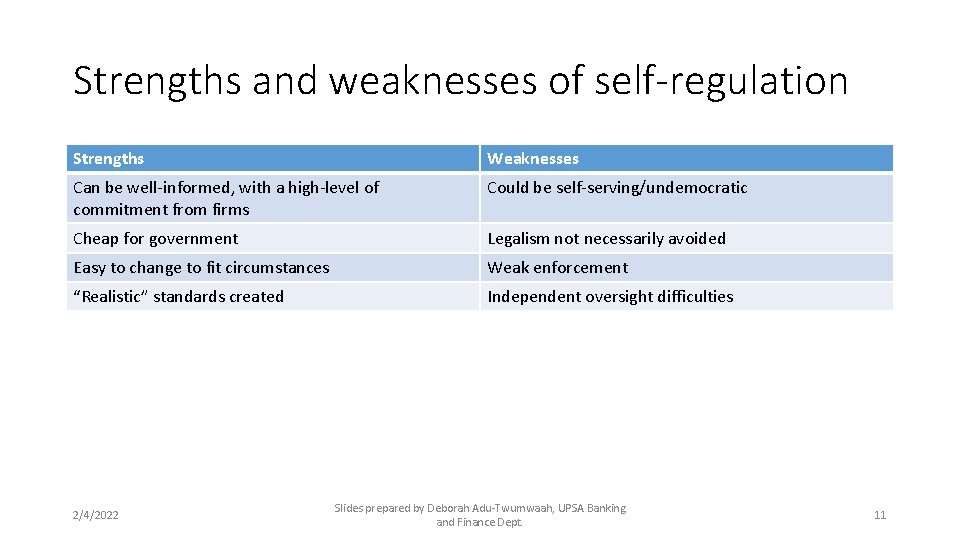
Strengths and weaknesses of self-regulation Strengths Weaknesses Can be well-informed, with a high-level of commitment from firms Could be self-serving/undemocratic Cheap for government Legalism not necessarily avoided Easy to change to fit circumstances Weak enforcement “Realistic” standards created Independent oversight difficulties 2/4/2022 Slides prepared by Deborah Adu-Twumwaah, UPSA Banking and Finance Dept. 11

Incentive-based regulation • An incentive is any policy, rule, pricing mechanism, or procedure that seeks to modify the behaviour of persons or companies by changing the marginal costs or marginal benefits associated with particular decisions and activities. • It could be said that all regulations are based on incentives in one way or another, as regulation functions through the basic concept of penalties for “bad” behaviour and rewards for “good” behaviour. 2/4/2022 Slides prepared by Deborah Adu-Twumwaah, UPSA Banking and Finance Dept. 12
• Incentive-based regulation tries to reward the utility with increased profits for reducing costs and improving services in a more pronounced fashion than other forms of regulations. • The aim is to induce a regulatee to limit or stop an undesirable activity by imposing taxes or granting subsidies—in other words a “carrot and stick” approach to ensure a socially desirable end. • To apply incentive-based regulation the general steps are to choose the units of measurement, set the baseline level, choose targets for improvement and/or maintenance and then apply incentives and penalties. 2/4/2022 Slides prepared by Deborah Adu-Twumwaah, UPSA Banking and Finance Dept. 13
Advantages • The scheme of punishment and reward operates in a mechanical way, so reducing the scope for regulatory discretion, which in turn reduces the possibility of regulatory capture. • It also allows the company a degree of flexibility in deciding whether to conform to the rule, or to accept the punishment. 2/4/2022 Slides prepared by Deborah Adu-Twumwaah, UPSA Banking and Finance Dept. 14
Disadvantages • The incentive-based approach can create rules that are too complicated and inflexible and do not take into account market realities, especially if they are not updated regularly to follow developments in the market. • In addition, sometimes it is difficult to predict the impact of this type of regulation, for example, “bad” behaviour, e. g. pollution, could be rewarded if the rules are not set correctly. 2/4/2022 Slides prepared by Deborah Adu-Twumwaah, UPSA Banking and Finance Dept. 15
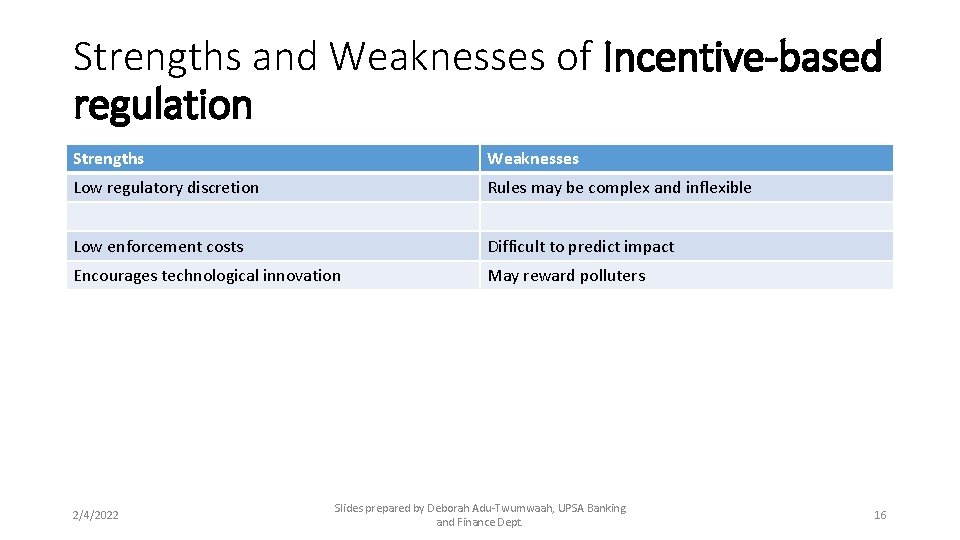
Strengths and Weaknesses of Incentive-based regulation Strengths Weaknesses Low regulatory discretion Rules may be complex and inflexible Low enforcement costs Difficult to predict impact Encourages technological innovation May reward polluters 2/4/2022 Slides prepared by Deborah Adu-Twumwaah, UPSA Banking and Finance Dept. 16
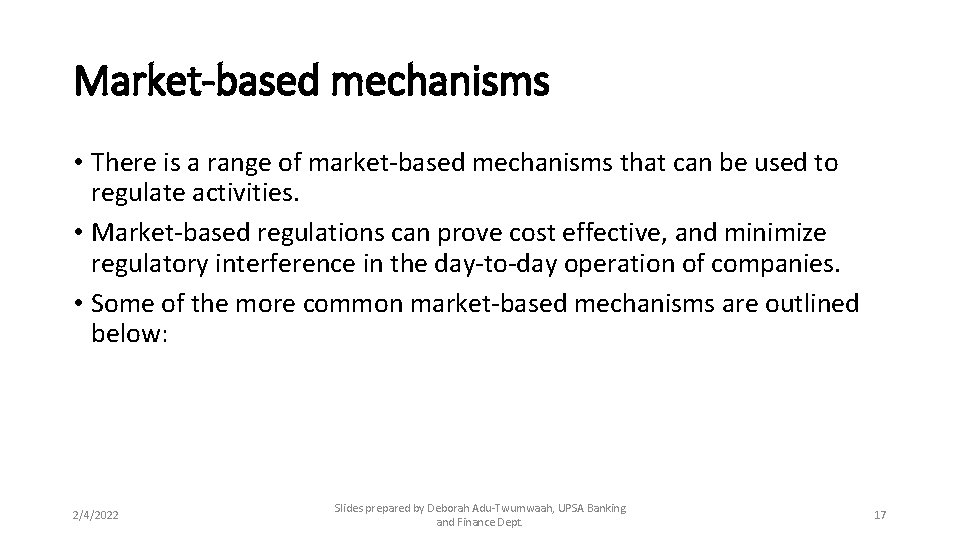
Market-based mechanisms • There is a range of market-based mechanisms that can be used to regulate activities. • Market-based regulations can prove cost effective, and minimize regulatory interference in the day-to-day operation of companies. • Some of the more common market-based mechanisms are outlined below: 2/4/2022 Slides prepared by Deborah Adu-Twumwaah, UPSA Banking and Finance Dept. 17
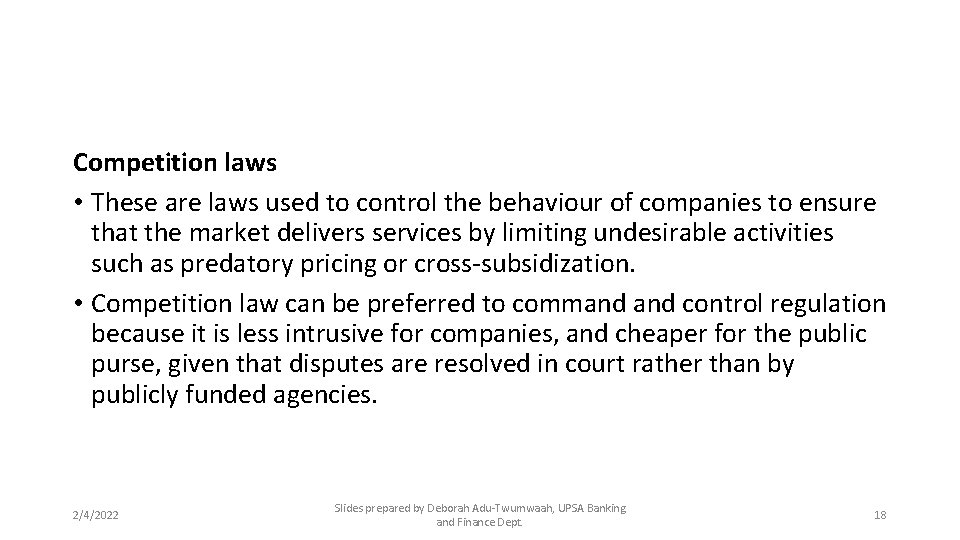
Competition laws • These are laws used to control the behaviour of companies to ensure that the market delivers services by limiting undesirable activities such as predatory pricing or cross-subsidization. • Competition law can be preferred to command control regulation because it is less intrusive for companies, and cheaper for the public purse, given that disputes are resolved in court rather than by publicly funded agencies. 2/4/2022 Slides prepared by Deborah Adu-Twumwaah, UPSA Banking and Finance Dept. 18
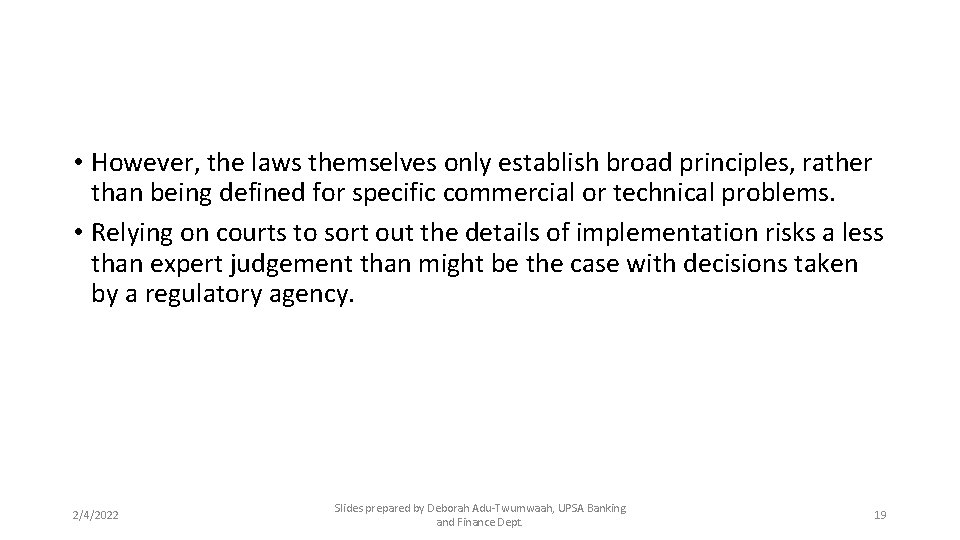
• However, the laws themselves only establish broad principles, rather than being defined for specific commercial or technical problems. • Relying on courts to sort out the details of implementation risks a less than expert judgement than might be the case with decisions taken by a regulatory agency. 2/4/2022 Slides prepared by Deborah Adu-Twumwaah, UPSA Banking and Finance Dept. 19
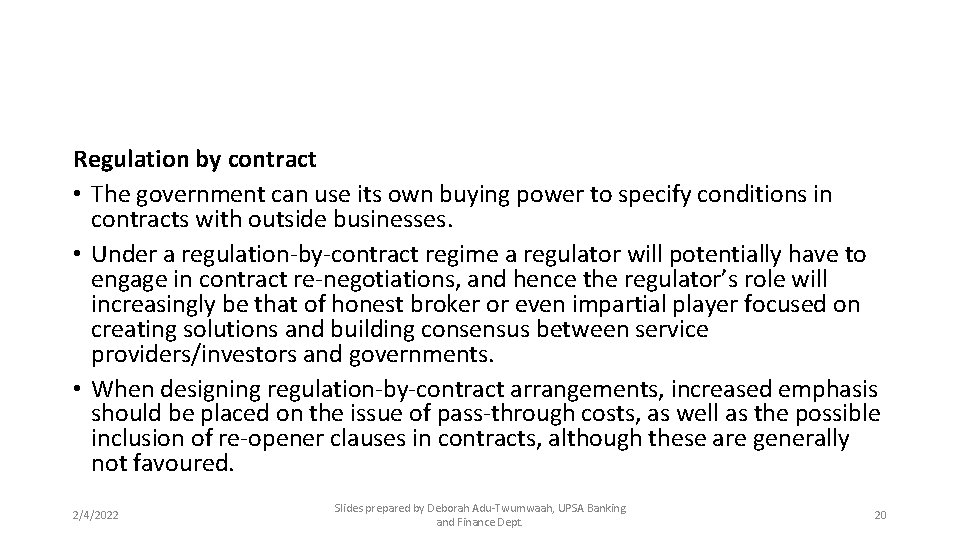
Regulation by contract • The government can use its own buying power to specify conditions in contracts with outside businesses. • Under a regulation-by-contract regime a regulator will potentially have to engage in contract re-negotiations, and hence the regulator’s role will increasingly be that of honest broker or even impartial player focused on creating solutions and building consensus between service providers/investors and governments. • When designing regulation-by-contract arrangements, increased emphasis should be placed on the issue of pass-through costs, as well as the possible inclusion of re-opener clauses in contracts, although these are generally not favoured. 2/4/2022 Slides prepared by Deborah Adu-Twumwaah, UPSA Banking and Finance Dept. 20
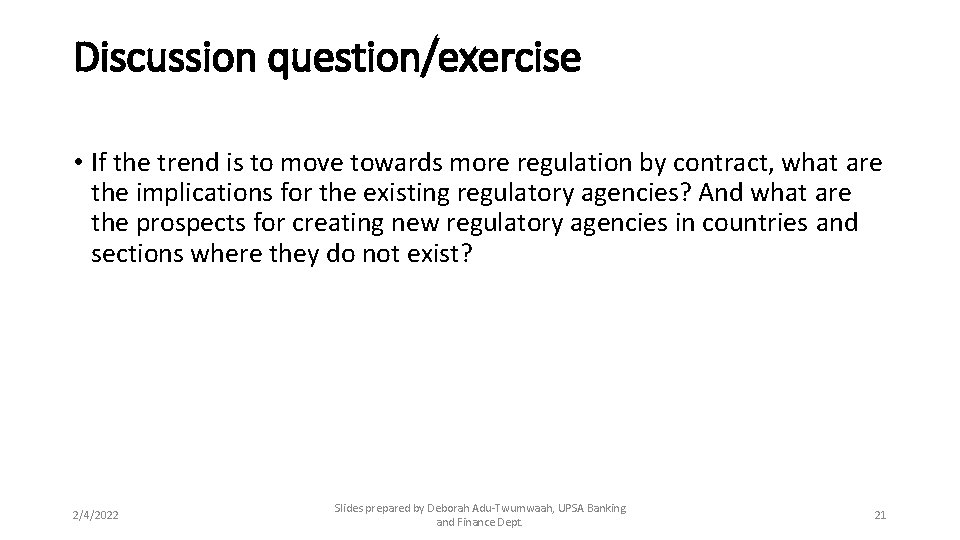
Discussion question/exercise • If the trend is to move towards more regulation by contract, what are the implications for the existing regulatory agencies? And what are the prospects for creating new regulatory agencies in countries and sections where they do not exist? 2/4/2022 Slides prepared by Deborah Adu-Twumwaah, UPSA Banking and Finance Dept. 21
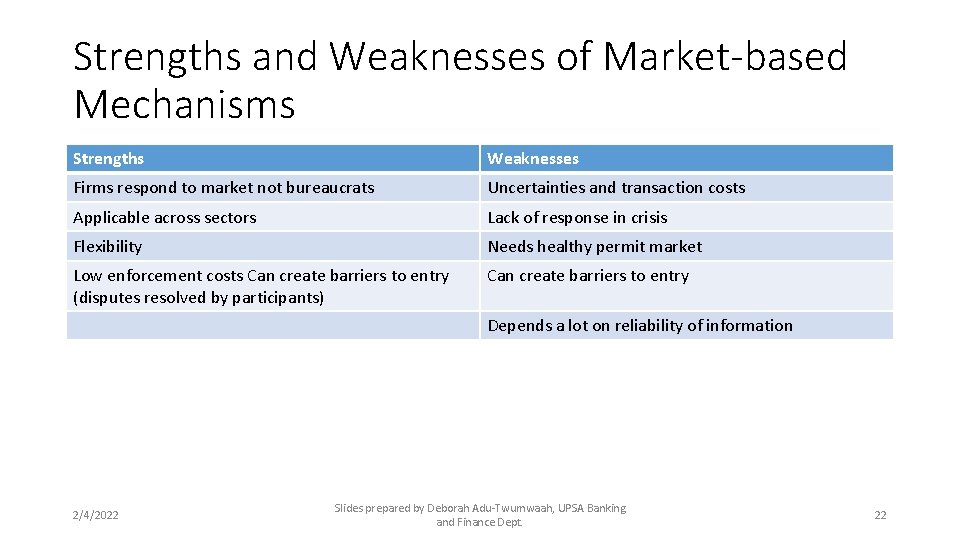
Strengths and Weaknesses of Market-based Mechanisms Strengths Weaknesses Firms respond to market not bureaucrats Uncertainties and transaction costs Applicable across sectors Lack of response in crisis Flexibility Needs healthy permit market Low enforcement costs Can create barriers to entry (disputes resolved by participants) Can create barriers to entry Depends a lot on reliability of information 2/4/2022 Slides prepared by Deborah Adu-Twumwaah, UPSA Banking and Finance Dept. 22
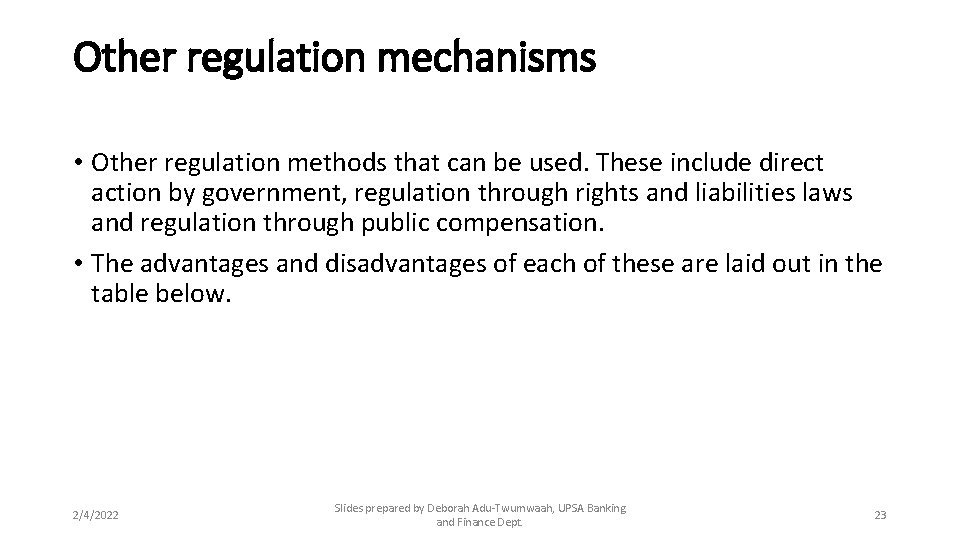
Other regulation mechanisms • Other regulation methods that can be used. These include direct action by government, regulation through rights and liabilities laws and regulation through public compensation. • The advantages and disadvantages of each of these are laid out in the table below. 2/4/2022 Slides prepared by Deborah Adu-Twumwaah, UPSA Banking and Finance Dept. 23
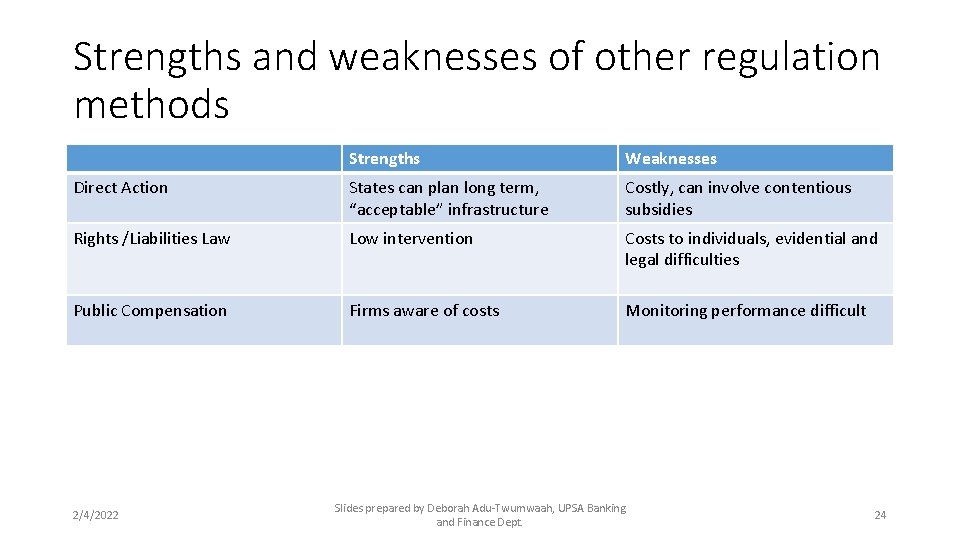
Strengths and weaknesses of other regulation methods Strengths Weaknesses Direct Action States can plan long term, “acceptable” infrastructure Costly, can involve contentious subsidies Rights /Liabilities Law Low intervention Costs to individuals, evidential and legal difficulties Public Compensation Firms aware of costs Monitoring performance difficult 2/4/2022 Slides prepared by Deborah Adu-Twumwaah, UPSA Banking and Finance Dept. 24
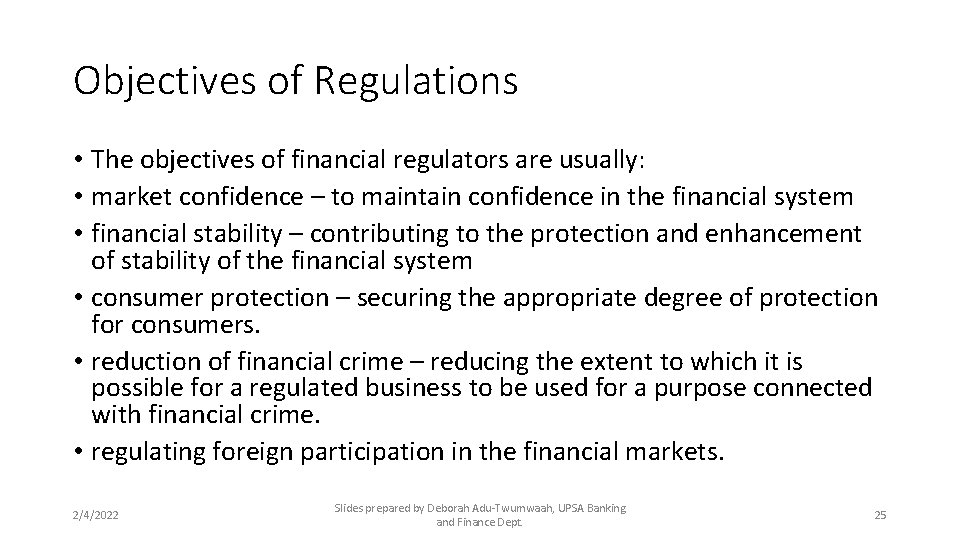
Objectives of Regulations • The objectives of financial regulators are usually: • market confidence – to maintain confidence in the financial system • financial stability – contributing to the protection and enhancement of stability of the financial system • consumer protection – securing the appropriate degree of protection for consumers. • reduction of financial crime – reducing the extent to which it is possible for a regulated business to be used for a purpose connected with financial crime. • regulating foreign participation in the financial markets. 2/4/2022 Slides prepared by Deborah Adu-Twumwaah, UPSA Banking and Finance Dept. 25
MODELS OF FINANCIAL REGULATIONS • There are so many models and theories explaining financial regulations but this class will adopt the models of Centre for International Finance and Regulations (CIFR). • Andrew Schumulow conducted a survey research on behalf of the CIFR using so many countries in the world dubbed “ approaches to financial Regulations” and he was able to identify four models discussed below as the models adopted by most countries in the world for their financial institutions regulation. 2/4/2022 Slides prepared by Deborah Adu-Twumwaah, UPSA Banking and Finance Dept. 26
The four models are: • Institutional, Traditional or Silo Model • Functional Model • Integrated or Unified Model • Twin Peak 2/4/2022 Slides prepared by Deborah Adu-Twumwaah, UPSA Banking and Finance Dept. 27
Institutional, Traditional, or Silos Model • This approach focuses on the form of legal entity under regulation and, accordingly, assigns a particular regulator. • A firm’s legal status determines who regulates it and what business activities are permissible. This model of financial system regulation is used in China, Mexico, Hong Kong. 2/4/2022 Slides prepared by Deborah Adu-Twumwaah, UPSA Banking and Finance Dept. 28
(a) China • In the case of the People’s Republic of China, primary responsibility for the supervision of the banking sector was moved from the People’s Bank of China (China’s national central bank (Bo. C)), to the China Banking Regulatory Commission (CBRC) in 2003. The CBRC’s remit includes banks, financial asset managers, trust and investment companies, and other depositary financial institutions. Its responsibilities include approving new banking licences, formulating prudential rules, and conducting compliance examinations. • The People’s Bank of China is limited to setting monetary policy and acting as lender of last resort (Lo. LR). The China Securities Regulatory Commission 2/4/2022 Slides prepared by Deborah Adu-Twumwaah, UPSA Banking and Finance Dept. 29
• (CSRC) regulates and supervises the securities and futures markets, and enforces sanctions. In future, as financial entities in China increasingly offer products that ‘blur the boundaries’, thereby creating issues of supervisory prerogative and, by implication confusion, contradictions and potential conflicts are more likely to arise. 2/4/2022 Slides prepared by Deborah Adu-Twumwaah, UPSA Banking and Finance Dept. 30
(b) Mexico • Similarly with Mexico, an institutional approach holds sway; what the Mexican authorities refer to as a ‘silo’ approach. Mexico maintains separate regulators for the regulation and supervision of financial entities, namely the National Banking and Securities Commission (Comisión Nacional Bancaria y de Valores) (CNBV), which is a decentralized entity and a division of the country’s finance ministry. The CNBV is responsible for maintaining and promoting the stability of the financial system and protecting depositors. The CNBV supervises and regulates all financial institutions including banks, non -bank finance companies, stockbrokers and mutual funds. 2/4/2022 Slides prepared by Deborah Adu-Twumwaah, UPSA Banking and Finance Dept. 31
• The National Insurance and Bond Companies Commission is responsible for regulating the insurance and surety bond markets, and the National Commission for the Retirement Savings System is both regulator and supervisor of Mexico’s pension system. Its main objective is to regulate private financial institutions in charge of the administration and investment of retirement savings. There is no consolidated supervision and no lead supervisor of financial groups. The National Commission for the Protection of Financial Services Users is in charge of protection of consumers of financial services. Its main objectives are to ‘promote, advise, protect and defend the rights of people who use financial services offered by institutions operating within Mexico. ’ 2/4/2022 Slides prepared by Deborah Adu-Twumwaah, UPSA Banking and Finance Dept. 32
• Hong Kong • In Hong Kong, the Hong Kong Monetary Authority (HKMA) is the Hong Kong government’s authority charged with responsibility for the maintenance of monetary and banking stability. Its main functions include the promotion of the stability and integrity of the financial system, including the banking system, the maintenance of Hong Kong’s status as an international financial centre, the management of the Exchange Fund and the maintenance and development of Hong Kong’s financial infrastructure. It is also Hong Kong’s central bank. • The HKMA enjoys a high degree of autonomy, and is accountable through the Financial Secretary of Hong Kong, and through the laws passed by the Legislative Council that set out the Monetary Authority’s powers and responsibilities. In his control of the Exchange Fund, the Financial Secretary is advised by the Exchange Fund Advisory Committee 2/4/2022 Slides prepared by Deborah Adu-Twumwaah, UPSA Banking and Finance Dept. 33
• Securities and Futures are regulated by the Hong Kong Securities and Futures Commission, whose purpose is to ‘ensure orderly securities and futures market operations, to protect investors and help promote Hong Kong as an international financial centre and a key financial market in China. ’ It is an independent statutory body. 2/4/2022 Slides prepared by Deborah Adu-Twumwaah, UPSA Banking and Finance Dept. 34
FUNCTIONAL MODEL • The functional approach pays no regard to the type of legal entity in question, but rather focuses on the types of transactions or products under regulation. • Consequently, one firm engaging in multiple types of transactions will be subject to multiple regulators. Each regulator is then responsible for the safety and soundness of the firm, as well as the business conduct of the firm, as it applies to each type of product covered by the jurisdiction of each regulator. This approach is currently employed in Italy, France, and Brazil 2/4/2022 Slides prepared by Deborah Adu-Twumwaah, UPSA Banking and Finance Dept. 35
• (a) Italy • In Italy, banking, investment services, asset management, and insurance each have their own supervisor, legal framework, and rules. The Bank of Italy, sets monetary policy and is a member of the European System of Central Banks (Euro system). It is also the bank regulator and supervisor, and is charged with financial system stability. The Bank of Italy not only sets prudential rules and supervises adherence thereto, but may also impose the full range of sanctions in instances of breach, which includes the power of intervention and liquidation. Italy’s Companies and Stock Exchange Commission’s focus is primarily conduct-of-business oriented, and as such contains an element of ‘Twin Peaks’. 2/4/2022 Slides prepared by Deborah Adu-Twumwaah, UPSA Banking and Finance Dept. 36
• They are responsible for: • protecting the investing public, by ensuring transparency and correct behaviour by financial market participants; • ensuring the disclosure of complete and accurate information to the investing public by listed companies; • ensuring accuracy in the prospectuses of transferable securities offered to the public; • compliance with regulations by auditors entered in the Special Register; • and the conduct of investigations of potential infringements of insider trading and market manipulation 2/4/2022 Slides prepared by Deborah Adu-Twumwaah, UPSA Banking and Finance Dept. 37
• France • Similarly, France’s regulatory model is a functional one, with elements of ‘Twin Peaks. ’ The French Prudential Supervisory Authority (Autorité de contrôle prudentiel et de résolution) (ACPR), established in January 2010, is an independent administrative authority, which monitors the activities of banks and insurance companies, and provides for consumer protection. The ACPR acts as supervisor, regulator and enforcer of rules, and is also responsible for system stability. The market conduct regulator is the Autorité des Marchés Financiers (AMF). The AMF is an independent body responsible for safeguarding investments in financial products; ensuring that investors receive material information by way of disclosure; and the maintenance of orderly financial markets. 2/4/2022 Slides prepared by Deborah Adu-Twumwaah, UPSA Banking and Finance Dept. 38
• The obvious shortcomings of this model relate chiefly to safety and soundness considerations, with different regulators potentially taking different views on the threat posed to the financial system, of particular firms. Moreover, the types of activities being regulated must be definable with sufficient clarity, in order to determine which regulator has jurisdiction. While this system of financial regulation is common, and can be effective, provided there is a high degree of communication and co-operation between regulators, it is nonetheless regarded as suboptimal. 2/4/2022 Slides prepared by Deborah Adu-Twumwaah, UPSA Banking and Finance Dept. 39
INTEGRATED OR UNIFIED MODEL • Under this model there exists a single financial regulator responsible for both safety and soundness and business conduct considerations. Under this model, one regulator is in charge of all the financial institutions’ supervision, stability of the economy etc. • This model differs from the ‘Twin Peaks’ model in that it combines both stability and business conduct considerations, whereas the ‘Twin Peaks’ model separates stability and market conduct oversight. • The integrated approach is currently employed in Japan, Singapore, Germany and the Scandinavian countries. It was formerly employed in the UK. Under the aegis of this system, the United Kingdom performed poorly and through various inquiries, declared that this mode of regulation had failed, and should be replaced. 2/4/2022 Slides prepared by Deborah Adu-Twumwaah, UPSA Banking and Finance Dept. 40
(a) Japan • In Japan, The Financial Services Agency is responsible for overseeing banking, securities and exchange, and insurance, in order to ensure the stability of the financial system. It is responsible for the protection of depositors, insurance policy holders, and securities investors. It is responsible for the inspection and supervision of private sector financial institutions, and the surveillance of securities transactions. It is an external organ of the Cabinet Office of the Government of Japan. The agency is headed by a Commissioner and reports to the Minister of State for Financial Services. It has jurisdiction over the Securities and Exchange Surveillance Commission (SESC) and the Certified Public Accountants and Auditing Oversight Board. Its remit includes the maintenance of fair and transparent financial markets, the protection of users of the financial system, increased user convenience, and, as mentioned, the establishment of a stable financial system 2/4/2022 Slides prepared by Deborah Adu-Twumwaah, UPSA Banking and Finance Dept. 41
(b) Singapore • In Singapore, the Monetary Authority of Singapore (MAS), is the market conduct regulator, and the prudential regulator. It is an ‘integrated supervisor overseeing all financial institutions in Singapore - banks, insurers, capital market intermediaries, financial advisors, and the stock exchange. ’ It also promotes retail investor education. While the MAS is a unitary supervisor, it is nonetheless highly regarded and is exceptionally effective, and maintains tight control of the financial sector in Singapore 2/4/2022 Slides prepared by Deborah Adu-Twumwaah, UPSA Banking and Finance Dept. 42
(c) Germany • In Germany the Deutsche Bundesbank (DB) and the Federal Financial Supervisory Authority (Ba. Fin) are responsible for system stability, and a smoothly functioning banking supervision regime. The DB’s regulatory philosophy is one of safeguarding the viability of the financial sector, which is sensitive to fluctuations in confidence, by pursuing creditor (note, not purely depositor) protection. • The intensity of supervision depends on the type and scale of the regulated entity’s business, that is to say, in essence, its risk profile (a risk-based supervision regime). In this regard, the regulator concentrates its attention on whether institutions maintain adequate capital and liquidity, and on whether they have appropriate risk control mechanisms 2/4/2022 Slides prepared by Deborah Adu-Twumwaah, UPSA Banking and Finance Dept. 43
• The division of supervision between these two entities, in its most simple form, is that Ba. Fin is the lead supervisor, whereas the Bundesbank is responsible for macro-prudential supervision. Ba. Fin’s supervisory guidelines are issued in consultation with the Bundesbank, and co-operation between the two is mandated by the Banking Act. The supervisory guidelines delineate areas of authority and are intended to prevent overlap 2/4/2022 Slides prepared by Deborah Adu-Twumwaah, UPSA Banking and Finance Dept. 44
TWIN PEAKS • This method is exemplified by regulation by objective. As the name suggests, this regime comprises two regulators, whose objectives are, alternatively, systemic stability, and market conduct and consumer protection. Examples include Australia, the Netherlands, Switzerland, Qatar, and Spain. Italy, France, and the USA have indicated an interest in adopting this method of financial regulation, the UK has adopted ‘Twin Peaks’, and South Africa is well advanced towards adoption. 2/4/2022 Slides prepared by Deborah Adu-Twumwaah, UPSA Banking and Finance Dept. 45
Question / Discussion • Looking at the four models presented above, which of these models do you think Ghana’s Regulatory system falls? • Discuss the model chosen above and highlight on the main regulatory bodies and their key functions. 2/4/2022 Slides prepared by Deborah Adu-Twumwaah, UPSA Banking and Finance Dept. 46
GHANA’S FINANCIAL REGULATIONS REGIME • Ghana’s financial sector has been undergoing extensive restructuring and transformation during the last two decades as an integral part of a comprehensive growth agenda. • A more diversified financial sector began to emerge under the first generation Financial Sector Adjustment Programs (FINSAP I and II) of the 1980 s. • The reforms focused on the restructuring of distressed banks, improving the regulatory and supervisory framework, and promoting non-bank financial institutions. 2/4/2022 Slides prepared by Deborah Adu-Twumwaah, UPSA Banking and Finance Dept. 47
• The period witnessed the enactment of the Banking Law in 1989, enabling suitable locally incorporated bodies to file applications for licences to operate as banking institutions • The period also witnessed the commencement of the development of an organised capital market with the establishment of the Ghana Stock Exchange in 1990 and an increase in the number of non-bank financial institutions among others. 2/4/2022 Slides prepared by Deborah Adu-Twumwaah, UPSA Banking and Finance Dept. 48
CLASSIFICATION OF FINANCIAL INSTITUTIONS • They are the financial intermediaries who link up the surplus and the deficit units. Per section 69 of Bo. G Act, 2002, Act 612, Financial Institutions can be grouped under two main umbrellas: • Depository Financial Institutions • Non-Depository Financial Institutions 2/4/2022 Slides prepared by Deborah Adu-Twumwaah, UPSA Banking and Finance Dept. 49
Depository Financial Institutions A financial institution that is legally allowed to accept monetary deposits from consumers. This includes: • Banks • Savings and loan associations • Credit unions • Mutual savings company Depository Financial Institutions can be further grouped into two. Banking and Non-Banking Financial Institutions. All these institutions are regulated by the Central Bank of Ghana (Bo. G). 2/4/2022 Slides prepared by Deborah Adu-Twumwaah, UPSA Banking and Finance Dept. 50
Non-Depository Financial Institutions Financial institutions that do not accept deposits but do pool the payments of many people in the form of premiums or contributions and either invest them or provide credit to others. They include: • Pension funds • Insurance companies • Brokerage firm • Investment company 2/4/2022 Slides prepared by Deborah Adu-Twumwaah, UPSA Banking and Finance Dept. 51
- Slides: 51