
Overview of Public Health Surveillance Denise Koo MD

Overview of Public Health Surveillance Denise Koo, MD, MPH Epidemiology Program Office Centers for Disease Control and Prevention
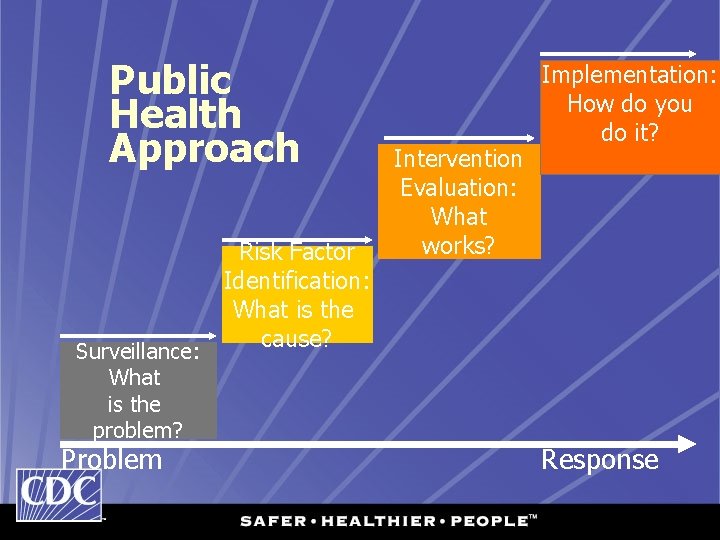
Public Health Approach Surveillance: What is the problem? Problem Risk Factor Identification: What is the cause? Intervention Evaluation: What works? Implementation: How do you do it? Response

Public Health Surveillance n Ongoing, systematic collection, analysis, and interpretation of health-related data essential to the planning, implementation, and evaluation of public health practice, closely integrated with the timely dissemination of these data to those responsible for prevention and control.
Public Health Surveillance Systematic, ongoing n Collection n Analysis n Interpretation n Dissemination n Link to public health practice
Purposes of Public Health Surveillance n n Assess public health status Define public health priorities Evaluate programs Stimulate research
Surveillance Information for Action
Uses of Public Health Surveillance n n n n n Estimate magnitude of the problem Determine geographic distribution of illness Portray the natural history of a disease Detect epidemics/define a problem Generate hypotheses, stimulate research Evaluate control measures Monitor changes in infectious agents Detect changes in health practices Facilitate planning
Uses of Public Health Surveillance n n n n n Estimate magnitude of the problem Determine geographic distribution of illness Portray the natural history of a disease Detect epidemics/define a problem Generate hypotheses, stimulate research Evaluate control measures Monitor changes in infectious agents Detect changes in health practices Facilitate planning
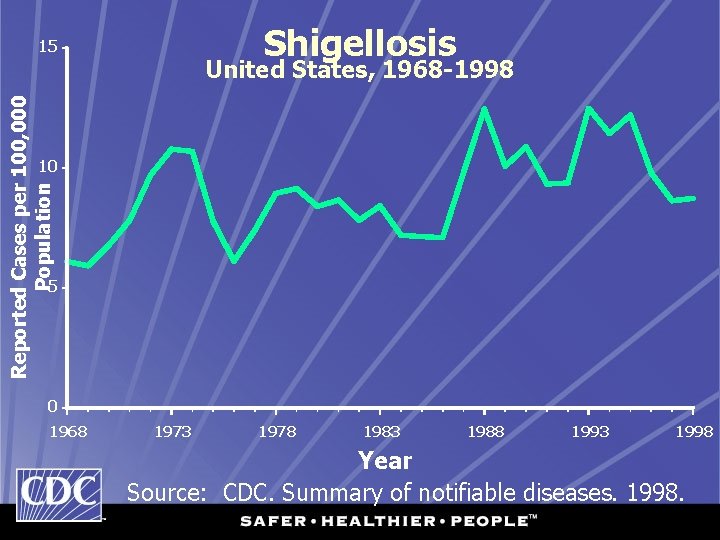
Shigellosis 15 Reported Cases per 100, 000 Population United States, 1968 -1998 10 5 0 1968 1973 1978 1983 1988 1993 1998 Year Source: CDC. Summary of notifiable diseases. 1998.
Uses of Public Health Surveillance n n n n n Estimate magnitude of the problem Determine geographic distribution of illness Portray the natural history of a disease Detect epidemics/define a problem Generate hypotheses, stimulate research Evaluate control measures Monitor changes in infectious agents Detect changes in health practices Facilitate planning
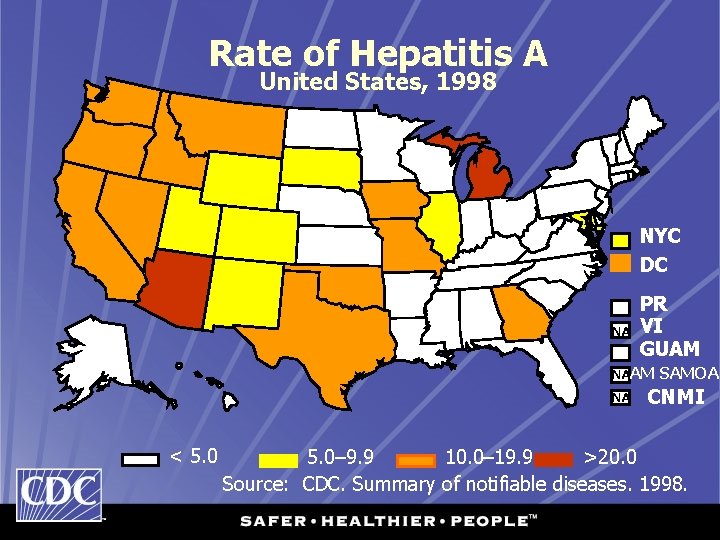
Rate of Hepatitis A United States, 1998 NYC DC NA PR VI GUAM NA < 5. 0 SAMOA CNMI 5. 0– 9. 9 10. 0– 19. 9 >20. 0 Source: CDC. Summary of notifiable diseases. 1998.
Uses of Public Health Surveillance n n n n n Estimate magnitude of the problem Determine geographic distribution of illness Portray the natural history of a disease Detect epidemics/define a problem Generate hypotheses, stimulate research Evaluate control measures Monitor changes in infectious agents Detect changes in health practices Facilitate planning
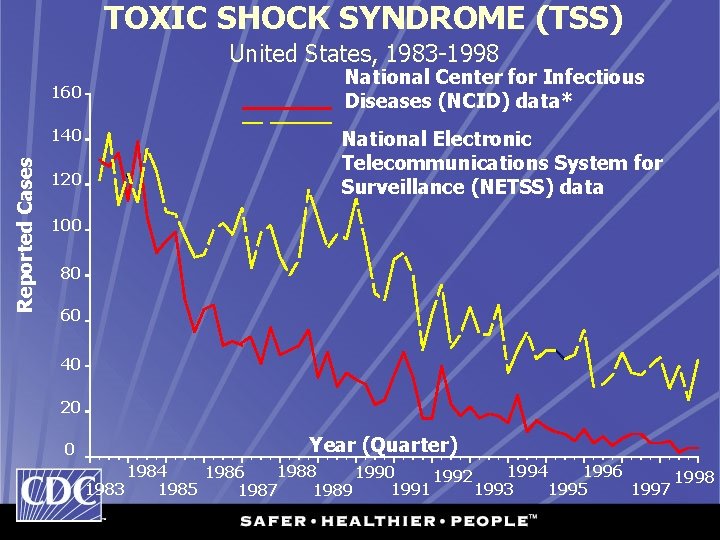
TOXIC SHOCK SYNDROME (TSS) United States, 1983 -1998 160 Reported Cases 140 120 National Center for Infectious Diseases (NCID) data* National Electronic Telecommunications System for Surveillance (NETSS) data 100 80 60 40 20 0 Year (Quarter) 1984 1988 1994 1996 1986 1990 1992 1998 1983 1985 1991 1993 1995 1997 1989
Uses of Public Health Surveillance n n n n n Estimate magnitude of the problem Determine geographic distribution of illness Portray the natural history of a disease Detect epidemics/define a problem Generate hypotheses, stimulate research Evaluate control measures Monitor changes in infectious agents Detect changes in health practices Facilitate planning
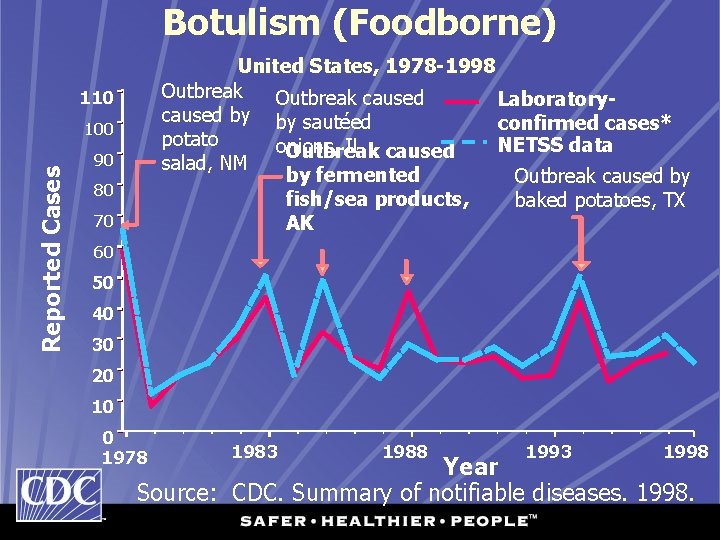
Botulism (Foodborne) United States, 1978 -1998 Outbreak caused Laboratorycaused by by sautéed confirmed cases* potato NETSS data onions, IL caused Outbreak salad, NM by fermented Outbreak caused by fish/sea products, baked potatoes, TX AK 110 Reported Cases 100 90 80 70 60 50 40 30 20 10 0 1978 1983 1988 1993 1998 Year Source: CDC. Summary of notifiable diseases. 1998.
Uses of Public Health Surveillance n n n n n Estimate magnitude of the problem Determine geographic distribution of illness Portray the natural history of a disease Detect epidemics/define a problem Generate hypotheses, stimulate research Evaluate control measures Monitor changes in infectious agents Detect changes in health practices Facilitate planning
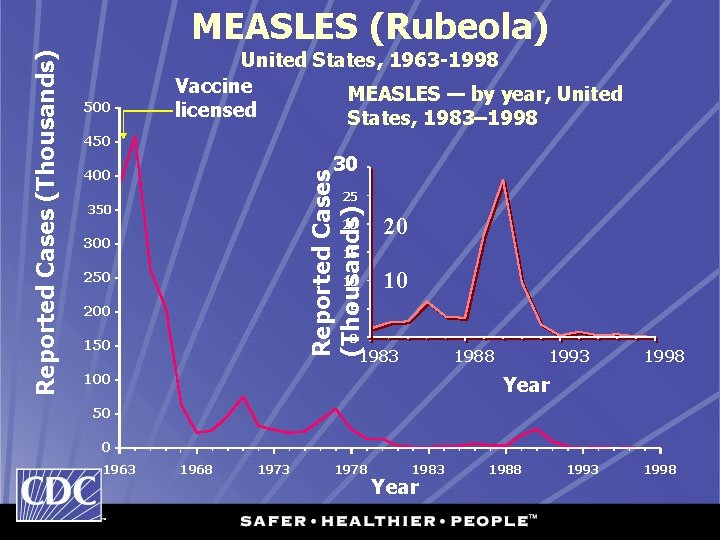
500 United States, 1963 -1998 Vaccine MEASLES — by year, United licensed States, 1983– 1998 450 30 400 Reported Cases (Thousands) MEASLES (Rubeola) 25 350 20 300 20 15 250 10 200 10 5 0 150 1983 1988 100 1993 1998 Year 50 0 1963 1968 1973 1978 1983 Year 1988 1993 1998
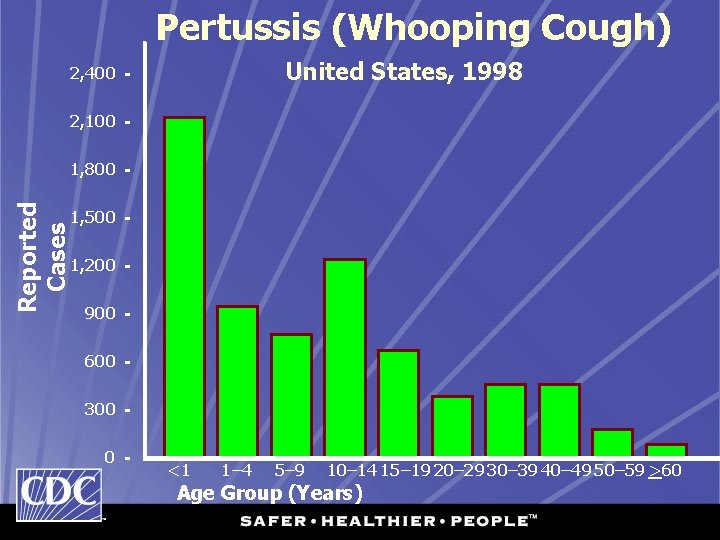
Pertussis (Whooping Cough) United States, 1998 2, 400 2, 100 Reported Cases 1, 800 1, 500 1, 200 900 600 300 0 <1 1– 4 5– 9 10– 14 15– 19 20– 29 30– 39 40– 49 50– 59 >60 Age Group (Years)
Uses of Public Health Surveillance n n n n n Estimate magnitude of the problem Determine geographic distribution of illness Portray the natural history of a disease Detect epidemics/define a problem Generate hypotheses, stimulate research Evaluate control measures Monitor changes in infectious agents Detect changes in health practices Facilitate planning
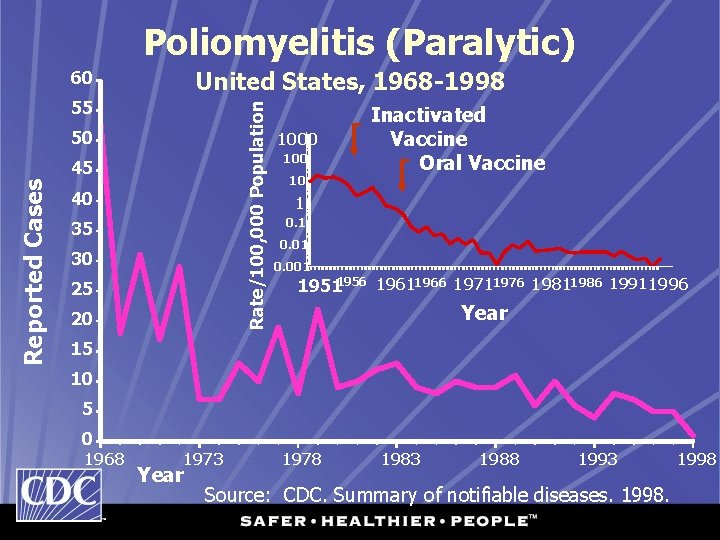
Poliomyelitis (Paralytic) United States, 1968 -1998 60 Rate/100, 000 Population 55 50 Reported Cases 45 40 35 30 25 20 100 10 Inactivated Vaccine Oral Vaccine 1 0. 01 0. 001 19511956 19611966 19711976 19811986 1991 1996 Year 15 10 5 0 1968 1973 Year 1978 1983 1988 1993 Source: CDC. Summary of notifiable diseases. 1998
Uses of Public Health Surveillance n n n n n Estimate magnitude of the problem Determine geographic distribution of illness Portray the natural history of a disease Detect epidemics/define a problem Generate hypotheses, stimulate research Evaluate control measures Monitor changes in infectious agents Detect changes in health practices Facilitate planning
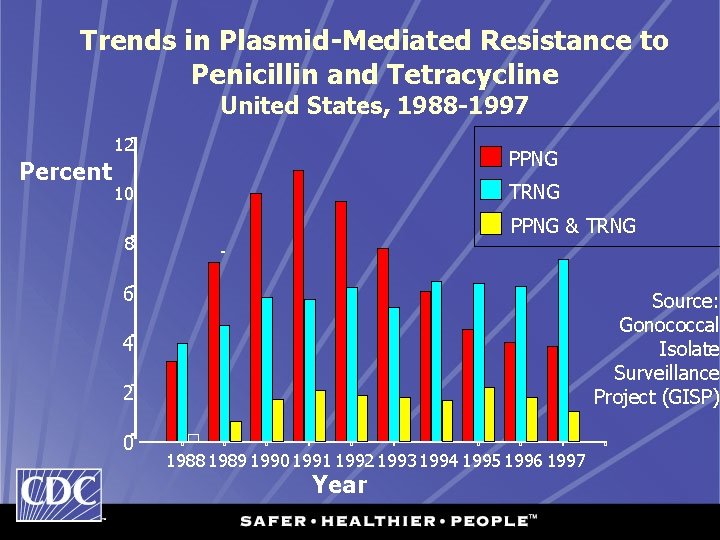
Trends in Plasmid-Mediated Resistance to Penicillin and Tetracycline United States, 1988 -1997 12 Percent PPNG TRNG 10 PPNG & TRNG 8 6 Source: Gonococcal Isolate Surveillance Project (GISP) 4 2 0 1988 1989 1990 1991 1992 1993 1994 1995 1996 1997 Year
Uses of Public Health Surveillance n n n n n Estimate magnitude of the problem Determine geographic distribution of illness Portray the natural history of a disease Detect epidemics/define a problem Generate hypotheses, stimulate research Evaluate control measures Monitor changes in infectious agents Detect changes in health practices Facilitate planning
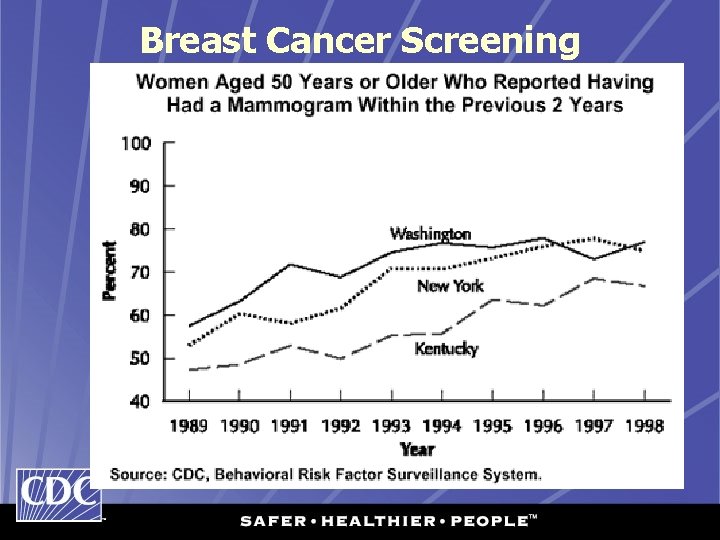
Breast Cancer Screening
Uses of Public Health Surveillance n n n n n Estimate magnitude of the problem Determine geographic distribution of illness Portray the natural history of a disease Detect epidemics/define a problem Generate hypotheses, stimulate research Evaluate control measures Monitor changes in infectious agents Detect changes in health practices Facilitate planning
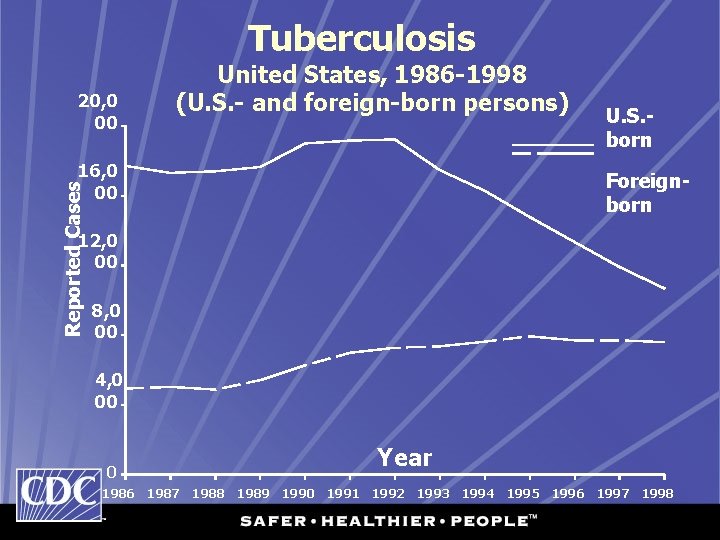
Tuberculosis 20, 0 00 United States, 1986 -1998 (U. S. - and foreign-born persons) Reported Cases 16, 0 00 U. S. born Foreignborn 12, 0 00 8, 0 00 4, 0 00 0 Year 1986 1987 1988 1989 1990 1991 1992 1993 1994 1995 1996 1997 1998
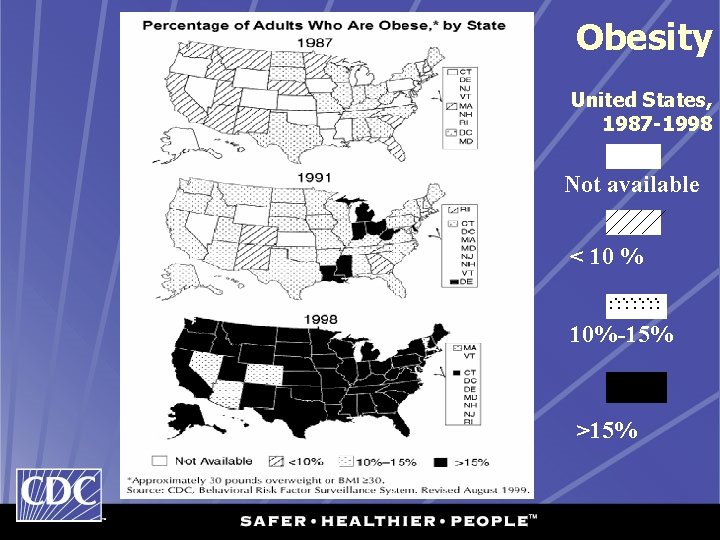
Obesity United States, 1987 -1998 Not available < 10 % …… ……. 10%-15% >15%
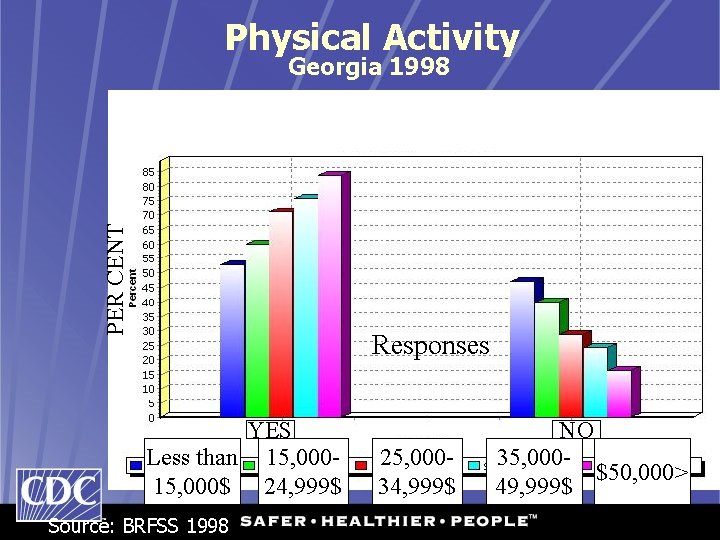
Physical Activity PER CENT Georgia 1998 Responses YES Less than 15, 000$ 24, 999$ Source: BRFSS 1998 25, 00034, 999$ NO 35, 000$50, 000> 49, 999$
- Slides: 28