
Overview of Previous Lessons Over View Algorithm for




- Slides: 37
Overview of Previous Lesson(s)
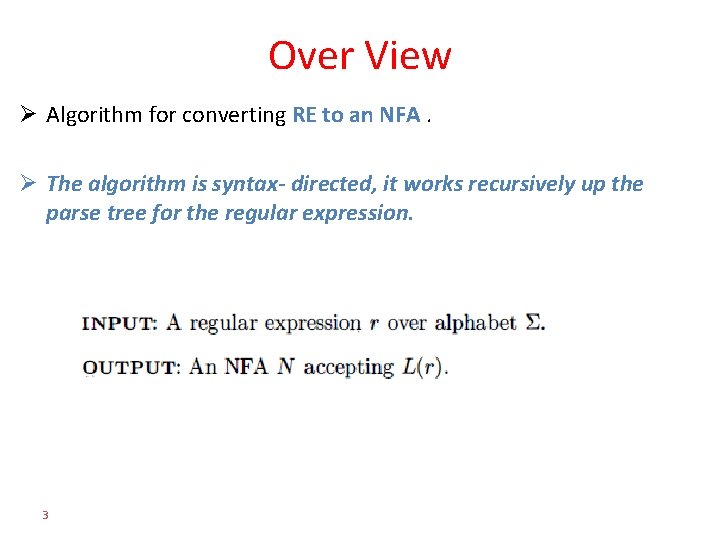
Over View Ø Algorithm for converting RE to an NFA. Ø The algorithm is syntax- directed, it works recursively up the parse tree for the regular expression. 3
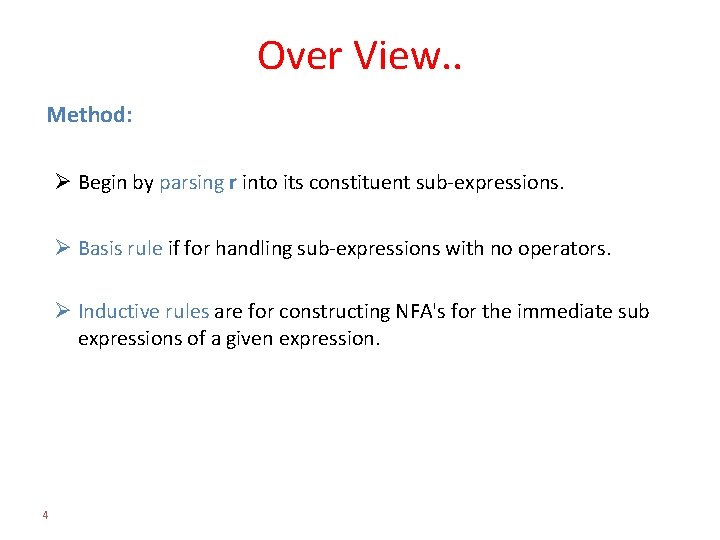
Over View. . Method: Ø Begin by parsing r into its constituent sub-expressions. Ø Basis rule if for handling sub-expressions with no operators. Ø Inductive rules are for constructing NFA's for the immediate sub expressions of a given expression. 4
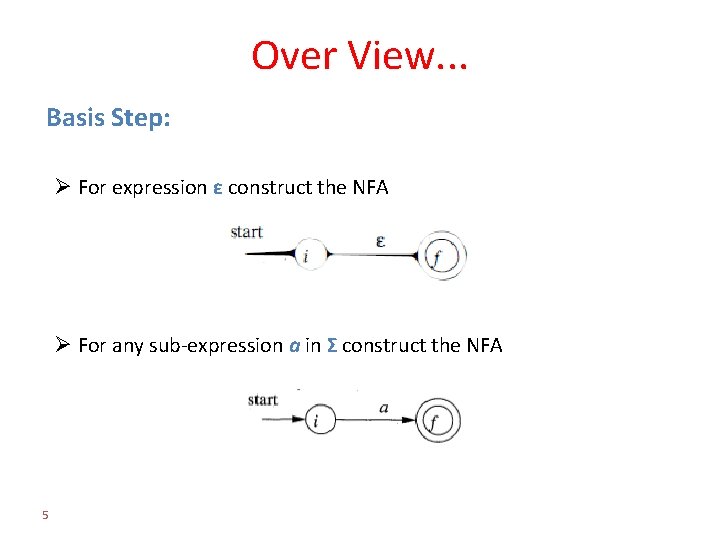
Over View. . . Basis Step: Ø For expression ε construct the NFA Ø For any sub-expression a in Σ construct the NFA 5
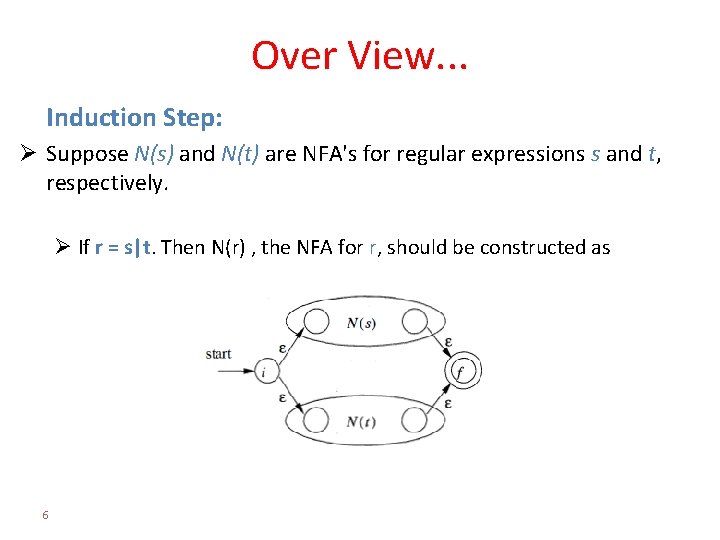
Over View. . . Induction Step: Ø Suppose N(s) and N(t) are NFA's for regular expressions s and t, respectively. Ø If r = s|t. Then N(r) , the NFA for r, should be constructed as 6
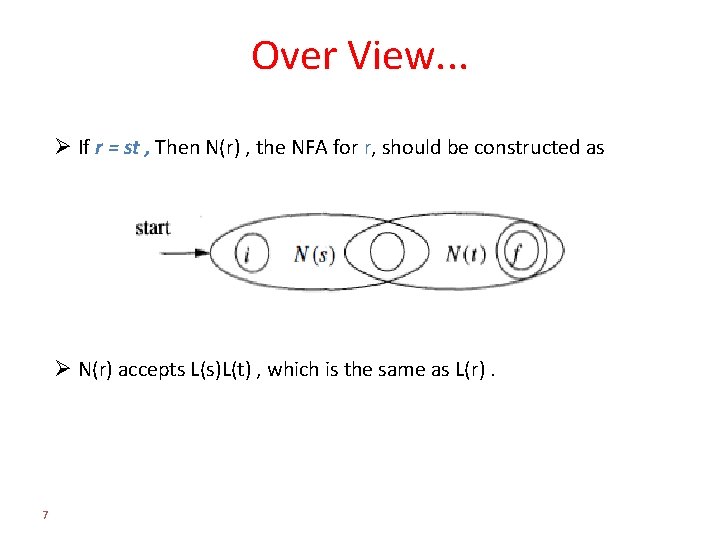
Over View. . . Ø If r = st , Then N(r) , the NFA for r, should be constructed as Ø N(r) accepts L(s)L(t) , which is the same as L(r). 7
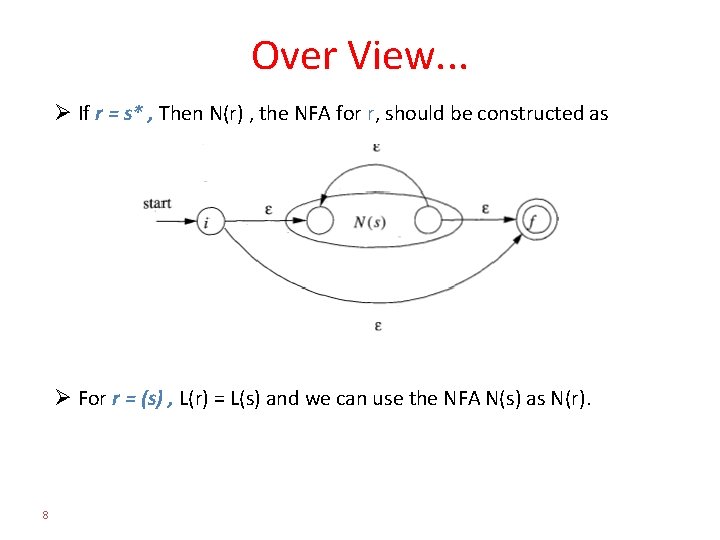
Over View. . . Ø If r = s* , Then N(r) , the NFA for r, should be constructed as Ø For r = (s) , L(r) = L(s) and we can use the NFA N(s) as N(r). 8
Over View. . . Ø Algorithms that have been used to implement and optimize pattern matchers constructed from regular expressions. Ø The first algorithm is useful in a Lex compiler, because it constructs a DFA directly from a regular expression, without constructing an intermediate NFA. Ø The resulting DFA also may have fewer states than the DFA constructed via an NFA. 9
Over View. . . Ø The second algorithm minimizes the number of states of any DFA, by combining states that have the same future behavior. Ø The algorithm itself is quite efficient, running in time O(n log n), where n is the number of states of the DFA. Ø The third algorithm produces more compact representations of transition tables than the standard, two-dimensional table. 10
Over View. . . Ø A state of an NFA can be declared as important if it has a non-ɛ out -transition. Ø NFA has only one accepting state, but this state, having no outtransitions, is not an important state. Ø By concatenating a unique right endmarker # to a regular expression r, we give the accepting state for r a transition on #, making it an important state of the NFA for (r) #. Ø The important states of the NFA correspond directly to the positions in the regular expression that hold symbols of the alphabet. 11
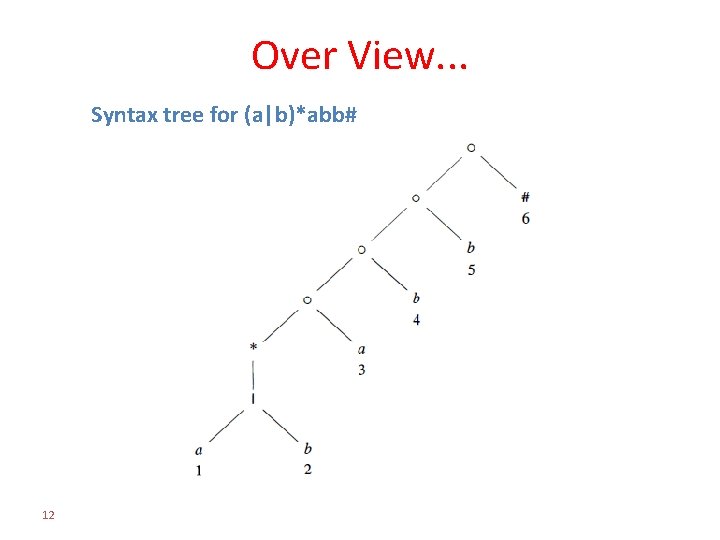
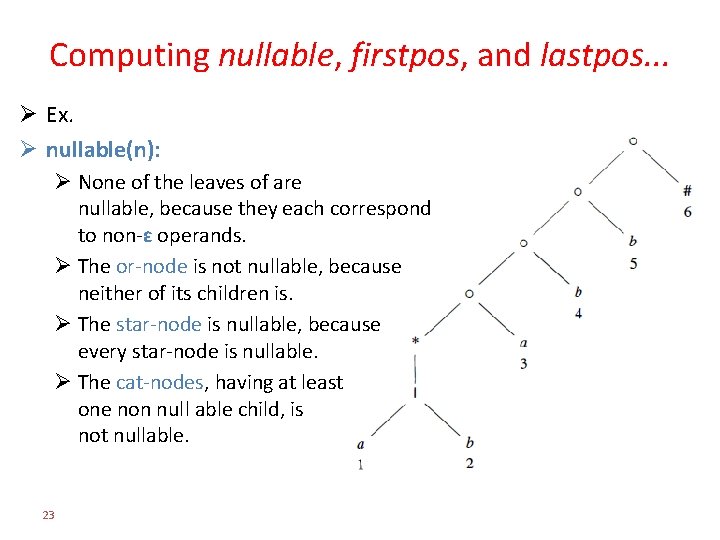
Over View. . . Syntax tree for (a|b)*abb# 12
13
Contents Ø Optimization of DFA-Based Pattern Matchers Ø Important States of an NFA Ø Functions Computed From the Syntax Tree Ø Computing nullable, firstpos, and lastpos Ø Computing followups Ø Converting a RE Directly to DFA Ø Minimizing the Number of States of DFA Ø Trading Time for Space in DFA Simulation Ø Two dimensional Table Ø Terminologies 14
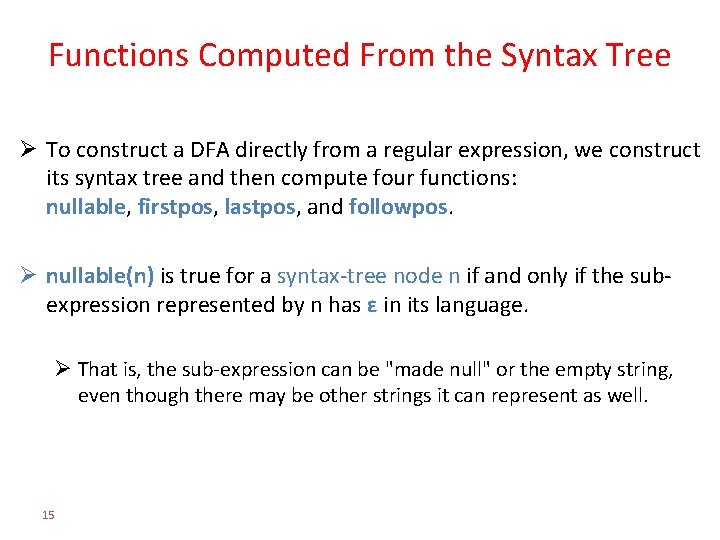
Functions Computed From the Syntax Tree Ø To construct a DFA directly from a regular expression, we construct its syntax tree and then compute four functions: nullable, firstpos, lastpos, and followpos. Ø nullable(n) is true for a syntax-tree node n if and only if the subexpression represented by n has ɛ in its language. Ø That is, the sub-expression can be "made null" or the empty string, even though there may be other strings it can represent as well. 15
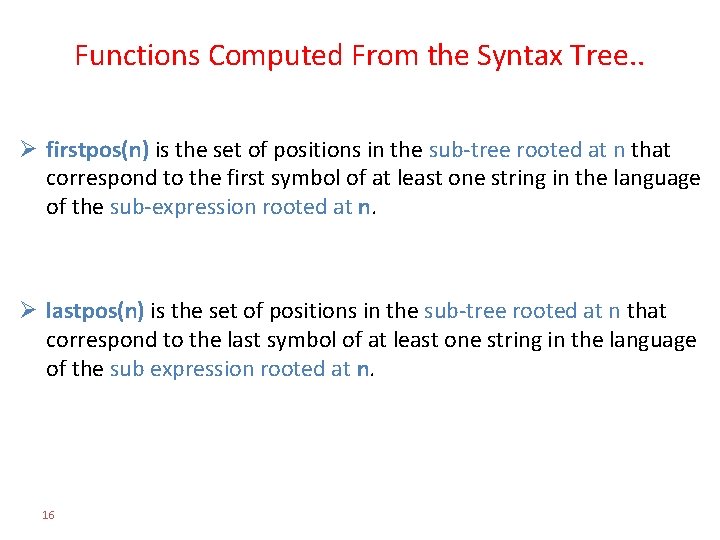
Functions Computed From the Syntax Tree. . Ø firstpos(n) is the set of positions in the sub-tree rooted at n that correspond to the first symbol of at least one string in the language of the sub-expression rooted at n. Ø lastpos(n) is the set of positions in the sub-tree rooted at n that correspond to the last symbol of at least one string in the language of the sub expression rooted at n. 16
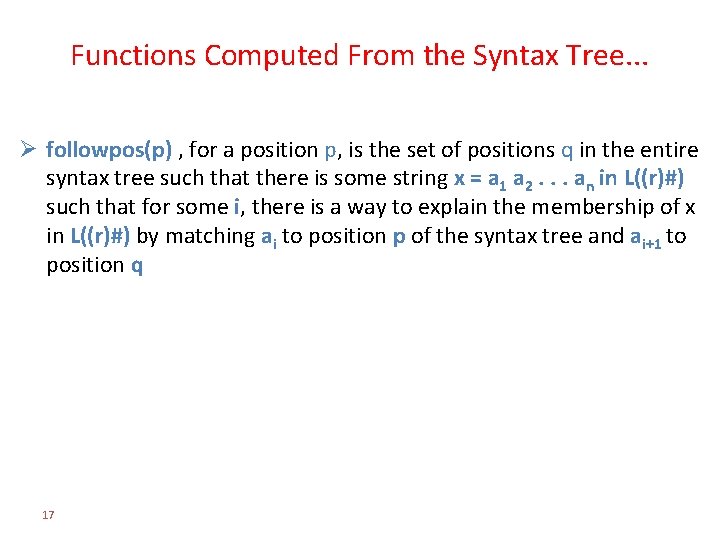
Functions Computed From the Syntax Tree. . . Ø followpos(p) , for a position p, is the set of positions q in the entire syntax tree such that there is some string x = a 1 a 2. . . an in L((r)#) such that for some i, there is a way to explain the membership of x in L((r)#) by matching ai to position p of the syntax tree and ai+1 to position q 17
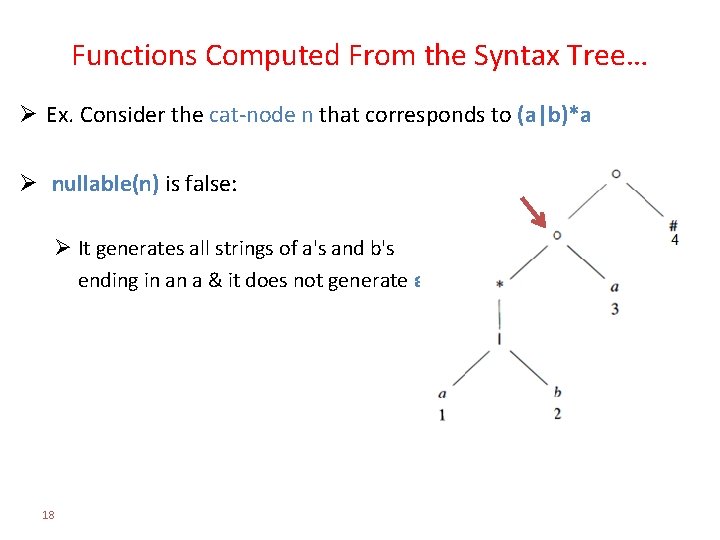
Functions Computed From the Syntax Tree… Ø Ex. Consider the cat-node n that corresponds to (a|b)*a Ø nullable(n) is false: Ø It generates all strings of a's and b's ending in an a & it does not generate ɛ. 18
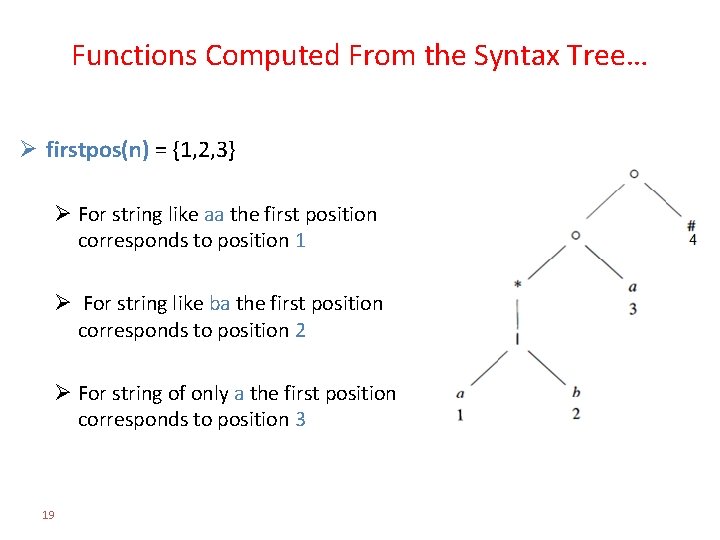
Functions Computed From the Syntax Tree… Ø firstpos(n) = {1, 2, 3} Ø For string like aa the first position corresponds to position 1 Ø For string like ba the first position corresponds to position 2 Ø For string of only a the first position corresponds to position 3 19
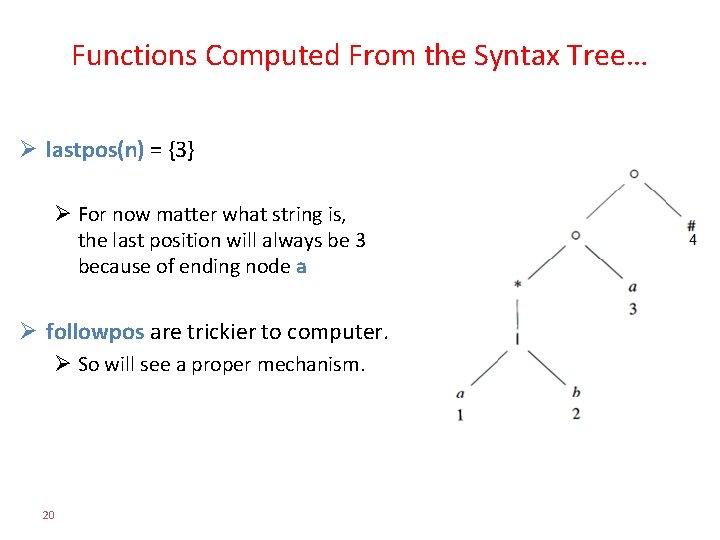
Functions Computed From the Syntax Tree… Ø lastpos(n) = {3} Ø For now matter what string is, the last position will always be 3 because of ending node a Ø followpos are trickier to computer. Ø So will see a proper mechanism. 20
Computing nullable, firstpos, and lastpos Ø nullable, firstpos, and lastpos can be computed by a straight forward recursion on the height of the tree. 21
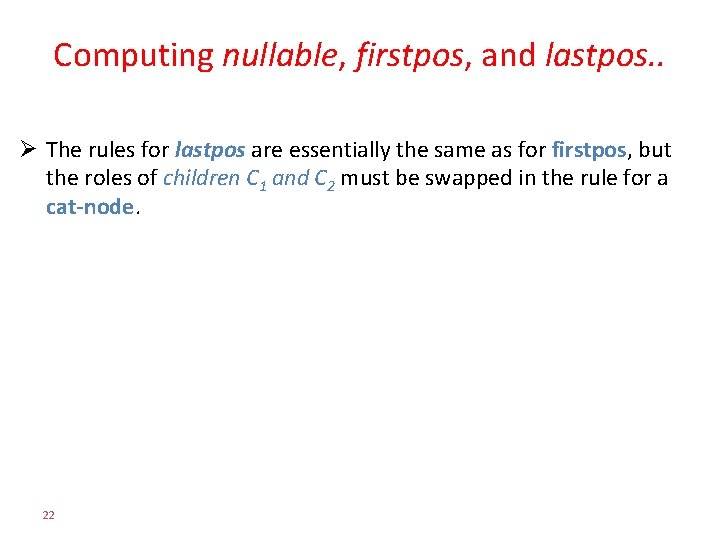
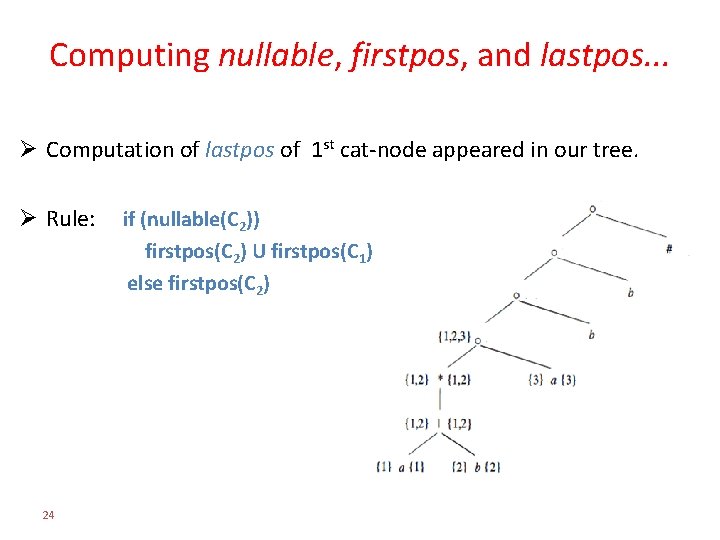
Computing nullable, firstpos, and lastpos. . Ø The rules for lastpos are essentially the same as for firstpos, but the roles of children C 1 and C 2 must be swapped in the rule for a cat-node. 22
Computing nullable, firstpos, and lastpos. . . Ø Ex. Ø nullable(n): Ø None of the leaves of are nullable, because they each correspond to non-ɛ operands. Ø The or-node is not nullable, because neither of its children is. Ø The star-node is nullable, because every star-node is nullable. Ø The cat-nodes, having at least one non null able child, is not nullable. 23
Computing nullable, firstpos, and lastpos. . . Ø Computation of lastpos of 1 st cat-node appeared in our tree. Ø Rule: 24 if (nullable(C 2)) firstpos(C 2) U firstpos(C 1) else firstpos(C 2)
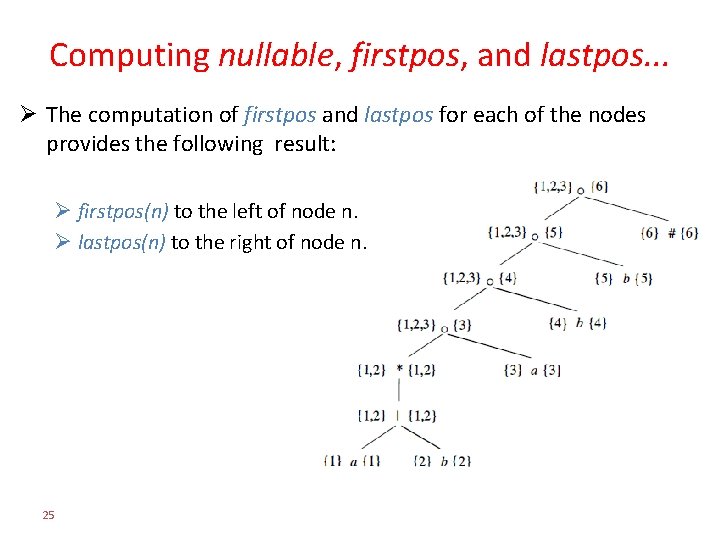
Computing nullable, firstpos, and lastpos. . . Ø The computation of firstpos and lastpos for each of the nodes provides the following result: Ø firstpos(n) to the left of node n. Ø lastpos(n) to the right of node n. 25
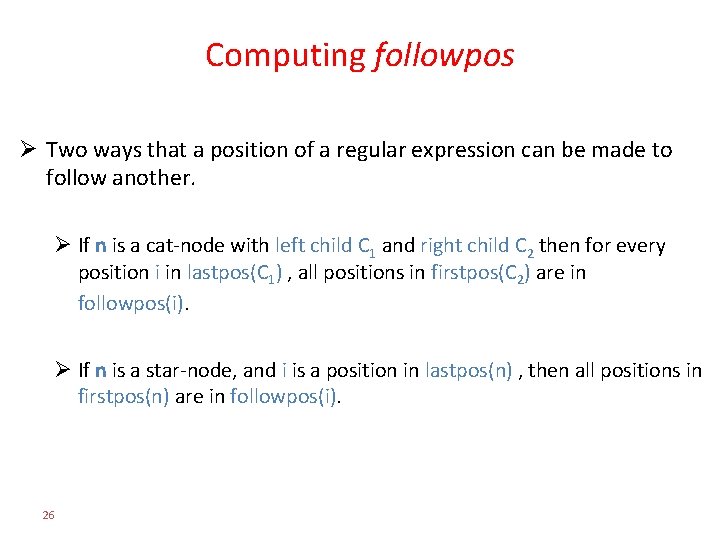
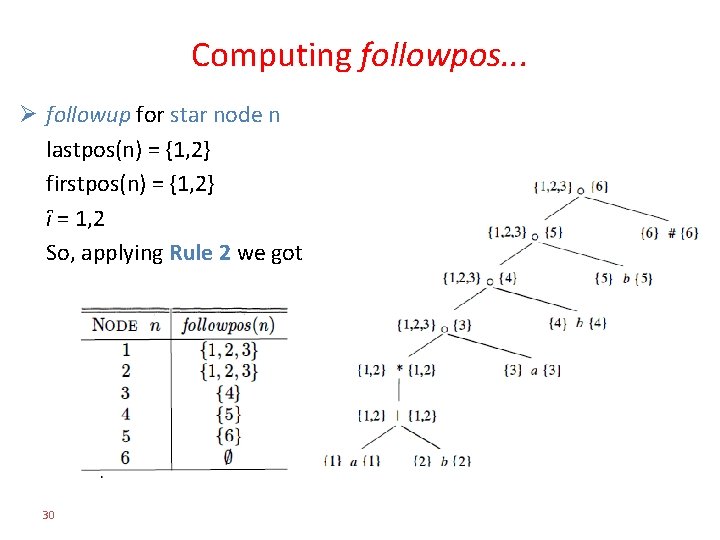
Computing followpos Ø Two ways that a position of a regular expression can be made to follow another. Ø If n is a cat-node with left child C 1 and right child C 2 then for every position i in lastpos(C 1) , all positions in firstpos(C 2) are in followpos(i). Ø If n is a star-node, and i is a position in lastpos(n) , then all positions in firstpos(n) are in followpos(i). 26
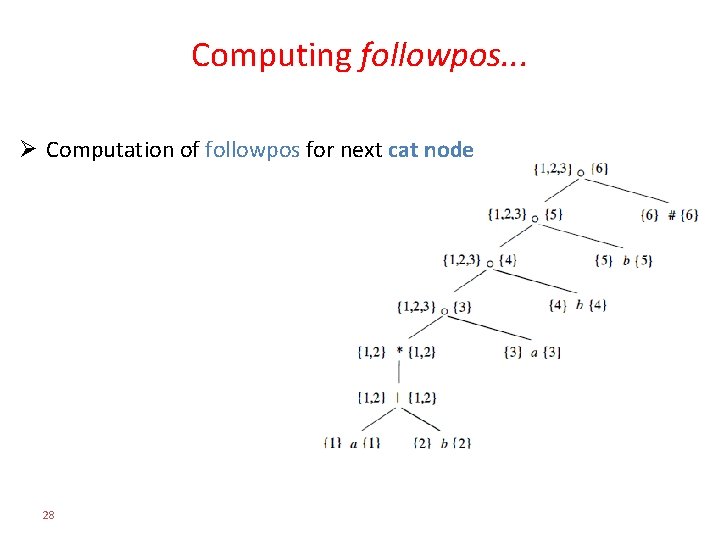
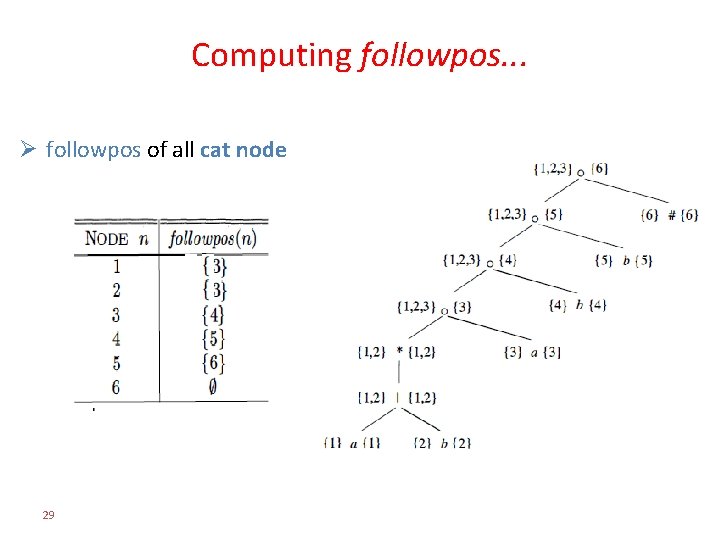
Computing followpos. . Ø Ex. Ø Starting from lowest cat node lastpos(c 1) = {1, 2} firstpos(c 2) = {3} So, applying Rule 1 we got 27
Computing followpos. . . Ø Computation of followpos for next cat node 28
Computing followpos. . . Ø followpos of all cat node 29
Computing followpos. . . Ø followup for star node n lastpos(n) = {1, 2} firstpos(n) = {1, 2} ȋ = 1, 2 So, applying Rule 2 we got 30
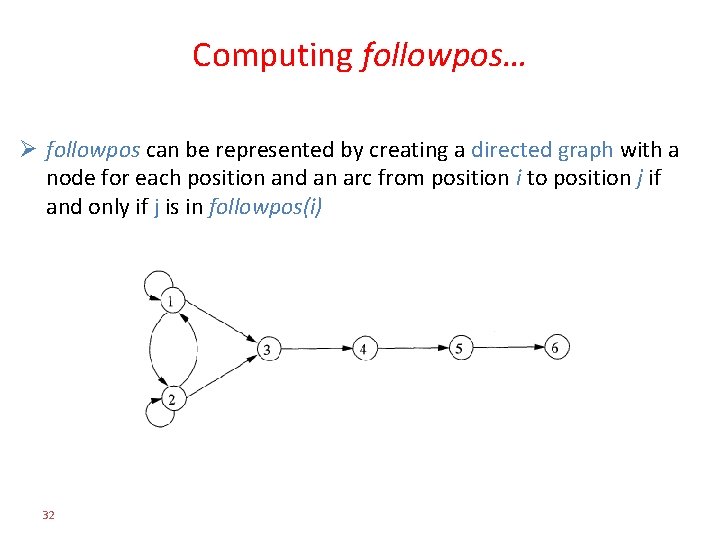
Computing followpos… Ø followpos can be represented by creating a directed graph with a node for each position and an arc from position i to position j if and only if j is in followpos(i) 31
Computing followpos… Ø followpos can be represented by creating a directed graph with a node for each position and an arc from position i to position j if and only if j is in followpos(i) 32
Converting RE directly to DFA INPUT: A regular expression r OUTPUT: A DFA D that recognizes L(r) METHOD: Construct a syntax tree T from the augmented regular expression (r) #. Compute nullable, firstpos, lastpos, and followpos for T. Construct Dstates, the set of states of DFA D , and Dtran, the transition function for D (Procedure). The states of D are sets of positions in T. Initially, each state is "unmarked, " and a state becomes "marked" just before we consider its out-transitions. The start state of D is firstpos(n 0) , where node n 0 is the root of T. The accepting states are those containing the position for the endmarker symbol #. 33
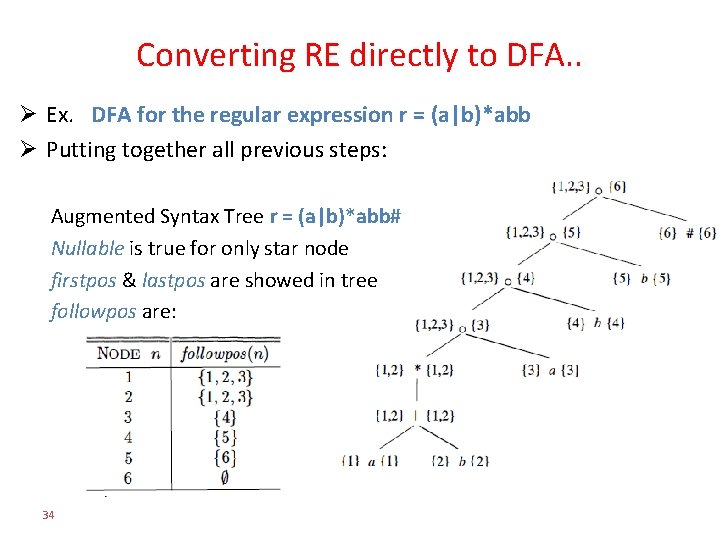
Converting RE directly to DFA. . Ø Ex. DFA for the regular expression r = (a|b)*abb Ø Putting together all previous steps: Augmented Syntax Tree r = (a|b)*abb# Nullable is true for only star node firstpos & lastpos are showed in tree followpos are: 34
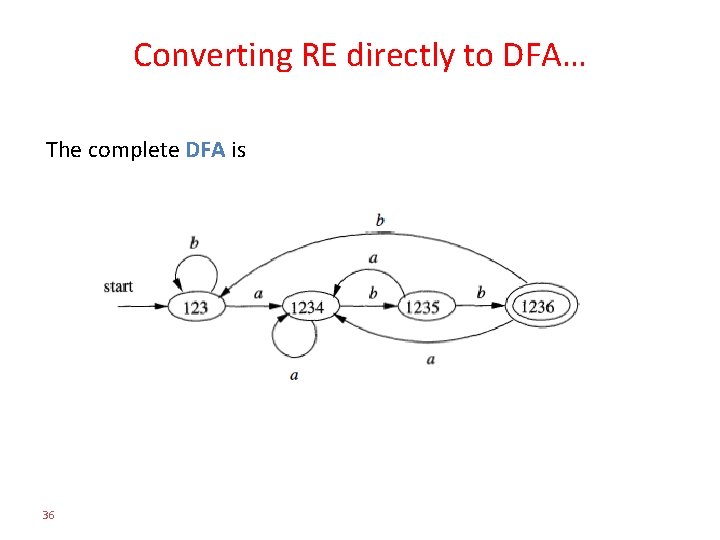
Converting RE directly to DFA… Ø Start state of D = A = firstpos(rootnode) = {1, 2, 3} Ø Now we have to compute Dtran[A, a] & Dtran[A, b] Ø Among the positions of A, 1 and 3 corresponds to a, while 2 corresponds to b. Ø Dtran[A, a] = followpos(1) U followpos(3) = { l , 2, 3, 4} Ø Dtran[A, b] = followpos(2) = {1, 2, 3} Ø State A is similar, and does not have to be added to Dstates. Ø B = {I, 2, 3, 4 } , is new, so we add it to Dstates. Ø Proceed to compute its transitions. . 35
Converting RE directly to DFA… The complete DFA is 36
Thank You