
OVERVIEW OF POLISH BANKING SECTOR Daniel Astraud May
OVERVIEW OF POLISH BANKING SECTOR Daniel Astraud May 2017
Agenda 1. Macroeconomic situation 2. Deposit market 3. Loan market 4. Polish banking sector 5. Major changes in the regulations and legislation 6. Banking sector results 7. Conclusions 2
![Macroeconmic conditions have been favorable GDP GROWTH [q/q] 3. 3% 3. 9% OBSERVATIONS &](http://slidetodoc.com/presentation_image_h/370a8f462feb473cb475635e7728e68f/image-3.jpg "Macroeconmic conditions have been favorable GDP GROWTH [q/q] 3. 3% 3. 9% OBSERVATIONS &")
Macroeconmic conditions have been favorable GDP GROWTH [q/q] 3. 3% 3. 9% OBSERVATIONS & KEY TAKEAWAYS 4. 6% 3. 4% 3. 7% 3. 0% 3. 1% 2. 7% 2. 5% • GDP growth should accelerate to 3. 2% in 2017 vs. 2. 8% in 2016 • Robust private consumption, supported by rising wages and social transfers, will remain the key growth driver. Dec/14 Jun/15 Dec/15 Jun/16 Dec/16 • Capital spending should rebound due to higher EU funds inflows this year. • In light of tight labour market conditions the unemployment rate should decline steadily in the months ahead INFLATION AND UNEMPLOYMENT 11. 9% 8. 2% 2. 0% • CPI inflation grew to 2. 0% y/y in 1 q 2017 from 0. 2% y/y in 4 q 2016. Inflation should reach the central bank’s target of 2. 5% in H 1 2017 and to stay close to this level in the remainder of the year. -1. 4% Jan/15 Jul/15 Inflation (CPI) Jan/16 Jul/16 Jan/17 Unemployment rate Source: BGZ BNP Paribas Chief Economist Bureau 3
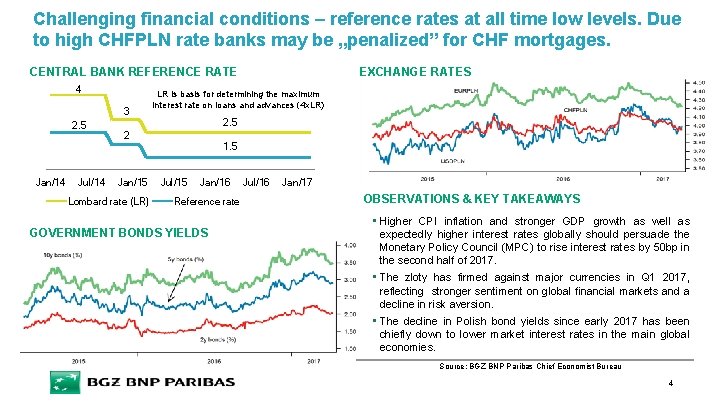
Challenging financial conditions – reference rates at all time low levels. Due to high CHFPLN rate banks may be „penalized” for CHF mortgages. CENTRAL BANK REFERENCE RATE 4 3 2. 5 Jan/14 Jul/14 LR is basis for determining the maximum interest rate on loans and advances (4 x. LR) 2. 5 2 Jan/15 Lombard rate (LR) EXCHANGE RATES 1. 5 Jul/15 Jan/16 Reference rate GOVERNMENT BONDS YIELDS Jul/16 Jan/17 OBSERVATIONS & KEY TAKEAWAYS • Higher CPI inflation and stronger GDP growth as well as expectedly higher interest rates globally should persuade the Monetary Policy Council (MPC) to rise interest rates by 50 bp in the second half of 2017. • The zloty has firmed against major currencies in Q 1 2017, reflecting stronger sentiment on global financial markets and a decline in risk aversion. • The decline in Polish bond yields since early 2017 has been chiefly down to lower market interest rates in the main global economies. Source: BGZ BNP Paribas Chief Economist Bureau 4
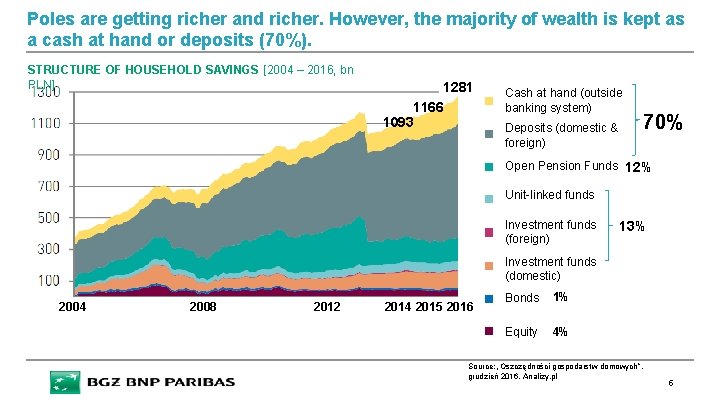
Poles are getting richer and richer. However, the majority of wealth is kept as a cash at hand or deposits (70%). STRUCTURE OF HOUSEHOLD SAVINGS [2004 – 2016, bn PLN] 1281 1166 1093 Cash at hand (outside banking system) Deposits (domestic & foreign) 70% Open Pension Funds 12% Unit-linked funds Investment funds (foreign) 13% Investment funds (domestic) 2004 2008 2012 2014 2015 2016 Bonds 1% Equity 4% Source: „Oszczędności gospodarstw domowych”, grudzień 2016, Analizy. pl 5
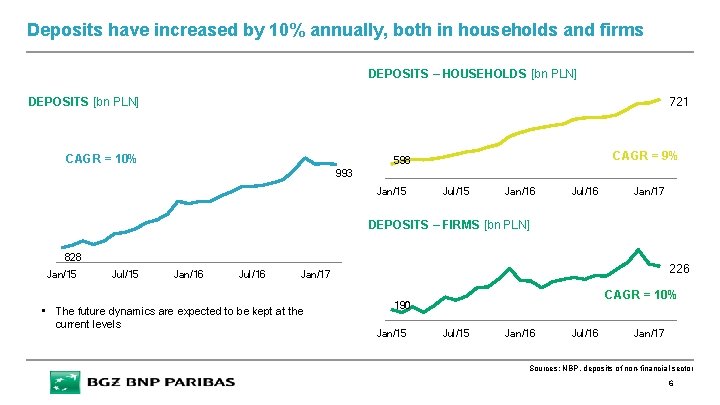
Deposits have increased by 10% annually, both in households and firms DEPOSITS – HOUSEHOLDS [bn PLN] 721 DEPOSITS [bn PLN] CAGR = 10% CAGR = 9% 598 993 Jan/15 Jul/15 Jan/16 Jul/16 Jan/17 DEPOSITS – FIRMS [bn PLN] 828 Jan/15 Jul/15 Jan/16 Jul/16 226 Jan/17 • The future dynamics are expected to be kept at the current levels CAGR = 10% 190 Jan/15 Jul/15 Jan/16 Jul/16 Jan/17 Sources: NBP, deposits of non-financial sector 6
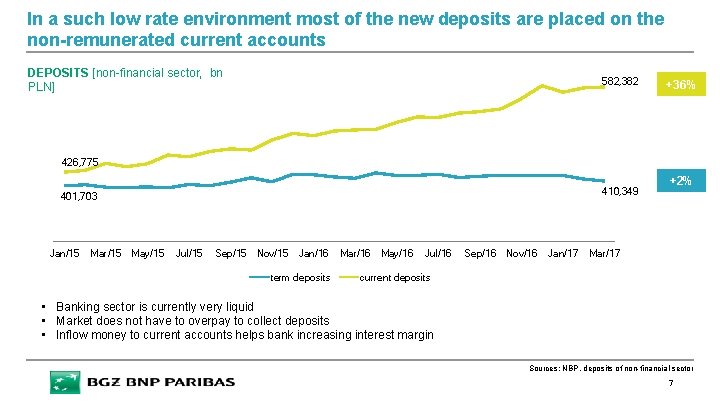
In a such low rate environment most of the new deposits are placed on the non-remunerated current accounts DEPOSITS [non-financial sector, bn PLN] 582, 382 +36% 426, 775 410, 349 401, 703 Jan/15 Mar/15 May/15 Jul/15 Sep/15 Nov/15 Jan/16 term deposits Mar/16 May/16 Jul/16 Sep/16 Nov/16 Jan/17 +2% Mar/17 current deposits • Banking sector is currently very liquid • Market does not have to overpay to collect deposits • Inflow money to current accounts helps bank increasing interest margin Sources: NBP, deposits of non-financial sector 7
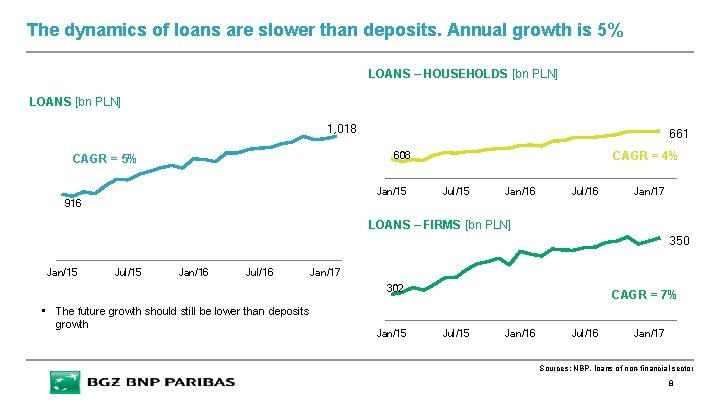
The dynamics of loans are slower than deposits. Annual growth is 5% LOANS – HOUSEHOLDS [bn PLN] LOANS [bn PLN] 1, 018 661 608 CAGR = 5% Jan/15 CAGR = 4% Jul/15 Jan/16 Jul/16 Jan/17 916 LOANS – FIRMS [bn PLN] 350 Jan/15 Jul/15 Jan/16 Jul/16 Jan/17 302 • The future growth should still be lower than deposits growth Jan/15 CAGR = 7% Jul/15 Jan/16 Jul/16 Jan/17 Sources: NBP, loans of non-financial sector 8
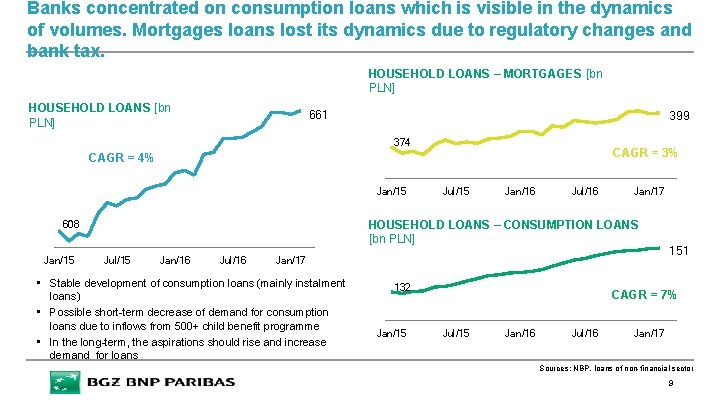
Banks concentrated on consumption loans which is visible in the dynamics of volumes. Mortgages loans lost its dynamics due to regulatory changes and bank tax. HOUSEHOLD LOANS – MORTGAGES [bn PLN] HOUSEHOLD LOANS [bn PLN] 661 399 374 CAGR = 3% CAGR = 4% Jan/15 Jan/16 Jul/16 Jan/17 HOUSEHOLD LOANS – CONSUMPTION LOANS [bn PLN] 608 Jan/15 Jul/15 Jan/16 Jul/16 Jan/17 • Stable development of consumption loans (mainly instalment loans) • Possible short-term decrease of demand for consumption loans due to inflows from 500+ child benefit programme • In the long-term, the aspirations should rise and increase demand for loans 132 Jan/15 151 CAGR = 7% Jul/15 Jan/16 Jul/16 Jan/17 Sources: NBP, loans of non-financial sector 9
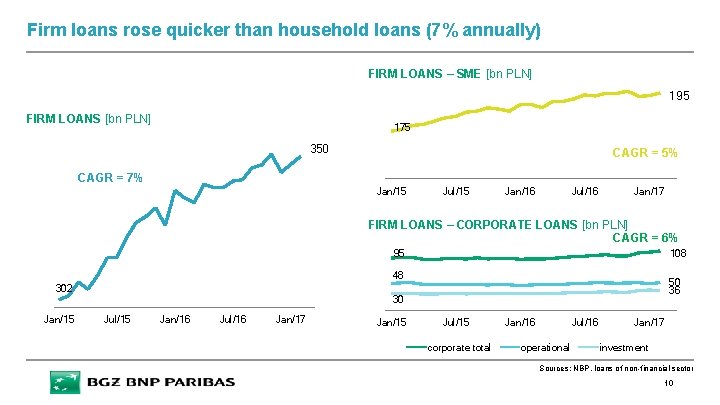
Firm loans rose quicker than household loans (7% annually) FIRM LOANS – SME [bn PLN] 195 FIRM LOANS [bn PLN] 175 350 CAGR = 5% CAGR = 7% Jan/15 Jul/15 Jan/16 Jul/16 Jan/17 FIRM LOANS – CORPORATE LOANS [bn PLN] CAGR = 6% 95 108 48 50 36 302 30 Jan/15 Jul/15 Jan/16 Jul/16 Jan/17 Jan/15 Jul/15 corporate total Jan/16 Jul/16 operational Jan/17 investment Sources: NBP, loans of non-financial sector 10
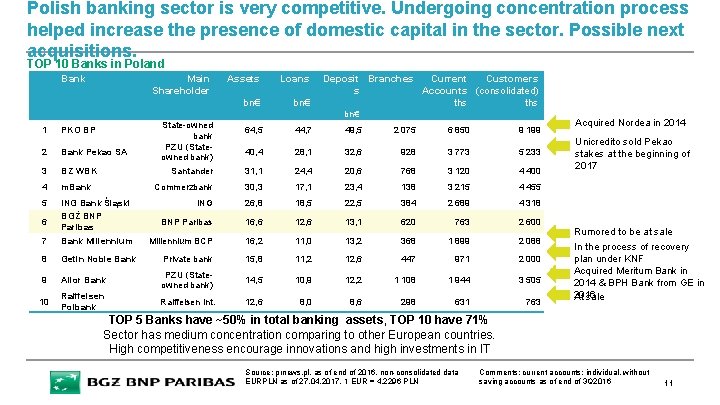
Polish banking sector is very competitive. Undergoing concentration process helped increase the presence of domestic capital in the sector. Possible next acquisitions. TOP 10 Banks in Poland Bank Main Shareholder Assets Loans bn€ Deposit Branches Current Customers s Accounts (consolidated) ths bn€ State-owned bank PZU (Stateowned bank) Santander 64, 5 44, 7 49, 5 2 075 6 850 9 199 40, 4 28, 1 32, 6 928 3 773 5 233 31, 1 24, 4 20, 6 768 3 120 4 400 Commerzbank 30, 3 17, 1 23, 4 138 3 215 4 455 ING 26, 8 18, 5 22, 5 384 2 689 4 318 BNP Paribas 16, 6 12, 6 13, 1 620 763 2 600 Millennium BCP 16, 2 11, 0 13, 2 368 1 899 2 088 Getin Noble Bank Private bank 15, 8 11, 2 12, 6 447 971 2 000 9 Alior Bank PZU (Stateowned bank) 14, 5 10, 9 12, 2 1 108 1 944 3 505 10 Raiffeisen Polbank Raiffeisen Int. 12, 6 8, 0 8, 6 298 631 763 1 PKO BP 2 Bank Pekao SA 3 BZ WBK 4 m. Bank 5 7 ING Bank Śląski BGŻ BNP Paribas Bank Millennium 8 6 Acquired Nordea in 2014 Unicredito sold Pekao stakes at the beginning of 2017 Rumored to be at sale In the process of recovery plan under KNF Acquired Meritum Bank in 2014 & BPH Bank from GE in 2016 At sale TOP 5 Banks have ~50% in total banking assets, TOP 10 have 71% Sector has medium concentration comparing to other European countries. High competitiveness encourage innovations and high investments in IT Source: prnews. pl, as of end of 2016, non-consolidated data EURPLN as of 27. 04. 2017, 1 EUR = 4, 2296 PLN Comments: current accounts: individual, without saving accounts as of end of 3 Q 2016 11
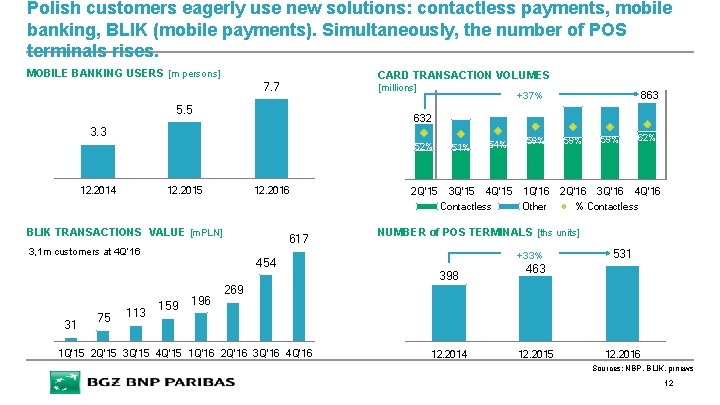
Polish customers eagerly use new solutions: contactless payments, mobile banking, BLIK (mobile payments). Simultaneously, the number of POS terminals rises. MOBILE BANKING USERS [m persons] CARD TRANSACTION VOLUMES 7. 7 [millions] 5. 5 632 3. 3 12. 2014 12. 2015 12. 2016 52% 51% 54% 59% 59% 62% 2 Q'15 3 Q'15 4 Q'15 1 Q'16 2 Q'16 3 Q'16 4 Q'16 Contactless BLIK TRANSACTIONS VALUE [m. PLN] 617 3, 1 m customers at 4 Q’ 16 31 75 113 454 159 196 863 +37% Other % Contactless NUMBER of POS TERMINALS [ths units] +33% 398 531 463 269 1 Q'15 2 Q'15 3 Q'15 4 Q'15 1 Q'16 2 Q'16 3 Q'16 4 Q'16 12. 2014 12. 2015 12. 2016 Sources: NBP, BLIK, prnews 12
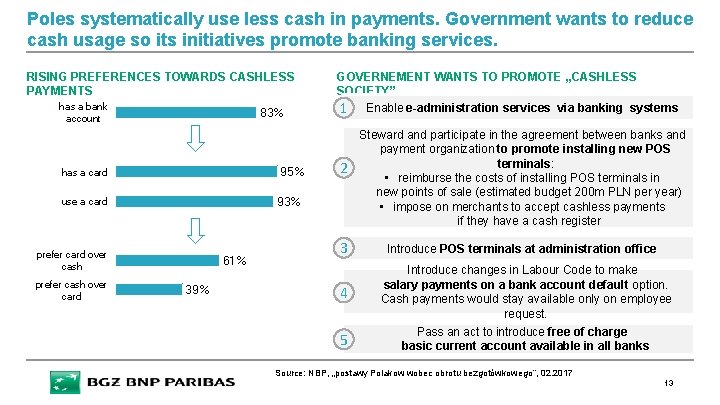
Poles systematically use less cash in payments. Government wants to reduce cash usage so its initiatives promote banking services. RISING PREFERENCES TOWARDS CASHLESS PAYMENTS has a bank account 83% 95% has a card 2 93% use a card prefer card over cash prefer cash over card GOVERNEMENT WANTS TO PROMOTE „CASHLESS SOCIETY” 1 Enable e-administration services via banking systems 61% 39% 3 Steward and participate in the agreement between banks and payment organization to promote installing new POS terminals: • reimburse the costs of installing POS terminals in new points of sale (estimated budget 200 m PLN per year) • impose on merchants to accept cashless payments if they have a cash register Introduce POS terminals at administration office 4 Introduce changes in Labour Code to make salary payments on a bank account default option. Cash payments would stay available only on employee request. 5 Pass an act to introduce free of charge basic current account available in all banks Source: NBP, „postawy Polakow wobec obrotu bezgotówkowego”, 02. 2017 13
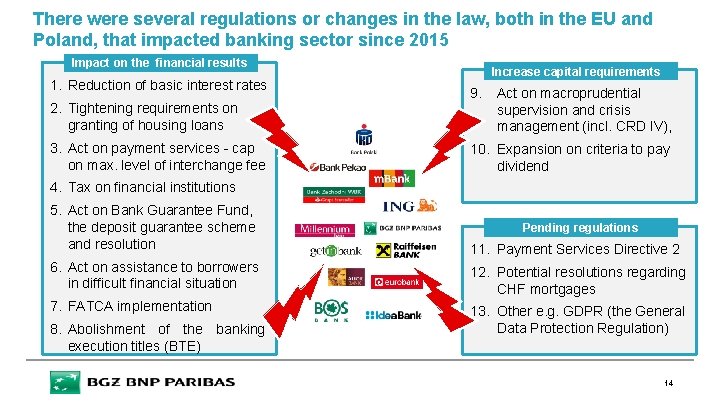
There were several regulations or changes in the law, both in the EU and Poland, that impacted banking sector since 2015 Impact on the financial results 1. Reduction of basic interest rates 2. Tightening requirements on granting of housing loans 3. Act on payment services - cap on max. level of interchange fee Increase capital requirements 9. Act on macroprudential supervision and crisis management (incl. CRD IV), 10. Expansion on criteria to pay dividend 4. Tax on financial institutions 5. Act on Bank Guarantee Fund, the deposit guarantee scheme and resolution 11. Payment Services Directive 2 6. Act on assistance to borrowers in difficult financial situation 12. Potential resolutions regarding CHF mortgages 7. FATCA implementation 13. Other e. g. GDPR (the General Data Protection Regulation) 8. Abolishment of the banking execution titles (BTE) Pending regulations 14
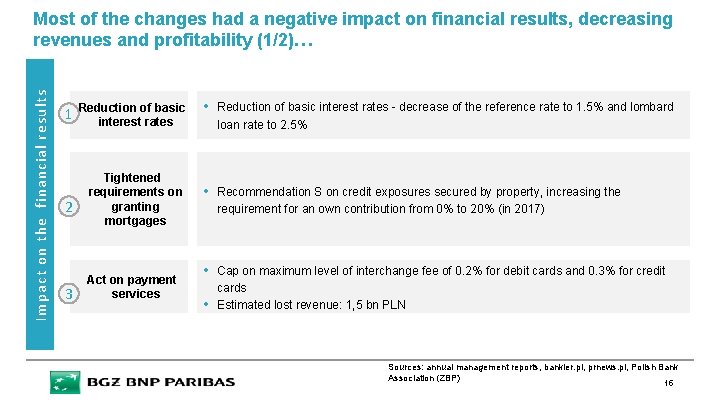
Impact on the financial results Most of the changes had a negative impact on financial results, decreasing revenues and profitability (1/2)… 1 2 3 Reduction of basic interest rates Tightened requirements on granting mortgages Act on payment services • Reduction of basic interest rates - decrease of the reference rate to 1. 5% and lombard loan rate to 2. 5% • Recommendation S on credit exposures secured by property, increasing the requirement for an own contribution from 0% to 20% (in 2017) • Cap on maximum level of interchange fee of 0. 2% for debit cards and 0. 3% for credit • cards Estimated lost revenue: 1, 5 bn PLN Sources: annual management reports, bankier. pl, prnews. pl, Polish Bank Association (ZBP) 15
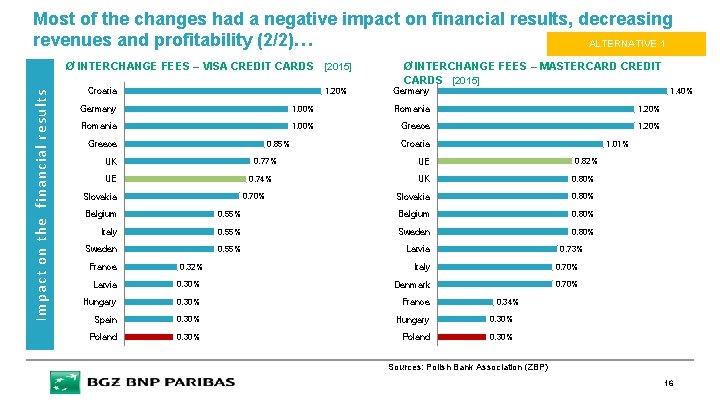
Most of the changes had a negative impact on financial results, decreasing revenues and profitability (2/2)… ALTERNATIVE 1 Impact on the financial results Ø INTERCHANGE FEES – VISA CREDIT CARDS [2015] Croatia 1. 20% Ø INTERCHANGE FEES – MASTERCARD CREDIT CARDS [2015] Germany 1. 40% Germany 1. 00% Romania 1. 20% Romania 1. 00% Greece 1. 20% Greece 0. 85% UK 0. 77% UE 0. 74% Slovakia 0. 70% Croatia 1. 01% UE 0. 82% UK 0. 80% Slovakia 0. 80% Belgium 0. 55% Belgium 0. 80% Italy 0. 55% Sweden 0. 80% Sweden 0. 55% Latvia France 0. 32% 0. 73% Italy 0. 70% Latvia 0. 30% Denmark Hungary 0. 30% France Spain 0. 30% Hungary 0. 30% Poland 0. 30% 0. 34% Sources: Polish Bank Association (ZBP) 16
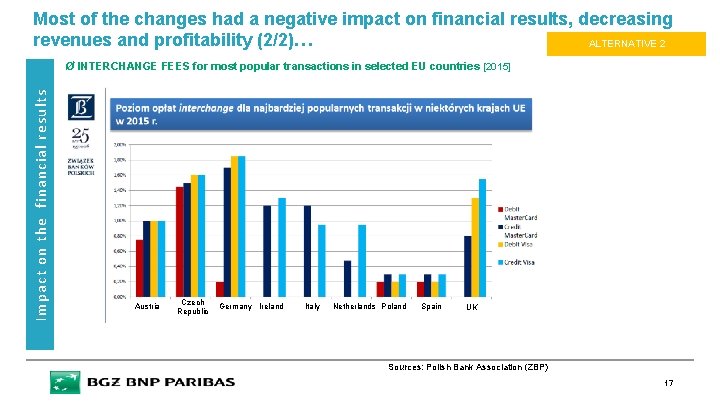
Most of the changes had a negative impact on financial results, decreasing revenues and profitability (2/2)… ALTERNATIVE 2 Impact on the financial results Ø INTERCHANGE FEES for most popular transactions in selected EU countries [2015] Austria Czech Republic Germany Ireland Italy Netherlands Poland Spain UK Sources: Polish Bank Association (ZBP) 17
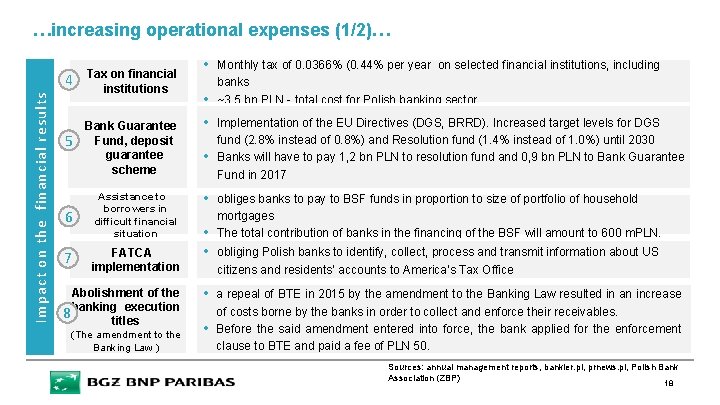
…increasing operational expenses (1/2)… Impact on the financial results 4 5 Tax on financial institutions Bank Guarantee Fund, deposit guarantee scheme 6 Assistance to borrowers in difficult financial situation 7 FATCA implementation Abolishment of the execution 8 bankingtitles (The amendment to the Banking Law ) • Monthly tax of 0. 0366% (0. 44% per year on selected financial institutions, including • banks ~3, 5 bn PLN - total cost for Polish banking sector • Implementation of the EU Directives (DGS, BRRD). Increased target levels for DGS • fund (2. 8% instead of 0. 8%) and Resolution fund (1. 4% instead of 1. 0%) until 2030 Banks will have to pay 1, 2 bn PLN to resolution fund and 0, 9 bn PLN to Bank Guarantee Fund in 2017 • obliges banks to pay to BSF funds in proportion to size of portfolio of household mortgages The total contribution of banks in the financing of the BSF will amount to 600 m. PLN. • • obliging Polish banks to identify, collect, process and transmit information about US citizens and residents’ accounts to America’s Tax Office • a repeal of BTE in 2015 by the amendment to the Banking Law resulted in an increase • of costs borne by the banks in order to collect and enforce their receivables. Before the said amendment entered into force, the bank applied for the enforcement clause to BTE and paid a fee of PLN 50. Sources: annual management reports, bankier. pl, prnews. pl, Polish Bank Association (ZBP) 18
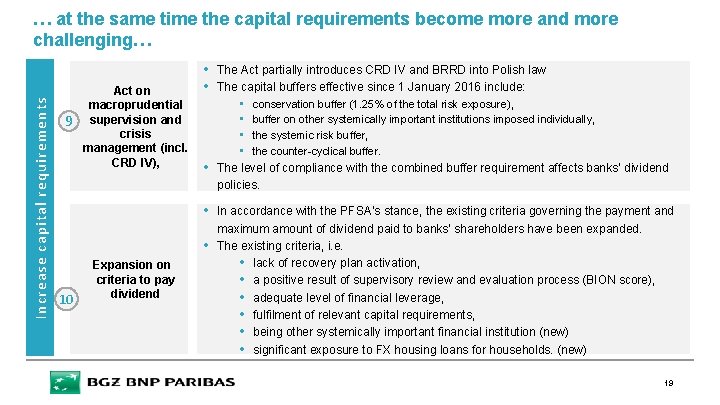
Increase capital requirements … at the same time the capital requirements become more and more challenging… 9 Act on macroprudential supervision and crisis management (incl. CRD IV), • The Act partially introduces CRD IV and BRRD into Polish law • The capital buffers effective since 1 January 2016 include: • • conservation buffer (1. 25% of the total risk exposure), buffer on other systemically important institutions imposed individually, the systemic risk buffer, the counter-cyclical buffer. • The level of compliance with the combined buffer requirement affects banks’ dividend policies. • In accordance with the PFSA’s stance, the existing criteria governing the payment and • 10 Expansion on criteria to pay dividend maximum amount of dividend paid to banks’ shareholders have been expanded. The existing criteria, i. e. • lack of recovery plan activation, • a positive result of supervisory review and evaluation process (BION score), • adequate level of financial leverage, • fulfilment of relevant capital requirements, • being other systemically important financial institution (new) • significant exposure to FX housing loans for households. (new) 19
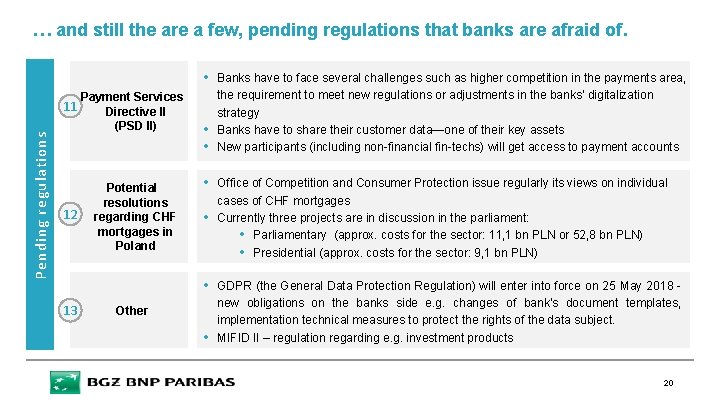
… and still the are a few, pending regulations that banks are afraid of. • Banks have to face several challenges such as higher competition in the payments area, Pending regulations 11 12 Payment Services Directive II (PSD II) Potential resolutions regarding CHF mortgages in Poland • • the requirement to meet new regulations or adjustments in the banks’ digitalization strategy Banks have to share their customer data—one of their key assets New participants (including non-financial fin-techs) will get access to payment accounts • Office of Competition and Consumer Protection issue regularly its views on individual • cases of CHF mortgages Currently three projects are in discussion in the parliament: • Parliamentary (approx. costs for the sector: 11, 1 bn PLN or 52, 8 bn PLN) • Presidential (approx. costs for the sector: 9, 1 bn PLN) • GDPR (the General Data Protection Regulation) will enter into force on 25 May 2018 13 Other • new obligations on the banks side e. g. changes of bank’s document templates, implementation technical measures to protect the rights of the data subject. MIFID II – regulation regarding e. g. investment products 20
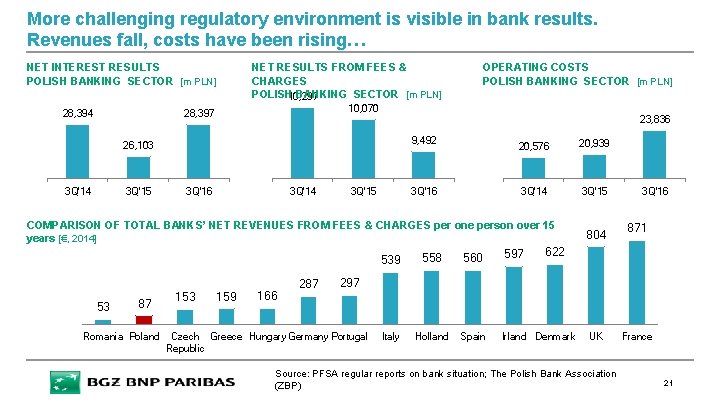
More challenging regulatory environment is visible in bank results. Revenues fall, costs have been rising… NET INTEREST RESULTS POLISH BANKING SECTOR [m PLN] NET RESULTS FROM FEES & CHARGES POLISH 10, 297 BANKING SECTOR [m PLN] 10, 070 28, 397 28, 394 23, 836 9, 492 26, 103 3 Q'14 3 Q'15 OPERATING COSTS POLISH BANKING SECTOR [m PLN] 3 Q'16 3 Q'14 3 Q'15 3 Q'16 20, 576 20, 939 3 Q'14 3 Q'15 COMPARISON OF TOTAL BANKS’ NET REVENUES FROM FEES & CHARGES per one person over 15 years [€, 2014] 53 87 Romania Poland 153 159 166 287 804 3 Q'16 871 622 539 558 560 597 Italy Holland Spain Irland Denmark 297 Czech Greece Hungary Germany Portugal Republic UK Source: PFSA regular reports on bank situation; The Polish Bank Association (ZBP) France 21
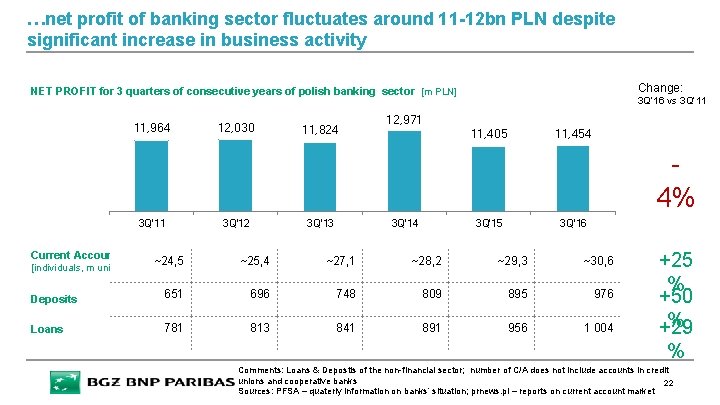
…net profit of banking sector fluctuates around 11 -12 bn PLN despite significant increase in business activity Change: NET PROFIT for 3 quarters of consecutive years of polish banking sector [m PLN] 11, 964 12, 030 11, 824 3 Q’ 16 vs 3 Q’ 11 12, 971 11, 454 11, 405 4% 3 Q'11 Current Accounts 3 Q'12 3 Q'13 3 Q'14 3 Q'15 3 Q'16 ~24, 5 ~25, 4 ~27, 1 ~28, 2 ~29, 3 ~30, 6 Deposits 651 696 748 809 895 976 Loans 781 813 841 891 956 1 004 [individuals, m units] +25 % +50 % +29 % Comments: Loans & Depostis of the non-financial sector; number of C/A does not include accounts in credit unions and cooperative banks 22 Sources: PFSA – quaterly Information on banks’ situation; prnews. pl – reports on current account market
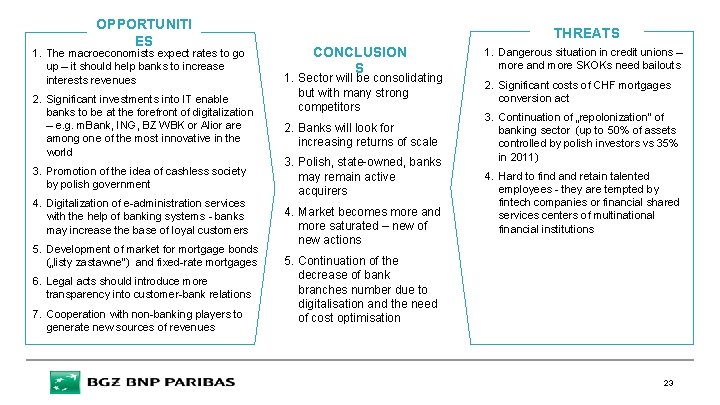
OPPORTUNITI ES 1. The macroeconomists expect rates to go up – it should help banks to increase interests revenues 2. Significant investments into IT enable banks to be at the forefront of digitalization – e. g. m. Bank, ING, BZ WBK or Alior are among one of the most innovative in the world 3. Promotion of the idea of cashless society by polish government 4. Digitalization of e-administration services with the help of banking systems - banks may increase the base of loyal customers 5. Development of market for mortgage bonds („listy zastawne”) and fixed-rate mortgages 6. Legal acts should introduce more transparency into customer-bank relations 7. Cooperation with non-banking players to generate new sources of revenues THREATS CONCLUSION S 1. Sector will be consolidating but with many strong competitors 2. Banks will look for increasing returns of scale 3. Polish, state-owned, banks may remain active acquirers 4. Market becomes more and more saturated – new of new actions 1. Dangerous situation in credit unions – more and more SKOKs need bailouts 2. Significant costs of CHF mortgages conversion act 3. Continuation of „repolonization” of banking sector (up to 50% of assets controlled by polish investors vs 35% in 2011) 4. Hard to find and retain talented employees - they are tempted by fintech companies or financial shared services centers of multinational financial institutions 5. Continuation of the decrease of bank branches number due to digitalisation and the need of cost optimisation 23
- Slides: 23