
Overview of Philosophy PART I Outline 1 Overview









- Slides: 44
Overview of Philosophy PART I
Outline: 1. Overview of field of Philosophy 2. Philosophical Methods 3. Classical philosophical questions 4. Major sub-fields of philosophy 5. Classical Antiquity 6. Historical overview
1. Overview Philosophy- “love of wisdom” Historically, any body of knowledge Closely related to religion, mathematics, natural science, education, and politics
Concerning matters: Existence Knowledge Values Reason Mind Language
EXISTENCE Ability to, directly or indirectly, interact with reality or, in more specific cases, the universe.
KNOWLEDGE Is a familiarity, awareness, or understanding of someone or something, such as: facts, information, descriptions, acquired or skills, through experience or education by perceiving, discovering, or learning.
VALUES (In ethics)denotes the degree of importance of some thing or action, with the aim of determining what actions are best to do or what way is best to live (normative ethics), or to describe the significance of different actions.
REASON Capacity for: consciously establishing making sense of things, and verifying facts, applying logic, and changing or justifying practices, institutions, and beliefs based on new or existing information.
MIND Set of cognitive faculties including: • consciousness, • perception, • thinking, judgement, • • language and memory. It is usually defined as the faculty of an entity's thoughts and consciousness
LANGUAGE System that consists of the development, acquisition, maintenance and use of complex systems of communication, particularly the human ability to do so; and a language is any specific example of such a system.
2. Philosophical methods The study of how to do philosophy. A common view among philosophers is that philosophy is distinguished by the ways that philosophers follow in addressing philosophical questions. There is not just one method that philosophers use to answer philosophical questions.
2. Philosophical Methods Questioning Socrates utilized an educational method that focused on discovering answers by asking questions from his students. Socrates believed that "the disciplined practice of thoughtful questioning enables the scholar/student to examine ideas and be able to determine the validity of those ideas" Critical discussion Rational argument form of cooperative argumentative dialogue between individuals, based on asking and answering questions to stimulate critical thinking and to draw out ideas and underlying presuppositions dialectical method, is at base a discourse between two or more people holding different points of view about a subject but wishing to establish the truth through reasoned arguments. Systematic presentation
3. Classical philosophical questions include: Is it possible to know anything and to prove it? What is most real? Is there a better way to live? Is it better to be just or unjust (if one can get away with it)? Do human have free will?
4. Major sub-fields of philosophy: Metaphysics Epistemology Ethics Aesthetics Political philosophy Logic Philosophy of science History of western philosophy and eastern intellectual tradition
5. Traditional/Classical Antiquity (Greco-Roman)division of philosophical inquiry: 1. Natural philosophy (split into various natural sciences) 2. Moral philosophy (social sciences) 3. Metaphysical philosophy (formal sciences, cosmology, and epistemology)
6. Historical Overview Western Middle Eastern Indian Buddhist East Asian African Indigenous-American, Aboriginal, other Feminism
Western Greek-pre-Socratic Hellenistic Roman Medieval Scholasticism Humanism Age of Reason/Enlightenment Early Modern and Modern, Existentialism Utilitarianism, Marxism, Chinese Marxism, Communism, 20 th Century
Middle Eastern Judaism and early Christian (Judeo-Christian), Persian (Zoroastrianism, Manichaeism, Mazdakism), Islamic (early, illuminationist, Sufi, Transcendent, Nahda)
Indian 1. Orthodox (Hindu) 2. Nyaya, Vaisheshika, Samkhya, Yoga, Mimamsa, Vedanta Heterodox Jain, Buddhist, Ajnana, Ajivika, Carvaka
Buddhist Tantrayana and Tibetan Mahayana Theravada
East Asian Confucianism Daoism Korean Japan (including Shinto)
African Animism Ethnophilosophy Ethiopian Ujamaa Negritude Pan-Africanism Black Existentialism Postcolonialism
Indigenous Americas Native American “Great Mystery” “Spiritual Power” Shaminism Ometeotl or “Dual Cosmic Energy” (Aztec) Yanantin and Masintin (Inca/Andean)
Feminism ?
Introduction to Environmental Ethics PART 2
Outline 1. Introduction: Defining and Challenges of Env. Ethics 2. Approaches and Viewpoints of Environmental Ethics 3. The Early Development of Environmental Ethics 4. Ethical Theories 5. Wilderness
What is Ethics? Ethics is the study of what’s right and wrong, good and bad, what we should and shouldn’t do or be, and related topics. Ethics is important to many aspects of our lives. Studying ethics can be very challenging, by forcing us to examine, question, and rethink our deeply held notions of how we should live.
Why study ethics? 1. Studying ethics helps us improve our own intuitions. 2. Ethical views that we hold serve as the foundation for what we should be and what we should do, and changing our views can lead to very major changes in our lives. Studying ethics helps us spot the ethics implicit in what other people say and do.
Difference between Ethics and Morals define personal character, while ethics stress a social system in which those morals are applied. In other words, ethics point to standards or codes of behavior expected by the group to which the individual belongs Morals are held beliefs while ethics are actions taken (usually).
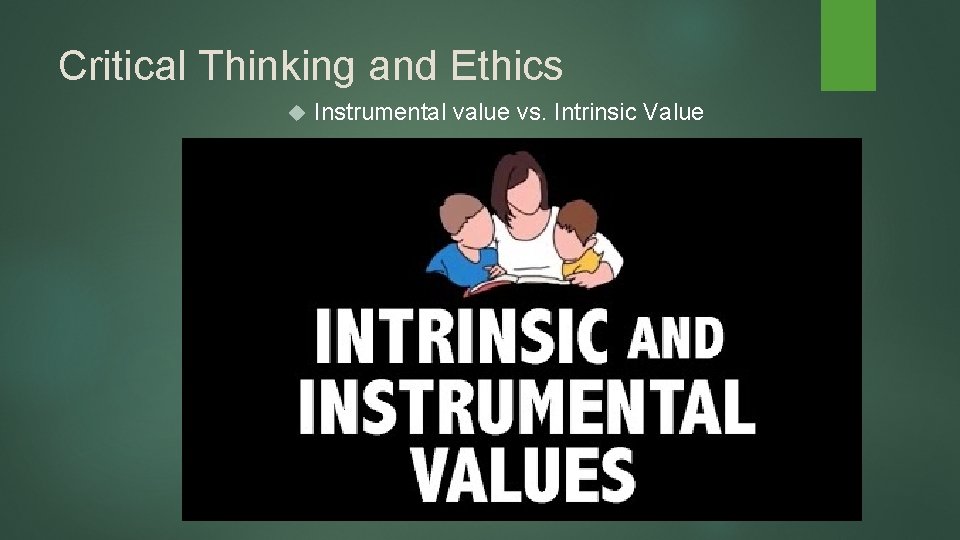
Critical Thinking and Ethics Instrumental value vs. Intrinsic Value
Overview of Environmental Ethics Tom Watenberg Intro to Environmental Ethics Discipline in philosophy that studies the moral relationship of human beings to, and also the value and moral status of, the environment and its nonhuman contents Exerts influence of a range of disciplines: Environmental law Environmental sociology Ecotheology Ecological economics Ecology and Environmental Geography
Brief History of Why? Environmental ethics as a subfield of philosophy didn’t really get its start until the early 1970 s. Growing environmental consciousness and social movements of the 1960 s, public interest increased in questions about humans’ moral relationship with the rest of the natural world. In the field of philosophy, a number of theorists at that time came to believe that traditional ethical theories were unable to provide an adequate account of this relationship. The motivation for the earliest work in environmental ethics, then, was a desire to formulate ethical theories that did a better job of accounting for our moral obligations to the nonhuman natural world. 2
Challenge of Environmental Ethics Suppose putting out natural fires, culling feral animals or destroying some individual members of overpopulated indigenous species is necessary for protection of the integrity of a certain ecosystem. Will these actions be morally permissible or even required? Is its morally acceptable for farmers in non-industrial countries to practice slash and burn techniques to clear areas for agriculture? Consider a mining company which has performed open pit mining in some previously unspoiled area. Does the company have a moral obligation to restore the landform and surface ecology? And what is the value of a humanly restored environment compared with the originally natural environment? Or is such behavior also wrong because the natural environment and/or its various contents have certain VALUES in their own right so that these values ought to be respected and protected in any case?
Challenge traditional anthropocentrism Questioned assumed moral superiority of human beings to members of other species on earth. Investigated the possibility of rational arguments for assigning intrinsic value to the natural environment and its non-human contents. Enlightened/Prudential anthropocentrism No need to develop new theories moral duties we have towards environment are derived from our direct duties to its human inhabitants. Practical purpose, in terms of policy-making
Environmental Ethics and Viewpoints Anthropocentrism Biocentrism Ecocentrism Deep Ecology and the Gaia Principle/Hypothesis Intrinsic Value Stewardship Holism and Individualism Dualism
Ethical Theories Two basic moral questions: 1. What kinds of things are intrinsically valuable, good, or bad? 2. What makes an action right or wrong? Three theories to answer: 1. Consequentialist 2. Deontological 3. Virtue Ethics
Consequentialist Intrinsic value/disvalue/ or goodness/badness to be more fundamental moral notions than rightness/wrongness, and maintain that whether an action is right/wrong is determined by whether its consequences are good/bad. Utilitarian, Jeremy Bentham Animal liberation movement, Peter Singer
Deontologist In contrast to consequentialism Maintain that whether an action is right or wrong is for the most part independent of whether its consequences are good or bad. Distinct moral rules or duties (e. g. not to kill or harm the innocent, not to lie, respect rights of others) Observance/violation of which is INTRINSICALLY right/wrong regardless of consequences Example: Biocentrism, Holism, Kant
Virtue Ethics Alternative to consequentialism and deontology Proposes to understand morality-and assesses the ethical quality of actions-in terms of ”thick” concepts Kindness, honesty, sincerity, and justice Theoretical focus not good/bad, or makes action right/wrong Emphasis on moral character “What are the moral reasons for acting one way or another? ” Motivation and justification of actions are inseparable from character traits of the acting agent.
Virtue Ethics
The early Development of Environmental Ethics See handout
The Idea of the Wilderness The most widely accepted definition is that found in Section 2 c of the 1964 United States Wilderness Act: 'A wilderness, in contrast with those areas where man and his works dominate the landscape, is hereby recognized as an area where the earth and its community of life are untrammeled by man, where man himself is a visitor who does not remain. An area of wilderness is further defined to mean …an area of undeveloped Federal land retaining its primeval character and influence, without permanent improvements or human habitation, which is protected and managed so as to preserve its natural conditions, and which (1) generally appears to have been affected primarily by the forces of nature, with the imprint of man's work substantially unnoticeable; (2) has outstanding opportunities for solitude or a primitive and unconfined type of recreation; (3) has at least 5000 acres, or if of sufficient size as to make practicable its preservation and use in an unimpaired condition; and (4) may also contain ecological, geological, or other features of scientific, educational or scenic value’. Self-Willed land Not under human control
Religious Views about the Environment University of Idaho: Greg Muller's "Religion and the Environment” A Muslim ecologist, Fazlun Khalid, once said: “Our self-indulgence has led us to compete with each other as consumers, as individuals and as countries sucking things out of the earth at an ever-increasing rate and discharging a level of waste which the earth cannot recycle, thus contributing to the rapid destruction of the habitats and lifestyles of the weakest amongst us. We are rampaging through the delicate balance of nature. Savaging other species to extinction. Robbing future generations of their inheritance. We have become so trapped in our own self-indulgence we are not even aware of it. ” (qtd. in Chapman, Petersen, and Smith-Moran, 1999) “Religious faiths and spirituality have an incredible influence on the lives of many people across the globe, and we must recognize that circumstance and its power for good, in an already damaged world. We need men and women of faith, and we need spiritual and religious leaders, to mobilize action to change our challenged future. Many have already heeded the call. We need a shared sense of inspiration, and faith, and a higher sense of goodwill for those we will never meet, but who will know us by the world we leave behind. Regardless of beliefs, faith, or cultural identity and allegiance, the degradation of the natural world is a challenge that affects all of humanity. For our survival and that of future generations, and the survival of nature in its timeless beauty and wonder, dominion must yield to balance, and harvest must yield to sow. With present and near future population and resource challenges, we need change, lest our last supper is the seed grain of our children"(Muller).