
Overview of Onsite Workshops Lean 8 D Quality
- Slides: 44
Overview of On-site Workshops Lean 8 D Quality Costs Root Cause Analysis Roy Kinkaid Quality Consultant LLC ASQ Philadelphia Section 0505
All the following are workshops not lectures. Hands on application is required.
Lean QM 310 Value Stream Mapping is one the foundational tools of Lean
Value Stream Mapping Value stream maps are more complicated than process maps as they contain in addition to the process workflow (activities), the flow of information and data required to enable the product/service to deliver value to the customer. 4
VSM Value stream maps facilitate process analysis, process improvement and the identification of value and non-value added (anything the customer does not pay you to do) activities in the process. Value is delivered to the customer through the value stream. 5
VSM The ideal would be for the Value Stream to consist of value-added activities only. All activities in the value stream are analyzed that create value (product or service) for the customer (process outcome). 6
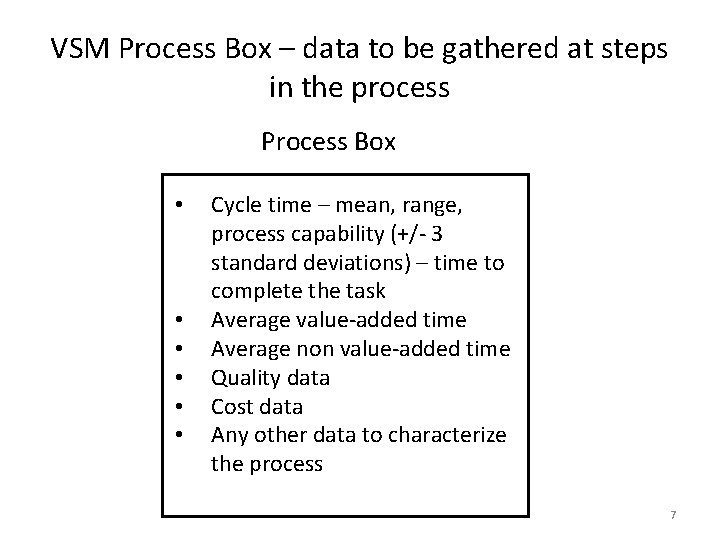
VSM Process Box – data to be gathered at steps in the process Process Box • • • Cycle time – mean, range, process capability (+/- 3 standard deviations) – time to complete the task Average value-added time Average non value-added time Quality data Cost data Any other data to characterize the process 7
Value Stream Mapping Two Examples: Healthcare Manufacturing
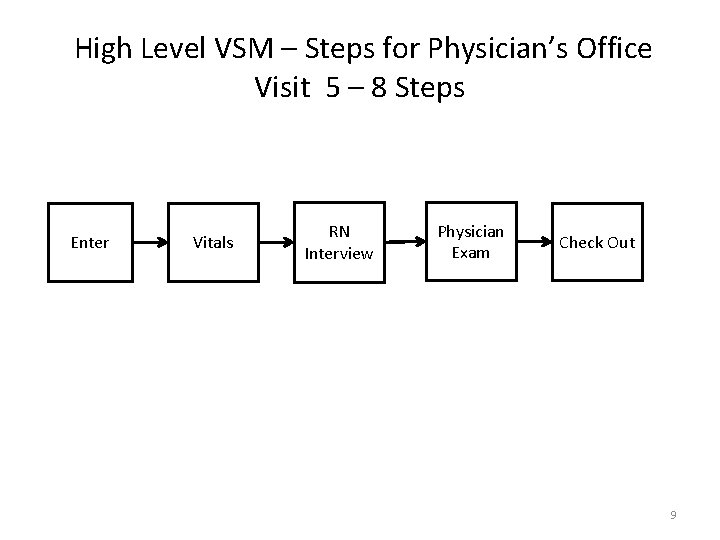
High Level VSM – Steps for Physician’s Office Visit 5 – 8 Steps Enter Vitals RN Interview Physician Exam Check Out 9
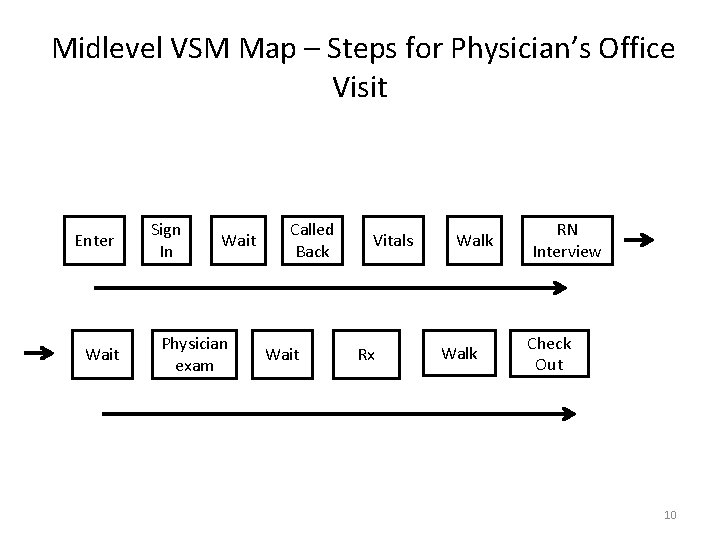
Midlevel VSM Map – Steps for Physician’s Office Visit Enter Wait Sign In Wait Physician exam Called Back Wait Vitals Rx Walk RN Interview Check Out 10
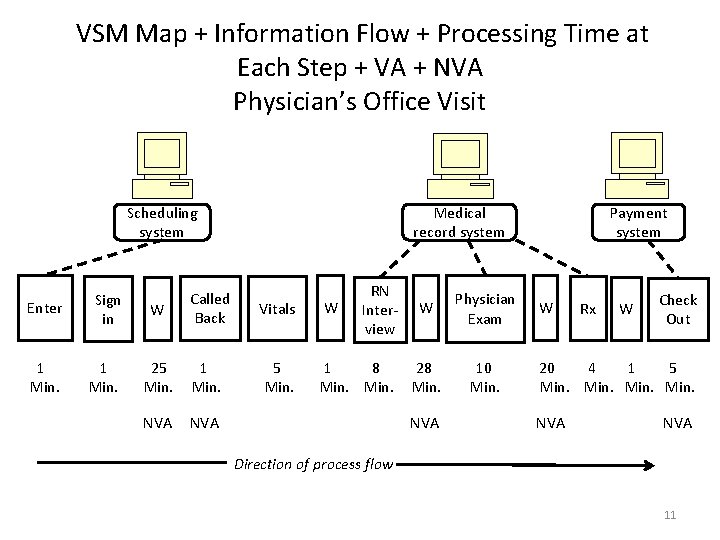
VSM Map + Information Flow + Processing Time at Each Step + VA + NVA Physician’s Office Visit Scheduling system Enter Sign in 1 Min. Medical record system W Called Back Vitals 25 Min. 1 Min. 5 Min. NVA W RN Interview 1 8 Min. W Physician Exam 28 Min. 10 Min. NVA Payment system W Rx W Check Out 20 4 1 5 Min. NVA Direction of process flow 11
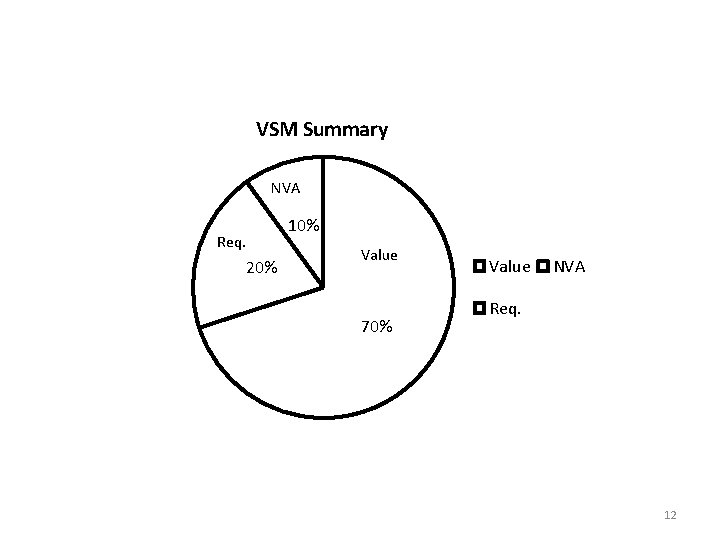
VSM Summary NVA Req. 20% 10% Value 70% Value NVA Req. 12
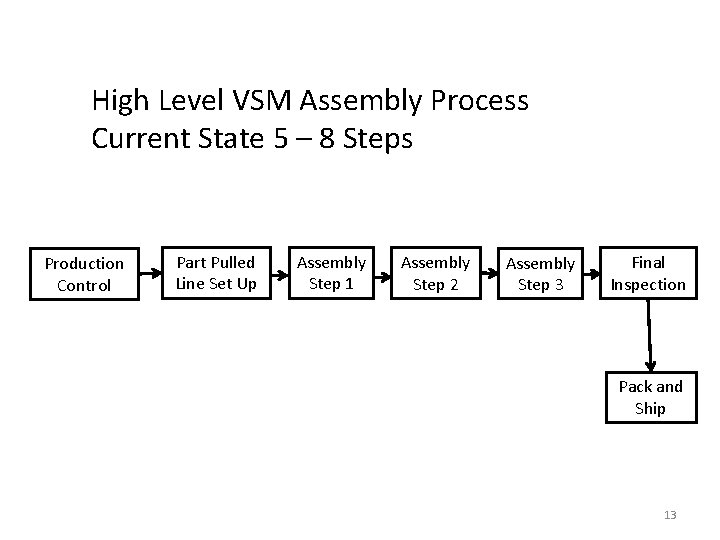
High Level VSM Assembly Process Current State 5 – 8 Steps Production Control Part Pulled Line Set Up Assembly Step 1 Assembly Step 2 Assembly Step 3 Final Inspection Pack and Ship 13
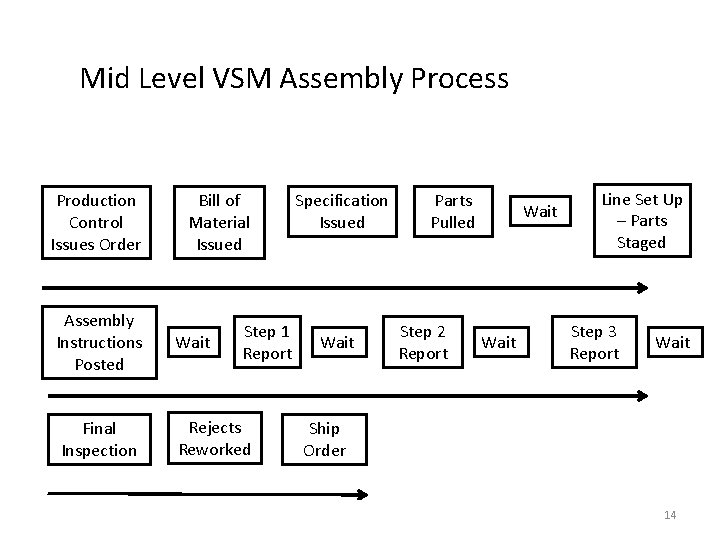
Mid Level VSM Assembly Process Production Control Issues Order Bill of Material Issued Assembly Instructions Posted Wait Final Inspection Rejects Reworked Step 1 Report Specification Issued Wait Parts Pulled Step 2 Report Wait Line Set Up – Parts Staged Step 3 Report Wait Ship Order 14
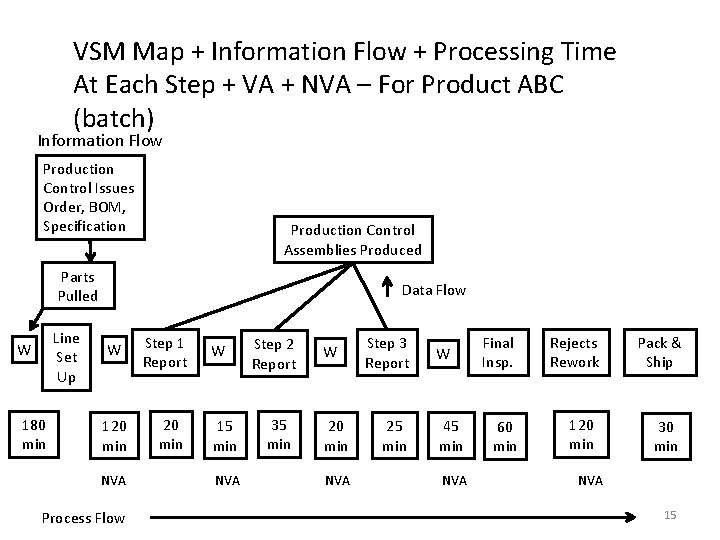
VSM Map + Information Flow + Processing Time At Each Step + VA + NVA – For Product ABC (batch) Information Flow Production Control Issues Order, BOM, Specification Production Control Assemblies Produced Parts Pulled Line Set Up W 180 min Data Flow W 120 min NVA Process Flow Step 1 Report 20 min W 15 min NVA Step 2 Report 35 min W 20 min NVA Step 3 Report 25 min W 45 min NVA Final Insp. 60 min Rejects Rework 120 min Pack & Ship 30 min NVA 15
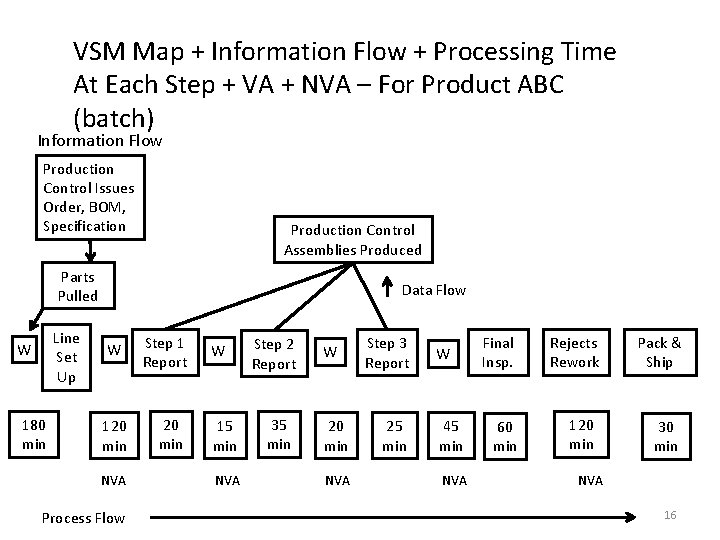
VSM Map + Information Flow + Processing Time At Each Step + VA + NVA – For Product ABC (batch) Information Flow Production Control Issues Order, BOM, Specification Production Control Assemblies Produced Parts Pulled Line Set Up W 180 min Data Flow W 120 min NVA Process Flow Step 1 Report 20 min W 15 min NVA Step 2 Report 35 min W 20 min NVA Step 3 Report 25 min W 45 min NVA Final Insp. 60 min Rejects Rework 120 min Pack & Ship 30 min NVA 16
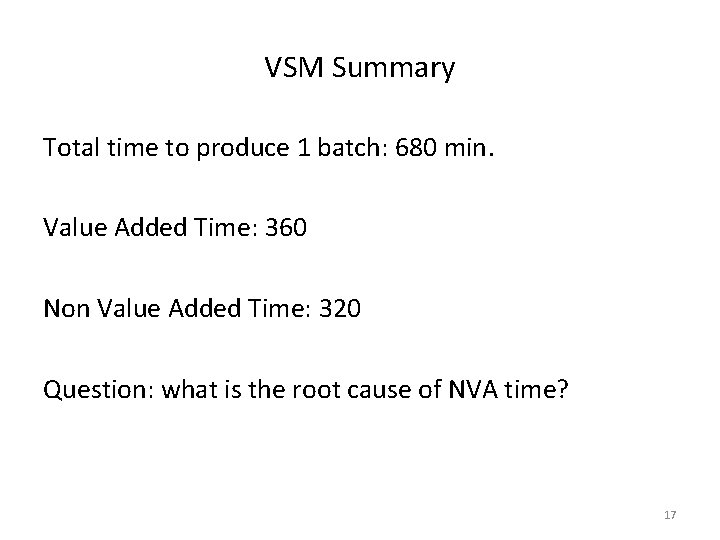
VSM Summary Total time to produce 1 batch: 680 min. Value Added Time: 360 Non Value Added Time: 320 Question: what is the root cause of NVA time? 17
8 D QM 451 The 8 D model – called the 8 Disciplines was developed by the US Government during WII and adopted in the 60’s and 70’s by the Ford Motor Company.
8 D consists of 8 documented steps. A few of the steps and quality tools required…….
8 D The approach establishes a permanent corrective action based on statistical analysis of the problem and focuses on the origin of the problem by determining its root causes. 20
Step 2 A Problem Definition (customer, defect sample, process map) Step 2 B Is/Is Not Matrix Step 4 A Cause and Effect Diagram (Fishbone) Step 4 B 5 Whys Analysis 21
Step 5 Identify Permanent Corrective Action (document and verify – data – trend chart) Step 6 Implementing & Validating the PCA (data collection and data analysis tools) Step 7 Preventing Recurrence (document improvement, changes, audit) 22
Quality Costs QM 270 Quality Costs or cost of poor quality are the costs associated with providing poor quality products or services
“Defects are not free, someone gets paid to make them” Edwards Deming
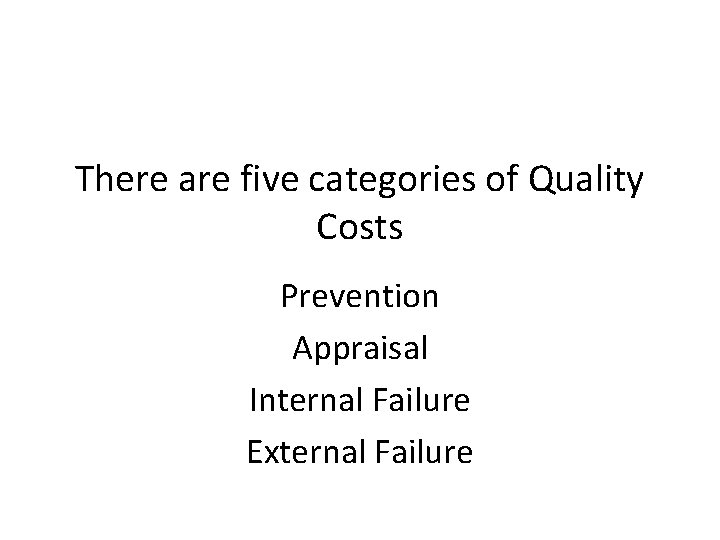
There are five categories of Quality Costs Prevention Appraisal Internal Failure External Failure
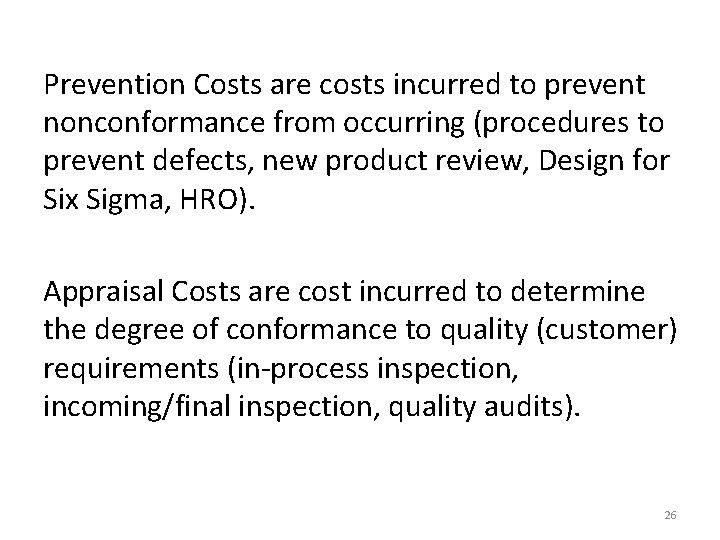
Prevention Costs are costs incurred to prevent nonconformance from occurring (procedures to prevent defects, new product review, Design for Six Sigma, HRO). Appraisal Costs are cost incurred to determine the degree of conformance to quality (customer) requirements (in-process inspection, incoming/final inspection, quality audits). 26
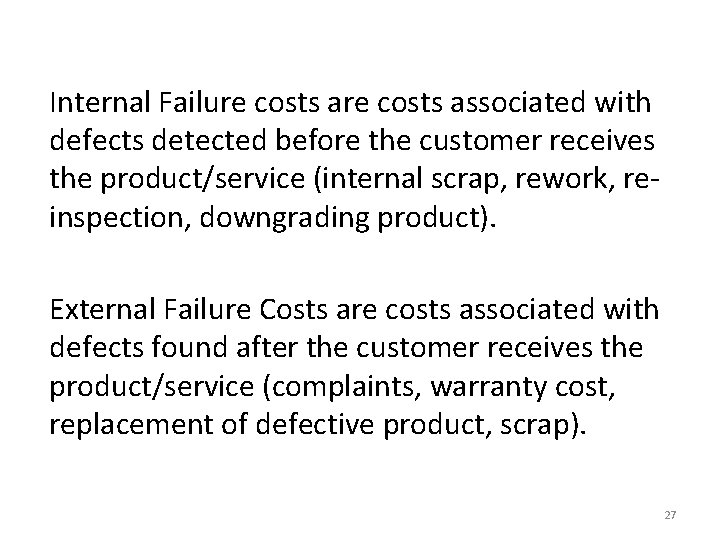
Internal Failure costs associated with defects detected before the customer receives the product/service (internal scrap, rework, reinspection, downgrading product). External Failure Costs are costs associated with defects found after the customer receives the product/service (complaints, warranty cost, replacement of defective product, scrap). 27
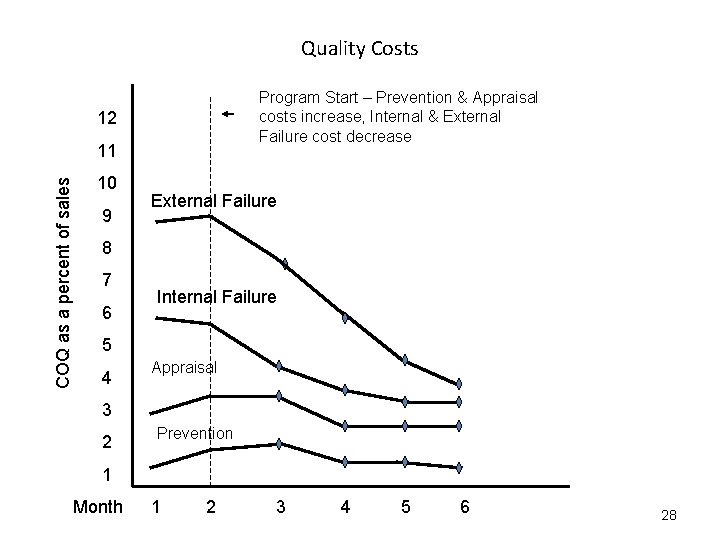
Quality Costs Program Start – Prevention & Appraisal costs increase, Internal & External Failure cost decrease 12 COQ as a percent of sales 11 10 9 External Failure 8 7 6 Internal Failure 5 4 Appraisal 3 2 Prevention 1 Month 1 2 3 4 5 6 28
Quality Costs - Note In a very well run manufacturing firm the proportion of prevention to appraisal to failure costs are often 1: 4: 9. That is one dollar of prevention, four dollars of appraisal and nine dollars of failure costs. In poorly run but still profitable manufacturing firms it can be 1: 6: 30. 29
Root Cause Analysis ES 244 Root Cause Analysis is a structured evaluation method that identifies the root cause of an undesired outcome and the actions to prevent recurrence.
Root Cause Analysis is a method that helps determine: - What happened? - How it happened - Why it happened? 31
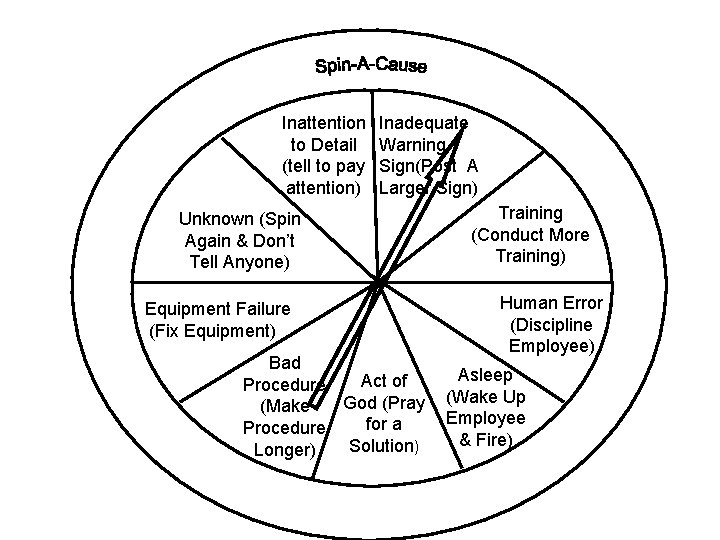
Root Cause is not: - A search for the guilty - Assigning blame - Spin – A - Cause 32
Inattention to Detail (tell to pay attention) Inadequate Warning Sign(Post A Larger Sign) Unknown (Spin Again & Don’t Tell Anyone) Equipment Failure (Fix Equipment) Bad Act of Procedure God (Pray (Make for a Procedure Solution) Longer) Training (Conduct More Training) Human Error (Discipline Employee) Asleep (Wake Up Employee & Fire)
Workshop Content – a few of the tools Problem statement – begin and end with data Process Map – identify where the problem may be occurring and where to collect data Pareto Diagram – focusing root cause effort – most frequently occurring potential cause 34
Fishbone Diagram illustrates the relationship between the problem and potential causes. Man, material, method, machine, measurement, environment are six common potential causes. Select causes that represent your process. 35
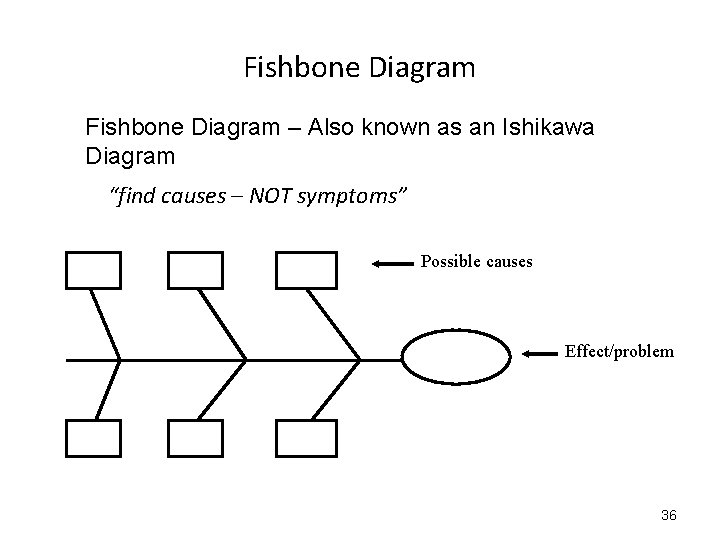
Fishbone Diagram – Also known as an Ishikawa Diagram “find causes – NOT symptoms” Possible causes Effect/problem 36
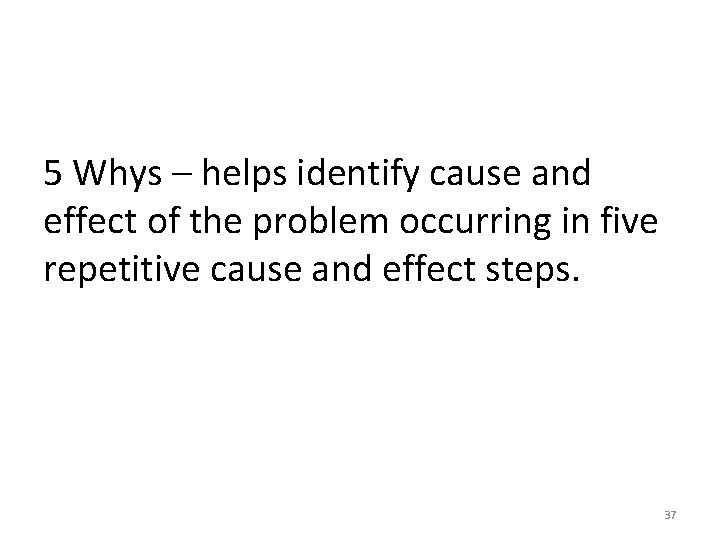
5 Whys – helps identify cause and effect of the problem occurring in five repetitive cause and effect steps. 37
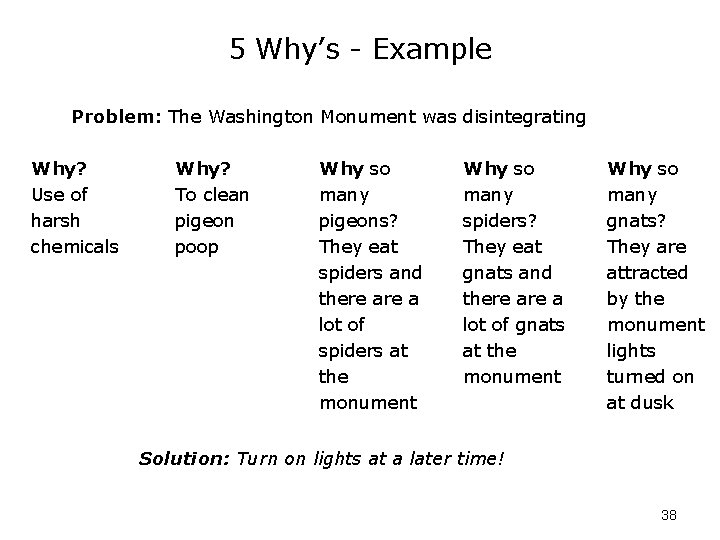
5 Why’s - Example Problem: The Washington Monument was disintegrating Why? Use of harsh chemicals Why? To clean pigeon poop Why so many pigeons? They eat spiders and there a lot of spiders at the monument Why so many spiders? They eat gnats and there a lot of gnats at the monument Why so many gnats? They are attracted by the monument lights turned on at dusk Solution: Turn on lights at a later time! 38
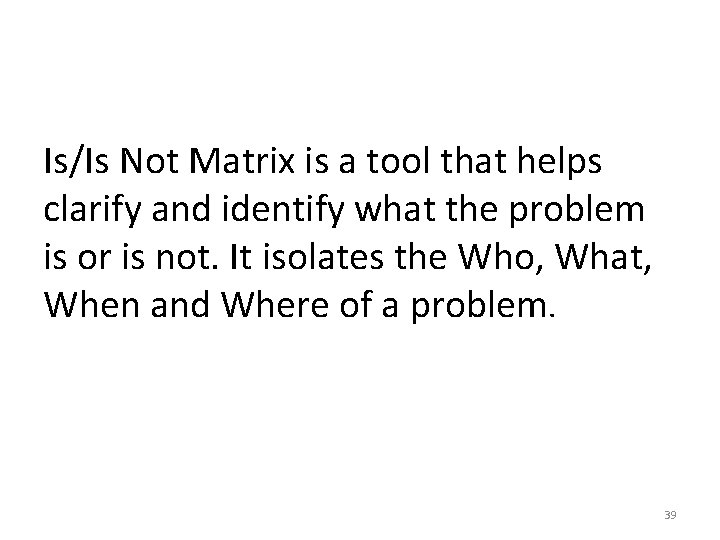
Is/Is Not Matrix is a tool that helps clarify and identify what the problem is or is not. It isolates the Who, What, When and Where of a problem. 39
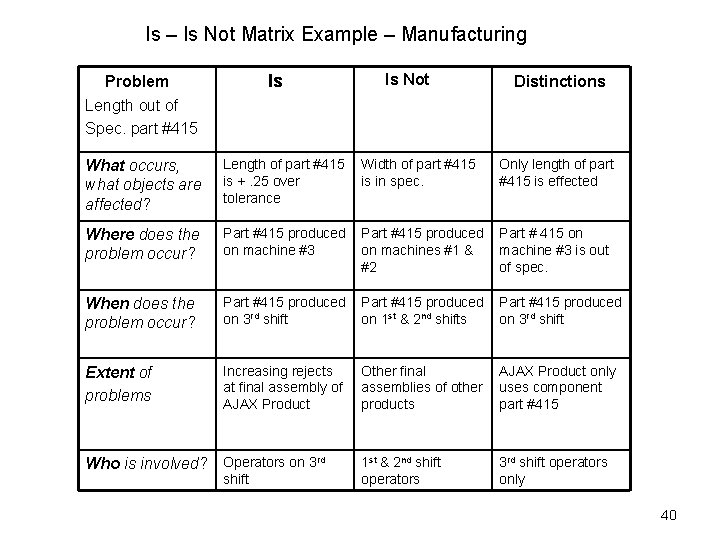
Is – Is Not Matrix Example – Manufacturing Is Problem Length out of Spec. part #415 Is Not Distinctions What occurs, what objects are affected? Length of part #415 is +. 25 over tolerance Width of part #415 is in spec. Only length of part #415 is effected Where does the problem occur? Part #415 produced on machine #3 Part #415 produced on machines #1 & #2 Part # 415 on machine #3 is out of spec. When does the problem occur? Part #415 produced on 3 rd shift Part #415 produced on 1 st & 2 nd shifts Part #415 produced on 3 rd shift Extent of problems Increasing rejects at final assembly of AJAX Product Other final assemblies of other products AJAX Product only uses component part #415 1 st & 2 nd shift operators 3 rd shift operators only Who is involved? Operators on 3 rd shift 40
Scatter Diagram is a graphical tool to determine if there is a relationship between two variables – cause and effect. 41
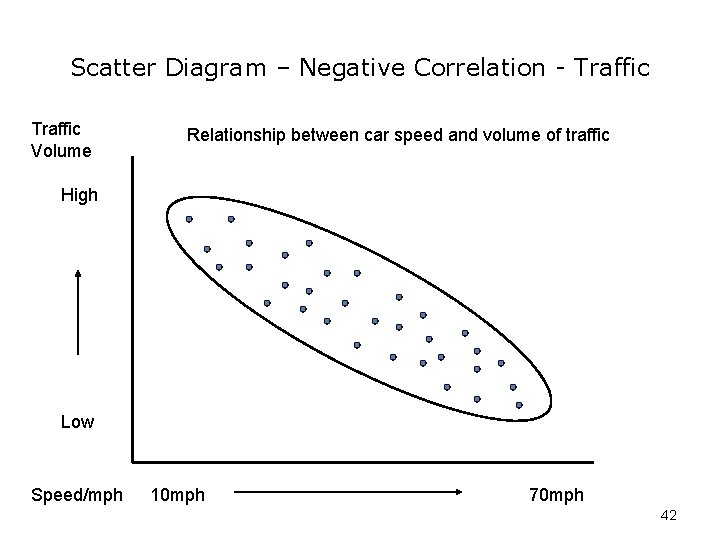
Scatter Diagram – Negative Correlation - Traffic Volume Relationship between car speed and volume of traffic High Low Speed/mph 10 mph 70 mph 42
Two on-site workshop options…. • One day, 8 hour workshop – hands on application. • Five day, 4 hours per day. Four days of hands on application (deep dive) – last four hour day report out to management. 43
For more information on the four workshops and other workshops go to asqphilly. org Roy Kinkaid Quality Consultant rkinka@hotmail. com 917 353 5342