
Overview of NHTSA EV Safety Testing and Research

- Slides: 31
Overview of NHTSA EV Safety Testing and Research May 2012 Claude Harris Director, Office of Vehicle Safety Compliance NHTSA
NHTSA Mission Safety Save lives, prevent injuries and reduce economic costs due to road traffic and non-traffic crashes through education, research, safety standards and enforcement activity. Consumer Programs Increase fuel economy, damage protection, and theft protection, reduce odometer tampering, and provide consumer information. 2
NHTSA Major Accomplishments ²The fatality rate per 100 million vehicle miles traveled (VMT) decreased from 1. 53 in 2000 to 1. 10 in 2010 • Over 10, 000 lives saved • Lowest level ever recorded ²Seat belt use increased from 71% in 2000 to 84% in 2011 • Primary seat belt laws in 32 states, DC, and Puerto Rico • Estimated 12, 546 lives saved by belts in 2010 • Seatbelts still are the most important safety feature on vehicles 3
History of NCAP/Enforcement Testing ²Each year NHTSA conducts both New Car Assessment (NCAP) and Enforcement testing (compliance) • NCAP tests rate crash performance and occupant protection of vehicles and offer comparative consumer information • Compliance tests verify that vehicles meet the applicable Federal Motor Vehicle Safety Standards (FMVSS) ²Both programs test vehicles with new technologies ²In 2011, NHTSA tested 2 EVs equipped with Li-ion batteries for NCAP ratings and to ensure they complied 4
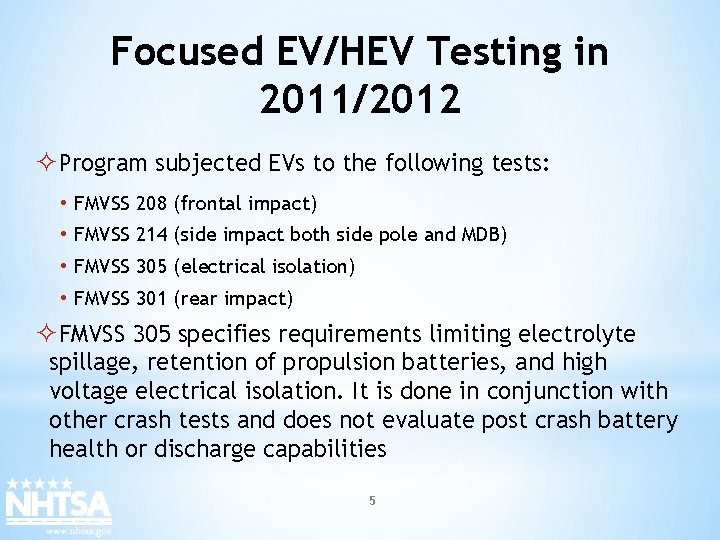
Focused EV/HEV Testing in 2011/2012 ²Program subjected EVs to the following tests: • FMVSS 208 (frontal impact) • FMVSS 214 (side impact both side pole and MDB) • FMVSS 305 (electrical isolation) • FMVSS 301 (rear impact) ²FMVSS 305 specifies requirements limiting electrolyte spillage, retention of propulsion batteries, and high voltage electrical isolation. It is done in conjunction with other crash tests and does not evaluate post crash battery health or discharge capabilities 5
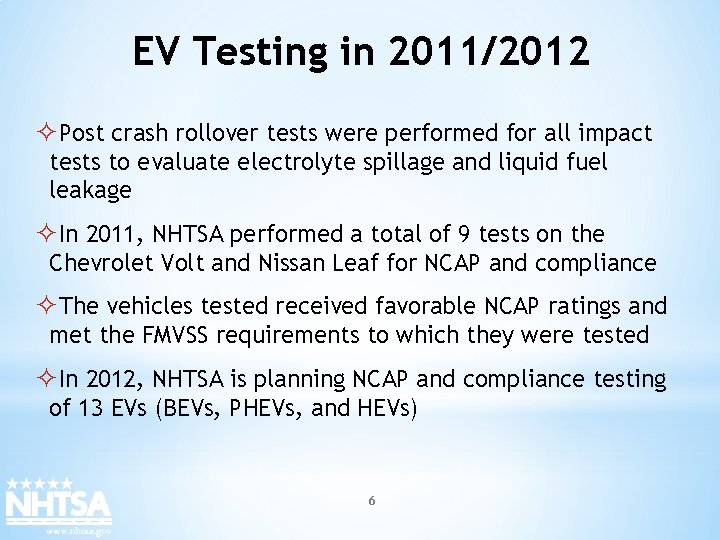
EV Testing in 2011/2012 ²Post crash rollover tests were performed for all impact tests to evaluate electrolyte spillage and liquid fuel leakage ²In 2011, NHTSA performed a total of 9 tests on the Chevrolet Volt and Nissan Leaf for NCAP and compliance ²The vehicles tested received favorable NCAP ratings and met the FMVSS requirements to which they were tested ²In 2012, NHTSA is planning NCAP and compliance testing of 13 EVs (BEVs, PHEVs, and HEVs) 6
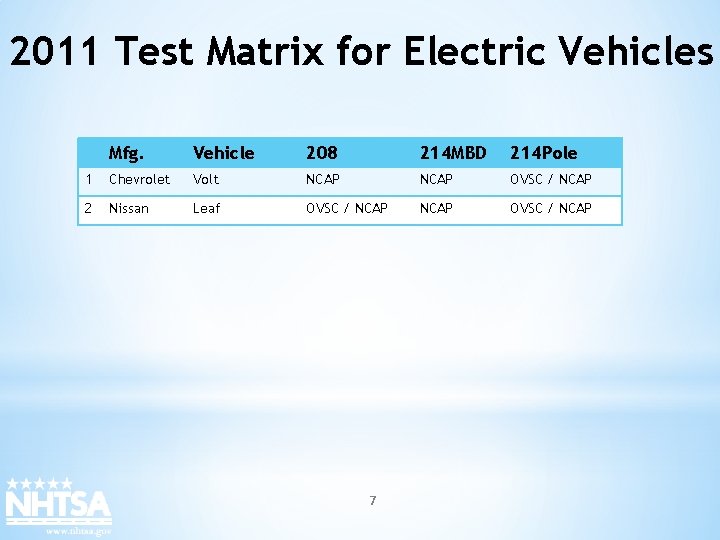
2011 Test Matrix for Electric Vehicles Mfg. Vehicle 208 214 MBD 214 Pole 1 Chevrolet Volt NCAP OVSC / NCAP 2 Nissan Leaf OVSC / NCAP 7
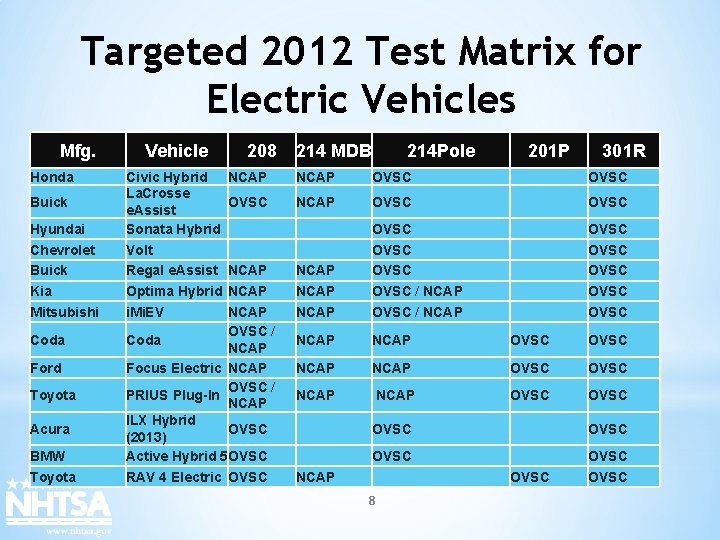
Targeted 2012 Test Matrix for Electric Vehicles Mfg. Honda Buick Hyundai Chevrolet Buick Kia Mitsubishi Coda Ford Toyota Acura BMW Toyota Vehicle 208 Civic Hybrid NCAP La. Crosse OVSC e. Assist Sonata Hybrid Volt Regal e. Assist NCAP Optima Hybrid NCAP i. Mi. EV NCAP OVSC / Coda NCAP Focus Electric NCAP OVSC / PRIUS Plug-In NCAP ILX Hybrid OVSC (2013) Active Hybrid 5 OVSC RAV 4 Electric OVSC 214 MDB 214 Pole 201 P 301 R NCAP OVSC NCAP OVSC / NCAP OVSC / NCAP OVSC OVSC NCAP OVSC NCAP OVSC OVSC Targeted 2012 Test Matrix for Electric Vehicles 8
Chevrolet Volt Incident ²NHTSA conducted NCAP side pole test on 2011 Volt ²Fire occurred 3 weeks after test event ²The fire consumed the vehicle ²Fire originated inside the vehicle and involved battery intrusion, coolant leakage, and electrical short circuits ²Available data did not indicate any similar in-use occurrences ² As a result, the vehicle manufacturer initiated a product improvement campaign to address battery intrusion and coolant leakage 9
Manufacturer Data on EVs ²Vehicle manufacturers provided NHTSA data about post incident protocols ²However, limitations were noted in the data regarding: • Battery discharge protocols • Post crash vehicle handling/storage • Addressing post crash fire protocols • Tools for evaluating post incident battery health 10
Other EV Related Short Term Activities ²Monitoring EV incidents • NHTSA has conducted some Special Crash Investigation on-scene examinations of severe EV crashes • NHTSA has conducted some field inquiries of non-crash EV fires 11
Other EV Related Short Term Activities (cont. ) ²NHTSA Interim Guidance - NHTSA in coordination with the National Fire Protection Association (NFPA) generated interim guidance for: • emergency response/law enforcement groups – recommended responders identify, immobilize, and discharge EVs • vehicle owners/public – provided guidance for dealing with EV crashes, fires, and post-incident events • tow and recovery operations – Provided guidance on EV identification, recovery/transportation, and vehicle storage 12
Other EV Related Short Term Activities (cont. ) ²Considering the need for supplemental procedures for NCAP/Enforcement post-crash vehicle inspections ²Supplemental procedures would evaluate post- crash Li-ion battery health and physical damage to battery ²Data will be collected, evaluated, and used to supplement crash test procedures as warranted 13
Overview of Commercial Vehicle Non -crash Field Inquiries ²Summary of field inquiries • Feb 2012 - Zero Truck fire • Mar 2012 - New. Flyer/BAE Bus fire 14
Overview of Light Vehicle Non-crash Field Inquiries ²April 2011 – Conducted field inquiry of incident in Conn. and determined EV was not the origin of fire ²November 2011 – Conducted field inquiry of incident in NC and determined the EV was not the origin of fire ²May 2012 – Conducting ongoing field inquiry of incident in TX. No determination has been made. 15
EV Safety Coordination with Other Government/Stakeholders ²Department of Defense/Department of Energy (DOD/DOE) Activities • Worked with DOD/DOE to devise program for testing Liion battery packs and follow-up safety research ²NFPA • Worked with NFPA to ensure that 1 st/2 nd responders identify Li-ion powered vehicles, know the safety risks, and know appropriate post-crash handling procedures ²SAE • Work with SAE and OEMs on a wide range of Li-ion battery safety topics 16
EV Safety Coordination with Foreign Government Entities ²EV Global Technical Regulations (GTR) ²Address occupant protection from high voltage electric shock and potential hazards associated with Li-ion batteries during and after a crash event ²Set provisions and test protocols to ensure the electrical components perform in a safe manner and are electrically managed while recharging at a residence or charging location 17
EV Safety Coordination with Foreign Government Entities ²The GTR will address the unique safety risks posed by EVs and their components, and will be performance-based so as not to restrict future technologies and help prioritize research and potential rulemaking ²In March 2012 a GTR working group on electric vehicle safety was formed with the United States (NHTSA) as chair. 18
Li-ion Based Rechargeable Energy Storage System Technology Description and Safety Research Programs Phillip Gorney Safety Research Engineer NHTSA
Modern EV technology The modern EV propulsion system is a culmination of advancements in many technologies used by the vehicle. ²Rechargeable Energy Storage Systems (RESS) • Li-ion battery (Li. B) based (present technology) ² Electronic communications including those with the electrical grid via charging systems both conductive (plugin) and inductive (non-contact) ² Electronic controls • Battery Management System • Vehicle to propulsion system • Power Electronics • Motor control • Regenerative Braking 20
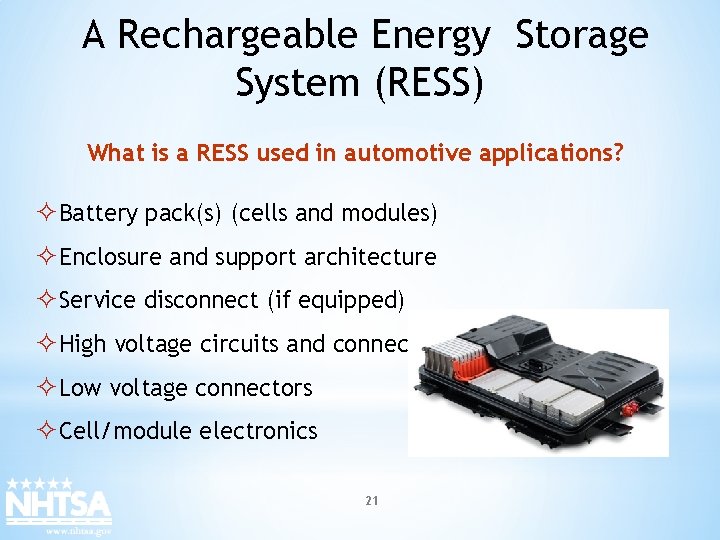
A Rechargeable Energy Storage System (RESS) What is a RESS used in automotive applications? ²Battery pack(s) (cells and modules) ²Enclosure and support architecture ²Service disconnect (if equipped) ²High voltage circuits and connections ²Low voltage connectors ²Cell/module electronics 21
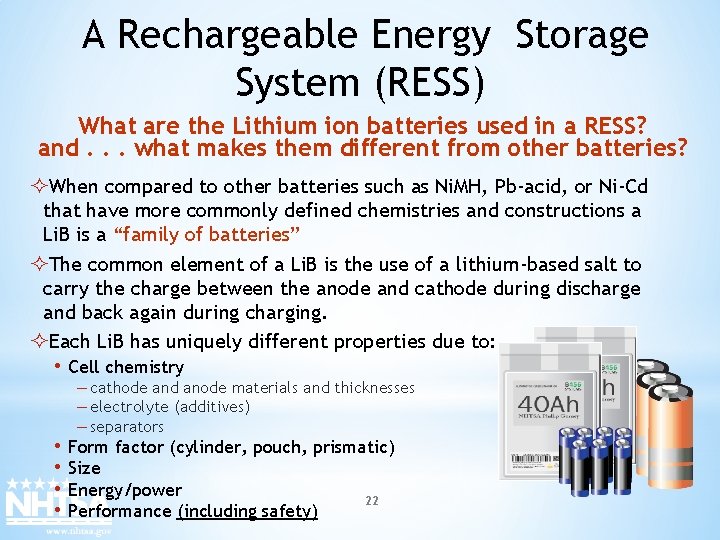
A Rechargeable Energy Storage System (RESS) What are the Lithium ion batteries used in a RESS? and. . . what makes them different from other batteries? ²When compared to other batteries such as Ni. MH, Pb-acid, or Ni-Cd that have more commonly defined chemistries and constructions a Li. B is a “family of batteries” ²The common element of a Li. B is the use of a lithium-based salt to carry the charge between the anode and cathode during discharge and back again during charging. ²Each Li. B has uniquely different properties due to: • Cell chemistry • • — cathode and anode materials and thicknesses — electrolyte (additives) — separators Form factor (cylinder, pouch, prismatic) Size Energy/power 22 Performance (including safety)
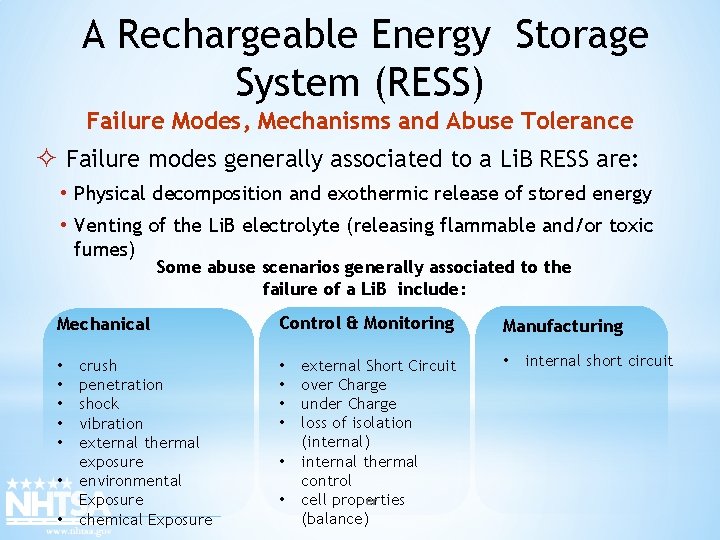
A Rechargeable Energy Storage System (RESS) Failure Modes, Mechanisms and Abuse Tolerance ² Failure modes generally associated to a Li. B RESS are: • Physical decomposition and exothermic release of stored energy • Venting of the Li. B electrolyte (releasing flammable and/or toxic fumes) Some abuse scenarios generally associated to the failure of a Li. B include: Mechanical • • crush penetration shock vibration external thermal exposure environmental Exposure chemical Exposure Control & Monitoring • • • external Short Circuit over Charge under Charge loss of isolation (internal) internal thermal control er cell properties (balance) Manufacturing • internal short circuit
NHTSA Vehicle Safety Research Physics dictates that all energy storage sources have an inherent risk associated with their use, storage, and handling. This concept applies equally to all petroleum-based fuels, hydraulic storage systems, mechanical or kinetic systems, or electric storage batteries. Research Question … How do we identify and quantify risks that are associated with Li. B powered EV technology? 24
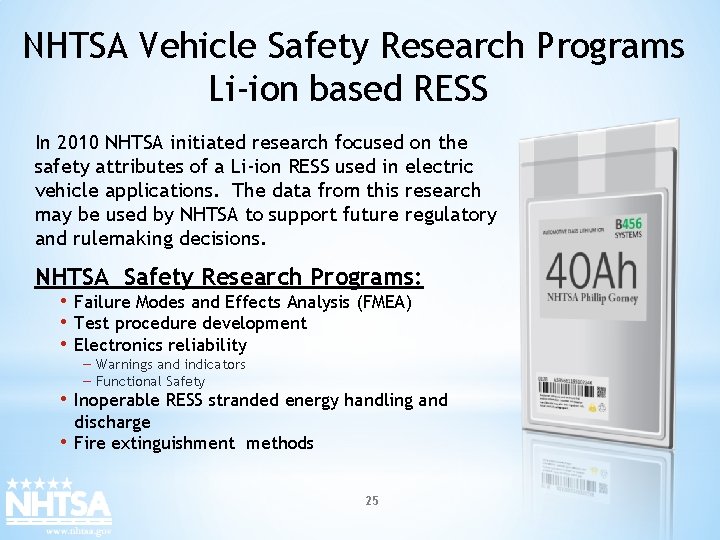
NHTSA Vehicle Safety Research Programs Li-ion based RESS In 2010 NHTSA initiated research focused on the safety attributes of a Li-ion RESS used in electric vehicle applications. The data from this research may be used by NHTSA to support future regulatory and rulemaking decisions. NHTSA Safety Research Programs: • Failure Modes and Effects Analysis (FMEA) • Test procedure development • Electronics reliability — Warnings and indicators — Functional Safety • Inoperable RESS stranded energy handling and discharge • Fire extinguishment methods 25
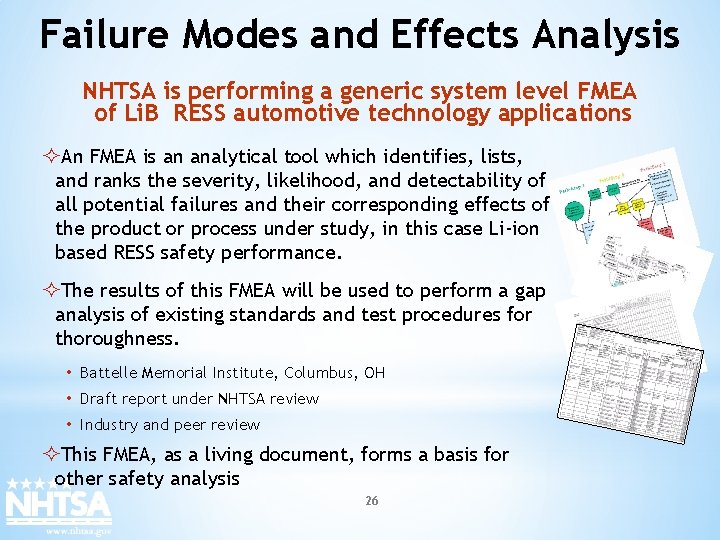
Failure Modes and Effects Analysis NHTSA is performing a generic system level FMEA of Li. B RESS automotive technology applications ²An FMEA is an analytical tool which identifies, lists, and ranks the severity, likelihood, and detectability of all potential failures and their corresponding effects of the product or process under study, in this case Li-ion based RESS safety performance. ²The results of this FMEA will be used to perform a gap analysis of existing standards and test procedures for thoroughness. • Battelle Memorial Institute, Columbus, OH • Draft report under NHTSA review • Industry and peer review ²This FMEA, as a living document, forms a basis for other safety analysis 26
Test Procedure Development The research objective is to develop and document repeatable vehicle-level safety performance test procedures with accurate definition of boundary and test limit conditions to measure the effects of the failure modes created during all operating conditions. Within this process, data generated by these procedures will be used by NHTSA for safety analysis. ²Critical potential failure modes (system, component) ²All areas of operation Including: charging, normal operation, crash, and post-crash ²Building upon the body of existing standards (SAE J 2464, SAE J 2929, ECE R 100, Etc. ) ² 2 contract awards: 24 month performance: October 2011 – October 2013 27
Electronic Reliability ²NHTSA has formed an Electronic Systems Safety Research Group which includes the scope of electrified propulsion in their reliability analysis. • Project 1 – Diagnostics, Warnings and Operator Messages — Scope: Research operator warning indicators for RESS safety critical criteria. Research potential prognostic conditions and warnings for anticipated safety critical events. — Research basic fail-safe conditions, diagnostic codes and indicators, data recording/storage, and safety prognostic requirements — Utilize outputs from FMEA and Discharge projects — Timing (20 months) • Project 2 – Functional Safety Analysis — Scope: Utilize functional safety criteria and analytical techniques to establish minimal performance criteria. — Use a Li-ion RESS technology as an 28 initial case study and method development foundation
Inoperable RESS Stranded Energy Handling and Discharge Standardized Battery Assessment, and Field Discharge Procedure Energy may become stranded in a RESS that has become inoperable. This energy must be removed from the RESS to a safe condition as dictated by the circumstances. The Scope of this project is to identify, develop, and demonstrate methods for the safe management and handling of RESS in post-crash and non-operational environments. These procedures should apply to both damaged and fully functional RESS systems. Non-operational environments may include: service repair, end of life disassembly, post-crash, post-fire, vehicle crash scene, vehicle tow, and vehicle storage. ²Areas of Focus: • Definition of common interface connector and location to support • Diagnostic interface • Diagnostic protocol • Standardized discharge port/terminal • Architectural requirements ²Project timing (2 years) 29
Fire Extinguishment Methods Standardized Battery Assessment, and Field Discharge Procedure NHTSA has partnered with DOE through the Idaho National Laboratory to conduct a research project with the NFPA and the automobile industry. ²The scope of this research is to establish common procedures in safety focused firefighting techniques. • Establish “when and how” a RESS fire should be extinguished in a vehicle environment. ²Project timing (2 years) 30
THANK YOU! 31