
Overview of Neutron Detection for Nuclear Threat Reduction
- Slides: 14
Overview of Neutron Detection for Nuclear Threat Reduction Steve Holloway Technical Authority, Detection Science Nuclear Threat Reduction AWE Aldermaston UK Ministry of Defence © Crown Owned Copyright 2019/AWE Doc Control Number OFFICIAL
Contents § § Introduction § Why Neutrons § Nuclear Security Applications § Requirements Historical Focus Areas § 3 He Replacements § Passive/Active Demonstrators § Underpinning research Future of Neutron Detection § Doing more with what we have § Beyond Radiation Detection § Testing, Evidence and IP Summary UK Ministry of Defence © Crown Owned Copyright 2019/AWE OFFICIAL
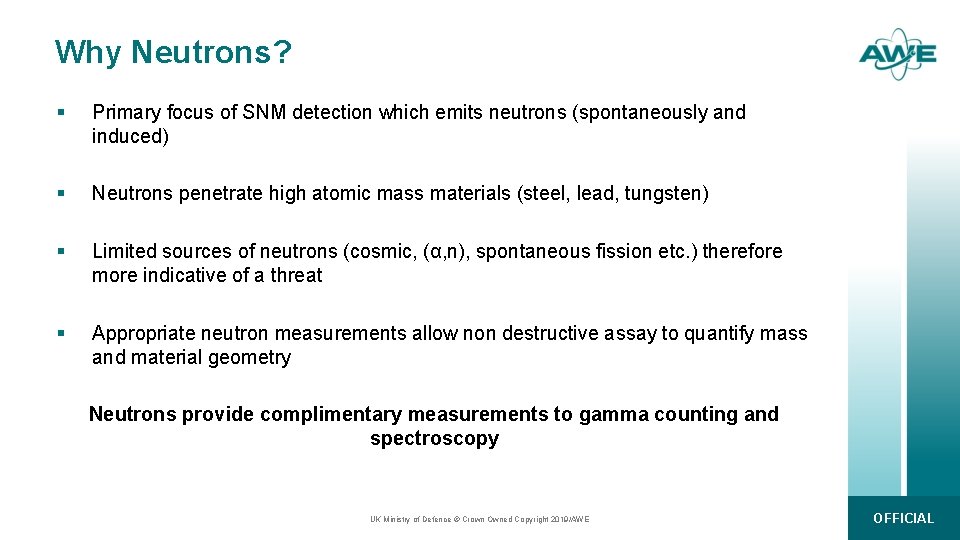
Why Neutrons? § Primary focus of SNM detection which emits neutrons (spontaneously and induced) § Neutrons penetrate high atomic mass materials (steel, lead, tungsten) § Limited sources of neutrons (cosmic, (α, n), spontaneous fission etc. ) therefore more indicative of a threat § Appropriate neutron measurements allow non destructive assay to quantify mass and material geometry Neutrons provide complimentary measurements to gamma counting and spectroscopy UK Ministry of Defence © Crown Owned Copyright 2019/AWE OFFICIAL
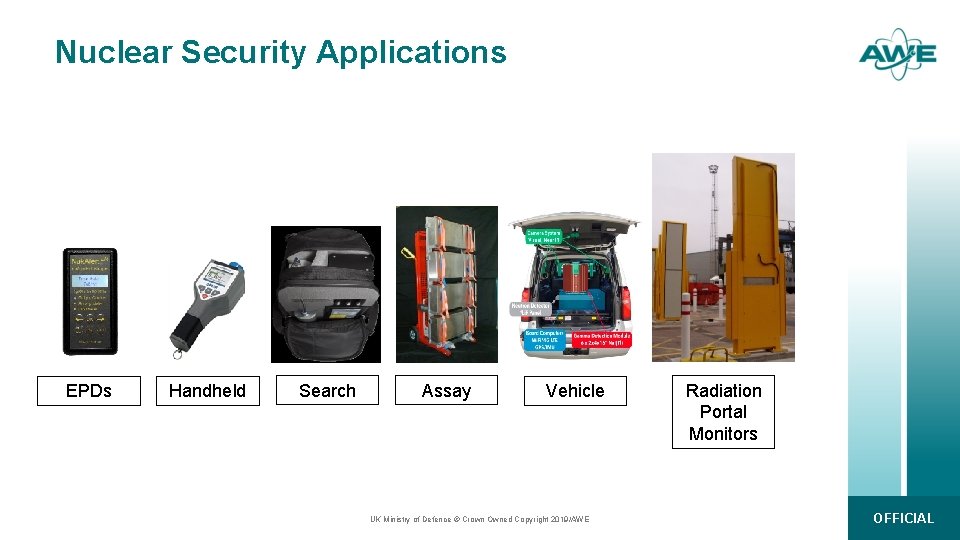
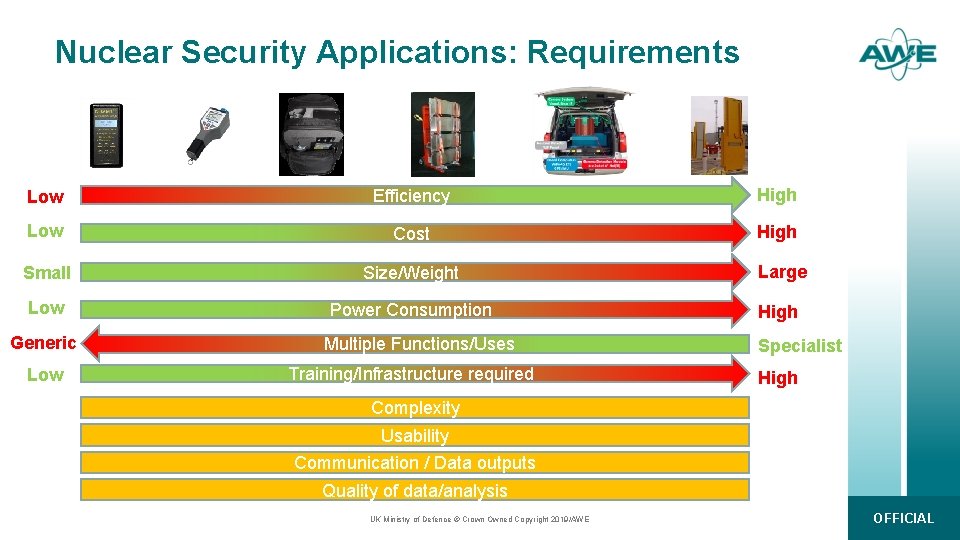
Nuclear Security Applications Backpack? EPDs Handheld Search Assay Vehicle UK Ministry of Defence © Crown Owned Copyright 2019/AWE Radiation Portal Monitors OFFICIAL
Nuclear Security Applications: Requirements Low Efficiency High Low Cost High Small Size/Weight Large Low Power Consumption High Generic Low Multiple Functions/Uses Training/Infrastructure required Specialist High Complexity Usability Communication / Data outputs Quality of data/analysis UK Ministry of Defence © Crown Owned Copyright 2019/AWE OFFICIAL
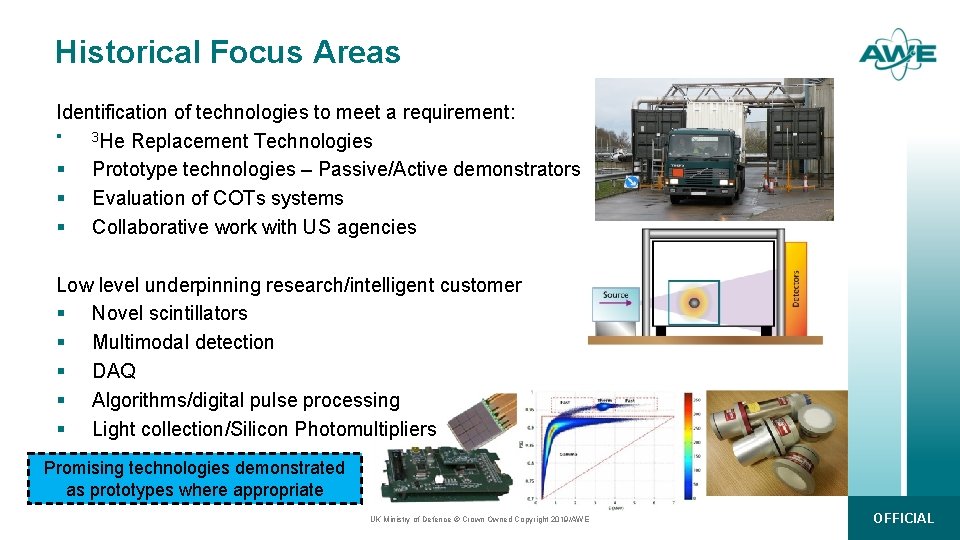
Historical Focus Areas Identification of technologies to meet a requirement: § 3 He Replacement Technologies § Prototype technologies – Passive/Active demonstrators § Evaluation of COTs systems § Collaborative work with US agencies Low level underpinning research/intelligent customer § Novel scintillators § Multimodal detection § DAQ § Algorithms/digital pulse processing § Light collection/Silicon Photomultipliers Promising technologies demonstrated as prototypes where appropriate UK Ministry of Defence © Crown Owned Copyright 2019/AWE OFFICIAL
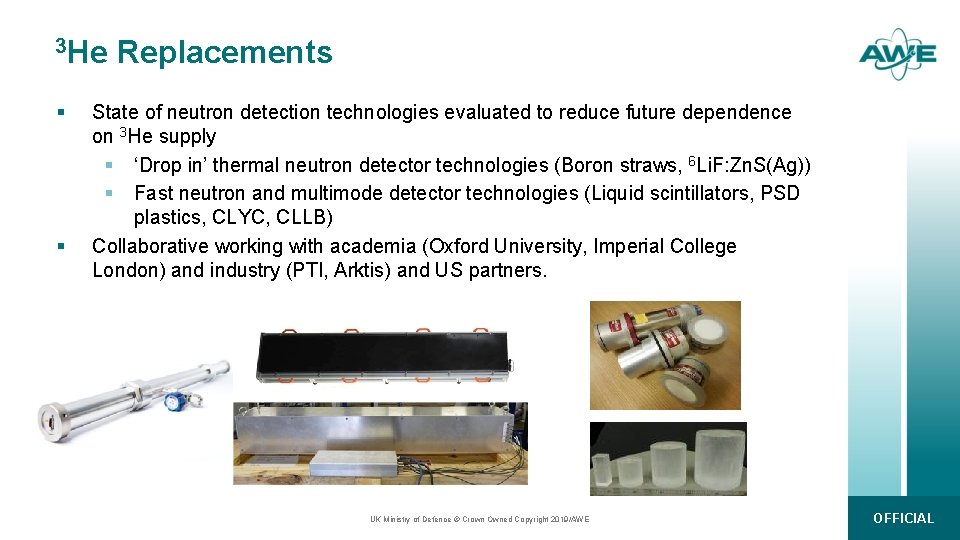
3 He § § Replacements State of neutron detection technologies evaluated to reduce future dependence on 3 He supply § ‘Drop in’ thermal neutron detector technologies (Boron straws, 6 Li. F: Zn. S(Ag)) § Fast neutron and multimode detector technologies (Liquid scintillators, PSD plastics, CLYC, CLLB) Collaborative working with academia (Oxford University, Imperial College London) and industry (PTI, Arktis) and US partners. UK Ministry of Defence © Crown Owned Copyright 2019/AWE OFFICIAL
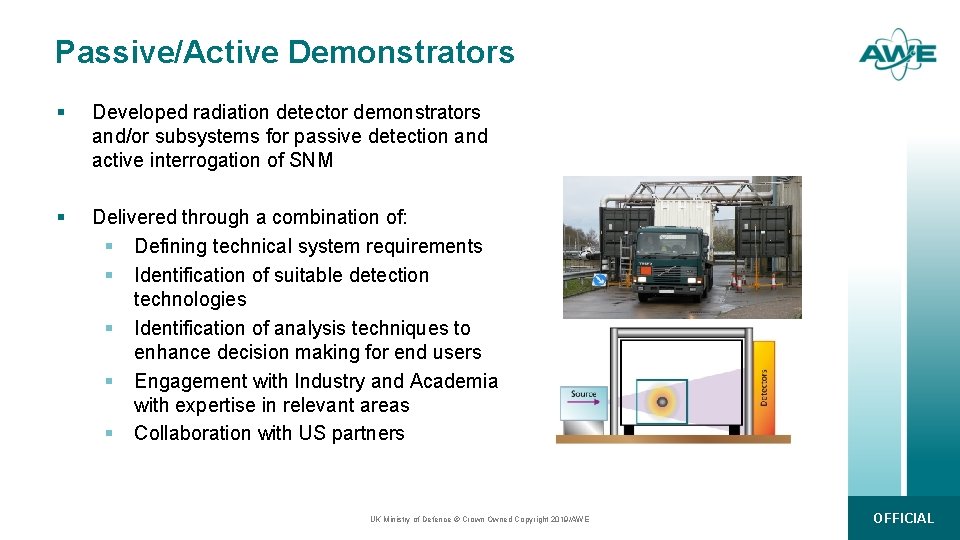
Passive/Active Demonstrators § Developed radiation detector demonstrators and/or subsystems for passive detection and active interrogation of SNM § Delivered through a combination of: § Defining technical system requirements § Identification of suitable detection technologies § Identification of analysis techniques to enhance decision making for end users § Engagement with Industry and Academia with expertise in relevant areas § Collaboration with US partners UK Ministry of Defence © Crown Owned Copyright 2019/AWE OFFICIAL
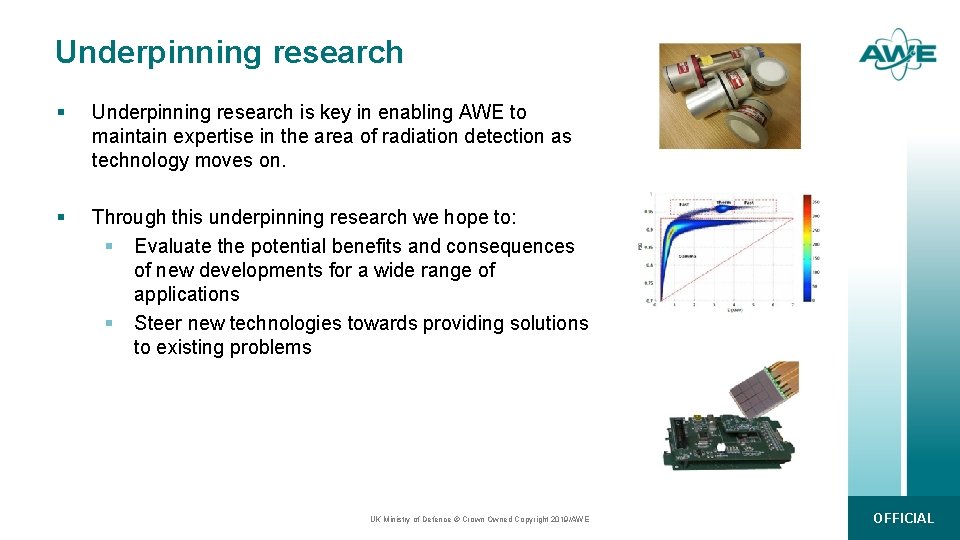
Underpinning research § Underpinning research is key in enabling AWE to maintain expertise in the area of radiation detection as technology moves on. § Through this underpinning research we hope to: § Evaluate the potential benefits and consequences of new developments for a wide range of applications § Steer new technologies towards providing solutions to existing problems UK Ministry of Defence © Crown Owned Copyright 2019/AWE OFFICIAL
Future of Neutron Detection How do we ensure that we stimulate and fully exploit developments in neutron detector technologies and techniques to benefit the user community and enhance nuclear security? § Doing more with what we have § Challenges beyond the detector § Testing, evidence and IP UK Ministry of Defence © Crown Owned Copyright 2019/AWE OFFICIAL
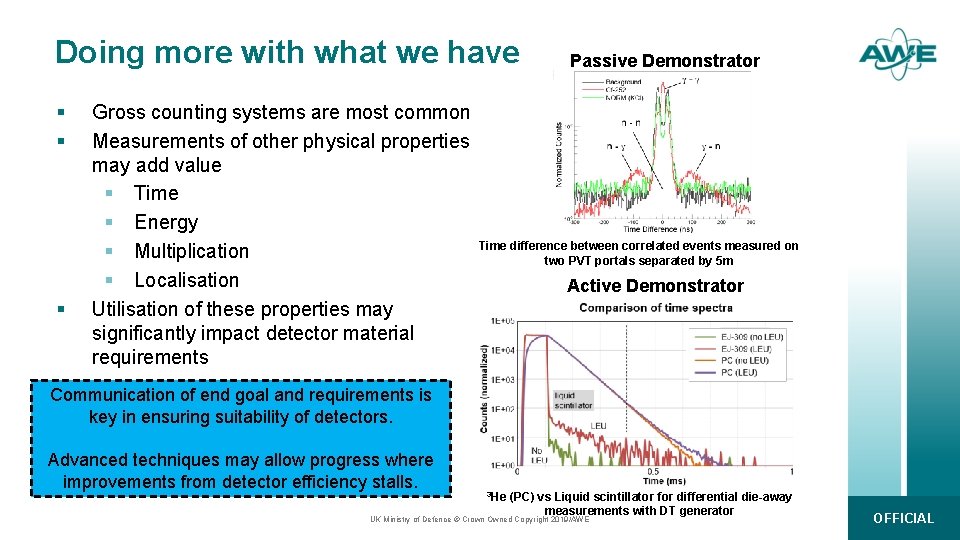
Doing more with what we have § § § Gross counting systems are most common Measurements of other physical properties may add value § Time § Energy § Multiplication § Localisation Utilisation of these properties may significantly impact detector material requirements Passive Demonstrator Time difference between correlated events measured on two PVT portals separated by 5 m Active Demonstrator Communication of end goal and requirements is key in ensuring suitability of detectors. Advanced techniques may allow progress where improvements from detector efficiency stalls. 3 He (PC) vs Liquid scintillator for differential die-away measurements with DT generator UK Ministry of Defence © Crown Owned Copyright 2019/AWE OFFICIAL
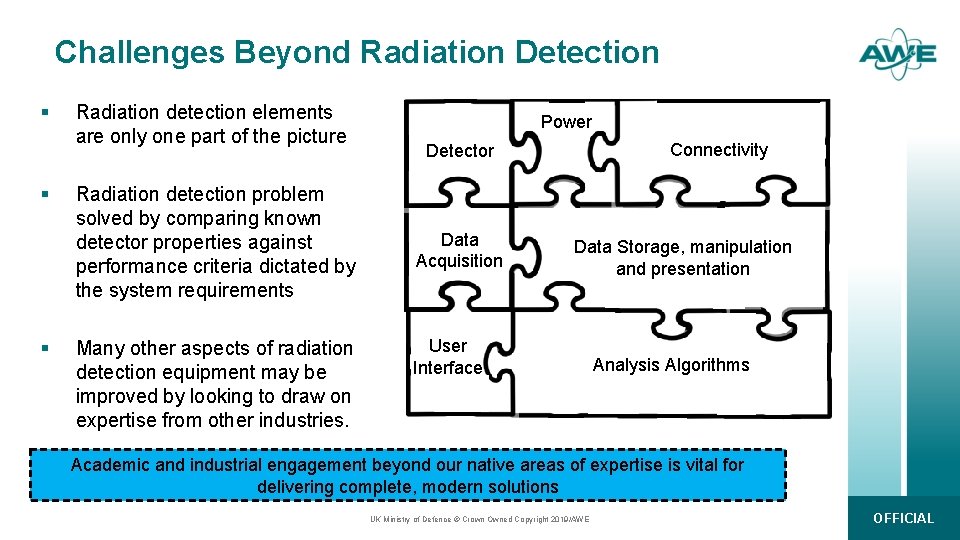
Challenges Beyond Radiation Detection § § § Radiation detection elements are only one part of the picture Radiation detection problem solved by comparing known detector properties against performance criteria dictated by the system requirements Many other aspects of radiation detection equipment may be improved by looking to draw on expertise from other industries. Power Connectivity Detector Data Acquisition Data Storage, manipulation and presentation User Interface Analysis Algorithms Academic and industrial engagement beyond our native areas of expertise is vital for delivering complete, modern solutions UK Ministry of Defence © Crown Owned Copyright 2019/AWE OFFICIAL
Testing, evidence and IP § ‘Black box’ test regimes usually required to address IP matters § NTR presents an increased challenge in this respect compared to product realisation in traditional Safeguards (IAEA / EURATOM inspection regimes) § Effort weighted on design of test plan; detailed, comprehensive (but could be unknowingly deficient) § Associated cost and material burden § Risk that aspects of performance remain undisclosed § These activities are costly (time and money) and limit out ability to understand whether a technology/technique/system satisfies our customers’ requirements Engagement and provision of high quality, evidence based performance assessments are key UK Ministry of Defence © Crown Owned Copyright 2019/AWE OFFICIAL
Summary § Neutron detection is important nuclear security applications § Nuclear security applications cover a wide problem space § AWE’s role is to: § Maintain expertise in emerging technologies § Understand identify where technologies show promise § Enable the development of solutions to current and future applications § Technically assess technologies/systems against radiation detection requirements § This can be achieved by strong engagement with academia and industry UK Ministry of Defence © Crown Owned Copyright 2019/AWE OFFICIAL