
Overview of MIMO systems S72 333 Postgraduate Course
- Slides: 28
Overview of MIMO systems S-72. 333 Postgraduate Course in Radio Communications Sylvain Ranvier Sylvain. ranvier@hut. fi SMARAD / Radio Laboratory
Outline 1 Presentation 1. 1 What is MIMO 1. 2 Wireless channels limitations 1. 3 MIMO Benefits 2 SISO Vs MIMO 3 Spatial multiplexing 3. 1 Principle 3. 2 Impact of channel model 3. 3 V-BLAST / D-BLAST 4 Receiver design 4. 1 Linear receivers for BLAST (Zero-Forcing, MMSE) 4. 2 Non linear receiver (ML, SIC) 4. 3 performance comparison 5 Space-Time Coding (Transmit / Receive Diversity) 6 Conclusion SMARAD / Radio Laboratory
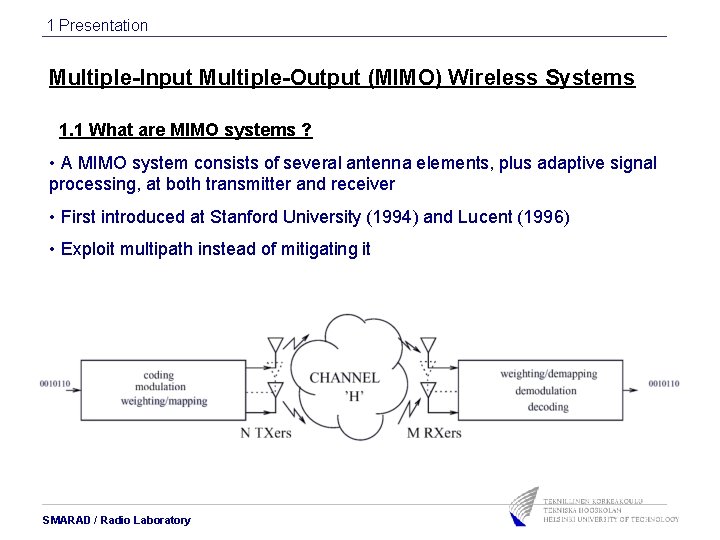
1 Presentation Multiple-Input Multiple-Output (MIMO) Wireless Systems 1. 1 What are MIMO systems ? • A MIMO system consists of several antenna elements, plus adaptive signal processing, at both transmitter and receiver • First introduced at Stanford University (1994) and Lucent (1996) • Exploit multipath instead of mitigating it SMARAD / Radio Laboratory
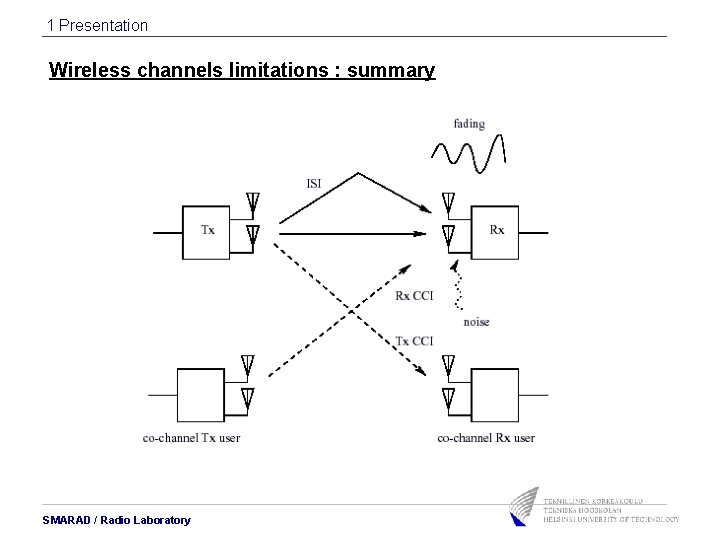
1 Presentation 1. 2 Wireless channels limitations Wireless transmission introduces: Fading: multiple paths with different phases add up at the receiver, giving a random (Rayleigh/Ricean) amplitude signal. ISI: multiple paths come with various delays, causing intersymbol interference. CCI: Co-channel users create interference to the target user Noise: electronics suffer from thermal noise, limiting the SNR. SMARAD / Radio Laboratory
1 Presentation Wireless channels limitations : summary SMARAD / Radio Laboratory
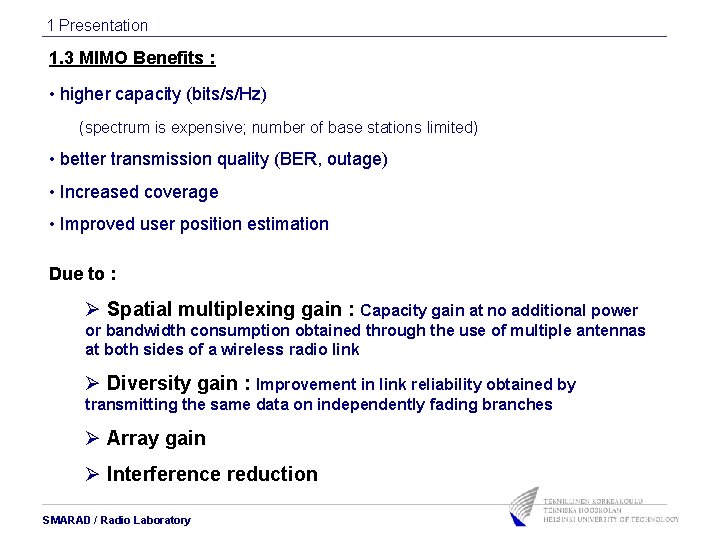
1 Presentation 1. 3 MIMO Benefits : • higher capacity (bits/s/Hz) (spectrum is expensive; number of base stations limited) • better transmission quality (BER, outage) • Increased coverage • Improved user position estimation Due to : Ø Spatial multiplexing gain : Capacity gain at no additional power or bandwidth consumption obtained through the use of multiple antennas at both sides of a wireless radio link Ø Diversity gain : Improvement in link reliability obtained by transmitting the same data on independently fading branches Ø Array gain Ø Interference reduction SMARAD / Radio Laboratory
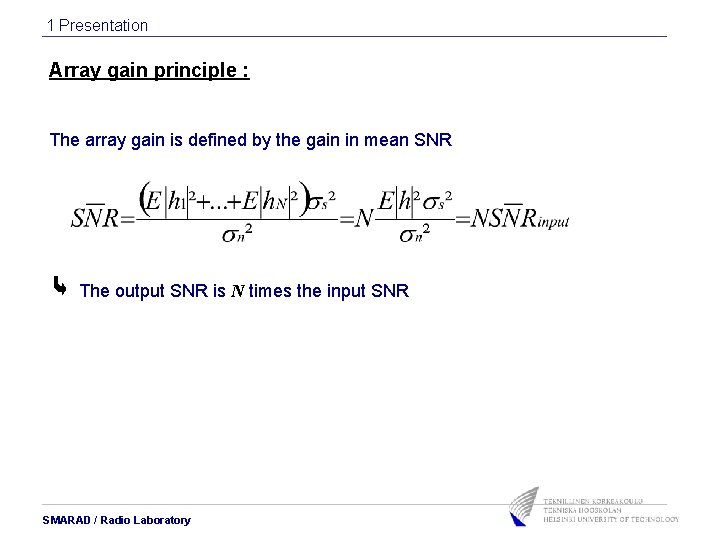
1 Presentation Array gain principle : The array gain is defined by the gain in mean SNR The output SNR is N times the input SNR SMARAD / Radio Laboratory
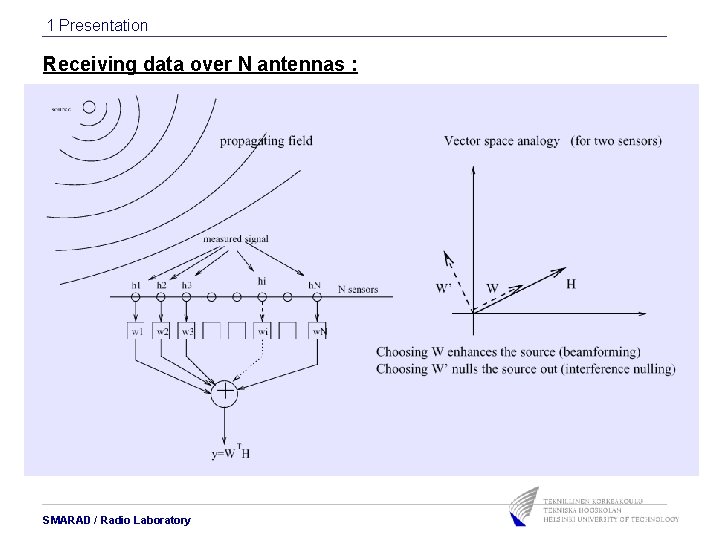
1 Presentation Receiving data over N antennas : SMARAD / Radio Laboratory
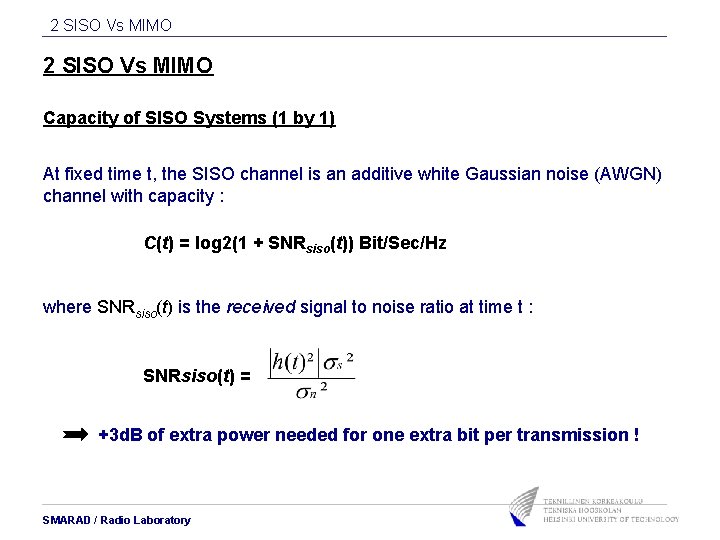
2 SISO Vs MIMO Capacity of SISO Systems (1 by 1) At fixed time t, the SISO channel is an additive white Gaussian noise (AWGN) channel with capacity : C(t) = log 2(1 + SNRsiso(t)) Bit/Sec/Hz where SNRsiso(t) is the received signal to noise ratio at time t : SNRsiso(t) = +3 d. B of extra power needed for one extra bit per transmission ! SMARAD / Radio Laboratory
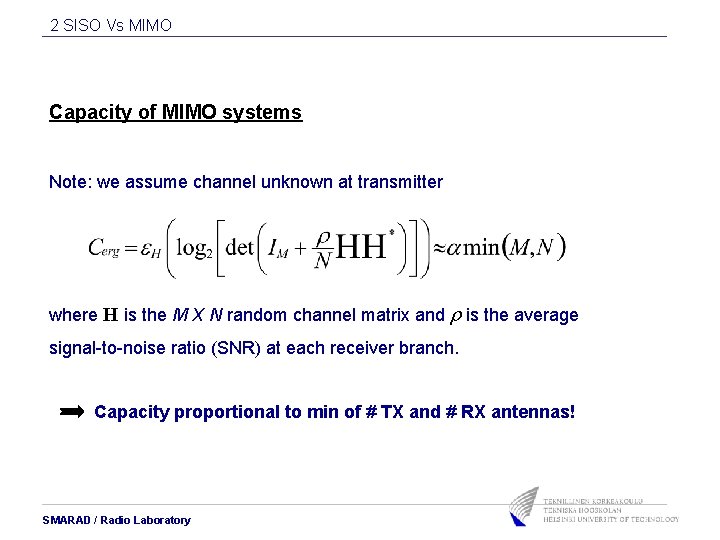
2 SISO Vs MIMO Capacity of MIMO systems Note: we assume channel unknown at transmitter where H is the M X N random channel matrix and r is the average signal-to-noise ratio (SNR) at each receiver branch. Capacity proportional to min of # TX and # RX antennas! SMARAD / Radio Laboratory
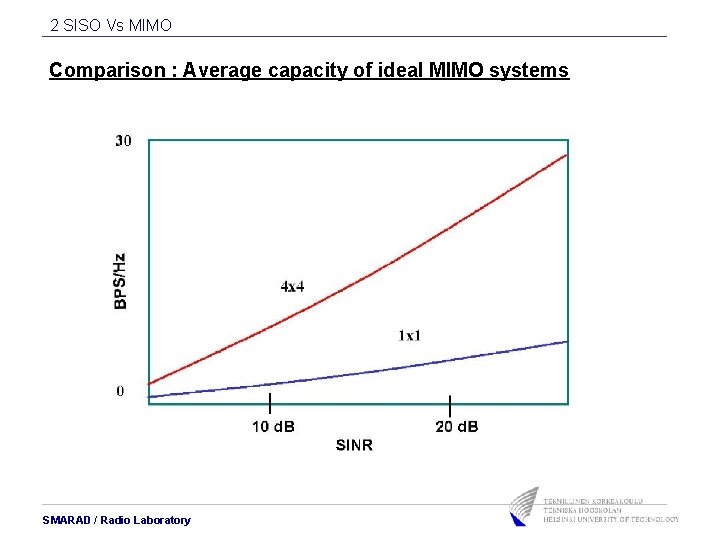
2 SISO Vs MIMO Comparison : Average capacity of ideal MIMO systems SMARAD / Radio Laboratory
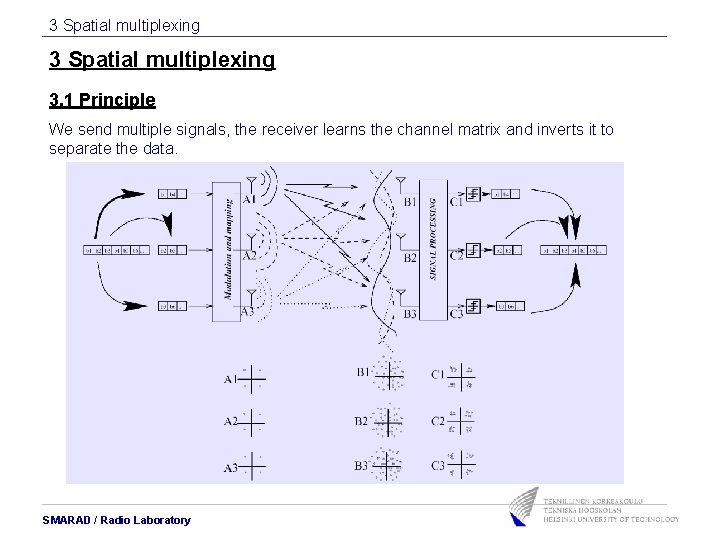
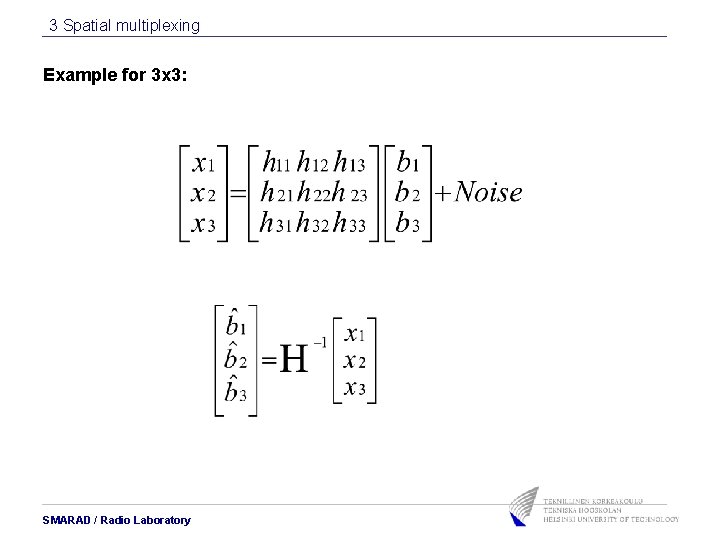
3 Spatial multiplexing 3. 1 Principle We send multiple signals, the receiver learns the channel matrix and inverts it to separate the data. SMARAD / Radio Laboratory
3 Spatial multiplexing Example for 3 x 3: SMARAD / Radio Laboratory
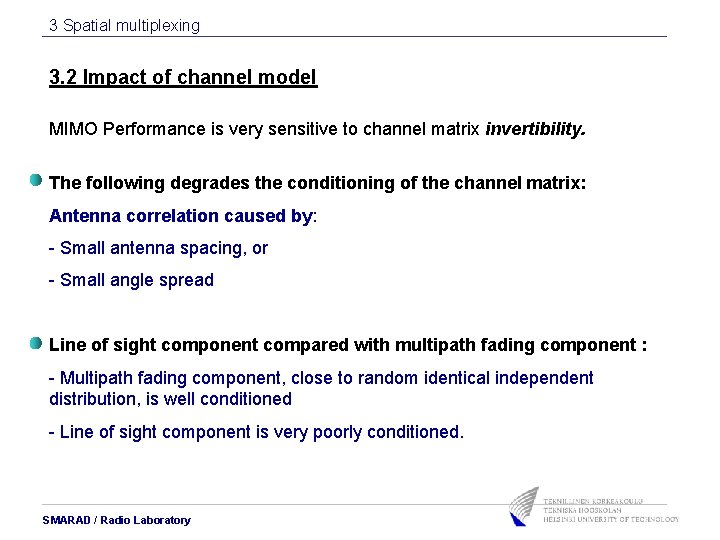
3 Spatial multiplexing 3. 2 Impact of channel model MIMO Performance is very sensitive to channel matrix invertibility. The following degrades the conditioning of the channel matrix: Antenna correlation caused by: - Small antenna spacing, or - Small angle spread Line of sight component compared with multipath fading component : - Multipath fading component, close to random identical independent distribution, is well conditioned - Line of sight component is very poorly conditioned. SMARAD / Radio Laboratory
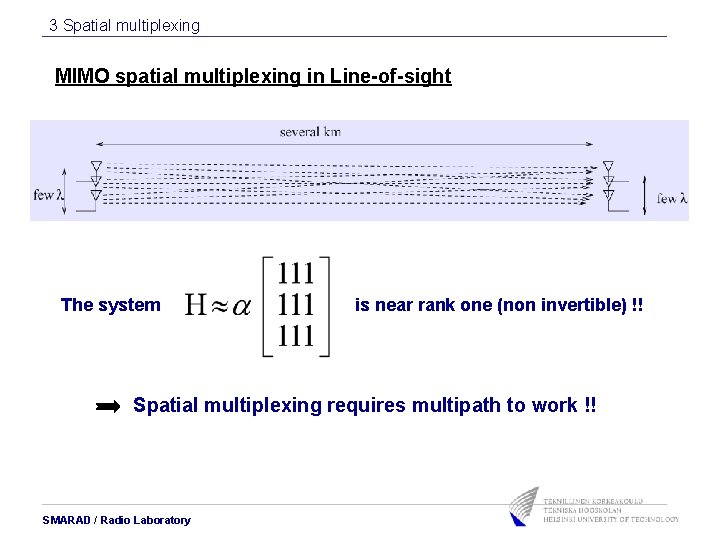
3 Spatial multiplexing MIMO spatial multiplexing in Line-of-sight The system is near rank one (non invertible) !! Spatial multiplexing requires multipath to work !! SMARAD / Radio Laboratory
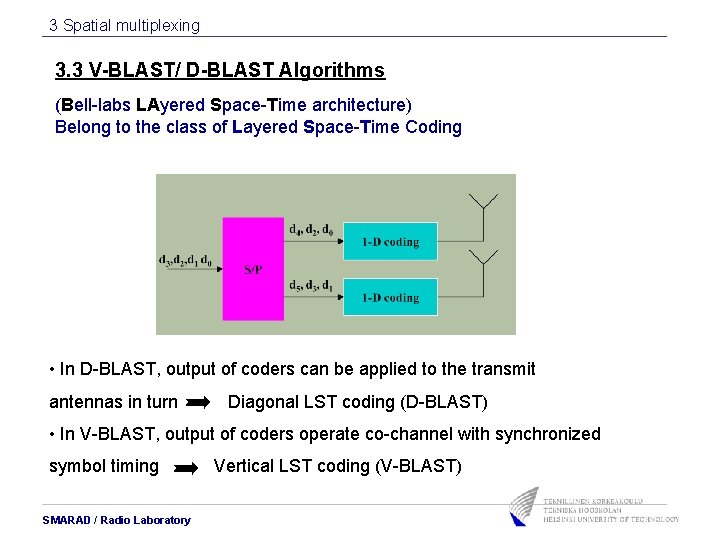
3 Spatial multiplexing 3. 3 V-BLAST/ D-BLAST Algorithms (Bell-labs LAyered Space-Time architecture) Belong to the class of Layered Space-Time Coding • In D-BLAST, output of coders can be applied to the transmit antennas in turn Diagonal LST coding (D-BLAST) • In V-BLAST, output of coders operate co-channel with synchronized symbol timing SMARAD / Radio Laboratory Vertical LST coding (V-BLAST)
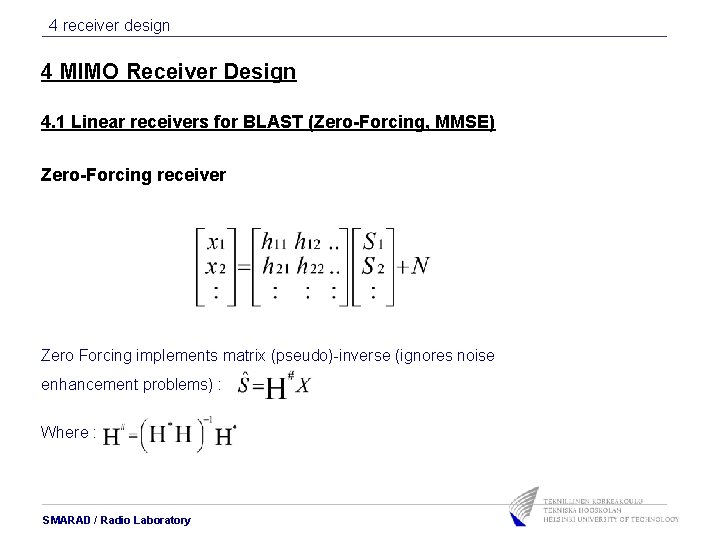
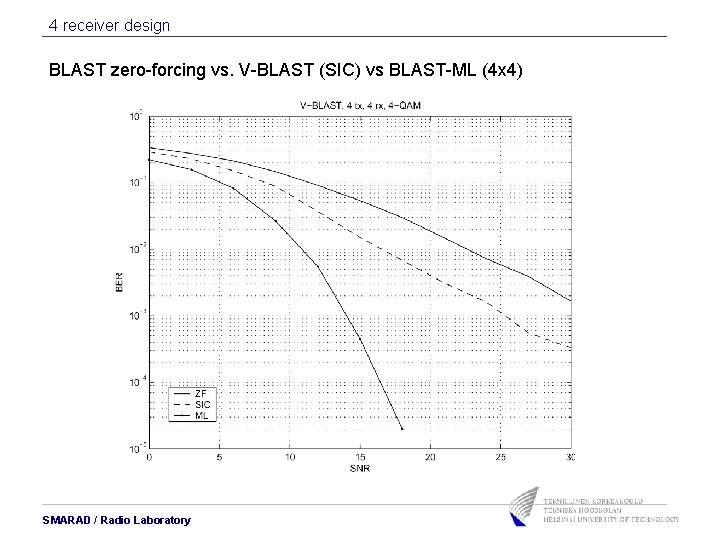
4 receiver design 4 MIMO Receiver Design 4. 1 Linear receivers for BLAST (Zero-Forcing, MMSE) Zero-Forcing receiver Zero Forcing implements matrix (pseudo)-inverse (ignores noise enhancement problems) : Where : SMARAD / Radio Laboratory
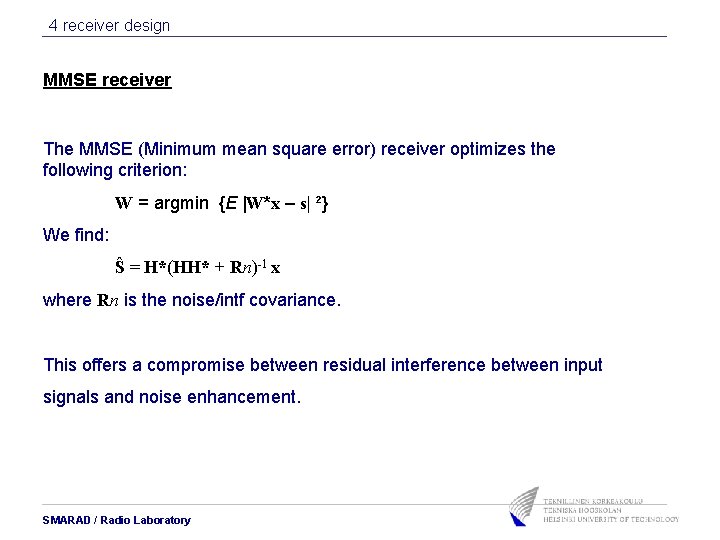
4 receiver design MMSE receiver The MMSE (Minimum mean square error) receiver optimizes the following criterion: W = argmin {E |W*x – s| ²} We find: Ŝ = H*(HH* + Rn)-1 x where Rn is the noise/intf covariance. This offers a compromise between residual interference between input signals and noise enhancement. SMARAD / Radio Laboratory
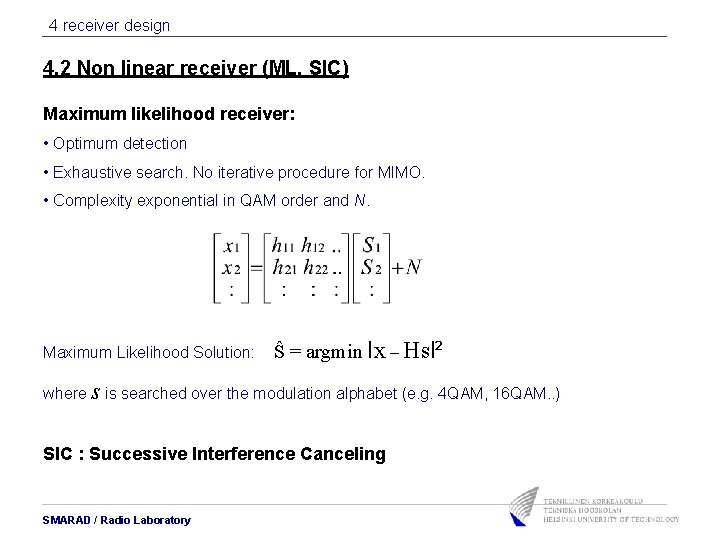
4 receiver design 4. 2 Non linear receiver (ML, SIC) Maximum likelihood receiver: • Optimum detection • Exhaustive search. No iterative procedure for MIMO. • Complexity exponential in QAM order and N. Maximum Likelihood Solution: Ŝ = argmin Ix – Hsl² where s is searched over the modulation alphabet (e. g. 4 QAM, 16 QAM. . ) SIC : Successive Interference Canceling SMARAD / Radio Laboratory
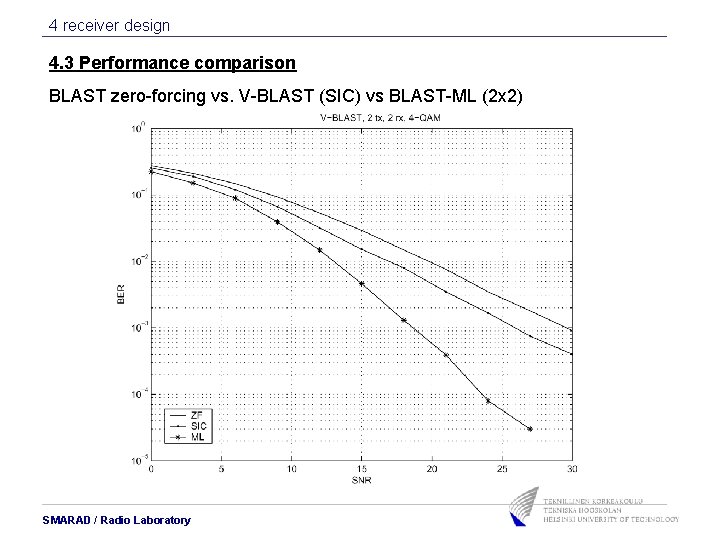
4 receiver design 4. 3 Performance comparison BLAST zero-forcing vs. V-BLAST (SIC) vs BLAST-ML (2 x 2) SMARAD / Radio Laboratory
4 receiver design BLAST zero-forcing vs. V-BLAST (SIC) vs BLAST-ML (4 x 4) SMARAD / Radio Laboratory
5 Space-Time Coding (Transmit / Receive Diversity) 5 Space-Time Coding (Transmit/Receive Diversity) Uses Transmission diversity to combat the detrimental effects in wireless fading channels. Three types: • Trellis space time codes : complex but best performance in slow fading environment (indoors). • Layered space time codes : easy to implement but not accurate due to error propagation effect. • Block space time codes : best trade-off of performance vs complexity. SMARAD / Radio Laboratory
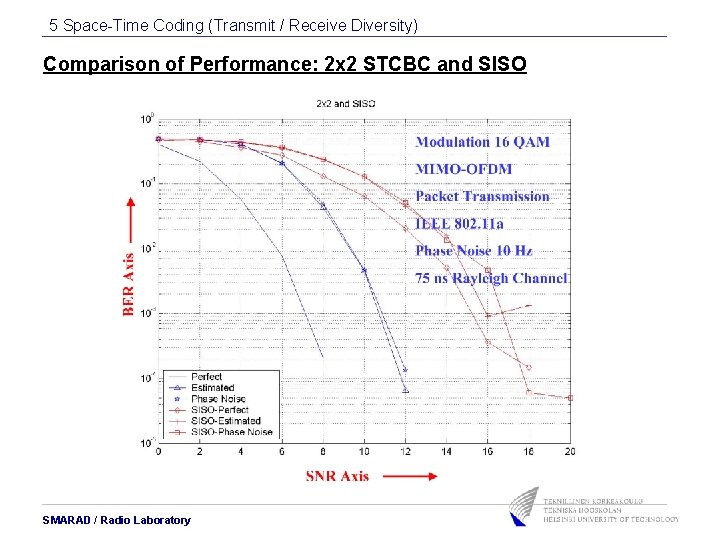
5 Space-Time Coding (Transmit / Receive Diversity) Comparison of Performance: 2 x 2 STCBC and SISO SMARAD / Radio Laboratory
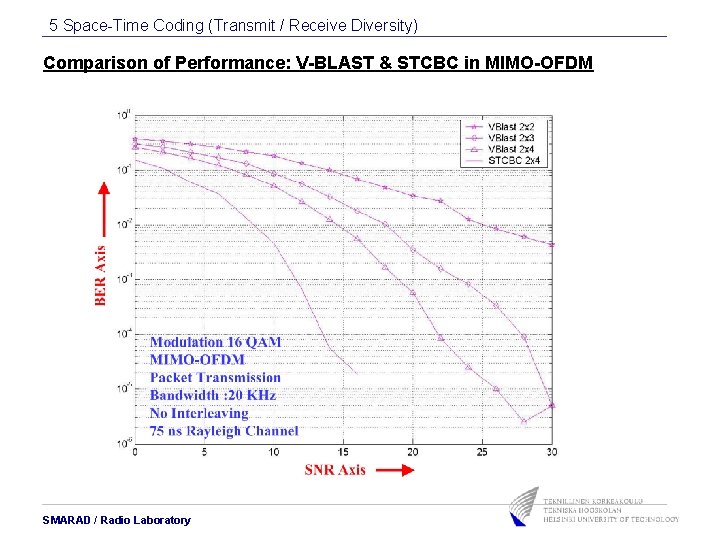
5 Space-Time Coding (Transmit / Receive Diversity) Comparison of Performance: V-BLAST & STCBC in MIMO-OFDM SMARAD / Radio Laboratory
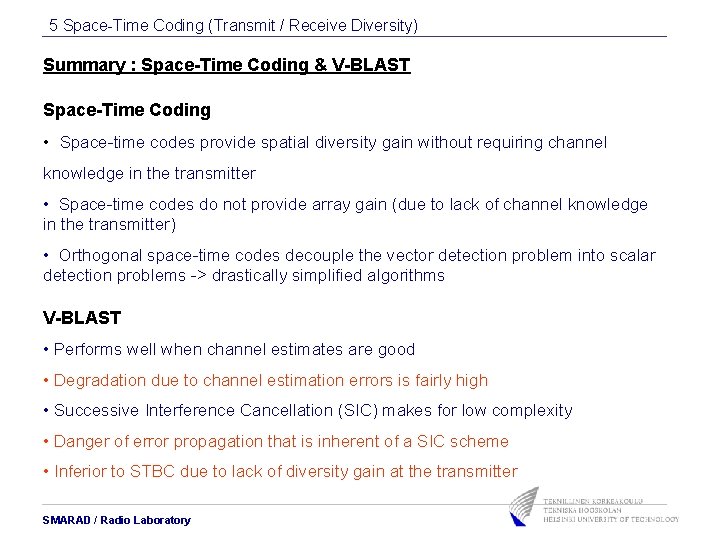
5 Space-Time Coding (Transmit / Receive Diversity) Summary : Space-Time Coding & V-BLAST Space-Time Coding • Space-time codes provide spatial diversity gain without requiring channel knowledge in the transmitter • Space-time codes do not provide array gain (due to lack of channel knowledge in the transmitter) • Orthogonal space-time codes decouple the vector detection problem into scalar detection problems -> drastically simplified algorithms V-BLAST • Performs well when channel estimates are good • Degradation due to channel estimation errors is fairly high • Successive Interference Cancellation (SIC) makes for low complexity • Danger of error propagation that is inherent of a SIC scheme • Inferior to STBC due to lack of diversity gain at the transmitter SMARAD / Radio Laboratory
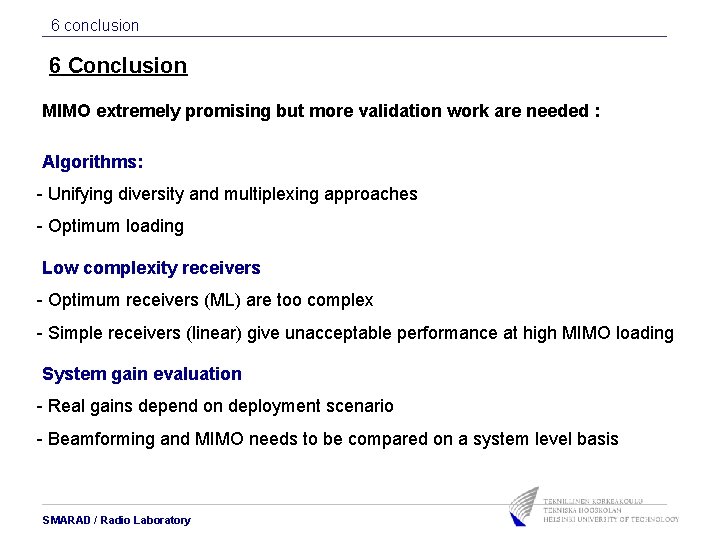
6 conclusion 6 Conclusion MIMO extremely promising but more validation work are needed : Algorithms: - Unifying diversity and multiplexing approaches - Optimum loading Low complexity receivers - Optimum receivers (ML) are too complex - Simple receivers (linear) give unacceptable performance at high MIMO loading System gain evaluation - Real gains depend on deployment scenario - Beamforming and MIMO needs to be compared on a system level basis SMARAD / Radio Laboratory
References • “On the Capacity of OFDM-Based Spatial Multiplexing Systems”, Helmut Bolcskei, David Gesbert and Arogyaswami J. Paulraj, IEEE Trans. Communications, Oct. 2001 • “An Overview of MIMO Communications- A Key to Gigabit Wireless”, A. J. Paulraj, D. Gore, R. U. Nabar, and H. B®olcskei • '' From theory to practice: An overview of space-time coded MIMO wireless systems '' D. Gesbert, M. Shafi, D. Shiu, P. Smith, , IEEE Journal on Selected Areas on Communications (JSAC). April 2003, special issue on MIMO systems. (Recipient of the 2004 IEEE Best Tutorial Paper Award by IEEE Comm. Society). • “Implementation of a MIMO OFDM-Based Wireless LAN System”, Allert van Zelst, Student Member, IEEE, and Tim C. W. Schenk, Student Member, IEEE • “MIMO Systems With Antenna Selection”, Andreas F. Molish, Moe Z. Win SMARAD / Radio Laboratory
Homework 1. Explain the principle of spatial multiplexing. 2. Describe briefly what happens in MIMO spatial multiplexing if there is just line of sight without multipath ? SMARAD / Radio Laboratory