
Overview of Management Defining and Explaining Management 1
- Slides: 21
Overview of Management
Defining and Explaining Management 1. What is Management? 2. Some simple definitions
Some definitions • Follet: “Management is the art of getting things done through people” • Appley (1981) “Management is the accomplishment of results through the efforts of other people. ” • Hill and Mc. Shane (2008) define management as “the art of getting things done through people in organizations”.
More elaborate definitions “Terry (1994): Management is a distinct process, consisting of planning, organizing, directing and controlling performed to determine and accomplish objectives by the use of people and other resources. Robbins (2003): The term management refers to the process of getting things done effectively and efficiently, through people. Kreitner’s (2000): Management is the process of working with and through others to achieve organizational objectives in a changing environment.
More definitions Rue & Byers (2003): Management is the process of deciding how best to use business resources to produce goods and provide services. Griffen (2000) points out that: Management is a set of activities (including planning and decision making, leading, and controlling) directed at organizational resources (human, financial, physical and information) with the aim of achieving organizational goals in an efficient and effective manner.
Cont. definitions Daft and Marcic (1998): Management is the attainment of organizational goals in an effective and efficient manner through planning, organizing, leading and controlling organizational resources.
Some observations from definitions • Management is an effort to seek organizational goals. • Management involves achieving these goals through people and other resources. • The job of management is performed through people. • Management is the process whereby managers perform the functions of planning, organizing, directing and controlling to achieve stated goals. • Consideration of an objective, either specifically stated or implied is a requisite of management.
Cont. Observations resource relation maximize to of inuse seeks to • the It the desired results. • It is universal in character. Its principles are equally applicable in all fields: business, industry, education and government. • Management is a unifying force. It integrates human and other resources to achieve desired objectives.
Management, therefore, concerns: • determining objectives • achieving objectives with a group of people and other resources • through the process of planning, organizing, directing and controlling.
Goals Some key words in definitions Objectives resources effectiveness and efficiency
Goals and Objectives Goals are desired outcome for individuals, groups or entire organizations. A profit-oriented business, for example, might have a return-on investment goal; a hospital would have goals centred on patient care; an educational institution would establish goals for teaching, research and community service.
Human and Non-Human resources include managerial talent and labour. The human resource of an organization consists of its employees described in terms of their training, experience, judgment, intelligence, relationships and insight. Together these are known as the organization’s human capital resources. Non-human resources Financial, Physical and Information.
Efficiency and Effectiveness: • The achievement of the organization’s goals. • Choosing appropriate goals and achieving them. • Doing the “right things” to help the organization attain its goals. Efficiency: Doing “things right. ” It is an input-output relationship.
Classifying Managers Who is a Manager? Durbin (2003): “ a person responsible for the work performance of group members …. A manager holds formal authority and commits organizational resources even if the approval of others is required”. Types of Managers: • Functional Managers • General Managers
Types of Managers Functional managers supervise the work of employees who perform specialized duties such as accounting, engineering, marketing, human resource and information systems. General Managers There are responsible for the work of several different groups that perform a variety of functions. They supervise the overall operations of a more complex unit such as a company or a division.
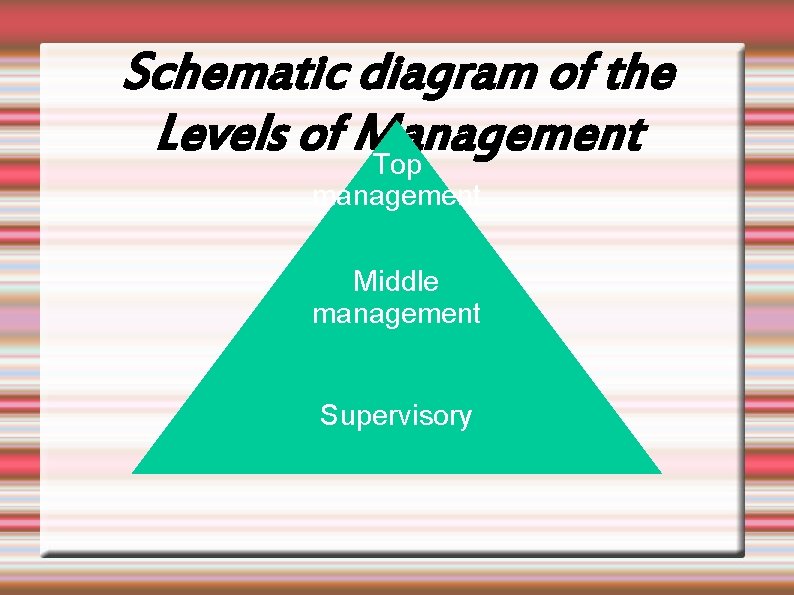
Levels of Management • Top level managers • Middle level managers • Lower level managers.
Levels of Management Top-Level Managers. What they basically do in organisations: • Make major decisions affecting the present and the future state of the organization. • Give the organization its general direction.
Schematic diagram of the Levels of Management Top management Middle management Supervisory
Levels of Management Typical titles of top managers include chief operating officer (CDD), chief executive officer (CEO), managing director, (MD) chairman, and executive director. • Represent their organizations in community affairs • Represent their organizations in business deals and government negotiations. • Spend most of their time talking with other top managers in the company, people outside the company, and to a lesser extent, middle managers and other subordinates.
Levels of Management Middle-level managers • Intermediaries between Top and Lower Management First-Level Managers • These are managers who supervise people who do the organization’s production work.
Levels of Management Lower level managers Also known as supervisory or operative level managers. They consists of: • • Supervisors Foremen Section officer Superintendent ect.