
Overview of LISA signals Pierre Bintruy APC Paris
Overview of LISA signals Pierre Binétruy, APC, Paris Gravitational waves, New frontier, Seoul, 17 January 2013

LISA has become a programme rather than a mission: • LISA Pathfinder • « classic » LISA now turned into « evolved » LISA or e. LISA in Europe • post-LISA missions considered in Japan (DECIGO), China, … Meanwhile, some progress has been made regarding the science of LISA

• Very significant progress these last years in data analysis methods thanks to the Mock LISA Data Challenge • Scientific breakthrough in numerical relativity with the computation of the signal due to the coalescence of two black holes ( « grand challenge » of the 1990 s)
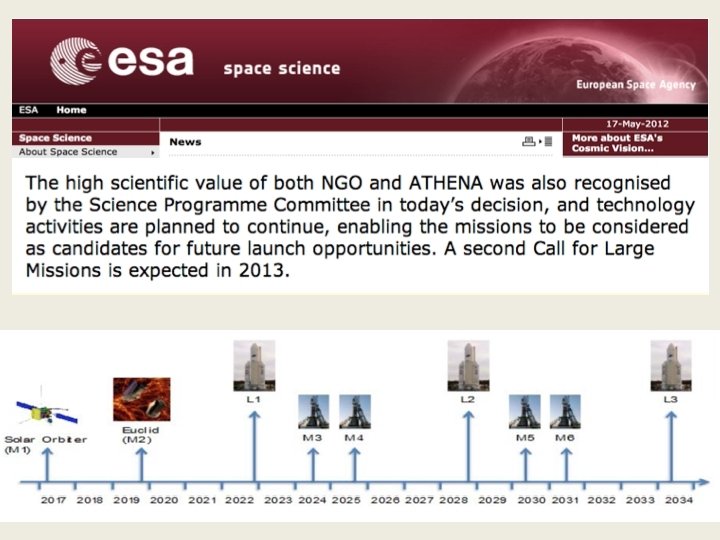
The LISA program in Europe has undergone a series of important reorientations since 2010: • January 2011: ESA abandons a joint mission with NASA • NGO (New Gravitational wave Observatory) proposed for selection as L 1 mission (together with the X-ray mission ATHENA and the JUICE mission to the moons of Jupiter) • May 2012: JUICE mission selected as L 1 • June 2012: ESA changes the selection process of L missions and announces a call in 2013/2014 • September 2012: ESA Member States launch the e. LISA consortium
LISA redefinition study (2011): the way to e. LISA/NGO Boundary conditions: • ESA-only mission • cost cap for ESA cost at 850 M€ • member state contribution at around 200 M€
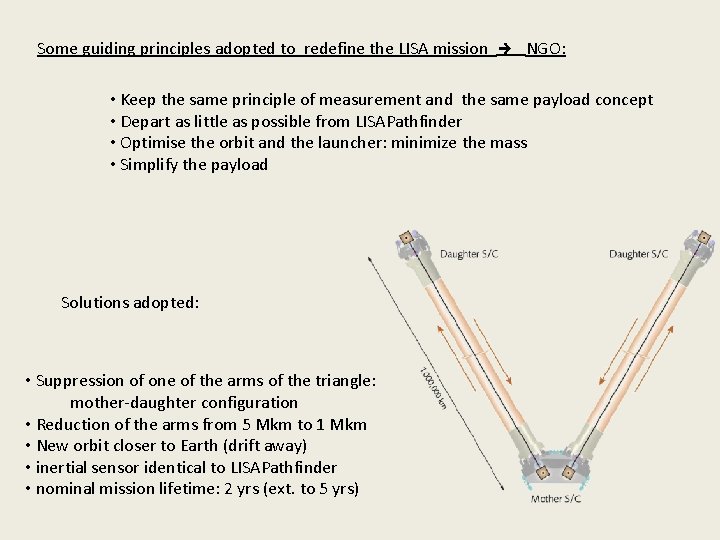
Some guiding principles adopted to redefine the LISA mission NGO: • Keep the same principle of measurement and the same payload concept • Depart as little as possible from LISAPathfinder • Optimise the orbit and the launcher: minimize the mass • Simplify the payload Solutions adopted: • Suppression of one of the arms of the triangle: mother-daughter configuration • Reduction of the arms from 5 Mkm to 1 Mkm • New orbit closer to Earth (drift away) • inertial sensor identical to LISAPathfinder • nominal mission lifetime: 2 yrs (ext. to 5 yrs)
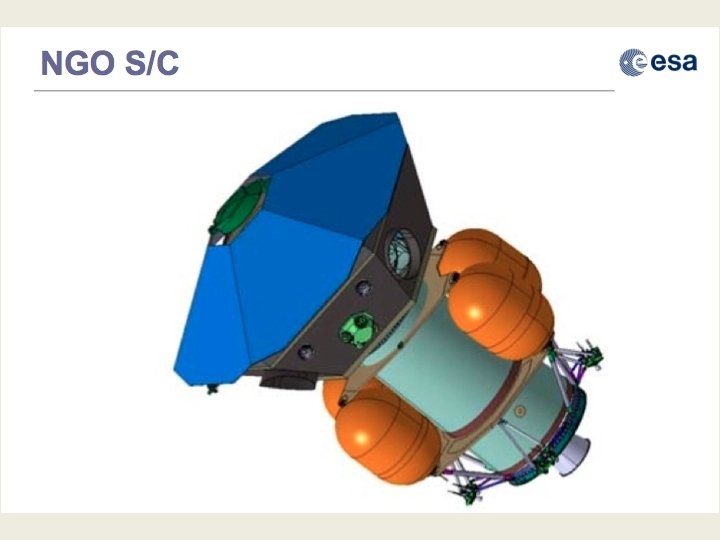
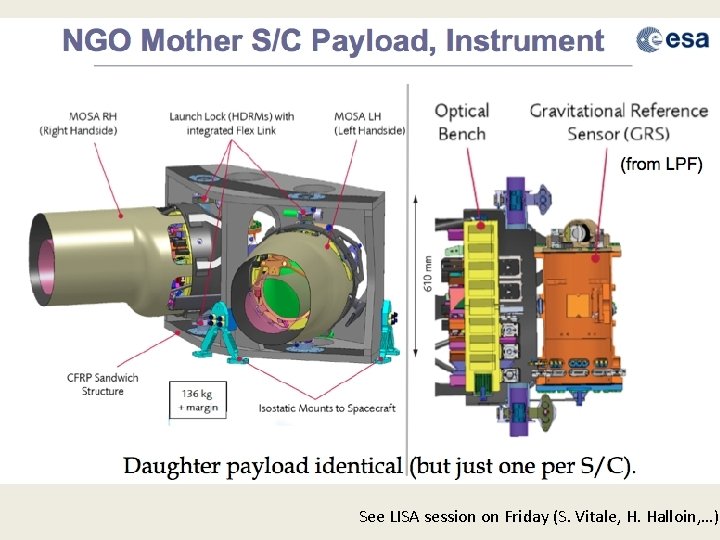
See LISA session on Friday (S. Vitale, H. Halloin, …)

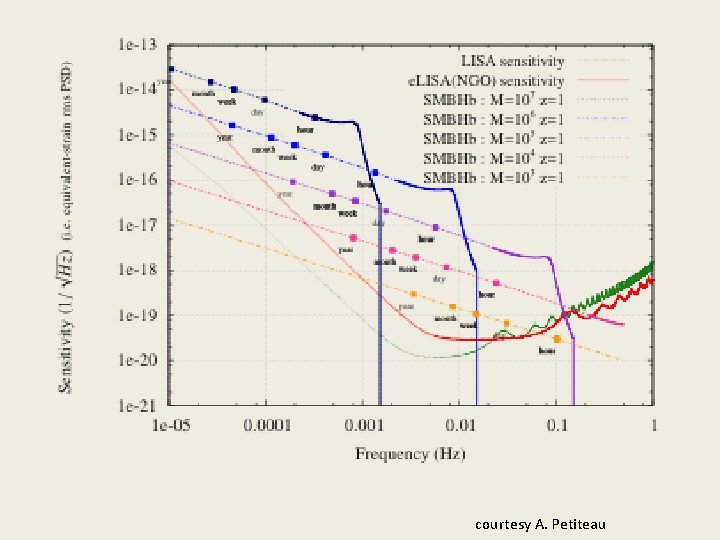
NGO/e. LISA vs classic LISA sensitivity
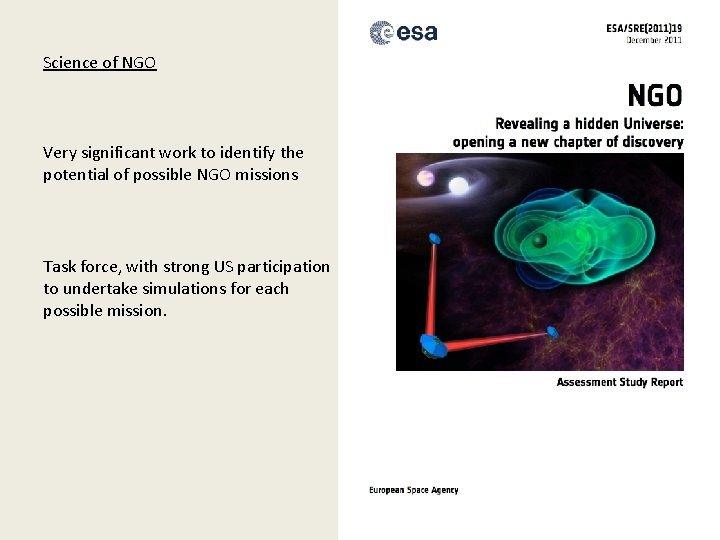
Science of NGO Very significant work to identify the potential of possible NGO missions Task force, with strong US participation to undertake simulations for each possible mission.
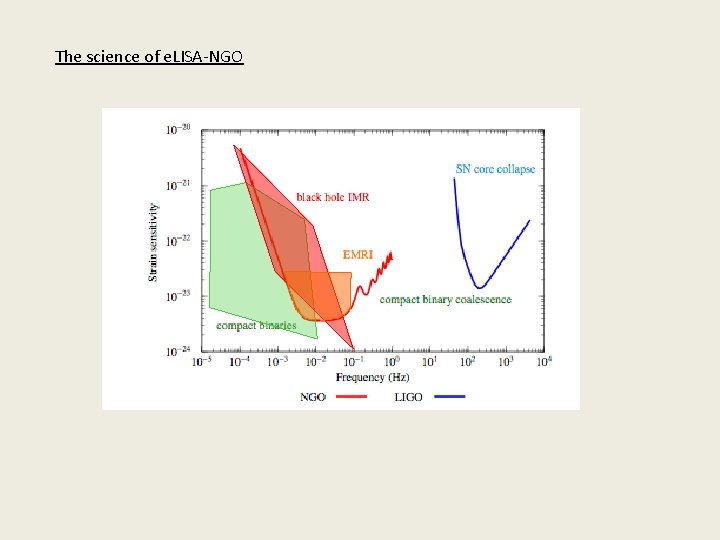
The science of e. LISA-NGO
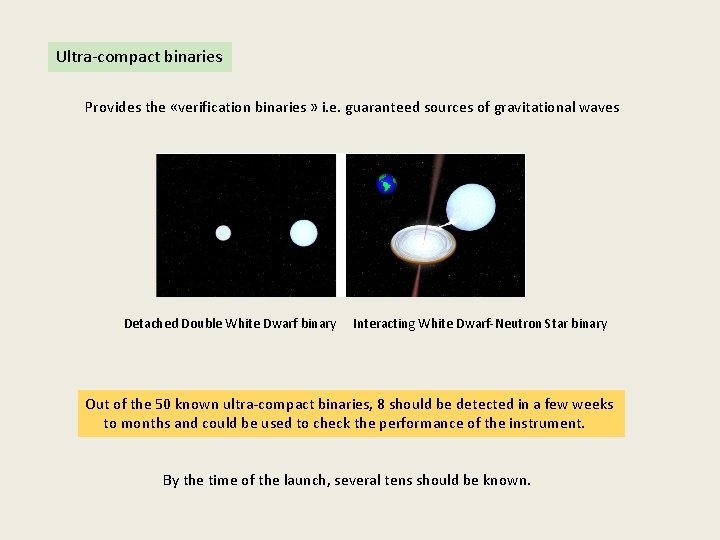
Ultra-compact binaries Provides the «verification binaries » i. e. guaranteed sources of gravitational waves Detached Double White Dwarf binary Interacting White Dwarf-Neutron Star binary Out of the 50 known ultra-compact binaries, 8 should be detected in a few weeks to months and could be used to check the performance of the instrument. By the time of the launch, several tens should be known.
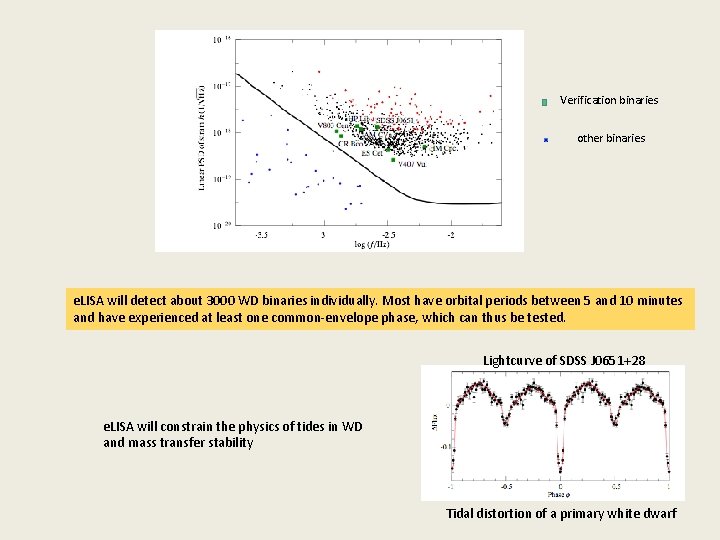
Verification binaries other binaries e. LISA will detect about 3000 WD binaries individually. Most have orbital periods between 5 and 10 minutes and have experienced at least one common-envelope phase, which can thus be tested. Lightcurve of SDSS J 0651+28 e. LISA will constrain the physics of tides in WD and mass transfer stability Tidal distortion of a primary white dwarf
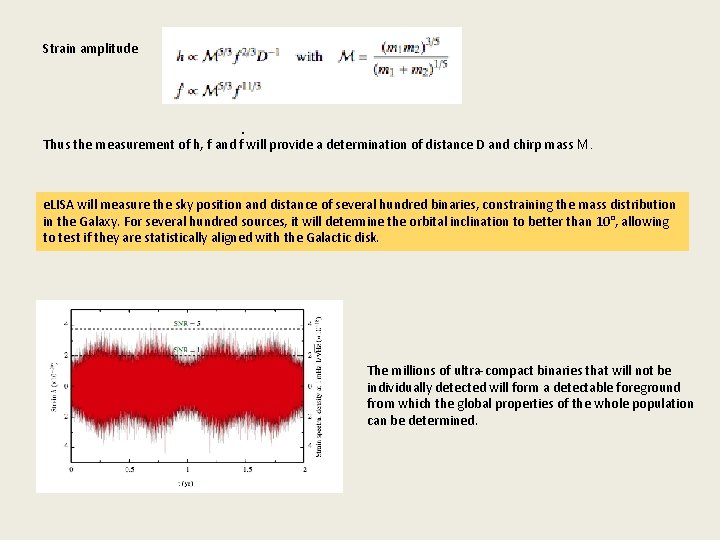
Strain amplitude . Thus the measurement of h, f and f will provide a determination of distance D and chirp mass M. e. LISA will measure the sky position and distance of several hundred binaries, constraining the mass distribution in the Galaxy. For several hundred sources, it will determine the orbital inclination to better than 10°, allowing to test if they are statistically aligned with the Galactic disk. The millions of ultra-compact binaries that will not be individually detected will form a detectable foreground from which the global properties of the whole population can be determined.
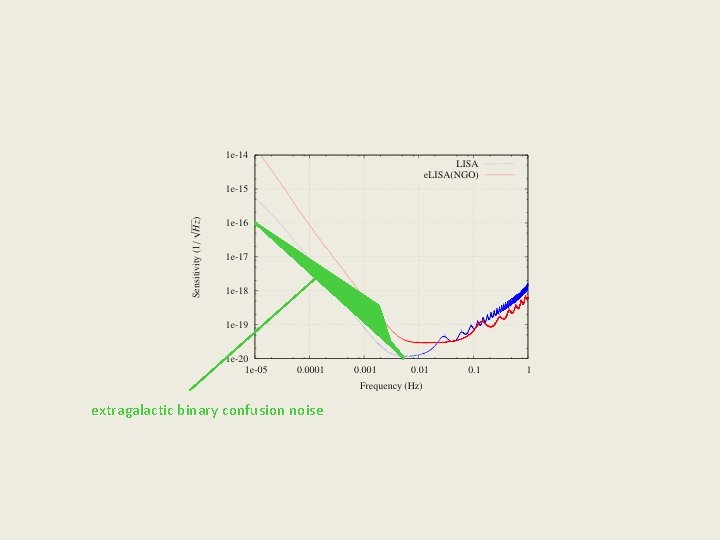
extragalactic binary confusion noise
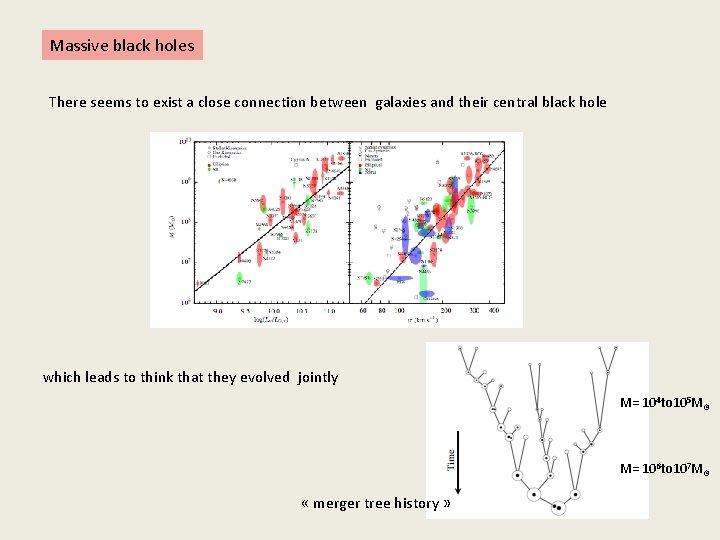
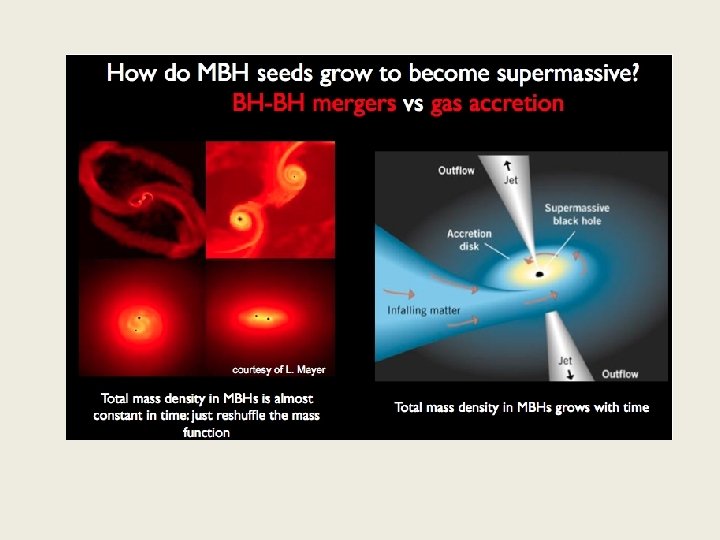
Massive black holes There seems to exist a close connection between galaxies and their central black hole which leads to think that they evolved jointly M= 104 to 105 M M= 106 to 107 M « merger tree history »
courtesy A. Petiteau
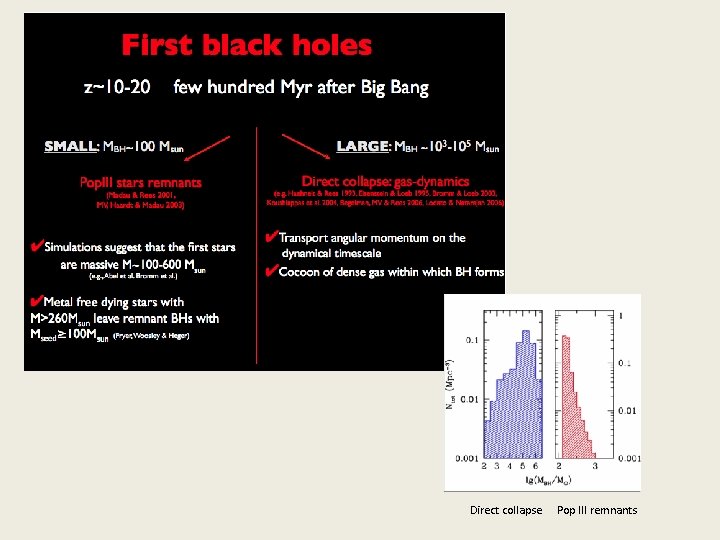
Direct collapse Pop III remnants
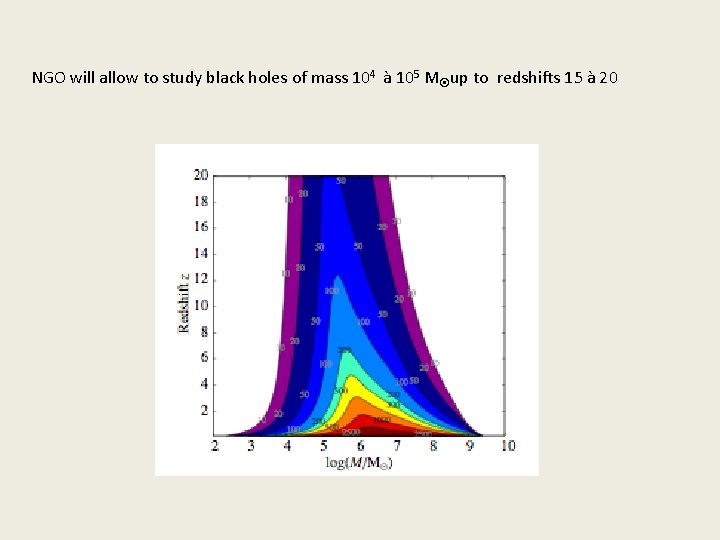
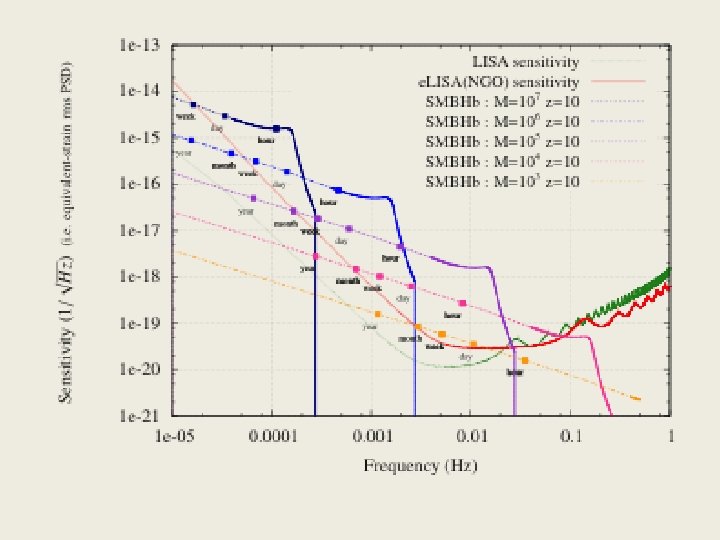
NGO will allow to study black holes of mass 104 à 105 M up to redshifts 15 à 20
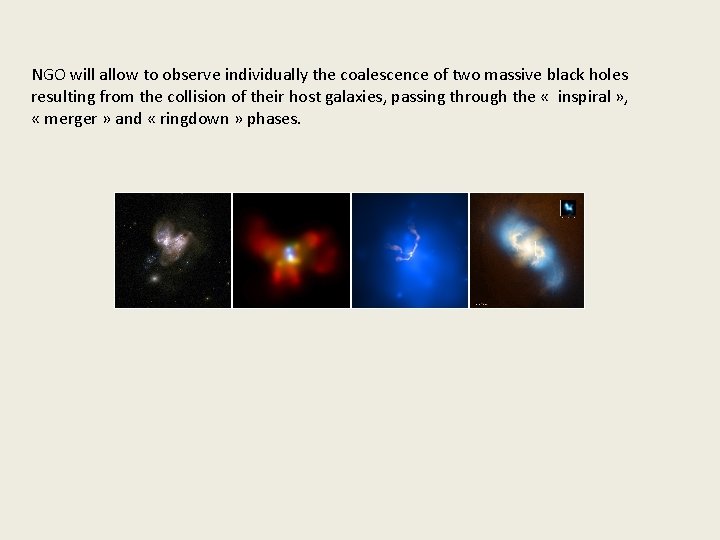
NGO will allow to observe individually the coalescence of two massive black holes resulting from the collision of their host galaxies, passing through the « inspiral » , « merger » and « ringdown » phases.
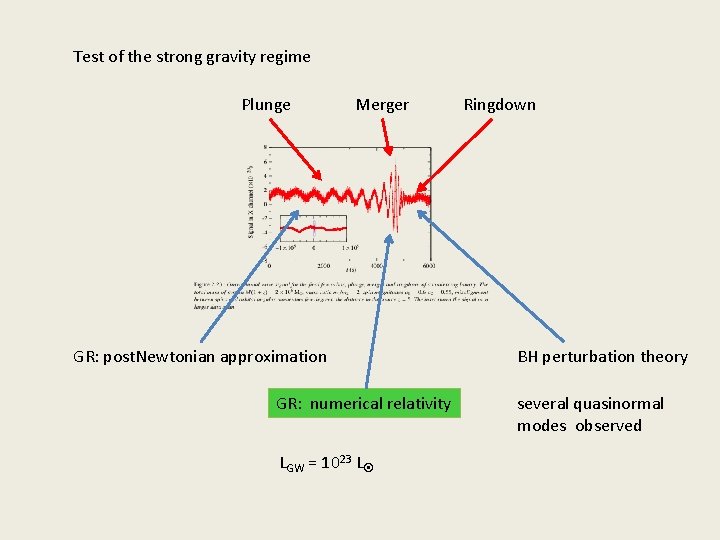
Test of the strong gravity regime Plunge Merger GR: post. Newtonian approximation GR: numerical relativity LGW = 1023 L Ringdown BH perturbation theory several quasinormal modes observed
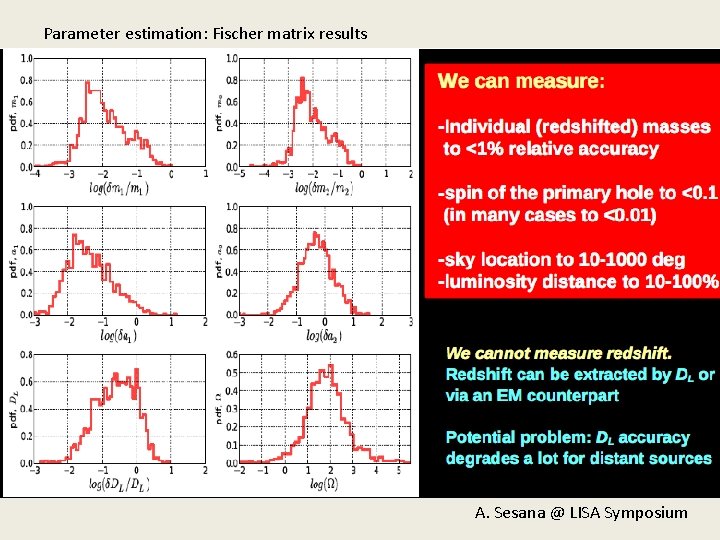
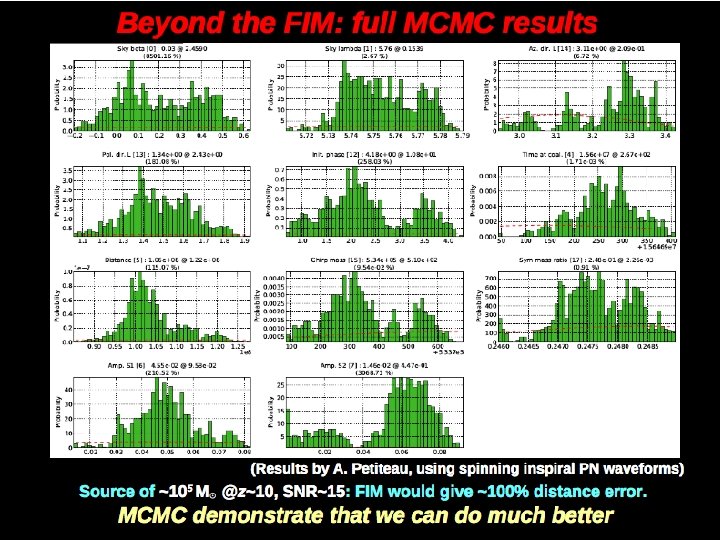
Parameter estimation: Fischer matrix results A. Sesana @ LISA Symposium

EMRI (Extreme Mass Ratio Inspiral) Gravitational waves produced by massive objects (mass 10 to 100 M ) falling into the horizon of a supermassive black hole allow to identify in a unique way the geometry of space-time, to identify the characteristics of the black hole and to verify the predictions of GR.
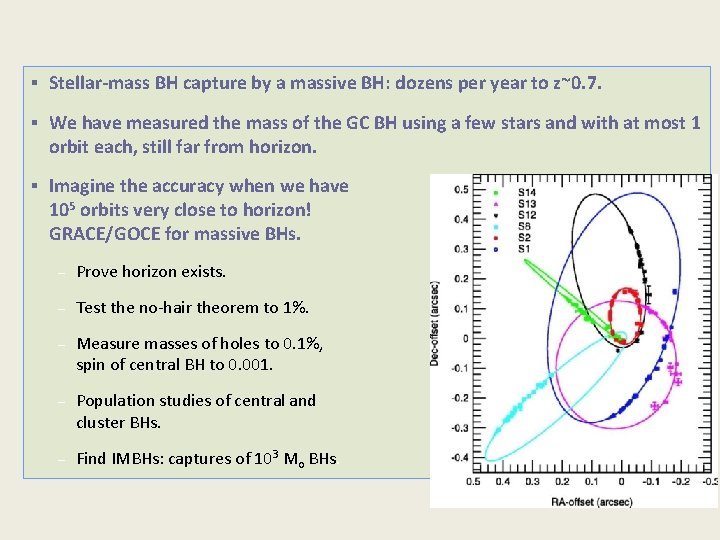
§ Stellar-mass BH capture by a massive BH: dozens per year to z~0. 7. § We have measured the mass of the GC BH using a few stars and with at most 1 orbit each, still far from horizon. § Imagine the accuracy when we have 105 orbits very close to horizon! GRACE/GOCE for massive BHs. – Prove horizon exists. – Test the no-hair theorem to 1%. – Measure masses of holes to 0. 1%, spin of central BH to 0. 001. – Population studies of central and cluster BHs. – Find IMBHs: captures of 103 Mo BHs.
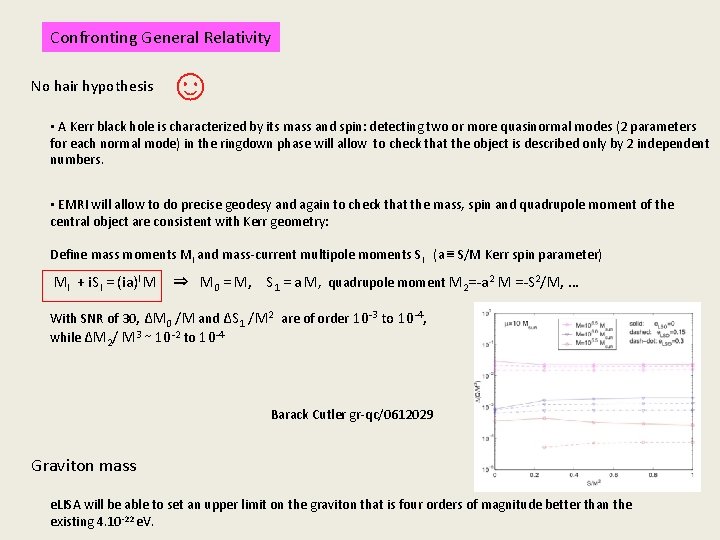
Confronting General Relativity No hair hypothesis ☺ • A Kerr black hole is characterized by its mass and spin: detecting two or more quasinormal modes (2 parameters for each normal mode) in the ringdown phase will allow to check that the object is described only by 2 independent numbers. • EMRI will allow to do precise geodesy and again to check that the mass, spin and quadrupole moment of the central object are consistent with Kerr geometry: Define mass moments Ml and mass-current multipole moments Sl (a ≣ S/M Kerr spin parameter) Ml + i. Sl = (ia)l M ⇒ M 0 = M, S 1 = a M, quadrupole moment M 2=-a 2 M =-S 2/M, … With SNR of 30, ΔM 0 /M and ΔS 1 /M 2 are of order 10 -3 to 10 -4, while ΔM 2/ M 3 ∼ 10 -2 to 10 -4 Barack Cutler gr-qc/0612029 Graviton mass e. LISA will be able to set an upper limit on the graviton that is four orders of magnitude better than the existing 4. 10 -22 e. V.
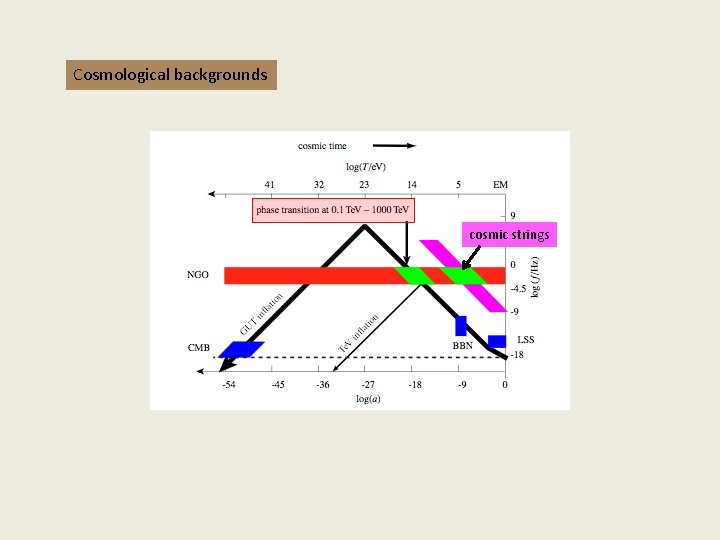
Cosmological backgrounds cosmic strings
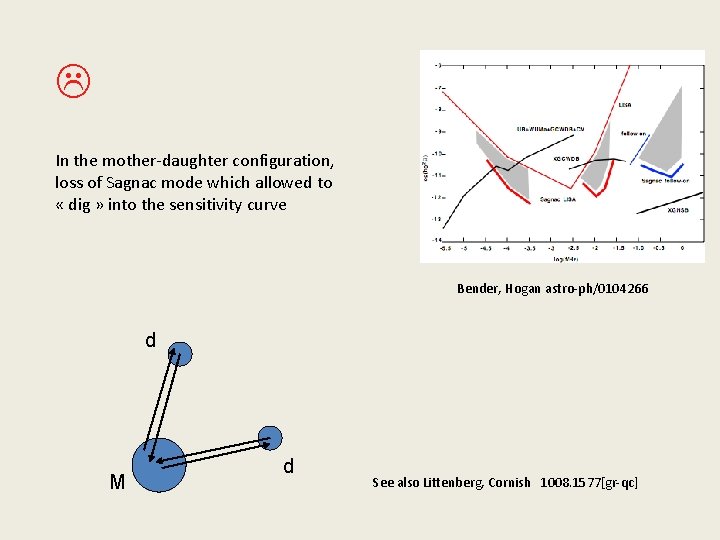
In the mother-daughter configuration, loss of Sagnac mode which allowed to « dig » into the sensitivity curve Bender, Hogan astro-ph/0104266 d M d See also Littenberg, Cornish 1008. 1577[gr-qc]
Still possible to detect stochastic backgrounds if they have a frequency dependence different from the background. Hence effort to understand not only the amplitude of cosmological background but also the nature of their frequency dependence and how generic it is. ☺
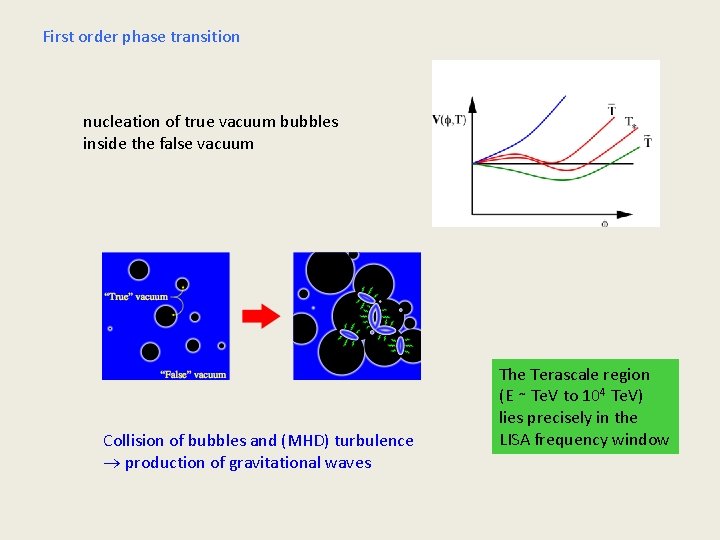
First order phase transition nucleation of true vacuum bubbles inside the false vacuum Collision of bubbles and (MHD) turbulence production of gravitational waves The Terascale region (E ∼ Te. V to 104 Te. V) lies precisely in the LISA frequency window
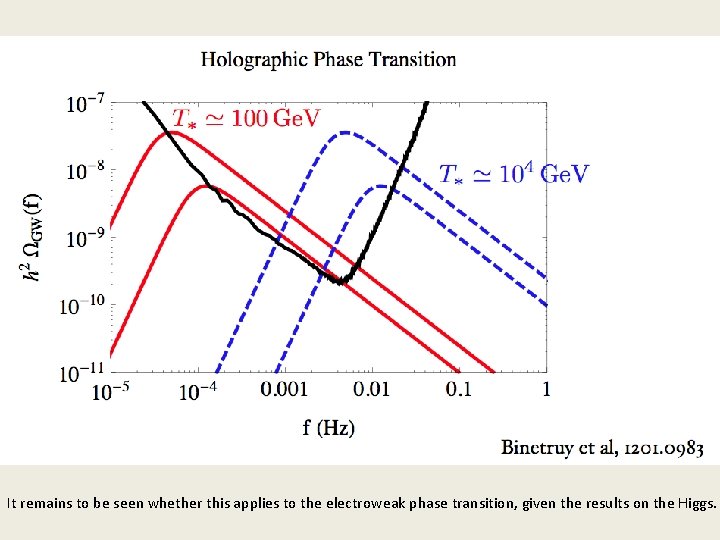
It remains to be seen whether this applies to the electroweak phase transition, given the results on the Higgs.
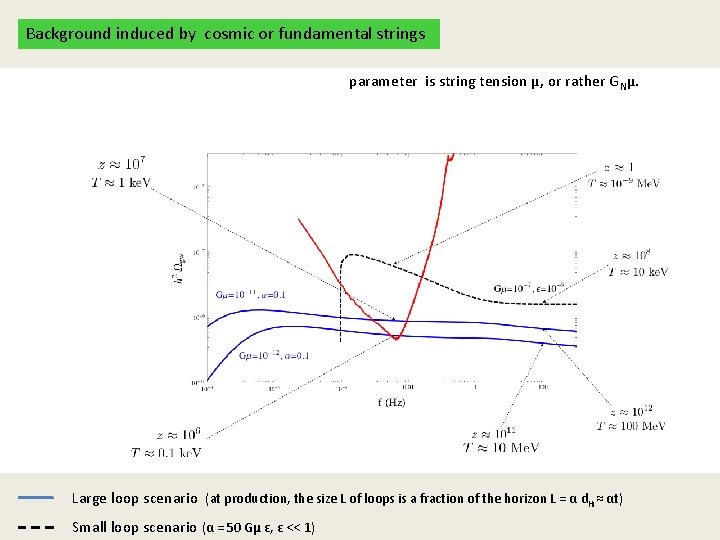
Background induced by cosmic or fundamental strings parameter is string tension μ, or rather GNμ. Large loop scenario (at production, the size L of loops is a fraction of the horizon L = α d. H ≈ αt) Small loop scenario (α = 50 Gμ ε, ε << 1)
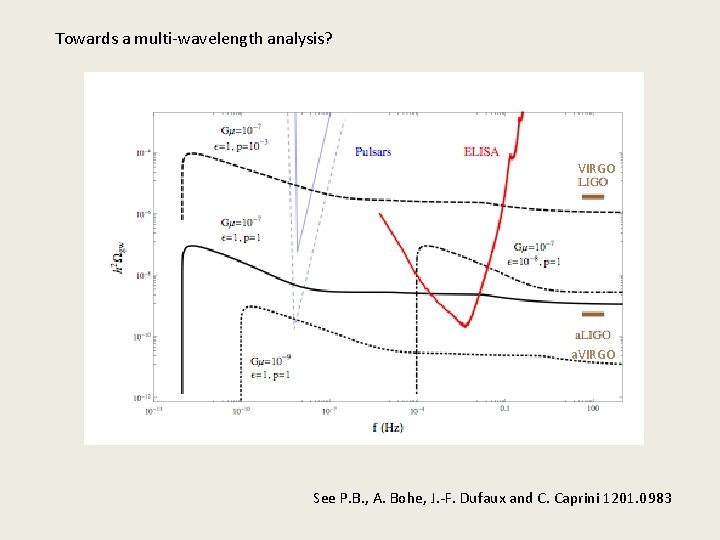
Towards a multi-wavelength analysis? VIRGO a. VIRGO See P. B. , A. Bohe, J. -F. Dufaux and C. Caprini 1201. 0983
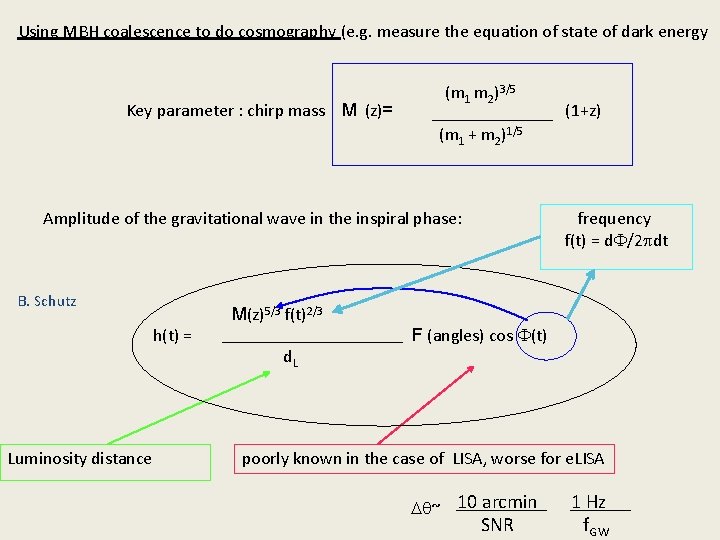
Using MBH coalescence to do cosmography (e. g. measure the equation of state of dark energy Key parameter : chirp mass M (z)= (m 1 m 2)3/5 (1+z) (m 1 + m 2)1/5 Amplitude of the gravitational wave in the inspiral phase: B. Schutz frequency f(t) = d /2 dt M(z)5/3 f(t)2/3 h(t) = F (angles) cos (t) d. L Luminosity distance poorly known in the case of LISA, worse for e. LISA ~ 10 arcmin SNR 1 Hz f. GW

When both a measure of the direction and of the redshift are allowed Holz and Hughes 0. 5% d. L/d. L But beware of gravitational lensing! delensing methods? Can one identify the host galaxy (and thus z)? Use subdominant signal harmonics () to narrow the LISA window Broeck, Trias, Sathyaprakash, Sintes 1001. 3099 Enforce statistical consistency with cosmological parameter determination for all possible hosts Petiteau, Babak, Sesana 1102. 0769
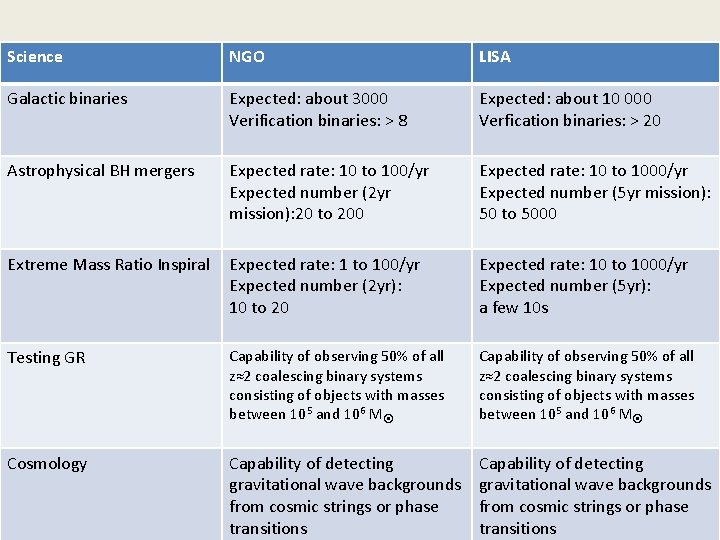
Science NGO LISA Galactic binaries Expected: about 3000 Verification binaries: > 8 Expected: about 10 000 Verfication binaries: > 20 Astrophysical BH mergers Expected rate: 10 to 100/yr Expected number (2 yr mission): 20 to 200 Expected rate: 10 to 1000/yr Expected number (5 yr mission): 50 to 5000 Extreme Mass Ratio Inspiral Expected rate: 1 to 100/yr Expected number (2 yr): 10 to 20 Expected rate: 10 to 1000/yr Expected number (5 yr): a few 10 s Testing GR Capability of observing 50% of all z≈2 coalescing binary systems consisting of objects with masses between 105 and 106 M Cosmology Capability of detecting gravitational wave backgrounds from cosmic strings or phase transitions
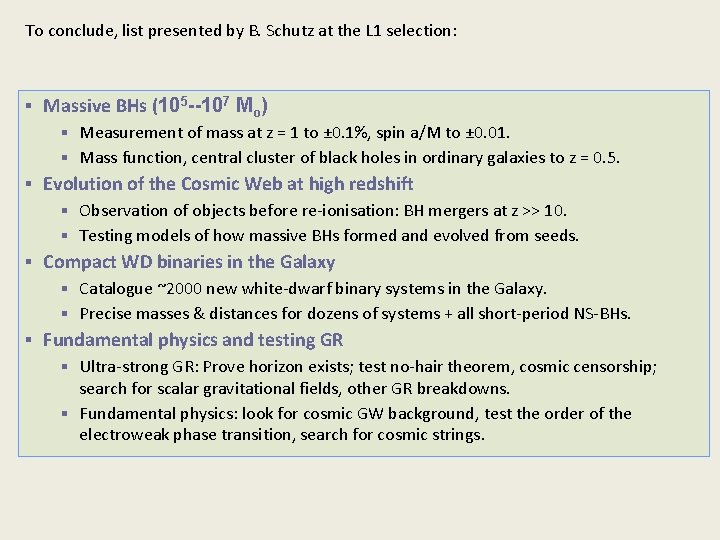
To conclude, list presented by B. Schutz at the L 1 selection: § Massive BHs (105 --107 Mo) § Measurement of mass at z = 1 to ± 0. 1%, spin a/M to ± 0. 01. § Mass function, central cluster of black holes in ordinary galaxies to z = 0. 5. § Evolution of the Cosmic Web at high redshift § Observation of objects before re-ionisation: BH mergers at z >> 10. § Testing models of how massive BHs formed and evolved from seeds. § Compact WD binaries in the Galaxy § Catalogue ~2000 new white-dwarf binary systems in the Galaxy. § Precise masses & distances for dozens of systems + all short-period NS-BHs. § Fundamental physics and testing GR § Ultra-strong GR: Prove horizon exists; test no-hair theorem, cosmic censorship; search for scalar gravitational fields, other GR breakdowns. § Fundamental physics: look for cosmic GW background, test the order of the electroweak phase transition, search for cosmic strings.
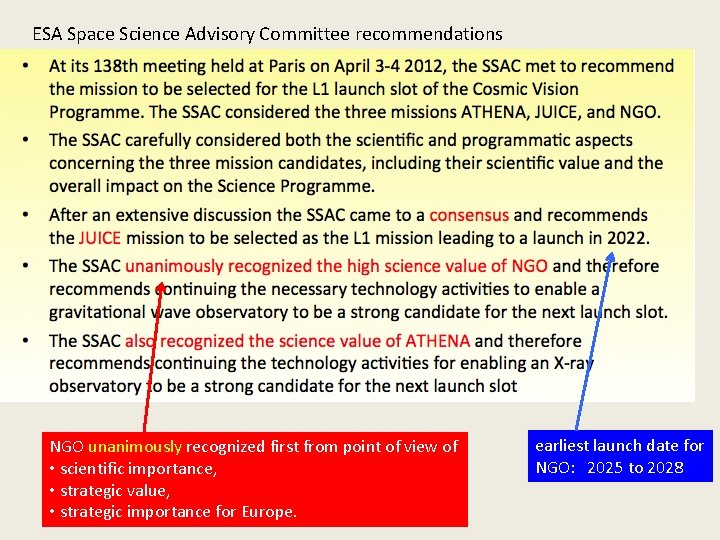
ESA Space Science Advisory Committee recommendations NGO unanimously recognized first from point of view of • scientific importance, • strategic value, • strategic importance for Europe. earliest launch date for NGO: 2025 to 2028

e. LISA Science Working Groups • ultra-compact binaries • astrophysical black holes • EMRI • cosmology: backgrounds, cosmography, formation of large structures • tests of fundamental laws • data analysis • science of measurement
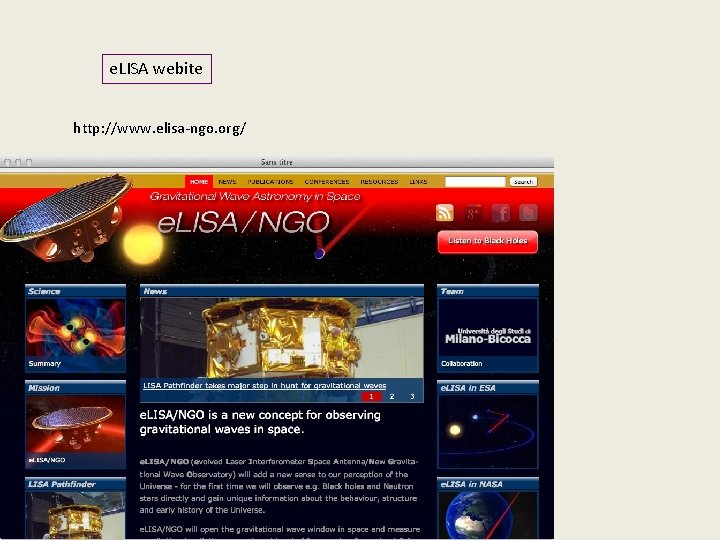
e. LISA webite http: //www. elisa-ngo. org/
- Slides: 43