
Overview of LHCb RICH Detector Development On Behalf

Overview of LHCb RICH Detector Development On Behalf of LHCb-RICH Group RICH 2004 Playa Del Carmen, Mexico December 4, 2004 S. Easo Rutherford-Appleton Laboratory, U. K.
OUTLINE § LHCb and its Particle Identification § Design and Main Features of LHCb-RICH § Components of RICH 1 and RICH 2: Radiators: Aerogel, C 4 F 10 gas, Mirrors: Beryllium , Glass Type. CF 4 gas. § RICH Photodetectors: HPD, Readout System § RICH Performance : LHCb Detector Simulations § Summary
LHCb EXPERIMENT • Precision measurements of CP violation in B Meson System • Search for Signals of ‘New Physics’ beyond Standard Model • Large samples of events with Bd and Bs Mesons • At the beginning of LHC 2 * 10 9 b b events per year after trigger selection • Most of the b-hadrons produced at small polar angles • Single forward arm spectrometer with open geometry • From the CP Asymmetries in the final states of B meson decays, measure CKM Angles. Examples: g from B 0 d p+ p- , B 0 s K+K- g from B 0 s Ds+K-
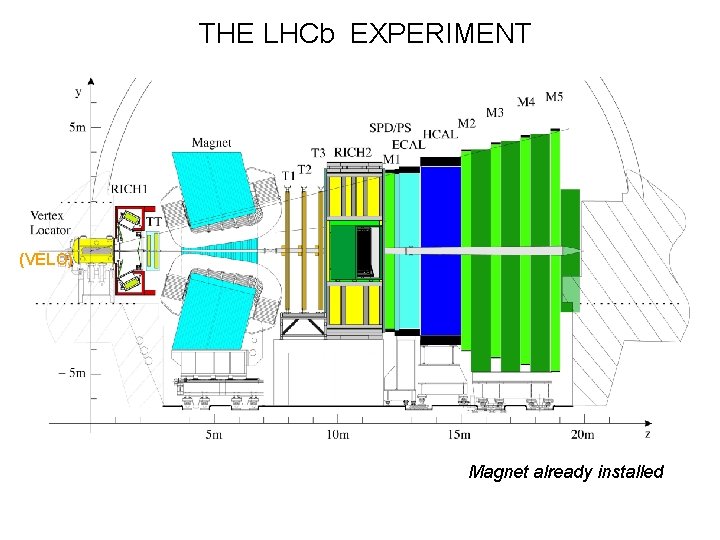
THE LHCb EXPERIMENT (VELO) Magnet already installed
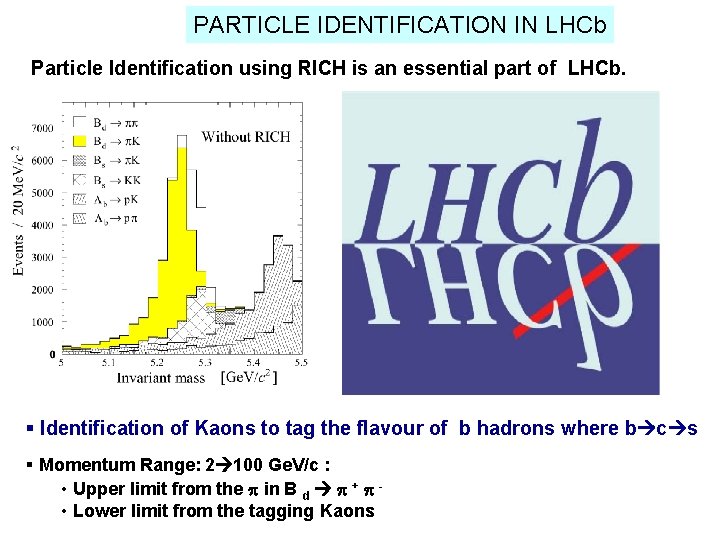
PARTICLE IDENTIFICATION IN LHCb Particle Identification using RICH is an essential part of LHCb. § Identification of Kaons to tag the flavour of b hadrons where b c s § Momentum Range: 2 100 Ge. V/c : • Upper limit from the p in B d p + p • Lower limit from the tagging Kaons

LHCb-RICH SPECIFICATIONS RICH 1: Aerogel L=5 cm p: 2 10 Ge. V/c n=1. 03 (nominal at 540 nm) C 4 F 10 L=85 cm p: < 70 Ge. V/c n=1. 0014 (nominal at 400 nm) Upstream of LHCb Magnet Acceptance: 25 250 mrad (vertical) 300 mrad (horizontal) Gas vessel: 2 X 3 X 1 m 3 RICH 2: CF 4 L=196 cm p: < 100 Ge. V/c n =1. 0005 (nominal at 400 nm) Downstream of LHCb Magnet Acceptance: 15 100 mrad (vertical) 120 mrad (horizontal) Gas vessel : 100 m 3
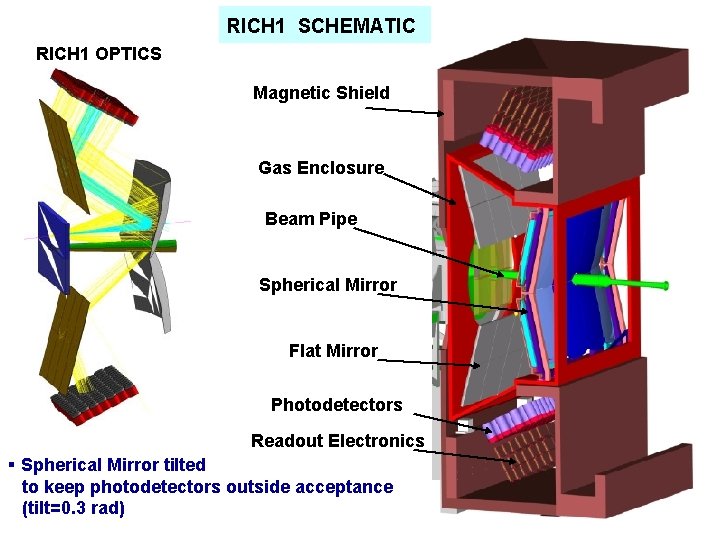
RICH 1 SCHEMATIC RICH 1 OPTICS Magnetic Shield Gas Enclosure Beam Pipe Spherical Mirror Flat Mirror Photodetectors Readout Electronics § Spherical Mirror tilted to keep photodetectors outside acceptance (tilt=0. 3 rad)
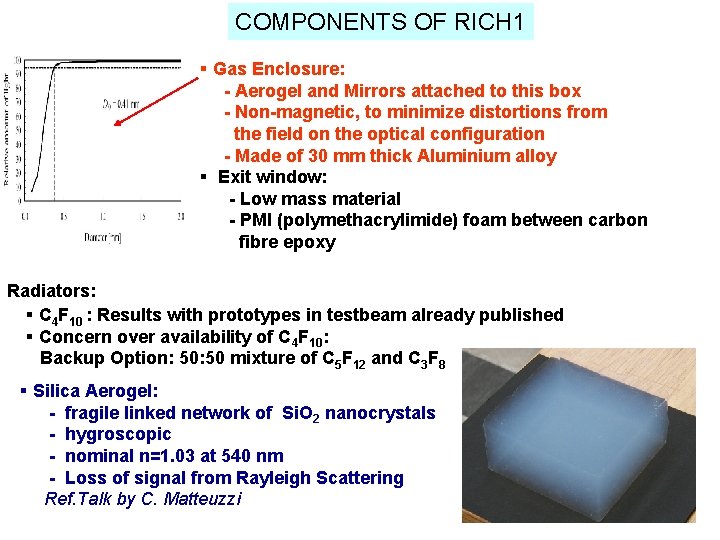
COMPONENTS OF RICH 1 § Gas Enclosure: - Aerogel and Mirrors attached to this box - Non-magnetic, to minimize distortions from the field on the optical configuration - Made of 30 mm thick Aluminium alloy § Exit window: - Low mass material - PMI (polymethacrylimide) foam between carbon fibre epoxy Radiators: § C 4 F 10 : Results with prototypes in testbeam already published § Concern over availability of C 4 F 10: Backup Option: 50 mixture of C 5 F 12 and C 3 F 8 § Silica Aerogel: - fragile linked network of Si. O 2 nanocrystals - hygroscopic - nominal n=1. 03 at 540 nm - Loss of signal from Rayleigh Scattering Ref. Talk by C. Matteuzzi

RICH 1 MIRRORS § Spherical Mirror inside LHCb acceptance § Requirements: - Minimum material with sufficient rigidity - D 0 < 2. 5 mm (size of circle at focal plane with 95 % image intensity from a point source) - Reflectivity > 90 % in 200 -700 nm § Selected 3 mm thick Beryllium + < 0. 3 mm glass coated with Al+Si. O 2+Hf 02: 0. 8 % X 0. - Ro. C =2700 mm - 8 segments : 410 X 600 mm and 385 X 600 mm - D 0 = 0. 41 mm for prototype, FEA: negligible distortions § Flat Mirror outside LHCb acceptance: - 16 segments : 370 X 387 mm - 6 mm thick Simax (Borosilicate) glass or equivalent Be Prototype
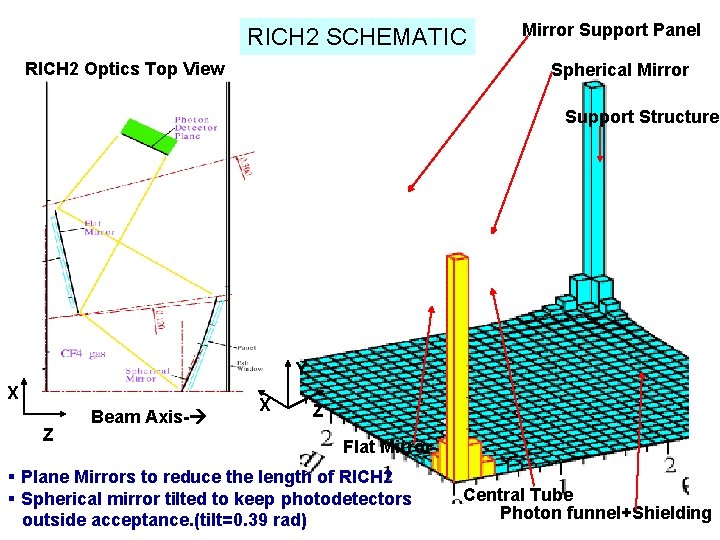
RICH 2 SCHEMATIC RICH 2 Optics Top View Mirror Support Panel Spherical Mirror Support Structure Y X Z Beam Axis- X Z Flat Mirror § Plane Mirrors to reduce the length of RICH 2 § Spherical mirror tilted to keep photodetectors outside acceptance. (tilt=0. 39 rad) Central Tube Photon funnel+Shielding
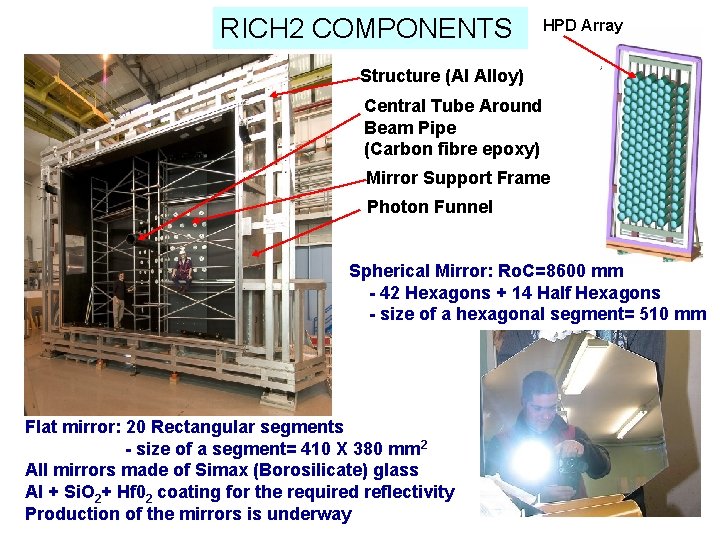
RICH 2 COMPONENTS HPD Array Structure (Al Alloy) Central Tube Around Beam Pipe (Carbon fibre epoxy) Mirror Support Frame Photon Funnel Spherical Mirror: Ro. C=8600 mm - 42 Hexagons + 14 Half Hexagons - size of a hexagonal segment= 510 mm Flat mirror: 20 Rectangular segments - size of a segment= 410 X 380 mm 2 All mirrors made of Simax (Borosilicate) glass Al + Si. O 2+ Hf 02 coating for the required reflectivity Production of the mirrors is underway
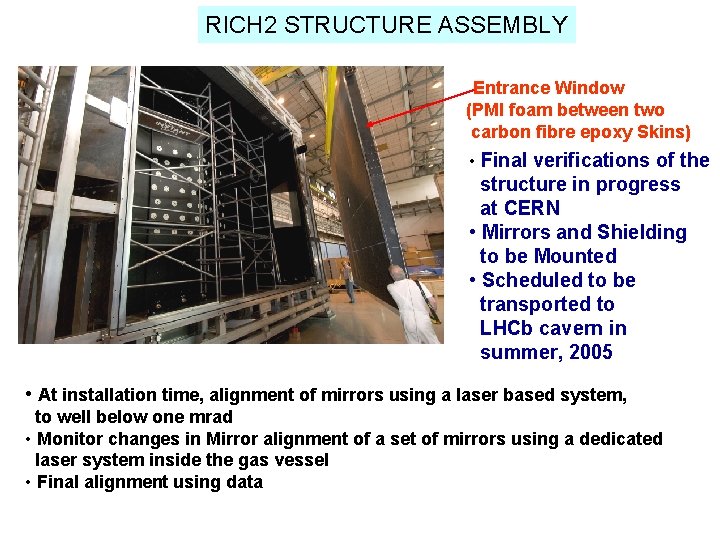
RICH 2 STRUCTURE ASSEMBLY Entrance Window (PMI foam between two carbon fibre epoxy Skins) • Final verifications of the structure in progress at CERN • Mirrors and Shielding to be Mounted • Scheduled to be transported to LHCb cavern in summer, 2005 • At installation time, alignment of mirrors using a laser based system, to well below one mrad • Monitor changes in Mirror alignment of a set of mirrors using a dedicated laser system inside the gas vessel • Final alignment using data

Photon Detectors and Readout System • Active area fraction (>73 %), Granularity of 2. 5 X 2. 5 mm 2, Sensitive in 200 600 nm, 40 MHz readout and tolerant well beyond 3 K Rad/year Pixel HPD • Pixel Chip: - 16 X 16 mm 2 - 13 million transistors - 0. 25 m m CMOS technology - Analogue input Binary Output - Data collected in testbeams with HPD+Pixel Chip Overall Readout System • 198 + 288 HPDs to cover 2. 6 m 2 in RICH 1 + RICH 2 • Ref. Talk by N. Kanaya on tests using HPDs
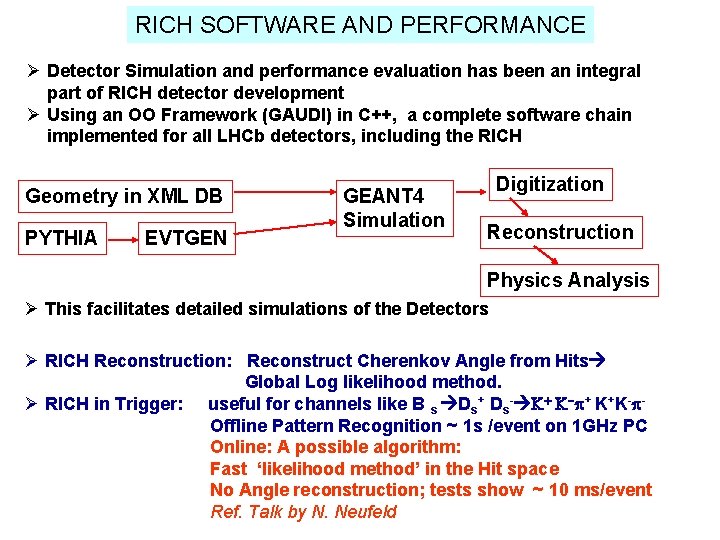
RICH SOFTWARE AND PERFORMANCE Ø Detector Simulation and performance evaluation has been an integral part of RICH detector development Ø Using an OO Framework (GAUDI) in C++, a complete software chain implemented for all LHCb detectors, including the RICH Geometry in XML DB PYTHIA EVTGEN GEANT 4 Simulation Digitization Reconstruction Physics Analysis Ø This facilitates detailed simulations of the Detectors Ø RICH Reconstruction: Reconstruct Cherenkov Angle from Hits Global Log likelihood method. Ø RICH in Trigger: useful for channels like B s Ds+ Ds- K+ K-p+ K+K-p. Offline Pattern Recognition ~ 1 s /event on 1 GHz PC Online: A possible algorithm: Fast ‘likelihood method’ in the Hit space No Angle reconstruction; tests show ~ 10 ms/event Ref. Talk by N. Neufeld
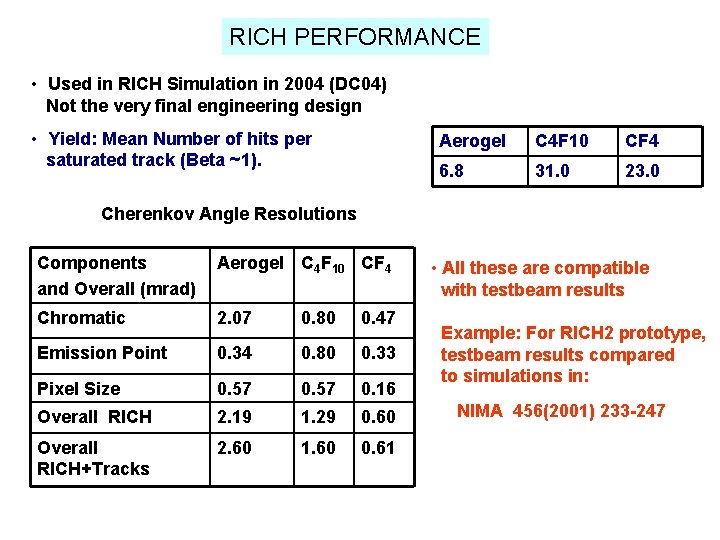
RICH PERFORMANCE • Used in RICH Simulation in 2004 (DC 04) Not the very final engineering design • Yield: Mean Number of hits per saturated track (Beta ~1). Aerogel C 4 F 10 CF 4 6. 8 31. 0 23. 0 Cherenkov Angle Resolutions Components and Overall (mrad) Aerogel C 4 F 10 CF 4 Chromatic 2. 07 0. 80 0. 47 Emission Point 0. 34 0. 80 0. 33 Pixel Size 0. 57 0. 16 Overall RICH 2. 19 1. 29 0. 60 Overall RICH+Tracks 2. 60 1. 60 0. 61 • All these are compatible with testbeam results Example: For RICH 2 prototype, testbeam results compared to simulations in: NIMA 456(2001) 233 -247
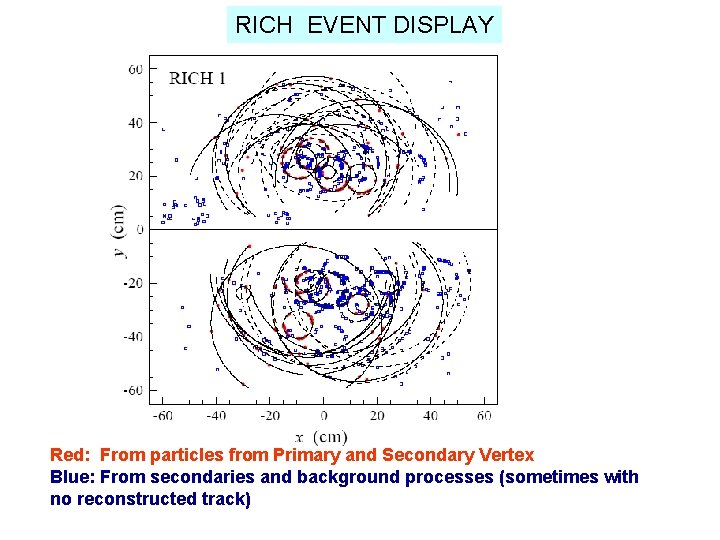
RICH EVENT DISPLAY Red: From particles from Primary and Secondary Vertex Blue: From secondaries and background processes (sometimes with no reconstructed track)
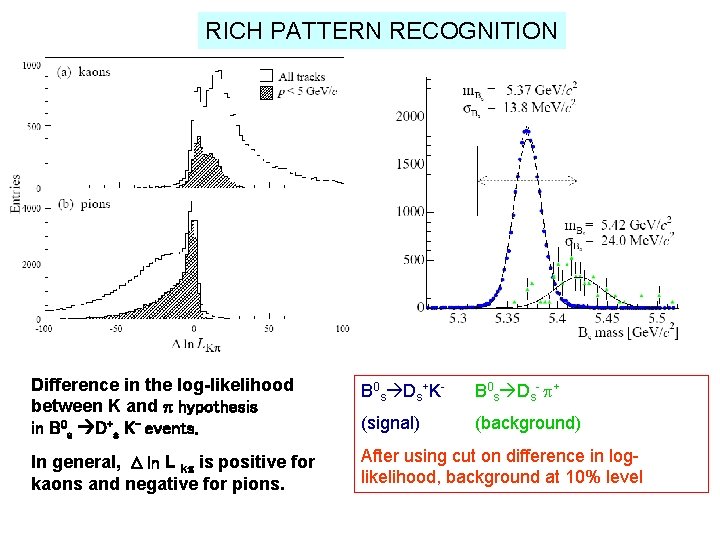
RICH PATTERN RECOGNITION Difference in the log-likelihood between K and p hypothesis in B 0 s D+s K- events. B 0 s Ds+K- B 0 s Ds- p+ (signal) (background) In general, D ln L kp is positive for kaons and negative for pions. After using cut on difference in loglikelihood, background at 10% level
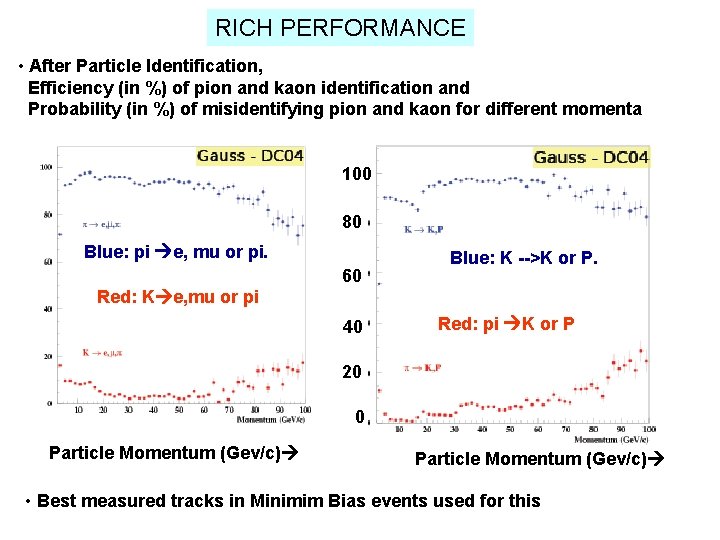
RICH PERFORMANCE • After Particle Identification, Efficiency (in %) of pion and kaon identification and Probability (in %) of misidentifying pion and kaon for different momenta 100 80 Blue: pi e, mu or pi. 60 Blue: K -->K or P. Red: K e, mu or pi 40 Red: pi K or P 20 0 Particle Momentum (Gev/c) • Best measured tracks in Minimim Bias events used for this
SUMMARY AND PLANS § RICH is an essential component of LHCb § HPDs are now being produced for the RICH detectors § Engineering Designs of both RICH detectors are accomplished § RICH 2 construction almost complete and RICH 1 construction underway § Installation expected to be completed by October 2006 § Detailed simulation using GEANT 4 done and expected performance verified
- Slides: 19