
Overview of ISO standardisation actions by Jan Engelen
Overview of ISO standardisation actions by Jan Engelen (K. U. Leuven) jan. engelen@esat. kuleuven. be USEM network day October 29, 2009
What is ISO ? • ISO (International Organization for Standardization) is the world's largest developer of standards; probably over 17500 ! • Administrative headquarters in Geneva • Real standardisation work is split over an hierarchical system of Technical Committees (TC), Subcommittees (SC) and Working Groups (WG). • Due to intensive overlap with IEC (International Electrotechnical Committee), a Joint technical committee (JTC 1) does exist too. • ISO standards can have several parts (sometimes several hundreds); often also the date is added to the name. • One could start participating as member of a national mirror committee or TAG (if existing!) or contact COPOLCO (Anec) • Finally: – – Most ISO standards are not in the public domain, they are sold ! EXCEPTION: Standards edited by JTC 1 can be downloaded freely On the web almost final drafts often can be found! There also many Wikipedia pages for individual ISO standards
ISO standards on Ergonomics (1) Are produced mainly by two working groups: • ISO TC 159/SC 1 (Ergonomic Guiding Principles) and ISO TC 159/SC 4 (Ergonomics of Human-System Interaction) • A few examples: – ISO 24503 - Ergonomics – Accessible design - Using tactile dots and bars on consumer products – ISO 28803 - Ergonomics of the physical environment -Application of international standards for people with special requirements – ISO 9241 - Ergonomics of human-system interaction {more on next slide}
ISO standards on Ergonomics (2) • ISO/TC 159/SC 4/WG 5 (Software ergonomics and human-computer interaction) ISO 9241 - Ergonomics of human-system interaction is a huge multi-part standard – ISO 9241 -135 – Natural language dialogues This standard would provide recommendations and guidelines for the user-centred design of software user interfaces for voice controlled dialogue systems to increase usability. – ISO 9241 -136 – Voice/Auditory interaction This standard would provide recommendations and guidelines for the user-centred design of software user interfaces for voice interaction systems to increase usability. Other parts (cf. wikipedia page for “ISO_9241”): – ISO 9241 -152 – Interpersonal communication – Usability and accessibility of computerbased data and voice communication – ISO 9241 -129 – Guidance on software individualisation – ISO 9241 -154 – Design guidance for interactive voice response (IVR) applications – ISO 9241 -210 – Human Centred design process for interactive systems (WG 6) – ISO 9241 - Parts 900, 910, 930, 940, 971 – Tactile and haptic interactions (WG 9)
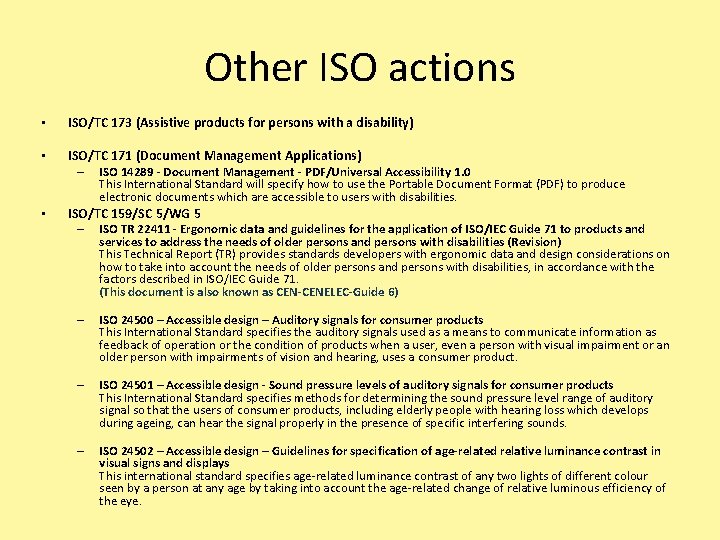
Other ISO actions • ISO/TC 173 (Assistive products for persons with a disability) • ISO/TC 171 (Document Management Applications) – ISO 14289 - Document Management - PDF/Universal Accessibility 1. 0 • This International Standard will specify how to use the Portable Document Format (PDF) to produce electronic documents which are accessible to users with disabilities. ISO/TC 159/SC 5/WG 5 – ISO TR 22411 - Ergonomic data and guidelines for the application of ISO/IEC Guide 71 to products and services to address the needs of older persons and persons with disabilities (Revision) This Technical Report (TR) provides standards developers with ergonomic data and design considerations on how to take into account the needs of older persons and persons with disabilities, in accordance with the factors described in ISO/IEC Guide 71. (This document is also known as CEN-CENELEC-Guide 6) – ISO 24500 – Accessible design – Auditory signals for consumer products This International Standard specifies the auditory signals used as a means to communicate information as feedback of operation or the condition of products when a user, even a person with visual impairment or an older person with impairments of vision and hearing, uses a consumer product. – ISO 24501 – Accessible design - Sound pressure levels of auditory signals for consumer products This International Standard specifies methods for determining the sound pressure level range of auditory signal so that the users of consumer products, including elderly people with hearing loss which develops during ageing, can hear the signal properly in the presence of specific interfering sounds. – ISO 24502 – Accessible design – Guidelines for specification of age-related relative luminance contrast in visual signs and displays This international standard specifies age-related luminance contrast of any two lights of different colour seen by a person at any age by taking into account the age-related change of relative luminous efficiency of the eye.
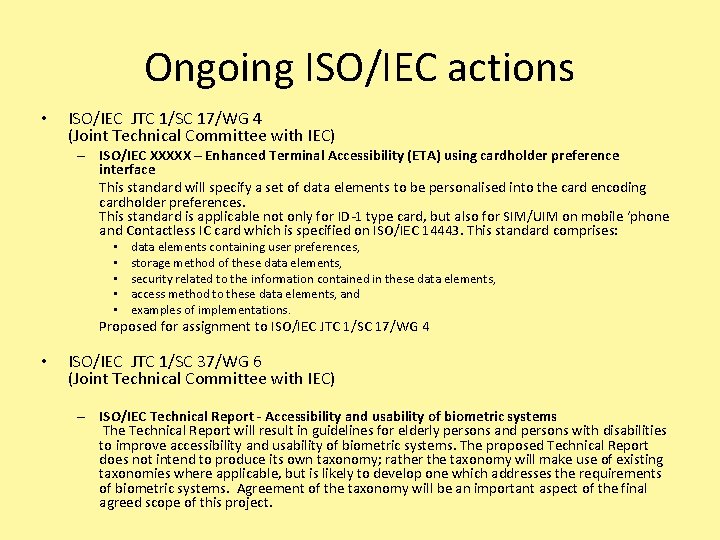
Ongoing ISO/IEC actions • ISO/IEC JTC 1/SC 17/WG 4 (Joint Technical Committee with IEC) – ISO/IEC XXXXX – Enhanced Terminal Accessibility (ETA) using cardholder preference interface This standard will specify a set of data elements to be personalised into the card encoding cardholder preferences. This standard is applicable not only for ID-1 type card, but also for SIM/UIM on mobile ‘phone and Contactless IC card which is specified on ISO/IEC 14443. This standard comprises: • • • data elements containing user preferences, storage method of these data elements, security related to the information contained in these data elements, access method to these data elements, and examples of implementations. Proposed for assignment to ISO/IEC JTC 1/SC 17/WG 4 • ISO/IEC JTC 1/SC 37/WG 6 (Joint Technical Committee with IEC) – ISO/IEC Technical Report - Accessibility and usability of biometric systems The Technical Report will result in guidelines for elderly persons and persons with disabilities to improve accessibility and usability of biometric systems. The proposed Technical Report does not intend to produce its own taxonomy; rather the taxonomy will make use of existing taxonomies where applicable, but is likely to develop one which addresses the requirements of biometric systems. Agreement of the taxonomy will be an important aspect of the final agreed scope of this project.
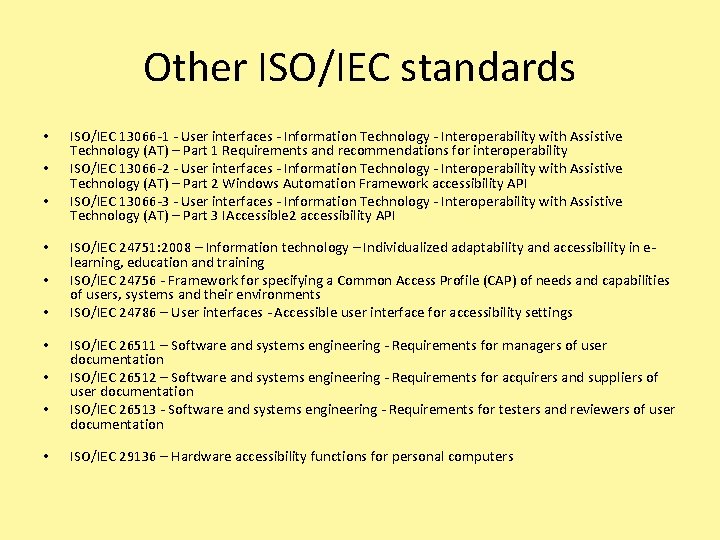
Other ISO/IEC standards • • • ISO/IEC 13066 -1 - User interfaces - Information Technology - Interoperability with Assistive Technology (AT) – Part 1 Requirements and recommendations for interoperability ISO/IEC 13066 -2 - User interfaces - Information Technology - Interoperability with Assistive Technology (AT) – Part 2 Windows Automation Framework accessibility API ISO/IEC 13066 -3 - User interfaces - Information Technology - Interoperability with Assistive Technology (AT) – Part 3 IAccessible 2 accessibility API ISO/IEC 24751: 2008 – Information technology – Individualized adaptability and accessibility in elearning, education and training ISO/IEC 24756 - Framework for specifying a Common Access Profile (CAP) of needs and capabilities of users, systems and their environments ISO/IEC 24786 – User interfaces - Accessible user interface for accessibility settings ISO/IEC 26511 – Software and systems engineering - Requirements for managers of user documentation ISO/IEC 26512 – Software and systems engineering - Requirements for acquirers and suppliers of user documentation ISO/IEC 26513 - Software and systems engineering - Requirements for testers and reviewers of user documentation ISO/IEC 29136 – Hardware accessibility functions for personal computers
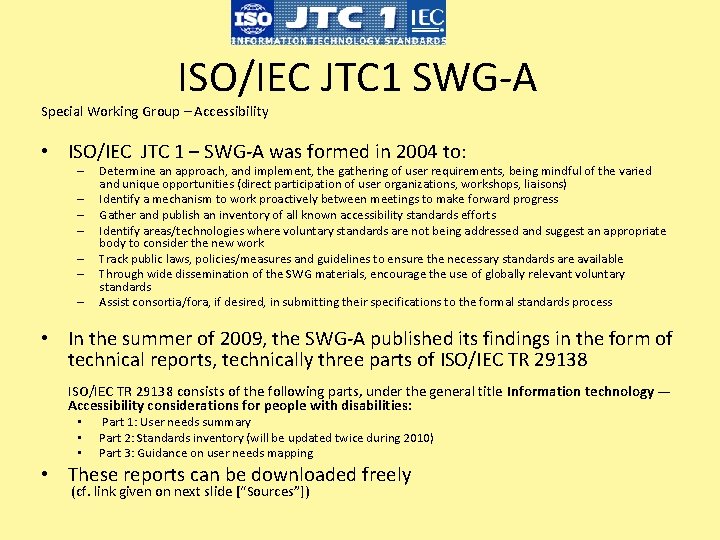
ISO/IEC JTC 1 SWG-A Special Working Group – Accessibility • ISO/IEC JTC 1 – SWG-A was formed in 2004 to: – – – – Determine an approach, and implement, the gathering of user requirements, being mindful of the varied and unique opportunities (direct participation of user organizations, workshops, liaisons) Identify a mechanism to work proactively between meetings to make forward progress Gather and publish an inventory of all known accessibility standards efforts Identify areas/technologies where voluntary standards are not being addressed and suggest an appropriate body to consider the new work Track public laws, policies/measures and guidelines to ensure the necessary standards are available Through wide dissemination of the SWG materials, encourage the use of globally relevant voluntary standards Assist consortia/fora, if desired, in submitting their specifications to the formal standards process • In the summer of 2009, the SWG-A published its findings in the form of technical reports, technically three parts of ISO/IEC TR 29138 consists of the following parts, under the general title Information technology — Accessibility considerations for people with disabilities: • • • Part 1: User needs summary Part 2: Standards inventory (will be updated twice during 2010) Part 3: Guidance on user needs mapping • These reports can be downloaded freely (cf. link given on next slide [“Sources”])
Sources • Richard Hodgkinson (Institute of Scientific and Technical Communicators - ISTC): “Report on International ICT Accessibility Standards Proposed, being developed and recently published” This report is regularly updated and can be downloaded from the Tiresias Website http: //www. tiresias. org/research/standards/report_10. htm • Jan Engelen: “EDEAN member contributions to active standardisation items” (2008) http: //www. dfaei. edean. org/deliverables/dfa@einclusion%20 -%20 Del 2. 4 a. pdf • ISO Ergonomics standards overview • Freely downloadable ISO standards (produced by JTC 1) • Technical reports by ISO/IEC JTC 1 SWG-A http: //www. hfes. org/web/bulletinpdf/0805 bulletin. pdf http: //standards. iso. org/ittf/Publicly. Available. Standards/index. html http: //www. jtc 1 access. org/TR 29138. htm
THANK YOU For more details, you can contact the author: Jan Engelen Kath. Universiteit Leuven (Belgium) jan. engelen@esat. kuleuven. be
- Slides: 10