
OVERVIEW OF INTERNET OF THINGS IOT The term






- Slides: 74
OVERVIEW OF INTERNET OF THINGS (IOT)
The term… ê Kevin Ashton first proposed the concept of the Internet of in 1999. 2
Definitions ê Cluster of European RFID Project (CERP) defines in 2009. êInternet of Things (Io. T) is an integrated part of Future Internet and could be defined as a dynamic global network infrastructure with self configuring capabilities based on standard and interoperable communication protocols where physical and virtual “things” have identities, physical attributes, and virtual personalities and use intelligent interfaces, and are seamlessly integrated into the information network. 3
Definitions ê Hua-Dong Ma (马华东), “Internet of things: Objectives and scientific challenges, ” Journal of Computer Science and Technology, Vol. 26(6), pp. 919 -244, 2011. ê Based on the traditional information carriers including the Internet, telecommunication network and so on, Internet of Things (Io. T) is a network that inter-connects ordinary physical objects with the identifiable addresses so that provides intelligent services. 4
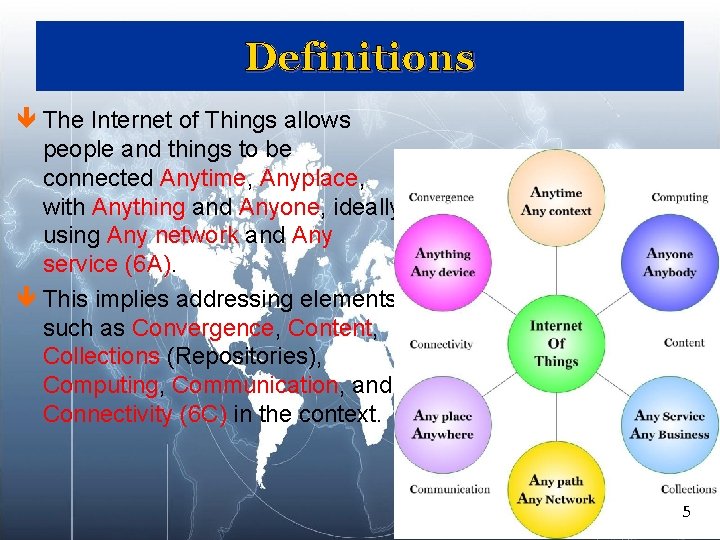
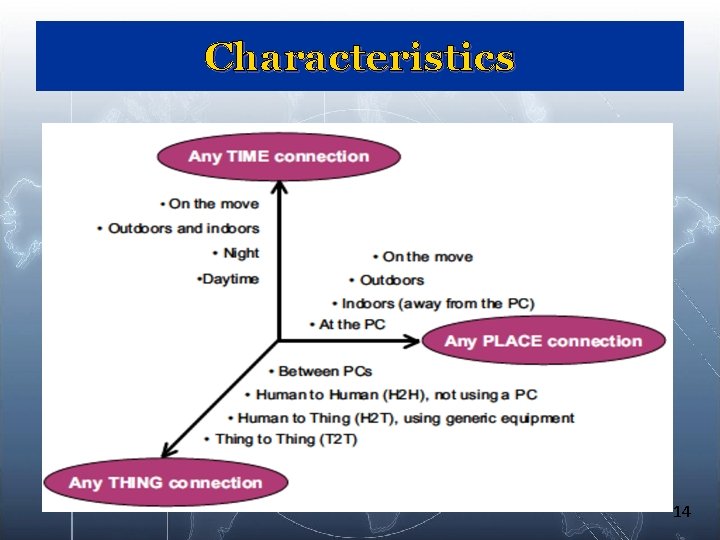
Definitions ê The Internet of Things allows people and things to be connected Anytime, Anyplace, with Anything and Anyone, ideally using Any network and Any service (6 A). ê This implies addressing elements such as Convergence, Content, Collections (Repositories), Computing, Communication, and Connectivity (6 C) in the context. 5
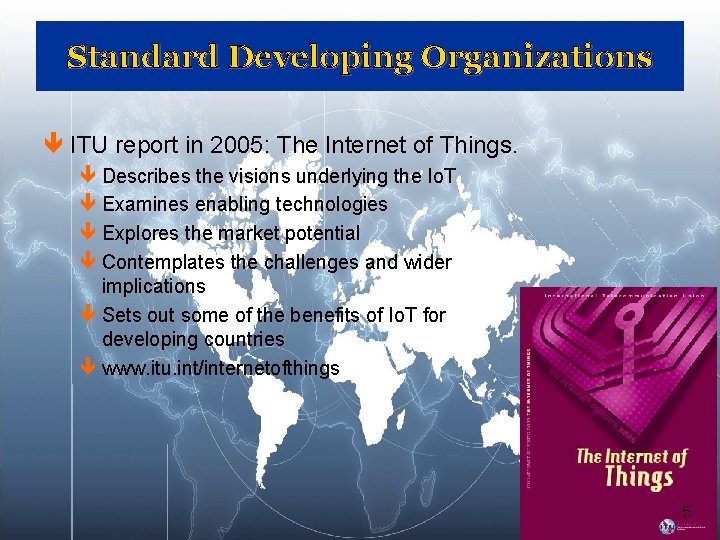
Standard Developing Organizations ê ITU report in 2005: The Internet of Things. ê Describes the visions underlying the Io. T ê Examines enabling technologies ê Explores the market potential ê Contemplates the challenges and wider implications ê Sets out some of the benefits of Io. T for developing countries ê www. itu. int/internetofthings 6
Standard Developing Organizations ê The Global Standards Initiative on Internet of Things (Io. T-GSI) in ITU-T. ê Develop of technical standards enabling the Internet of Things on a global scale (Recommendations). ê Participation from: industry, government entities and SDOs: êETSI M 2 M, GSC MSTF, ISO/IEC JTC 1, TIA, AICTO, ARIB, ATIS, CCSA, GISFI, IEC, IEEE, IETF, ISO, TTA, TTC, IETF etc. 7
ARCHITECTURE
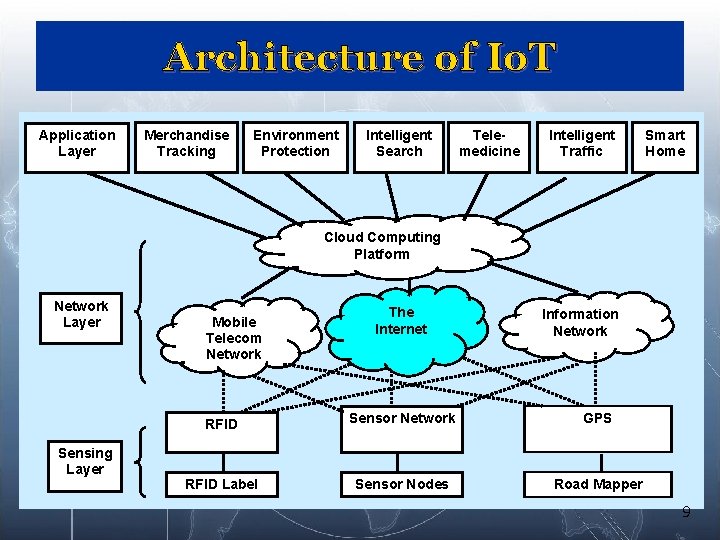
Architecture of Io. T Application Layer Merchandise Tracking Environment Protection Intelligent Search Telemedicine Intelligent Traffic Smart Home Cloud Computing Platform Network Layer Sensing Layer Mobile Telecom Network The Internet Information Network RFID Sensor Network GPS RFID Label Sensor Nodes Road Mapper 9
A Holistic Internet of Things Scenario Including Companies, Public Institutions and People ê Uckelmann, Dieter; Harrison, Mark , Architecting the Internet of Things, Michahelles, Florian (Eds. ), 2011. 10
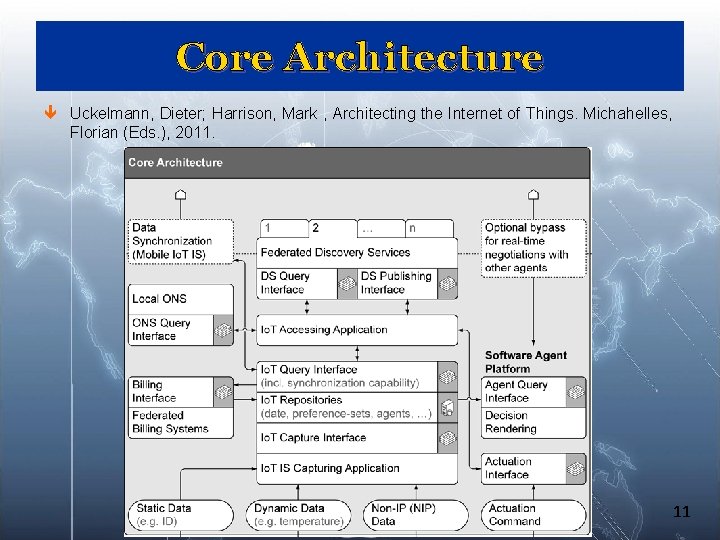
Core Architecture ê Uckelmann, Dieter; Harrison, Mark , Architecting the Internet of Things. Michahelles, Florian (Eds. ), 2011. 11
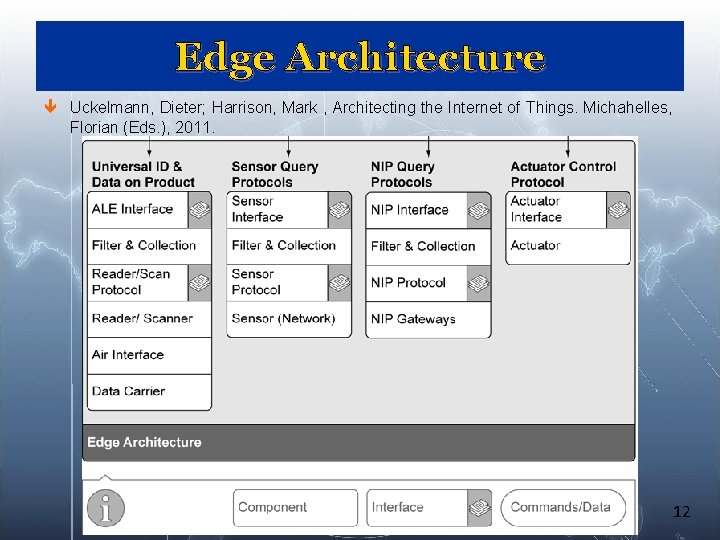
Edge Architecture ê Uckelmann, Dieter; Harrison, Mark , Architecting the Internet of Things. Michahelles, Florian (Eds. ), 2011. 12
CHARACTERISTICS
Characteristics 14
Characteristics ê Ordinary objects are instrumented. ê It means that ordinary objects such as cups, tables, screws, foods and automobile tires can be individually addressed by means of being embedded with chip, RFID, bar code and so on. ê Autonomic terminals are interconnected. ê It means that the instrumented physical objects are connected as autonomic network terminals. ê Pervasive services are intelligent. ê In such an extensively-interconnected network, letting every object participate in the service flow to make the pervasive service intelligent. ê For example, the sensor nodes of vehicle-carrying network or human-carrying network can monitor the status of road or the body of driver to obtain real-time information for guiding driving behaviors. ê From: Hua-Dong Ma (马华东), “Internet of things: Objectives and scientific challenges, ” Journal of Computer Science and Technology, Vol. 26(6), pp. 919 -244, 2011. 15
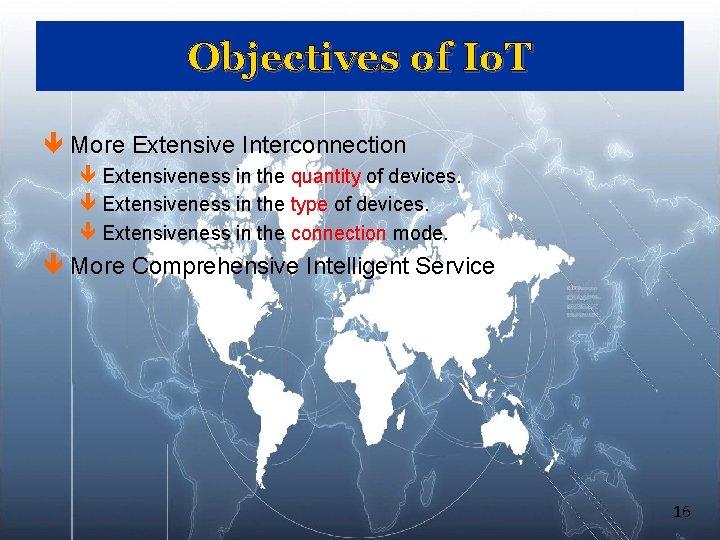
Objectives of Io. T ê More Extensive Interconnection ê Extensiveness in the quantity of devices. ê Extensiveness in the type of devices. ê Extensiveness in the connection mode. ê More Comprehensive Intelligent Service 16
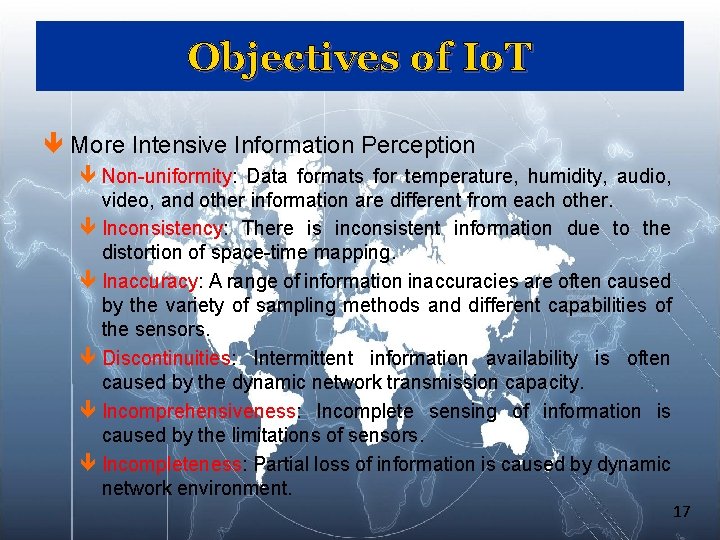
Objectives of Io. T ê More Intensive Information Perception ê Non-uniformity: Data formats for temperature, humidity, audio, video, and other information are different from each other. ê Inconsistency: There is inconsistent information due to the distortion of space-time mapping. ê Inaccuracy: A range of information inaccuracies are often caused by the variety of sampling methods and different capabilities of the sensors. ê Discontinuities: Intermittent information availability is often caused by the dynamic network transmission capacity. ê Incomprehensiveness: Incomplete sensing of information is caused by the limitations of sensors. ê Incompleteness: Partial loss of information is caused by dynamic network environment. 17
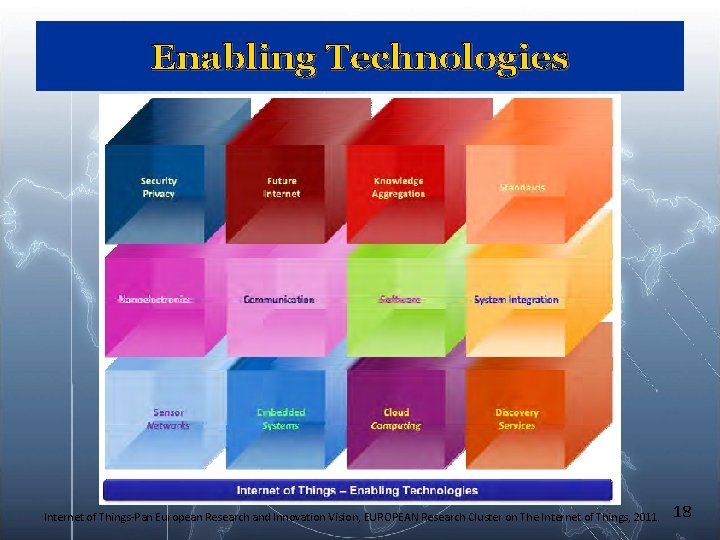
Enabling Technologies Internet of Things-Pan European Research and Innovation Vision, EUROPEAN Research Cluster on The Internet of Things, 2011. 18
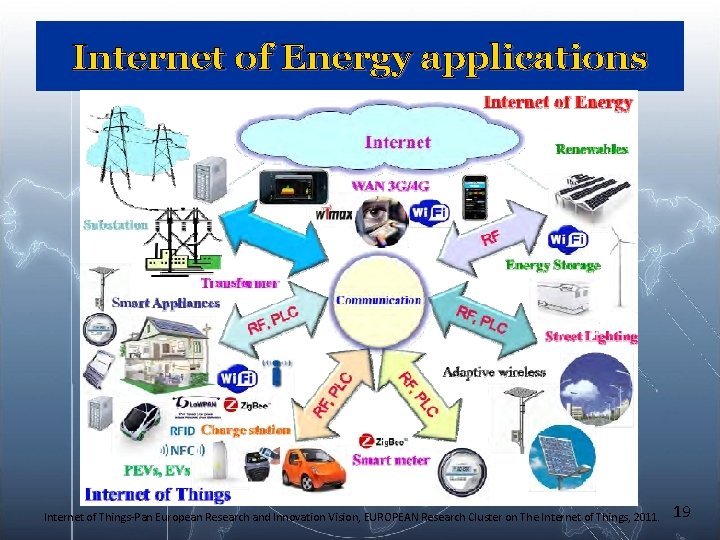
Internet of Energy applications Internet of Things-Pan European Research and Innovation Vision, EUROPEAN Research Cluster on The Internet of Things, 2011. 19
APPLICATIONS
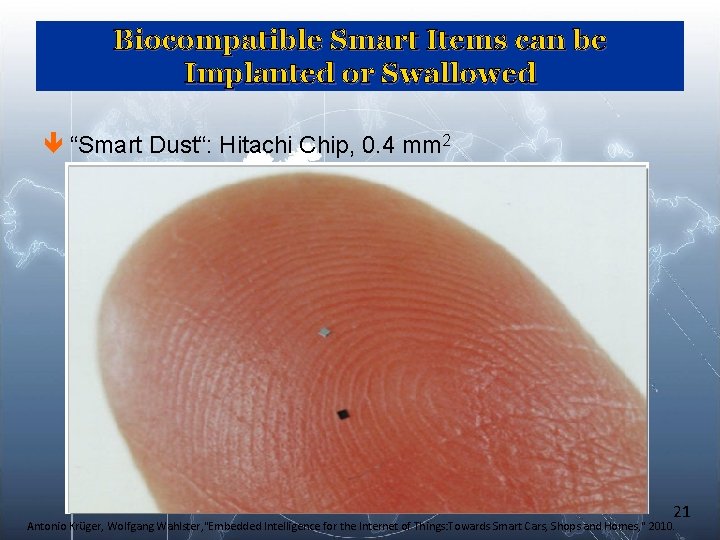
Biocompatible Smart Items can be Implanted or Swallowed ê “Smart Dust“: Hitachi Chip, 0. 4 mm 2 21 Antonio Krüger, Wolfgang Wahlster, "Embedded Intelligence for the Internet of Things: Towards Smart Cars, Shops and Homes, " 2010.
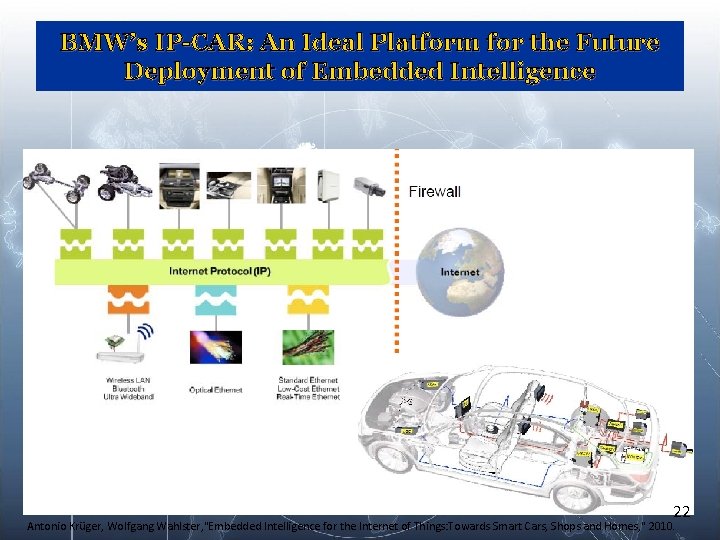
BMW’s IP-CAR: An Ideal Platform for the Future Deployment of Embedded Intelligence 22 Antonio Krüger, Wolfgang Wahlster, "Embedded Intelligence for the Internet of Things: Towards Smart Cars, Shops and Homes, " 2010.
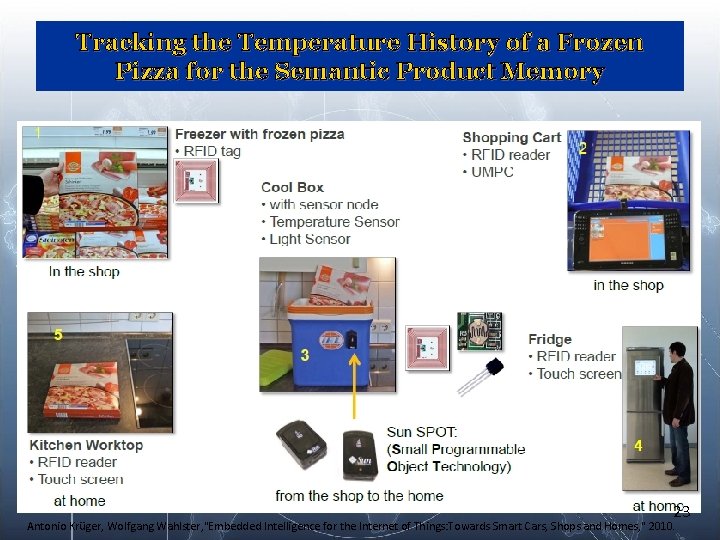
Tracking the Temperature History of a Frozen Pizza for the Semantic Product Memory 23 Antonio Krüger, Wolfgang Wahlster, "Embedded Intelligence for the Internet of Things: Towards Smart Cars, Shops and Homes, " 2010.
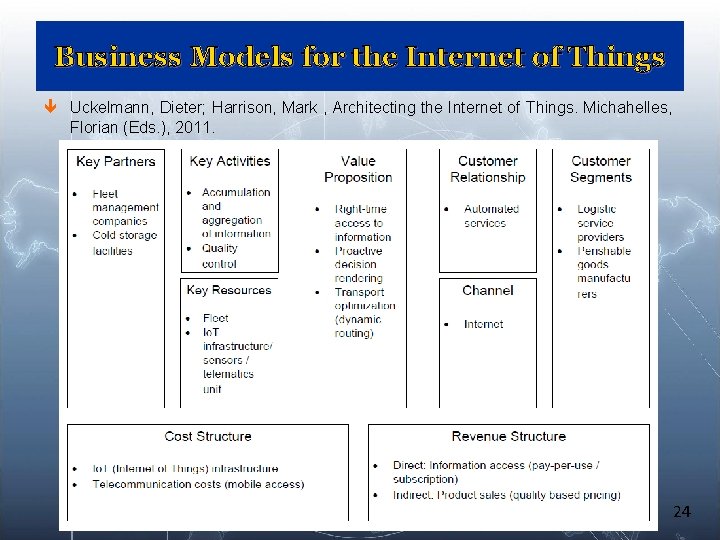
Business Models for the Internet of Things ê Uckelmann, Dieter; Harrison, Mark , Architecting the Internet of Things. Michahelles, Florian (Eds. ), 2011. 24
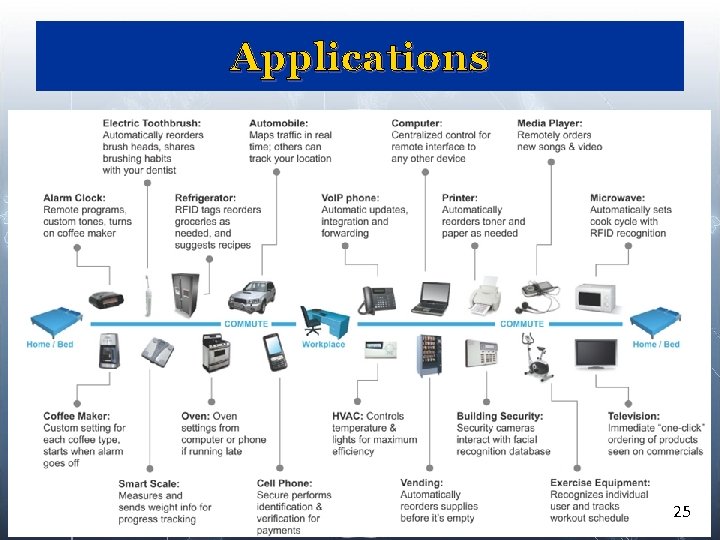
Applications 25
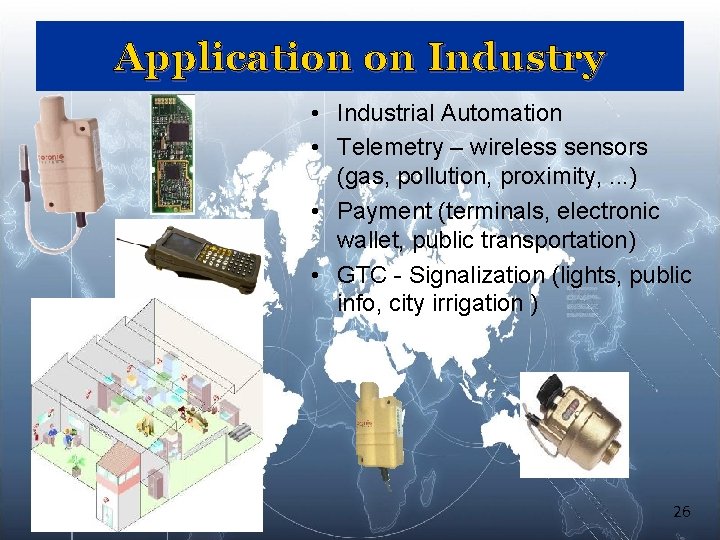
Application on Industry • Industrial Automation • Telemetry – wireless sensors (gas, pollution, proximity, . . . ) • Payment (terminals, electronic wallet, public transportation) • GTC - Signalization (lights, public info, city irrigation ) 26
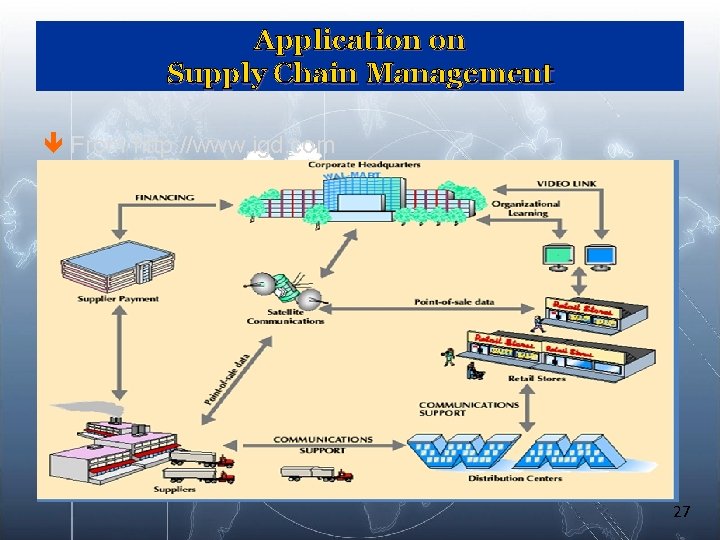
Application on Supply Chain Management ê From http: //www. igd. com 27
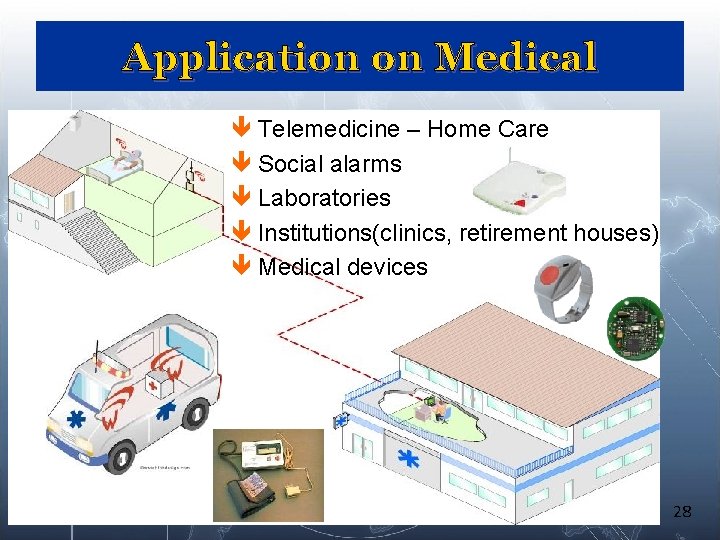
Application on Medical ê Telemedicine – Home Care ê Social alarms ê Laboratories ê Institutions(clinics, retirement houses) ê Medical devices 28
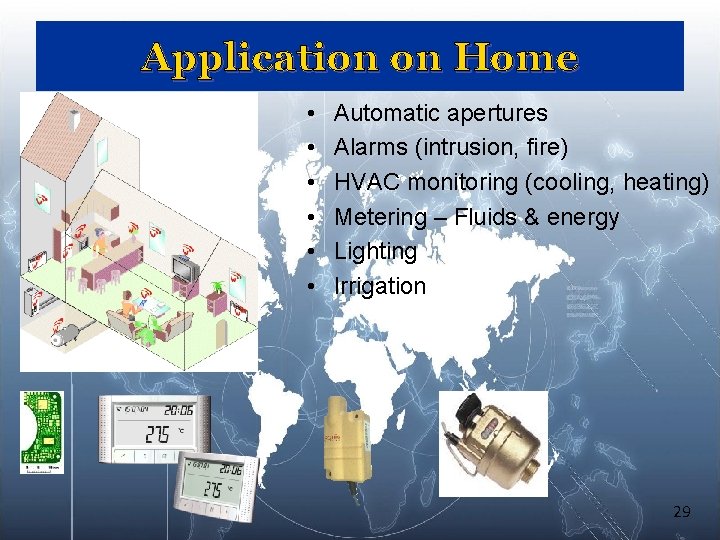
Application on Home • • • Automatic apertures Alarms (intrusion, fire) HVAC monitoring (cooling, heating) Metering – Fluids & energy Lighting Irrigation 29
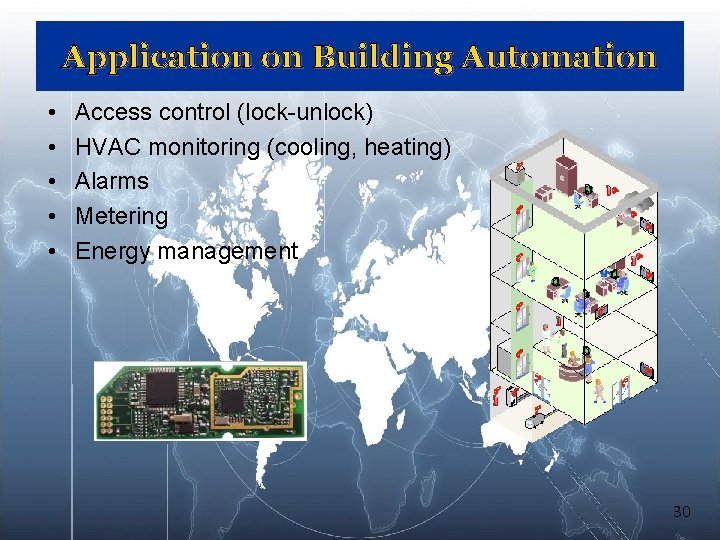
Application on Building Automation • • • Access control (lock-unlock) HVAC monitoring (cooling, heating) Alarms Metering Energy management 30
Strategic Vertical Industries ê ITS: Intelligent Transport System Communications ê ITU-T Focus Group on Car Communication ê ITU-T Focus Group on Driver Distraction ê Smart Grid ê ITU-T Focus Group ê e. Health ê Planned workshop on e. Health (in cooperation with WHO) and related technology standards. 31
OPEN ISSUES
Issues ê What is a thing? ê Computers equipped with communication interfaces. ê Not computers, but who are associated with computers equipped with communication interfaces. ê What is the identifier of a thing? ê A serial number, such as an EPC code. ê An IP address. ê Others: a fix hash value, or adhoc naming scheme. ê Authentication ê Identity Protection ê Identity protection enforces privacy by hiding things identities. 33
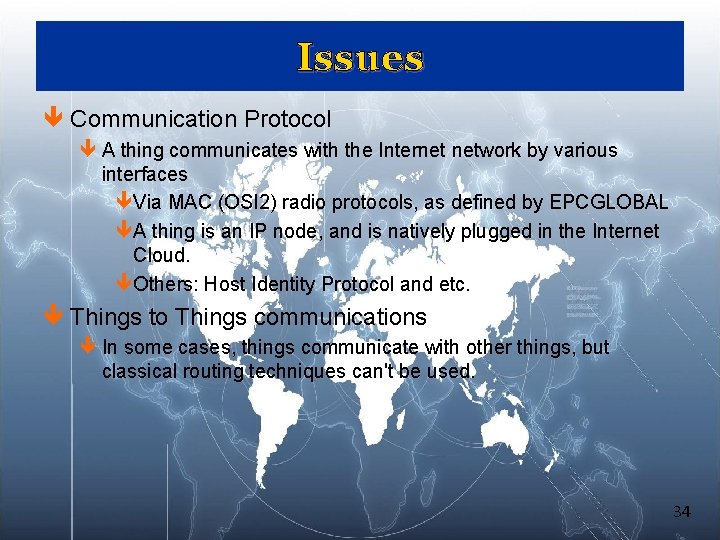
Issues ê Communication Protocol ê A thing communicates with the Internet network by various interfaces êVia MAC (OSI 2) radio protocols, as defined by EPCGLOBAL êA thing is an IP node, and is natively plugged in the Internet Cloud. êOthers: Host Identity Protocol and etc. ê Things to Things communications ê In some cases, things communicate with other things, but classical routing techniques can't be used. 34
Future Highlights ê The Io. T-GSI will approve a new Io. T-Overview on which aims to cover 02 -2012 : ê High level concept (vision) ê Business and social drivers, ecosystem and business models ê Essential terminology ê Scope (applications/services, networks, M 2 M, devices, security, enabling technologies, etc. ) ê Very High Level Requirements ê Key features / key areas / key components ê High level Io. T diagrams ê Taxonomies 35
CONSIDERATIONS
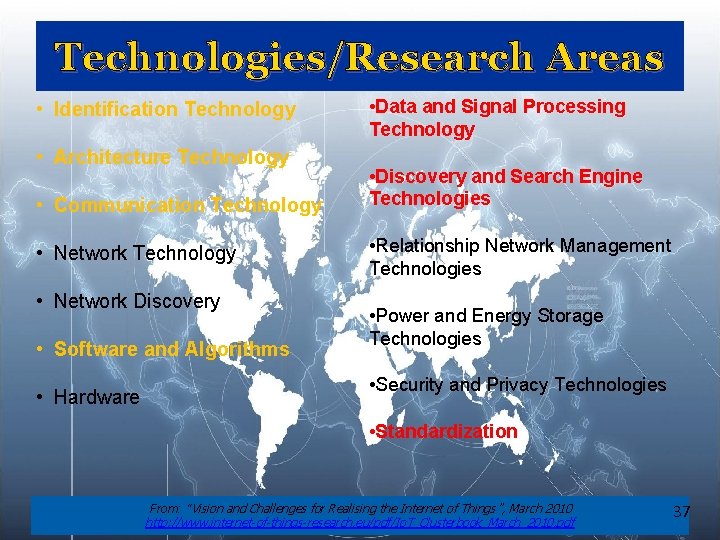
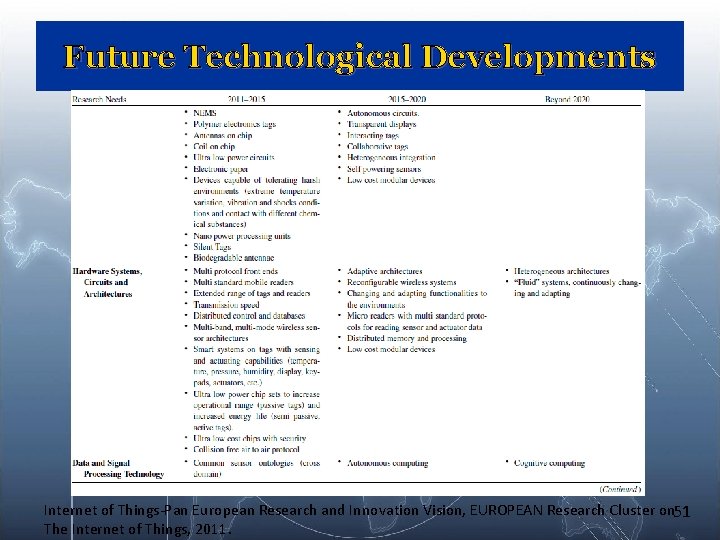
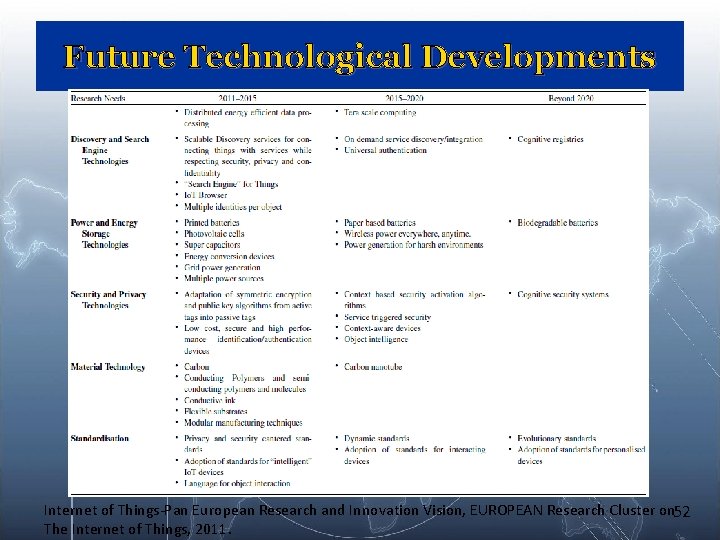
Technologies/Research Areas • Identification Technology • Architecture Technology • Communication Technology • Network Discovery • Software and Algorithms • Hardware • Data and Signal Processing Technology • Discovery and Search Engine Technologies • Relationship Network Management Technologies • Power and Energy Storage Technologies • Security and Privacy Technologies • Standardization From: “Vision and Challenges for Realising the Internet of Things ”, March 2010 http: //www. internet-of-things-research. eu/pdf/Io. T_Clusterbook_March_2010. pdf 37
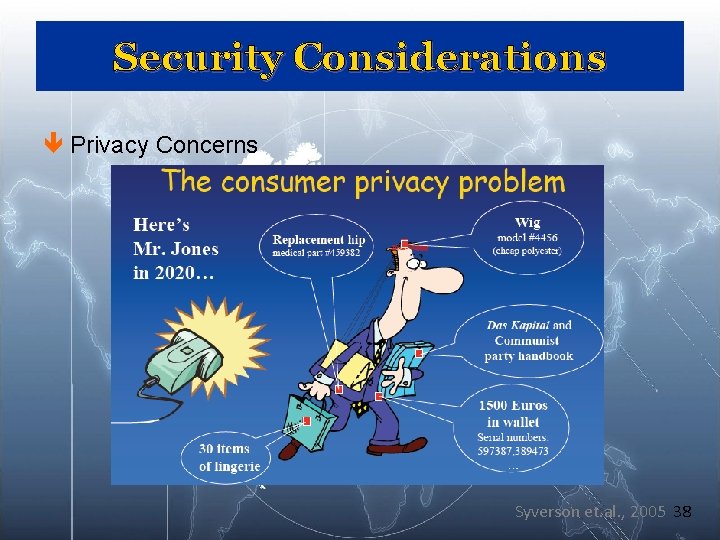
Security Considerations ê Privacy Concerns Syverson et. al. , 2005 38
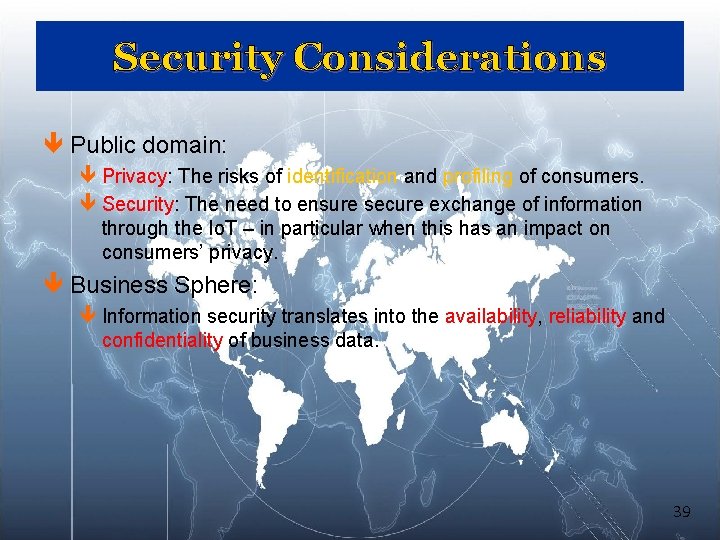
Security Considerations ê Public domain: ê Privacy: The risks of identification and profiling of consumers. ê Security: The need to ensure secure exchange of information through the Io. T – in particular when this has an impact on consumers’ privacy. ê Business Sphere: ê Information security translates into the availability, reliability and confidentiality of business data. 39
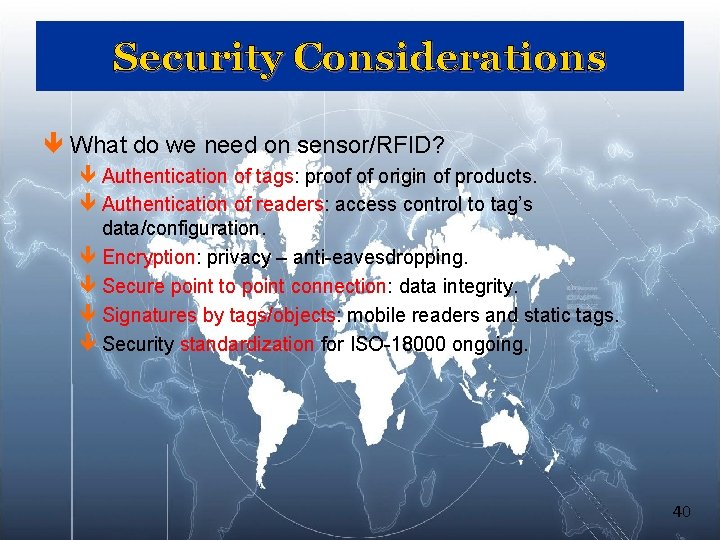
Security Considerations ê What do we need on sensor/RFID? ê Authentication of tags: proof of origin of products. ê Authentication of readers: access control to tag’s data/configuration. ê Encryption: privacy – anti-eavesdropping. ê Secure point to point connection: data integrity. ê Signatures by tags/objects: mobile readers and static tags. ê Security standardization for ISO-18000 ongoing. 40
CHALLENGES &TRENDS
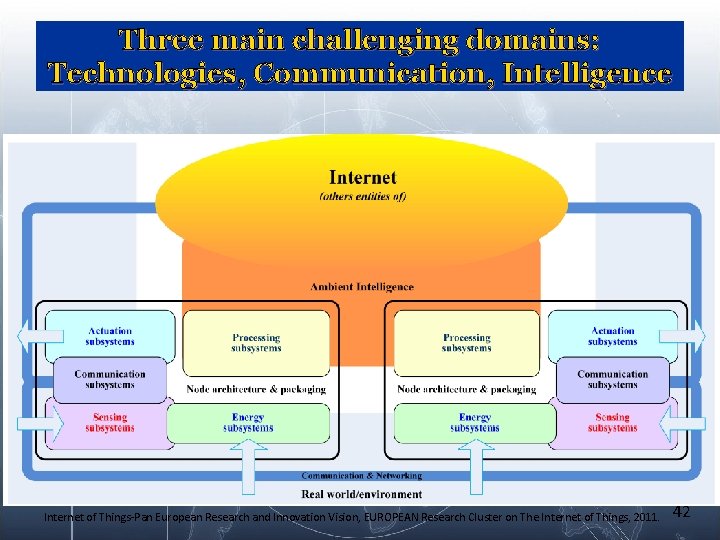
Three main challenging domains: Technologies, Communication, Intelligence Internet of Things-Pan European Research and Innovation Vision, EUROPEAN Research Cluster on The Internet of Things, 2011. 42
Challenges ê Scaling ê Can/how do the “things” work in an Io. T environment on a large scale – billions/trillions or more sensors/“things”? ê Discovery ê How do I find services? And how do I make my things discoverable? ê Performance ê Moving towards event-driven, publish/subscribe, Complex Event Processing mechanisms to optimize the flow of information. ê Information can be stored as needed, filtered and sent to the appropriate recipients/applications 43
Challenges ê Standards Harmonization ê Multiple standards need to be harmonized in order to realize interoperability across systems. ê Big Data ê Things of Io. T add to the growing amount of monitoring data that is available to a wide range of users. ê How do we effectively analyze all of this data and ensure that meaningful and relevant data and decisions are made? 44
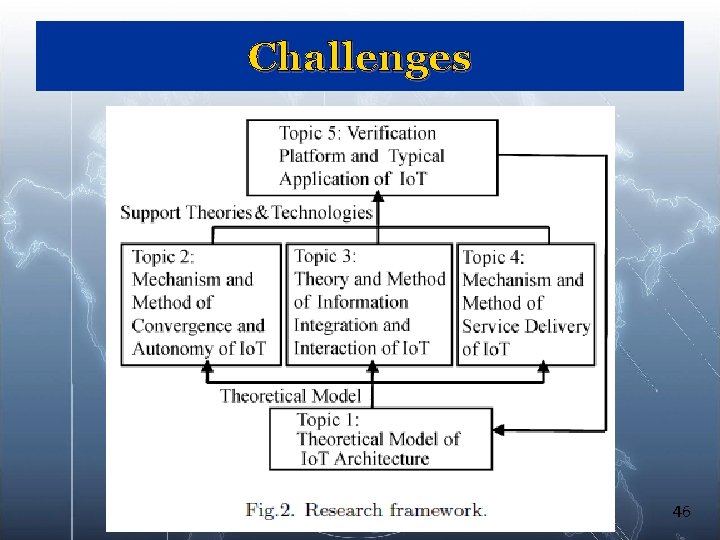
Challenges ê Hua-Dong Ma (马华东) proposed: ê Problem 1: Data exchange among large-scale heterogeneous network elements. ê Problem 2: Effective integration and interaction adaptation of uncertain information. ê Problem 3: Service adaptation in the dynamic system environment. ê Topic 1~Topic 5 45
Challenges 46
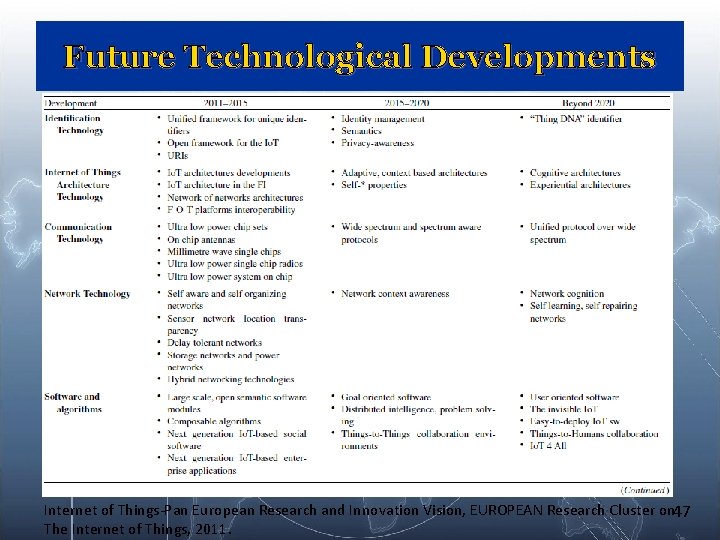
Future Technological Developments Internet of Things-Pan European Research and Innovation Vision, EUROPEAN Research Cluster on 47 The Internet of Things, 2011.
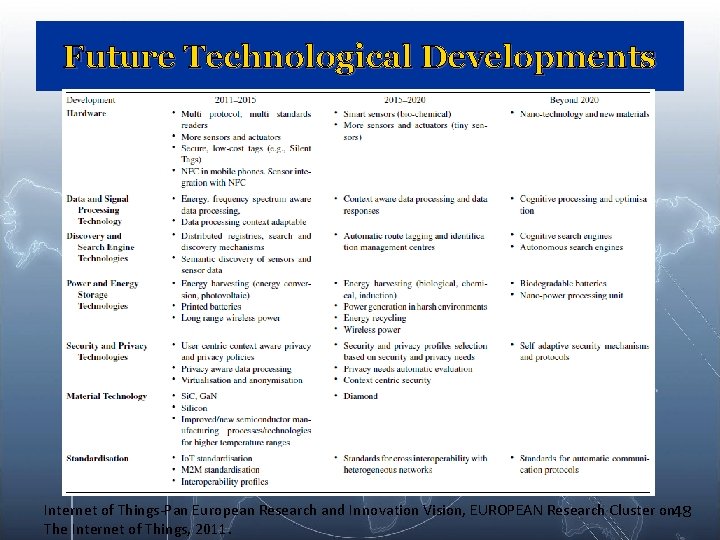
Future Technological Developments Internet of Things-Pan European Research and Innovation Vision, EUROPEAN Research Cluster on 48 The Internet of Things, 2011.
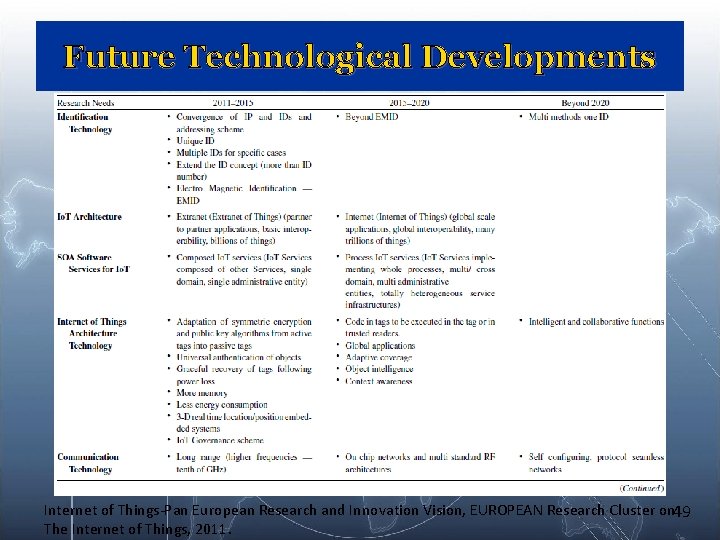
Future Technological Developments Internet of Things-Pan European Research and Innovation Vision, EUROPEAN Research Cluster on 49 The Internet of Things, 2011.
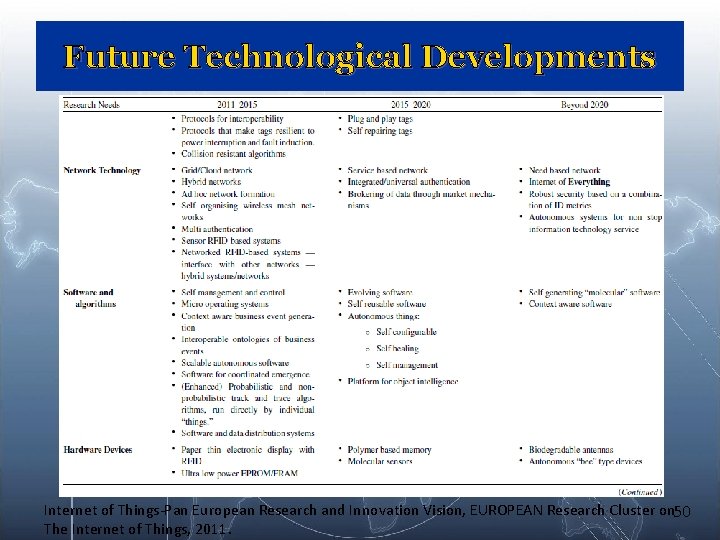
Future Technological Developments Internet of Things-Pan European Research and Innovation Vision, EUROPEAN Research Cluster on 50 The Internet of Things, 2011.
Future Technological Developments Internet of Things-Pan European Research and Innovation Vision, EUROPEAN Research Cluster on 51 The Internet of Things, 2011.
Future Technological Developments Internet of Things-Pan European Research and Innovation Vision, EUROPEAN Research Cluster on 52 The Internet of Things, 2011.
Thanks We humans generate data, a lot of data as we develop in time. This data tells stories about our lives, therefore we need to make art that captures it.
APPENDIX CURRENT POSITION OF SENSOR
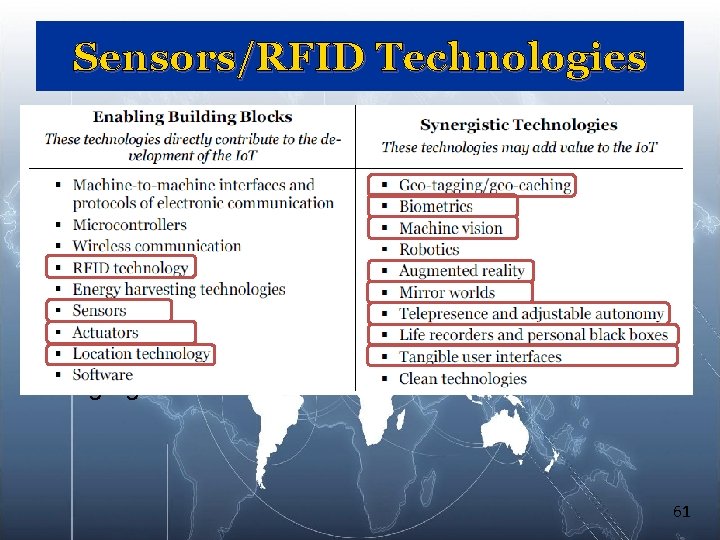
Sensors/RFID Technologies ê highlighted in red. 61
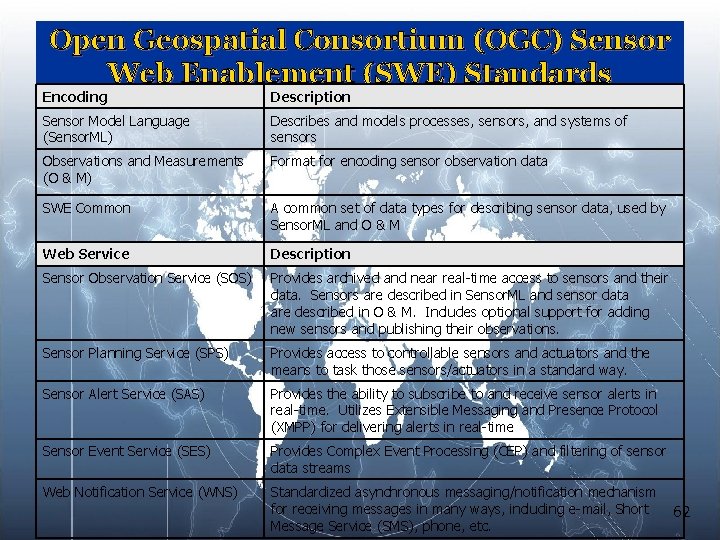
Open Geospatial Consortium (OGC) Sensor Web Enablement (SWE) Standards Encoding Description Sensor Model Language (Sensor. ML) Describes and models processes, sensors, and systems of sensors Observations and Measurements (O & M) Format for encoding sensor observation data SWE Common A common set of data types for describing sensor data, used by Sensor. ML and O & M Web Service Description Sensor Observation Service (SOS) Provides archived and near real-time access to sensors and their data. Sensors are described in Sensor. ML and sensor data are described in O & M. Includes optional support for adding new sensors and publishing their observations. Sensor Planning Service (SPS) Provides access to controllable sensors and actuators and the means to task those sensors/actuators in a standard way. Sensor Alert Service (SAS) Provides the ability to subscribe to and receive sensor alerts in real-time. Utilizes Extensible Messaging and Presence Protocol (XMPP) for delivering alerts in real-time Sensor Event Service (SES) Provides Complex Event Processing (CEP) and filtering of sensor data streams Web Notification Service (WNS) Standardized asynchronous messaging/notification mechanism for receiving messages in many ways, including e-mail, Short Message Service (SMS), phone, etc. 62
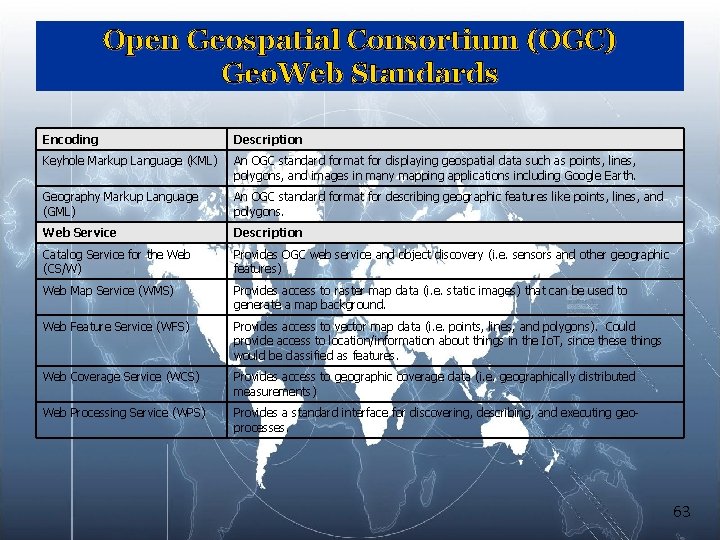
Open Geospatial Consortium (OGC) Geo. Web Standards Encoding Description Keyhole Markup Language (KML) An OGC standard format for displaying geospatial data such as points, lines, polygons, and images in many mapping applications including Google Earth. Geography Markup Language (GML) An OGC standard format for describing geographic features like points, lines, and polygons. Web Service Description Catalog Service for the Web (CS/W) Provides OGC web service and object discovery (i. e. sensors and other geographic features) Web Map Service (WMS) Provides access to raster map data (i. e. static images) that can be used to generate a map background. Web Feature Service (WFS) Provides access to vector map data (i. e. points, lines, and polygons). Could provide access to location/information about things in the Io. T, since these things would be classified as features. Web Coverage Service (WCS) Provides access to geographic coverage data (i. e. geographically distributed measurements) Web Processing Service (WPS) Provides a standard interface for discovering, describing, and executing geoprocesses. 63
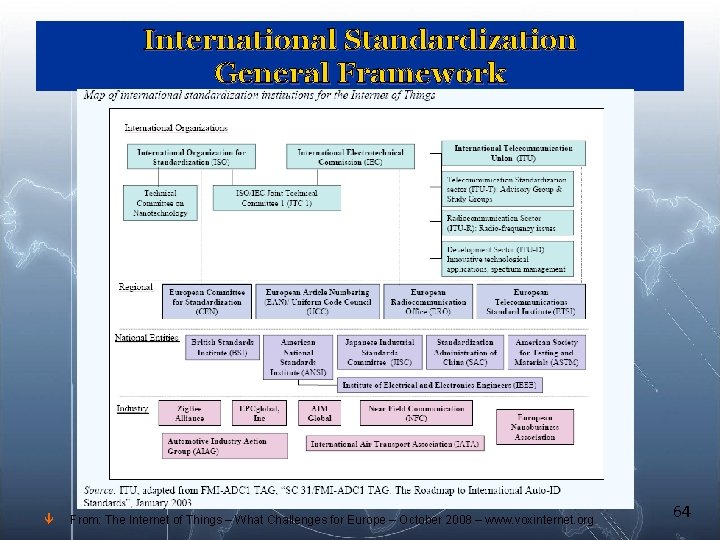
International Standardization General Framework ê From: The Internet of Things – What Challenges for Europe – October 2008 – www. voxinternet. org 64
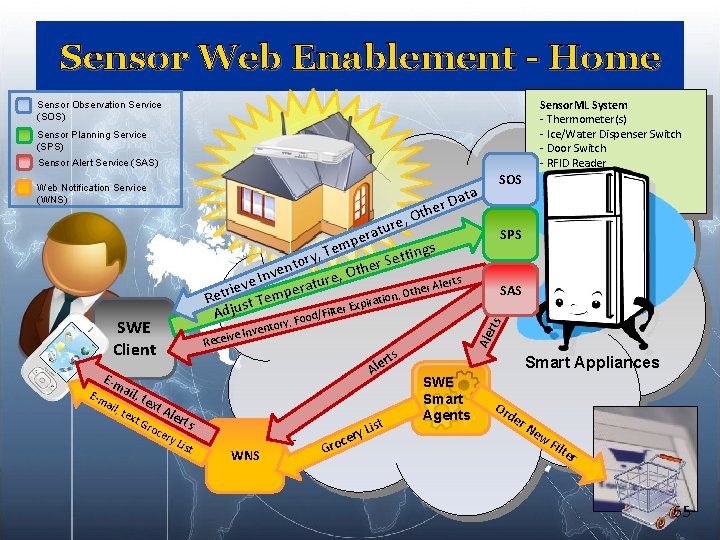
Sensor Web Enablement - Home Sensor. ML System - Thermometer(s) - Ice/Water Dispenser Switch - Door Switch - RFID Reader Sensor Observation Service (SOS) Sensor Planning Service (SPS) Sensor Alert Service (SAS) Web Notification Service (WNS) ata D r he E-m ail, F rts e l A tex t Ale t. G rts roc ery List tex y, entor v n I e v Recei st y Li WNS cer Gro SPS SAS Ale rts SWE Client , Ot e r ratu e p em T , tings t y e r S o t ther ven O , n I e rts ratur eve er Ale i h e t r p O t , ion Re st Tem xpirat E r u j e t l i Ad ood/F SOS Smart Appliances SWE Smart Agents Or de r. N ew Fil ter 65
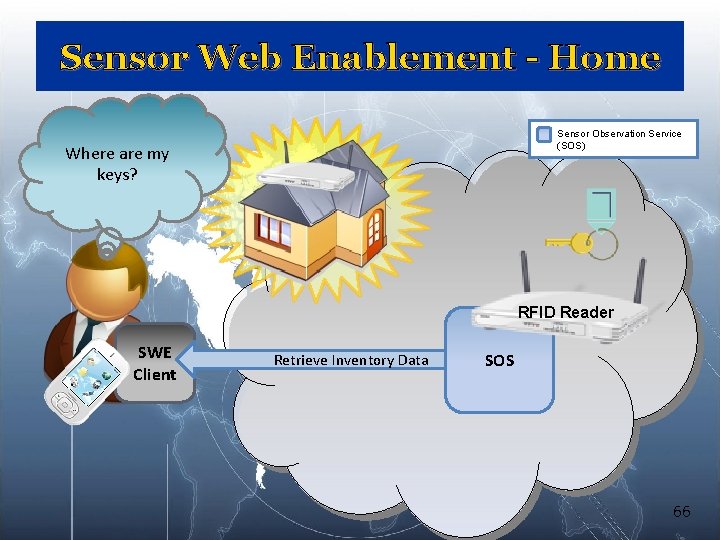
Sensor Web Enablement - Home Sensor Observation Service (SOS) Where are my keys? RFID Reader SWE Client Retrieve Inventory Data SOS 66
APPENDIX CURRENT POSITION OF RFID Anthony Furness, "Insight into the Current Position of RFID-UK, Europe and around the World, " Intellect Wireless Council 21 st October 2010.
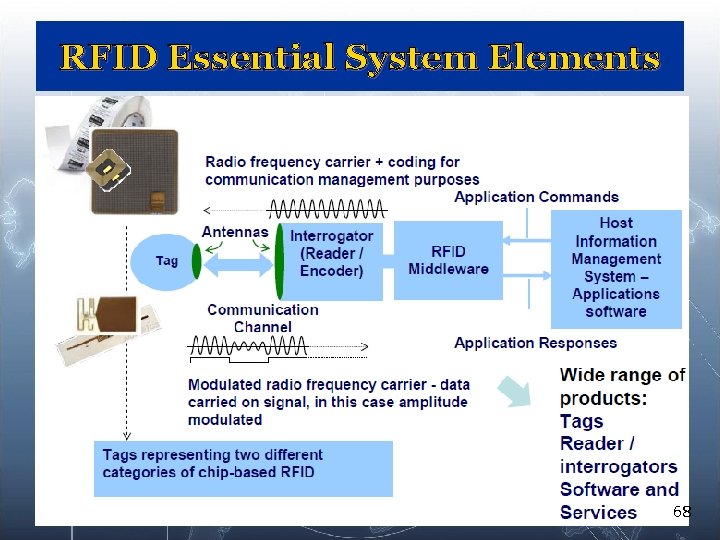
RFID Essential System Elements 68
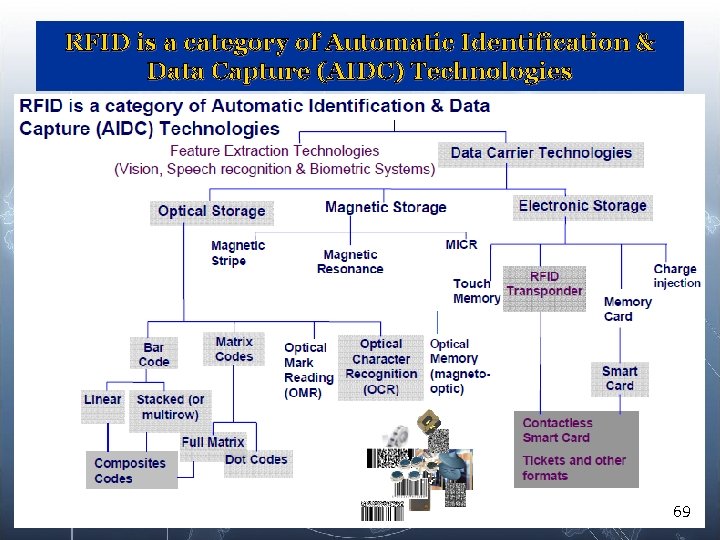
RFID is a category of Automatic Identification & Data Capture (AIDC) Technologies 69
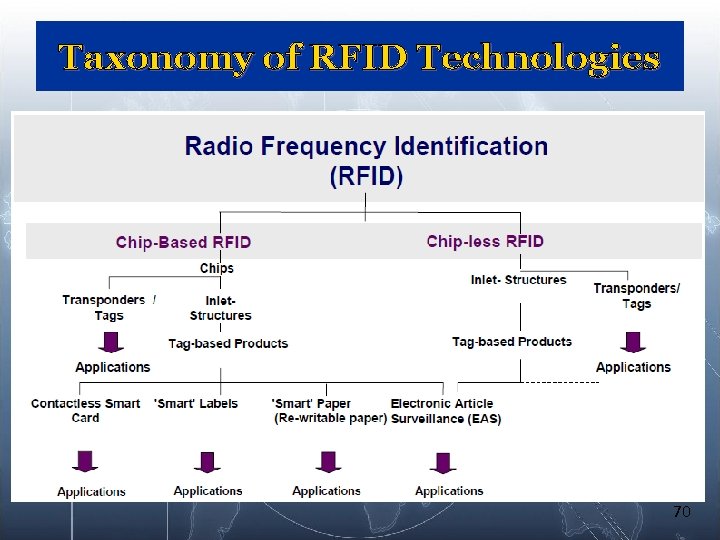
Taxonomy of RFID Technologies 70
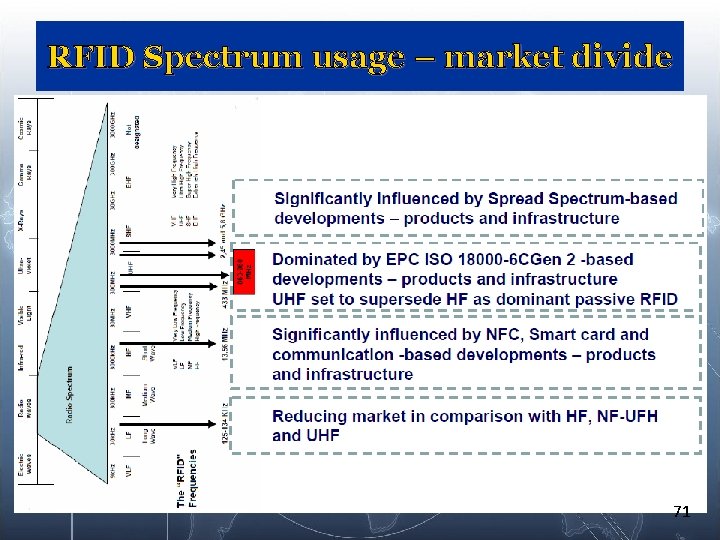
RFID Spectrum usage – market divide 71
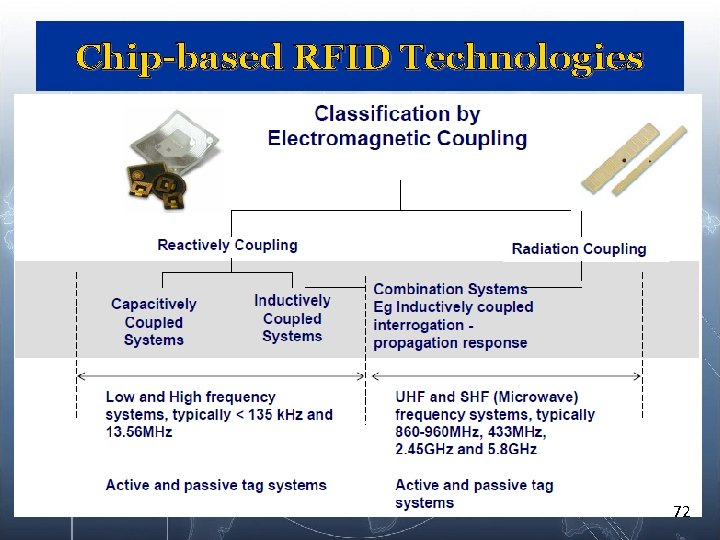
Chip-based RFID Technologies 72
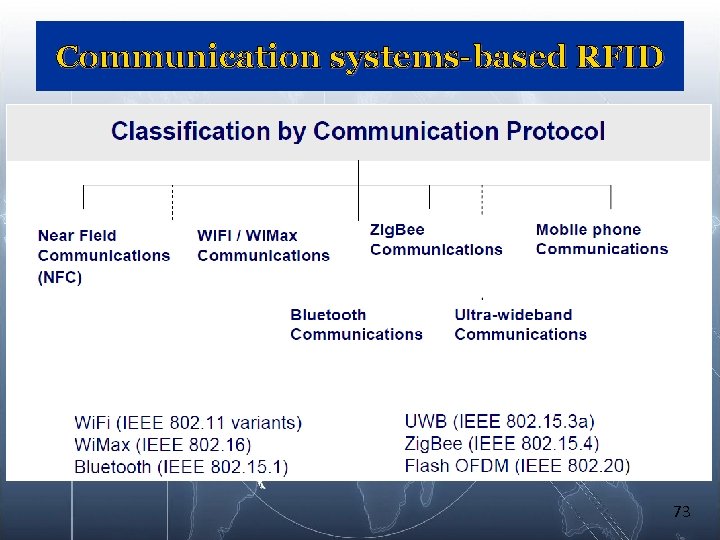
Communication systems-based RFID 73
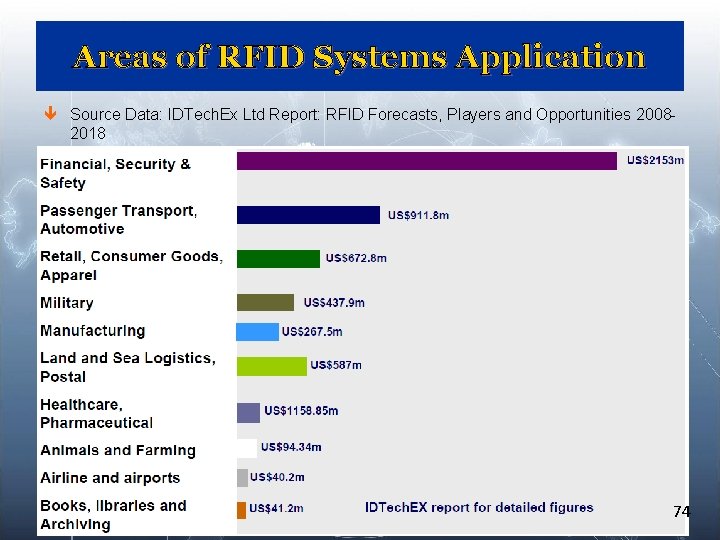
Areas of RFID Systems Application ê Source Data: IDTech. Ex Ltd Report: RFID Forecasts, Players and Opportunities 20082018 74