
OVERVIEW OF INTELLIGENCE TEST Degree Course Three Years
- Slides: 52
OVERVIEW OF INTELLIGENCE TEST Degree Course (Three Years) Psychology Honours B. A. Part– II Paper III by Dr. Ranjan Kumar Ph. D ; M Phil ; PGDGC Assistant Professor of Psychology Ram Ratan Singh College, Mokama Patliputra University, Patna
TESTS OF INTELLIGENCE Do you think IQ tests are good indication of intelligence? A. Yes B. No C. Not sure
What is intelligence? �A loaded question. . . �Ability to understand, reason and perceive ; quickness in learning; mental alertness; ability to grasp relationships etc �Buddhi, pratibha, prajna, medha, dhi, chaturya are terms used in Indian context �The capacity to profit from experience and to go beyond the given
�Intelligence is what intelligence test measures(Alfred Binet, 1904) �The ability to judge well, to understand well and to reason well (Binet & Simon, 1905) �The aggregate capacity of the individual to act purposefully, to think rationally and to deal effectively with the environment(David Wechsler, 1939) �The ability or skill to solve problems or fashion products which are valued within one or more cultural settings(Howard Gardner, 1986)
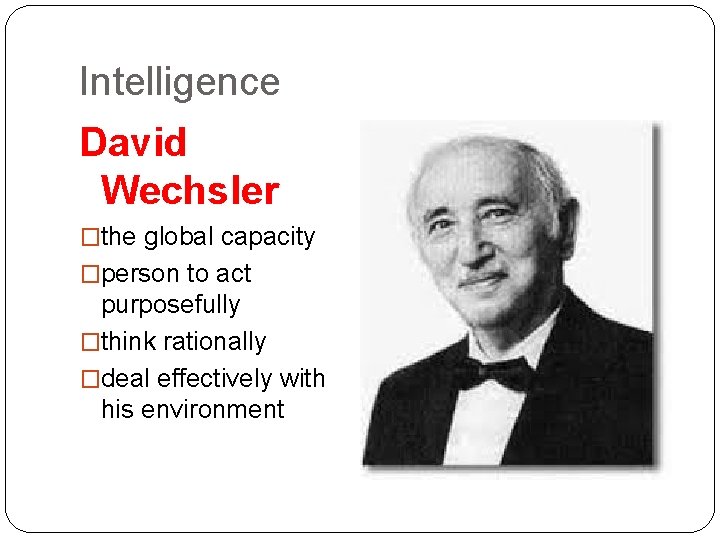
Intelligence David Wechsler �the global capacity �person to act purposefully �think rationally �deal effectively with his environment
Intelligence testing in retrospect �British scientist Sir Francis Galton establishes first anthropometric lab in 1884 to measure intelligence (head circumference, reaction time strength and movement, visual discrimination, breathing capacity) �Father of mental testing �James Mc. Keen Cattell coined the term mental test �Both reduced intelligence to sensory , perceptual and motor processes
�First systematic attempt by Alfred Binet and his student T Simon in 1904 �First test of intelligence consisting of 30 items came out in 1905 to identify children with special needs(Binet-Simon test) �Items ranged from the ability to touch one’s ear when asked, to draw designs from memory and define abstract concepts. �Core of intelligence consists of more complex mental processes such as memory, imagery, comprehension and judgment
�The Binet-Simon test was revised and expanded in 1908 where he introduced the concept of mental age �Another version came out in 1911 �William Stern introduced the concept of mental quotient in 1912(MA/CA)
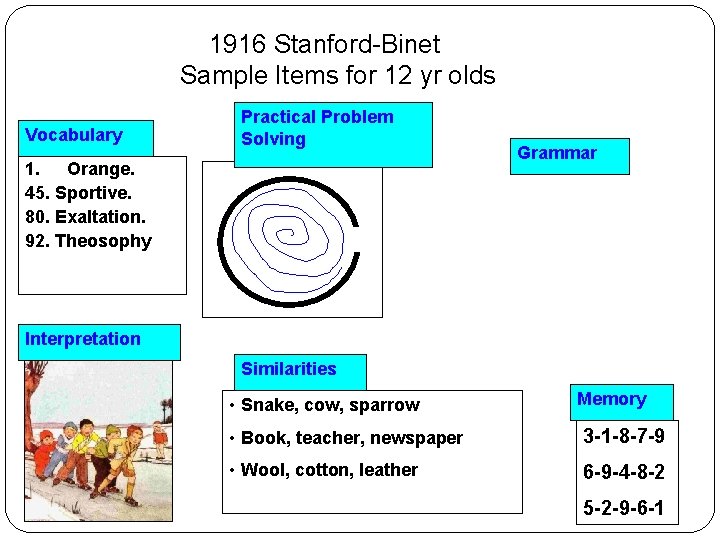
�First US intelligence test introduced by Lewis Terman in 1916 �Revision of Binet-Simon test at Stanford University �Stanford-Binet test �Currently 5 th revision of SB test in use �Converted MQ to intelligence quotient (MA/CA x 100)
Types of IQ �Ratio IQ �Deviation IQ �First type of IQ �A type of standard �Stern (1938) score �Mean = 100, SD = 15/16 �Compares IQ to same age peers �Normal distribution �WISC uses this �IQ = MA/CA x 100 �Same IQ has different meanings at different ages �Not used as often now
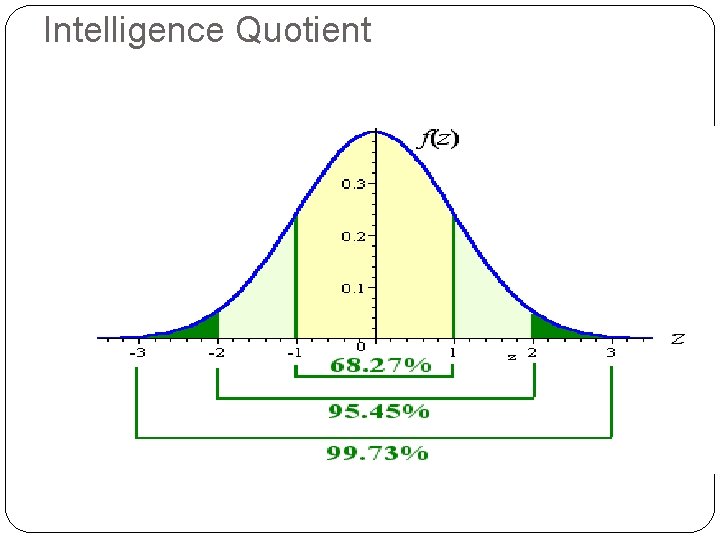
Intelligence Quotient
Standard Tools: Basic Criteria �Mean =100(SD of 15) �Standardization �Norms �Measures of Reliability �Measures of Validity �Proper Revision in every 10 -15 years to counter Flynn effect
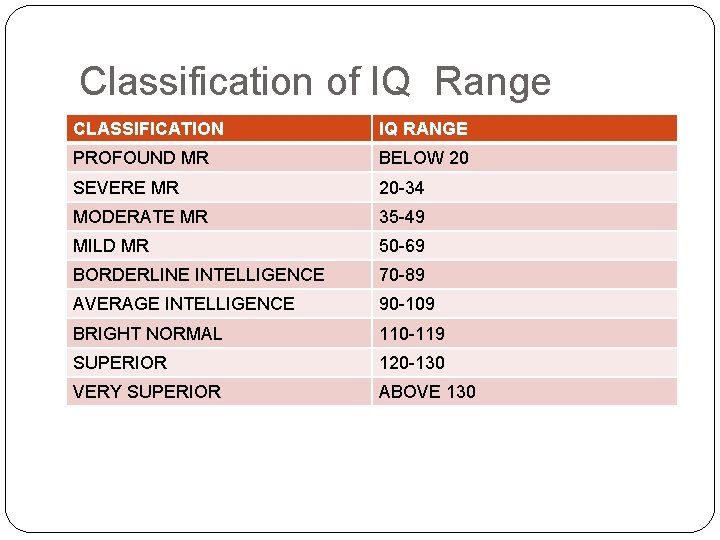
Classification of IQ Range CLASSIFICATION IQ RANGE PROFOUND MR BELOW 20 SEVERE MR 20 -34 MODERATE MR 35 -49 MILD MR 50 -69 BORDERLINE INTELLIGENCE 70 -89 AVERAGE INTELLIGENCE 90 -109 BRIGHT NORMAL 110 -119 SUPERIOR 120 -130 VERY SUPERIOR ABOVE 130
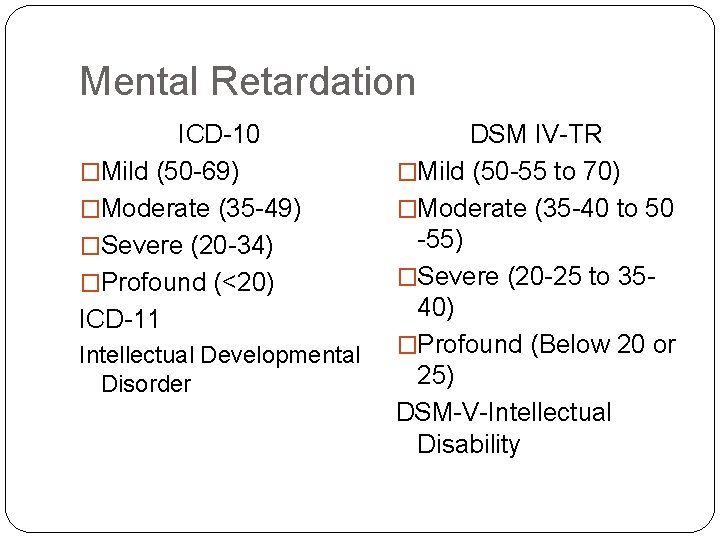
Mental Retardation ICD-10 �Mild (50 -69) �Moderate (35 -49) �Severe (20 -34) �Profound (<20) ICD-11 Intellectual Developmental Disorder DSM IV-TR �Mild (50 -55 to 70) �Moderate (35 -40 to 50 -55) �Severe (20 -25 to 3540) �Profound (Below 20 or 25) DSM-V-Intellectual Disability
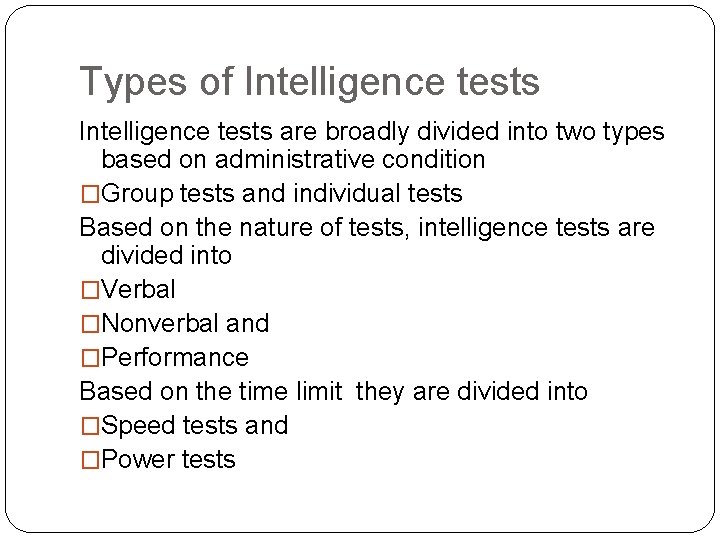
Types of Intelligence tests are broadly divided into two types based on administrative condition �Group tests and individual tests Based on the nature of tests, intelligence tests are divided into �Verbal �Nonverbal and �Performance Based on the time limit they are divided into �Speed tests and �Power tests
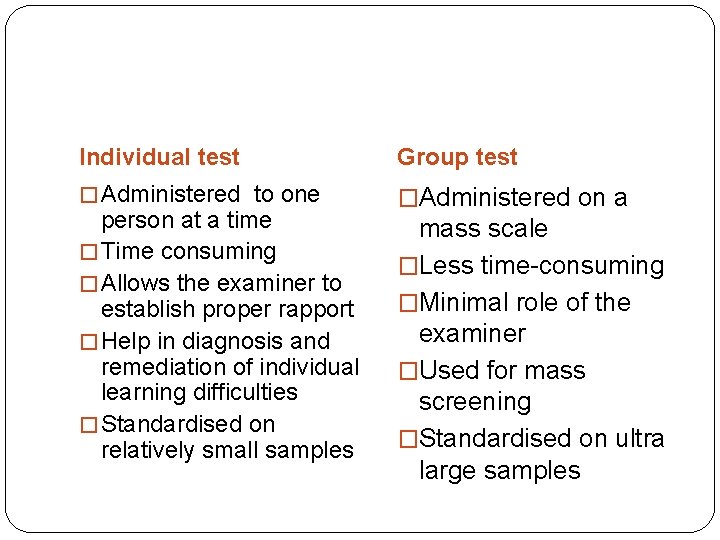
Individual test Group test � Administered to one �Administered on a person at a time � Time consuming � Allows the examiner to establish proper rapport � Help in diagnosis and remediation of individual learning difficulties � Standardised on relatively small samples mass scale �Less time-consuming �Minimal role of the examiner �Used for mass screening �Standardised on ultra large samples
Verbal , Non-verbal and Performance tests Verbal test demands understanding of written words �Can only be administered to literates �e. g. Verbal Adult Intelligence scale (VAIS) Non verbal tests Use picture or illustration as items �e. g Raven’s Progressive Matrices Performance tests are made up of certain concrete tasks e. g. Koh’s Block Design Test, WAPIS
�In speed tests there is a prescribed time limit to complete the test, Individual differences depend entirely on the speed of performance e. g. WAPIS �In power tests there is no time limit to finish the test. A pure power test has a time limit long enough to permit everyone to attempt all items e. g Raven’s Progressive Matrices
Performance/Non-verbal �Raven’s Progressive Matrices �Seguin Form Board Test (3 -11 yrs) �Bhatia’s Intelligence Battery (Above 11 yrs) �Pass Along Test (Speed Test) �Koh’s Block Design Test(Speed Test) �Porteus Maze Test
Wechsler’s Intelligence tests � Best standardised and most widely used intelligence tests in the world � Designed in 1939 by David Wechsler There are three types of Wechsler’s Intelligence tests � WPPSI-Wechsler’s Preschool and Primary Scale of Intelligence for the age range of 4 -6. 5 years � WISC-IV-Wechsler’s Intelligence Scale for Children for the age range of 6 -15 years � WAIS-III-Wechsler’s Adult intelligence Scale (16 -24 Years) � WAPIS-Wechsler’s Adult Performance Intelligence Scale (15 -44 years) is the Indian adaptation of WAIS scale standardised by Prabha Ramalingaswamy in 1974
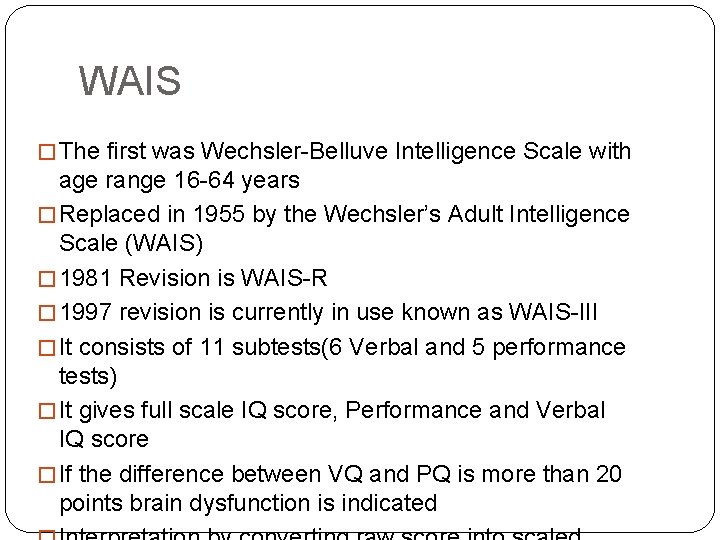
WAIS � The first was Wechsler-Belluve Intelligence Scale with age range 16 -64 years � Replaced in 1955 by the Wechsler’s Adult Intelligence Scale (WAIS) � 1981 Revision is WAIS-R � 1997 revision is currently in use known as WAIS-III � It consists of 11 subtests(6 Verbal and 5 performance tests) � It gives full scale IQ score, Performance and Verbal IQ score � If the difference between VQ and PQ is more than 20 points brain dysfunction is indicated
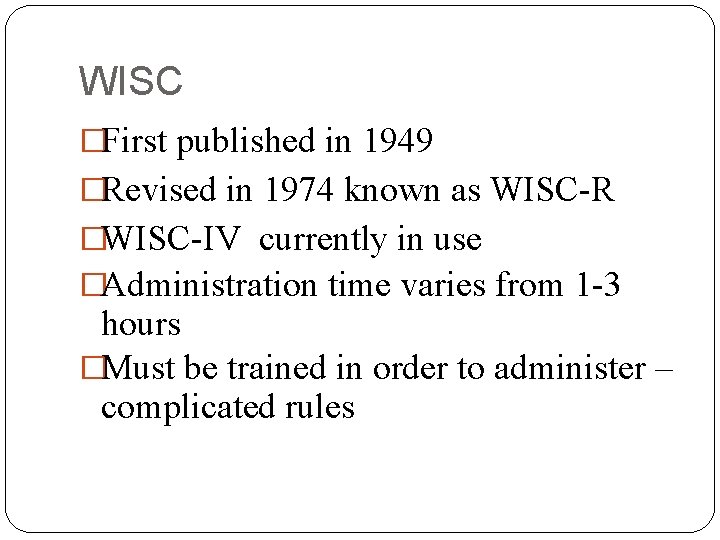
WISC �First published in 1949 �Revised in 1974 known as WISC-R �WISC-IV currently in use �Administration time varies from 1 -3 hours �Must be trained in order to administer – complicated rules
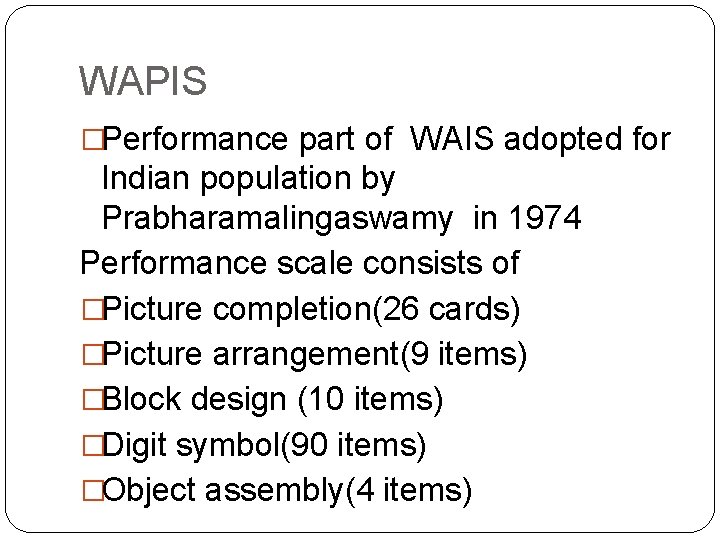
WAPIS �Performance part of WAIS adopted for Indian population by Prabharamalingaswamy in 1974 Performance scale consists of �Picture completion(26 cards) �Picture arrangement(9 items) �Block design (10 items) �Digit symbol(90 items) �Object assembly(4 items)
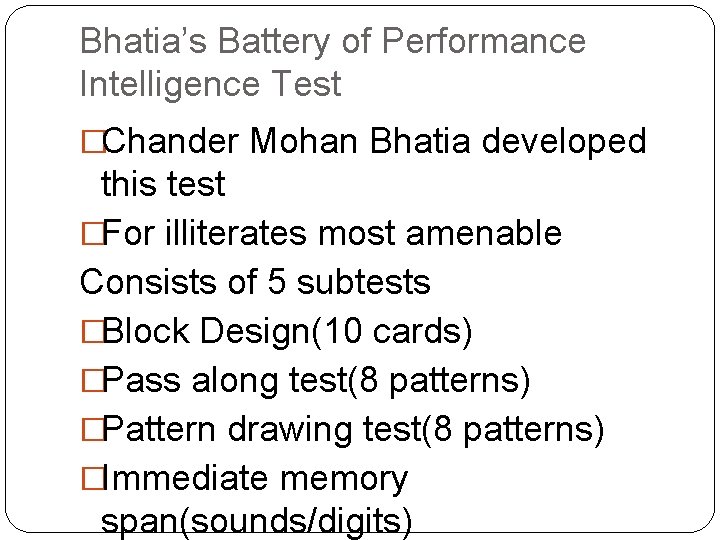
Bhatia’s Battery of Performance Intelligence Test �Chander Mohan Bhatia developed this test �For illiterates most amenable Consists of 5 subtests �Block Design(10 cards) �Pass along test(8 patterns) �Pattern drawing test(8 patterns) �Immediate memory span(sounds/digits)
1916 Stanford-Binet Sample Items for 12 yr olds Vocabulary Practical Problem Solving 1. Orange. 45. Sportive. 80. Exaltation. 92. Theosophy Grammar Interpretation Similarities • Snake, cow, sparrow Memory • Book, teacher, newspaper 3 -1 -8 -7 -9 • Wool, cotton, leather 6 -9 -4 -8 -2 5 -2 -9 -6 -1
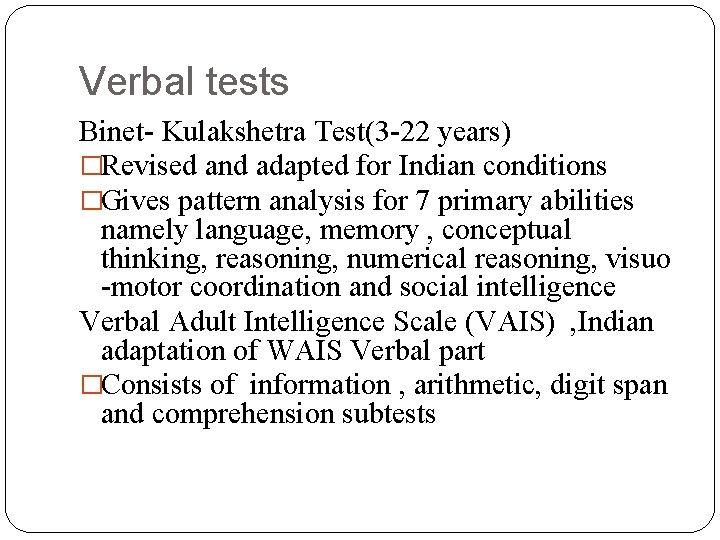
Verbal tests Binet- Kulakshetra Test(3 -22 years) �Revised and adapted for Indian conditions �Gives pattern analysis for 7 primary abilities namely language, memory , conceptual thinking, reasoning, numerical reasoning, visuo -motor coordination and social intelligence Verbal Adult Intelligence Scale (VAIS) , Indian adaptation of WAIS Verbal part �Consists of information , arithmetic, digit span and comprehension subtests
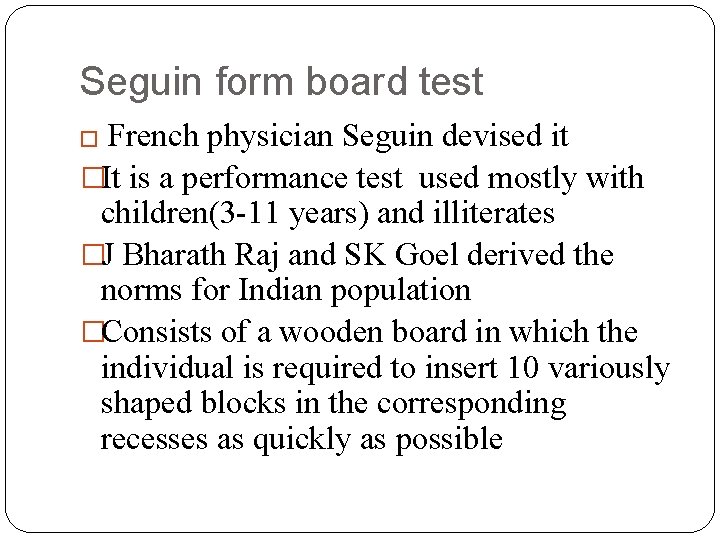
Seguin form board test French physician Seguin devised it �It is a performance test used mostly with children(3 -11 years) and illiterates �J Bharath Raj and SK Goel derived the norms for Indian population �Consists of a wooden board in which the individual is required to insert 10 variously shaped blocks in the corresponding recesses as quickly as possible �
Differential Ability Tests �Developed by Elliott �Used for analyzing and diagnosing children’s learning difficulties �To identify, select and classify children(2. 5 to 17 years ) with learning disabilities
�Consists of 20 subtests including 12 core subtests, 5 diagnostic subtests and 3 achievement subtests �Provide useful information for understanding child’s cognitive strengths and weaknesses
Peabody Picture Vocabulary Test �Used when testing time is limited or/are subject’s reading skills are poor �It uses only pictures as test materials �Used for age level 2. 5 to 85 years
Tests for hearing handicapped �Hiskey-Nebraska Test of learning Aptitude �Consists of 12 nonverbal subtests administered with pantomimic directions to deaf children �Wechsler’s performance subtests can also be used
Tests for visually handicapped �Haptic intelligence Scale for Adult Blind �Wechsler’s verbal subtests can be used for blind and partially sighted �Perkin-Binet test of intelligence
Developmental schedules �Used with severely retarded children who are not receptive to verbal, nonverbal and performance tests �Also used with small children and infants �Testing with infants are difficult because of short attention span and greater susceptibility to fatigue
Brazelton neonatal behavioral assessment scale � Age range is 3 days to 4 weeks � Scored on 26 behavioral items and 20 elicited responses including measures of neurological, behavioral and social functioning
Bayley Scales of Infant Development � Age range-1 to 30 months � Consists of 3 parts Mental scale Motor scale Behavioral rating scale
Mc. Carty Scales of children abilities �Age range-2. 5 to 8. 5 years �Consists of 6 measures of intellectual and motor development Verbal Perceptual performance Quantitative General cognitive Memory and Motor
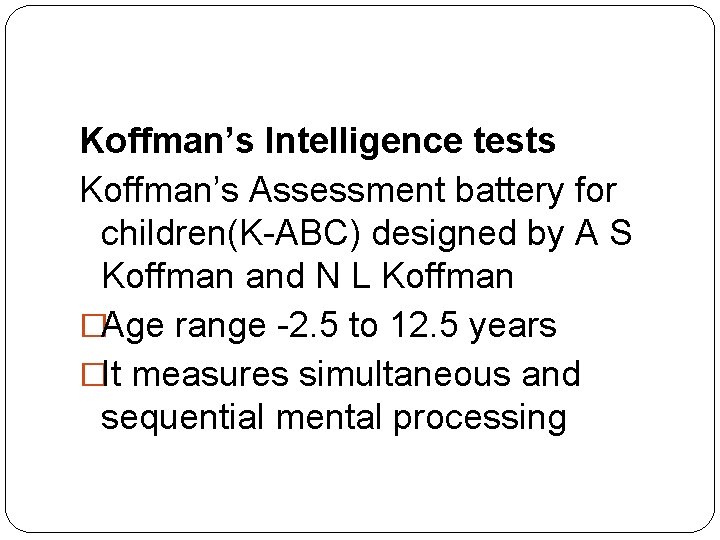
Koffman’s Intelligence tests Koffman’s Assessment battery for children(K-ABC) designed by A S Koffman and N L Koffman �Age range -2. 5 to 12. 5 years �It measures simultaneous and sequential mental processing
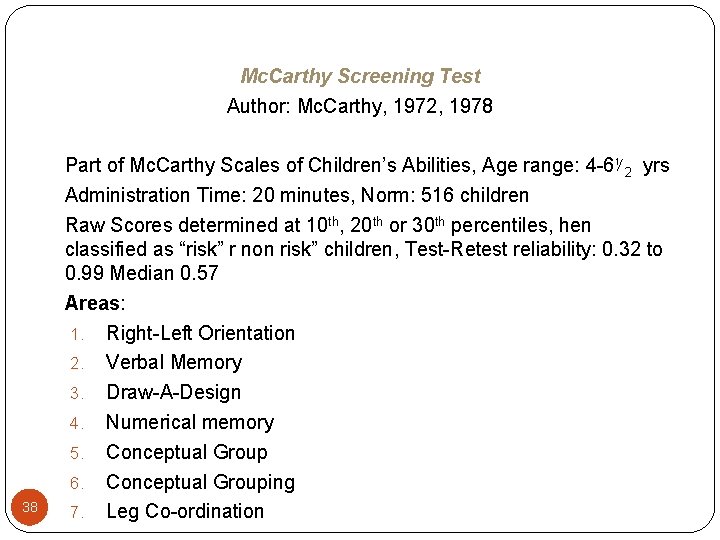
Mc. Carthy Screening Test Author: Mc. Carthy, 1972, 1978 38 Part of Mc. Carthy Scales of Children’s Abilities, Age range: 4 -6⅟ 2 yrs Administration Time: 20 minutes, Norm: 516 children Raw Scores determined at 10 th, 20 th or 30 th percentiles, hen classified as “risk” r non risk” children, Test-Retest reliability: 0. 32 to 0. 99 Median 0. 57 Areas: 1. Right-Left Orientation 2. Verbal Memory 3. Draw-A-Design 4. Numerical memory 5. Conceptual Group 6. Conceptual Grouping 7. Leg Co-ordination
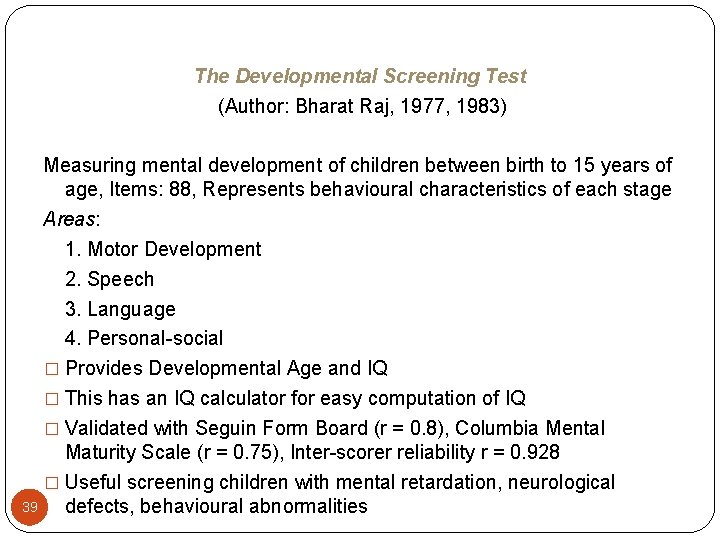
The Developmental Screening Test (Author: Bharat Raj, 1977, 1983) Measuring mental development of children between birth to 15 years of age, Items: 88, Represents behavioural characteristics of each stage Areas: 1. Motor Development 2. Speech 3. Language 4. Personal-social � Provides Developmental Age and IQ � This has an IQ calculator for easy computation of IQ � Validated with Seguin Form Board (r = 0. 8), Columbia Mental Maturity Scale (r = 0. 75), Inter-scorer reliability r = 0. 928 � Useful screening children with mental retardation, neurological 39 defects, behavioural abnormalities
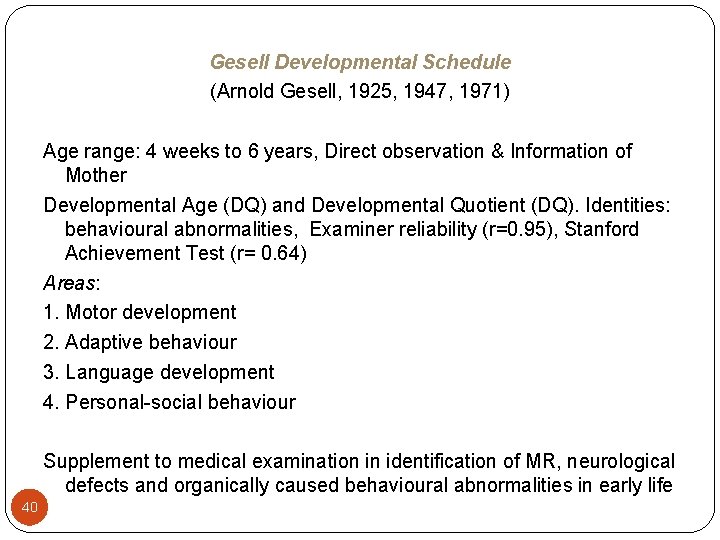
Gesell Developmental Schedule (Arnold Gesell, 1925, 1947, 1971) Age range: 4 weeks to 6 years, Direct observation & Information of Mother Developmental Age (DQ) and Developmental Quotient (DQ). Identities: behavioural abnormalities, Examiner reliability (r=0. 95), Stanford Achievement Test (r= 0. 64) Areas: 1. Motor development 2. Adaptive behaviour 3. Language development 4. Personal-social behaviour Supplement to medical examination in identification of MR, neurological defects and organically caused behavioural abnormalities in early life 40
Group Intelligence tests �Multilevel Group intelligence Tests Used to compare intellectual growth of children over several years 1. Otis-Lennon School Ability Test(OLSAT) 2. Cognitive Ability Test 3. Wonderic Personnel Test
Culture free and culture fair tests �Culture free tests are tests yielding scores that are completely independent of all cultural influences �Culture fair tests are tests which are fair and appropriate for respondents of all cultures and subcultures e. g Cattell Culture Fair series, Learning Potential Assessment Device, Raven’s Progressive Matrices
Raven’s Progressive Matrices �It is a nonverbal test of observation and clear thinking �It consists of 3 matrices(Subtests) 1. Standard progressive matrices(6 -80 years) 2. Coloured progressive matrices (5 -11 years) 3. Adult progressive matrices for average adults
�RPM assesses the two components of g identified by Spearman as educative ability and reproductive ability �Educative ability refers to making meaning out of confusion, developing new insights and decision making �Reproductive ability involves mastering, recalling and reproducing material which forms a cultural store of explicit, verbalised knowledge
Intelligence derived from Rorschach Above average Intelligence �more than 7 W(whole) responses with good form level, �M ( Movement) responses more than 5 �Pure color responses 3 to 4 �Percent good form responses 79% & above �Low animal responses
Intelligence testing in India �First systematic attempt to standardize a test of intelligence (Binet’s test) was made by Dr Rice in 1930 in Urdu &Punjabi �First doctorate on test construction was awarded to K G Desai in 1954 for the development of group test of intelligence in Gujarati �National Library of Educational and Psychological Tests(NLEPT) at National Council Of Educational Research and training(NCERT) has documented Indian tests
Some tests developed in India Verbal tests 1. Group test of intelligence by Prayag Mehta 2. Group test of mental ability by S Jalota 3. Indian adaptation of Binet-Simon Scale by S K Kulshreshta 4. Test of general mental ability by M C Joshi 5. Bihar test of intelligence by S M Mohsin Performance tests 1. Adaptation of WAPIS by R Ramalingaswamy 2. Draw –a- Man test by Pramila Pathak 3. Performance test of intelligence by C M Bhatia
Biological measures of intelligence �Reaction time : refers to the time gap (in seconds) between presentations of a stimulus and the beginning of a response by the individual. Intelligent person takes less time to process information �Inspection time : is the minimum amount of time a particular stimulus must be exposed to an individual to make a judgment about it that meets some pre-established criteria of
Applications of intelligence testing �Utilized in various settings like schools, hospitals �Foremost reason is to measure cognitive capacity �Need to obtain clinically relevant information about cognitive strength and weaknesses �Assess the functional integrity of the brain �Assist in determining appropriate vocational or educational placement
§ reliable measure of individual differences – important for identifying need, allocating resources § reliable predictor of school achievement § identify discrepancies between expected and actual performance § allow for accountability, measurement of change and evaluation of program effectiveness
When to refer case for Intelligence Assessment �When the level of intellectual functioning is doubtful. �Mental Retardation �Pervasive Developmental Disorder �Learning Disability �Age related regression �Intelligence deterioration as a sequel of chronic psychiatric condition such as Schizophrenia �IQ deterioration as a consequence of Neuro. Psychiatric Conditions �Pre-post neurosurgery.
References 1. Kahn & Giffin (1960), Psychological 2. 3. 4. 5. Techniques in Diagnosis and Evaluation, Pergamon Press, New. York Twenty-first century Psychology: A Reference Handbook, Sage e-Reference Online A Anastasi, Psychological testing, Macmillan Company, New York Aiken (10 th Edition) Psychological Testing and Assessment Morgan & King (7 th Edition), Introduction to Psychology