
Overview of important design parameters and technologies Status
![Operational margin of a superconducting magnet Applied Magnetic Field [T] Bc critical field Bc](https://slidetodoc.com/presentation_image_h2/b353a70ef28ad25b6c1b1bbfd5358a2f/image-40.jpg "Operational margin of a superconducting magnet Applied Magnetic Field [T] Bc critical field Bc")
- Slides: 57
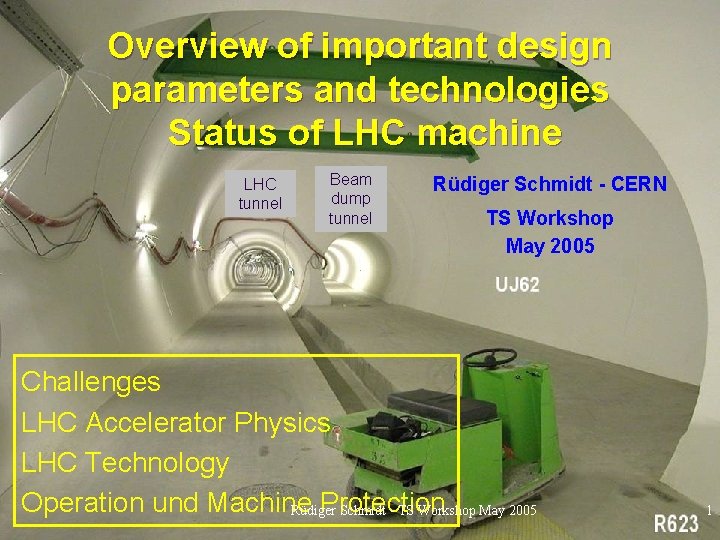
Overview of important design parameters and technologies Status of LHC machine LHC tunnel Beam dump tunnel Rüdiger Schmidt - CERN TS Workshop May 2005 Challenges LHC Accelerator Physics LHC Technology Operation und Machine Protection Rüdiger Schmidt - TS Workshop May 2005 1
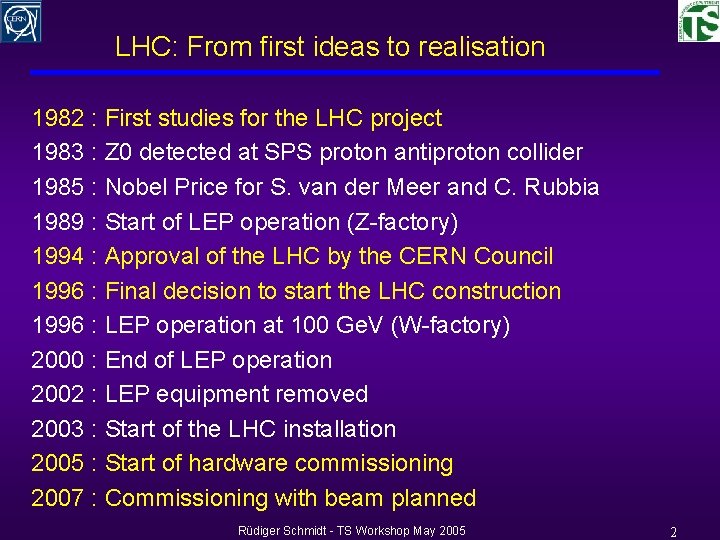
LHC: From first ideas to realisation 1982 : First studies for the LHC project 1983 : Z 0 detected at SPS proton antiproton collider 1985 : Nobel Price for S. van der Meer and C. Rubbia 1989 : Start of LEP operation (Z-factory) 1994 : Approval of the LHC by the CERN Council 1996 : Final decision to start the LHC construction 1996 : LEP operation at 100 Ge. V (W-factory) 2000 : End of LEP operation 2002 : LEP equipment removed 2003 : Start of the LHC installation 2005 : Start of hardware commissioning 2007 : Commissioning with beam planned Rüdiger Schmidt - TS Workshop May 2005 2
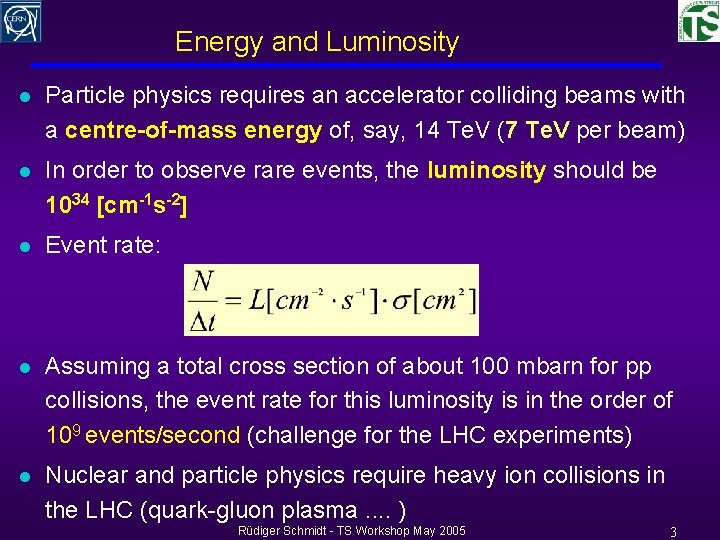
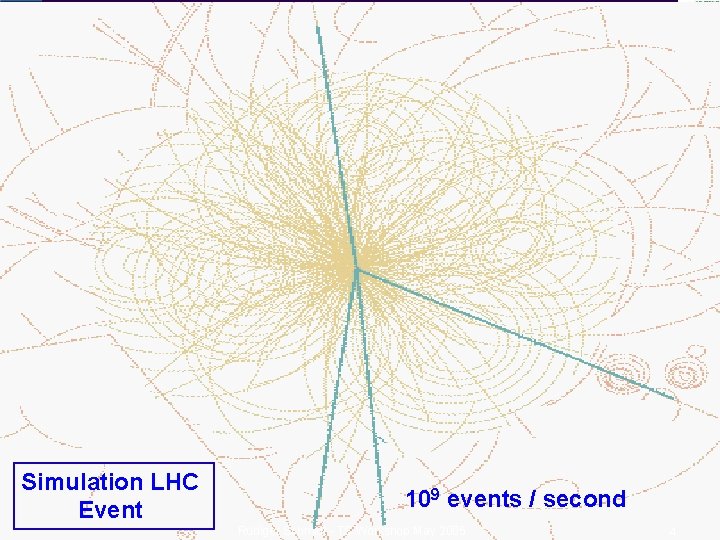
Energy and Luminosity l Particle physics requires an accelerator colliding beams with a centre-of-mass energy of, say, 14 Te. V (7 Te. V per beam) l In order to observe rare events, the luminosity should be 1034 [cm-1 s-2] l Event rate: l Assuming a total cross section of about 100 mbarn for pp collisions, the event rate for this luminosity is in the order of 109 events/second (challenge for the LHC experiments) l Nuclear and particle physics require heavy ion collisions in the LHC (quark-gluon plasma. . ) Rüdiger Schmidt - TS Workshop May 2005 3
Simulation LHC Event 109 events / second Rüdiger Schmidt - TS Workshop May 2005 4
Recap Very high particle energy • • Very high luminosity • • • Rüdiger Schmidt - TS Workshop May 2005 5
LHC Accelerator Physics: An Introduction Why in the LEP tunnel? Why superconducting magnets? Why protons? Why “two” accelerators in one tunnel? Rüdiger Schmidt - TS Workshop May 2005 6
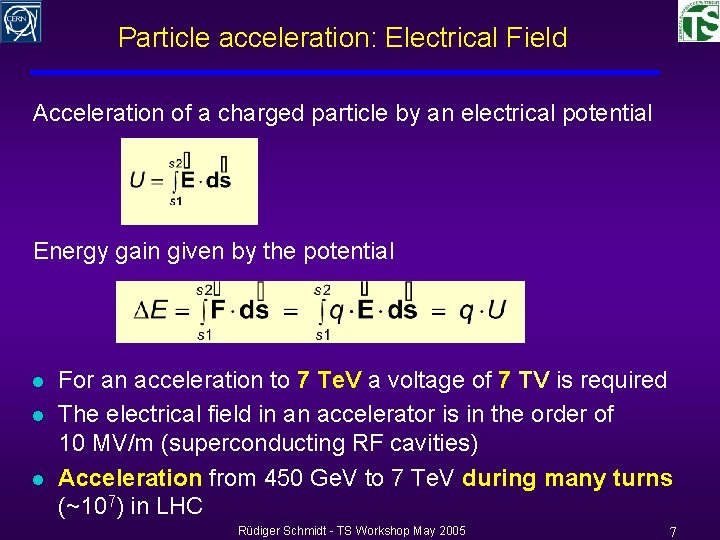
Particle acceleration: Electrical Field Acceleration of a charged particle by an electrical potential Energy gain given by the potential l For an acceleration to 7 Te. V a voltage of 7 TV is required The electrical field in an accelerator is in the order of 10 MV/m (superconducting RF cavities) Acceleration from 450 Ge. V to 7 Te. V during many turns (~107) in LHC Rüdiger Schmidt - TS Workshop May 2005 7
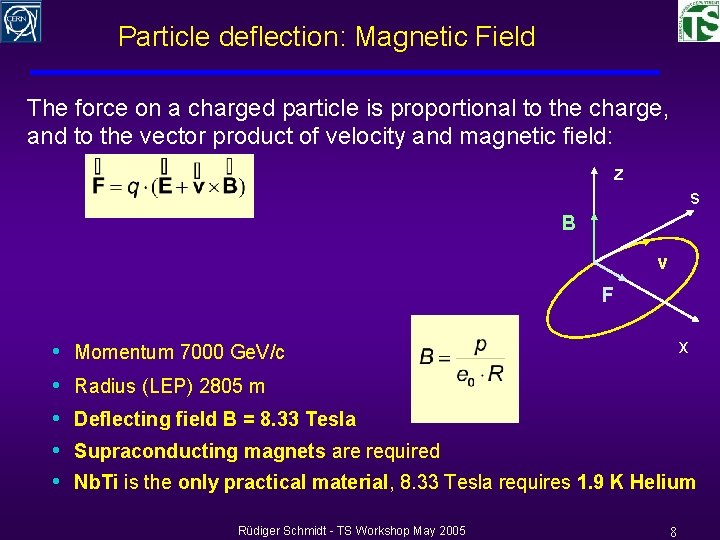
Particle deflection: Magnetic Field The force on a charged particle is proportional to the charge, and to the vector product of velocity and magnetic field: z s B v F • • • x Momentum 7000 Ge. V/c Radius (LEP) 2805 m Deflecting field B = 8. 33 Tesla Supraconducting magnets are required Nb. Ti is the only practical material, 8. 33 Tesla requires 1. 9 K Helium Rüdiger Schmidt - TS Workshop May 2005 8
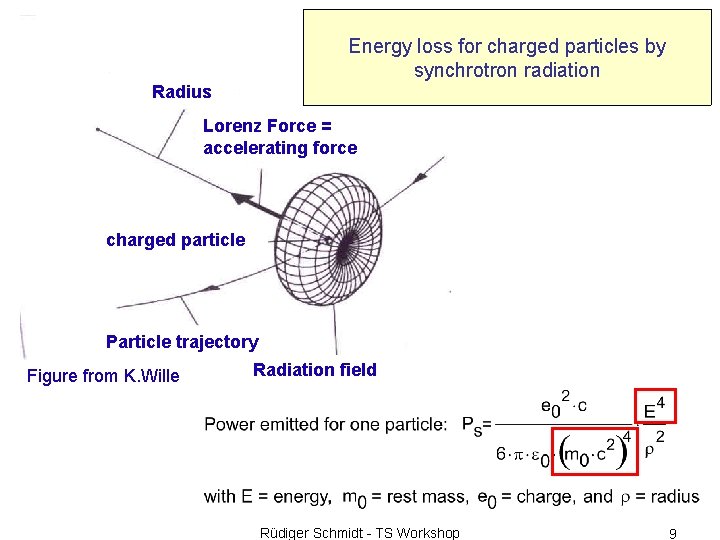
Energy loss for charged particles by synchrotron radiation Radius Lorenz Force = accelerating force charged particle Particle trajectory Figure from K. Wille Radiation field Rüdiger Schmidt - TS Workshop 9
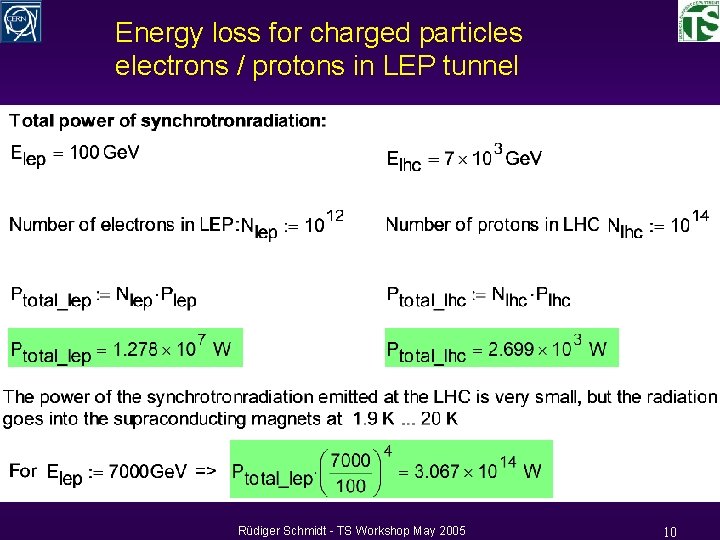
Energy loss for charged particles electrons / protons in LEP tunnel Rüdiger Schmidt - TS Workshop May 2005 10
Recap Very high particle energy • Proton Collider (no electrons - positrons) • Superconducting Magnets • Helium cooling at 1. 9 K • High energy stored in sc magnets => Machine Protection Very high luminosity • • • Rüdiger Schmidt - TS Workshop May 2005 11
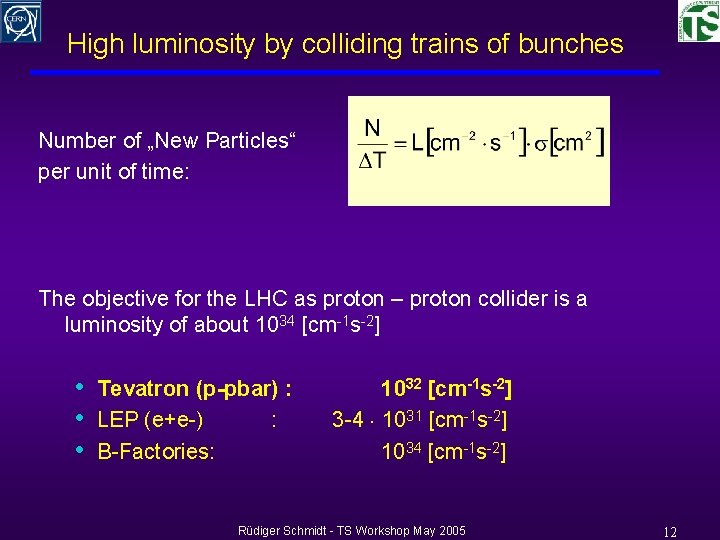
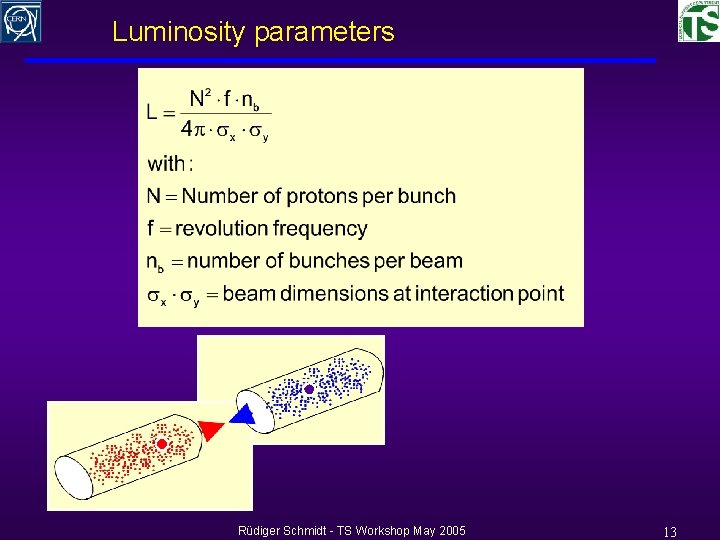
High luminosity by colliding trains of bunches Number of „New Particles“ per unit of time: The objective for the LHC as proton – proton collider is a luminosity of about 1034 [cm-1 s-2] • Tevatron (p-pbar) : • LEP (e+e-) : • B-Factories: 1032 [cm-1 s-2] 3 -4 1031 [cm-1 s-2] 1034 [cm-1 s-2] Rüdiger Schmidt - TS Workshop May 2005 12
Luminosity parameters Rüdiger Schmidt - TS Workshop May 2005 13
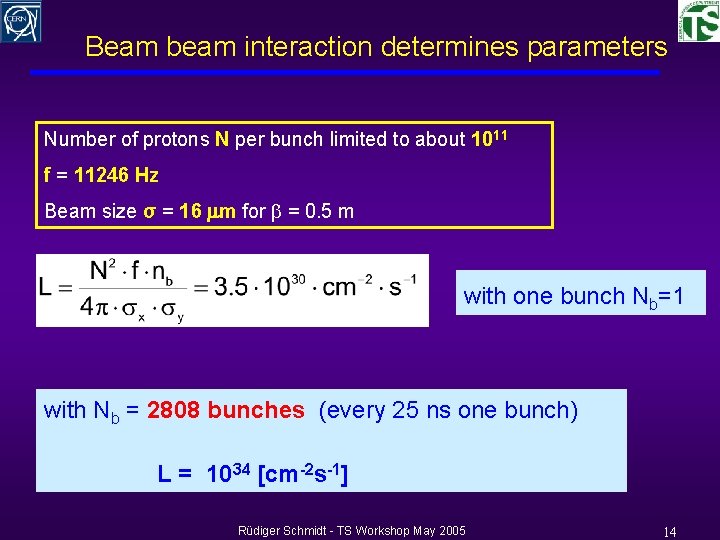
Beam beam interaction determines parameters Number of protons N per bunch limited to about 1011 f = 11246 Hz Beam size σ = 16 m for = 0. 5 m with one bunch Nb=1 with Nb = 2808 bunches (every 25 ns one bunch) L = 1034 [cm-2 s-1] Rüdiger Schmidt - TS Workshop May 2005 14
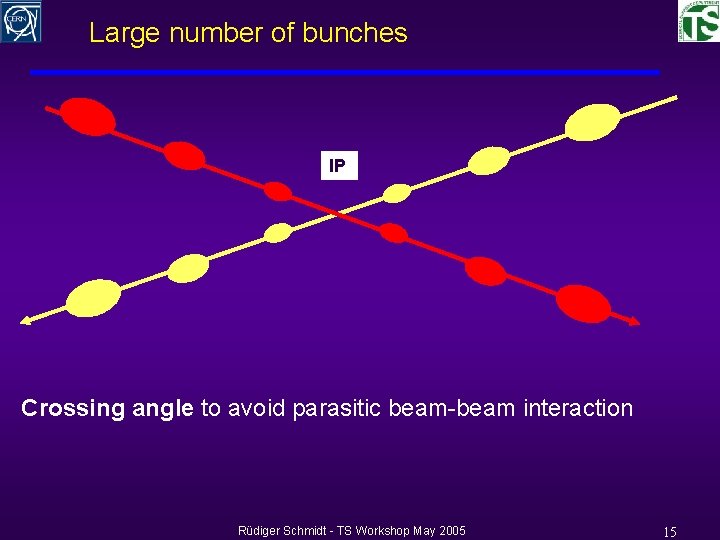
Large number of bunches IP Crossing angle to avoid parasitic beam-beam interaction Rüdiger Schmidt - TS Workshop May 2005 15
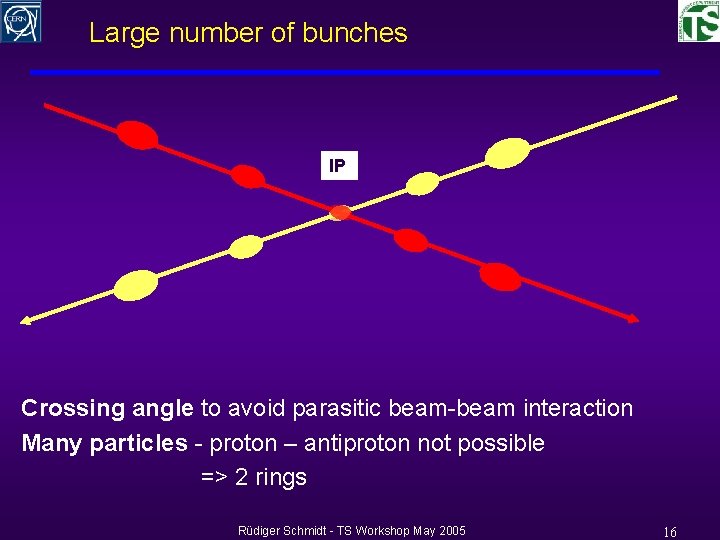
Large number of bunches IP Crossing angle to avoid parasitic beam-beam interaction Many particles - proton – antiproton not possible => 2 rings Rüdiger Schmidt - TS Workshop May 2005 16
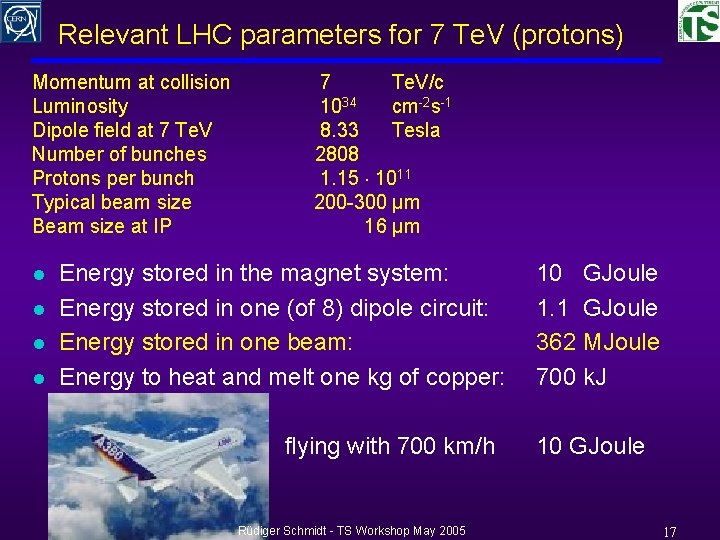
Relevant LHC parameters for 7 Te. V (protons) Momentum at collision Luminosity Dipole field at 7 Te. V Number of bunches Protons per bunch Typical beam size Beam size at IP l l 7 Te. V/c 1034 cm-2 s-1 8. 33 Tesla 2808 1. 15 1011 200 -300 µm 16 µm Energy stored in the magnet system: Energy stored in one (of 8) dipole circuit: Energy stored in one beam: Energy to heat and melt one kg of copper: flying with 700 km/h Rüdiger Schmidt - TS Workshop May 2005 10 GJoule 1. 1 GJoule 362 MJoule 700 k. J 10 GJoule 17
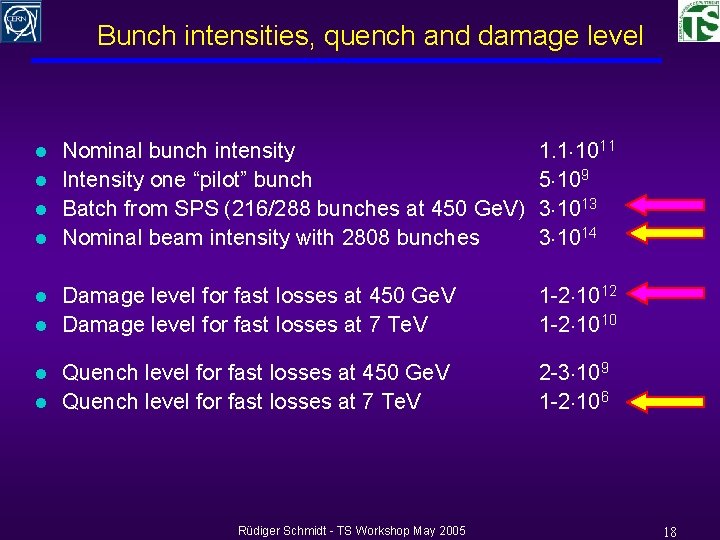
Bunch intensities, quench and damage level l l l l Nominal bunch intensity Intensity one “pilot” bunch Batch from SPS (216/288 bunches at 450 Ge. V) Nominal beam intensity with 2808 bunches 1. 1 1011 5 109 3 1013 3 1014 Damage level for fast losses at 450 Ge. V Damage level for fast losses at 7 Te. V 1 -2 1012 1 -2 1010 Quench level for fast losses at 450 Ge. V Quench level for fast losses at 7 Te. V 2 -3 109 1 -2 106 Rüdiger Schmidt - TS Workshop May 2005 18
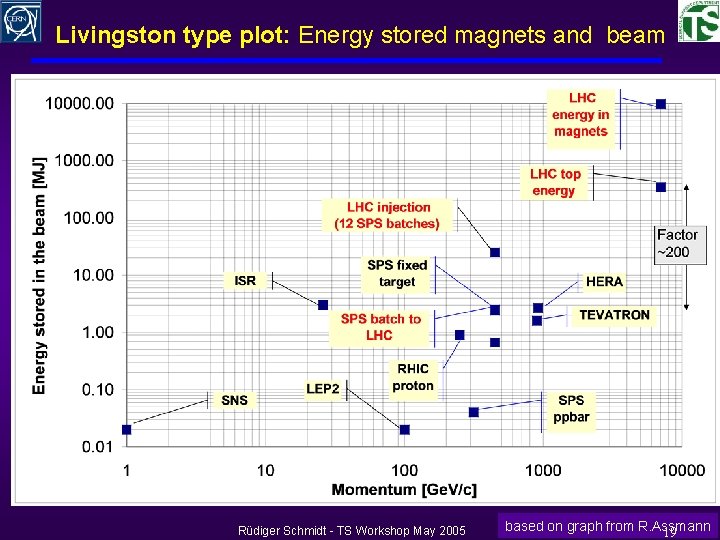
Livingston type plot: Energy stored magnets and beam Rüdiger Schmidt - TS Workshop May 2005 based on graph from R. Assmann 19
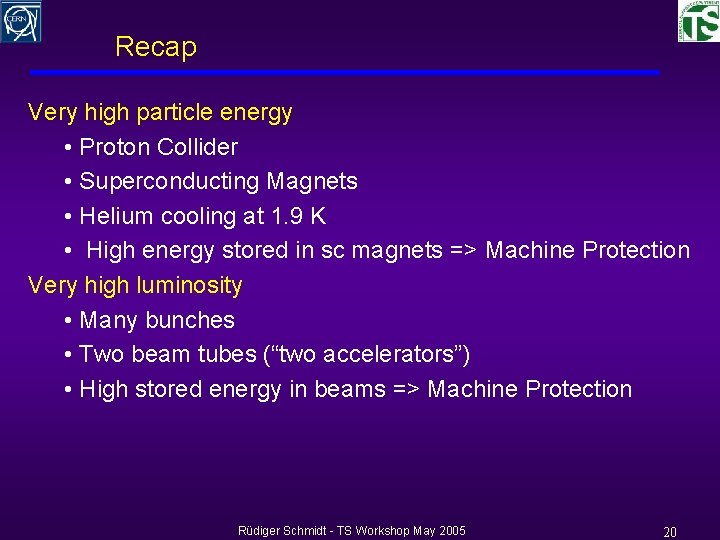
Recap Very high particle energy • Proton Collider • Superconducting Magnets • Helium cooling at 1. 9 K • High energy stored in sc magnets => Machine Protection Very high luminosity • Many bunches • Two beam tubes (“two accelerators”) • High stored energy in beams => Machine Protection Rüdiger Schmidt - TS Workshop May 2005 20
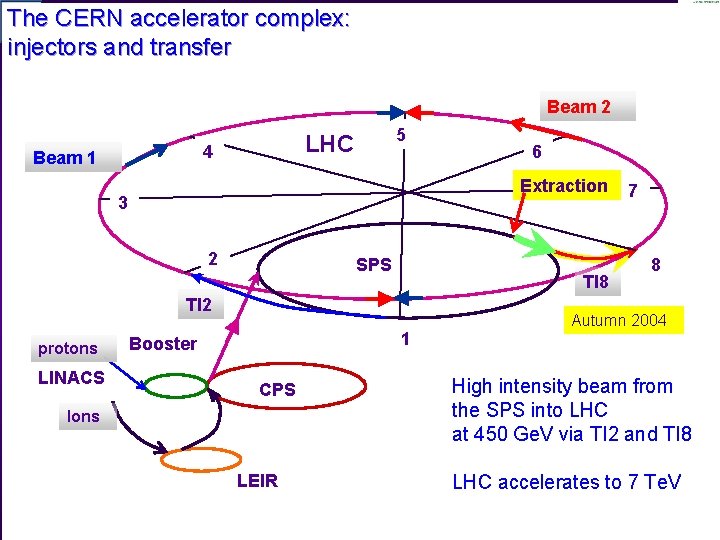
The CERN accelerator complex: injectors and transfer Beam 2 4 Beam 1 5 LHC 6 Extraction 3 2 SPS TI 8 TI 2 protons LINACS CPS Ions LEIR 8 Autumn 2004 1 Booster 7 High intensity beam from the SPS into LHC at 450 Ge. V via TI 2 and TI 8 LHC accelerates to 7 Te. V Rüdiger Schmidt - TS Workshop May 2005 21
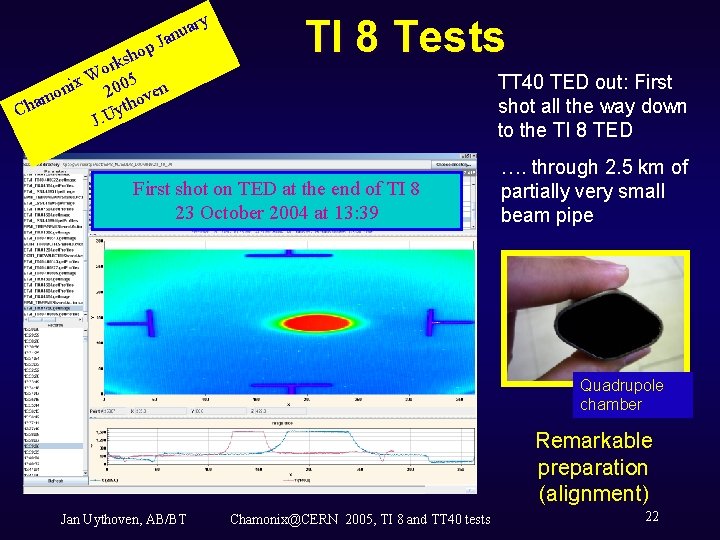
p sho ry a u an J ork W nix 2005 ven o am tho y Ch J. U TI 8 Tests TT 40 TED out: First shot all the way down to the TI 8 TED First shot on TED at the end of TI 8 23 October 2004 at 13: 39 …. through 2. 5 km of partially very small beam pipe Quadrupole chamber Remarkable preparation (alignment) Jan Uythoven, AB/BT Chamonix@CERN 2005, TI 8 and TT 40 tests 22
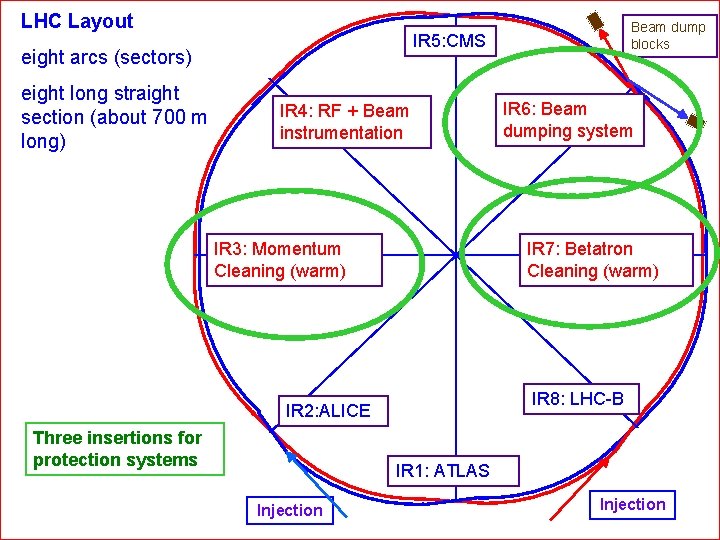
LHC Layout eight arcs (sectors) eight long straight section (about 700 m long) Beam dump blocks IR 5: CMS IR 4: RF + Beam instrumentation IR 3: Momentum Cleaning (warm) IR 7: Betatron Cleaning (warm) IR 8: LHC-B IR 2: ALICE Three insertions for protection systems IR 6: Beam dumping system IR 1: ATLAS Injection Rüdiger Schmidt - TS Workshop May 2005 Injection 23
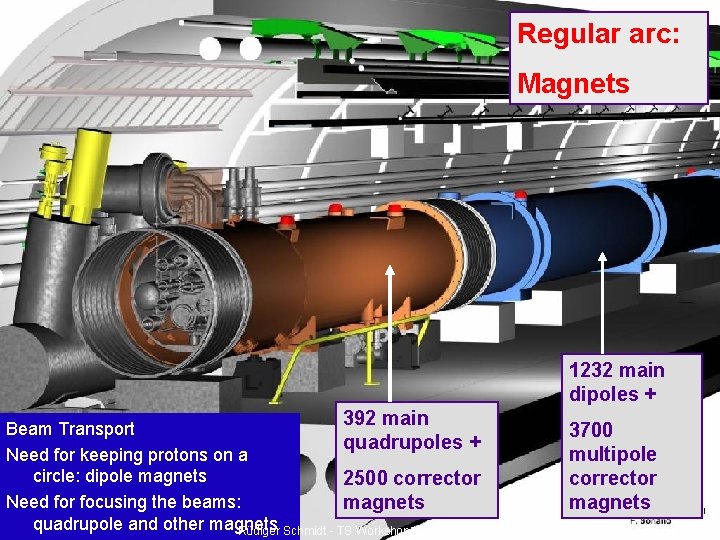
Regular arc: Magnets 1232 main dipoles + 392 main Beam Transport quadrupoles + Need for keeping protons on a circle: dipole magnets 2500 corrector Need for focusing the beams: magnets quadrupole and other magnets Rüdiger Schmidt - TS Workshop May 2005 3700 multipole corrector magnets 24
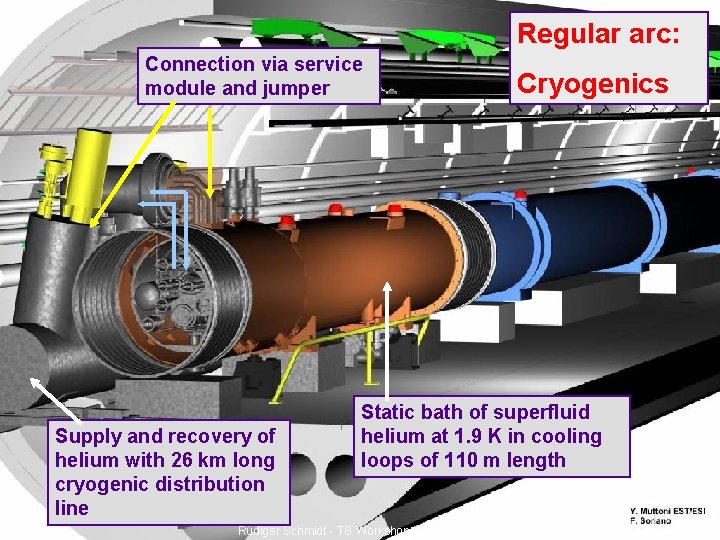
Regular arc: Connection via service module and jumper Supply and recovery of helium with 26 km long cryogenic distribution line Cryogenics Static bath of superfluid helium at 1. 9 K in cooling loops of 110 m length Rüdiger Schmidt - TS Workshop May 2005 25
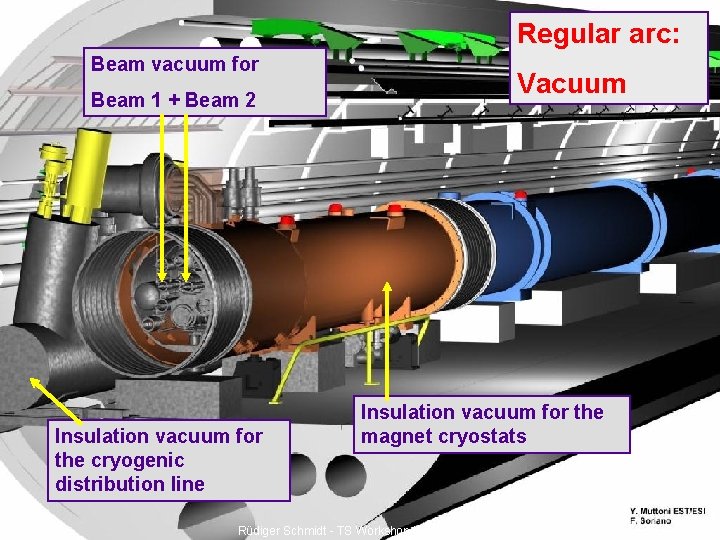
Regular arc: Beam vacuum for Vacuum Beam 1 + Beam 2 Insulation vacuum for the cryogenic distribution line Insulation vacuum for the magnet cryostats Rüdiger Schmidt - TS Workshop May 2005 26
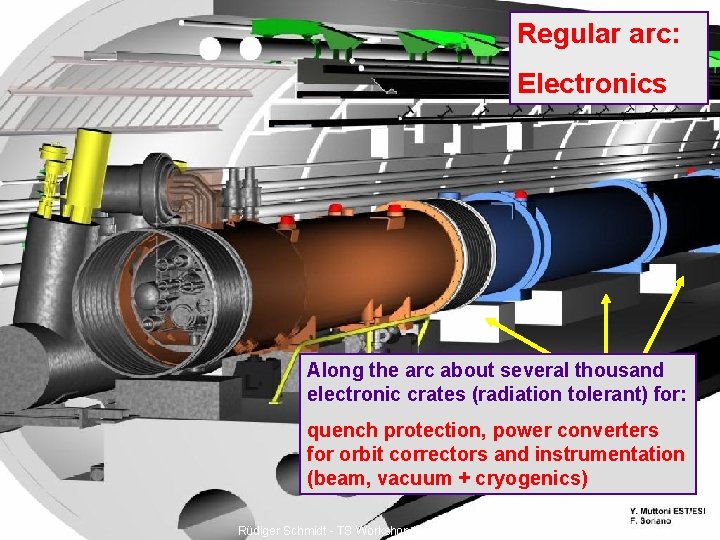
Regular arc: Electronics Along the arc about several thousand electronic crates (radiation tolerant) for: quench protection, power converters for orbit correctors and instrumentation (beam, vacuum + cryogenics) Rüdiger Schmidt - TS Workshop May 2005 27
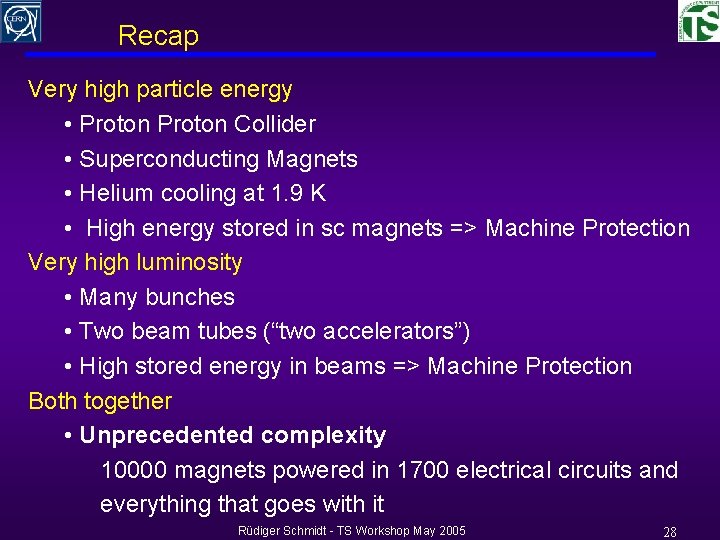
Recap Very high particle energy • Proton Collider • Superconducting Magnets • Helium cooling at 1. 9 K • High energy stored in sc magnets => Machine Protection Very high luminosity • Many bunches • Two beam tubes (“two accelerators”) • High stored energy in beams => Machine Protection Both together • Unprecedented complexity 10000 magnets powered in 1700 electrical circuits and everything that goes with it Rüdiger Schmidt - TS Workshop May 2005 28
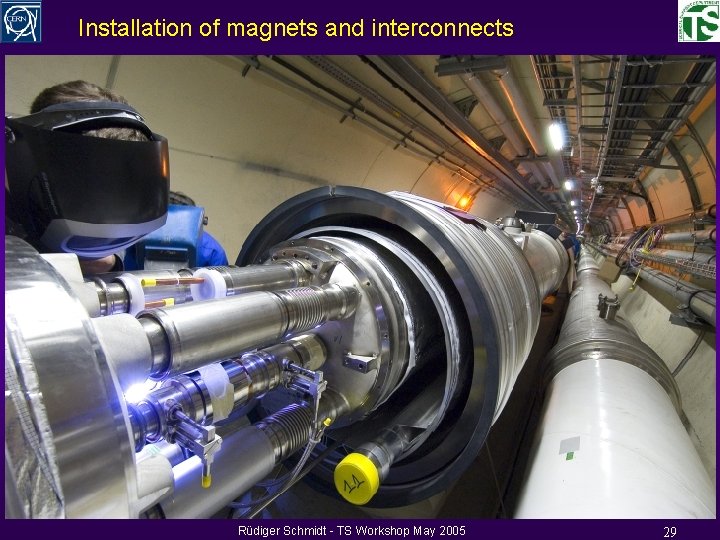
Installation of magnets and interconnects Rüdiger Schmidt - TS Workshop May 2005 29
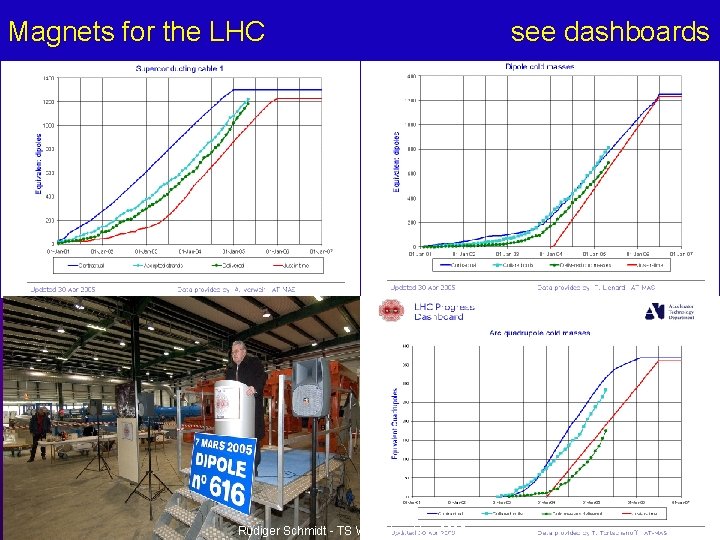
Magnets for the LHC Rüdiger Schmidt - TS Workshop May 2005 see dashboards 30
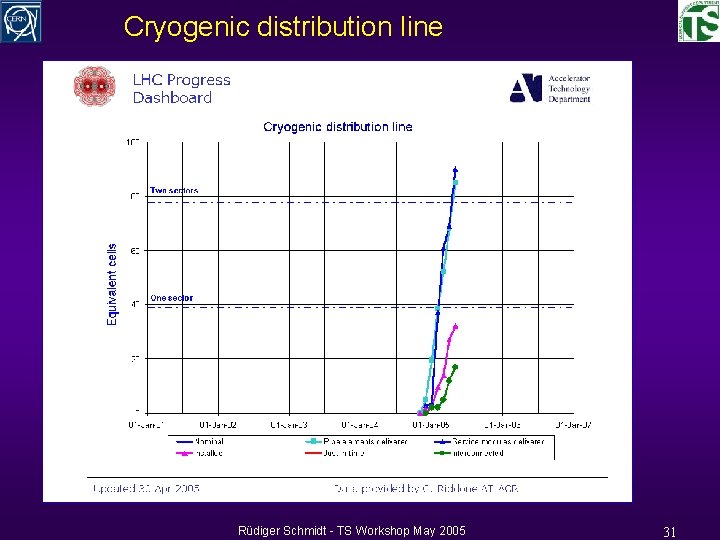
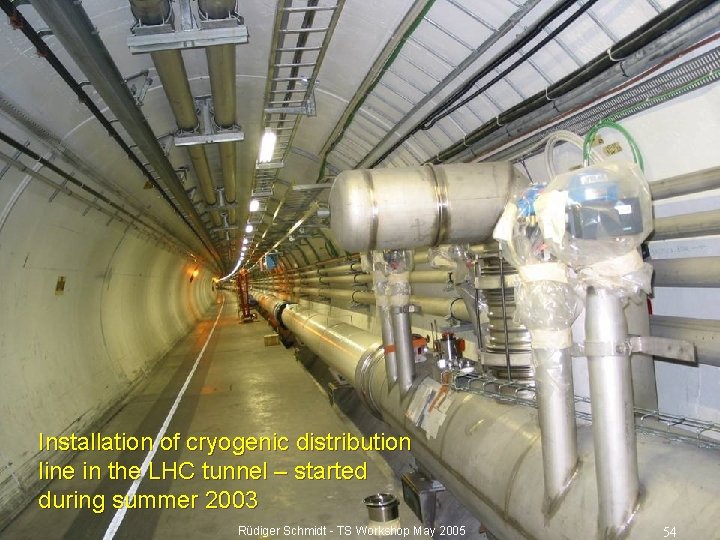
Cryogenic distribution line Rüdiger Schmidt - TS Workshop May 2005 31
Operation and machine protection Rüdiger Schmidt - TS Workshop May 2005 32
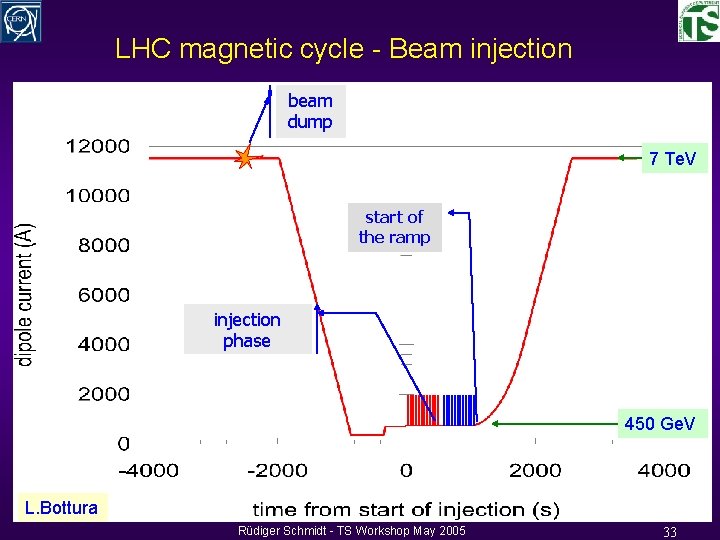
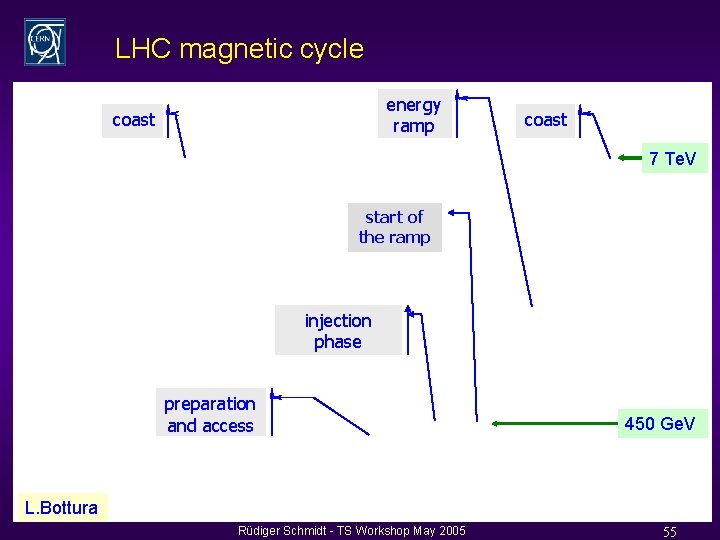
LHC magnetic cycle - Beam injection beam dump 7 Te. V start of the ramp injection phase 450 Ge. V L. Bottura Rüdiger Schmidt - TS Workshop May 2005 33
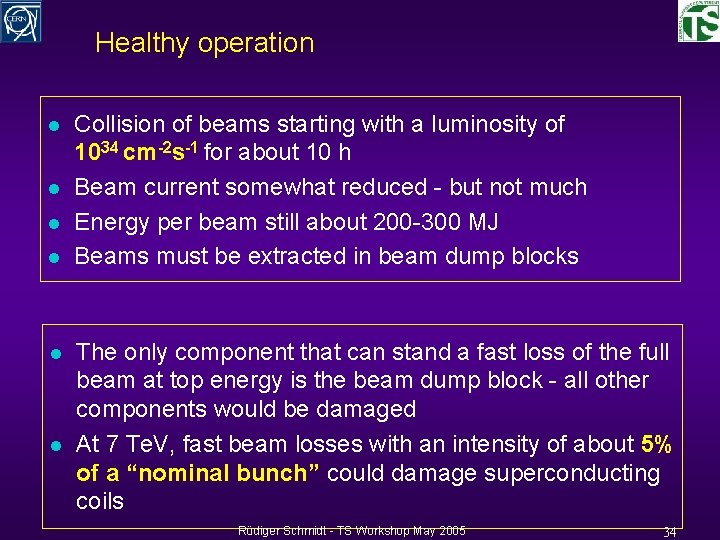
Healthy operation l l l Collision of beams starting with a luminosity of 1034 cm-2 s-1 for about 10 h Beam current somewhat reduced - but not much Energy per beam still about 200 -300 MJ Beams must be extracted in beam dump blocks The only component that can stand a fast loss of the full beam at top energy is the beam dump block - all other components would be damaged At 7 Te. V, fast beam losses with an intensity of about 5% of a “nominal bunch” could damage superconducting coils Rüdiger Schmidt - TS Workshop May 2005 34
Protection and Beam Energy Proton losses lead to particle cascades in materials => temperature increase A small fraction of beam sufficient for damage Very efficient protection systems throughout the cycle are required A tiny fraction of the beam is sufficient to quench a magnet Very efficient beam cleaning is required Rüdiger Schmidt - TS Workshop May 2005 35
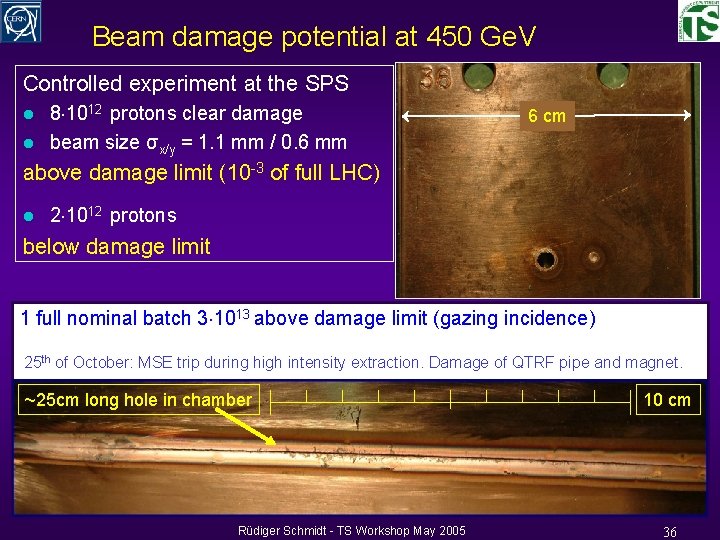
Beam damage potential at 450 Ge. V Controlled experiment at the SPS l l 8 1012 protons clear damage beam size σx/y = 1. 1 mm / 0. 6 mm 6 cm above damage limit (10 -3 of full LHC) l 2 1012 protons below damage limit 1 full nominal batch 3 1013 above damage limit (gazing incidence) 25 th of October: MSE trip during high intensity extraction. Damage of QTRF pipe and magnet. ~25 cm long hole in chamber Rüdiger Schmidt - TS Workshop May 2005 10 cm 36
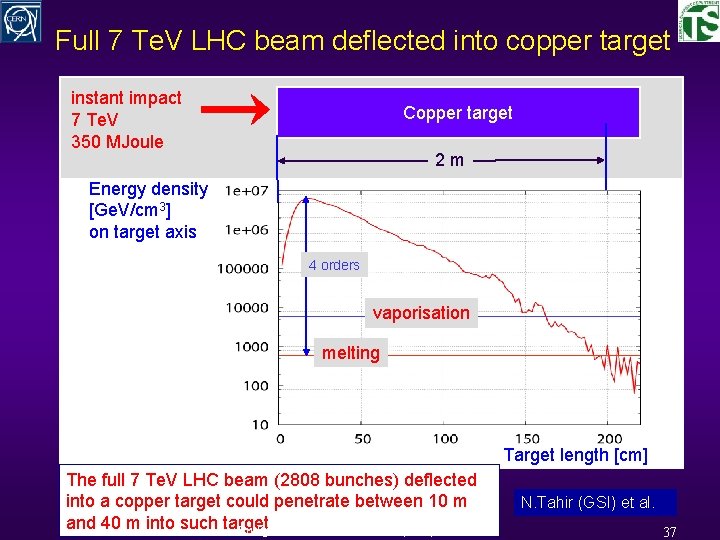
Full 7 Te. V LHC beam deflected into copper target instant impact 7 Te. V 350 MJoule Copper target 2 m Energy density [Ge. V/cm 3] on target axis 4 orders vaporisation melting Target length [cm] The full 7 Te. V LHC beam (2808 bunches) deflected into a copper target could penetrate between 10 m and 40 m into such target Rüdiger Schmidt - TS Workshop May 2005 N. Tahir (GSI) et al. 37
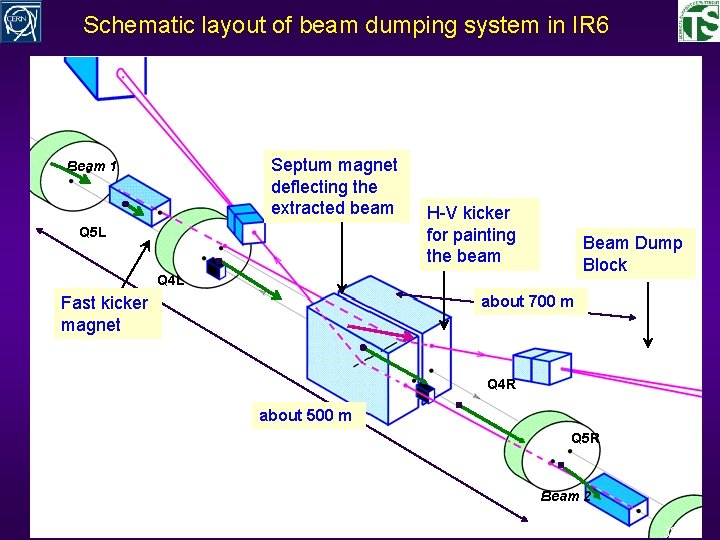
Schematic layout of beam dumping system in IR 6 Septum magnet deflecting the extracted beam Beam 1 Q 5 L H-V kicker for painting the beam Beam Dump Block Q 4 L about 700 m Fast kicker magnet Q 4 R about 500 m Q 5 R Beam 2 Rüdiger Schmidt - TS Workshop May 2005 38
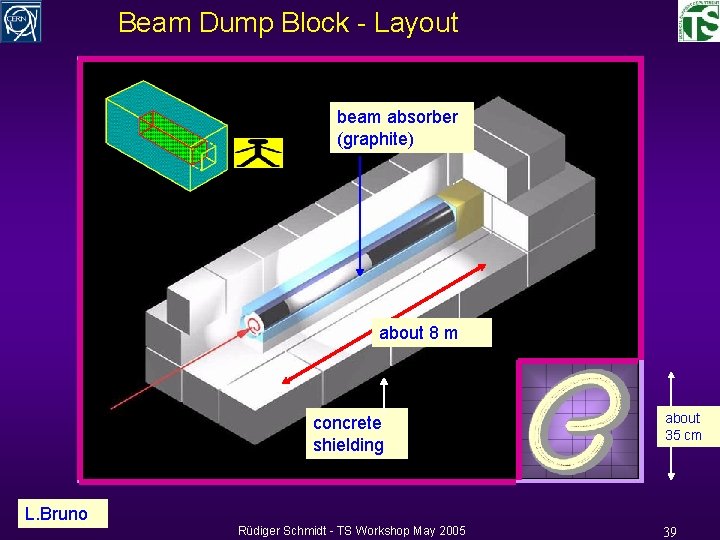
Beam Dump Block - Layout beam absorber (graphite) about 8 m concrete shielding L. Bruno Rüdiger Schmidt - TS Workshop May 2005 about 35 cm 39
Operational margin of a superconducting magnet Applied Magnetic Field [T] Bc critical field Bc quench with fast loss of ~5 · 106 protons 8. 3 T QUENCH quench with fast loss of ~5 · 109 protons 0. 54 T 1. 9 K Tc critical Tc temperature 9 K Rüdiger Schmidt - TS Workshop May 2005 40
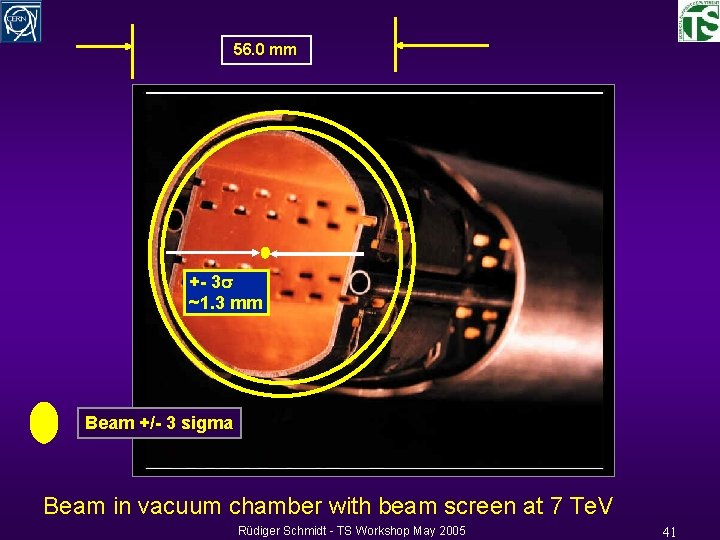
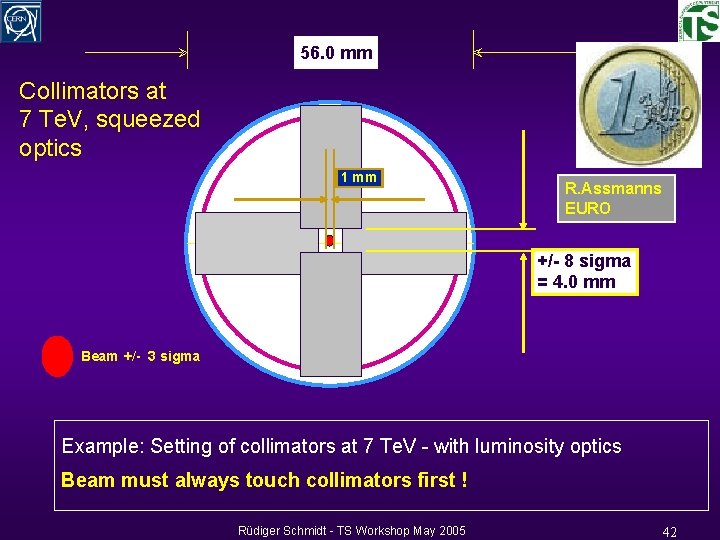
56. 0 mm +- 3 ~1. 3 mm Beam +/- 3 sigma Beam in vacuum chamber with beam screen at 7 Te. V Rüdiger Schmidt - TS Workshop May 2005 41
56. 0 mm Collimators at 7 Te. V, squeezed optics 1 mm R. Assmanns EURO +/- 8 sigma = 4. 0 mm Beam +/- 3 sigma Example: Setting of collimators at 7 Te. V - with luminosity optics Beam must always touch collimators first ! Rüdiger Schmidt - TS Workshop May 2005 42
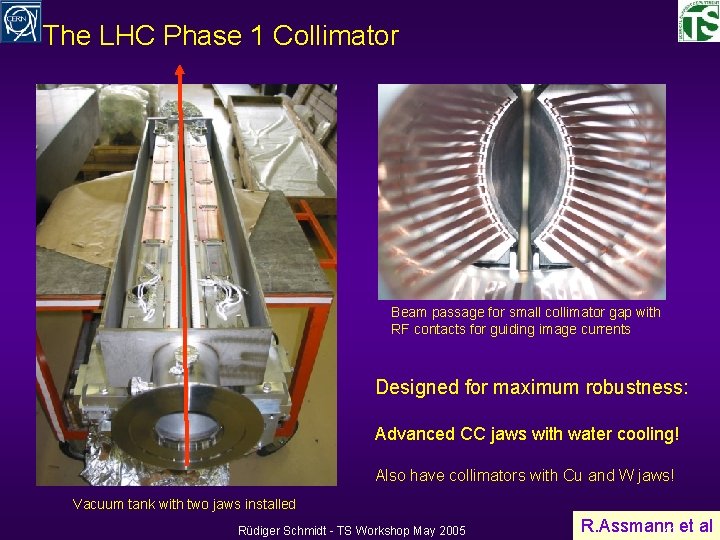
The LHC Phase 1 Collimator Beam passage for small collimator gap with RF contacts for guiding image currents Designed for maximum robustness: Advanced CC jaws with water cooling! Also have collimators with Cu and W jaws! Vacuum tank with two jaws installed Rüdiger Schmidt - TS Workshop May 2005 R. Assmann 43 et al
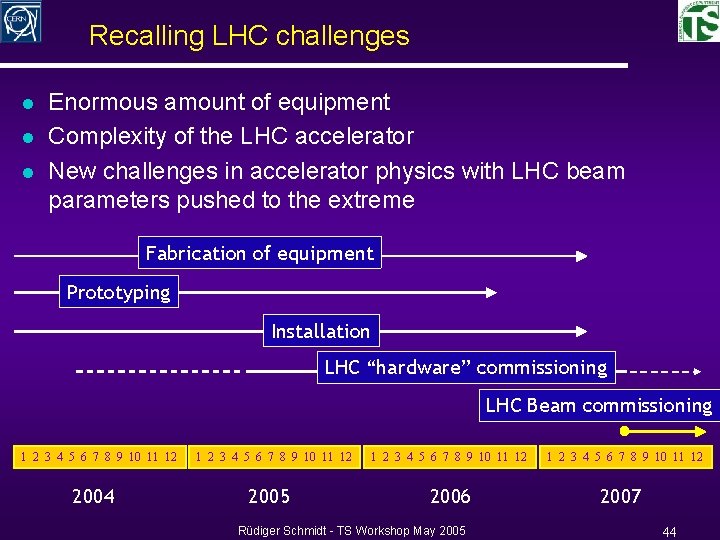
Recalling LHC challenges l l l Enormous amount of equipment Complexity of the LHC accelerator New challenges in accelerator physics with LHC beam parameters pushed to the extreme Fabrication of equipment Prototyping Installation LHC “hardware” commissioning LHC Beam commissioning 1 2 3 4 5 6 7 8 9 10 11 12 2004 1 2 3 4 5 6 7 8 9 10 11 12 2005 1 2 3 4 5 6 7 8 9 10 11 12 2006 Rüdiger Schmidt - TS Workshop May 2005 1 2 3 4 5 6 7 8 9 10 11 12 2007 44
Conclusions l The LHC is a global project with the world-wide highenergy physics community devoted to its progress and results l As a project, it is much more complex and diversified than the SPS or LEP or any other large accelerator project constructed to date Machine Advisory Committee, chaired by M. Tigner, March 2002 The problem is obvious: l Magnetic field increase only a factor of two l Energy increase only a factor of seven l Stored energy increase > two orders of magnitude (damage/quench) Review on LHC Machine Protection, chaired by M. Harrison: April 2005 Rüdiger Schmidt - TS Workshop May 2005 45
It need all CERN (and more. . . ) to make LHC a success l l l l Superconducting magnets and 1. 9 K large scale cryogenics Magnet powering and protection Four vacuum systems HTS current leads in complex feedbox Collimation system and beam absorbers Highly reliable beam instruments RF system with low level controls, very low noise Reliable interlock systems and controls Integration and machine description (databases), project management tools Installation (logistics, transport, interconnects, planning) Alignment Hardware commissioning Access system and radiation monitoring Water cooling and ventilation Electricity distribution and magnet powering Rüdiger Schmidt - TS Workshop May 2005 46
Acknowledgement The LHC accelerator is being realised by CERN in collaboration with institutes from many countries over a period of more than 20 years Main contribution come from the USA, Russia, India, Canada, special contributions from France and Switzerland Industry plays a major role in the construction of the LHC Rüdiger Schmidt - TS Workshop May 2005 47
Abstract For the LHC to provide particle physics with proton-proton collisions at the centre of mass energy of 14 Te. V with a luminosity of 10^34 cm- 2 s-1, the machine will operate with high-field dipole magnets using Nb. Ti superconductors cooled to below the lambda point of helium. In order to reach design performance, the LHC requires both, the use of existing technologies pushed to the limits as well as the application of novel technologies. The construction follows a decade of intensive R&D and technical validation of major collider sub-systems. The lecture will focus on the required LHC performance, and on the implications on the technologies. The consequences of the unprecedented quantity of energy stored in both magnets and beams will be discussed. A brief outlook to operation will be given. Rüdiger Schmidt - TS Workshop May 2005 48
Some references Accelerator physics l Proceedings of CERN ACCELERATOR SCHOOL (CAS), http: //schools. web. cern. ch/Schools/CAS_Proceedings. html • In particular: 5 th General CERN Accelerator School, CERN 94 -01, 26 January 1994, 2 Volumes, edited by S. Turner Superconducting magnets / cryogenics l Superconducting Accelerator Magnets, K. H. Mess, P. Schmüser, S. Wolff, World Scientific 1996 l Superconducting Magnets, M. Wilson, Oxford Press l Superconducting Magnets for Accelerators and Detectors, L. Rossi, CERN-AT 2003 -002 -MAS (2003) LHC l Technological challenges for the LHC, CERN Academic Training, 5 Lectures, March 2003 (CERN WEB site) l Beam Physics at LHC, L. Evans, CERN-LHC Project Report 635, 2003 l Status of LHC, R. Schmidt, CERN-LHC Project Report 569, 2003 l. . . collimation system. . , R. Assmann et al. , CERN-LHC Project Report 640, 2003 l LHC Design Report 1995 l LHC Design Report 2003 - in preparation Rüdiger Schmidt - TS Workshop May 2005 49
summarising constraints and consequences…. Centre-of-mass energy must well exceed 1 Te. V, LHC installed into LEP tunnel l Colliding protons, and also heavy ions l Magnetic field of 8. 3 T with superconducting magnets l Large amount of energy stored in magnets Luminosity of 1034 cm-2 s-1 l Need for “two accelerators” in one tunnel with beam parameters pushed to the extreme – with opposite magnetic dipole field l Large amount of energy stored in beams Rüdiger Schmidt - TS Workshop May 2005 50
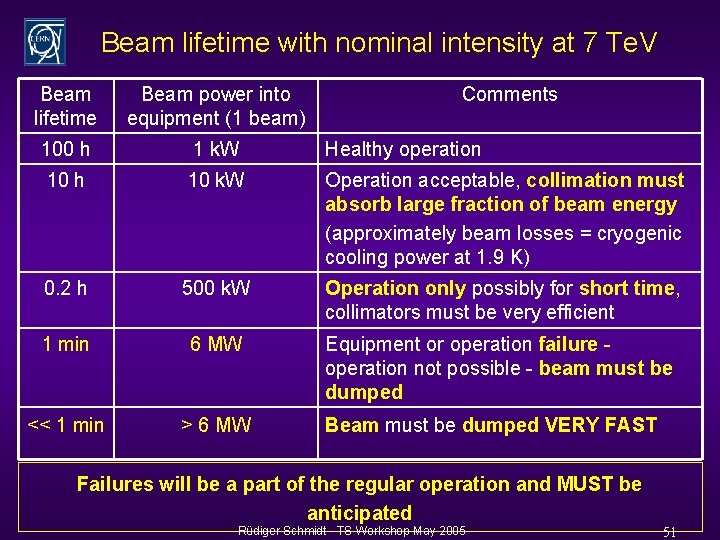
Beam lifetime with nominal intensity at 7 Te. V Beam lifetime Beam power into equipment (1 beam) Comments 100 h 1 k. W Healthy operation 10 h 10 k. W Operation acceptable, collimation must absorb large fraction of beam energy (approximately beam losses = cryogenic cooling power at 1. 9 K) 0. 2 h 500 k. W Operation only possibly for short time, collimators must be very efficient 1 min 6 MW Equipment or operation failure operation not possible - beam must be dumped << 1 min > 6 MW Beam must be dumped VERY FAST Failures will be a part of the regular operation and MUST be anticipated Rüdiger Schmidt - TS Workshop May 2005 51
Crossing angle for multi bunch operation u u u Total crossing angle of 300 mrad Beam size at IP 16 mm, in arcs about 0. 2 mm Beams in the arcs in two vacuum chambers Rüdiger Schmidt - TS Workshop May 2005 52
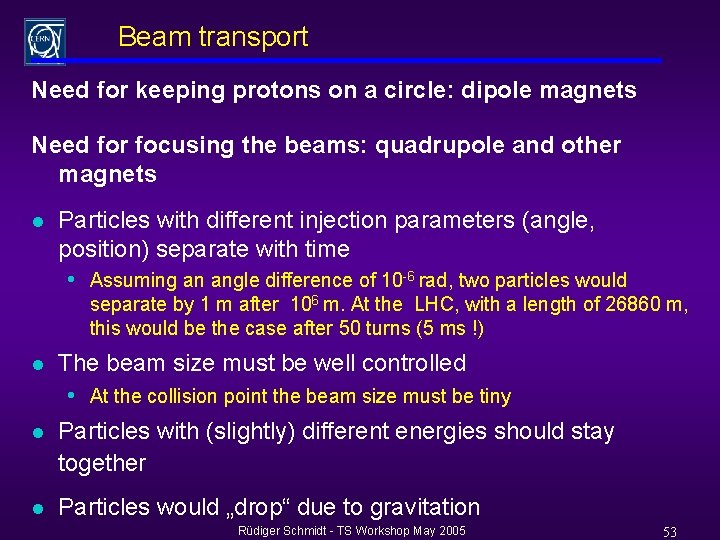
Beam transport Need for keeping protons on a circle: dipole magnets Need for focusing the beams: quadrupole and other magnets l Particles with different injection parameters (angle, position) separate with time • Assuming an angle difference of 10 -6 rad, two particles would separate by 1 m after 106 m. At the LHC, with a length of 26860 m, this would be the case after 50 turns (5 ms !) l The beam size must be well controlled • At the collision point the beam size must be tiny l Particles with (slightly) different energies should stay together l Particles would „drop“ due to gravitation Rüdiger Schmidt - TS Workshop May 2005 53
Installation of cryogenic distribution line in the LHC tunnel – started during summer 2003 Rüdiger Schmidt - TS Workshop May 2005 54
LHC magnetic cycle energy ramp coast 7 Te. V start of the ramp injection phase preparation and access 450 Ge. V L. Bottura Rüdiger Schmidt - TS Workshop May 2005 55
Beam losses into material l l Proton losses lead to particle cascades in materials The energy deposition leads to a temperature increase For the maximum energy deposition as a function of material there is no straightforward expression Programs such as FLUKA are being used for the calculation of the energy deposition Magnets could quench…. . • beam lost - re-establish condition will take hours Equipment could be damaged…. . • melting • losing their performance (mechanical strength) Repair could take several weeks Rüdiger Schmidt - TS Workshop May 2005 56
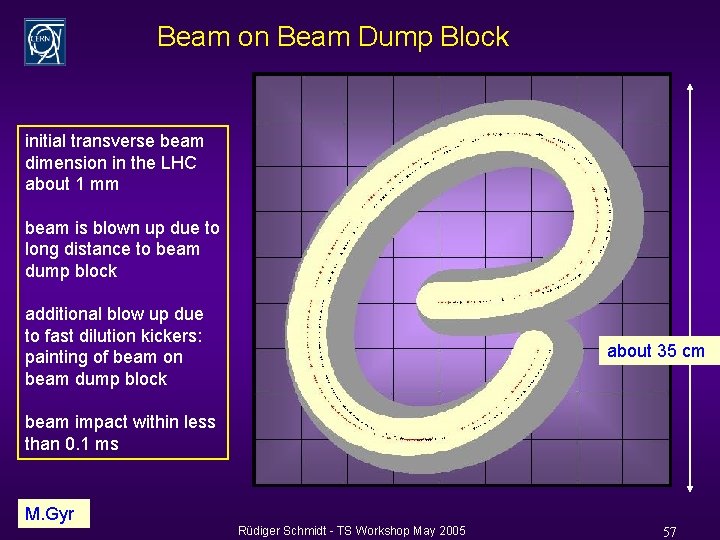
Beam on Beam Dump Block initial transverse beam dimension in the LHC about 1 mm beam is blown up due to long distance to beam dump block additional blow up due to fast dilution kickers: painting of beam on beam dump block about 35 cm beam impact within less than 0. 1 ms M. Gyr Rüdiger Schmidt - TS Workshop May 2005 57