
OVERVIEW OF IGS PRODUCTS ANALYSIS CENTER MODELING Status
- Slides: 35
OVERVIEW OF IGS PRODUCTS & ANALYSIS CENTER MODELING • Status of core products – focus on Ultra-rapid predicted orbits – issues with current products • Comparisons of AC analysis strategies – evidence for systematic errors, esp. fortnightly harmonics • Recommendations Jim Ray, NOAA/NGS Jake Griffiths, NOAA/NGS IGS 2008 Workshop, Miami Beach, 2 June 2008
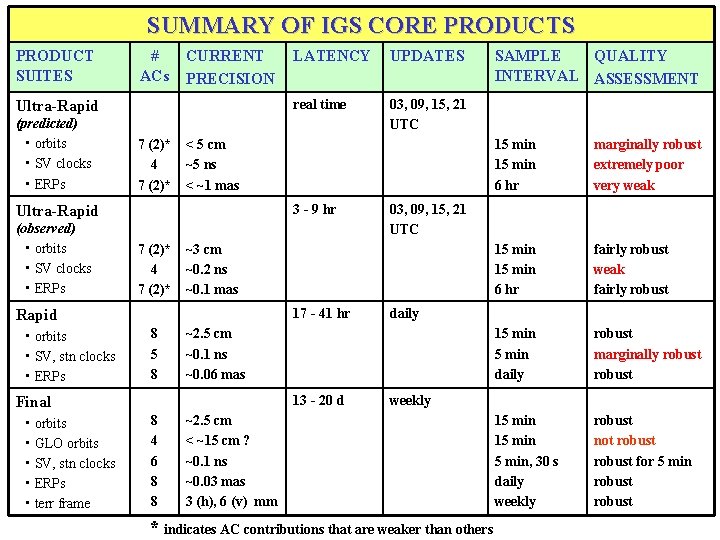
SUMMARY OF IGS CORE PRODUCTS PRODUCT SUITES # ACs CURRENT PRECISION Ultra-Rapid (predicted) • orbits • SV clocks • ERPs 7 (2)* 4 7 (2)* 03, 09, 15, 21 UTC 17 - 41 hr 8 5 8 8 4 6 8 8 15 min 6 hr marginally robust extremely poor very weak 15 min 6 hr fairly robust weak fairly robust 15 min daily robust marginally robust 15 min, 30 s daily weekly robust not robust for 5 min robust daily ~2. 5 cm ~0. 1 ns ~0. 06 mas 13 - 20 d SAMPLE QUALITY INTERVAL ASSESSMENT 03, 09, 15, 21 UTC ~3 cm ~0. 2 ns ~0. 1 mas Final • orbits • GLO orbits • SV, stn clocks • ERPs • terr frame real time 3 - 9 hr Rapid • orbits • SV, stn clocks • ERPs UPDATES < 5 cm ~5 ns < ~1 mas Ultra-Rapid (observed) • orbits • SV clocks • ERPs LATENCY weekly ~2. 5 cm < ~15 cm ? ~0. 1 ns ~0. 03 mas 3 (h), 6 (v) mm * indicates AC contributions that are weaker than others
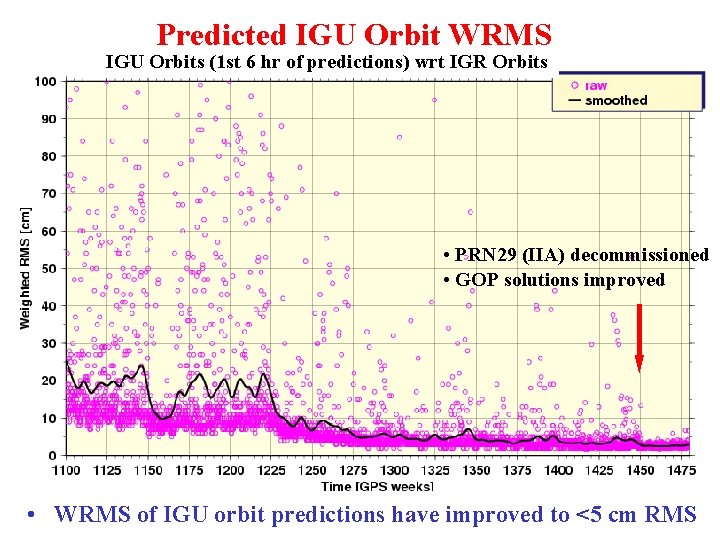
Predicted IGU Orbit WRMS IGU Orbits (1 st 6 hr of predictions) wrt IGR Orbits • PRN 29 (IIA) decommissioned • GOP solutions improved • WRMS of IGU orbit predictions have improved to <5 cm RMS
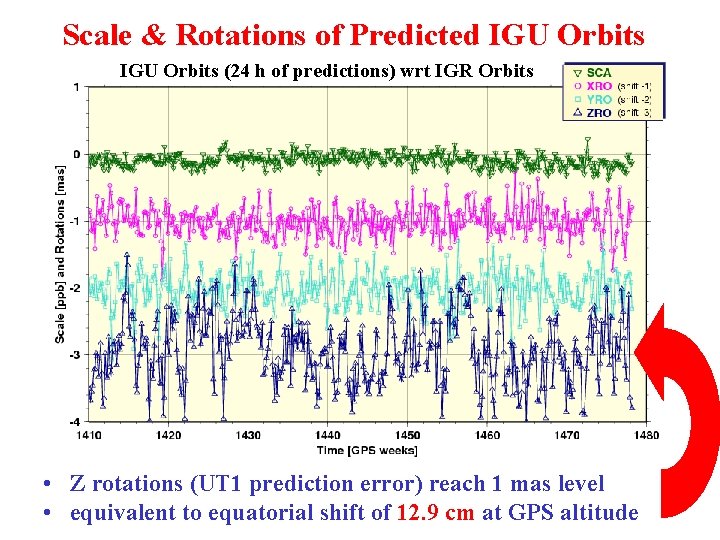
Scale & Rotations of Predicted IGU Orbits (24 h of predictions) wrt IGR Orbits (shifted) • Z rotations (UT 1 prediction error) reach 1 mas level • equivalent to equatorial shift of 12. 9 cm at GPS altitude
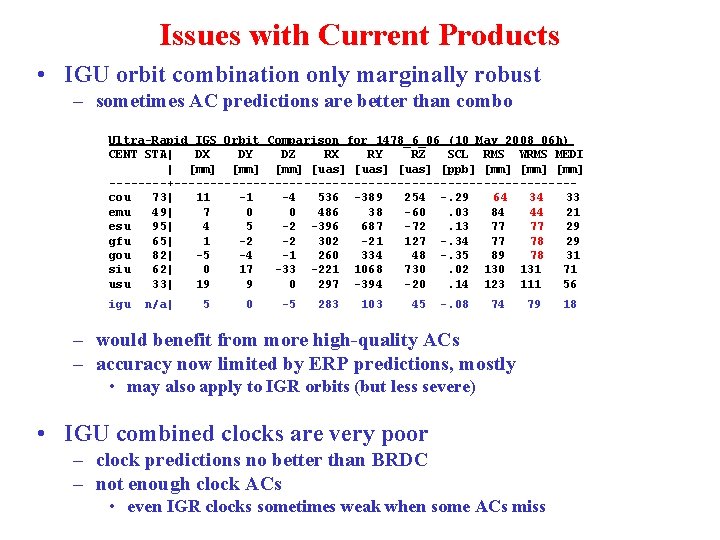
Issues with Current Products • IGU orbit combination only marginally robust – sometimes AC predictions are better than combo Ultra-Rapid IGS Orbit Comparison for 1478_6_06 (10 May 2008 06 h) CENT STA| DX DY DZ RX RY RZ SCL RMS WRMS MEDI | [mm] [uas] [ppb] [mm] ----+----------------------------cou 73| 11 -1 -4 536 -389 254 -. 29 64 34 33 emu 49| 7 0 0 486 38 -60. 03 84 44 21 esu 95| 4 5 -2 -396 687 -72. 13 77 77 29 gfu 65| 1 -2 -2 302 -21 127 -. 34 77 78 29 gou 82| -5 -4 -1 260 334 48 -. 35 89 78 31 siu 62| 0 17 -33 -221 1068 730. 02 130 131 71 usu 33| 19 9 0 297 -394 -20. 14 123 111 56 igu n/a| 5 0 -5 283 103 45 -. 08 74 79 – would benefit from more high-quality ACs – accuracy now limited by ERP predictions, mostly • may also apply to IGR orbits (but less severe) • IGU combined clocks are very poor – clock predictions no better than BRDC – not enough clock ACs • even IGR clocks sometimes weak when some ACs miss 18
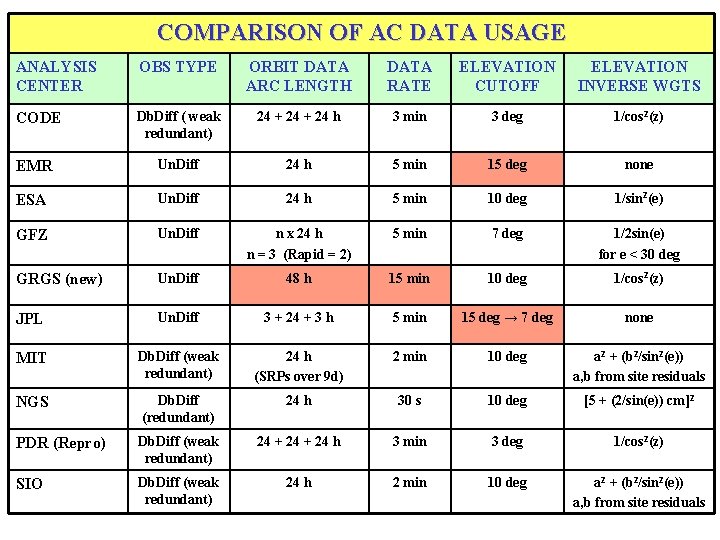
COMPARISON OF AC DATA USAGE ANALYSIS CENTER OBS TYPE ORBIT DATA ARC LENGTH DATA RATE ELEVATION CUTOFF ELEVATION INVERSE WGTS CODE Db. Diff ( weak redundant) 24 + 24 h 3 min 3 deg 1/cos 2(z) EMR Un. Diff 24 h 5 min 15 deg none ESA Un. Diff 24 h 5 min 10 deg 1/sin 2(e) GFZ Un. Diff n x 24 h n = 3 (Rapid = 2) 5 min 7 deg 1/2 sin(e) for e < 30 deg GRGS (new) Un. Diff 48 h 15 min 10 deg 1/cos 2(z) JPL Un. Diff 3 + 24 + 3 h 5 min 15 deg → 7 deg none MIT Db. Diff (weak redundant) 24 h (SRPs over 9 d) 2 min 10 deg a 2 + (b 2/sin 2(e)) a, b from site residuals NGS Db. Diff (redundant) 24 h 30 s 10 deg [5 + (2/sin(e)) cm]2 PDR (Repro) Db. Diff (weak redundant) 24 + 24 h 3 min 3 deg 1/cos 2(z) SIO Db. Diff (weak redundant) 24 h 2 min 10 deg a 2 + (b 2/sin 2(e)) a, b from site residuals
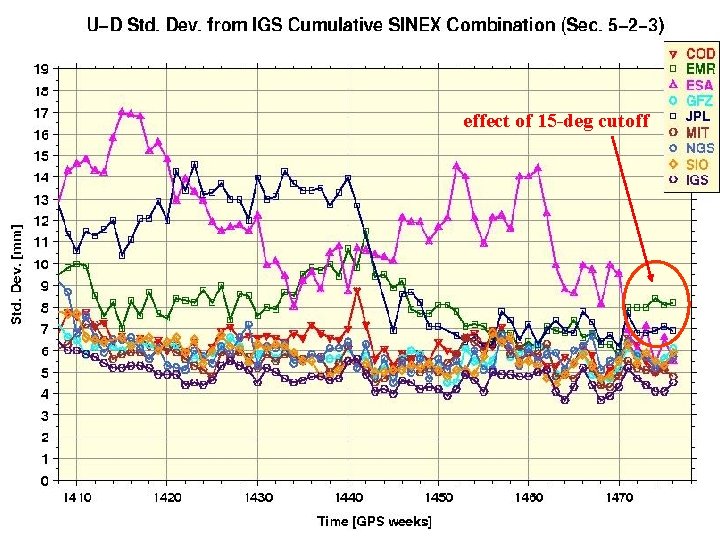
effect of 15 -deg cutoff
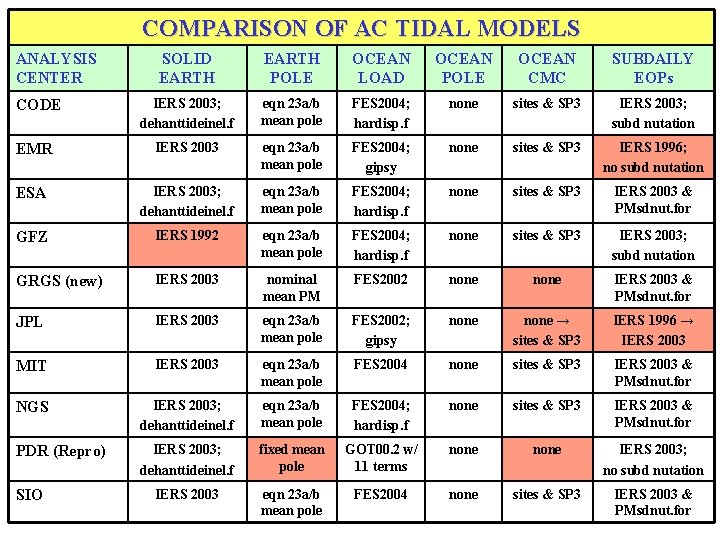
COMPARISON OF AC TIDAL MODELS ANALYSIS CENTER SOLID EARTH POLE OCEAN LOAD OCEAN POLE OCEAN CMC SUBDAILY EOPs IERS 2003; dehanttideinel. f eqn 23 a/b mean pole FES 2004; hardisp. f none sites & SP 3 IERS 2003; subd nutation EMR IERS 2003 eqn 23 a/b mean pole FES 2004; gipsy none sites & SP 3 IERS 1996; no subd nutation ESA IERS 2003; dehanttideinel. f eqn 23 a/b mean pole FES 2004; hardisp. f none sites & SP 3 IERS 2003 & PMsdnut. for GFZ IERS 1992 eqn 23 a/b mean pole FES 2004; hardisp. f none sites & SP 3 IERS 2003; subd nutation GRGS (new) IERS 2003 nominal mean PM FES 2002 none IERS 2003 & PMsdnut. for JPL IERS 2003 eqn 23 a/b mean pole FES 2002; gipsy none → sites & SP 3 IERS 1996 → IERS 2003 MIT IERS 2003 eqn 23 a/b mean pole FES 2004 none sites & SP 3 IERS 2003 & PMsdnut. for NGS IERS 2003; dehanttideinel. f eqn 23 a/b mean pole FES 2004; hardisp. f none sites & SP 3 IERS 2003 & PMsdnut. for PDR (Repro) IERS 2003; dehanttideinel. f fixed mean pole GOT 00. 2 w/ 11 terms none IERS 2003; no subd nutation IERS 2003 eqn 23 a/b mean pole FES 2004 none sites & SP 3 IERS 2003 & PMsdnut. for CODE SIO
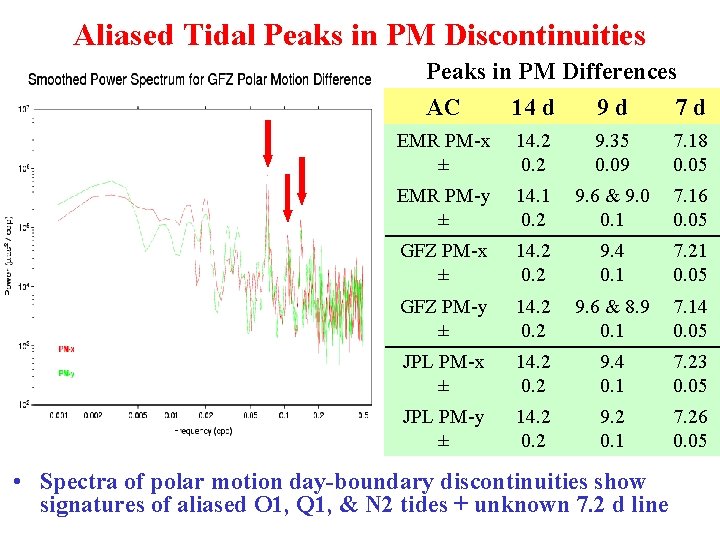
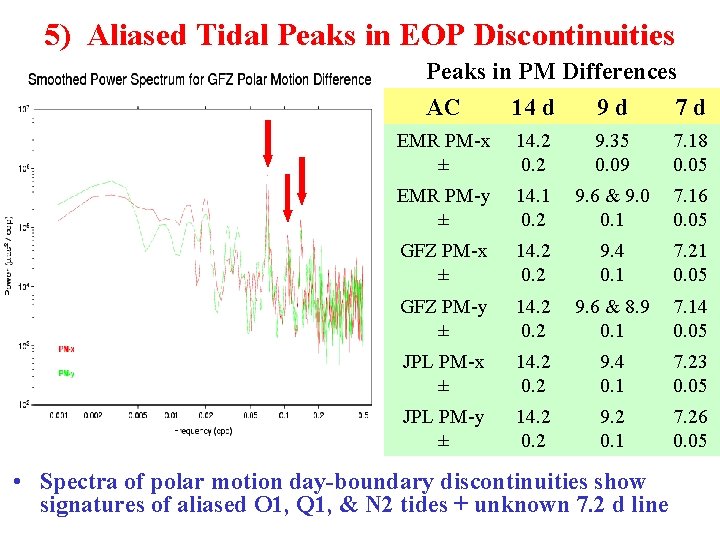
Aliased Tidal Peaks in PM Discontinuities Peaks in PM Differences AC 14 d 9 d 7 d EMR PM-x ± 14. 2 0. 2 9. 35 0. 09 7. 18 0. 05 EMR PM-y ± 14. 1 0. 2 9. 6 & 9. 0 0. 1 7. 16 0. 05 GFZ PM-x ± 14. 2 0. 2 9. 4 0. 1 7. 21 0. 05 GFZ PM-y ± 14. 2 0. 2 9. 6 & 8. 9 0. 1 7. 14 0. 05 JPL PM-x ± 14. 2 0. 2 9. 4 0. 1 7. 23 0. 05 JPL PM-y ± 14. 2 0. 2 9. 2 0. 1 7. 26 0. 05 • Spectra of polar motion day-boundary discontinuities show signatures of aliased O 1, Q 1, & N 2 tides + unknown 7. 2 d line
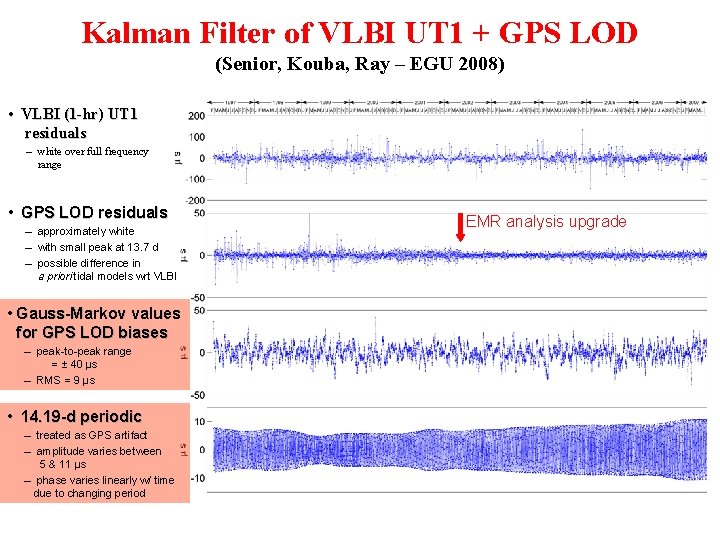
Kalman Filter of VLBI UT 1 + GPS LOD (Senior, Kouba, Ray – EGU 2008) • VLBI (1 -hr) UT 1 residuals – white over full frequency range • GPS LOD residuals – approximately white – with small peak at 13. 7 d – possible difference in a priori tidal models wrt VLBI • Gauss-Markov values for GPS LOD biases – peak-to-peak range = ± 40 μs – RMS = 9 μs • 14. 19 -d periodic – treated as GPS artifact – amplitude varies between 5 & 11 μs – phase varies linearly w/ time due to changing period EMR analysis upgrade
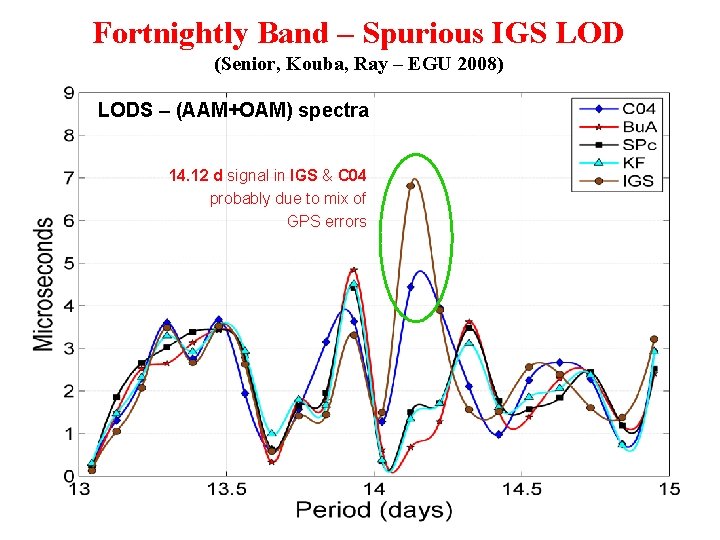
Fortnightly Band – Spurious IGS LOD (Senior, Kouba, Ray – EGU 2008) LODS – (AAM+OAM) spectra 14. 12 d signal in IGS & C 04 probably due to mix of GPS errors
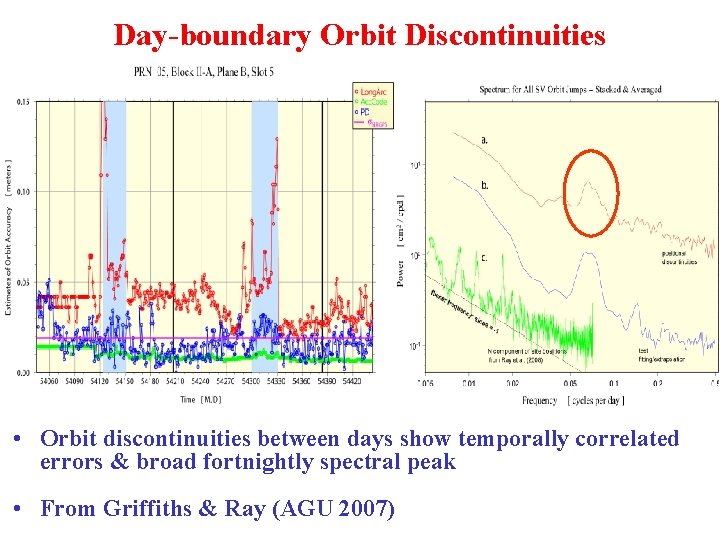
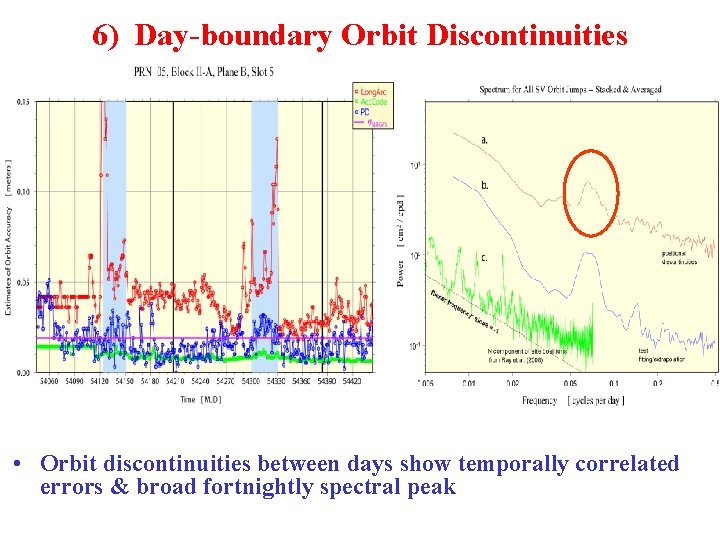
Day-boundary Orbit Discontinuities • Orbit discontinuities between days show temporally correlated errors & broad fortnightly spectral peak • From Griffiths & Ray (AGU 2007)
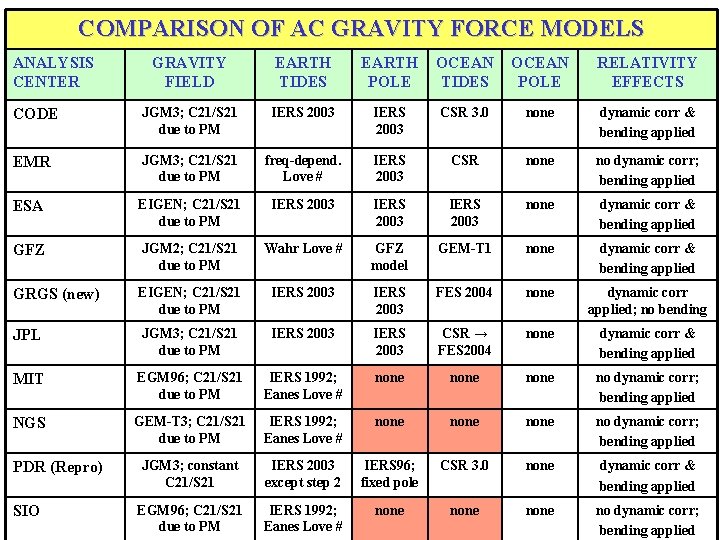
COMPARISON OF AC GRAVITY FORCE MODELS ANALYSIS CENTER GRAVITY FIELD EARTH TIDES EARTH POLE OCEAN TIDES OCEAN POLE RELATIVITY EFFECTS CODE JGM 3; C 21/S 21 due to PM IERS 2003 CSR 3. 0 none dynamic corr & bending applied EMR JGM 3; C 21/S 21 due to PM freq-depend. Love # IERS 2003 CSR none no dynamic corr; bending applied ESA EIGEN; C 21/S 21 due to PM IERS 2003 none dynamic corr & bending applied GFZ JGM 2; C 21/S 21 due to PM Wahr Love # GFZ model GEM-T 1 none dynamic corr & bending applied GRGS (new) EIGEN; C 21/S 21 due to PM IERS 2003 FES 2004 none dynamic corr applied; no bending JPL JGM 3; C 21/S 21 due to PM IERS 2003 CSR → FES 2004 none dynamic corr & bending applied MIT EGM 96; C 21/S 21 due to PM IERS 1992; Eanes Love # none no dynamic corr; bending applied NGS GEM-T 3; C 21/S 21 due to PM IERS 1992; Eanes Love # none no dynamic corr; bending applied JGM 3; constant C 21/S 21 IERS 2003 except step 2 IERS 96; fixed pole CSR 3. 0 none dynamic corr & bending applied EGM 96; C 21/S 21 due to PM IERS 1992; Eanes Love # none no dynamic corr; bending applied PDR (Repro) SIO
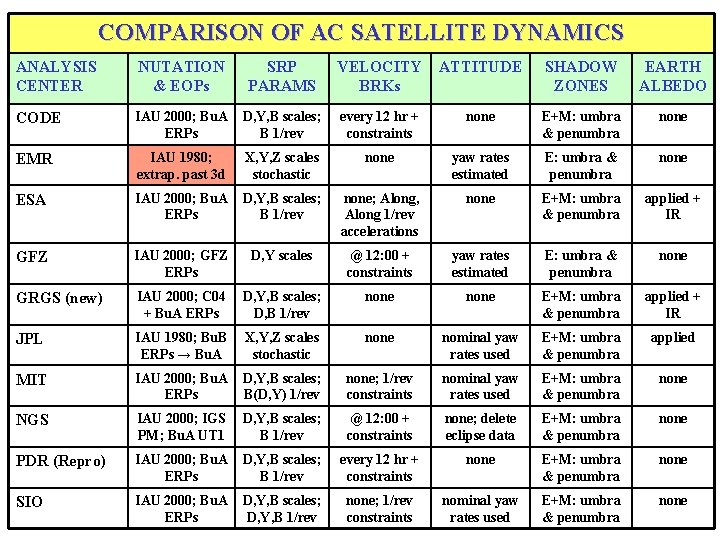
COMPARISON OF AC SATELLITE DYNAMICS ANALYSIS CENTER NUTATION & EOPs SRP PARAMS VELOCITY BRKs ATTITUDE SHADOW ZONES EARTH ALBEDO CODE IAU 2000; Bu. A ERPs D, Y, B scales; B 1/rev every 12 hr + constraints none E+M: umbra & penumbra none EMR IAU 1980; extrap. past 3 d X, Y, Z scales stochastic none yaw rates estimated E: umbra & penumbra none ESA IAU 2000; Bu. A ERPs D, Y, B scales; B 1/rev none; Along, Along 1/rev accelerations none E+M: umbra & penumbra applied + IR GFZ IAU 2000; GFZ ERPs D, Y scales @ 12: 00 + constraints yaw rates estimated E: umbra & penumbra none GRGS (new) IAU 2000; C 04 + Bu. A ERPs D, Y, B scales; D, B 1/rev none E+M: umbra & penumbra applied + IR JPL IAU 1980; Bu. B ERPs → Bu. A X, Y, Z scales stochastic none nominal yaw rates used E+M: umbra & penumbra applied MIT IAU 2000; Bu. A ERPs D, Y, B scales; B(D, Y) 1/rev none; 1/rev constraints nominal yaw rates used E+M: umbra & penumbra none NGS IAU 2000; IGS PM; Bu. A UT 1 D, Y, B scales; B 1/rev @ 12: 00 + constraints none; delete eclipse data E+M: umbra & penumbra none PDR (Repro) IAU 2000; Bu. A ERPs D, Y, B scales; B 1/rev every 12 hr + constraints none E+M: umbra & penumbra none SIO IAU 2000; Bu. A ERPs D, Y, B scales; D, Y, B 1/rev none; 1/rev constraints nominal yaw rates used E+M: umbra & penumbra none
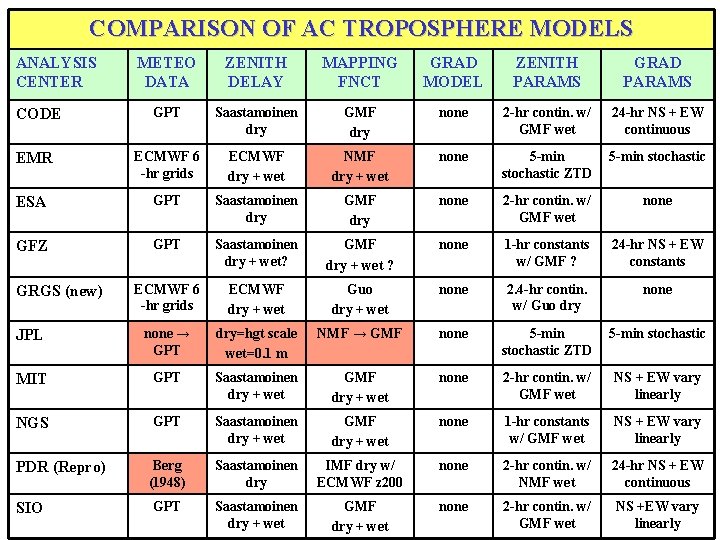
COMPARISON OF AC TROPOSPHERE MODELS ANALYSIS CENTER METEO DATA ZENITH DELAY MAPPING FNCT GRAD MODEL ZENITH PARAMS GRAD PARAMS GPT Saastamoinen dry GMF dry none 2 -hr contin. w/ GMF wet 24 -hr NS + EW continuous EMR ECMWF 6 -hr grids ECMWF dry + wet NMF dry + wet none 5 -min stochastic ZTD 5 -min stochastic ESA GPT Saastamoinen dry GMF dry none 2 -hr contin. w/ GMF wet none GFZ GPT Saastamoinen dry + wet? GMF dry + wet ? none 1 -hr constants w/ GMF ? 24 -hr NS + EW constants ECMWF 6 -hr grids ECMWF dry + wet Guo dry + wet none 2. 4 -hr contin. w/ Guo dry none JPL none → GPT dry=hgt scale wet=0. 1 m NMF → GMF none 5 -min stochastic ZTD 5 -min stochastic MIT GPT Saastamoinen dry + wet GMF dry + wet none 2 -hr contin. w/ GMF wet NS + EW vary linearly NGS GPT Saastamoinen dry + wet GMF dry + wet none 1 -hr constants w/ GMF wet NS + EW vary linearly Berg (1948) Saastamoinen dry IMF dry w/ ECMWF z 200 none 2 -hr contin. w/ NMF wet 24 -hr NS + EW continuous GPT Saastamoinen dry + wet GMF dry + wet none 2 -hr contin. w/ GMF wet NS +EW vary linearly CODE GRGS (new) PDR (Repro) SIO
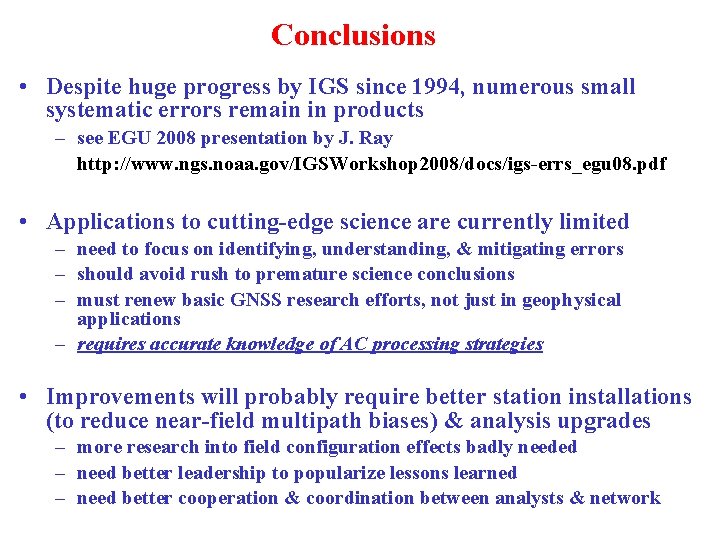
Conclusions • Despite huge progress by IGS since 1994, numerous small systematic errors remain in products – see EGU 2008 presentation by J. Ray http: //www. ngs. noaa. gov/IGSWorkshop 2008/docs/igs-errs_egu 08. pdf • Applications to cutting-edge science are currently limited – need to focus on identifying, understanding, & mitigating errors – should avoid rush to premature science conclusions – must renew basic GNSS research efforts, not just in geophysical applications – requires accurate knowledge of AC processing strategies • Improvements will probably require better station installations (to reduce near-field multipath biases) & analysis upgrades – more research into field configuration effects badly needed – need better leadership to popularize lessons learned – need better cooperation & coordination between analysts & network
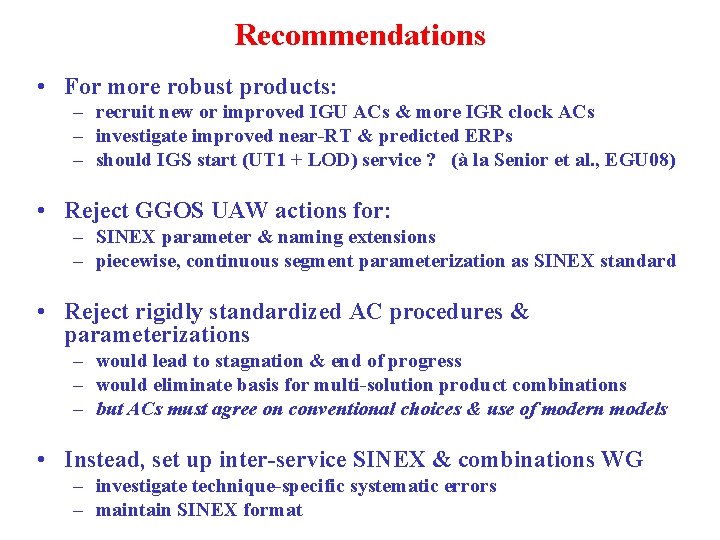
Recommendations • For more robust products: – recruit new or improved IGU ACs & more IGR clock ACs – investigate improved near-RT & predicted ERPs – should IGS start (UT 1 + LOD) service ? (à la Senior et al. , EGU 08) • Reject GGOS UAW actions for: – SINEX parameter & naming extensions – piecewise, continuous segment parameterization as SINEX standard • Reject rigidly standardized AC procedures & parameterizations – would lead to stagnation & end of progress – would eliminate basis for multi-solution product combinations – but ACs must agree on conventional choices & use of modern models • Instead, set up inter-service SINEX & combinations WG – investigate technique-specific systematic errors – maintain SINEX format
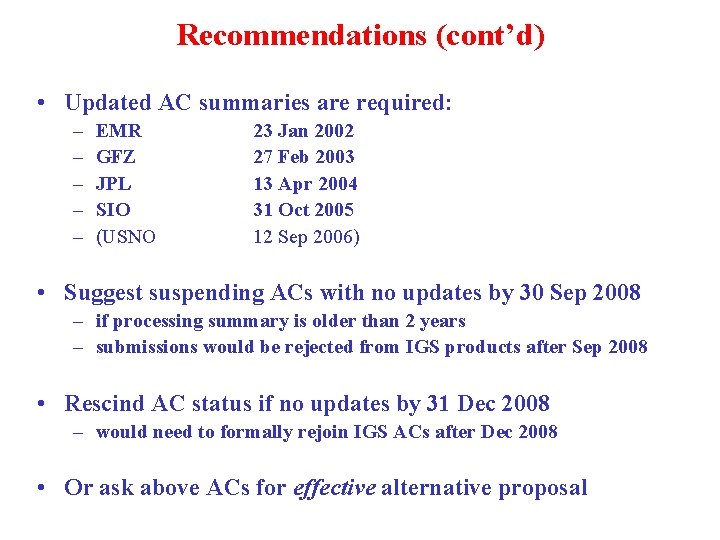
Recommendations (cont’d) • Updated AC summaries are required: – – – EMR GFZ JPL SIO (USNO 23 Jan 2002 27 Feb 2003 13 Apr 2004 31 Oct 2005 12 Sep 2006) • Suggest suspending ACs with no updates by 30 Sep 2008 – if processing summary is older than 2 years – submissions would be rejected from IGS products after Sep 2008 • Rescind AC status if no updates by 31 Dec 2008 – would need to formally rejoin IGS ACs after Dec 2008 • Or ask above ACs for effective alternative proposal
Backup Slides 1
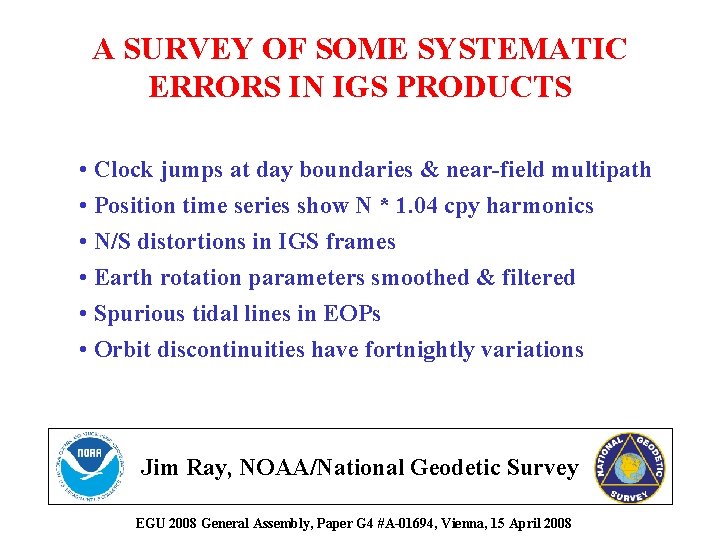
A SURVEY OF SOME SYSTEMATIC ERRORS IN IGS PRODUCTS • Clock jumps at day boundaries & near-field multipath • Position time series show N * 1. 04 cpy harmonics • N/S distortions in IGS frames • Earth rotation parameters smoothed & filtered • Spurious tidal lines in EOPs • Orbit discontinuities have fortnightly variations Jim Ray, NOAA/National Geodetic Survey EGU 2008 General Assembly, Paper G 4 #A-01694, Vienna, 15 April 2008
Context • GPS errors are propagated formally but true data noise is unknown – highly site-dependent & not white noise – e. g. , variances of AC frame solutions differ by > x 100 • dealt with by empirical rescaling of covariance matrix • Evidence for systematic effects in IGS product covariances is well known – e. g. , user velocity errors are routinely inflated to account for temporal correlation of position errors • but methods are purely empirical • Objective: Survey systematic errors in some IGS product values – underlying causes mostly unknown or not confirmed
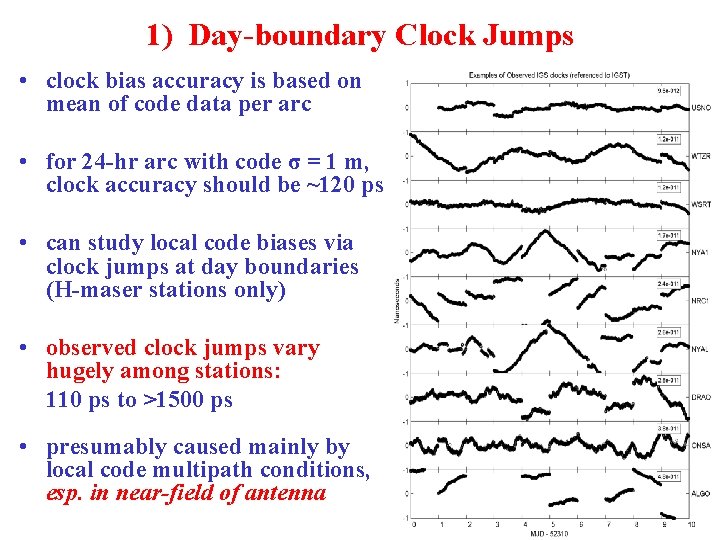
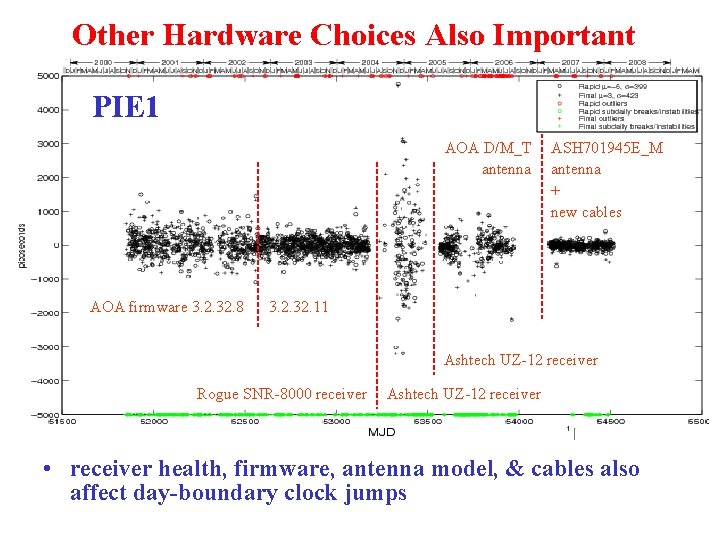
1) Day-boundary Clock Jumps • clock bias accuracy is based on mean of code data per arc • for 24 -hr arc with code σ = 1 m, clock accuracy should be ~120 ps • can study local code biases via clock jumps at day boundaries (H-maser stations only) • observed clock jumps vary hugely among stations: 110 ps to >1500 ps • presumably caused mainly by local code multipath conditions, esp. in near-field of antenna
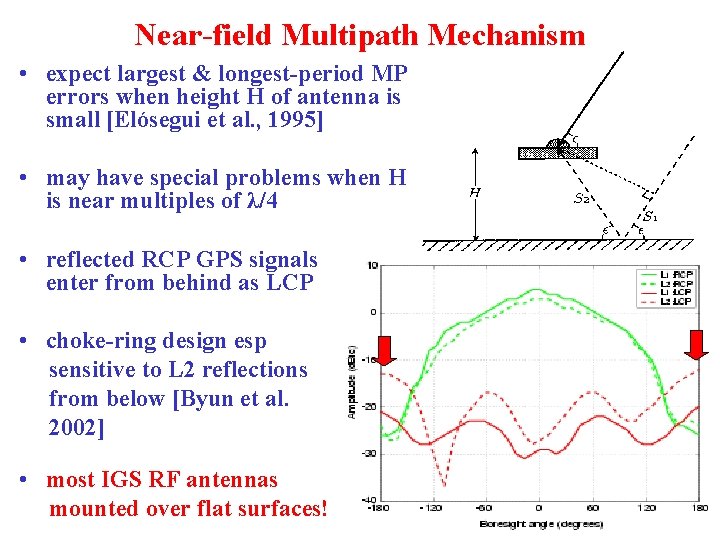
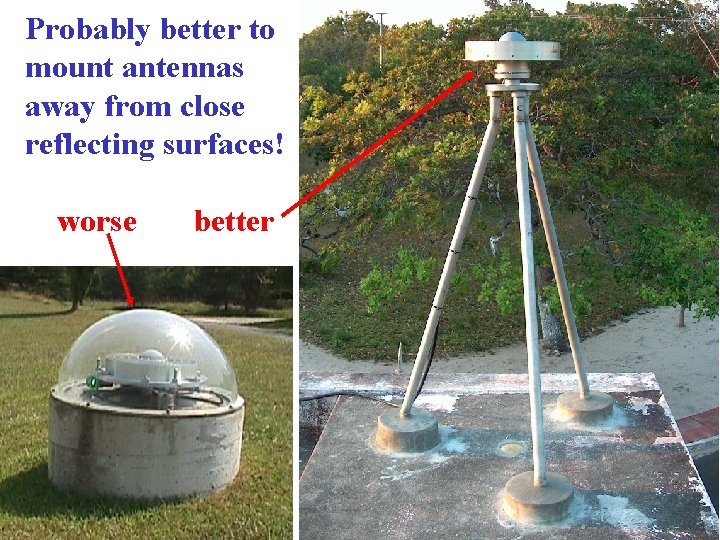
Near-field Multipath Mechanism • expect largest & longest-period MP errors when height H of antenna is small [Elósegui et al. , 1995] • may have special problems when H is near multiples of λ/4 • reflected RCP GPS signals enter from behind as LCP • choke-ring design esp sensitive to L 2 reflections from below [Byun et al. 2002] • most IGS RF antennas mounted over flat surfaces!
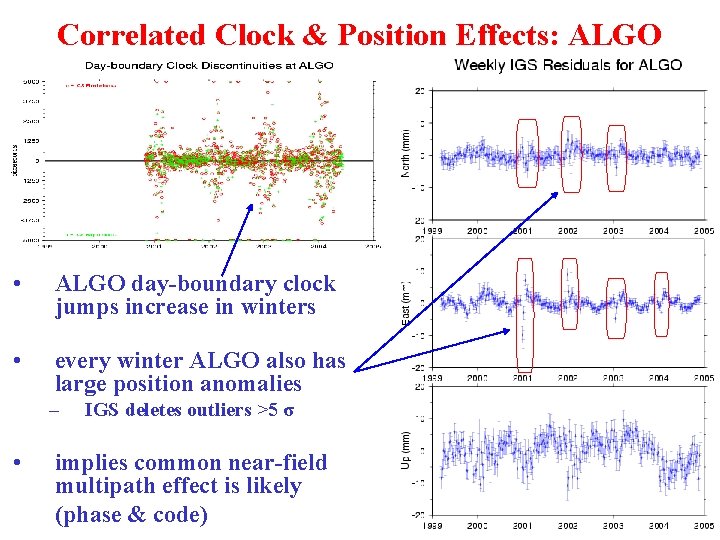
Correlated Clock & Position Effects: ALGO • ALGO day-boundary clock jumps increase in winters • every winter ALGO also has large position anomalies – • IGS deletes outliers >5 σ implies common near-field multipath effect is likely (phase & code)
Probably better to mount antennas away from close reflecting surfaces! worse better
Other Hardware Choices Also Important PIE 1 AOA D/M_T antenna AOA firmware 3. 2. 32. 8 ASH 701945 E_M antenna + new cables 3. 2. 32. 11 Ashtech UZ-12 receiver Rogue SNR-8000 receiver Ashtech UZ-12 receiver • receiver health, firmware, antenna model, & cables also affect day-boundary clock jumps
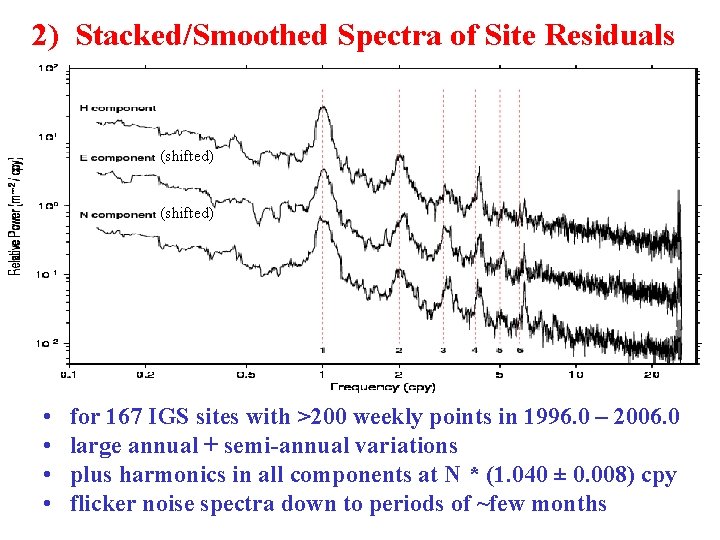
2) Stacked/Smoothed Spectra of Site Residuals (shifted) • • for 167 IGS sites with >200 weekly points in 1996. 0 – 2006. 0 large annual + semi-annual variations plus harmonics in all components at N * (1. 040 ± 0. 008) cpy flicker noise spectra down to periods of ~few months
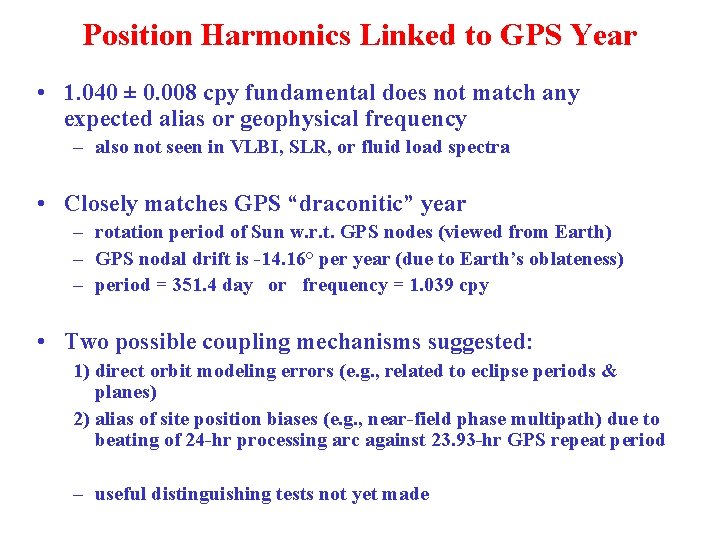
Position Harmonics Linked to GPS Year • 1. 040 ± 0. 008 cpy fundamental does not match any expected alias or geophysical frequency – also not seen in VLBI, SLR, or fluid load spectra • Closely matches GPS “draconitic” year – rotation period of Sun w. r. t. GPS nodes (viewed from Earth) – GPS nodal drift is -14. 16° per year (due to Earth’s oblateness) – period = 351. 4 day or frequency = 1. 039 cpy • Two possible coupling mechanisms suggested: 1) direct orbit modeling errors (e. g. , related to eclipse periods & planes) 2) alias of site position biases (e. g. , near-field phase multipath) due to beating of 24 -hr processing arc against 23. 93 -hr GPS repeat period – useful distinguishing tests not yet made
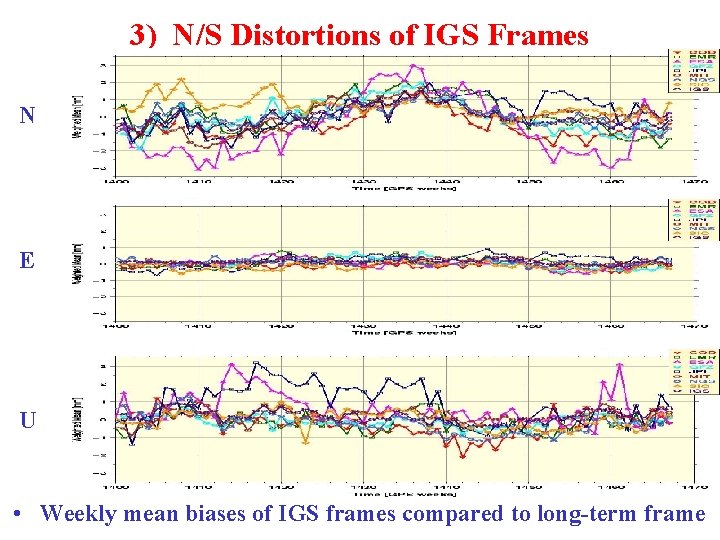
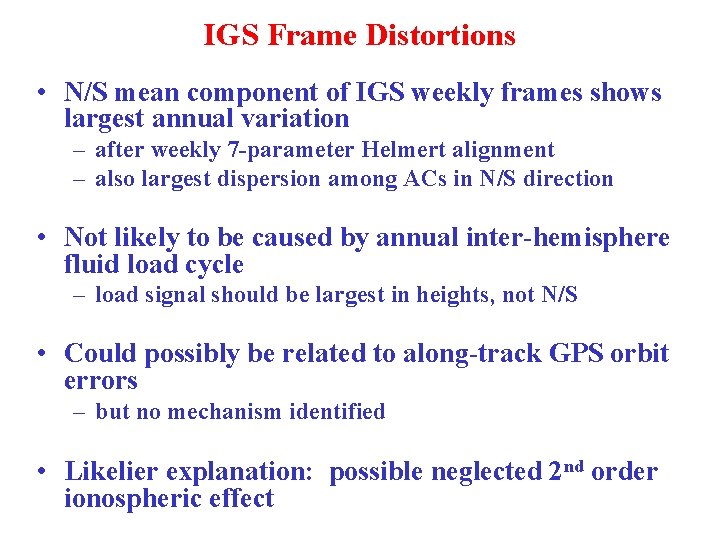
3) N/S Distortions of IGS Frames N E U • Weekly mean biases of IGS frames compared to long-term frame
IGS Frame Distortions • N/S mean component of IGS weekly frames shows largest annual variation – after weekly 7 -parameter Helmert alignment – also largest dispersion among ACs in N/S direction • Not likely to be caused by annual inter-hemisphere fluid load cycle – load signal should be largest in heights, not N/S • Could possibly be related to along-track GPS orbit errors – but no mechanism identified • Likelier explanation: possible neglected 2 nd order ionospheric effect
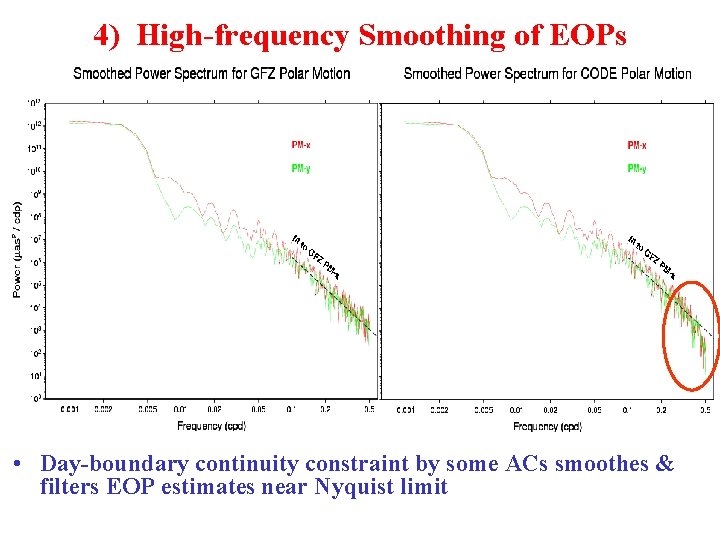
4) High-frequency Smoothing of EOPs • Day-boundary continuity constraint by some ACs smoothes & filters EOP estimates near Nyquist limit
Filter/Smoother by Continuity Constraints • Some ACs estimate EOPs (& others) by continuous linear segments – attenuates power by factor 4 at Nyquist limit – smoothes estimates – filters certain phase components • To avoid contaminating IGS combination, such EOP solutions rejected since January 2008 (wk 1460) – but effects on other parameters probably still present • Past high-frequency studies should be reconsidered • Can use GFZ polar motion to estimate background, non-tidal, sub-daily variance: 13. 6 to 20. 7 μas 2
5) Aliased Tidal Peaks in EOP Discontinuities Peaks in PM Differences AC 14 d 9 d 7 d EMR PM-x ± 14. 2 0. 2 9. 35 0. 09 7. 18 0. 05 EMR PM-y ± 14. 1 0. 2 9. 6 & 9. 0 0. 1 7. 16 0. 05 GFZ PM-x ± 14. 2 0. 2 9. 4 0. 1 7. 21 0. 05 GFZ PM-y ± 14. 2 0. 2 9. 6 & 8. 9 0. 1 7. 14 0. 05 JPL PM-x ± 14. 2 0. 2 9. 4 0. 1 7. 23 0. 05 JPL PM-y ± 14. 2 0. 2 9. 2 0. 1 7. 26 0. 05 • Spectra of polar motion day-boundary discontinuities show signatures of aliased O 1, Q 1, & N 2 tides + unknown 7. 2 d line
6) Day-boundary Orbit Discontinuities • Orbit discontinuities between days show temporally correlated errors & broad fortnightly spectral peak
Conclusions • Despite huge progress by IGS since 1994, numerous small systematic errors remain in products • Applications to cutting-edge science must recognize limitations – need to focus on identifying, understanding, & mitigating errors – must renew basic GNSS research efforts, not just in geophysical applications – should avoid rush to premature science conclusions • Improvements will probably require better station installations (to reduce near-field multipath) & analysis upgrades – more research into field configuration effects badly needed – need better leadership to popularize lessons learned – need better cooperation & coordination between analysts & network