
Overview of General Ethics QUESTION Is it possible
Overview of General Ethics QUESTION: Is it possible to derive values from facts, or whether facts must always remain neutral?
Facts & Values—is it relative or absoulute? Facts say WHAT IS Values say WHAT OUGHT TO BE Can we ever derive an “ought” from an “is? ” If the answer is no, then how are we to decide issues of morality. If no facts can be used to establish morality, can there be absolute moral rules, or all more decisions relative—dependent upon particular circumstances, feeling, or desires.
Freedom vs. Determinism: How Free Are We? Freedom—if we are free to make a choice, then we are responsible for what we do. Praise or blame are appropriate. We can act on the basis of values that we hold Determinism—If we are totally conditioned (either by a God or social conditioning) we have no “real” choice in what we do, and it makes no sense to speak of moral action springing from choices and values, or action being worthy of praise or blame.
Degrees of Freedom We are all conditioned by many factors Determinism, however, leaves no scope for human freedom and choice (we are automata) Those who argue against determinism claim that there remains a measure of freedom that is exercised within the prevailing conditions.
Types of Ethics Descriptive Normative Meta-Ethics
Descriptive Ethics Descriptive ethics—straightforward form of ethical language that simply describes what happens, what moral choices are made and in which particular circumstances. For example, rather than making a statement about the rights or wrongs of abortions, descriptive ethics simply gives fats and figures about how many abortions take place, how they are carried out, and what legal restraints are placed on that practice. Descriptive ethics is about “rather than ought”
Normative Ethics Normative ethics deals with the norms (typical or average customs) of action, in terms of whether an action is considered good or bad, right or wrong. It is what is accepted normally in society. Norms change. It expresses values and makes a moral judgement based on them. It may relate to facts, but it is not wholly defined by facts. It may be justified in a number of ways. Normative ethics is about “ought”; it makes judgements.
Meta-Ethics—when philosophy examines the claims made in normative ethics, a number of questions are raised. What does it mean to say that something is right or wrong? Can moral statements be said to be either true or false? Do they express more than the preferences of the person who makes them? What is the meaning of the terms used in ethical discourse? _______________________________ These questions are not themselves moral statement; they do not say that a particular thing is right or wrong Meta-ethics is a part of philosophy which does to normative ethical statement what philosophy does to language in general—it examines ethical language to find out what it means and how it is used.
Three Bases for Ethics If moral language is simply expressing an emotion or a preference, then it does not seem to need further justification; it implies no more than the feeling of the moment. If we want to argue for a moral position, however, we need to find a rational basis for ethics. Within the history of Western philosophy, there have been three principle bases offered: Natural law, Utilitarianism, and Categorical Imperative.
Aristotle says, “Every art and every enquiry, and similarly every action and pursuit, is thought to aim at some good; and for this reason the good has rightly been declared to be that at which all things aim. ” Aristotle's “supreme good for human beings is happiness. ” Everything has a final cause or purpose—a good for which it exists, or if you accept with Plato Ideal Forms (there exist a pure form) and “Forms—especially the Form of Good” have a permanent reality independent of our own minds and perceptions, then it should be possible to specify which things are good and which bad, which actions are right and which are wrong—in an independent and objective ways.
Natural Law The approach to ethics which claims that something is right if it fulfils its true purpose in life, wrong if it goes against it. Natural law is not the same as a consideration of what appears as a natural response to a situation—natural in the sense that it reflects the nature that humankind shares with the rest of the animal kingdom RATHER—it is a nature as seen through the eyes of reason—often colored by religious views, with the would seen as the purposeful creation by God.
Utilitarianism is an approach to ethics by which the rightness of an action is decided by the fruitfulness or utility of its consequences. The doctrine that an action is right insofar as it promotes happiness, and that the greatest happiness of the greatest number should be the guiding principle of conduct. Utilitarianism is a morality theory associated with Jeremy Bentham and John Stuart Mill.
Types of Utilitarianism Hedonism—the achievement of happiness is the prime goal in life. Epicurious considered that the wise should lead a life free from anxiety, and if morality had nay purpose it was to maximize the amount of wellbeing that life can offer. Basis of utilitarian theories—right thing to do on any occasion is that which aims to give maximum happiness to all concerned. The greatest good for the greatest number. A theory based on the expected results of an action, rather than any inherent sense of right or wrong.
Certain Problems associated with Utilitarianism You can never be certain what the total effects of an action will be. For example, you may save the life of a drowning child, who then grows up to be a mass murder. The definition of what is happiness may not be the same for everybody, or that happiness may not be viewed objectively. Others may not want what you deem to be their happiness or in their best interest. How do you judge between pain caused to a single individual and the resulting happiness of many others? Would global benefit actuallyjustify the inflicting of pain on a single, innocent person?
Kant’s Contribution Remember, Kant made a distinction between things as we perceive them and things as they are in themselves, and the categories of space, time and causality by which we interpret our experience. He sought to formulate a general and universally applicable principle by which pure practical reason could distinguish right from wrong.
Kant’s Categorical Imperative People have a sense of moral obligation called categorical imperative. We all know of things we “should do” irrespective of the consequences. He contrasted this with a hypothetical imperative—which says what you need to do in order to achieve some chosen result: For example: You should work hard (categorical imperative). You should work hard if you want to succeed in this business (hypothetical imperative).
Kant’s Interpretation Which means: 1) act only on that maxim which you can at the same time will that it should become a universal law. Whatever one wishes to do, one should be prepared for everyone else to act upon that same principle. If you are not prepared for your action to become a universal rule, then you should not do it in your individual circumstances. 2) Act in such a way as to treat people as ends and never as a means. If you want to express your own moral autonomy, you should treat all others on the basis that they would want the same. You should not treat them as a means to your own end, but as ends in themselves. 3) Act as though you were legislating for a kingdom of ends. You should make your moral judgements as though you had responsibility for legislating in a kingdom in which everyone was an end, respected as an autonomous moral being
Absolute or Relative Morality? Absolute—if moral rules are absolute, then a particular action may be consider wrong no matter what the circumstances. Stealing, no matter if you are starving and want to feed your family, is wrong and the consequences will always be the same. Relative—you start with a particular situation and assess the intentions and consequences involve. You bring to bear your general views about life and the implications that various actions have on society as a whole. So, if a starving family steals to survive, it is not considered “wrong” and the consequences may be different. Complete relativism sometimes refuses to accept any general moral norms and everything is relative and it becomes increasingly difficult to make any moral judgement that may not be challenged on the basis of the gender, race, religion or social position of the person making that judgement.
Virtue Ethics Rather than looking at actions, and asking if they are right or wrong, one could start by asking the basic questions: What does it mean to be a “good” person? And develop this to explore the qualities and virtues that make up the “good life. ” Similar to Aristotle who linked the displaying of certain qualities with the final end or purpose of life. More ‘naturalistic’ in that is moves away from the idea of simply obeying rules to an appreciation of how one might express one’s own fundamental nature, and thus fulfil one’s potential as a human being.
Virtue Ethics’ Basic Questions Do we have a fixed essence? Are there particular masculine or feminine qualities that give rise to virtues appropriate to ech sex? If our nature has been shaped by factor over which we hav enot control (culture, experiences in childhood, genetics etc. )are we responsible for out actions? How should we relate the expression of an individual’s virtue to the actual needs of society? How are you able to decide between different ways of expressing the same virtue. For example, someone with a sense of love and compassion might lead that person to help someone who has a terminal illness to die, whereas someone else sees compassion as one in which you help keep that person alive.
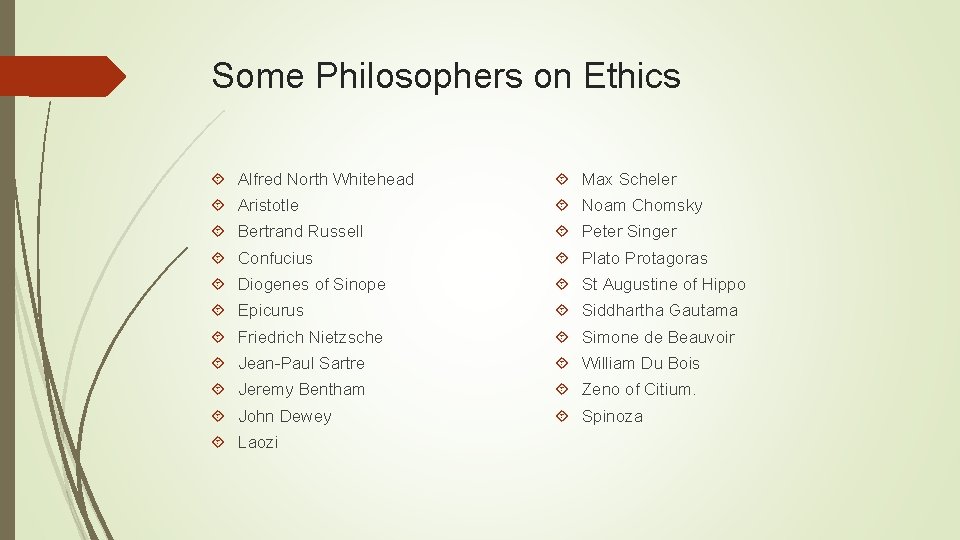
Some Philosophers on Ethics Alfred North Whitehead Max Scheler Aristotle Noam Chomsky Bertrand Russell Peter Singer Confucius Plato Protagoras Diogenes of Sinope St Augustine of Hippo Epicurus Siddhartha Gautama Friedrich Nietzsche Simone de Beauvoir Jean-Paul Sartre William Du Bois Jeremy Bentham Zeno of Citium. John Dewey Spinoza Laozi
Now. . . View power point of more specific theories/philosophers.
- Slides: 22