
Overview of Fusion Research Activities in Japan Presented
- Slides: 23
Overview of Fusion Research Activities in Japan Presented by Masayoshi SUGIMOTO (JAEA) IAEA’s Technical Meeting on Nuclear Data Libraries for Advanced Systems: Fusion Devices (Nu. DL: FD) 31 October – 2 November 2007, Vienna
INTRODUCTION • To focus on perspective activities in Japan related to the fusion nuclear technology toward DEMO design and construction. • To introduce a presentation made at ISFNT-8 on 3 October 2007. • To summarize the expected cooperation with the Nuclear Data Community in the world.
ISFNT-8 October 3, 2007 Heidelberg, Germany Japanese Perspective of Fusion Nuclear Technology from ITER to DEMO Satoru Tanaka* and Hideyuki Takatsu** *University of Tokyo, Japan **Japan Atomic Energy Agency, Naka, Japan
Contents q Introduction q Japanese Strategy from ITER to DEMO — ‘National Policy of Futute Fusion R&D’ issued by ad-hoc committee and then endorsed by Japan Atomic Energy commission (Nov. 2005) — Approach from ITER to DEMO — Fission-Fusion Synergy Effect — Scope of DEMO and DEMO Studies q ITER Project — Procurement — Construction, Operation and Maintenance — Exploitation q Broader Approach Activities q Other Complementary R&Ds q Possible Road Map toward DEMO q Summary -1 -
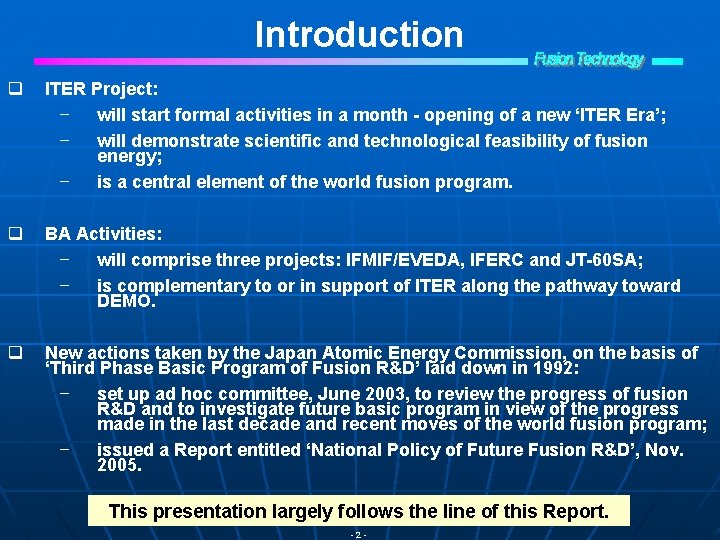
Introduction q ITER Project: — will start formal activities in a month - opening of a new ‘ITER Era’; — will demonstrate scientific and technological feasibility of fusion energy; — is a central element of the world fusion program. q BA Activities: — will comprise three projects: IFMIF/EVEDA, IFERC and JT-60 SA; — is complementary to or in support of ITER along the pathway toward DEMO. q New actions taken by the Japan Atomic Energy Commission, on the basis of ‘Third Phase Basic Program of Fusion R&D’ laid down in 1992: — set up ad hoc committee, June 2003, to review the progress of fusion R&D and to investigate future basic program in view of the progress made in the last decade and recent moves of the world fusion program; — issued a Report entitled ‘National Policy of Future Fusion R&D’, Nov. 2005. This presentation largely follows the line of this Report. -2 -
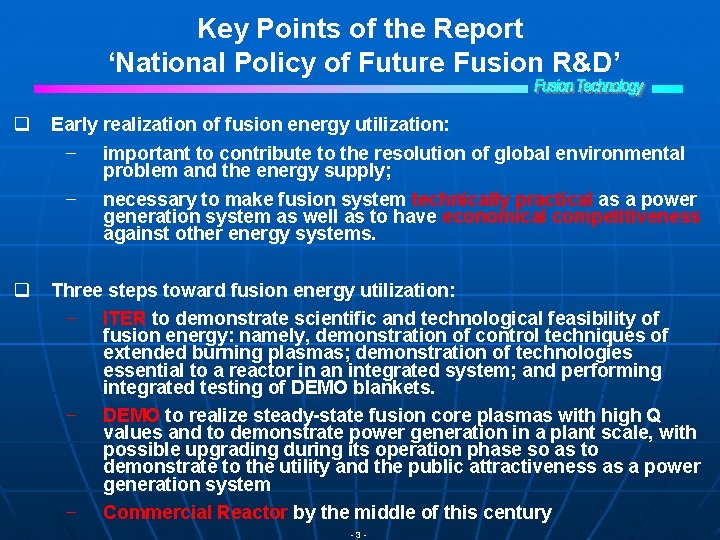
Key Points of the Report ‘National Policy of Future Fusion R&D’ q Early realization of fusion energy utilization: — — q important to contribute to the resolution of global environmental problem and the energy supply; necessary to make fusion system technically practical as a power generation system as well as to have economical competitiveness against other energy systems. Three steps toward fusion energy utilization: — ITER to demonstrate scientific and technological feasibility of fusion energy: namely, demonstration of control techniques of extended burning plasmas; demonstration of technologies essential to a reactor in an integrated system; and performing integrated testing of DEMO blankets. — DEMO to realize steady-state fusion core plasmas with high Q values and to demonstrate power generation in a plant scale, with possible upgrading during its operation phase so as to demonstrate to the utility and the public attractiveness as a power generation system — Commercial Reactor by the middle of this century -3 -
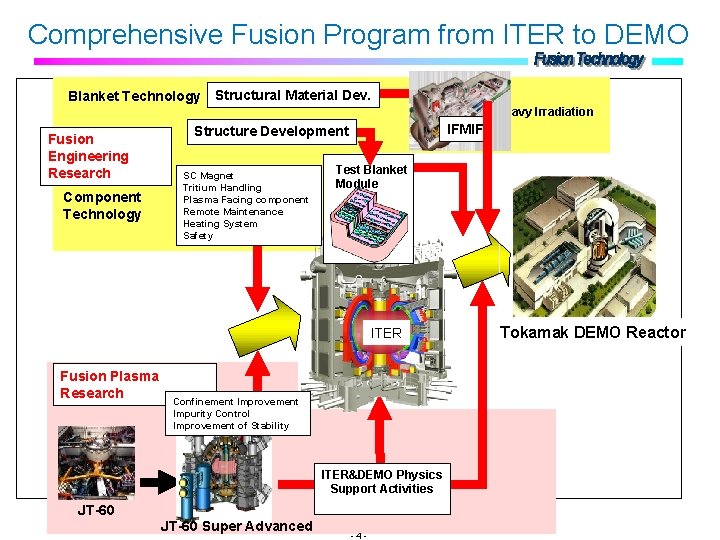
Comprehensive Fusion Program from ITER to DEMO Blanket Technology Structural Material Dev. Heavy Irradiation Fusion Engineering Research Component Technology IFMIF Structure Development SC Magnet Tritium Handling Plasma Facing component Remote Maintenance Heating System Safety Test Blanket Module ITER Fusion Plasma Research Confinement Improvement Impurity Control Improvement of Stability ITER&DEMO Physics Support Activities JT-60 Super Advanced -4 - Tokamak DEMO Reactor
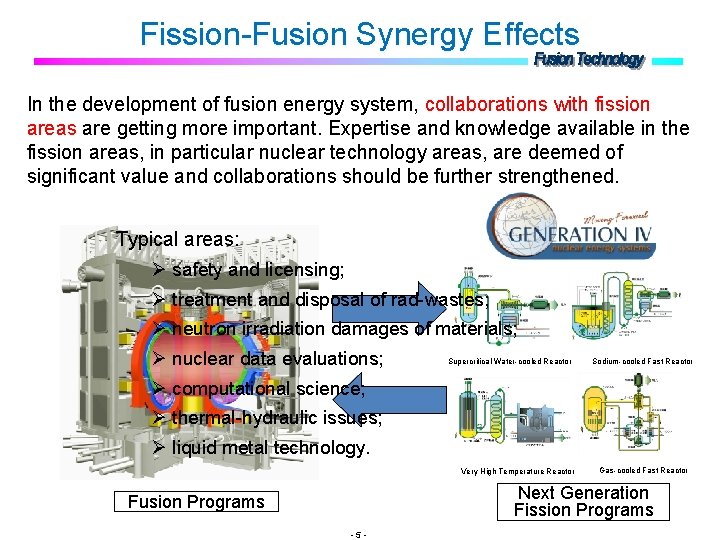
Fission-Fusion Synergy Effects In the development of fusion energy system, collaborations with fission areas are getting more important. Expertise and knowledge available in the fission areas, in particular nuclear technology areas, are deemed of significant value and collaborations should be further strengthened. Typical areas: Ø safety and licensing; Ø treatment and disposal of rad-wastes; Ø neutron irradiation damages of materials; Ø nuclear data evaluations; Ø computational science; Ø thermal-hydraulic issues; Ø liquid metal technology. Supercritical Water-cooled Reactor Very High Temperature Reactor Sodium-cooled Fast Reactor Gas-cooled Fast Reactor Next Generation Fission Programs Fusion Programs -5 -
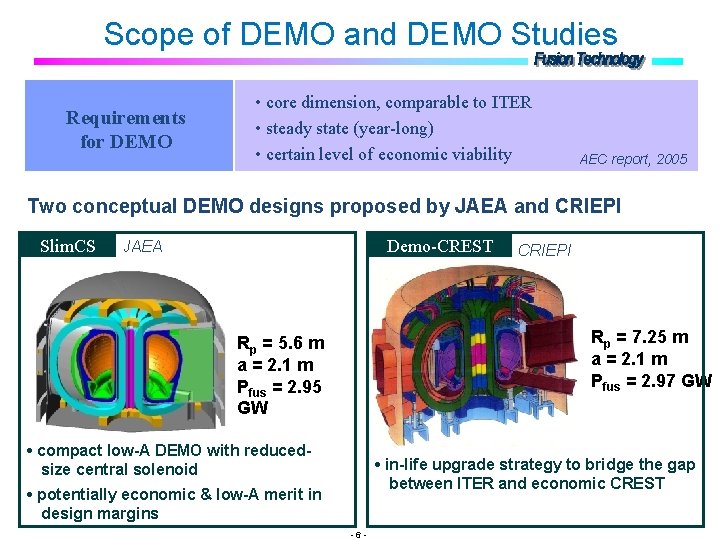
Scope of DEMO and DEMO Studies Requirements for DEMO • core dimension, comparable to ITER • steady state (year-long) • certain level of economic viability AEC report, 2005 Two conceptual DEMO designs proposed by JAEA and CRIEPI Slim. CS Demo-CREST JAEA CRIEPI Rp = 7. 25 m a = 2. 1 m Pfus = 2. 97 GW Rp = 5. 6 m a = 2. 1 m Pfus = 2. 95 GW • compact low-A DEMO with reducedsize central solenoid • in-life upgrade strategy to bridge the gap between ITER and economic CREST • potentially economic & low-A merit in design margins -6 -
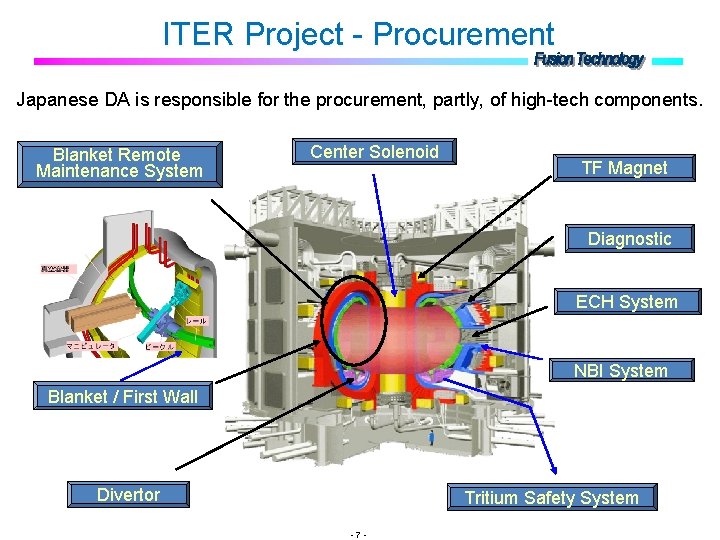
ITER Project - Procurement Japanese DA is responsible for the procurement, partly, of high-tech components. Blanket Remote Maintenance System Center Solenoid TF Magnet Diagnostic ECH System NBI System Blanket / First Wall Divertor Tritium Safety System -7 -
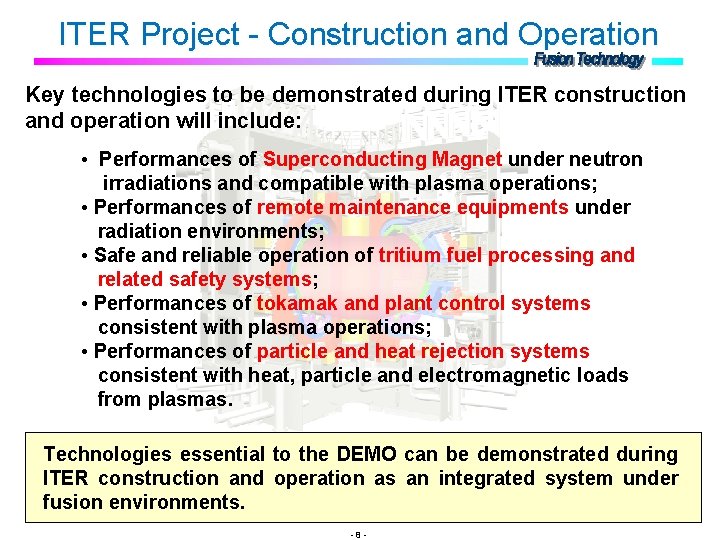
ITER Project - Construction and Operation Key technologies to be demonstrated during ITER construction and operation will include: • Performances of Superconducting Magnet under neutron irradiations and compatible with plasma operations; • Performances of remote maintenance equipments under radiation environments; • Safe and reliable operation of tritium fuel processing and related safety systems; • Performances of tokamak and plant control systems consistent with plasma operations; • Performances of particle and heat rejection systems consistent with heat, particle and electromagnetic loads from plasmas. Technologies essential to the DEMO can be demonstrated during ITER construction and operation as an integrated system under fusion environments. -8 -
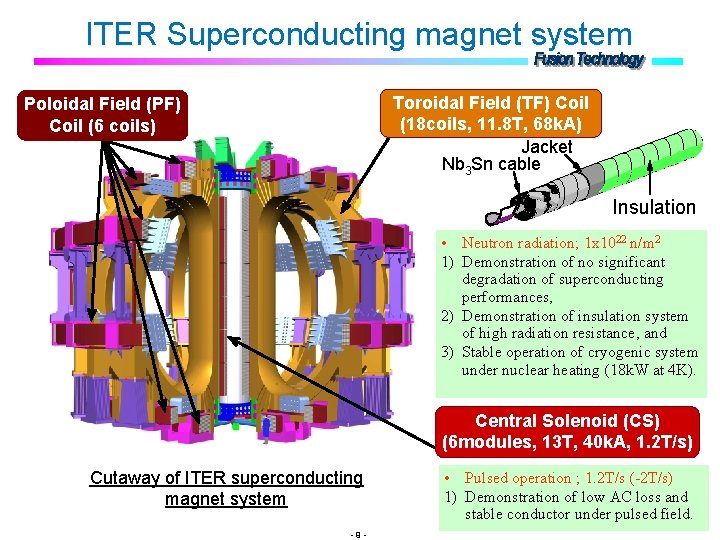
ITER Superconducting magnet system Toroidal Field (TF) Coil (18 coils, 11. 8 T, 68 k. A) Jacket Nb 3 Sn cable Poloidal Field (PF) Coil (6 coils) Insulation • Neutron radiation; 1 x 10²² n/m 2 1) Demonstration of no significant degradation of superconducting performances, 2) Demonstration of insulation system of high radiation resistance, and 3) Stable operation of cryogenic system under nuclear heating (18 k. W at 4 K). Central Solenoid (CS) (6 modules, 13 T, 40 k. A, 1. 2 T/s) Cutaway of ITER superconducting magnet system -9 - • Pulsed operation ; 1. 2 T/s (-2 T/s) 1) Demonstration of low AC loss and stable conductor under pulsed field.
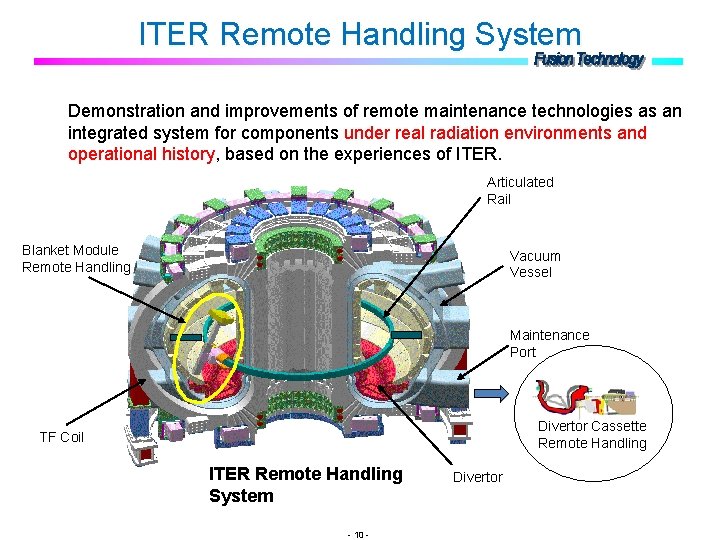
ITER Remote Handling System Demonstration and improvements of remote maintenance technologies as an integrated system for components under real radiation environments and operational history, based on the experiences of ITER. Articulated Rail Blanket Module Remote Handling Vacuum Vessel Maintenance Port Divertor Cassette Remote Handling TF Coil ITER Remote Handling System - 10 - Divertor
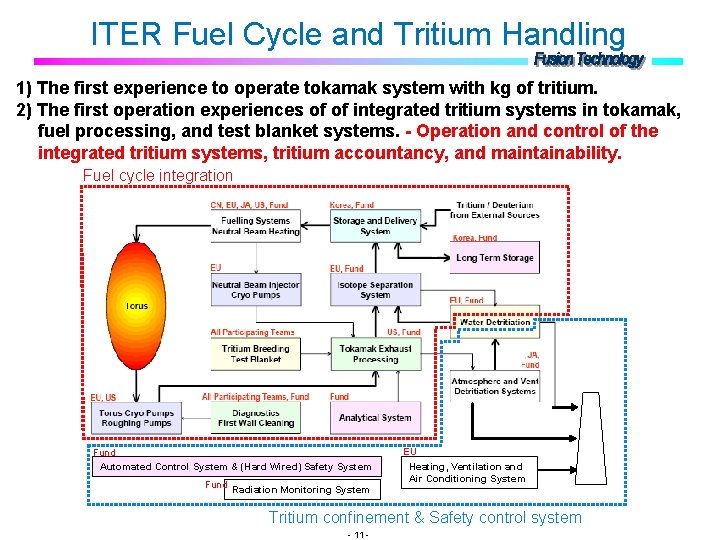
ITER Fuel Cycle and Tritium Handling 1) The first experience to operate tokamak system with kg of tritium. 2) The first operation experiences of of integrated tritium systems in tokamak, fuel processing, and test blanket systems. - Operation and control of the integrated tritium systems, tritium accountancy, and maintainability. Fuel cycle integration Fund Automated Control System & (Hard Wired) Safety System Fund EU Heating, Ventilation and Air Conditioning System Radiation Monitoring System Tritium confinement & Safety control system - 11 -
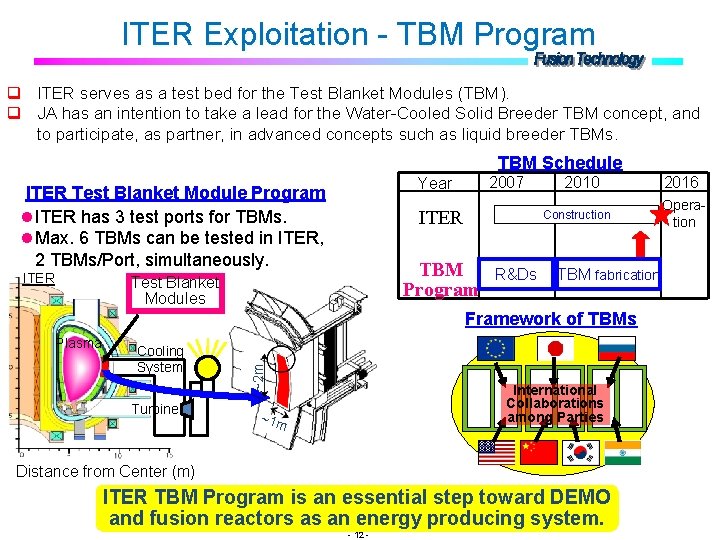
ITER Exploitation - TBM Program q ITER serves as a test bed for the Test Blanket Modules (TBM). q JA has an intention to take a lead for the Water-Cooled Solid Breeder TBM concept, and to participate, as partner, in advanced concepts such as liquid breeder TBMs. TBM Schedule ITER 2007 Year ITER Test Blanket Module Program l ITER has 3 test ports for TBMs. l Max. 6 TBMs can be tested in ITER, 2 TBMs/Port, simultaneously. ITER Construction TBM Program Test Blanket Modules 2010 R&Ds TBM fabrication Plasma Cooling System Turbine ~2 m Framework of TBMs International Collaborations among Parties ~1 m Distance from Center (m) ITER TBM Program is an essential step toward DEMO and fusion reactors as an energy producing system. - 12 - 2016 Operation
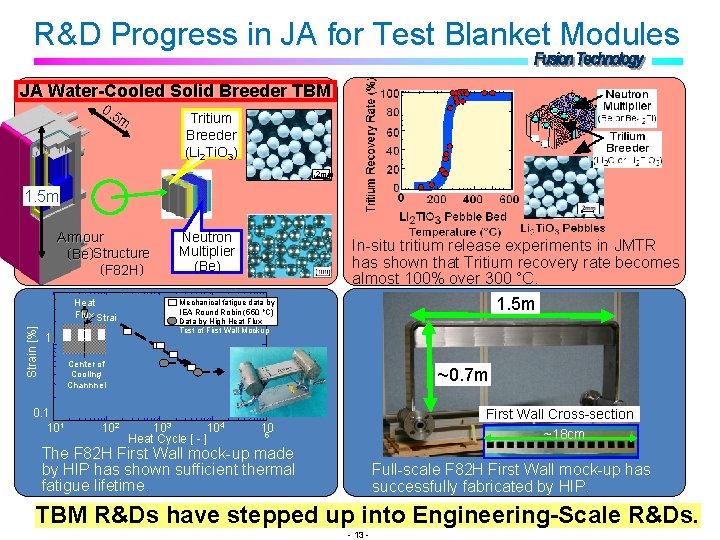
R&D Progress in JA for Test Blanket Modules JA Water-Cooled Solid Breeder TBM 0. 5 m Tritium Breeder (Li 2 Ti. O 3) 2 mm 1. 5 m Strain [%] Armour Structure (Be) (F 82 H) 1 Heat Flux Strai n Neutron Multiplier (Be) In-situ tritium release experiments in JMTR has shown that Tritium recovery rate becomes almost 100% over 300 °C. 1. 5 m Mechanical fatigue data by IEA Round Robin (550 o. C) Data by High Heat Flux Test of First Wall Mockup Center of Cooling Channnel 0. 1 102 ~0. 7 m 103 104 Heat Cycle [ - ] First Wall Cross-section ~18 cm 10 5 The F 82 H First Wall mock-up made by HIP has shown sufficient thermal fatigue lifetime. Full-scale F 82 H First Wall mock-up has successfully fabricated by HIP. TBM R&Ds have stepped up into Engineering-Scale R&Ds. - 13 -
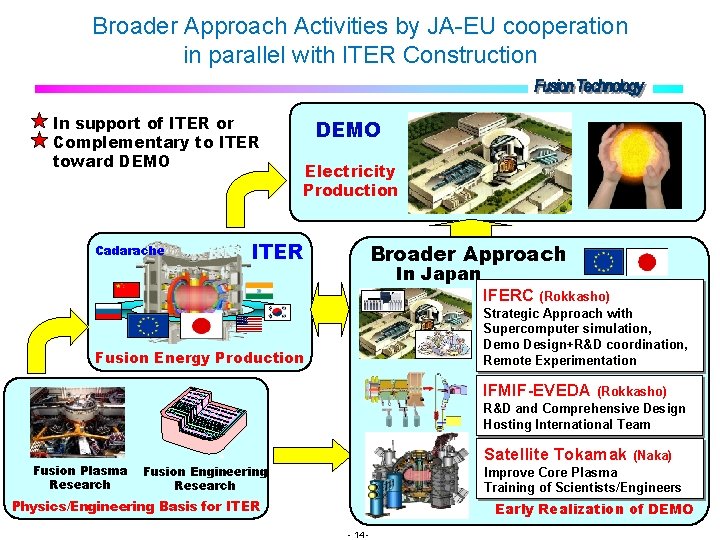
Broader Approach Activities by JA-EU cooperation in parallel with ITER Construction In support of ITER or Complementary to ITER toward DEMO Cadarache DEMO Electricity Production ITER Broader Approach In Japan IFERC (Rokkasho) Strategic Approach with Supercomputer simulation, Demo Design+R&D coordination, Remote Experimentation Fusion Energy Production IFMIF-EVEDA (Rokkasho) R&D and Comprehensive Design Hosting International Team Fusion Plasma Research Satellite Tokamak Fusion Engineering Research (Naka) Improve Core Plasma Training of Scientists/Engineers Physics/Engineering Basis for ITER Early Realization of DEMO - 14 -
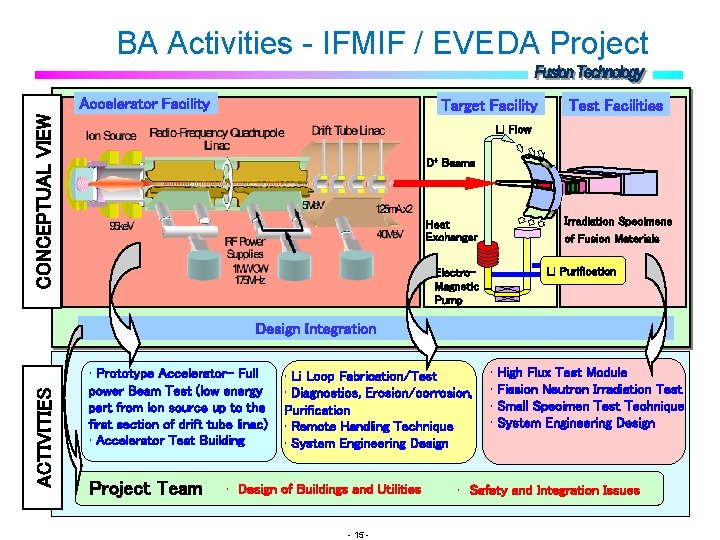
BA Activities - IFMIF / EVEDA Project Accelerator Facility CONCEPTUAL VIEW Target Facility Test Facilities Li Flow D+ Beams Heat Exchanger Electro. Magnetic Pump Irradiation Specimens of Fusion Materials Li Purification ACTIVITIES Design Integration • Prototype Accelerator- Full power Beam Test (low energy part from ion source up to the first section of drift tube linac) • Accelerator Test Building Project Team • Li Loop Fabrication/Test • Diagnostics, Erosion/corrosion, Purification • Remote Handling Technique • System Engineering Design • Design of Buildings and Utilities - 15 - • High Flux Test Module • Fission Neutron Irradiation Test • Small Specimen Test Technique • System Engineering Design • Safety and Integration Issues
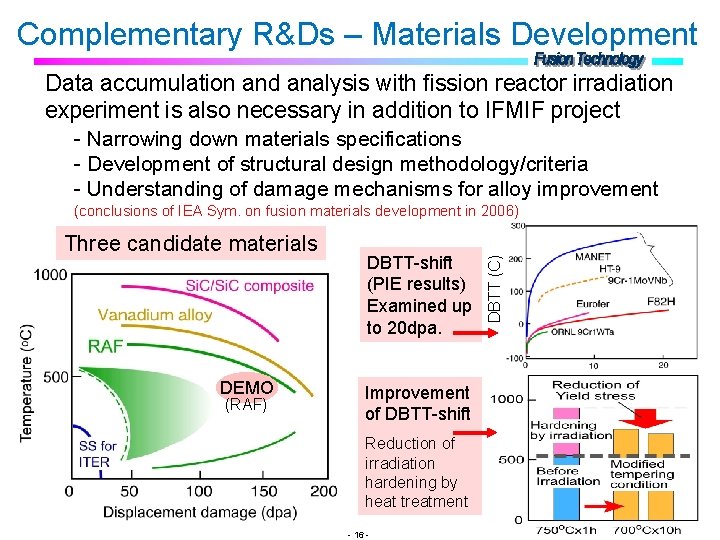
Complementary R&Ds – Materials Development Data accumulation and analysis with fission reactor irradiation experiment is also necessary in addition to IFMIF project - Narrowing down materials specifications - Development of structural design methodology/criteria - Understanding of damage mechanisms for alloy improvement Three candidate materials DEMO (RAF) DBTT-shift (PIE results) Examined up to 20 dpa. Improvement of DBTT-shift Reduction of irradiation hardening by heat treatment - 16 - DBTT (C) (conclusions of IEA Sym. on fusion materials development in 2006)
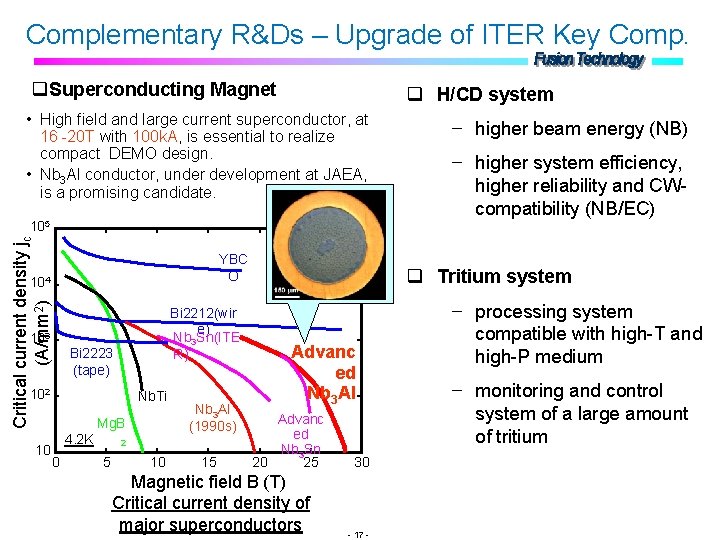
Complementary R&Ds – Upgrade of ITER Key Comp. q. Superconducting Magnet q H/CD system • High field and large current superconductor, at 16 -20 T with 100 k. A, is essential to realize compact DEMO design. • Nb 3 Al conductor, under development at JAEA, is a promising candidate. Critical current density jc (A/mm 2) 105 YBC O 104 103 Bi 2212(wir e) Nb 3 Sn(ITE R) Bi 2223 (tape) 102 10 Nb. Ti Mg. B 4. 2 K 0 Nb 3 Al (1990 s) 2 5 10 15 — higher beam energy (NB) — higher system efficiency, higher reliability and CWcompatibility (NB/EC) q Tritium system Advanc ed Nb 3 Al Advanc ed Nb 3 Sn 20 25 Magnetic field B (T) Critical current density of major superconductors 30 - 17 - — processing system compatible with high-T and high-P medium — monitoring and control system of a large amount of tritium
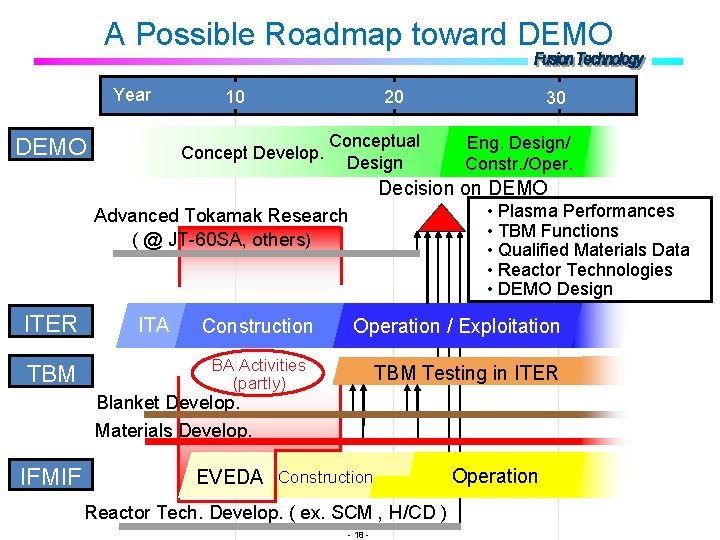
A Possible Roadmap toward DEMO Year DEMO 10 Concept Develop. 20 Conceptual Design 30 Eng. Design/ Constr. /Oper. Decision on DEMO • Plasma Performances • TBM Functions • Qualified Materials Data • Reactor Technologies • DEMO Design Advanced Tokamak Research ( @ JT-60 SA, others) ITER TBM ITA Construction Operation / Exploitation BA Activities (partly) TBM Testing in ITER Blanket Develop. Materials Develop. IFMIF EVEDA Construction Reactor Tech. Develop. ( ex. SCM , H/CD ) - 18 - Operation
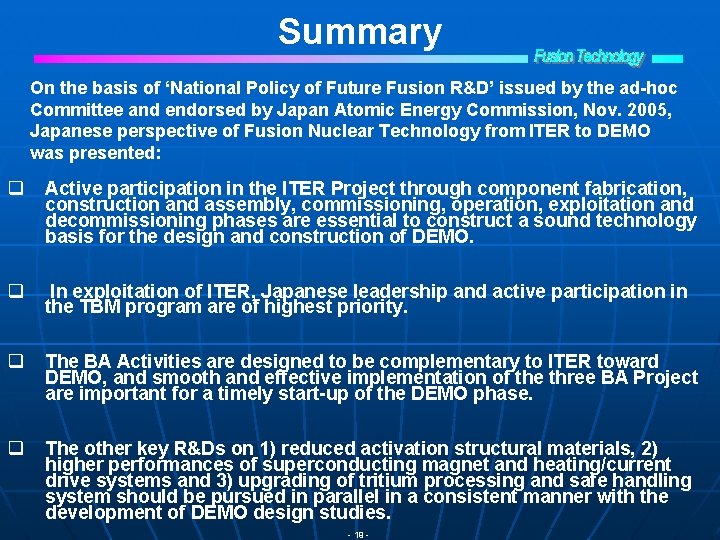
Summary On the basis of ‘National Policy of Future Fusion R&D’ issued by the ad-hoc Committee and endorsed by Japan Atomic Energy Commission, Nov. 2005, Japanese perspective of Fusion Nuclear Technology from ITER to DEMO was presented: q Active participation in the ITER Project through component fabrication, construction and assembly, commissioning, operation, exploitation and decommissioning phases are essential to construct a sound technology basis for the design and construction of DEMO. q In exploitation of ITER, Japanese leadership and active participation in the TBM program are of highest priority. q The BA Activities are designed to be complementary to ITER toward DEMO, and smooth and effective implementation of the three BA Project are important for a timely start-up of the DEMO phase. q The other key R&Ds on 1) reduced activation structural materials, 2) higher performances of superconducting magnet and heating/current drive systems and 3) upgrading of tritium processing and safe handling system should be pursued in parallel in a consistent manner with the development of DEMO design studies. - 19 -
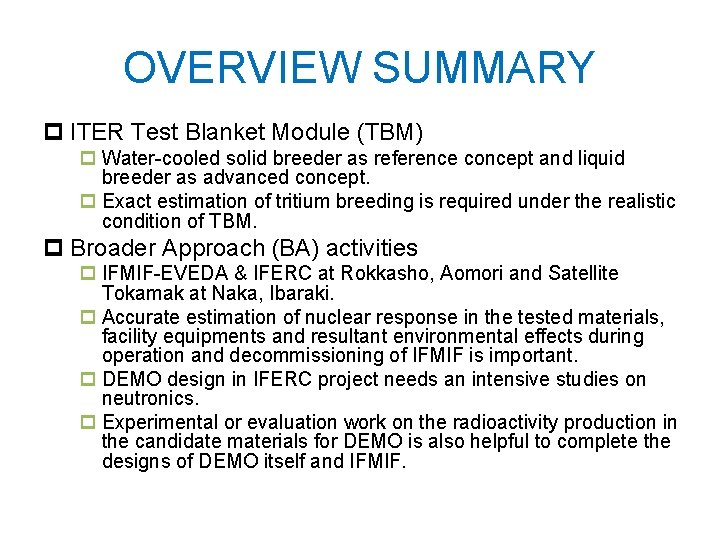
OVERVIEW SUMMARY p ITER Test Blanket Module (TBM) p Water-cooled solid breeder as reference concept and liquid breeder as advanced concept. p Exact estimation of tritium breeding is required under the realistic condition of TBM. p Broader Approach (BA) activities p IFMIF-EVEDA & IFERC at Rokkasho, Aomori and Satellite Tokamak at Naka, Ibaraki. p Accurate estimation of nuclear response in the tested materials, facility equipments and resultant environmental effects during operation and decommissioning of IFMIF is important. p DEMO design in IFERC project needs an intensive studies on neutronics. p Experimental or evaluation work on the radioactivity production in the candidate materials for DEMO is also helpful to complete the designs of DEMO itself and IFMIF.