
Overview of Flip Chip Research Daniel Blass March

Overview of Flip Chip Research Daniel Blass March 2002
Assembly • Lead-Free Assembly • Flip Chip in Air • Flux Jetting of Liquid No-Clean Fluxes • Flip Chip on Flex • Reflow Encapsulants • Substrate Characterizations Ø Information Needed For Yield Predictions • Assembly Yield Software 2
Underfilling • Self-Filleting • Solder Extrusions & Trench Solder Mask Openings • Underfill Flow Modeling • Transfer Molding Ø No Void-Free Process Yet • Reflow Encapsulant Codification Ø Process Cook-Book / Guide • Underfilling Codification 3
Reliability • Moisture and Aging Ø Fillet Cracking Experiments Ø Crack Growth Experiments and Modeling • Lead-Free Reliability Ø Pad Finish Ø Reflow Attach Profile Ø Additional Reflows/JEDEC Level 3 Test • Transfer Molded Flip Chips Ø Results Comparable to a Capillary Flow Underfill 4
High Temp JEDEC Level 3 Testing • Moisture/Reflow Sensitivity Classification for Nonhermetic Solid State Surface Mount Devices • Component Qualification Test • Moisture Load Parts and Reflow 3 Times • Most Lead-Free Alloys Require Much Hotter Reflow Temperatures • Qualify to Higher Reflow Temperatures 5
Lead-Free Assembly • LF-2 (Sn 95. 5 Ag 3. 5 Cu 1. 0) from K&S Flip Chip Ø Liquidus of Approx. 217°C • Previous Process Recommendations Ø Dip in 2. 0 mil of Kester TSF-6522 Flux Ø Nitrogen Reflow Atmosphere (50 ppm O 2) Ø Peak Reflow Temperature of 238°C to 245°C Ø 50 to 70 Seconds Above 217°C Ø Soldering to Ni/Au or Cu-OSP Pads (Entek Plus) • This Process, However, Has Not Given Consistent Defect-Free Assembly Ø Incomplete Wetting of Pad, Poor Self-Centering Ø Only One Electrical Open (on Cu-OSP Pads) 6
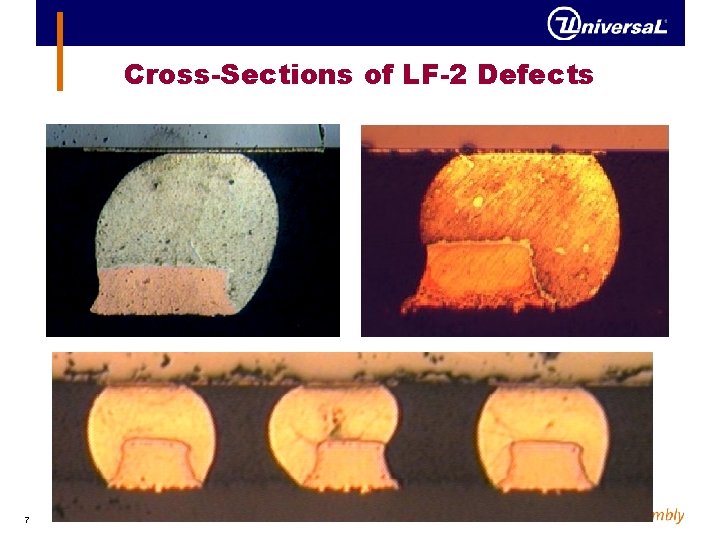
Cross-Sections of LF-2 Defects 7
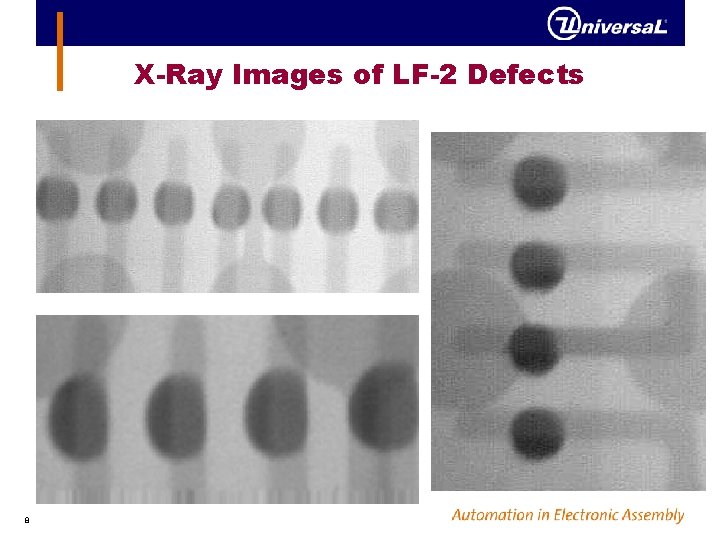
X-Ray Images of LF-2 Defects 8
Better Soldering to Ni/Au Pads 9 • 250+ Chips On Each Pad Finish
Most LF-2 Chips Attached to Ni/Au Pads Had No Defects 10 • 250+ Chips On Each Pad Finish

Sample Sizes with Each Process Largest Sample Sizes Built With Profile B or Profile G & 2 mil Kester TSF-6522 11
Average Defects Per Chip on Each Ni/Au Board Built With Profile B or G & 2 mil of Kester TSF-6522 Flux 12
Average Defects Per Chip on Each Cu-OSP Board Built With Profile B or G & 2 mil of Kester TSF-6522 Flux 13

No Clear Profile Preference for Ni/Au Pads 14
No Clear Profile Preference for Cu-OSP Pads 15

Large Variation Within Each Process • Limits Ability to Compare Processes that Have Smaller Sample Sizes • Would Have to Build Many More Die To Decide Whether a Reflow Profile Was Better • All Processes Gave Soldering Defects 16

Thicker Flux Often Gave More Defects • Real Effect or Just Small Sample Sizes? • Good that 1. 5 mil of Flux Is Not Worse 17
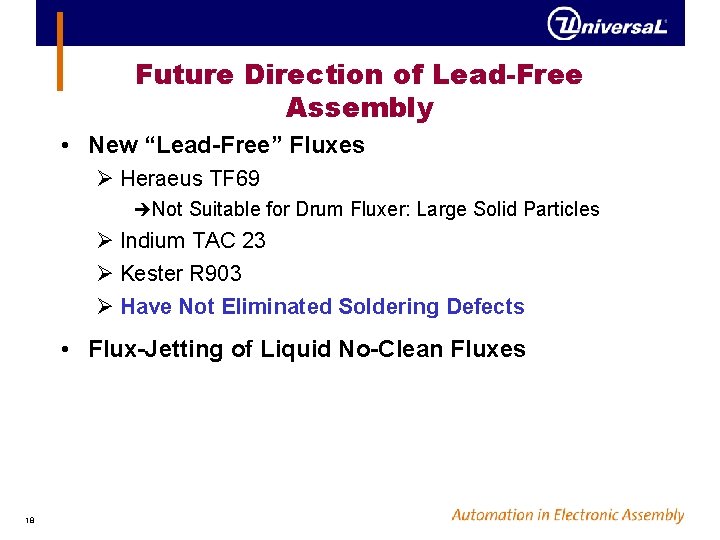
Future Direction of Lead-Free Assembly • New “Lead-Free” Fluxes Ø Heraeus TF 69 èNot Suitable for Drum Fluxer: Large Solid Particles Ø Indium TAC 23 Ø Kester R 903 Ø Have Not Eliminated Soldering Defects • Flux-Jetting of Liquid No-Clean Fluxes 18
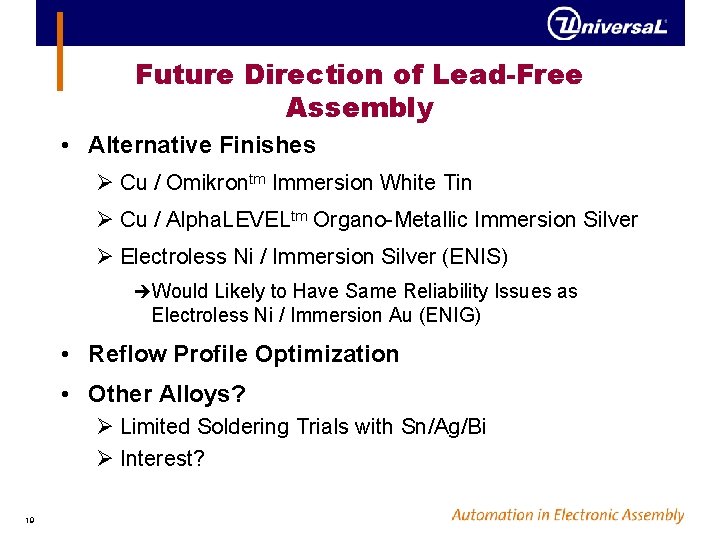
Future Direction of Lead-Free Assembly • Alternative Finishes Ø Cu / Omikrontm Immersion White Tin Ø Cu / Alpha. LEVELtm Organo-Metallic Immersion Silver Ø Electroless Ni / Immersion Silver (ENIS) èWould Likely to Have Same Reliability Issues as Electroless Ni / Immersion Au (ENIG) • Reflow Profile Optimization • Other Alloys? Ø Limited Soldering Trials with Sn/Ag/Bi Ø Interest? 19
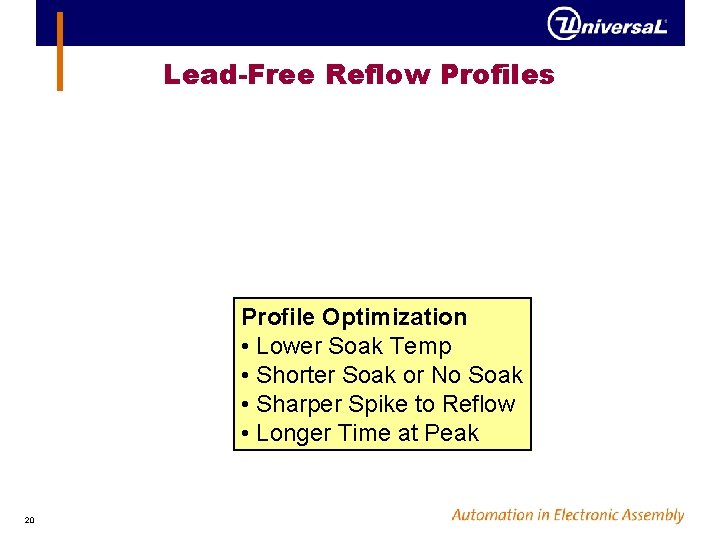
Lead-Free Reflow Profiles Profile Optimization • Lower Soak Temp • Shorter Soak or No Soak • Sharper Spike to Reflow • Longer Time at Peak 20
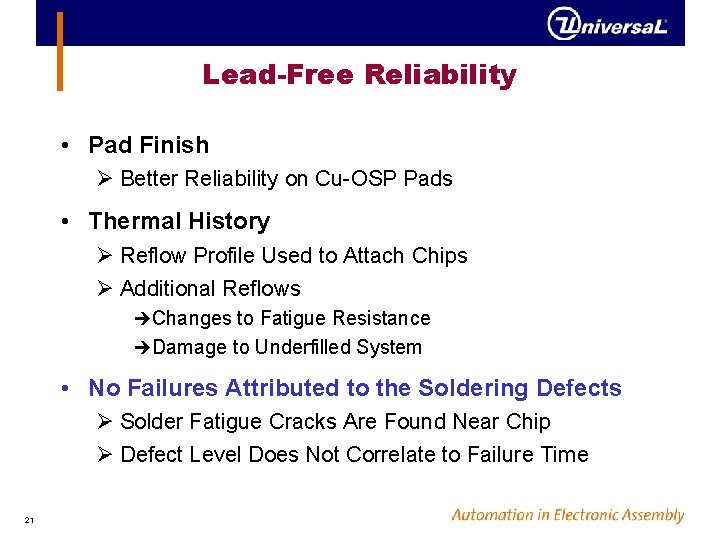
Lead-Free Reliability • Pad Finish Ø Better Reliability on Cu-OSP Pads • Thermal History Ø Reflow Profile Used to Attach Chips Ø Additional Reflows èChanges to Fatigue Resistance èDamage to Underfilled System • No Failures Attributed to the Soldering Defects Ø Solder Fatigue Cracks Are Found Near Chip Ø Defect Level Does Not Correlate to Failure Time 21

Poor Correlation of Defect Levels to Failure Time 22 • Dexter FP 4549, Cu-OSP Pads, Profiles B & G
LLTS Results for Chips Attached to Cu-OSP Pads 23 • Namics U 8437 -3 Underfill
LLTS Results for Chips Attached to Ni/Au Pads 24 • Namics U 8437 -3 Underfill
Better Reliability for Chips Attached to Cu-OSP Pads 25 • Namics U 8437 -3 Underfill
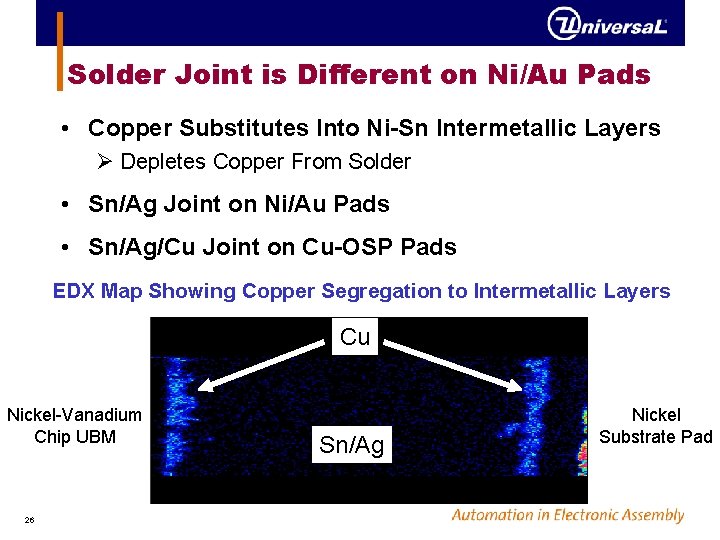
Solder Joint is Different on Ni/Au Pads • Copper Substitutes Into Ni-Sn Intermetallic Layers Ø Depletes Copper From Solder • Sn/Ag Joint on Ni/Au Pads • Sn/Ag/Cu Joint on Cu-OSP Pads EDX Map Showing Copper Segregation to Intermetallic Layers Cu Nickel-Vanadium Chip UBM 26 Sn/Ag Nickel Substrate Pad
Intermetallic Growth • Parts Supplied By Member of the Consortium Ø 10 mil Pitch Perimeter Bumped Chip èNi UBM Layer Ø Substrates with Ni/Au and Cu-OSP Pads Ø Chips Bumped With 3 Different Alloys èSn 95. 5 Ag 4. 0 Cu 0. 5 different from LF-2 (Sn 95. 5 Ag 3. 5 Cu 1. 0) èEutectic Sn/Pb èSn 95. 5 Ag 3. 5 Bi 1. 0 (limited supply) • High Temperature Storage Tests • Thermal Cycling 27
Aging of Sn 95. 5 Ag 4. 0 Cu 0. 5 Flip Chips • Aging at 125°C Ø 500 hours Ø 1000 hours • Aging at 150°C Ø 500 hours Ø 1000 hours • Little Intermetallic Growth For Chips Attached to Ni/Au Pads • Continued Intermetallic Growth For Chips Attached to Cu-OSP Pads • Both Results Consistent With Previous Investigations for LF-2 (Sn 95. 5 Ag 3. 5 Cu 1. 0) 28
125°C Aging of Sn 95. 5 Ag 4. 0 Cu 0. 5 Flip Chip Joints Soldered Cu-OSP As Reflowed 29 1000 hrs at 125°C
150°C Aging of Sn 95. 5 Ag 4. 0 Cu 0. 5 Flip Chip Joints Soldered Cu-OSP 500 hrs at 150°C 30 1000 hrs at 150°C

Continuing Intermetallic Investigation • Determination of Intermetallic Phase Compositions Ø At Interfaces Ø In Bulk Solder • Amount of the Various Phases • Understand the Growth Kinetics Ø Thermodynamics Ø Diffusion Mechanisms • Similar Analysis After 500 and 1000 cycles of Air to Air Thermal Cycling Ø -40°C to 125°C Ø -40°C to 150°C 31
LF-2 Reliability after High Temperature JEDEC Level 3 Test • Performed High Temperature JEDEC Level 3 Testing Ø Peak Temperatures of 244°C and 260°C • Both Namics U 8437 -3 and Dexter FP 4549 Underfills Failed at 260°C Ø Small Areas of Underfill Delamination at Chip-Underfill Interface Ø No Popcorning • Decreased LLTS Performance Ø Change in Solder Properties or Underfill Damage? 32
Multiple Reflow Experiment • Namics U 8437 -3 Underfill • Not a JEDEC Level Test Ø No Moisture Exposure • Profile 250 Used for All Reflows (250°C Peak) 33

LLTS Results for Ni/Au Pads after Extra Reflows 34
LLTS Results for Cu-OSP Pads after Extra Reflows 35
Extra Reflows After Underfilling Caused More Delamination in LLTS 36
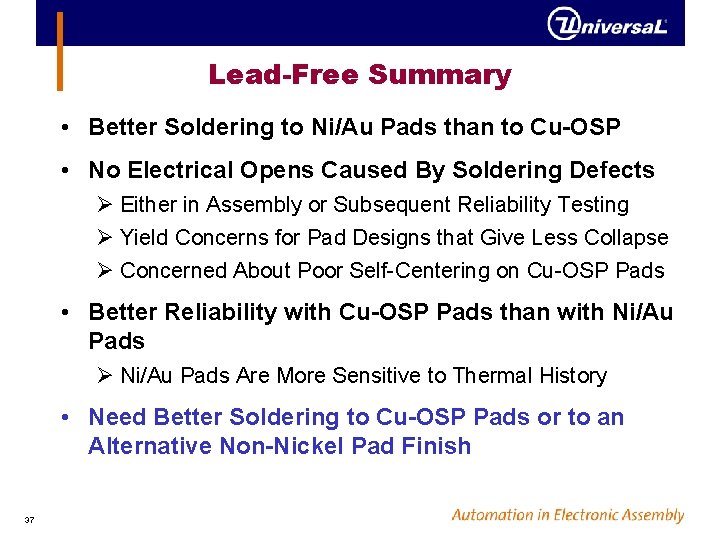
Lead-Free Summary • Better Soldering to Ni/Au Pads than to Cu-OSP • No Electrical Opens Caused By Soldering Defects Ø Either in Assembly or Subsequent Reliability Testing Ø Yield Concerns for Pad Designs that Give Less Collapse Ø Concerned About Poor Self-Centering on Cu-OSP Pads • Better Reliability with Cu-OSP Pads than with Ni/Au Pads Ø Ni/Au Pads Are More Sensitive to Thermal History • Need Better Soldering to Cu-OSP Pads or to an Alternative Non-Nickel Pad Finish 37
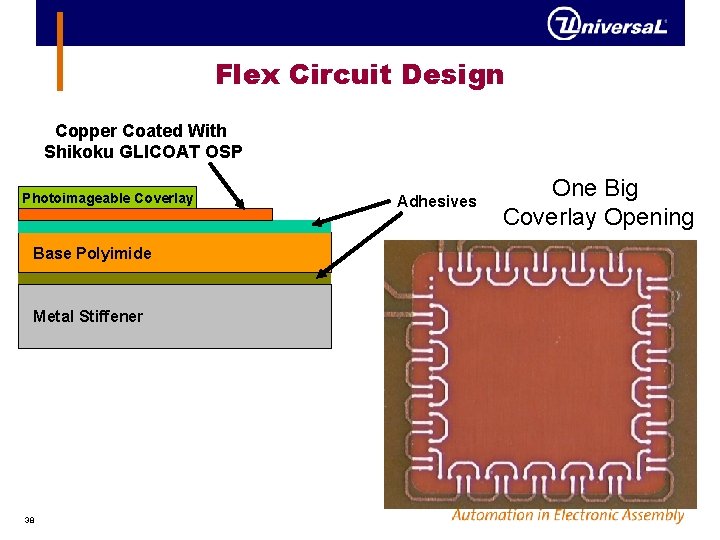
Flex Circuit Design Copper Coated With Shikoku GLICOAT OSP Photoimageable Coverlay Base Polyimide Metal Stiffener 38 Adhesives One Big Coverlay Opening
Flip Chip on Flex • Substrate Design Ø Work Around Poor Coverlay Tolerances Ø Large Window Opening to Define Pads • Handling / Fixturing Ø Want To Keep Die Area Flat During Placement and Reflow Ø Limit Handling Until Underfill Is Cured Ø Stiffeners Can Help But Not Lightweight Solution Ø Stiffeners Can Act As a Spring èNot a Problem with Dip Fluxing èDefects with Reflow Encapsulants Because Some Chips Shifted When Next Chip Was Placed 39
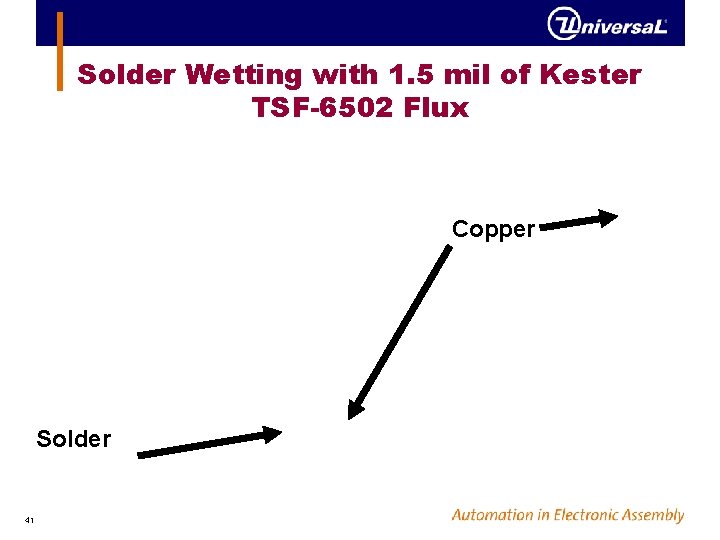
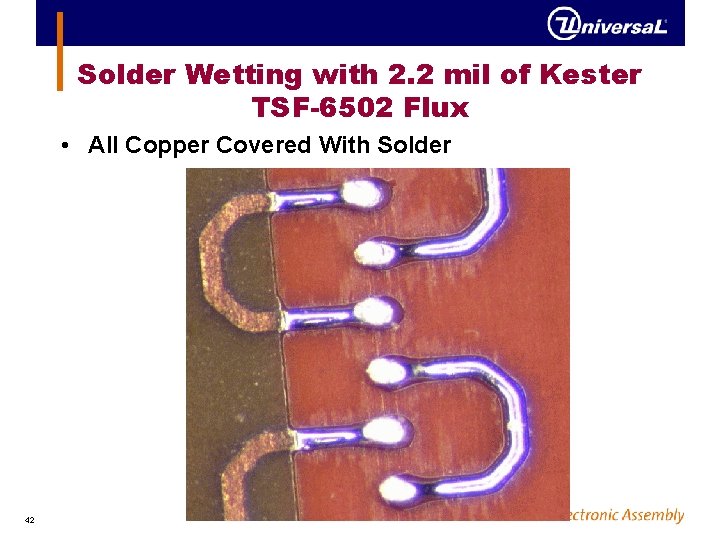
Flip Chip on Flex • Soldering to the Large Solderable Pads Ø Often Hear Concerns About “Too Much” Collapse Ø Shikoku GLICOAT OSP on Copper Pads èSupposed to Limit Solder Wetting to Pad Area • Used Typical Flip Chip Assembly Process Ø 1. 5 to 2. 2 mil of No-Clean Paste Flux Ø SMT Style Profile With Nitrogen (<50 ppm O 2) Ø Good Collapse But Gap Still Large Enough to Underfill • Underfilling Ø Could Not Use Chip Edges for Fiducials Ø Underfill Sometimes Pooled On Coverlay Without Wetting Edge of Chip 40
Solder Wetting with 1. 5 mil of Kester TSF-6502 Flux Copper Solder 41
Solder Wetting with 2. 2 mil of Kester TSF-6502 Flux • All Copper Covered With Solder 42
Reflow Encapsulants / No-Flow Underfills • Less Forgiving Approach This Year Ø Will Not Slow Down Placement Machine èShould Be as Fast as Dip Fluxing in Placement Machine Ø Wide Solder Reflow Process Window Needed For SMT Integration èHotter Soak and Peak Temperatures • Standard Placement and Soldering Trials Ø Designed to Quickly Weed Out Poor Performers Without Assembling Many Chips Ø Determine Whether a Material Is Worth More Effort Ø More Work Would Be Needed to Define Process 43
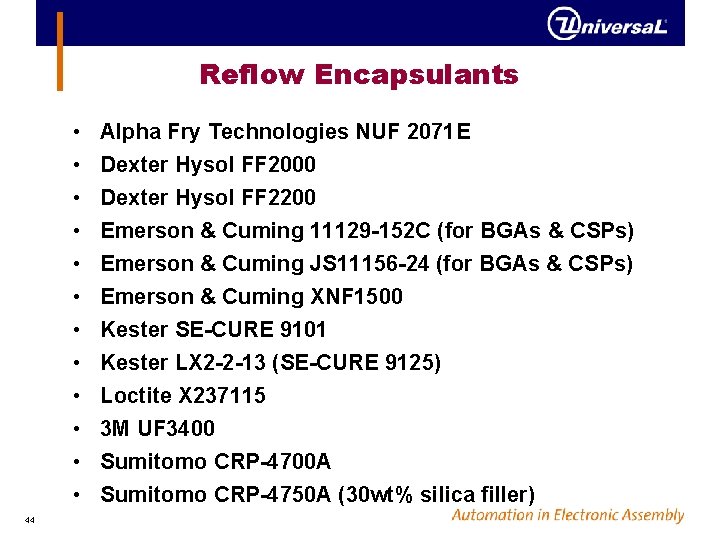
Reflow Encapsulants • • • 44 Alpha Fry Technologies NUF 2071 E Dexter Hysol FF 2000 Dexter Hysol FF 2200 Emerson & Cuming 11129 -152 C (for BGAs & CSPs) Emerson & Cuming JS 11156 -24 (for BGAs & CSPs) Emerson & Cuming XNF 1500 Kester SE-CURE 9101 Kester LX 2 -2 -13 (SE-CURE 9125) Loctite X 237115 3 M UF 3400 Sumitomo CRP-4700 A Sumitomo CRP-4750 A (30 wt% silica filler)
Battery of 10 Profiles for Reflow Encapsulant Soldering Evaluation 45
Battery of 10 Profiles for Reflow Encapsulant Soldering Evaluation • Soak Stage Temperature • Length of Soak Stage • Peak Reflow Temperature 46
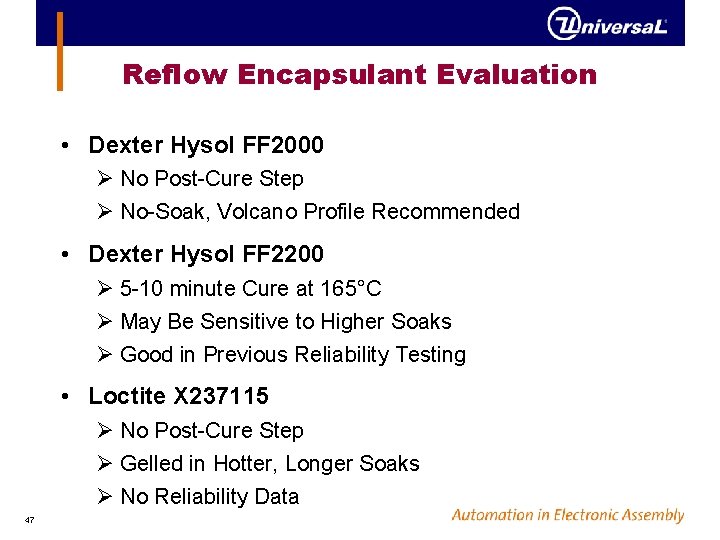
Reflow Encapsulant Evaluation • Dexter Hysol FF 2000 Ø No Post-Cure Step Ø No-Soak, Volcano Profile Recommended • Dexter Hysol FF 2200 Ø 5 -10 minute Cure at 165°C Ø May Be Sensitive to Higher Soaks Ø Good in Previous Reliability Testing • Loctite X 237115 Ø No Post-Cure Step Ø Gelled in Hotter, Longer Soaks Ø No Reliability Data 47
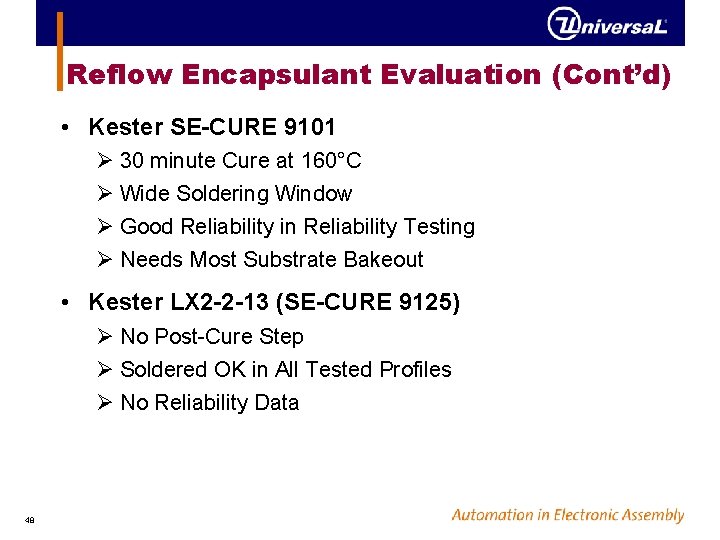
Reflow Encapsulant Evaluation (Cont’d) • Kester SE-CURE 9101 Ø 30 minute Cure at 160°C Ø Wide Soldering Window Ø Good Reliability in Reliability Testing Ø Needs Most Substrate Bakeout • Kester LX 2 -2 -13 (SE-CURE 9125) Ø No Post-Cure Step Ø Soldered OK in All Tested Profiles Ø No Reliability Data 48
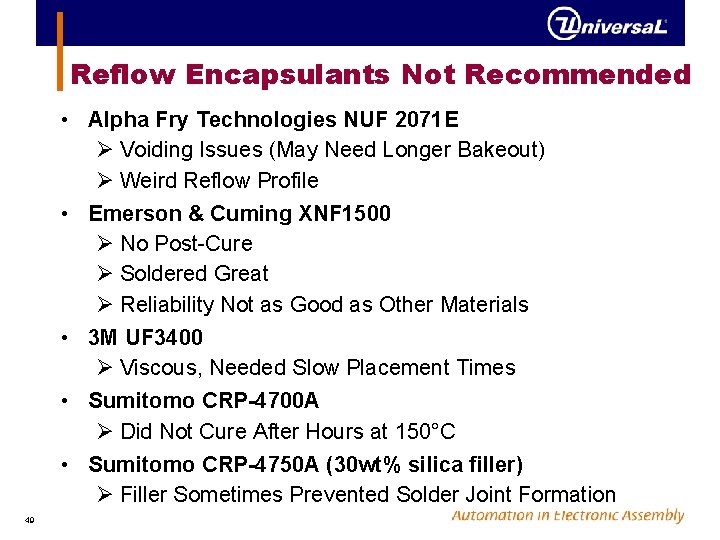
Reflow Encapsulants Not Recommended • Alpha Fry Technologies NUF 2071 E Ø Voiding Issues (May Need Longer Bakeout) Ø Weird Reflow Profile • Emerson & Cuming XNF 1500 Ø No Post-Cure Ø Soldered Great Ø Reliability Not as Good as Other Materials • 3 M UF 3400 Ø Viscous, Needed Slow Placement Times • Sumitomo CRP-4700 A Ø Did Not Cure After Hours at 150°C • Sumitomo CRP-4750 A (30 wt% silica filler) Ø Filler Sometimes Prevented Solder Joint Formation 49
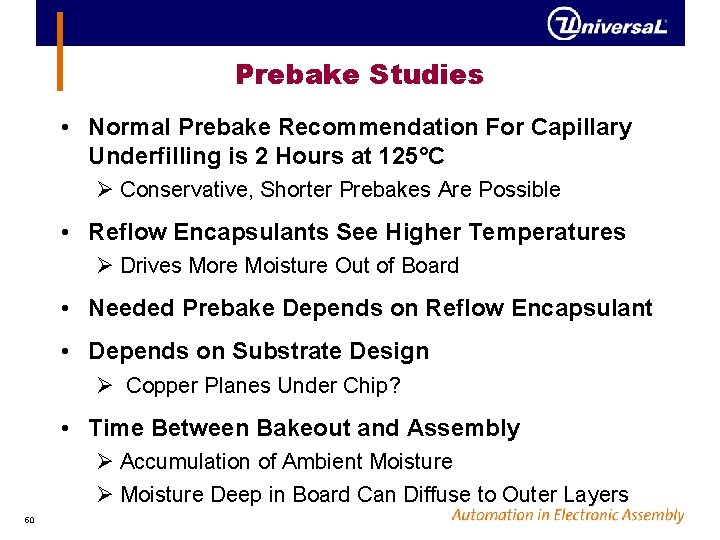
Prebake Studies • Normal Prebake Recommendation For Capillary Underfilling is 2 Hours at 125°C Ø Conservative, Shorter Prebakes Are Possible • Reflow Encapsulants See Higher Temperatures Ø Drives More Moisture Out of Board • Needed Prebake Depends on Reflow Encapsulant • Depends on Substrate Design Ø Copper Planes Under Chip? • Time Between Bakeout and Assembly Ø Accumulation of Ambient Moisture Ø Moisture Deep in Board Can Diffuse to Outer Layers 50
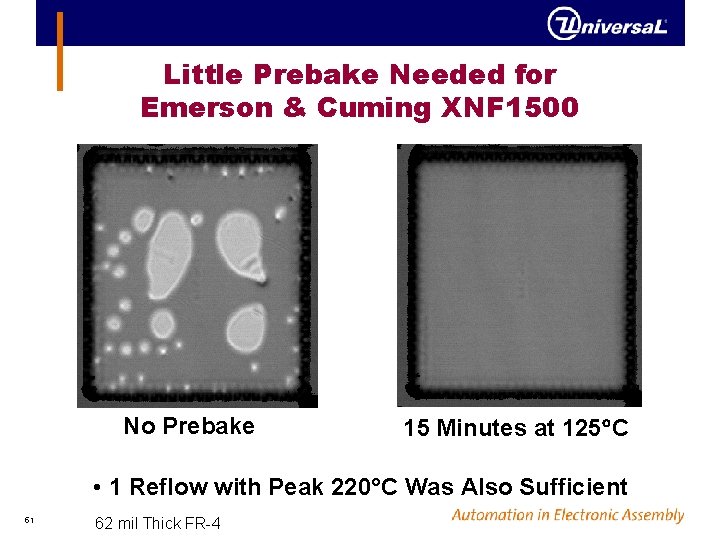
Little Prebake Needed for Emerson & Cuming XNF 1500 No Prebake 15 Minutes at 125 C • 1 Reflow with Peak 220°C Was Also Sufficient 51 62 mil Thick FR-4
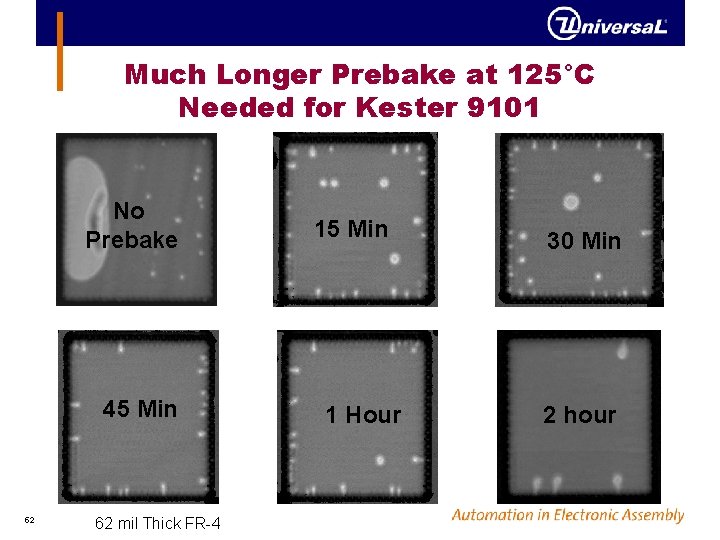
Much Longer Prebake at 125°C Needed for Kester 9101 No Prebake 45 Min 52 62 mil Thick FR-4 15 Min 1 Hour 30 Min 2 hour
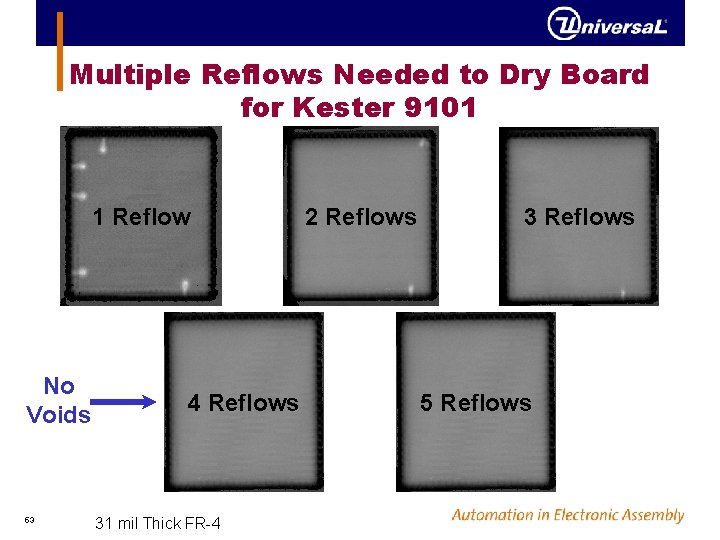
Multiple Reflows Needed to Dry Board for Kester 9101 1 Reflow No Voids 53 4 Reflows 31 mil Thick FR-4 2 Reflows 3 Reflows 5 Reflows
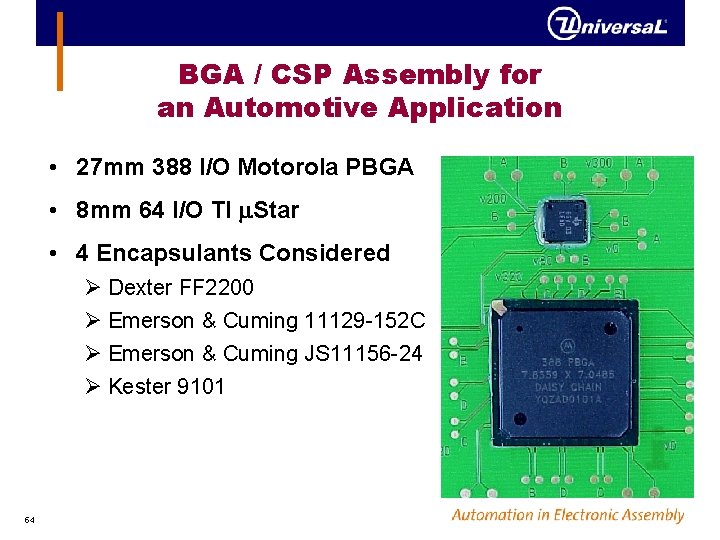
BGA / CSP Assembly for an Automotive Application • 27 mm 388 I/O Motorola PBGA • 8 mm 64 I/O TI Star • 4 Encapsulants Considered Ø Dexter FF 2200 Ø Emerson & Cuming 11129 -152 C Ø Emerson & Cuming JS 11156 -24 Ø Kester 9101 54
BGA / CSP Assembly Concerns • Bakeout of Both Substrate and Components • Dispense Pattern For Large Components Ø Maker Sure All Balls Are Fluxed Ø Minimize Placement Voids, If Possible Ø Takes A Long Time to Dispense • Different Thermal Profiles Experienced By Large and Small Components on Same Board Ø Wide Reflow Process Window to Prevent Underfill Gelling for Small Parts or Corner Balls of Big Parts Ø 14°C Difference in Peak Temp for These Components • High Placement Force and/or Hold Time 55
BGA / CSP Assembly Concerns (Cont’d) • Underfill Wetting Away From Component Ø Cover Other Components • Large Volume of Liquid Reflow Encapsulant Must Be Squeezed Out From Under Component During Soldering Ø Could Hold Up Component • Component Warpage Ø No Extra Solder Volume From Paste Printing Ø Will Not Work For All Components • Will All Balls Touch Pad & Solder? • Generally Not Reworkable 56
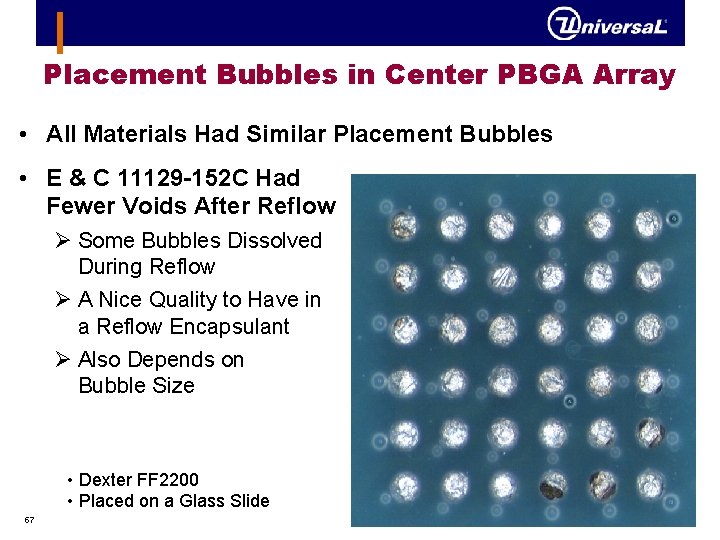
Placement Bubbles in Center PBGA Array • All Materials Had Similar Placement Bubbles • E & C 11129 -152 C Had Fewer Voids After Reflow Ø Some Bubbles Dissolved During Reflow Ø A Nice Quality to Have in a Reflow Encapsulant Ø Also Depends on Bubble Size • Dexter FF 2200 • Placed on a Glass Slide 57
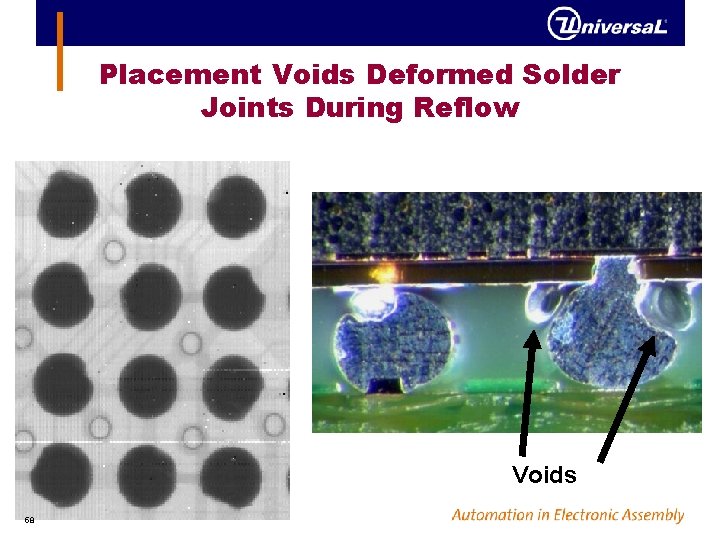
Placement Voids Deformed Solder Joints During Reflow Voids 58
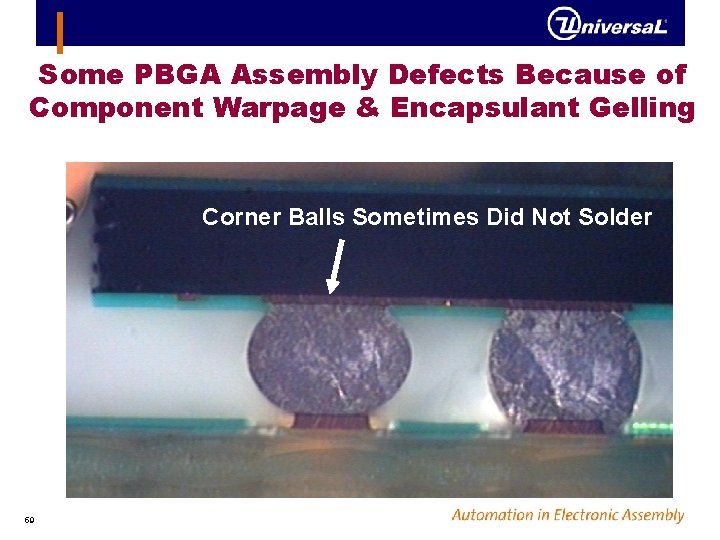
Some PBGA Assembly Defects Because of Component Warpage & Encapsulant Gelling Corner Balls Sometimes Did Not Solder 59
Reflow Encapsulant Build For Reliability Testing • Not a Good Process For All BGA and CSP Packages 60
Stencil Printing Reflow Encapsulants • Small Flip Chip in Package • Printed Deposits For a Strip of Components Ø High Throughput Compared to Dispensing Ø Obviously Not Compatible With Solder Paste Printing Ø Removes Fluxing From Placement Machine • Promising Trials With Existing Materials Ø Materials Not Optimized For Printing 61
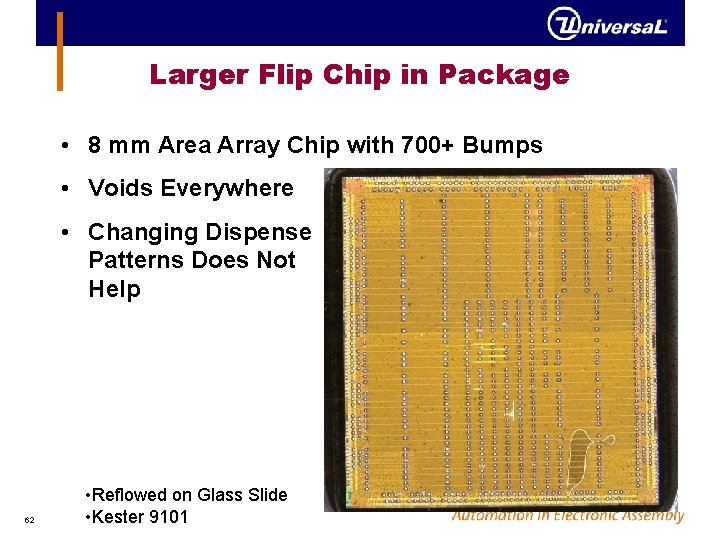
Larger Flip Chip in Package • 8 mm Area Array Chip with 700+ Bumps • Voids Everywhere • Changing Dispense Patterns Does Not Help 62 • Reflowed on Glass Slide • Kester 9101
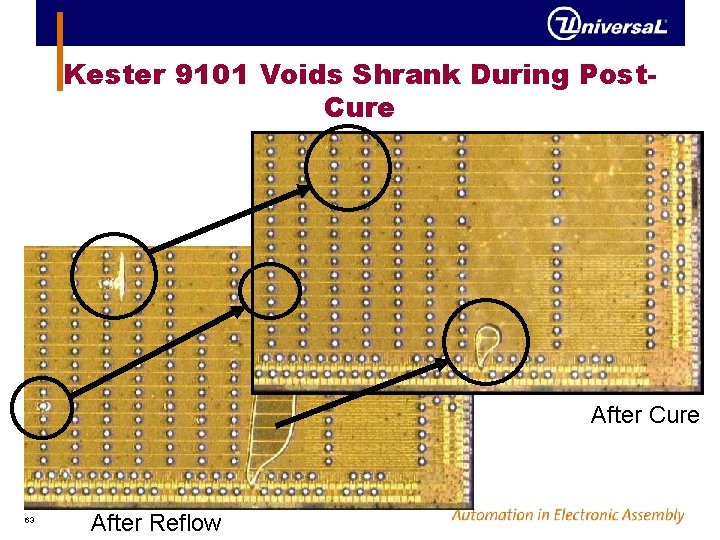
Kester 9101 Voids Shrank During Post. Cure After Cure 63 After Reflow
JEDEC Level 3 Testing of Reflow Encapsulant • Dexter FF 2200 • Kester 9101 • Kester LX 2 -2 -13 (SE-CURE 9125) • Tested 30 Chips With Each Material • All Passed JEDEC Level 3 With 240°C 64
Reflow Encapsulant Summary • More Standardized Assembly Evaluation • Prebake Requirements Vary • Can Make Bubbles and Voids Dissolve Ø Important For Area Array Bump Layouts • Stencil Printing Could Be an Option • Looking at Several Flip Chip in Package Possibilities Ø Probably Needs Overmolded for Reliability • Lead-Free? 65
Self-Filleting Underfills • Can Increase Underfill Dispenser Productivity • Need Fillet For Good Reliability • Want to Minimize Fillet Variation Ø Prevent Fillet Cracking and Early Failure 66
Self-Filleting: Productivity • Underfill Flow Times Are Not an Issue if There Are Enough Chips in the Underfill Dispenser Ø Dispenser Can Always Be Dispensing Ø Will Not Sit Idle Waiting on Underfill Flow • Dispensing Time Ø More Dispense Passes Per Chip Means Fewer Chips Underfilled • Self-Filleting Underfills Ø Eliminates Dispensing Close-up Pass to Form Fillets 67
Self-Filleting: Factors That Affect Underfill Wetting and Flow • Underfill Selection • Flux Selection • Chip Passivation/Coating • Solder Mask and/or Laminate • Chip Size • Any Contamination • Self-Filleting Will Be Sensitive to Changes in These Factors (Planned or Accidental) 68
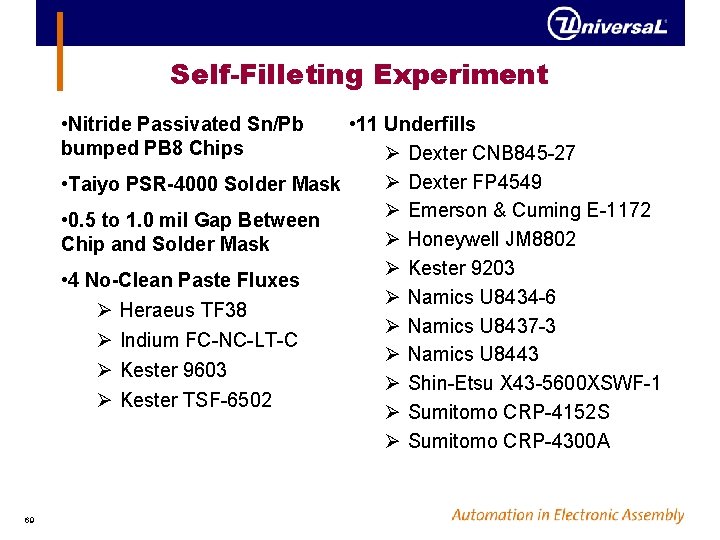
Self-Filleting Experiment • Nitride Passivated Sn/Pb bumped PB 8 Chips • 11 Underfills Ø Dexter CNB 845 -27 Ø Dexter FP 4549 • Taiyo PSR-4000 Solder Mask Ø Emerson & Cuming E-1172 • 0. 5 to 1. 0 mil Gap Between Ø Honeywell JM 8802 Chip and Solder Mask Ø Kester 9203 • 4 No-Clean Paste Fluxes Ø Namics U 8434 -6 Ø Heraeus TF 38 Ø Namics U 8437 -3 Ø Indium FC-NC-LT-C Ø Namics U 8443 Ø Kester 9603 Ø Shin-Etsu X 43 -5600 XSWF-1 Ø Kester TSF-6502 Ø Sumitomo CRP-4152 S Ø Sumitomo CRP-4300 A 69

Fillet Thickness Measurements For Different Types of Self-Filleting 70 • Kester 9603 Flux
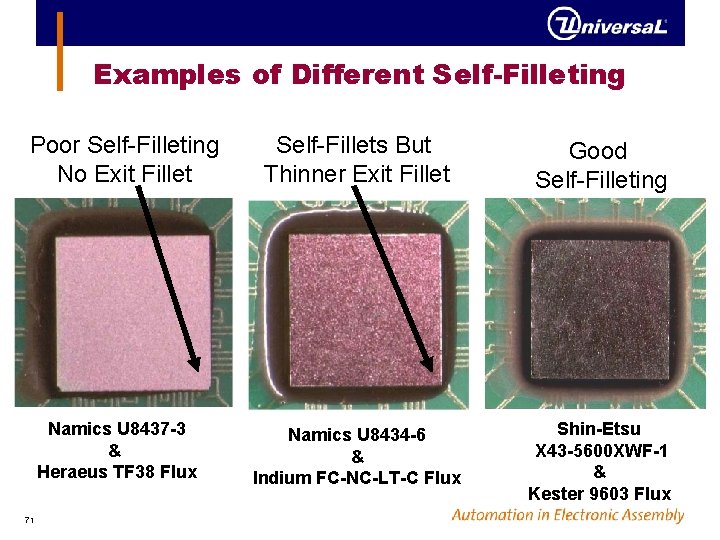
Examples of Different Self-Filleting Poor Self-Filleting No Exit Fillet Namics U 8437 -3 & Heraeus TF 38 Flux 71 Self-Fillets But Thinner Exit Fillet Good Self-Filleting Namics U 8434 -6 & Indium FC-NC-LT-C Flux Shin-Etsu X 43 -5600 XWF-1 & Kester 9603 Flux
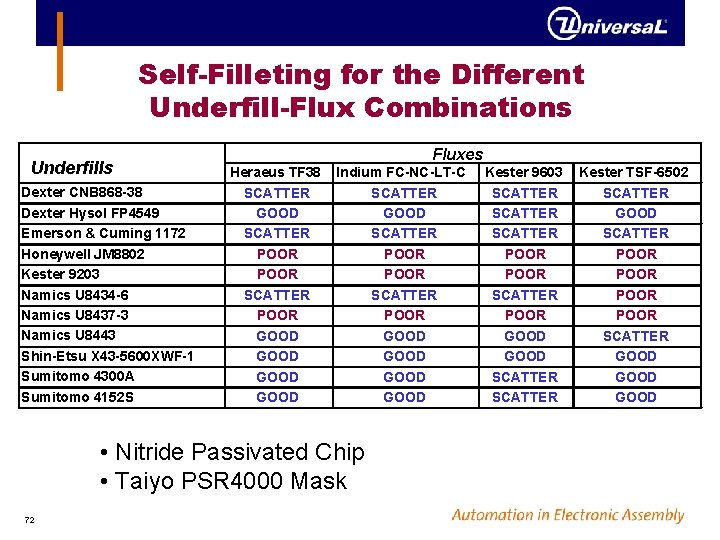
Self-Filleting for the Different Underfill-Flux Combinations Underfills Dexter CNB 868 -38 Dexter Hysol FP 4549 Emerson & Cuming 1172 Honeywell JM 8802 Kester 9203 Namics U 8434 -6 Namics U 8437 -3 Namics U 8443 Shin-Etsu X 43 -5600 XWF-1 Sumitomo 4300 A Sumitomo 4152 S Fluxes Heraeus TF 38 SCATTER GOOD SCATTER POOR GOOD Indium FC-NC-LT-C SCATTER GOOD SCATTER POOR GOOD • Nitride Passivated Chip • Taiyo PSR 4000 Mask 72 Kester 9603 SCATTER POOR SCATTER POOR GOOD SCATTER Kester TSF-6502 SCATTER GOOD SCATTER POOR SCATTER GOOD
Trench Solder Mask Openings & Solder Extrusions • Can Be a Convenient Way to Define Flip Chip Pads • Trenches Increase Chance of Forming Underfill Voids Near Solder Joints • Voids Provide a Path For Solder to Migrate During Thermal Excursions (Cycling or Reflow) • Solder Extrusion & Bridging (Electrical Short) Ø Bridging Only for Finer Pitches Ø Unlikely Above 10 mil Pitch 73

Voids Most Likely When Underfill Flows Parallel to the Trench Opening Underfill Flow Direction 74
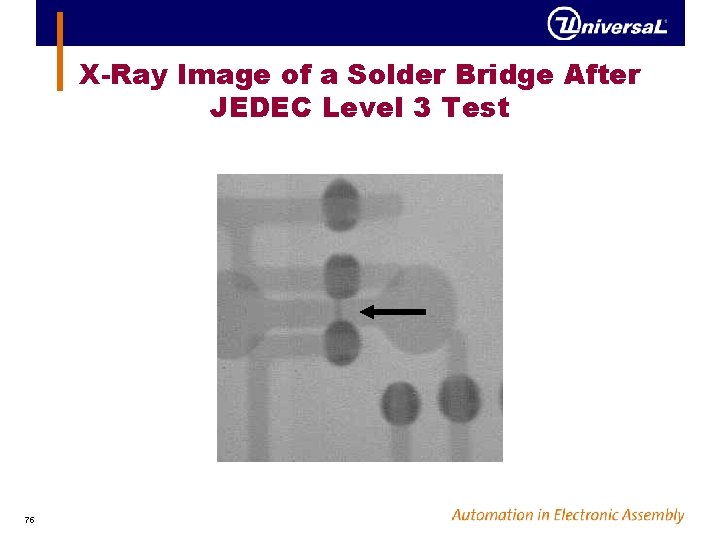
X-Ray Image of a Solder Bridge After JEDEC Level 3 Test 75

How Do You Prevent Voids in Trench Openings? • Pick the Right Underfill-Flux Combination Ø No Perfect Combination • Can the Cure Process Be Adjusted to Make Small Voids Dissolve? Ø Slower Ramp? • Use Individual Mask Openings for Each Pad 76
Use of Trench For Fine Pitches (Less Than 10 mil) • If Underfilled Chip Will Be Reflowed Ø Flip in Package or on Board (DCA) Ø Use Individual Solder Mask Openings èPhotodefined or Laser Ablated èWill Cost More • High Temperature Service and Cycling Requirements Ø Probably Should Use Individual Mask Openings • Mild Service Requirements Ø Extrusions May Form Too Slowly to Be a Concern 77
High Temp JEDEC Level 3 Testing • Moisture/Reflow Sensitivity Classification for Nonhermetic Solid State Surface Mount Devices Ø Component Qualification Test Ø Moisture Load Parts and Reflow 3 Times èPeak Temperature Depends on Component Type & Size èJEDEC Level 3: 8 Days of 30°C/60%R. H. Ø Failures: Popcorning, Delamination, Cracking, Electrical Failure, Solder Bridging èFor Unseen Damage or Weakening, Additional Testing Recommended • Most Lead-Free Alloys Require Much Hotter Reflow Temperatures 78
High Temp JEDEC Level 3 Testing • Current Standard (IPC/JEDEC J-STD-020 A) Ø Peak Temperature of 220°C / 235°C Ø BGAs classified at 220°C Peak Reflow Temperature • Draft of Future Standard (IPC/JEDEC J-STD-020 B) Ø Sn/Pb Eutectic to be Classified at 225°C / 240°C Ø “Lead Free” to be Classified at 245°C / 250°C • Our Experiments Used 220°C, 240°C, and 260°C Ø Sn/Pb and Sn/Ag/Cu Bumped Chips Ø Only Chips With Nitride Passivation 79
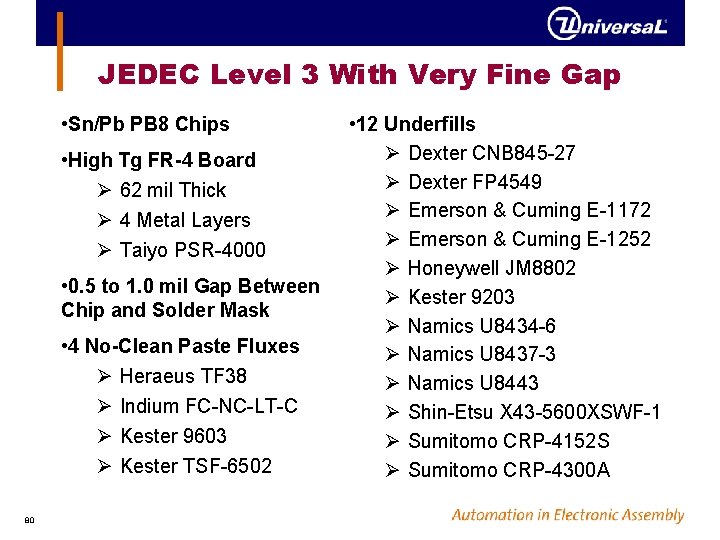
JEDEC Level 3 With Very Fine Gap • Sn/Pb PB 8 Chips • High Tg FR-4 Board Ø 62 mil Thick Ø 4 Metal Layers Ø Taiyo PSR-4000 • 0. 5 to 1. 0 mil Gap Between Chip and Solder Mask • 4 No-Clean Paste Fluxes Ø Heraeus TF 38 Ø Indium FC-NC-LT-C Ø Kester 9603 Ø Kester TSF-6502 80 • 12 Underfills Ø Dexter CNB 845 -27 Ø Dexter FP 4549 Ø Emerson & Cuming E-1172 Ø Emerson & Cuming E-1252 Ø Honeywell JM 8802 Ø Kester 9203 Ø Namics U 8434 -6 Ø Namics U 8437 -3 Ø Namics U 8443 Ø Shin-Etsu X 43 -5600 XSWF-1 Ø Sumitomo CRP-4152 S Ø Sumitomo CRP-4300 A
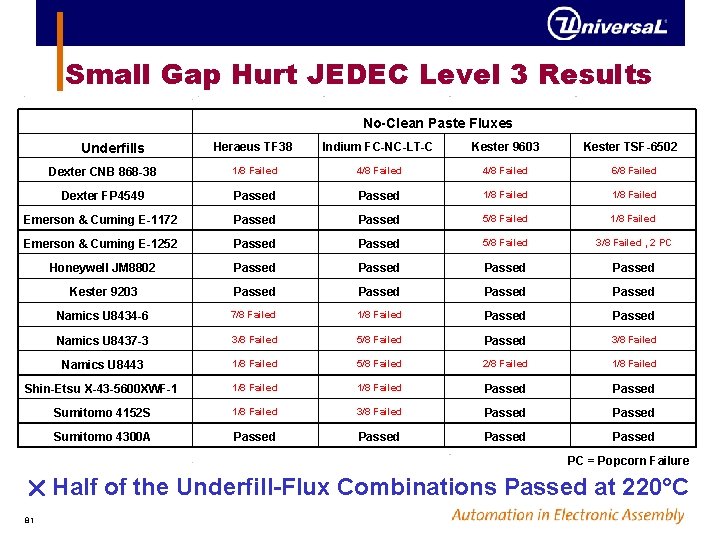
Small Gap Hurt JEDEC Level 3 Results No-Clean Paste Fluxes Heraeus TF 38 Indium FC-NC-LT-C Kester 9603 Dexter CNB 868 -38 1/8 Failed 4/8 Failed 6/8 Failed Dexter FP 4549 Passed 1/8 Failed Emerson & Cuming E-1172 Passed 5/8 Failed 1/8 Failed Emerson & Cuming E-1252 Passed 5/8 Failed 3/8 Failed , 2 PC Honeywell JM 8802 Passed Kester 9203 Passed Namics U 8434 -6 7/8 Failed 1/8 Failed Passed Namics U 8437 -3 3/8 Failed 5/8 Failed Passed 3/8 Failed Namics U 8443 1/8 Failed 5/8 Failed 2/8 Failed 1/8 Failed Shin-Etsu X-43 -5600 XWF-1 1/8 Failed Passed Sumitomo 4152 S 1/8 Failed 3/8 Failed Passed Sumitomo 4300 A Passed Underfills Kester TSF-6502 PC = Popcorn Failure r Half of the Underfill-Flux Combinations Passed at 220°C 81
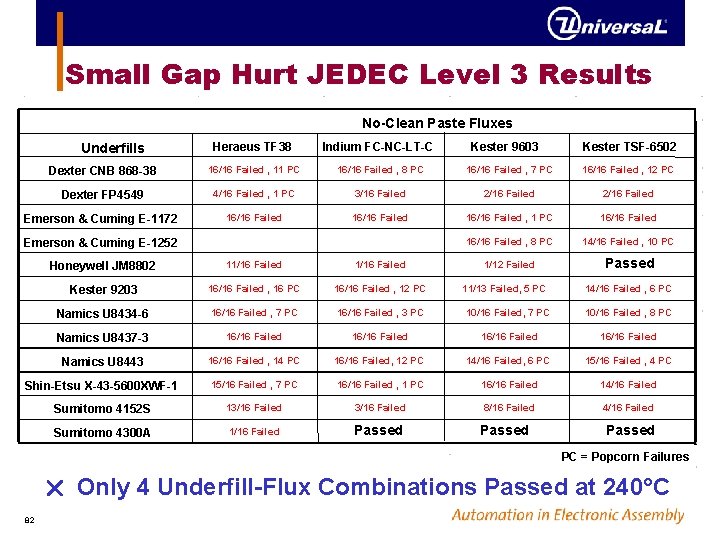
Small Gap Hurt JEDEC Level 3 Results No-Clean Paste Fluxes Heraeus TF 38 Indium FC-NC-LT-C Dexter CNB 868 -38 16/16 Failed , 11 PC 16/16 Failed , 8 PC 16/16 Failed , 7 PC 16/16 Failed , 12 PC Dexter FP 4549 4/16 Failed , 1 PC 3/16 Failed 2/16 Failed Emerson & Cuming E-1172 16/16 Failed , 1 PC 16/16 Failed , 8 PC 14/16 Failed , 10 PC 1/12 Failed Passed Underfills Emerson & Cuming E-1252 Kester 9603 Kester TSF-6502 Honeywell JM 8802 11/16 Failed Kester 9203 16/16 Failed , 16 PC 16/16 Failed , 12 PC Namics U 8434 -6 16/16 Failed , 7 PC 16/16 Failed , 3 PC 10/16 Failed, 7 PC 10/16 Failed , 8 PC Namics U 8437 -3 16/16 Failed Namics U 8443 16/16 Failed , 14 PC 16/16 Failed, 12 PC 14/16 Failed, 6 PC 15/16 Failed , 4 PC Shin-Etsu X-43 -5600 XWF-1 15/16 Failed , 7 PC 16/16 Failed , 1 PC 16/16 Failed 14/16 Failed Sumitomo 4152 S 13/16 Failed 8/16 Failed 4/16 Failed Sumitomo 4300 A 1/16 Failed Passed 11/13 Failed, 5 PC Passed 14/16 Failed , 6 PC Passed PC = Popcorn Failures r Only 4 Underfill-Flux Combinations Passed at 240°C 82
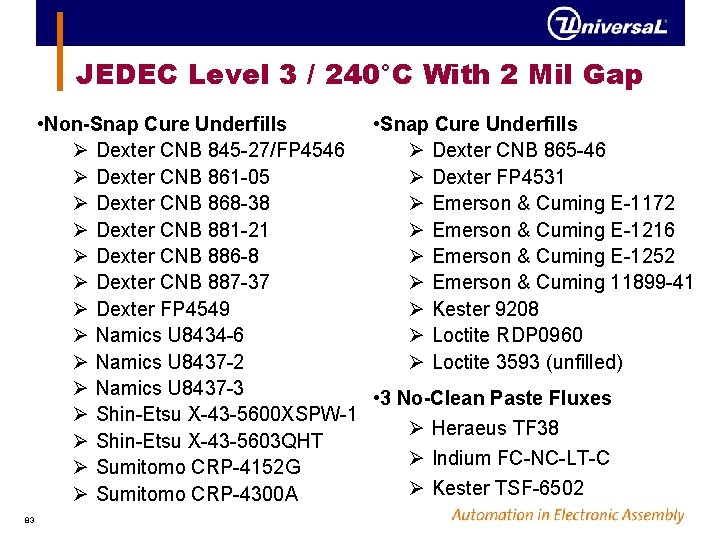
JEDEC Level 3 / 240°C With 2 Mil Gap • Non-Snap Cure Underfills • Snap Cure Underfills Ø Dexter CNB 845 -27/FP 4546 Ø Dexter CNB 865 -46 Ø Dexter CNB 861 -05 Ø Dexter FP 4531 Ø Dexter CNB 868 -38 Ø Emerson & Cuming E-1172 Ø Dexter CNB 881 -21 Ø Emerson & Cuming E-1216 Ø Dexter CNB 886 -8 Ø Emerson & Cuming E-1252 Ø Dexter CNB 887 -37 Ø Emerson & Cuming 11899 -41 Ø Dexter FP 4549 Ø Kester 9208 Ø Namics U 8434 -6 Ø Loctite RDP 0960 Ø Namics U 8437 -2 Ø Loctite 3593 (unfilled) Ø Namics U 8437 -3 • 3 No-Clean Paste Fluxes Ø Shin-Etsu X-43 -5600 XSPW-1 Ø Heraeus TF 38 Ø Shin-Etsu X-43 -5603 QHT Ø Indium FC-NC-LT-C Ø Sumitomo CRP-4152 G Ø Kester TSF-6502 Ø Sumitomo CRP-4300 A 83
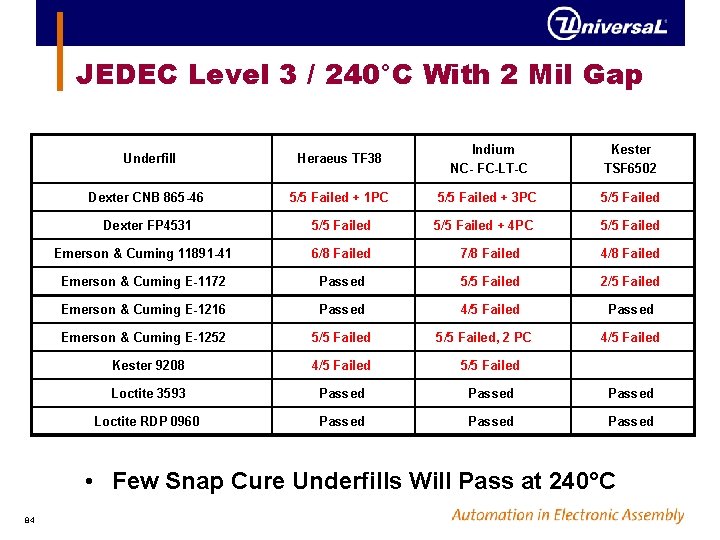
JEDEC Level 3 / 240°C With 2 Mil Gap Underfill Heraeus TF 38 Indium NC- FC-LT-C Kester TSF 6502 Dexter CNB 865 -46 5/5 Failed + 1 PC 5/5 Failed + 3 PC 5/5 Failed Dexter FP 4531 5/5 Failed + 4 PC 5/5 Failed Emerson & Cuming 11891 -41 6/8 Failed 7/8 Failed 4/8 Failed Emerson & Cuming E-1172 Passed 5/5 Failed 2/5 Failed Emerson & Cuming E-1216 Passed 4/5 Failed Passed Emerson & Cuming E-1252 5/5 Failed, 2 PC 4/5 Failed Kester 9208 4/5 Failed 5/5 Failed Loctite 3593 Passed Loctite RDP 0960 Passed • Few Snap Cure Underfills Will Pass at 240°C 84
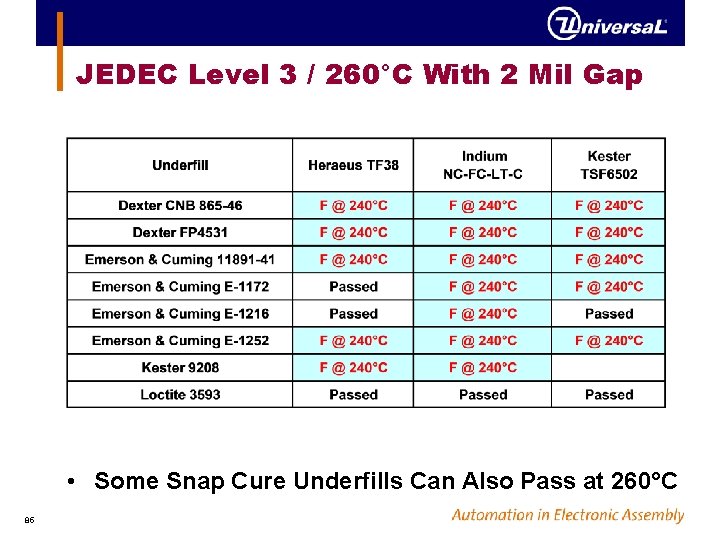
JEDEC Level 3 / 260°C With 2 Mil Gap • Some Snap Cure Underfills Can Also Pass at 260°C 85

JEDEC Level 3 / 240°C With 2 Mil Gap 86 • Most Non-Snap Cure Underfills Passed at 240°C • No Popcorn Failures
JEDEC Level 3 / 240°C With 2 Mil Gap • Tested a Subset of the Underfills With More Fluxes 87
JEDEC Level 3 / 260°C With 2 Mil Gap • Five Underfills Passed at 260°C With All 3 Fluxes 88
High Temperature JEDEC Summary • Better Results Than Expected Ø A Number of Materials Capable of 260°C Peak • Small Gaps Hurt Performance • Snap Cure Underfills Were More Likely to Fail and to Popcorn • Have Not Tested Subsequent Reliability of the Parts That Pass JEDEC Ø Expect Reduction As Seen With Lead-Free Parts 89
Codification Projects • Defect Prediction Programs Ø Placement Yield èNow Has Illustrated Help Files Ø Assembly Yield èNow Includes Solder Bridging Defects • Step-By-Step Guides Ø Emphasis on Creating a Database About Your Materials & Equipment So That Less Effort Required to Develop Product Specific Processes Ø Underfill Process Ø Reflow Encapsulant Assembly èNew This Year 90
- Slides: 90