
Overview of Extraction Line Designs and Issues Y
- Slides: 22
Overview of Extraction Line Designs and Issues Y. Nosochkov (SLAC) On behalf of the 14 mrad, 2 mrad and head-on teams ILC Interaction Region Engineering Design Workshop SLAC, 17 – 21 September, 2007 IRENG 07
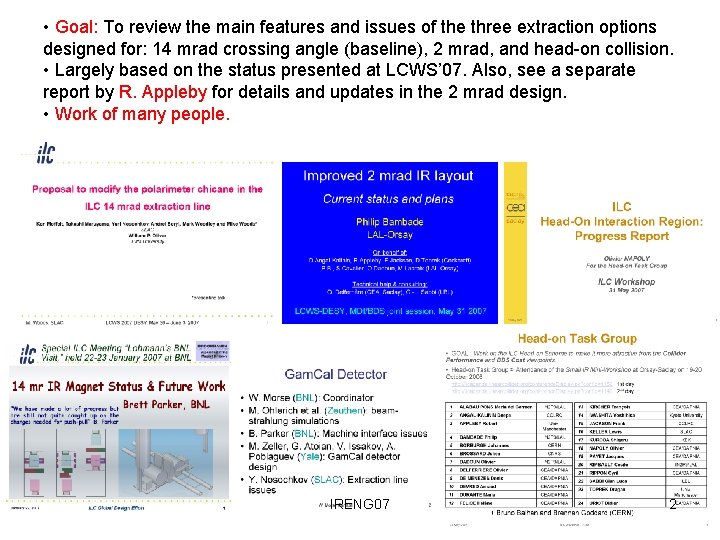
• Goal: To review the main features and issues of the three extraction options designed for: 14 mrad crossing angle (baseline), 2 mrad, and head-on collision. • Largely based on the status presented at LCWS’ 07. Also, see a separate report by R. Appleby for details and updates in the 2 mrad design. • Work of many people. IRENG 07 2
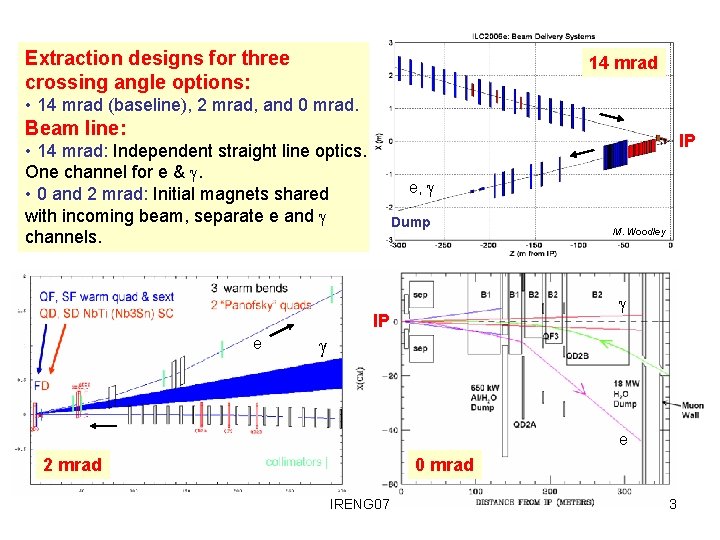
Extraction designs for three crossing angle options: 14 mrad • 14 mrad (baseline), 2 mrad, and 0 mrad. Beam line: IP • 14 mrad: Independent straight line optics. One channel for e & g. • 0 and 2 mrad: Initial magnets shared with incoming beam, separate e and g channels. e, g Dump g IP e M. Woodley g e 2 mrad 0 mrad IRENG 07 3
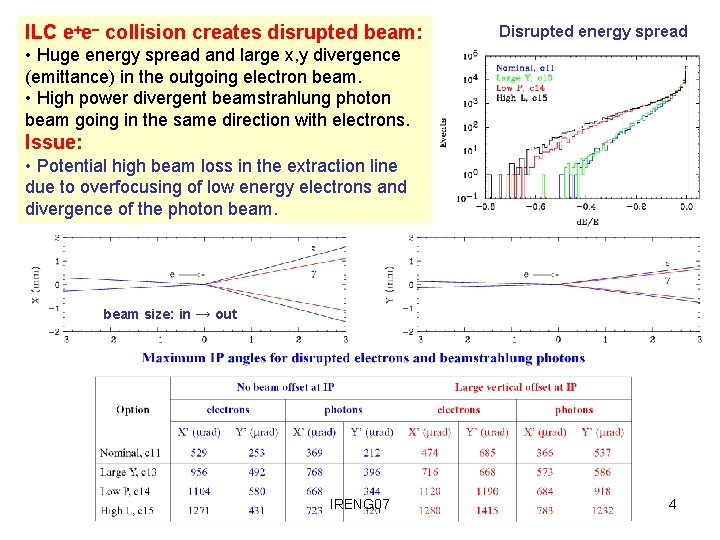
ILC e+e- collision creates disrupted beam: Disrupted energy spread • Huge energy spread and large x, y divergence (emittance) in the outgoing electron beam. • High power divergent beamstrahlung photon beam going in the same direction with electrons. Issue: • Potential high beam loss in the extraction line due to overfocusing of low energy electrons and divergence of the photon beam size: in → out IRENG 07 4
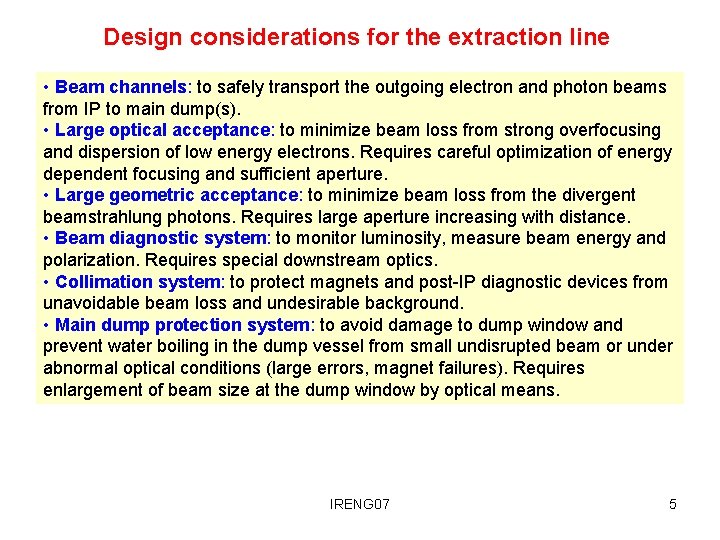
Design considerations for the extraction line • Beam channels: to safely transport the outgoing electron and photon beams from IP to main dump(s). • Large optical acceptance: to minimize beam loss from strong overfocusing and dispersion of low energy electrons. Requires careful optimization of energy dependent focusing and sufficient aperture. • Large geometric acceptance: to minimize beam loss from the divergent beamstrahlung photons. Requires large aperture increasing with distance. • Beam diagnostic system: to monitor luminosity, measure beam energy and polarization. Requires special downstream optics. • Collimation system: to protect magnets and post-IP diagnostic devices from unavoidable beam loss and undesirable background. • Main dump protection system: to avoid damage to dump window and prevent water boiling in the dump vessel from small undisrupted beam or under abnormal optical conditions (large errors, magnet failures). Requires enlargement of beam size at the dump window by optical means. IRENG 07 5
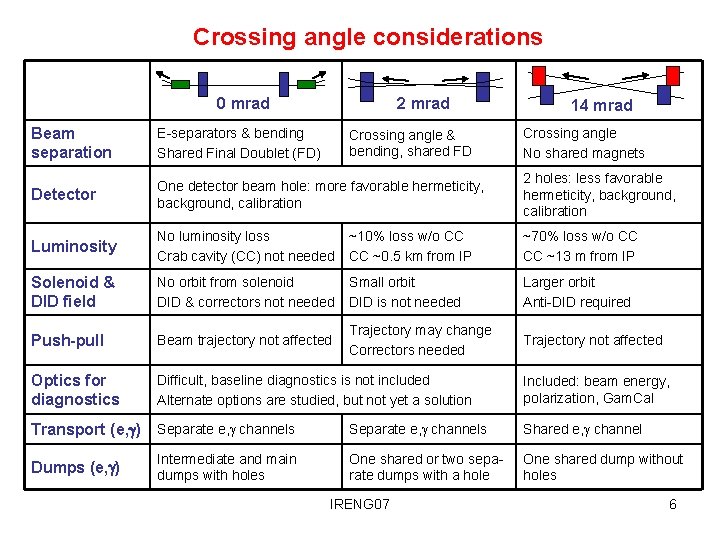
Crossing angle considerations 0 mrad 2 mrad 14 mrad Beam separation E-separators & bending Shared Final Doublet (FD) Detector One detector beam hole: more favorable hermeticity, background, calibration 2 holes: less favorable hermeticity, background, calibration Luminosity No luminosity loss Crab cavity (CC) not needed ~10% loss w/o CC CC ~0. 5 km from IP ~70% loss w/o CC CC ~13 m from IP Solenoid & DID field No orbit from solenoid DID & correctors not needed Small orbit DID is not needed Larger orbit Anti-DID required Push-pull Beam trajectory not affected Trajectory may change Correctors needed Trajectory not affected Optics for diagnostics Difficult, baseline diagnostics is not included Alternate options are studied, but not yet a solution Included: beam energy, polarization, Gam. Cal Transport (e, g) Separate e, g channels Shared e, g channel Dumps (e, g) Intermediate and main dumps with holes One shared or two separate dumps with a hole One shared dump without holes Crossing angle & bending, shared FD IRENG 07 Crossing angle No shared magnets 6
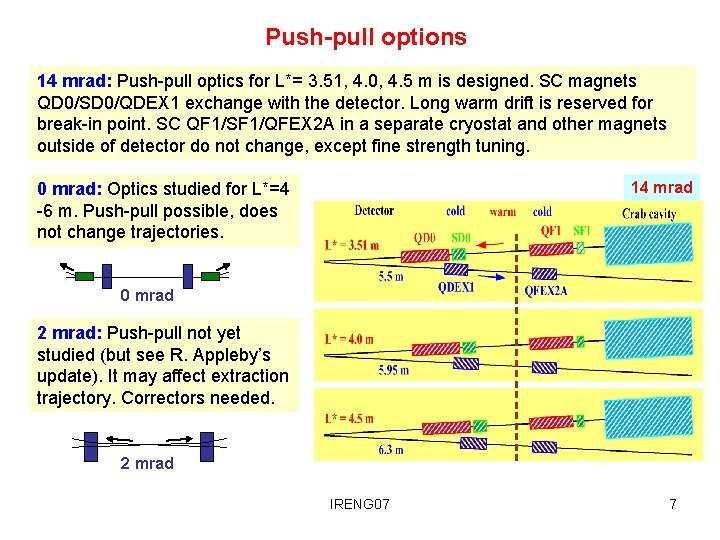
Push-pull options 14 mrad: Push-pull optics for L*= 3. 51, 4. 0, 4. 5 m is designed. SC magnets QD 0/SD 0/QDEX 1 exchange with the detector. Long warm drift is reserved for break-in point. SC QF 1/SF 1/QFEX 2 A in a separate cryostat and other magnets outside of detector do not change, except fine strength tuning. 14 mrad 0 mrad: Optics studied for L*=4 -6 m. Push-pull possible, does not change trajectories. 0 mrad 2 mrad: Push-pull not yet studied (but see R. Appleby’s update). It may affect extraction trajectory. Correctors needed. 2 mrad IRENG 07 7
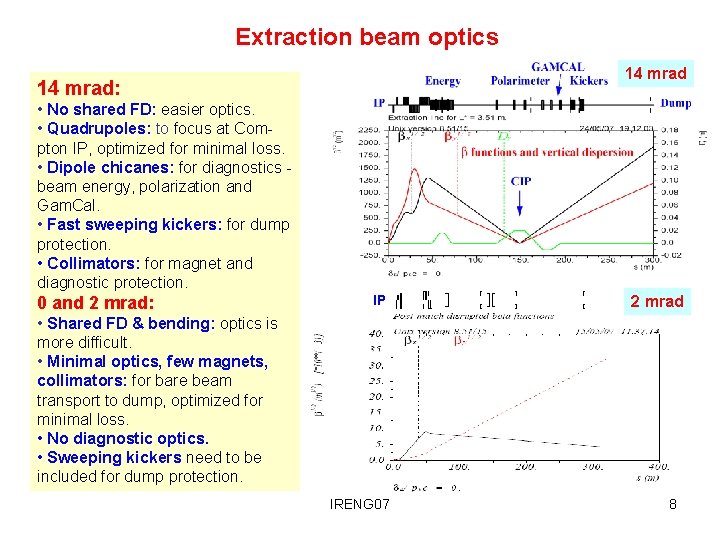
Extraction beam optics 14 mrad: • No shared FD: easier optics. • Quadrupoles: to focus at Compton IP, optimized for minimal loss. • Dipole chicanes: for diagnostics beam energy, polarization and Gam. Cal. • Fast sweeping kickers: for dump protection. • Collimators: for magnet and diagnostic protection. 0 and 2 mrad: IP 2 mrad • Shared FD & bending: optics is more difficult. • Minimal optics, few magnets, collimators: for bare beam transport to dump, optimized for minimal loss. • No diagnostic optics. • Sweeping kickers need to be included for dump protection. IRENG 07 8
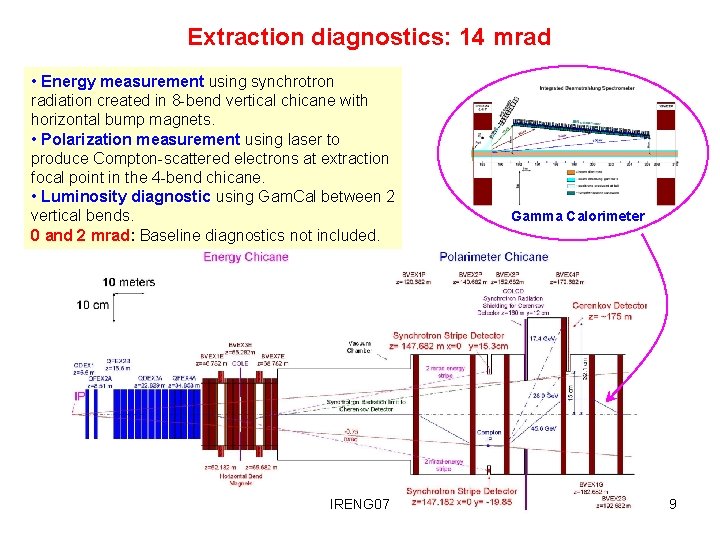
Extraction diagnostics: 14 mrad • Energy measurement using synchrotron radiation created in 8 -bend vertical chicane with horizontal bump magnets. • Polarization measurement using laser to produce Compton-scattered electrons at extraction focal point in the 4 -bend chicane. • Luminosity diagnostic using Gam. Cal between 2 vertical bends. 0 and 2 mrad: Baseline diagnostics not included. IRENG 07 Gamma Calorimeter 9
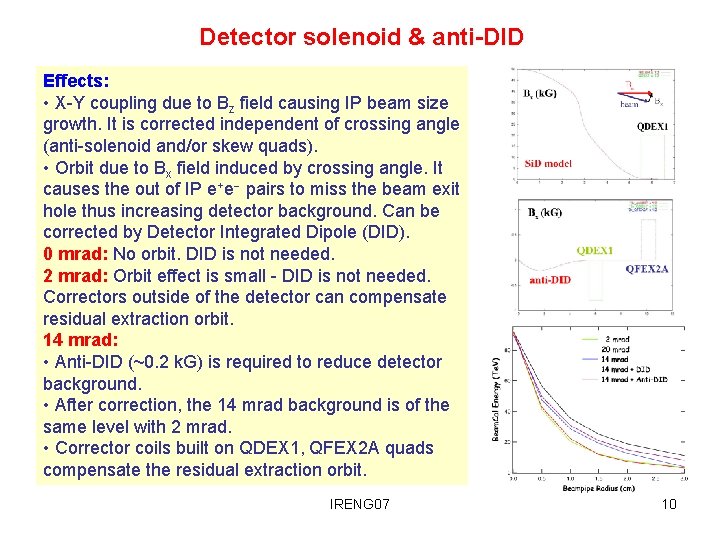
Detector solenoid & anti-DID Effects: • X-Y coupling due to Bz field causing IP beam size growth. It is corrected independent of crossing angle (anti-solenoid and/or skew quads). • Orbit due to Bx field induced by crossing angle. It causes the out of IP e+e- pairs to miss the beam exit hole thus increasing detector background. Can be corrected by Detector Integrated Dipole (DID). 0 mrad: No orbit. DID is not needed. 2 mrad: Orbit effect is small - DID is not needed. Correctors outside of the detector can compensate residual extraction orbit. 14 mrad: • Anti-DID (~0. 2 k. G) is required to reduce detector background. • After correction, the 14 mrad background is of the same level with 2 mrad. • Corrector coils built on QDEX 1, QFEX 2 A quads compensate the residual extraction orbit. IRENG 07 10
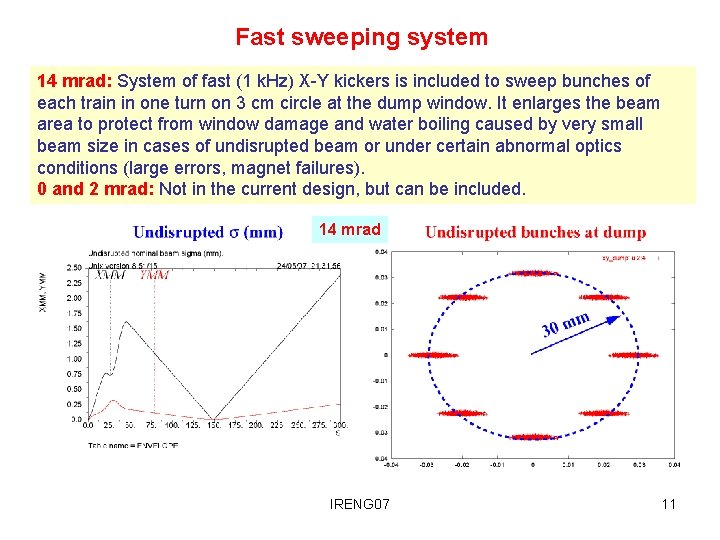
Fast sweeping system 14 mrad: System of fast (1 k. Hz) X-Y kickers is included to sweep bunches of each train in one turn on 3 cm circle at the dump window. It enlarges the beam area to protect from window damage and water boiling caused by very small beam size in cases of undisrupted beam or under certain abnormal optics conditions (large errors, magnet failures). 0 and 2 mrad: Not in the current design, but can be included. 14 mrad IRENG 07 11
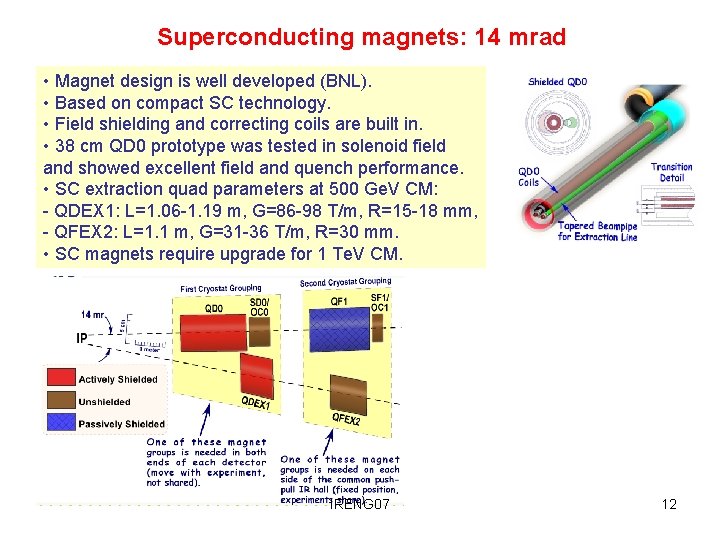
Superconducting magnets: 14 mrad • Magnet design is well developed (BNL). • Based on compact SC technology. • Field shielding and correcting coils are built in. • 38 cm QD 0 prototype was tested in solenoid field and showed excellent field and quench performance. • SC extraction quad parameters at 500 Ge. V CM: - QDEX 1: L=1. 06 -1. 19 m, G=86 -98 T/m, R=15 -18 mm, - QFEX 2: L=1. 1 m, G=31 -36 T/m, R=30 mm. • SC magnets require upgrade for 1 Te. V CM. IRENG 07 12
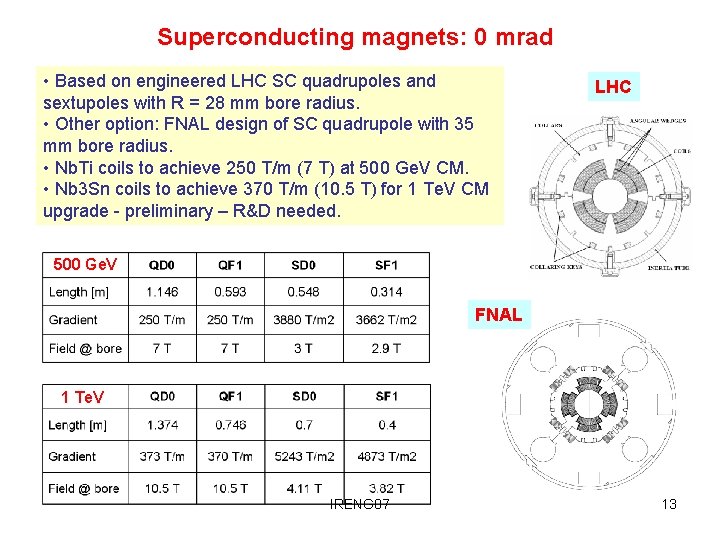
Superconducting magnets: 0 mrad • Based on engineered LHC SC quadrupoles and sextupoles with R = 28 mm bore radius. • Other option: FNAL design of SC quadrupole with 35 mm bore radius. • Nb. Ti coils to achieve 250 T/m (7 T) at 500 Ge. V CM. • Nb 3 Sn coils to achieve 370 T/m (10. 5 T) for 1 Te. V CM upgrade - preliminary – R&D needed. LHC 500 Ge. V FNAL 1 Te. V IRENG 07 13
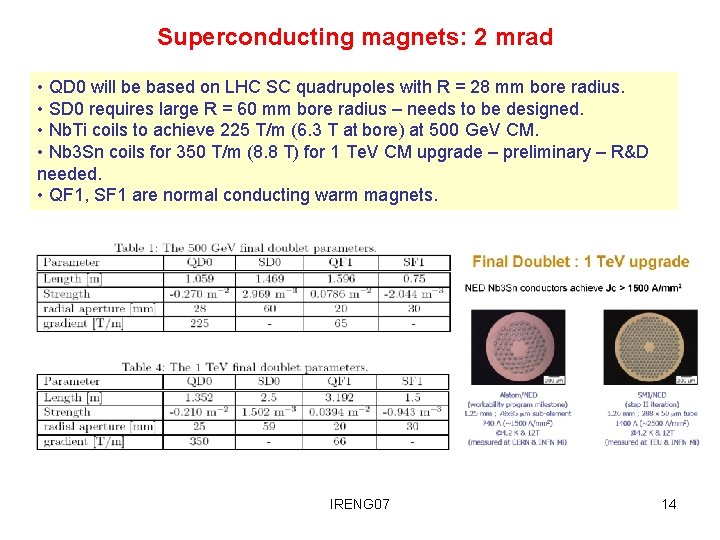
Superconducting magnets: 2 mrad • QD 0 will be based on LHC SC quadrupoles with R = 28 mm bore radius. • SD 0 requires large R = 60 mm bore radius – needs to be designed. • Nb. Ti coils to achieve 225 T/m (6. 3 T at bore) at 500 Ge. V CM. • Nb 3 Sn coils for 350 T/m (8. 8 T) for 1 Te. V CM upgrade – preliminary – R&D needed. • QF 1, SF 1 are normal conducting warm magnets. IRENG 07 14
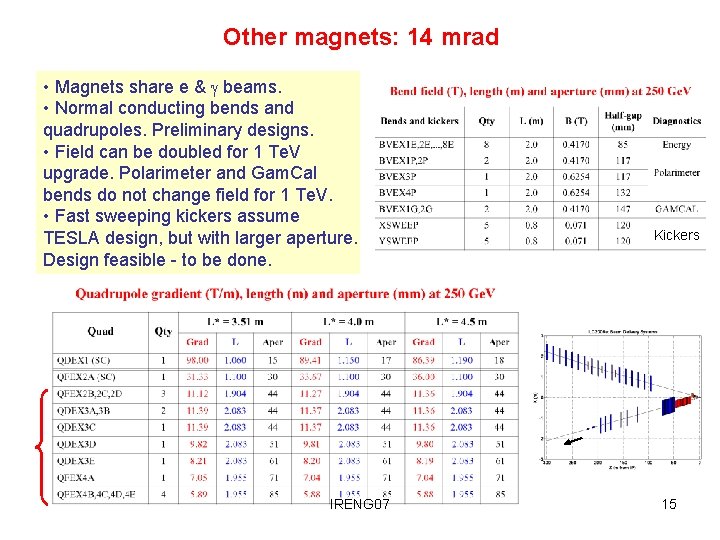
Other magnets: 14 mrad • Magnets share e & g beams. • Normal conducting bends and quadrupoles. Preliminary designs. • Field can be doubled for 1 Te. V upgrade. Polarimeter and Gam. Cal bends do not change field for 1 Te. V. • Fast sweeping kickers assume TESLA design, but with larger aperture. Design feasible - to be done. IRENG 07 Kickers 15
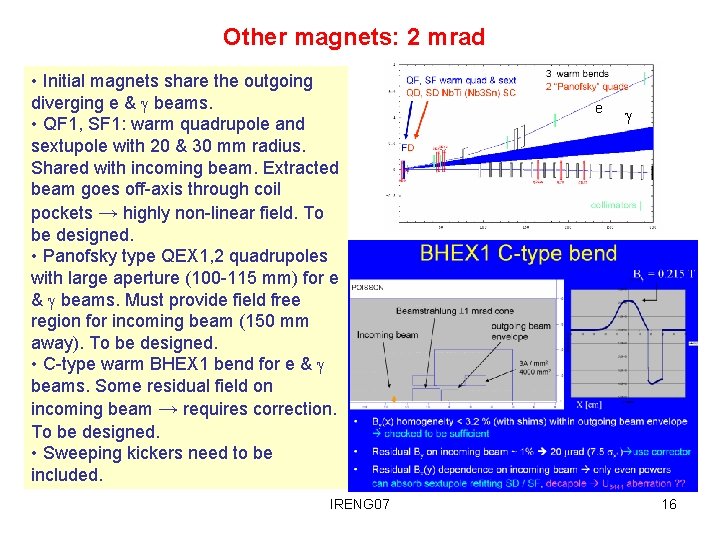
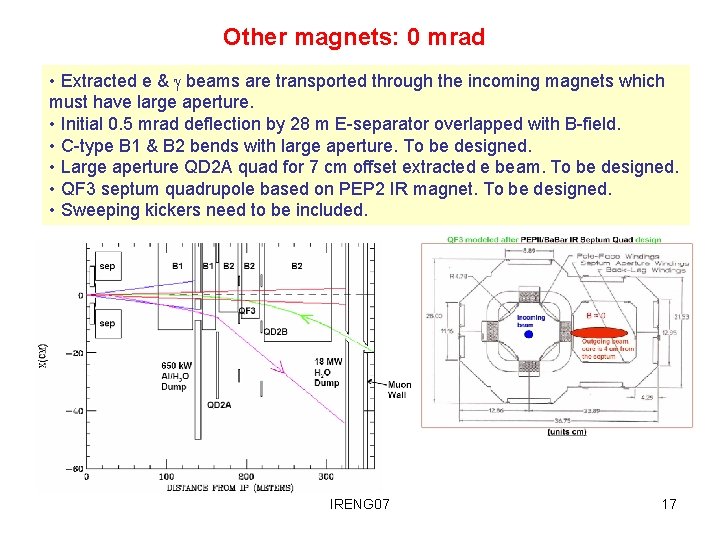
Other magnets: 2 mrad • Initial magnets share the outgoing diverging e & g beams. • QF 1, SF 1: warm quadrupole and sextupole with 20 & 30 mm radius. Shared with incoming beam. Extracted beam goes off-axis through coil pockets → highly non-linear field. To be designed. • Panofsky type QEX 1, 2 quadrupoles with large aperture (100 -115 mm) for e & g beams. Must provide field free region for incoming beam (150 mm away). To be designed. • C-type warm BHEX 1 bend for e & g beams. Some residual field on incoming beam → requires correction. To be designed. • Sweeping kickers need to be included. IRENG 07 e g 16
Other magnets: 0 mrad • Extracted e & g beams are transported through the incoming magnets which must have large aperture. • Initial 0. 5 mrad deflection by 28 m E-separator overlapped with B-field. • C-type B 1 & B 2 bends with large aperture. To be designed. • Large aperture QD 2 A quad for 7 cm offset extracted e beam. To be designed. • QF 3 septum quadrupole based on PEP 2 IR magnet. To be designed. • Sweeping kickers need to be included. IRENG 07 17
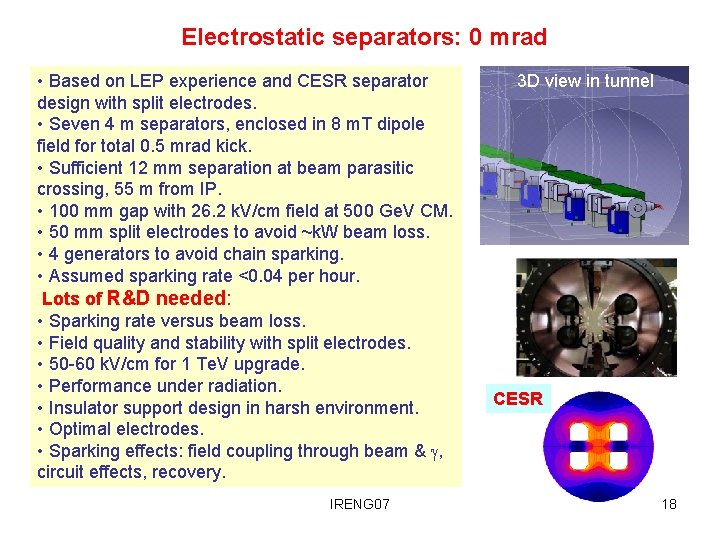
Electrostatic separators: 0 mrad • Based on LEP experience and CESR separator design with split electrodes. • Seven 4 m separators, enclosed in 8 m. T dipole field for total 0. 5 mrad kick. • Sufficient 12 mm separation at beam parasitic crossing, 55 m from IP. • 100 mm gap with 26. 2 k. V/cm field at 500 Ge. V CM. • 50 mm split electrodes to avoid ~k. W beam loss. • 4 generators to avoid chain sparking. • Assumed sparking rate <0. 04 per hour. Lots of R&D needed: • Sparking rate versus beam loss. • Field quality and stability with split electrodes. • 50 -60 k. V/cm for 1 Te. V upgrade. • Performance under radiation. • Insulator support design in harsh environment. • Optimal electrodes. • Sparking effects: field coupling through beam & g, circuit effects, recovery. IRENG 07 3 D view in tunnel CESR 18
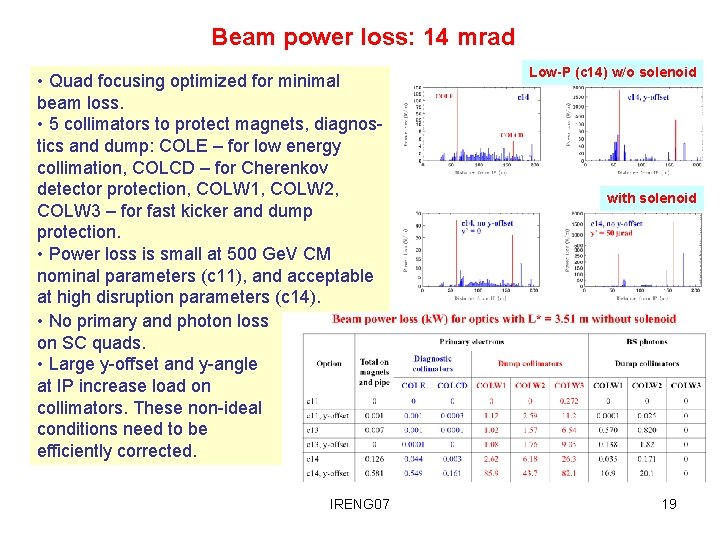
Beam power loss: 14 mrad • Quad focusing optimized for minimal beam loss. • 5 collimators to protect magnets, diagnostics and dump: COLE – for low energy collimation, COLCD – for Cherenkov detector protection, COLW 1, COLW 2, COLW 3 – for fast kicker and dump protection. • Power loss is small at 500 Ge. V CM nominal parameters (c 11), and acceptable at high disruption parameters (c 14). • No primary and photon loss on SC quads. • Large y-offset and y-angle at IP increase load on collimators. These non-ideal conditions need to be efficiently corrected. IRENG 07 Low-P (c 14) w/o solenoid with solenoid 19
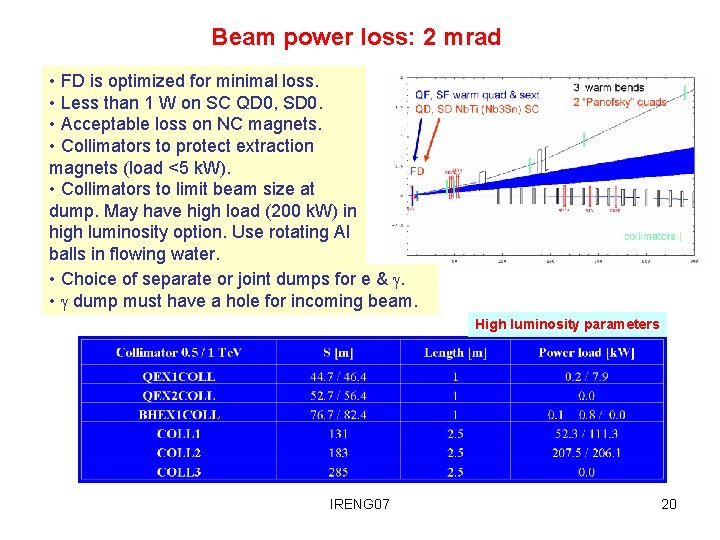
Beam power loss: 2 mrad • FD is optimized for minimal loss. • Less than 1 W on SC QD 0, SD 0. • Acceptable loss on NC magnets. • Collimators to protect extraction magnets (load <5 k. W). • Collimators to limit beam size at dump. May have high load (200 k. W) in high luminosity option. Use rotating Al balls in flowing water. • Choice of separate or joint dumps for e & g. • g dump must have a hole for incoming beam. High luminosity parameters IRENG 07 20
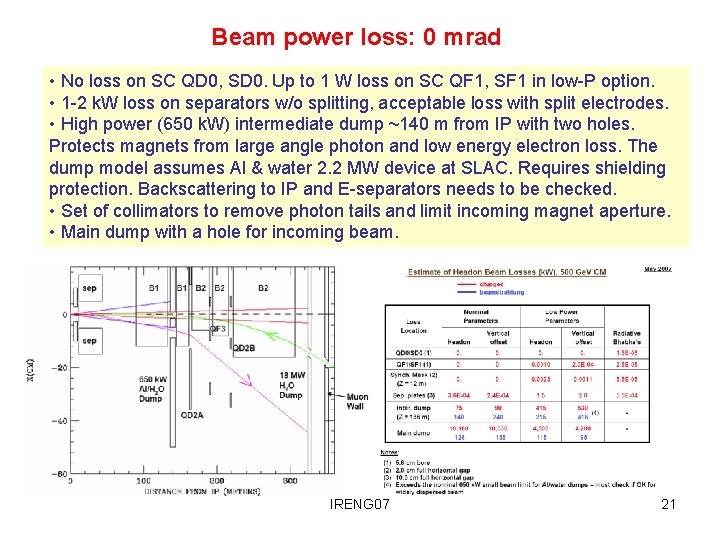
Beam power loss: 0 mrad • No loss on SC QD 0, SD 0. Up to 1 W loss on SC QF 1, SF 1 in low-P option. • 1 -2 k. W loss on separators w/o splitting, acceptable loss with split electrodes. • High power (650 k. W) intermediate dump ~140 m from IP with two holes. Protects magnets from large angle photon and low energy electron loss. The dump model assumes Al & water 2. 2 MW device at SLAC. Requires shielding protection. Backscattering to IP and E-separators needs to be checked. • Set of collimators to remove photon tails and limit incoming magnet aperture. • Main dump with a hole for incoming beam. IRENG 07 21
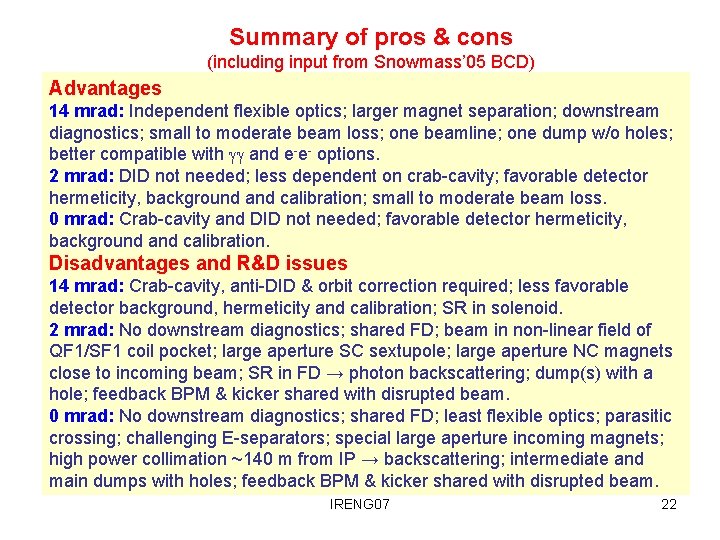
Summary of pros & cons (including input from Snowmass’ 05 BCD) Advantages 14 mrad: Independent flexible optics; larger magnet separation; downstream diagnostics; small to moderate beam loss; one beamline; one dump w/o holes; better compatible with gg and e-e- options. 2 mrad: DID not needed; less dependent on crab-cavity; favorable detector hermeticity, background and calibration; small to moderate beam loss. 0 mrad: Crab-cavity and DID not needed; favorable detector hermeticity, background and calibration. Disadvantages and R&D issues 14 mrad: Crab-cavity, anti-DID & orbit correction required; less favorable detector background, hermeticity and calibration; SR in solenoid. 2 mrad: No downstream diagnostics; shared FD; beam in non-linear field of QF 1/SF 1 coil pocket; large aperture SC sextupole; large aperture NC magnets close to incoming beam; SR in FD → photon backscattering; dump(s) with a hole; feedback BPM & kicker shared with disrupted beam. 0 mrad: No downstream diagnostics; shared FD; least flexible optics; parasitic crossing; challenging E-separators; special large aperture incoming magnets; high power collimation ~140 m from IP → backscattering; intermediate and main dumps with holes; feedback BPM & kicker shared with disrupted beam. IRENG 07 22