
OVERVIEW OF EXERCISE METABOLISM Lecture content provided by

OVERVIEW OF EXERCISE METABOLISM Lecture content provided by GSSI, a division of Pepsi. Co, Inc. Any opinions or scientific interpretations expressed in this presentation are those of the author and do not necessarily reflect the position or policy of Pepsi. Co, Inc.
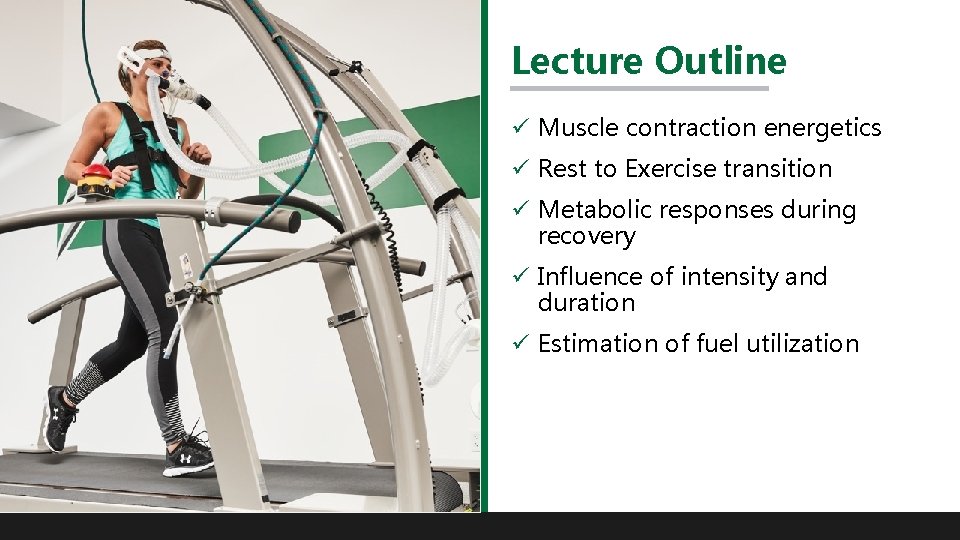
Lecture Outline ü Muscle contraction energetics ü Rest to Exercise transition ü Metabolic responses during recovery ü Influence of intensity and duration ü Estimation of fuel utilization

Energy for Muscle Contraction Adenosine Triphosphate (ATP) Molecule which provides energy for muscle fibers to contract The amount stored in the muscle is limited Hargreaves, M & Spriet, L. Nat Metab. 2020; https: //doi. org/10. 1038/s 42255 -020 -0251 -4.

Energy for Muscle Contraction Notes: Fuel Sources to Generate ATP for Muscle Contraction (phosphocreatine) Anaerobic Glycolysis Aerobic Metabolism High intensity ~5 s or less High intensity ~30 s – 3 min Lower intensity Long duration Regenerated during recovery Glucose Fatty Acids PCr ü Creatine is made in the body and consumed from meat. The PCr system is also the mechanism through which creatine supplements provide energy for high intensity muscle contraction ü Glucose is supplied mainly from the breakdown of GLYCOGEN, the storage form of glucose in the muscle and liver ü Amino acids can enter the aerobic glycolysis system, but their contribution to ATP generation is very small Hargreaves, M & Spriet, L. Nat Metab. 2020; https: //doi. org/10. 1038/s 42255 -020 -0251 -4.

HUMAN ENGINE FAT = ENDURANCE FUEL CARB = HIGH INTENSITY FUEL PCr = FAST ACCELERATIONS CAR ENGINE ONE KIND OF FUEL

Energy for Muscle Contraction - Byproducts Anaerobic glycolysis Aerobic Metabolism Previously thought to cause fatigue and muscle soreness. Lactate No longer believed to be the case, may provide an additional fuel source As oxygen is used in the process to convert fuels to ATP, carbon dioxide is produced CO 2 Respiration increases to remove the excess CO 2 from the body Hargreaves, M & Spriet, L. Nat Metab. 2020; https: //doi. org/10. 1038/s 42255 -020 -0251 -4.

TRANSITIONS

Rest to Exercise Transition Imagine a football player is standing on the sideline. On coach’s whistle, he is to begin sprinting. What is happening in the body to ensure the muscle has the fuel to go from rest to quick contractions?
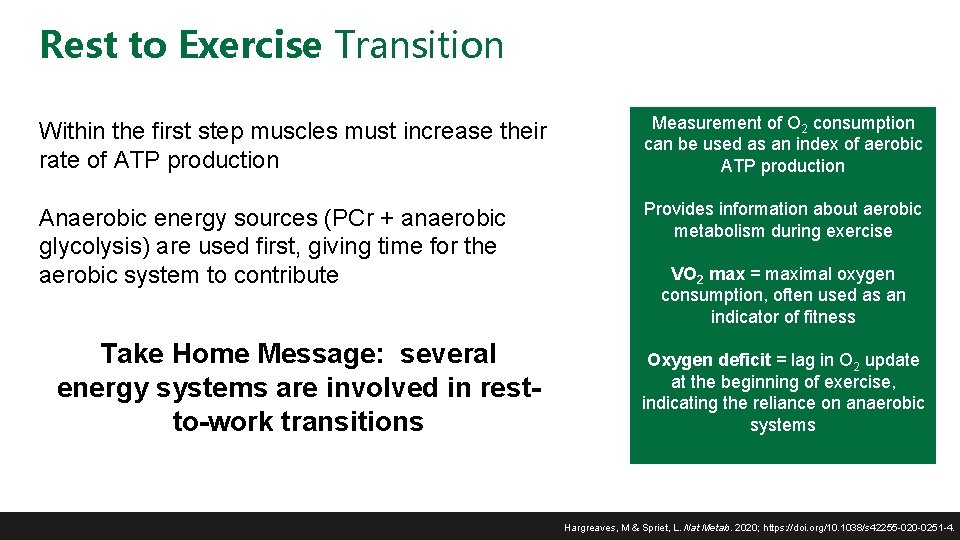
Rest to Exercise Transition Within the first step muscles must increase their rate of ATP production Measurement of O 2 consumption can be used as an index of aerobic ATP production Anaerobic energy sources (PCr + anaerobic glycolysis) are used first, giving time for the aerobic system to contribute Provides information about aerobic metabolism during exercise Take Home Message: several energy systems are involved in restto-work transitions VO 2 max = maximal oxygen consumption, often used as an indicator of fitness Oxygen deficit = lag in O 2 update at the beginning of exercise, indicating the reliance on anaerobic systems Hargreaves, M & Spriet, L. Nat Metab. 2020; https: //doi. org/10. 1038/s 42255 -020 -0251 -4.

Recovery from Exercise: Metabolic Responses Metabolism (indicated by oxygen uptake) remains elevated for several minutes after exercise The magnitude of elevation depends on the intensity of exercise Why does EPOC occur? § Resynthesize PC § Replace O 2 in muscle & blood § Elevated body temperature § Convert lactic acid to glucose § Elevated epinephrine & EPOC = Excess Post-Exercise Oxygen Consumption norepinephrine Sport Nutrition 3 rd Ed. Jeukendrup & Gleeson, Human Kinetics.

Influence of Intensity and Duration on Energy Pathway Selection
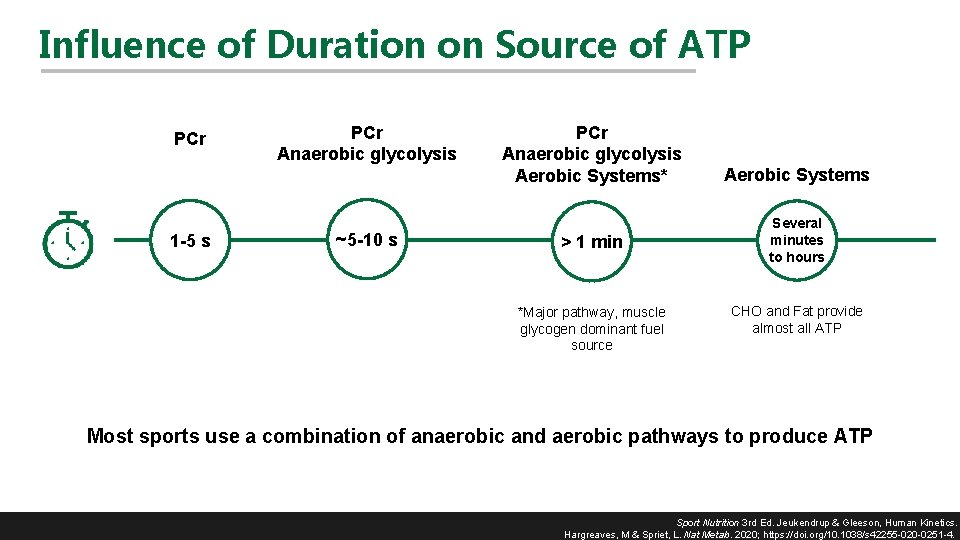
Influence of Duration on Source of ATP PCr 1 -5 s PCr Anaerobic glycolysis ~5 -10 s PCr Anaerobic glycolysis Aerobic Systems* > 1 min *Major pathway, muscle glycogen dominant fuel source Aerobic Systems Several minutes to hours CHO and Fat provide almost all ATP Most sports use a combination of anaerobic and aerobic pathways to produce ATP Sport Nutrition 3 rd Ed. Jeukendrup & Gleeson, Human Kinetics. Hargreaves, M & Spriet, L. Nat Metab. 2020; https: //doi. org/10. 1038/s 42255 -020 -0251 -4.
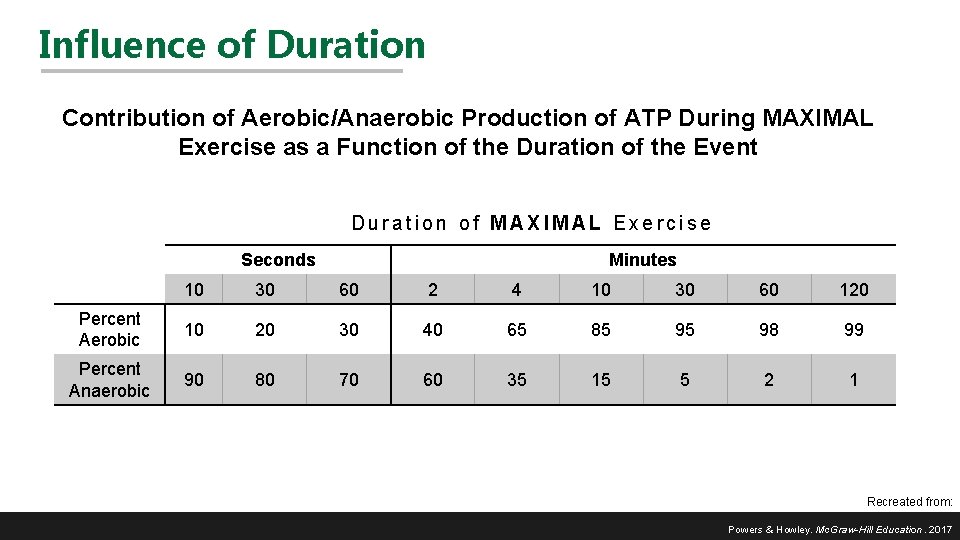
Influence of Duration Contribution of Aerobic/Anaerobic Production of ATP During MAXIMAL Exercise as a Function of the Duration of the Event Duration of MAXIMAL Exercise Seconds Minutes 10 30 60 2 4 10 30 60 120 Percent Aerobic 10 20 30 40 65 85 95 98 99 Percent Anaerobic 90 80 70 60 35 15 5 2 1 Recreated from: Powers & Howley. Mc. Graw-Hill Education. 2017
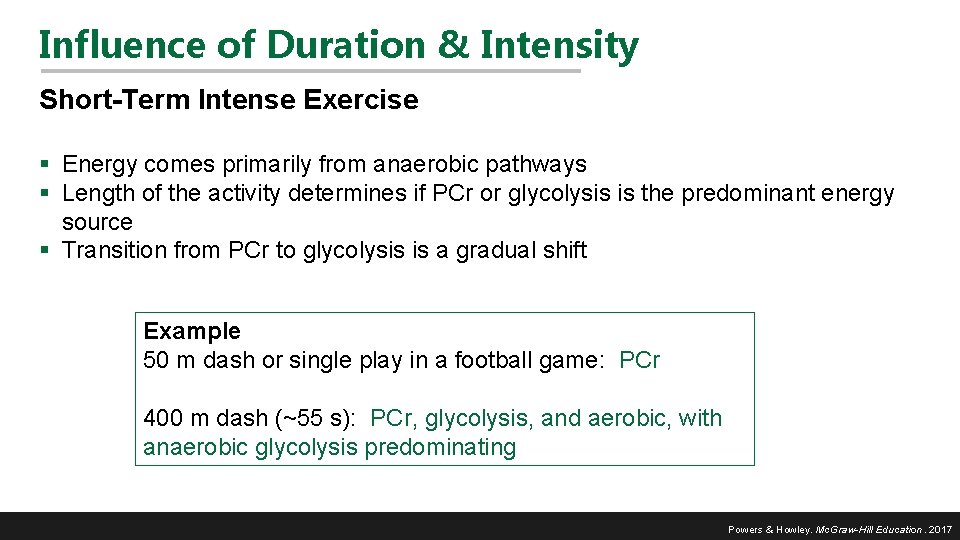
Influence of Duration & Intensity Short-Term Intense Exercise § Energy comes primarily from anaerobic pathways § Length of the activity determines if PCr or glycolysis is the predominant energy source § Transition from PCr to glycolysis is a gradual shift Example 50 m dash or single play in a football game: PCr 400 m dash (~55 s): PCr, glycolysis, and aerobic, with anaerobic glycolysis predominating Powers & Howley. Mc. Graw-Hill Education. 2017
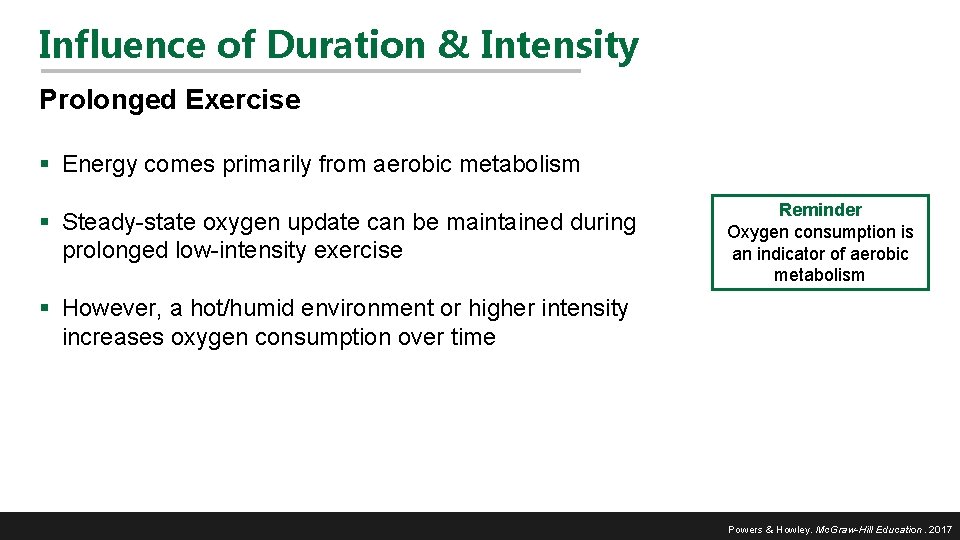
Influence of Duration & Intensity Prolonged Exercise § Energy comes primarily from aerobic metabolism § Steady-state oxygen update can be maintained during prolonged low-intensity exercise Reminder Oxygen consumption is an indicator of aerobic metabolism § However, a hot/humid environment or higher intensity increases oxygen consumption over time Powers & Howley. Mc. Graw-Hill Education. 2017

Assessing Metabolism during Exercise
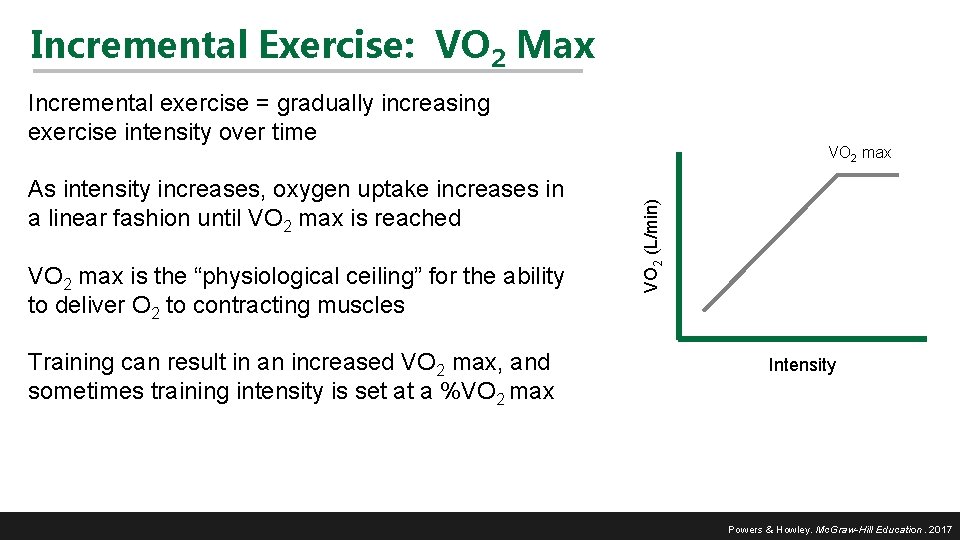
Incremental Exercise: VO 2 Max Incremental exercise = gradually increasing exercise intensity over time VO 2 max is the “physiological ceiling” for the ability to deliver O 2 to contracting muscles Training can result in an increased VO 2 max, and sometimes training intensity is set at a %VO 2 max VO 2 (L/min) As intensity increases, oxygen uptake increases in a linear fashion until VO 2 max is reached VO 2 max Intensity Powers & Howley. Mc. Graw-Hill Education. 2017
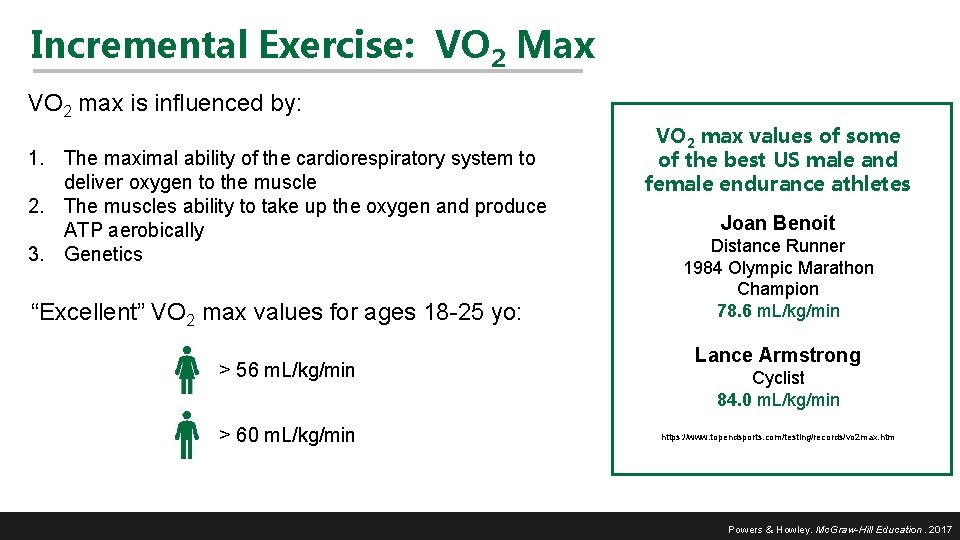
Incremental Exercise: VO 2 Max VO 2 max is influenced by: 1. The maximal ability of the cardiorespiratory system to deliver oxygen to the muscle 2. The muscles ability to take up the oxygen and produce ATP aerobically 3. Genetics “Excellent” VO 2 max values for ages 18 -25 yo: > 56 m. L/kg/min > 60 m. L/kg/min VO 2 max values of some of the best US male and female endurance athletes Joan Benoit Distance Runner 1984 Olympic Marathon Champion 78. 6 m. L/kg/min Lance Armstrong Cyclist 84. 0 m. L/kg/min https: //www. topendsports. com/testing/records/vo 2 max. htm Powers & Howley. Mc. Graw-Hill Education. 2017
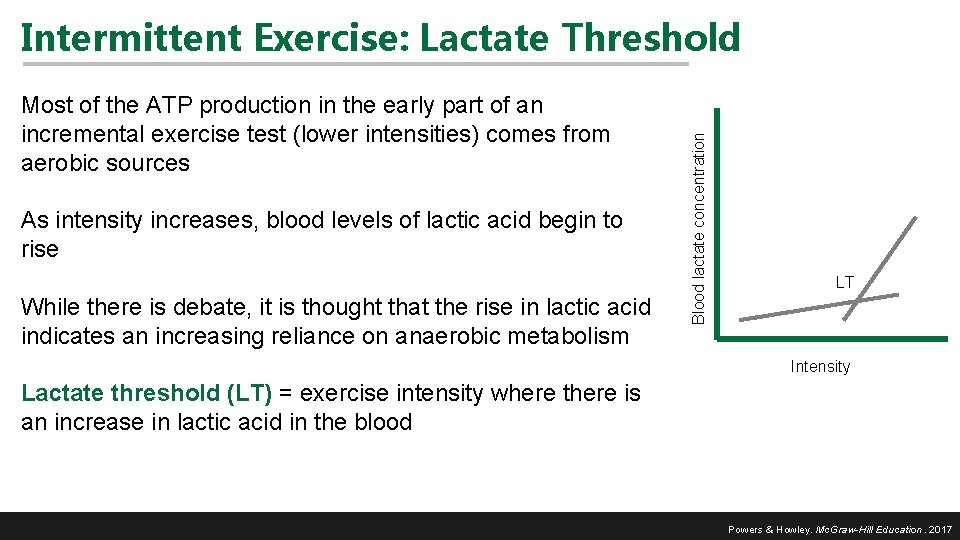
Most of the ATP production in the early part of an incremental exercise test (lower intensities) comes from aerobic sources As intensity increases, blood levels of lactic acid begin to rise While there is debate, it is thought that the rise in lactic acid indicates an increasing reliance on anaerobic metabolism Blood lactate concentration Intermittent Exercise: Lactate Threshold LT Intensity Lactate threshold (LT) = exercise intensity where there is an increase in lactic acid in the blood Powers & Howley. Mc. Graw-Hill Education. 2017
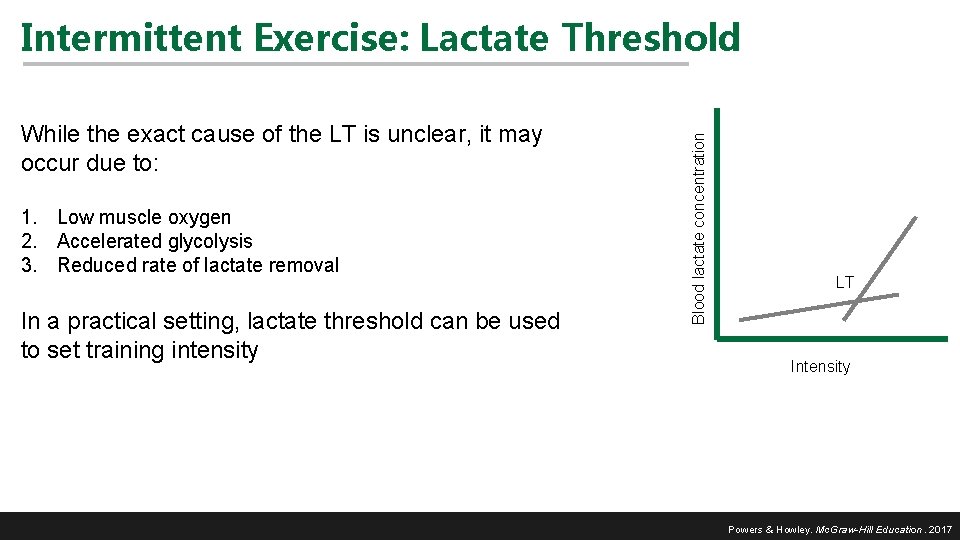
While the exact cause of the LT is unclear, it may occur due to: 1. Low muscle oxygen 2. Accelerated glycolysis 3. Reduced rate of lactate removal In a practical setting, lactate threshold can be used to set training intensity Blood lactate concentration Intermittent Exercise: Lactate Threshold LT Intensity Powers & Howley. Mc. Graw-Hill Education. 2017
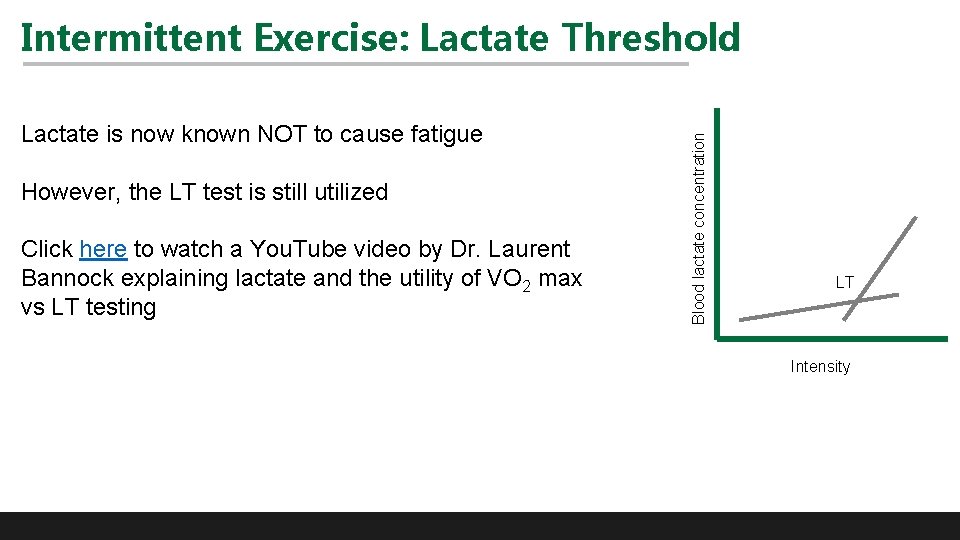
Lactate is now known NOT to cause fatigue However, the LT test is still utilized Click here to watch a You. Tube video by Dr. Laurent Bannock explaining lactate and the utility of VO 2 max vs LT testing Blood lactate concentration Intermittent Exercise: Lactate Threshold LT Intensity
Estimation of Fuel Utilization Respiratory Exchange Ratio (RER) = VCO 2/VO 2 = Ratio of carbon dioxide produced to oxygen consumed Based on their chemical structures, fat and carbohydrate differ in the amount of O 2 used and CO 2 produced during oxidation Fat oxidation requires more O 2 than carbohydrate Ignores protein, since protein contributes little as a fuel source Determined using a metabolic cart during steady state exercise Powers & Howley. Mc. Graw-Hill Education. 2017
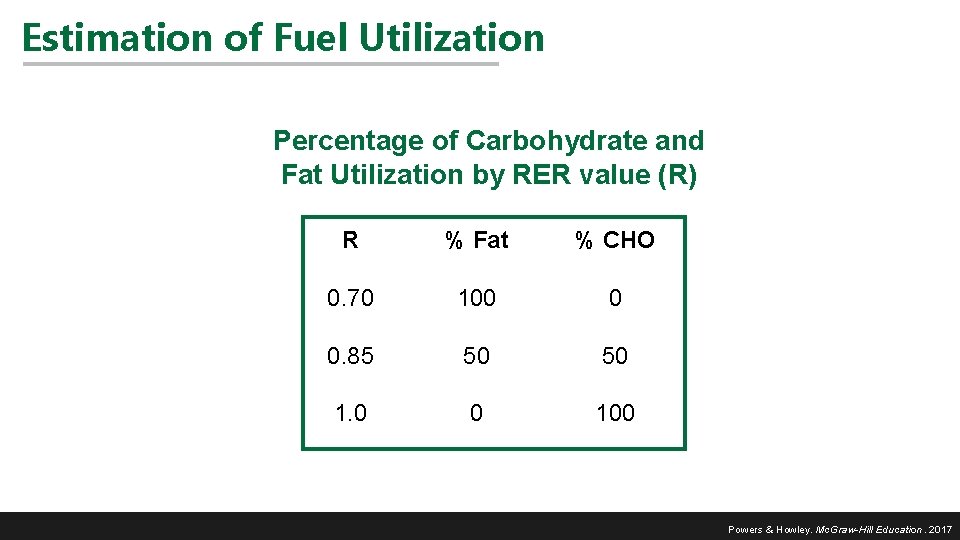
Estimation of Fuel Utilization Percentage of Carbohydrate and Fat Utilization by RER value (R) R % Fat % CHO 0. 70 100 0 0. 85 50 50 1. 0 0 100 Powers & Howley. Mc. Graw-Hill Education. 2017
Aerobic Metabolism: Influence of Intensity and Duration on Fuel Selection
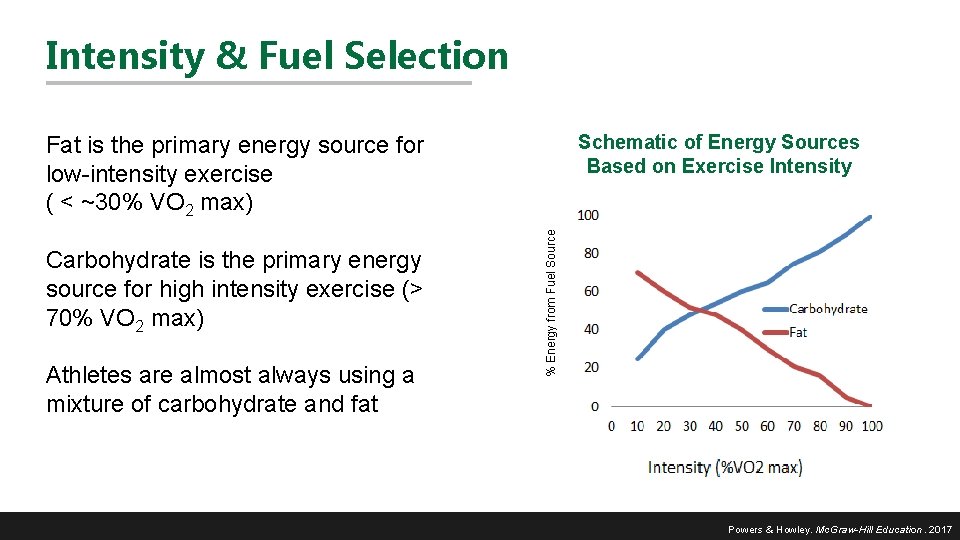
Intensity & Fuel Selection Schematic of Energy Sources Based on Exercise Intensity Carbohydrate is the primary energy source for high intensity exercise (> 70% VO 2 max) Athletes are almost always using a mixture of carbohydrate and fat % Energy from Fuel Source Fat is the primary energy source for low-intensity exercise ( < ~30% VO 2 max) Powers & Howley. Mc. Graw-Hill Education. 2017
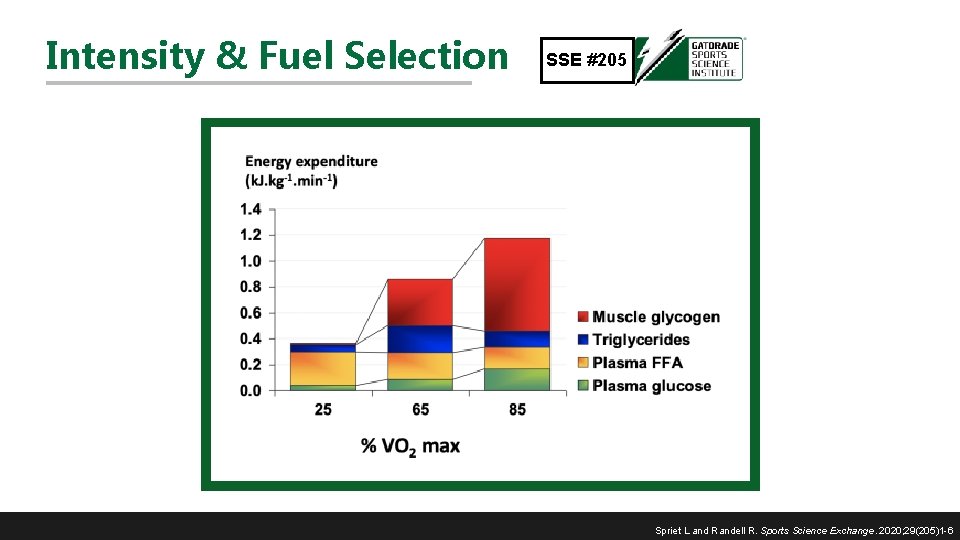
Intensity & Fuel Selection SSE #205 Spriet L and Randell R. Sports Science Exchange. 2020; 29(205)1 -6
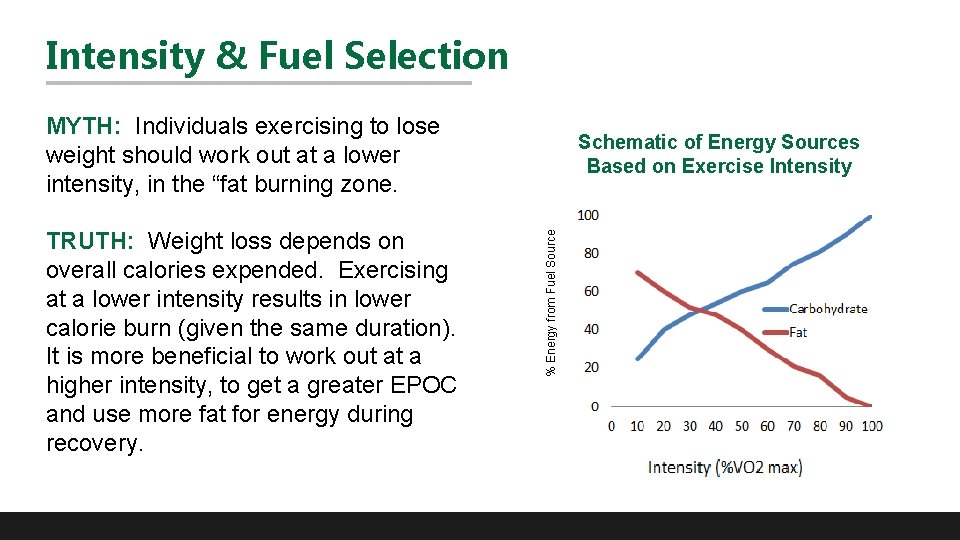
Intensity & Fuel Selection MYTH: Individuals exercising to lose weight should work out at a lower intensity, in the “fat burning zone. % Energy from Fuel Source TRUTH: Weight loss depends on overall calories expended. Exercising at a lower intensity results in lower calorie burn (given the same duration). It is more beneficial to work out at a higher intensity, to get a greater EPOC and use more fat for energy during recovery. Schematic of Energy Sources Based on Exercise Intensity
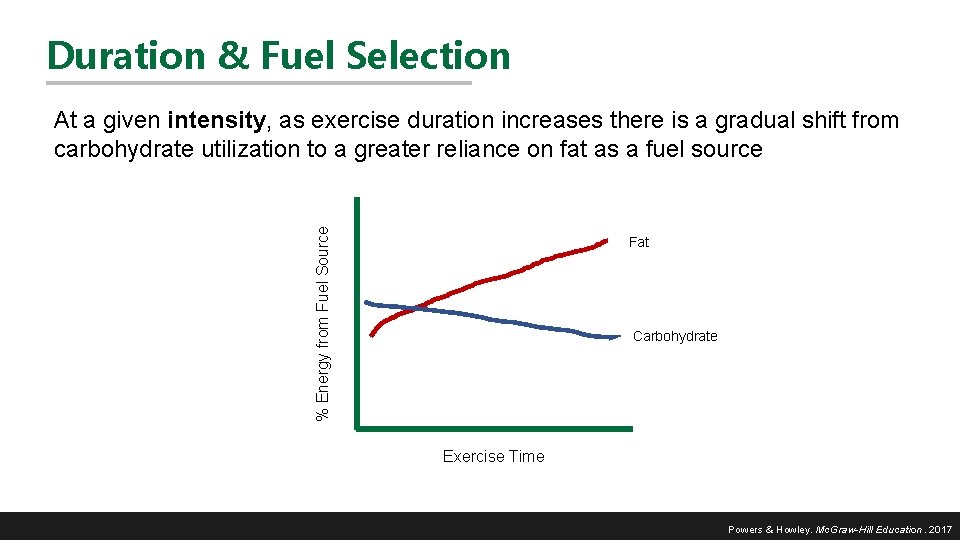
Duration & Fuel Selection % Energy from Fuel Source At a given intensity, as exercise duration increases there is a gradual shift from carbohydrate utilization to a greater reliance on fat as a fuel source Fat Carbohydrate Exercise Time Powers & Howley. Mc. Graw-Hill Education. 2017

TRAINING
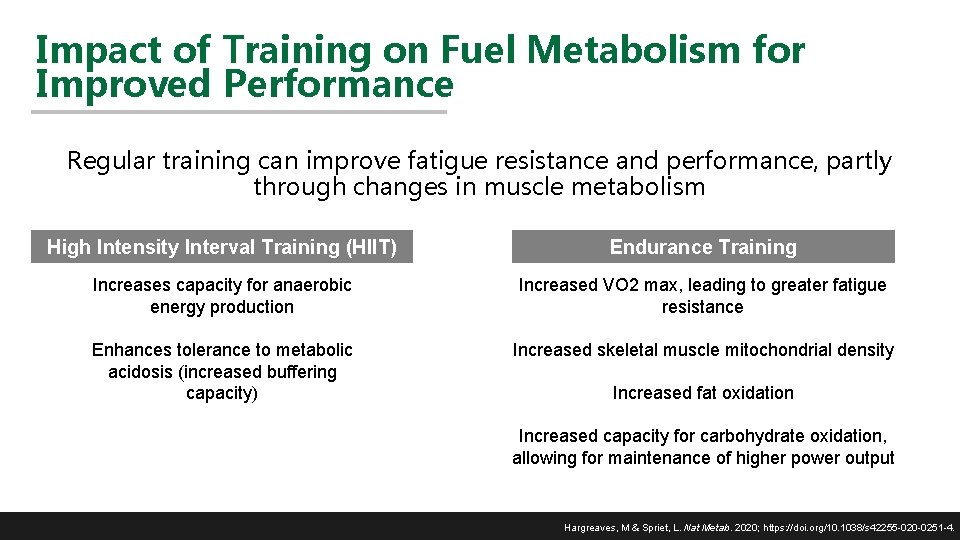
Impact of Training on Fuel Metabolism for Improved Performance Regular training can improve fatigue resistance and performance, partly through changes in muscle metabolism High Intensity Interval Training (HIIT) Endurance Training Increases capacity for anaerobic energy production Increased VO 2 max, leading to greater fatigue resistance Enhances tolerance to metabolic acidosis (increased buffering capacity) Increased skeletal muscle mitochondrial density Increased fat oxidation Increased capacity for carbohydrate oxidation, allowing for maintenance of higher power output Hargreaves, M & Spriet, L. Nat Metab. 2020; https: //doi. org/10. 1038/s 42255 -020 -0251 -4.

SUMMARY

Link to Summary Video
- Slides: 32