
Overview of Equitable Services Under ESSA Directors Institute
Overview of Equitable Services Under ESSA Directors Institute Federal Programs and Oversight Trudy Hughes, Regional Director of IDEA Oversight
Equitable Services Under ESSA Educational services and other benefits provided for private school students, families, teachers, and other educational personnel shall be equitable in comparison to services and other benefits for public school children, teachers, and other educational personnel participating in the program and shall be provided in a timely manner. 2
Equitable Services § Equitable services requirements for non-public/private schools apply to programs under § 1117 or § 8501: – – – Title I, Part A (Improving Basic Programs) Title I, Part C (Migrant Education) Title II, Part A (Supporting Effective Instruction)* Title III, Part A (English Language Acquisition) Title IV, Part A (Student Support & Academic Enrichment) Title IV, Part B (21 st CCLC) *largest number of participants statewide 3
Allocating Funds for Equitable Services Expenditures for equitable services to eligible private school students, families, teachers and other educational personnel must “be equal to the proportion of funds allocated to participating public school attendance areas” based on the number of students from low-income families who reside in those attendance areas and attend private schools. ESSA § 1117(a)(4)(A) 4
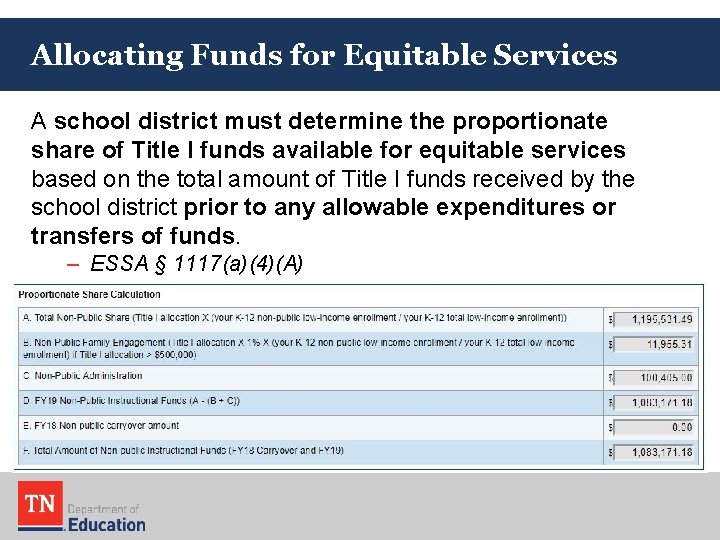
Allocating Funds for Equitable Services A school district must determine the proportionate share of Title I funds available for equitable services based on the total amount of Title I funds received by the school district prior to any allowable expenditures or transfers of funds. – ESSA § 1117(a)(4)(A)
Notice of Allocation by the Department The Tennessee Department of Education must provide notice in a timely manner of the allocation of funds for educational services and other benefits under each program that a school district has determined are available for eligible private school children, teachers and other educational personnel, and families. – ESSA §§ 1117(a)(4)(C) and 8501(a)(4)(C) 6
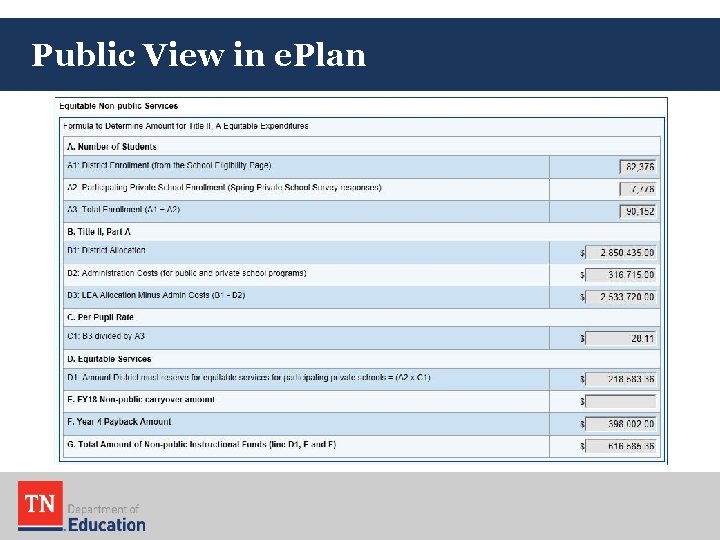
Public View in e. Plan
Obligation of Funds § Funds allocated to a school district for educational services and other benefits to eligible private school student, teachers, and other educational personnel, and families must be obligated in the fiscal year for which the funds are received by the school district. – ESSA §§ 1117(a)(4)(B) and 8501(a)(4)(B) – Extenuating circumstances: funds not obligated are available for equitable services in the subsequent school year. 8
Consultation Topics § The goal of consultation is to come to an agreement between the school district and appropriate private school officials on how to provide equitable and effective programs for eligible private school children. § The ongoing consultation process must discuss: – how the proportion of funds allocated under Title I for equitable services and/or how the amount of funds available for Titles II, III, and IV for equitable services are determined; – for Title I, the method or sources of data that the LEA will use to determine the number of private school children from lowincome families residing in participating public school attendance areas; 9
Consultation Topics – whether to coordinate funds available for Title I equitable services with funds available for equitable services required by Title VIII; – the size and scope of equitable services to be provided to eligible private school children, teachers, and other educational personnel and the amount of funds available for those services; – whether the LEA responsible for providing equitable services will provide the services directly, through a separate LEA, or through a third-party contractor; 10
Consultation Topics – whether to provide equitable services to eligible private school children by pooling funds or on a school-by-school basis; – how the students' needs will be identified; – what services will be provided, including how, when, where, and by whom; and – how decisions about the services will be made, how the services will be assessed, and how the results of the assessment will be used to improve those services. 11
Disagreement Over Use of Contractors § If the school district disagrees with the views of the private school officials on the provision of services through a contract, the school district must provide to the private school officials a written explanation of the reasons why the school district has chosen not to use a contractor. 12
Consultation Before the School District Makes Decisions § The consultation shall occur before the school district makes any decision that affects the opportunities of eligible private school children, teachers, and other educational personnel to participate in programs and shall continue throughout the implementation and assessment of activities under this section. 13
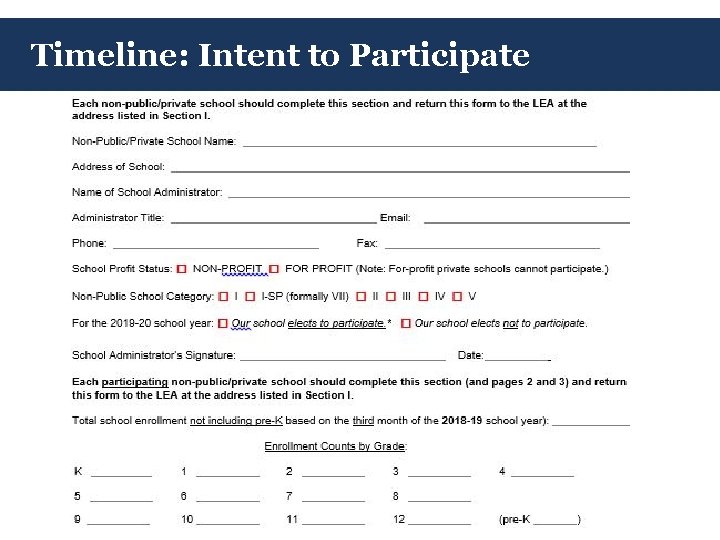
Timeline: Intent to Participate § Nov. of each year: – The LEA sends to non-public/private schools located in their geographic boundaries an Intent to Participate letter to request whether the schools would like to participate in ESSA programs. • LEAs should also send these letters to schools outside of their geographic boundaries if schools have had fund-generating students in the past or if the presence of enrolled students that reside in their boundaries is known. • If the LEA becomes aware of students that reside in their boundaries that have enrolled in a private school located in a different LEA, the LEA should send Intent to Participate forms at that time. 14
Timeline: Intent to Participate
Timeline: Intent to Participate § If there is no response from the non-public/private schools: – The LEA should make multiple attempts to communicate. – These attempts should include certified mail and may also include but are not limited to: regular mail, email, telephone calls, text messages, site visits, and facsimile. – The LEA shall document these attempts. 16
Timeline: Intent to Participate § Between Nov. and Jan. each year: – The LEA and non-public/private schools should identify consultation committee members. Consultation committee members should include appropriate representatives from the non-public/private schools and the LEA. 17
Timeline: Consultation § Jan. of each year: – The consultation committee members determine: • how poverty will be calculated pursuant to one of the allowable measures, • the criteria that will be used to determine which students receive services (using multiple, educationally related, objective criteria), • the pre-consultation documentation that will be requested. • non-public/private schools will draft a list of potential fundgenerating students. The list should contain addresses, grade levels, and income information. 18
Timeline: Non-public Survey § By Feb. 15 of each year: – the LEA utilizes information from the intent to participate form and other sources to complete their non-public survey to e. Plan. • • The survey will open February 1. The survey will import schools from the school directory. First submissions are due Feb. 15 (fiscal deadline). Districts will be able to make changes until the CFA opens (will have to be approved). • After the CFA opens, only the department can make changes. 19
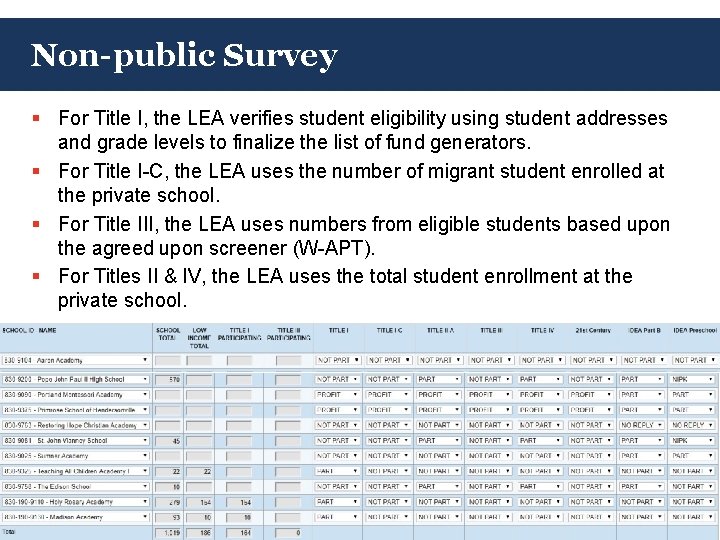
Non-public Survey § For Title I, the LEA verifies student eligibility using student addresses and grade levels to finalize the list of fund generators. § For Title I-C, the LEA uses the number of migrant student enrolled at the private school. § For Title III, the LEA uses numbers from eligible students based upon the agreed upon screener (W-APT). § For Titles II & IV, the LEA uses the total student enrollment at the private school.
Timeline: Consultation § By Feb. : – non-public/private schools complete any pre-consultation documentation that addresses what services are needed for eligible students, teachers, other educational personnel, and families in alignment with the criteria agreed upon by the consultation committee meeting in January. – pre-consultation documentation for Title I should include the agreed-upon multiple, educationally related, objective criteria, while the LEA may provide projected budget and funding requirements for addressing the needs of the students, teachers, educational personnel, and families. 21
Timeline: Consultation § By March of each year: – the LEA hosts consultation meetings with non-public/private school leaders to discuss services to eligible students, teachers, other educational personnel, and families for the following school year. – the consultation committee discusses all ESSA-required consultation issues including determining services to be provided, parental involvement and professional development plans, finalizing funding allocations, and scheduling mid-year check-ins/monitoring to ensure the agreement is effective and to address adjustments, if needed. 22
Timeline: Written Affirmation § By the end of April: – The LEA collects a signed affirmation from each participating non-public/private school attesting to the occurrence of the required timely and meaningful consultations. – The affirmation must have an option for non-public/private school officials to state that timely and meaningful consultation did not occur and/or that the services being provided are not equitable. – If the non-public/private school officials refuses to sign an affirmation, the LEA shall document the steps taken to provide the timely and meaningful consultation. 23
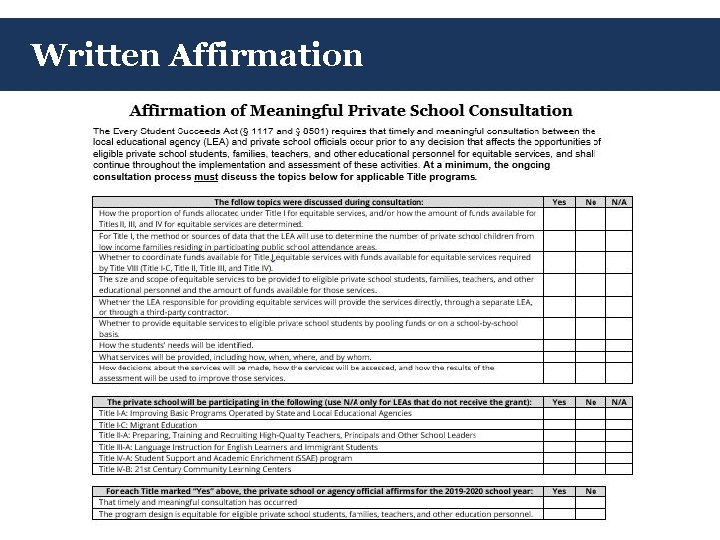
Written Affirmation
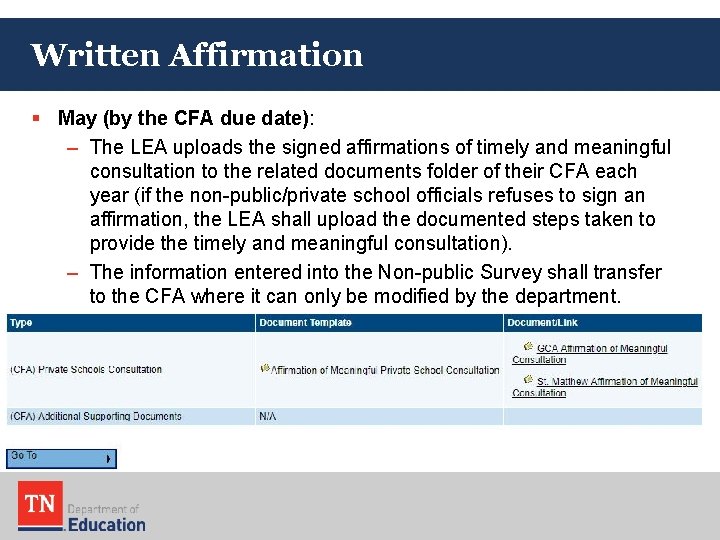
Written Affirmation § May (by the CFA due date): – The LEA uploads the signed affirmations of timely and meaningful consultation to the related documents folder of their CFA each year (if the non-public/private school officials refuses to sign an affirmation, the LEA shall upload the documented steps taken to provide the timely and meaningful consultation). – The information entered into the Non-public Survey shall transfer to the CFA where it can only be modified by the department.
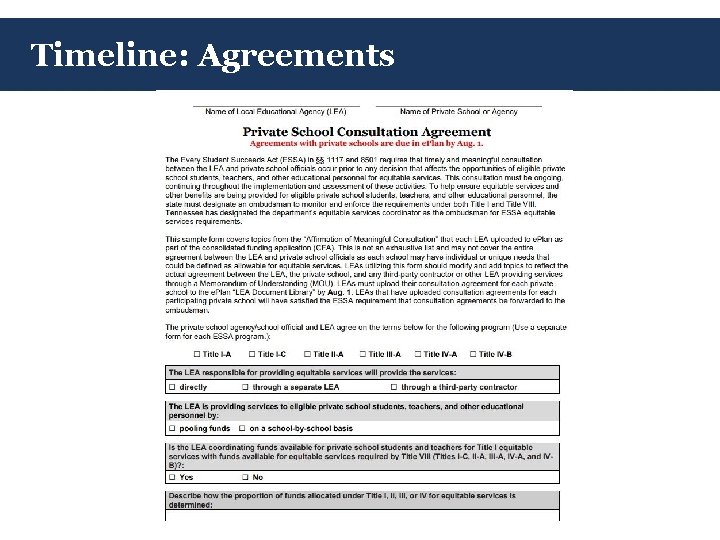
Timeline: Agreements § By Aug. 1: – The LEA shall finalize all ESSA equitable services agreements with the non-public/private school officials. – The agreements shall be signed by the LEA and the nonpublic/private school officials. Memorandums of Understanding (MOUs) or third party contracts being used by the LEA for equitable services shall be attached to the agreements. – The LEA uploads to the LEA Document Library in e. Plan the signed written agreement (including MOUs & third party contracts) for each non-public/private school participating in each ESSA program. 26
Timeline: Agreements
Timeline: Services § At the start of the school year: – LEA starts providing equitable services to participating nonpublic/private school students, teachers, other educational personnel, and families at the same time as services are provided to public school students. – Consultation between the LEA and the non-public/private school shall continue as an ongoing process throughout the implementation and assessment of the activities over the school year. As part of this process, the program shall be assessed for effectiveness using the agreed upon measures derived from consultation. 28
Ombudsman § To help ensure equitable services and other benefits for eligible private school children, teachers and other educational personnel, and families, the department must designate an ombudsman to monitor and enforce ESEA equitable services requirements under both Title I and Title VIII. – ESSA §§ 1117(a)(3)(B) and 8501(a)(3)(B) 29
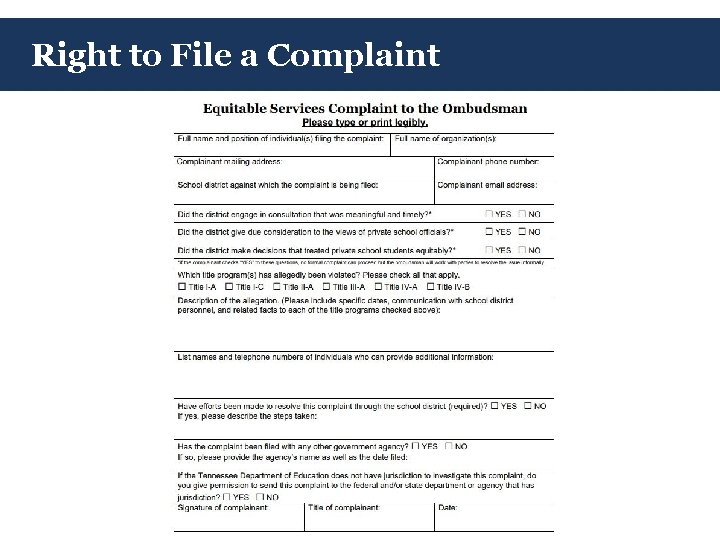
Right to File a Complaint § Non-public/private schools may file a complaint if they believe that: – timely and meaningful consultation did not occur; – the district did not give due consideration to the views of the non-public school officials; or – the funds generated or services to be provided are not equitable. 30
Right to File a Complaint
Right to File a Complaint § The sample complaint form is available in e. Plan under TDOE Resources as well as on the department’s website. § Private schools must send the complaint to the school district and the department. § The school district must upload to e. Plan all of their documents concerning the equitable services complaint. § The timeframe for the department’s response is 45 days. § The decision of the ombudsman is appealable to the Secretary of Education for the U. S. Department of Education. 32
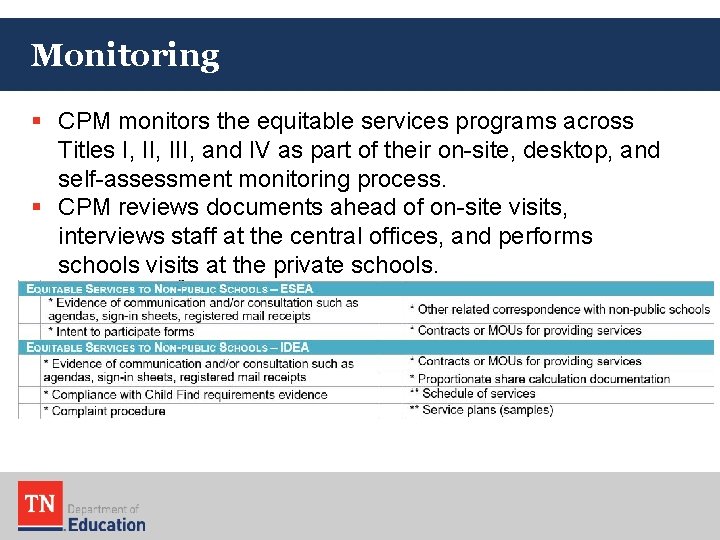
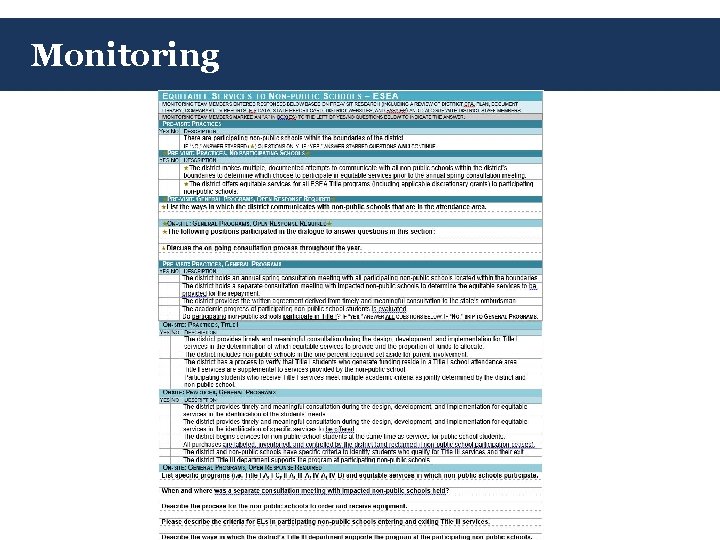
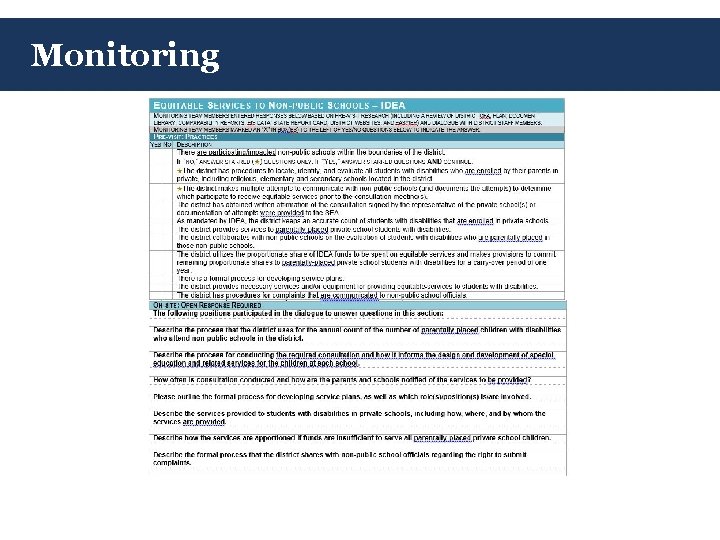
Monitoring § CPM monitors the equitable services programs across Titles I, III, and IV as part of their on-site, desktop, and self-assessment monitoring process. § CPM reviews documents ahead of on-site visits, interviews staff at the central offices, and performs schools visits at the private schools.
Monitoring
Monitoring
Compliance – State Services § The department will provide equitable services directly or through contracts with public or private agencies, organizations, or institutions, if appropriate private school officials have: – requested that the department provide such services directly; and – demonstrated that the LEA has not met applicable equitable services requirements as prescribed by the department. 36
School District Fiscal Repercussions § Districts are responsible for all students. – In instances where the state must intervene to ensure that eligible students in participating non-public schools are receiving appropriate services, the state will incorporate fiscal repercussions for districts through its policies and procedures. – Penalty may include the state withholding a percentage of the district’s administrative dollars for these services. 37
Resources § U. S. Department of Education Non-Regulatory Guidance and Resources: – ESEA Ensuring Equitable Services Title I Toolkit – ESSA Non-Regulatory Guidance: Fiscal Changes & Equitable Services – ESEA Non-Regulatory Guidance: Title I - Equitable Services for Eligible Private School Students – ESEA Non-Regulatory Guidance: Title IX (ESSA Title VIII) - Equitable Services for Eligible Private School Students/Teachers – ESSA Non-Regulatory Guidance: Title II, Part A - Building Systems of Support for Excellent Teaching and Leading – ESSA Non-Regulatory Guidance: Title III – English Learners – ESSA Non-Regulatory Guidance: Title IV, Part A – Student Support and Academic Enrichment Program 38
Resources § Tennessee Department of Education Sample Forms: – – Intent to Participate Form (2019 -20) Private School Consultation Packet Sample Private School Consultation Agreement Sample Equitable Services Complaint to the Ombudsman 39

Districts and schools in Tennessee will exemplify excellence and equity such that all students are equipped with the knowledge and skills to successfully embark on their chosen path in life. Excellence | Optimism | Judgment | Courage | Teamwork
FRAUD, WASTE, or ABUSE Citizens and agencies are encouraged to report fraud, waste, or abuse in State and Local government. NOTICE: This agency is a recipient of taxpayer funding. If you observe an agency director or employee engaging in any activity which you consider to be illegal, improper or wasteful, please call the state Comptroller’s toll-free Hotline: 1 -800 -232 -5454 Notifications can also be submitted electronically at: http: //www. comptroller. tn. gov/hotline 41
- Slides: 41