
Overview of Environmental Scan Findings Environmental Scan Year


- Slides: 26
Overview of Environmental Scan Findings
Environmental Scan – Year 1 • Quantitative and qualitative research methods: Surveys, Interviews, Focus Groups, Participant Observations, Document Reviews • Participants: Residents, Family members, Physicians, PSWs, RNs, RPNs, Spiritual Care, Social Work, Recreation, Dietary, Housekeeping, Maintenance, Administration, Volunteers and Community Partners
Participants and Data Collection • Surveys • All LTC home staff completed surveys – Sample sizes across 4 homes are approximately: • • • 205 PSWs 69 Licensed Nurses 79 Support Staff 32 Administration 39 Residents 64 Family Members
Summary of Survey Results that All Staff Completed
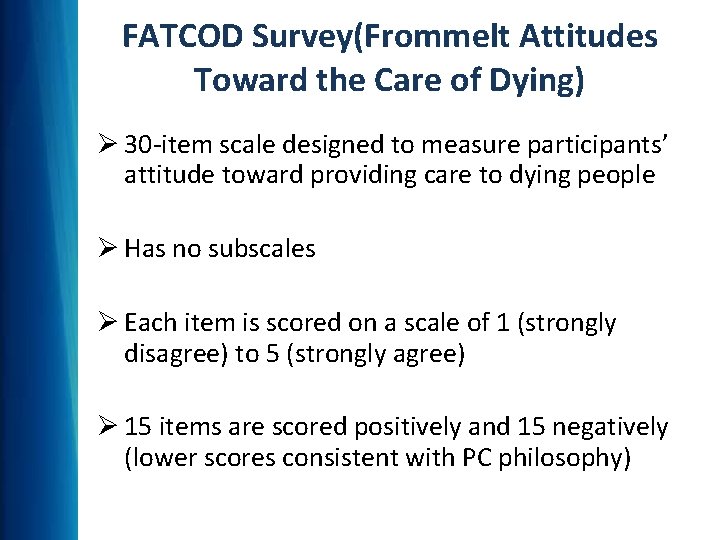
FATCOD Survey(Frommelt Attitudes Toward the Care of Dying) Ø 30 -item scale designed to measure participants’ attitude toward providing care to dying people Ø Has no subscales Ø Each item is scored on a scale of 1 (strongly disagree) to 5 (strongly agree) Ø 15 items are scored positively and 15 negatively (lower scores consistent with PC philosophy)
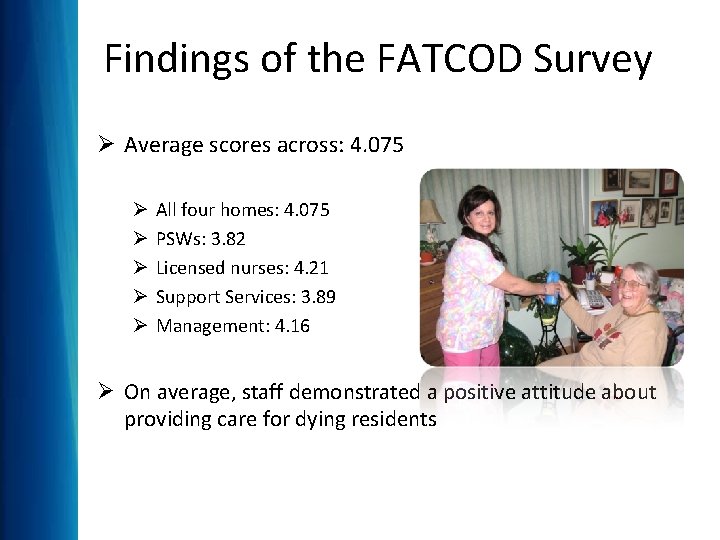
Findings of the FATCOD Survey Ø Average scores across: 4. 075 Ø Ø Ø All four homes: 4. 075 PSWs: 3. 82 Licensed nurses: 4. 21 Support Services: 3. 89 Management: 4. 16 Ø On average, staff demonstrated a positive attitude about providing care for dying residents
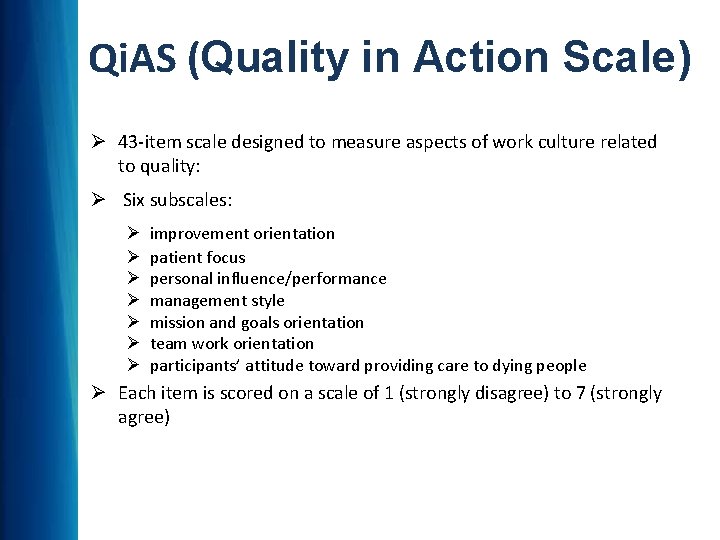
Qi. AS (Quality in Action Scale) Ø 43 -item scale designed to measure aspects of work culture related to quality: Ø Six subscales: Ø Ø Ø Ø improvement orientation patient focus personal influence/performance management style mission and goals orientation team work orientation participants’ attitude toward providing care to dying people Ø Each item is scored on a scale of 1 (strongly disagree) to 7 (strongly agree)
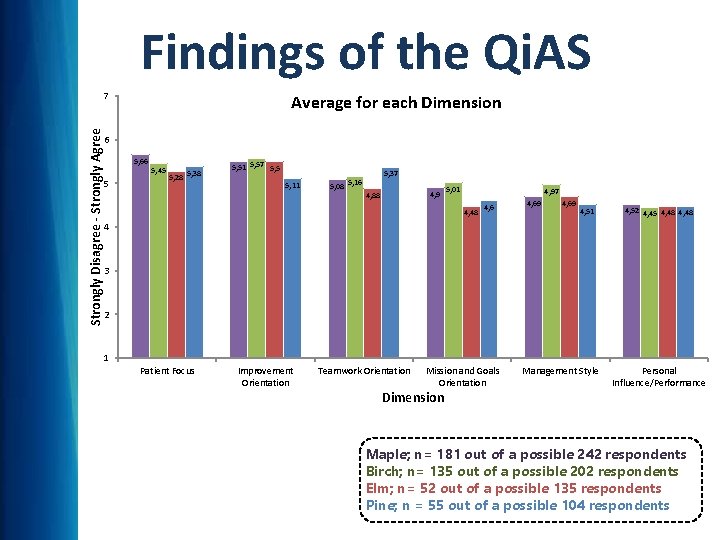
Findings of the Qi. AS Strongly Disagree - Strongly Agree 7 Average for each Dimension 6 5, 66 5 5, 45 5, 28 5, 38 5, 51 5, 57 5, 5 5, 11 5, 08 5, 16 5, 37 4, 9 4, 88 5, 01 4, 97 4, 48 4, 69 4, 51 4, 52 4, 45 4, 48 4 3 2 1 Patient Focus Improvement Orientation Teamwork Orientation Mission and Goals Orientation Dimension Management Style Personal Influence/Performance Maple; n= 181 out of a possible 242 respondents Birch; n= 135 out of a possible 202 respondents Elm; n= 52 out of a possible 135 respondents Pine; n = 55 out of a possible 104 respondents
Summary of PSW Survey Results
Psychological Empowerment in the Workplace (PEi. W) Survey Ø PEi. W is a 12 -item scale that measures direct care workers’ sense of personal empowerment within their workplace Ø Each item is scored on a scale of 1 (strongly disagree) to 7 (strongly agree) Ø Four dimensions are measured: Ø Ø meaning competency self-determination impact
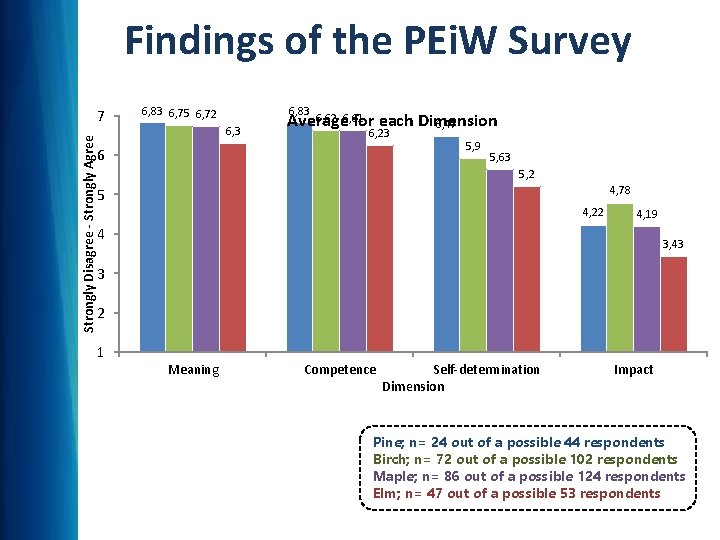
Findings of the PEi. W Survey Strongly Disagree - Strongly Agree 7 6, 83 6, 75 6, 72 6, 83 6, 62 6, 61 Average for each Dimension 6, 47 6, 23 6 5, 9 5, 63 5, 2 4, 78 5 4, 22 4, 19 4 3, 43 3 2 1 Meaning Competence Self-determination Dimension Impact Pine; n= 24 out of a possible 44 respondents Birch; n= 72 out of a possible 102 respondents Maple; n= 86 out of a possible 124 respondents Elm; n= 47 out of a possible 53 respondents
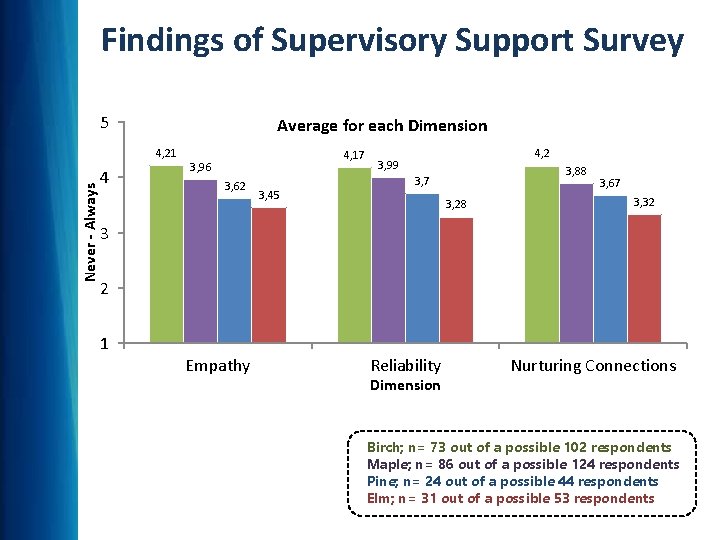
Supervisory Support Survey Ø SSS is a 15 -item scale that assesses aspects of supervisory support Ø Each item is scored on a scale of 1 (never) to 5 (always) Ø Three dimensions are measured: Øempathy Øreliability Ønurturing connections
Findings of Supervisory Support Survey 5 Average for each Dimension Never - Always 4, 21 4 4, 17 3, 96 3, 62 3, 45 4, 2 3, 99 3, 88 3, 7 3, 28 3, 67 3, 32 3 2 1 Empathy Reliability Dimension Nurturing Connections Birch; n= 73 out of a possible 102 respondents Maple; n= 86 out of a possible 124 respondents Pine; n= 24 out of a possible 44 respondents Elm; n= 31 out of a possible 53 respondents
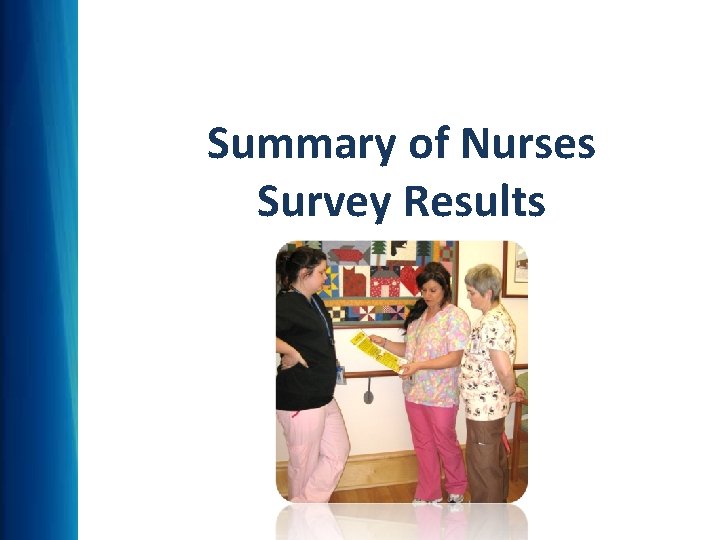
Summary of Nurses Survey Results
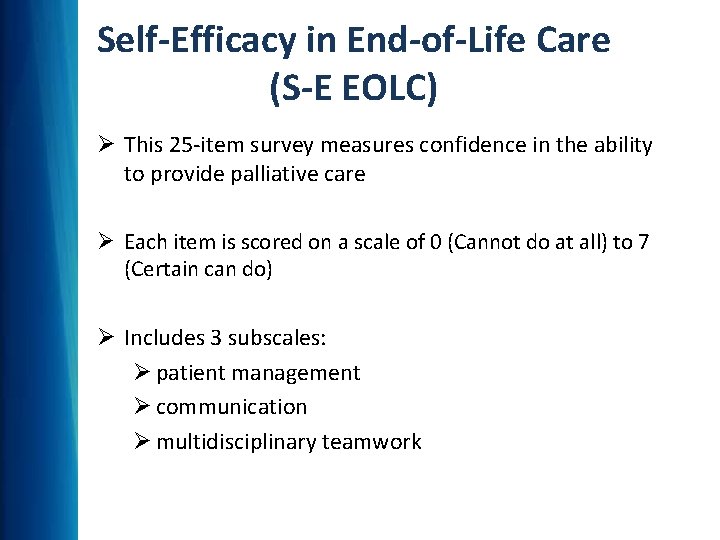
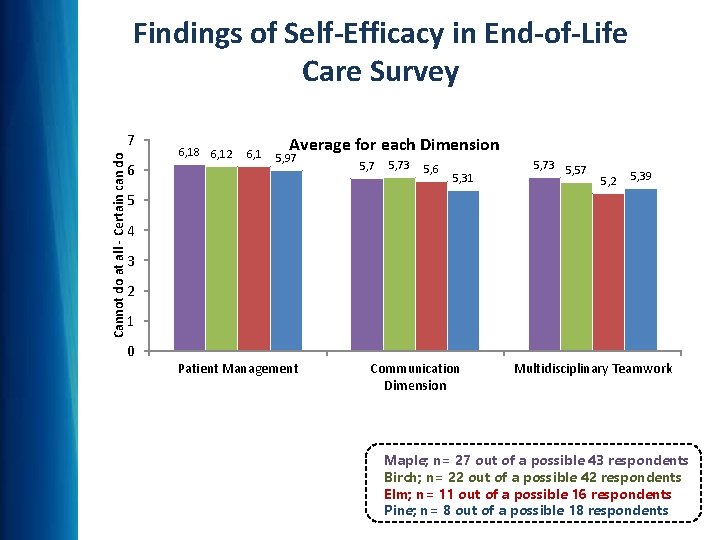
Self-Efficacy in End-of-Life Care (S-E EOLC) Ø This 25 -item survey measures confidence in the ability to provide palliative care Ø Each item is scored on a scale of 0 (Cannot do at all) to 7 (Certain can do) Ø Includes 3 subscales: Ø patient management Ø communication Ø multidisciplinary teamwork
Findings of Self-Efficacy in End-of-Life Care Survey Cannot do at all - Certain can do 7 6 6, 18 6, 12 6, 1 Average for each Dimension 5, 97 5, 73 5, 6 5, 31 5, 73 5, 57 5, 2 5, 39 5 4 3 2 1 0 Patient Management Communication Dimension Multidisciplinary Teamwork Maple; n= 27 out of a possible 43 respondents Birch; n= 22 out of a possible 42 respondents Elm; n= 11 out of a possible 16 respondents Pine; n= 8 out of a possible 18 respondents
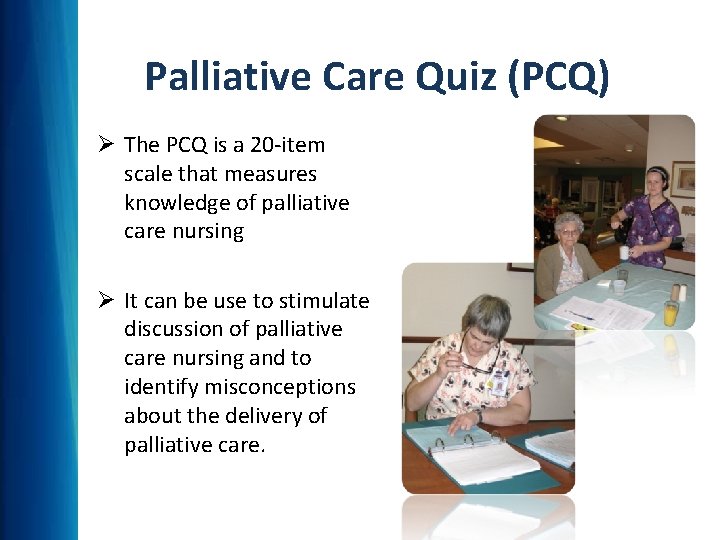
Palliative Care Quiz (PCQ) Ø The PCQ is a 20 -item scale that measures knowledge of palliative care nursing Ø It can be use to stimulate discussion of palliative care nursing and to identify misconceptions about the delivery of palliative care.
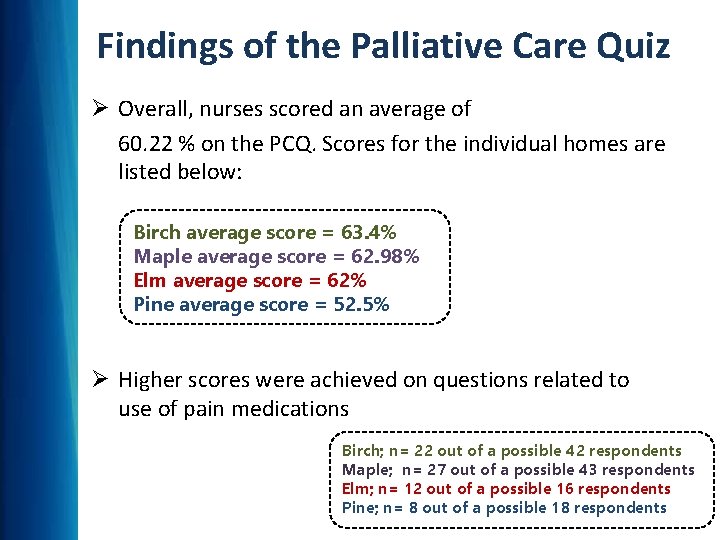
Findings of the Palliative Care Quiz Ø Overall, nurses scored an average of 60. 22 % on the PCQ. Scores for the individual homes are listed below: Birch average score = 63. 4% Maple average score = 62. 98% Elm average score = 62% Pine average score = 52. 5% Ø Higher scores were achieved on questions related to use of pain medications Birch; n= 22 out of a possible 42 respondents Maple; n= 27 out of a possible 43 respondents Elm; n= 12 out of a possible 16 respondents Pine; n= 8 out of a possible 18 respondents
Family and Resident Results
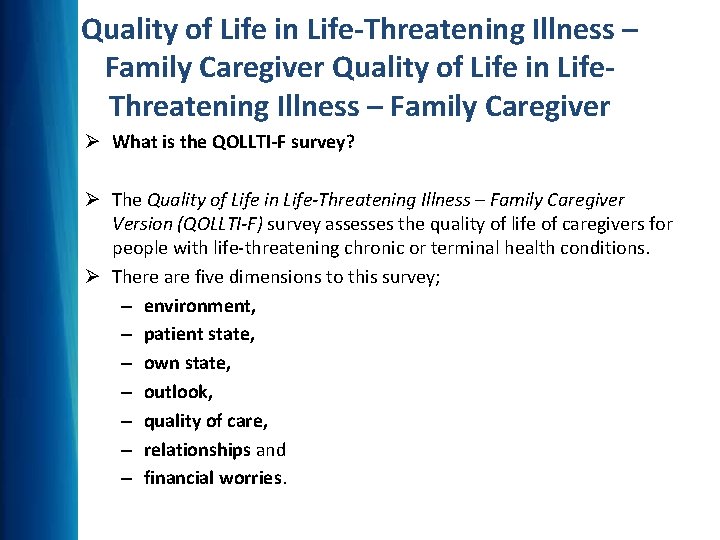
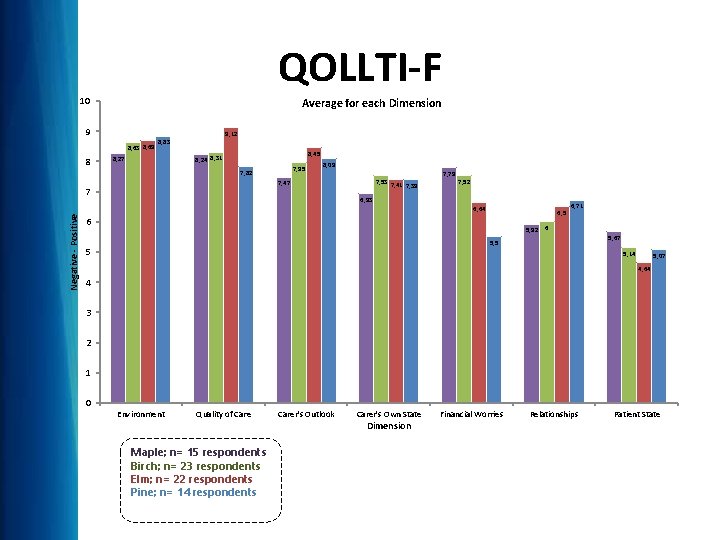
Quality of Life in Life-Threatening Illness – Family Caregiver Quality of Life in Life. Threatening Illness – Family Caregiver Ø What is the QOLLTI-F survey? Ø The Quality of Life in Life-Threatening Illness – Family Caregiver Version (QOLLTI-F) survey assesses the quality of life of caregivers for people with life-threatening chronic or terminal health conditions. Ø There are five dimensions to this survey; – environment, – patient state, – own state, – outlook, – quality of care, – relationships and – financial worries.
QOLLTI-F 10 Average for each Dimension 9 9, 12 8, 63 8, 69 8 8, 83 8, 45 8, 24 8, 31 8, 27 7, 95 7, 82 8, 09 7, 53 7, 47 7 7, 79 7, 41 7, 39 7, 52 6, 93 Negative - Positive 6, 64 6, 5 6 6, 71 5, 92 6 5, 5 5 5, 67 5, 14 5, 07 4, 64 4 3 2 1 0 Environment Quality of Care Maple; n= 15 respondents Birch; n= 23 respondents Elm; n= 22 respondents Pine; n= 14 respondents Carer's Outlook Carer's Own State Dimension Financial Worries Relationships Patient State
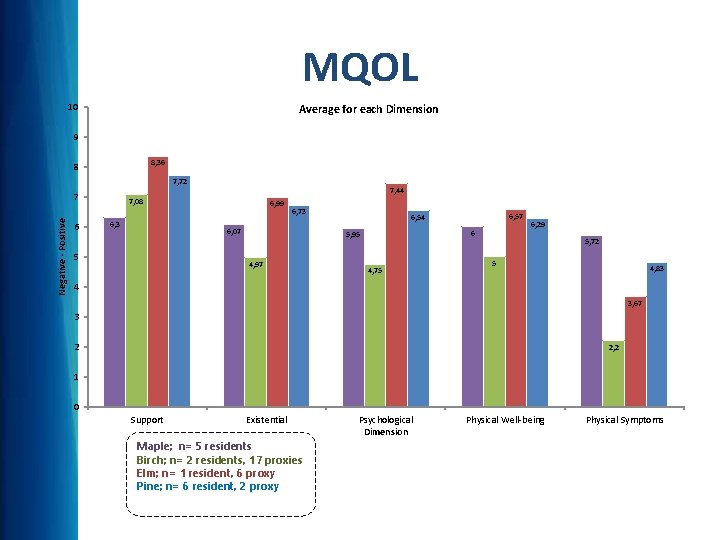
Mc. Gill Quality of life Survey Ø What is the MQo. L survey? Ø The Mc. Gill Quality of Life Questionnaire (MQo. L) was developed to measure five dimensions of quality of life which are: physical symptoms, physical well-being, psychological, existential and support. Ø What is quality of life? Ø Quality of life is defined as an individual’s subjective well -being.
MQOL 10 Average for each Dimension 9 8, 36 8 7, 72 Negative - Positive 7 6 7, 44 7, 08 6, 3 6, 99 6, 73 6, 07 5 6 5, 95 4, 97 6, 54 4, 75 6, 29 5, 72 5 4, 83 4 3, 67 3 2 2, 2 1 0 Support Existential Maple; n= 5 residents Birch; n= 2 residents, 17 proxies Elm; n= 1 resident, 6 proxy Pine; n= 6 resident, 2 proxy Psychological Dimension Physical Well-being Physical Symptoms
Group Discussion What surprised you most/least about the results of the environmental scan? What practices and strategies are you aware of that have been effective in providing palliative care in long-term care homes?
Acknowledgement Funding Provided By: Social Sciences and Humanities Council of Canada Thank you to our partners:
Contact Us Visit our website: www. palliativealliance. ca Email us: palliativealliance@lakeheadu. ca Call us: 807 -766 -7228 Thank You