
Overview of Energy Flow Accounts System of EnvironmentalEconomic
- Slides: 45
Overview of Energy Flow Accounts System of Environmental-Economic Accounting Central Framework (SEEA-CF) http: //www. unescap. org/our-work/statistics
Outline • Level 1: What are energy flow accounts? (30 min) • Links to other SEEA accounts • Links to SDGs • Group exercise (30 min) • Intermezzo: Linking energy balances and energy accounts (15 min) • Level 2: Issues, data sources, country examples (20 min) • Questions and discussion (10 min) 2 SEEA-CF - Energy Flow Accounts http: //www. unescap. org/our-work/statistics
Learning objectives • Know what Energy Flow Accounts are and why they are important • Understand the basic concepts and how they are treated in the SEEA • Learn to compile Energy Flow Accounts • Understand how Energy Flow Accounts are linked with Energy Balances and be aware of main differences • Be aware of data sources, country examples and measurement challenges 3 SEEA-CF - Energy Flow Accounts http: //www. unescap. org/our-work/statistics
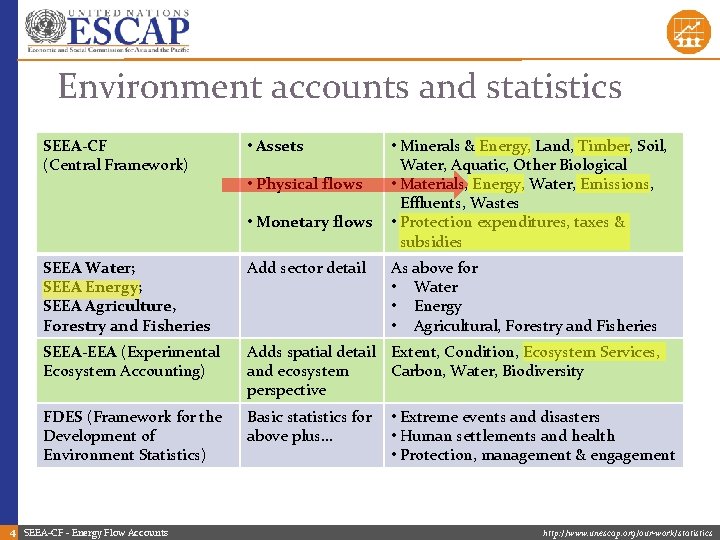
Environment accounts and statistics SEEA-CF (Central Framework) • Assets • Physical flows • Monetary flows • Minerals & Energy, Land, Timber, Soil, Water, Aquatic, Other Biological • Materials, Energy, Water, Emissions, Effluents, Wastes • Protection expenditures, taxes & subsidies SEEA Water; SEEA Energy; SEEA Agriculture, Forestry and Fisheries Add sector detail As above for • Water • Energy • Agricultural, Forestry and Fisheries SEEA-EEA (Experimental Ecosystem Accounting) Adds spatial detail and ecosystem perspective Extent, Condition, Ecosystem Services, Carbon, Water, Biodiversity FDES (Framework for the Development of Environment Statistics) Basic statistics for above plus… • Extreme events and disasters • Human settlements and health • Protection, management & engagement 4 SEEA-CF - Energy Flow Accounts http: //www. unescap. org/our-work/statistics
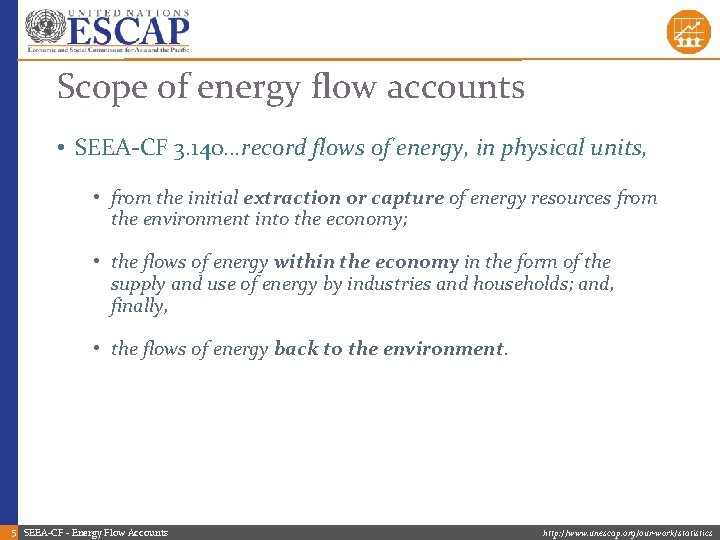
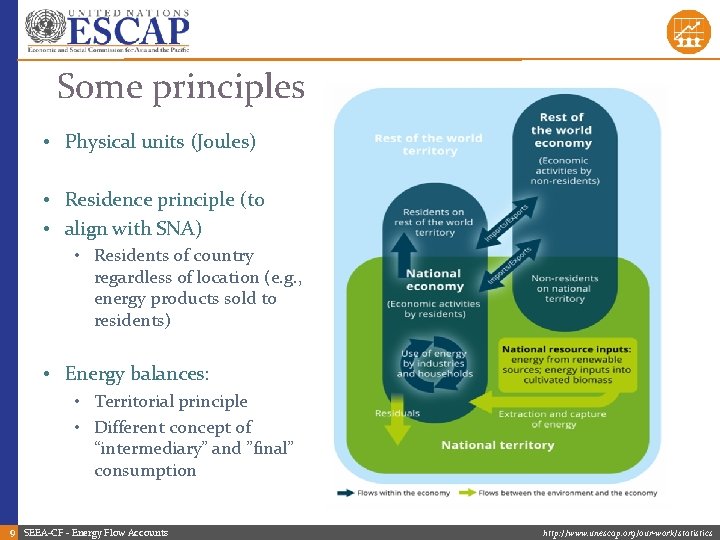
Scope of energy flow accounts • SEEA-CF 3. 140…record flows of energy, in physical units, • from the initial extraction or capture of energy resources from the environment into the economy; • the flows of energy within the economy in the form of the supply and use of energy by industries and households; and, finally, • the flows of energy back to the environment. 5 SEEA-CF - Energy Flow Accounts http: //www. unescap. org/our-work/statistics
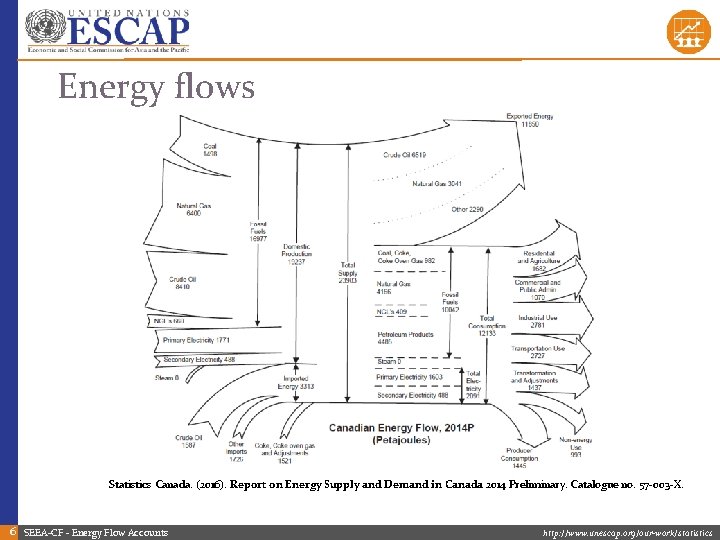
Energy flows Statistics Canada. (2016). Report on Energy Supply and Demand in Canada 2014 Preliminary. Catalogue no. 57 -003 -X. 6 SEEA-CF - Energy Flow Accounts http: //www. unescap. org/our-work/statistics
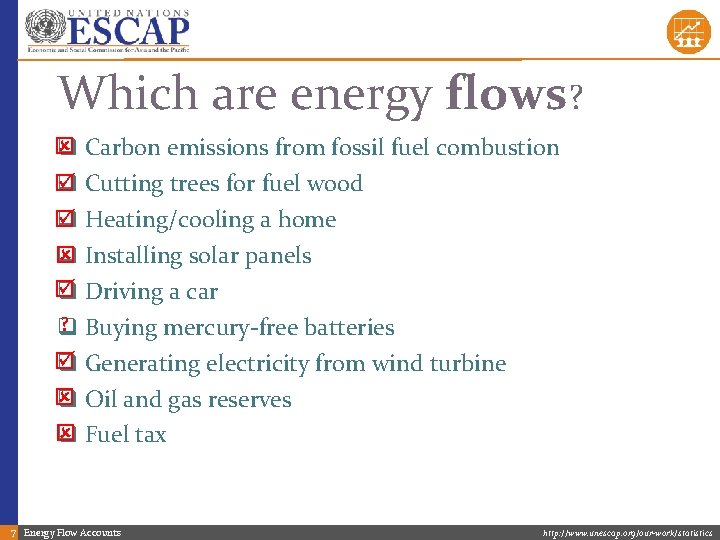
Which are energy flows? q Carbon emissions from fossil fuel combustion q Cutting trees for fuel wood q Heating/cooling a home q Installing solar panels q Driving a car ? Buying mercury-free batteries q q Generating electricity from wind turbine q Oil and gas reserves q Fuel tax 7 Energy Flow Accounts http: //www. unescap. org/our-work/statistics
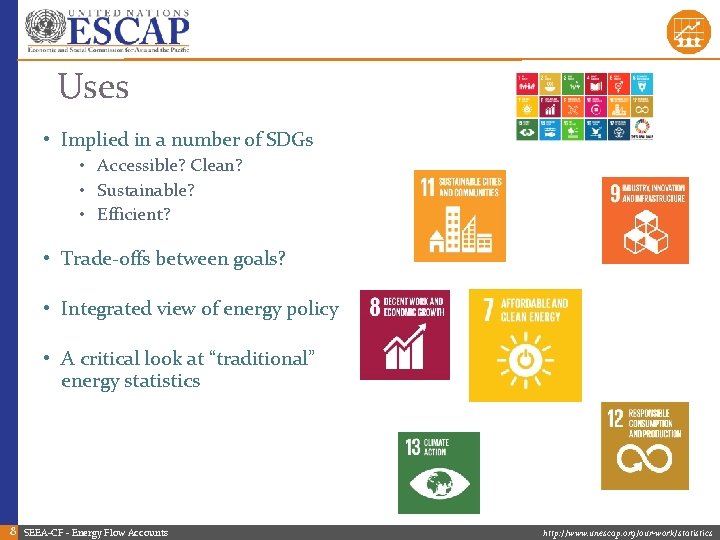
Uses • Implied in a number of SDGs • Accessible? Clean? • Sustainable? • Efficient? • Trade-offs between goals? • Integrated view of energy policy • A critical look at “traditional” energy statistics 8 SEEA-CF - Energy Flow Accounts http: //www. unescap. org/our-work/statistics
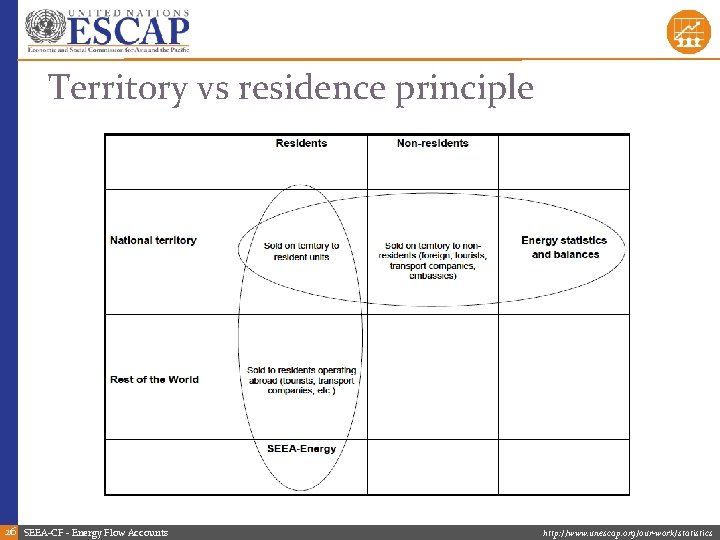
Some principles • Physical units (Joules) • Residence principle (to • align with SNA) • Residents of country regardless of location (e. g. , energy products sold to residents) • Energy balances: • Territorial principle • Different concept of “intermediary” and ”final” consumption 9 SEEA-CF - Energy Flow Accounts http: //www. unescap. org/our-work/statistics
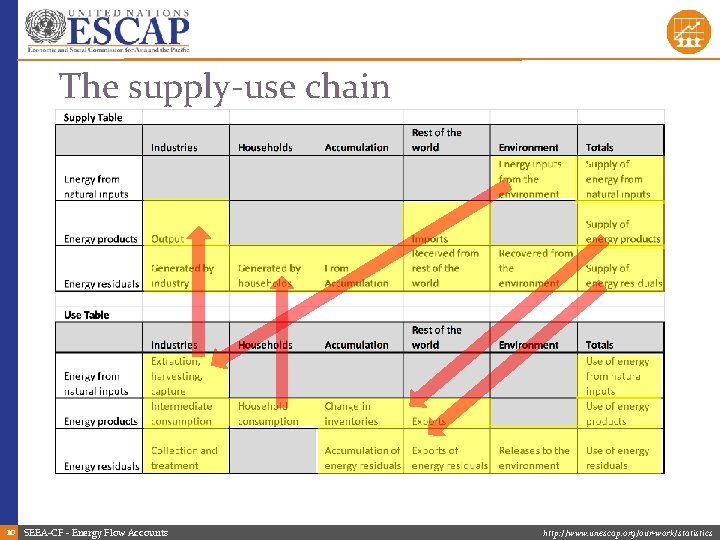
The supply-use chain 10 SEEA-CF - Energy Flow Accounts http: //www. unescap. org/our-work/statistics
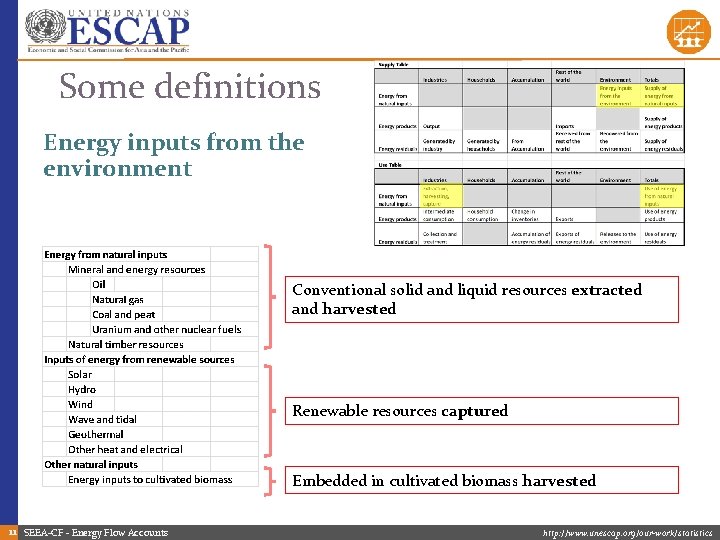
Some definitions Energy inputs from the environment Conventional solid and liquid resources extracted and harvested Renewable resources captured Embedded in cultivated biomass harvested 11 SEEA-CF - Energy Flow Accounts http: //www. unescap. org/our-work/statistics
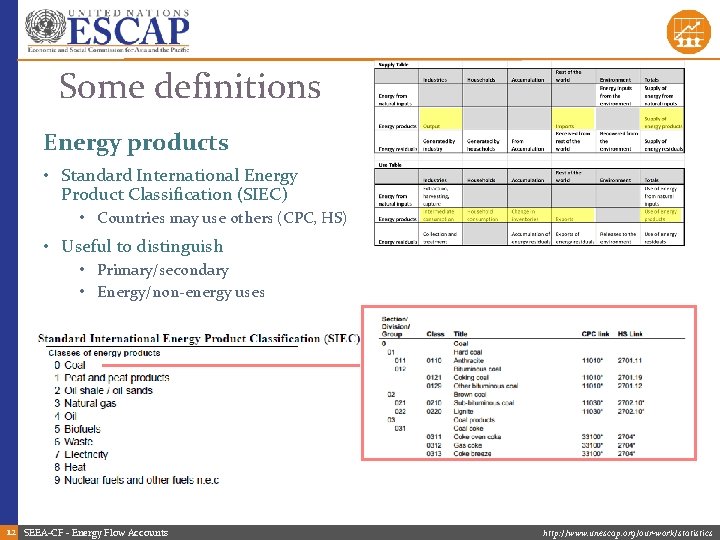
Some definitions Energy products • Standard International Energy Product Classification (SIEC) • Countries may use others (CPC, HS) • Useful to distinguish • Primary/secondary • Energy/non-energy uses 12 SEEA-CF - Energy Flow Accounts http: //www. unescap. org/our-work/statistics
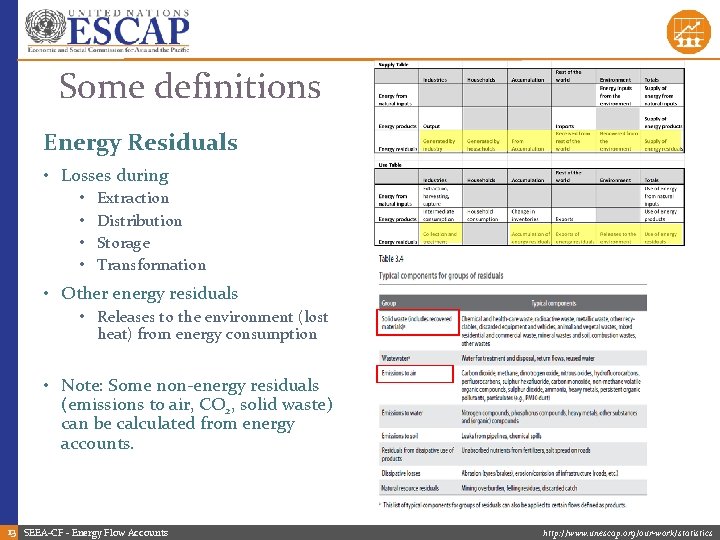
Some definitions Energy Residuals • Losses during • • Extraction Distribution Storage Transformation • Other energy residuals • Releases to the environment (lost heat) from energy consumption • Note: Some non-energy residuals (emissions to air, CO 2, solid waste) can be calculated from energy accounts. 13 SEEA-CF - Energy Flow Accounts http: //www. unescap. org/our-work/statistics
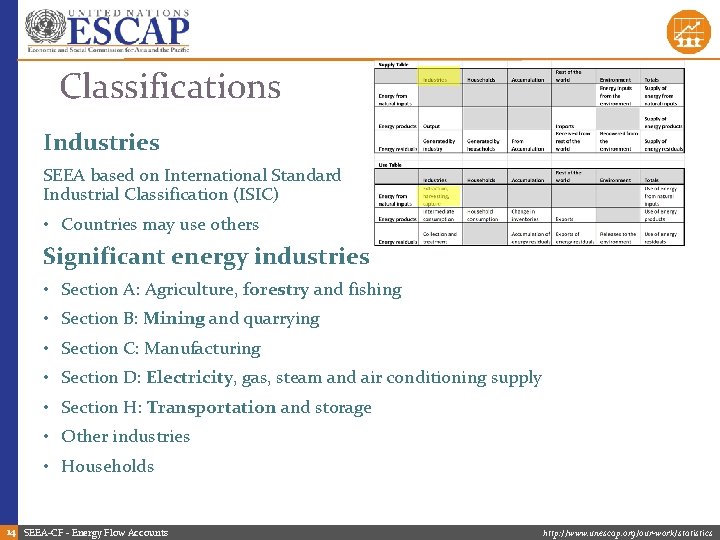
Classifications Industries SEEA based on International Standard Industrial Classification (ISIC) • Countries may use others Significant energy industries • Section A: Agriculture, forestry and fishing • Section B: Mining and quarrying • Section C: Manufacturing • Section D: Electricity, gas, steam and air conditioning supply • Section H: Transportation and storage • Other industries • Households 14 SEEA-CF - Energy Flow Accounts http: //www. unescap. org/our-work/statistics
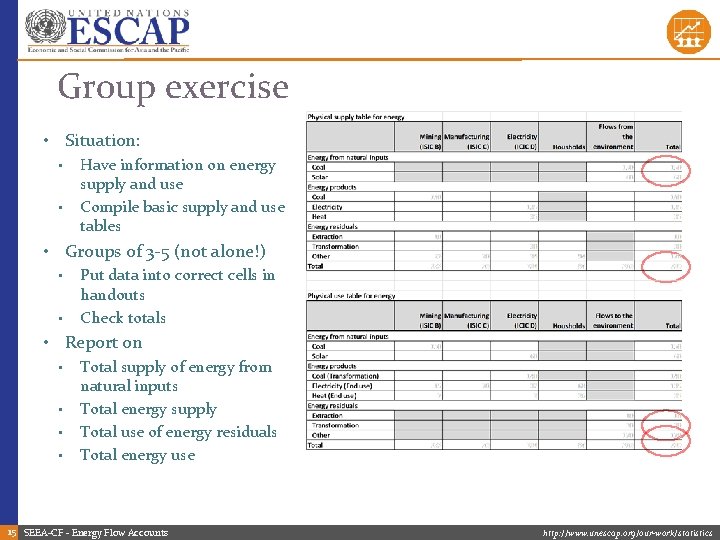
Group exercise • Situation: • • Have information on energy supply and use Compile basic supply and use tables • Groups of 3 -5 (not alone!) • • Put data into correct cells in handouts Check totals • Report on • • Total supply of energy from natural inputs Total energy supply Total use of energy residuals Total energy use 15 SEEA-CF - Energy Flow Accounts http: //www. unescap. org/our-work/statistics
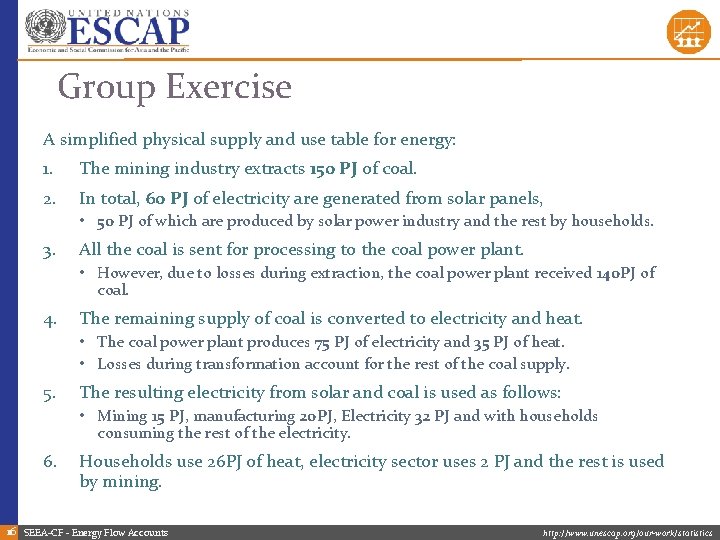
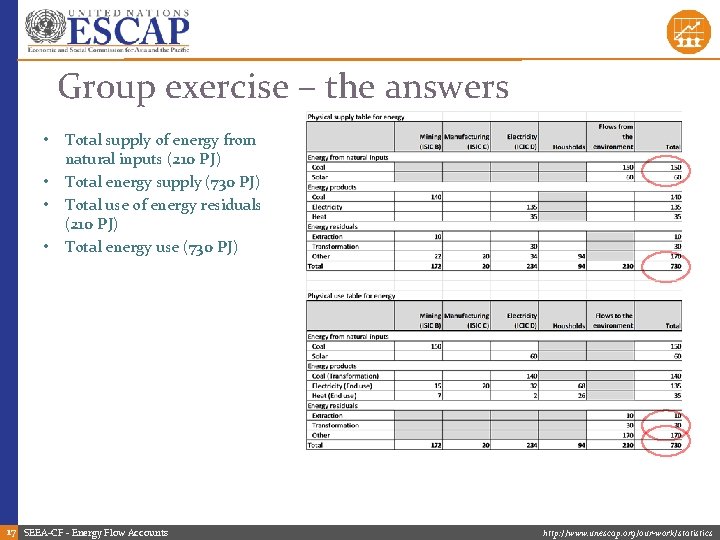
Group Exercise A simplified physical supply and use table for energy: 1. The mining industry extracts 150 PJ of coal. 2. In total, 60 PJ of electricity are generated from solar panels, • 50 PJ of which are produced by solar power industry and the rest by households. 3. All the coal is sent for processing to the coal power plant. • However, due to losses during extraction, the coal power plant received 140 PJ of coal. 4. The remaining supply of coal is converted to electricity and heat. • The coal power plant produces 75 PJ of electricity and 35 PJ of heat. • Losses during transformation account for the rest of the coal supply. 5. The resulting electricity from solar and coal is used as follows: • Mining 15 PJ, manufacturing 20 PJ, Electricity 32 PJ and with households consuming the rest of the electricity. 6. Households use 26 PJ of heat, electricity sector uses 2 PJ and the rest is used by mining. 16 SEEA-CF - Energy Flow Accounts http: //www. unescap. org/our-work/statistics
Group exercise – the answers • • Total supply of energy from natural inputs (210 PJ) Total energy supply (730 PJ) Total use of energy residuals (210 PJ) Total energy use (730 PJ) 17 SEEA-CF - Energy Flow Accounts http: //www. unescap. org/our-work/statistics
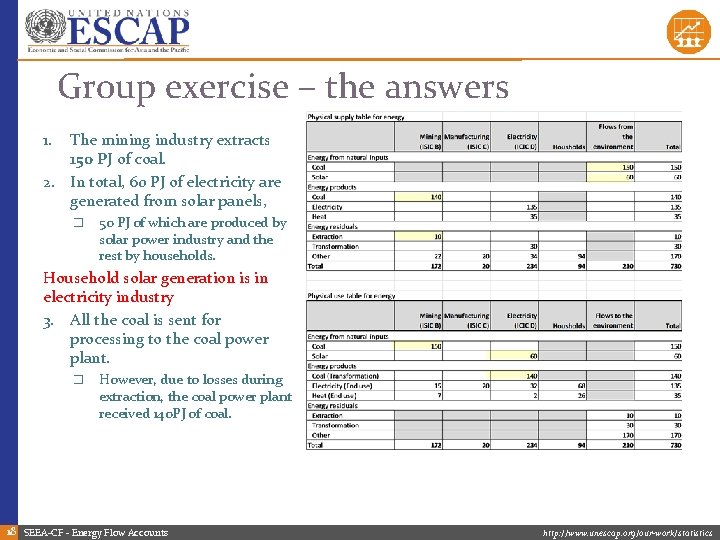
Group exercise – the answers The mining industry extracts 150 PJ of coal. 2. In total, 60 PJ of electricity are generated from solar panels, 1. � 50 PJ of which are produced by solar power industry and the rest by households. Household solar generation is in electricity industry 3. All the coal is sent for processing to the coal power plant. � However, due to losses during extraction, the coal power plant received 140 PJ of coal. 18 SEEA-CF - Energy Flow Accounts http: //www. unescap. org/our-work/statistics
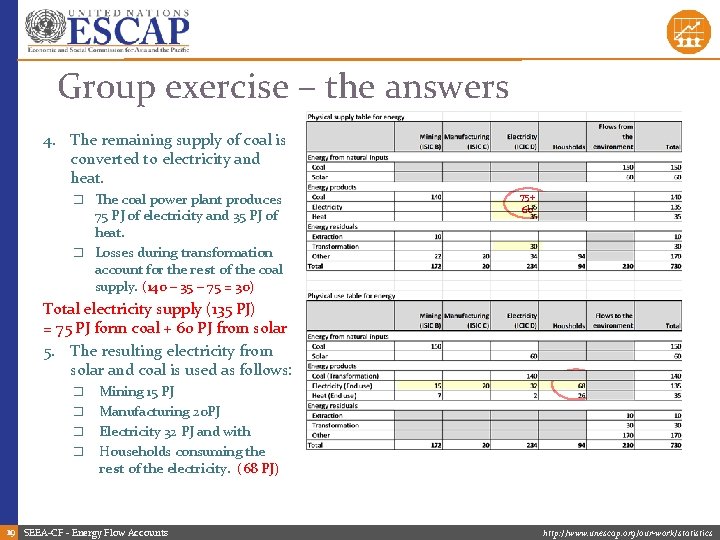
Group exercise – the answers 4. The remaining supply of coal is converted to electricity and heat. � The coal power plant produces 75 PJ of electricity and 35 PJ of heat. � Losses during transformation account for the rest of the coal supply. (140 – 35 – 75 = 30) 75+ 60 Total electricity supply (135 PJ) = 75 PJ form coal + 60 PJ from solar 5. The resulting electricity from solar and coal is used as follows: � � Mining 15 PJ Manufacturing 20 PJ Electricity 32 PJ and with Households consuming the rest of the electricity. (68 PJ) 19 SEEA-CF - Energy Flow Accounts http: //www. unescap. org/our-work/statistics
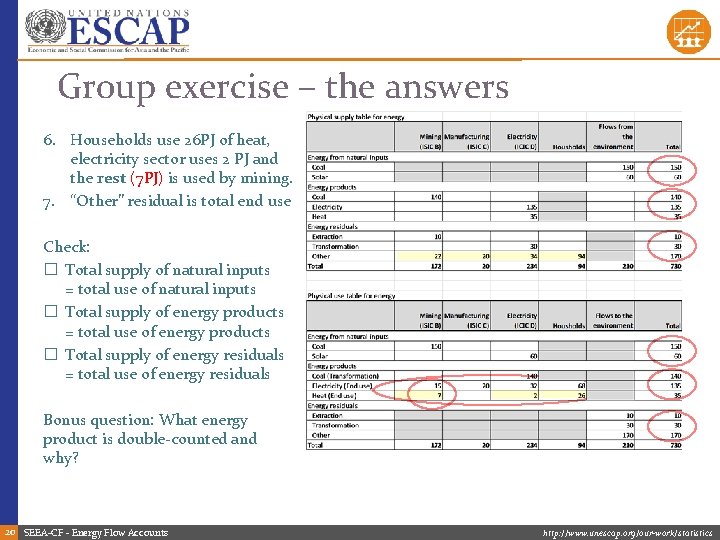
Group exercise – the answers 6. Households use 26 PJ of heat, electricity sector uses 2 PJ and the rest (7 PJ) is used by mining. 7. “Other” residual is total end use Check: � Total supply of natural inputs = total use of natural inputs � Total supply of energy products = total use of energy products � Total supply of energy residuals = total use of energy residuals Bonus question: What energy product is double-counted and why? 20 SEEA-CF - Energy Flow Accounts http: //www. unescap. org/our-work/statistics
Intermezzo …. . • Linking energy balances and energy accounts 21 SEEA-CF - Energy Flow Accounts http: //www. unescap. org/our-work/statistics
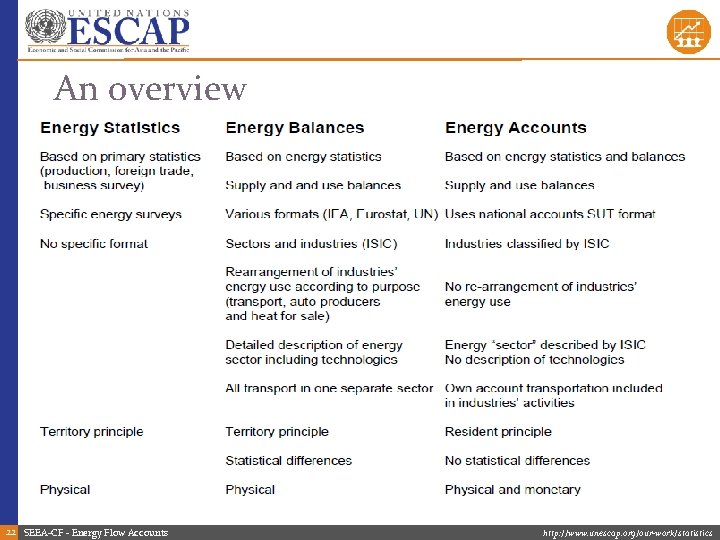
An overview 22 SEEA-CF - Energy Flow Accounts http: //www. unescap. org/our-work/statistics
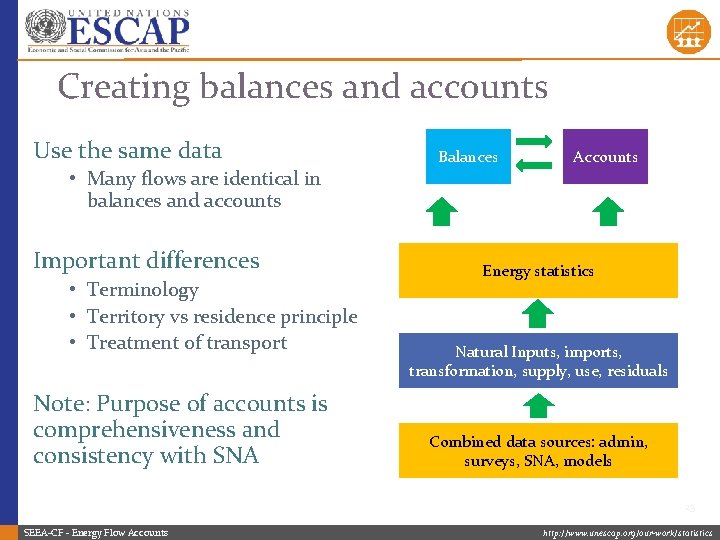
Creating balances and accounts Use the same data • Many flows are identical in balances and accounts Important differences • Terminology • Territory vs residence principle • Treatment of transport Note: Purpose of accounts is comprehensiveness and consistency with SNA Balances Accounts Energy statistics Natural Inputs, imports, transformation, supply, use, residuals Combined data sources: admin, surveys, SNA, models 23 SEEA-CF - Energy Flow Accounts http: //www. unescap. org/our-work/statistics
Terminology: Energy supply • Supply in the energy balance: Total energy supply = + Primary energy production + Import of primary and secondary energy - Export of primary and secondary energy - International (aviation and marine) bunkers - Stock changes • Supply in the energy account: Supply = output + imports 24 SEEA-CF - Energy Flow Accounts http: //www. unescap. org/our-work/statistics
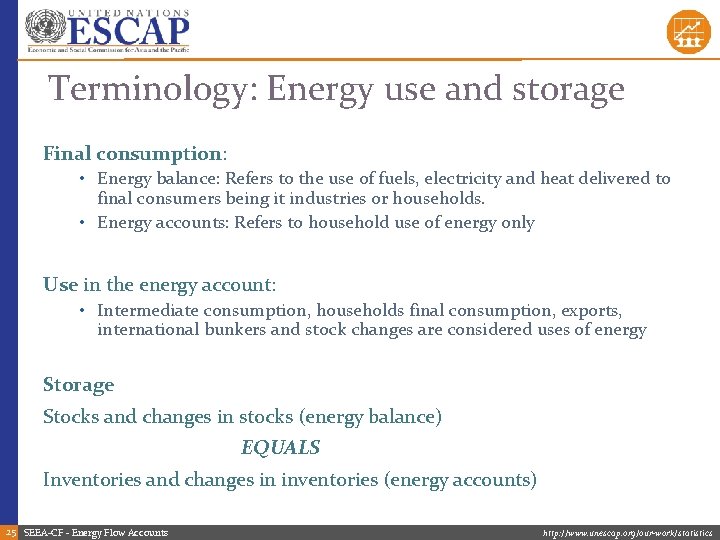
Terminology: Energy use and storage Final consumption: • Energy balance: Refers to the use of fuels, electricity and heat delivered to final consumers being it industries or households. • Energy accounts: Refers to household use of energy only Use in the energy account: • Intermediate consumption, households final consumption, exports, international bunkers and stock changes are considered uses of energy Storage Stocks and changes in stocks (energy balance) EQUALS Inventories and changes in inventories (energy accounts) 25 SEEA-CF - Energy Flow Accounts http: //www. unescap. org/our-work/statistics
Territory vs residence principle 26 SEEA-CF - Energy Flow Accounts http: //www. unescap. org/our-work/statistics
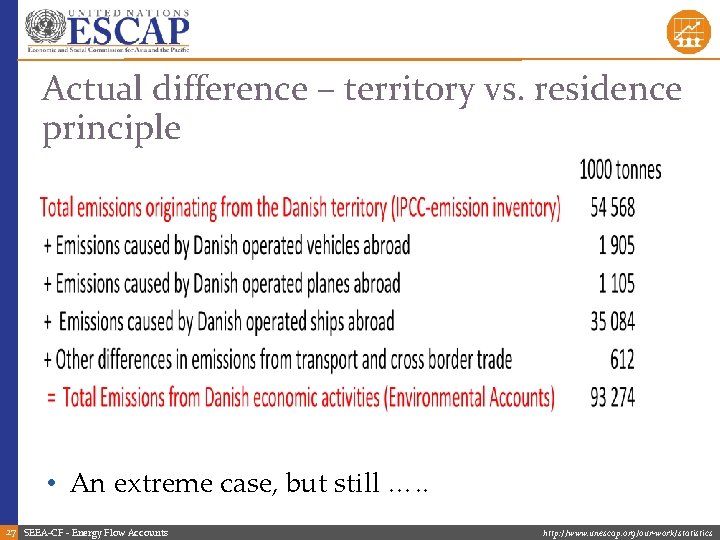
Actual difference – territory vs. residence principle • An extreme case, but still …. . 27 SEEA-CF - Energy Flow Accounts http: //www. unescap. org/our-work/statistics
Tools to ease the conversion • Working group led by UNSD (with IEA, Eurostat, OECD + experts) • Will provide assessment of existing sources; and roadmap • Applies to countries not currently filling the detailed IEA energy statistics questionnaires Page 28 http: //www. unescap. org/our-work/statistics
• Welcome to Level 2! (It’s not that easy) 29 SEEA-CF - Energy Flow Accounts http: //www. unescap. org/our-work/statistics
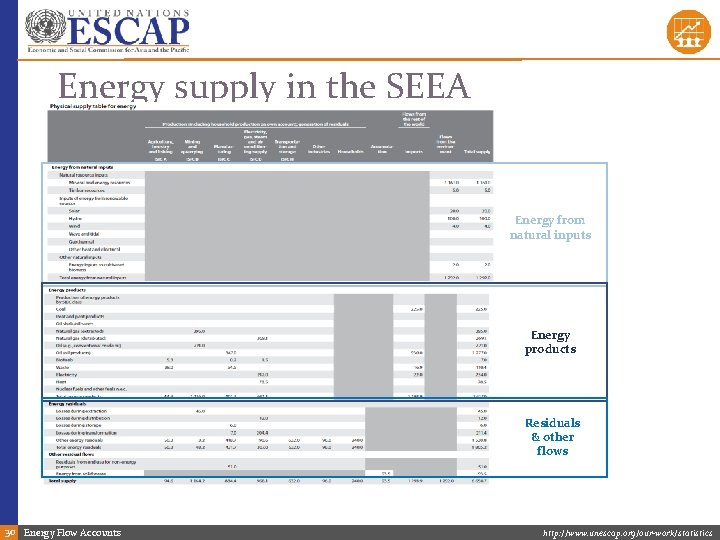
Energy supply in the SEEA Energy from natural inputs Energy products Residuals & other flows 30 Energy Flow Accounts http: //www. unescap. org/our-work/statistics
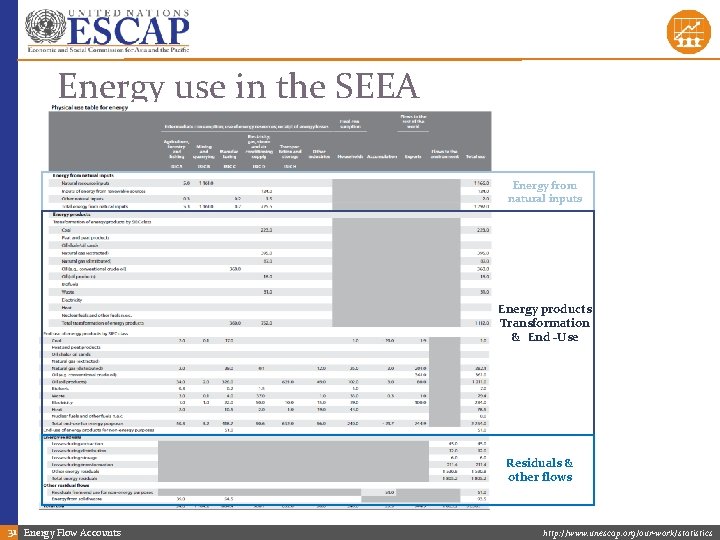
Energy use in the SEEA Energy from natural inputs Energy products Transformation & End -Use Residuals & other flows 31 Energy Flow Accounts http: //www. unescap. org/our-work/statistics
Compilation challenges & data Getting data in detail (energy balances help) • ISIC and SEIC Bridge tables to convert from balance to account • Balance may be by “purpose” (e. g. , transport) Getting data from importers/distributers • May be easier for NSOs than Energy/Environment (if for statistical purposes!) Allocating to natural inputs, products, residuals • “Mixed” producers (e. g. co-production of electricity and district heating; coal mines own power generation) 32 SEEA-CF - Energy Flow Accounts http: //www. unescap. org/our-work/statistics
Compilation challenges & data Energy from natural inputs • Supply & Use: May need to estimate losses from “factor” • Data: • • • Energy balances Ministries of energy, mining, natural resources, forestry (timber) Commodity reports, annual reports, industry associations Sample surveys Royalty payments on extraction, harvesting Administrative data (e. g. , reporting to government) 33 SEEA-CF - Energy Flow Accounts http: //www. unescap. org/our-work/statistics
Compilation challenges & data Energy products: • Supply & use: Industry & product detail • Conversion to energy units (different “kinds” of oil…) • Data: Energy balances, energy statistics, imports Ministries of Energy, utility companies, industry associations Commodity reports, annual reports National Accounts, I-O Tables (expenditures, transactions between producers/users) • Administrative (energy taxes, distribution to users) • Surveys (energy use by business and households) • • 34 SEEA-CF - Energy Flow Accounts http: //www. unescap. org/our-work/statistics
Compilation challenges & data Transformation of energy products • Supply & use: Duplicate energy flows (multiple inputs) • Data: • Same as above (balances, statistics, surveys, admin) • Estimate from transformation efficiency “factors” • 100 PJ black coal 33 PJ electricity • Estimate unknowns from balance between supply and use • • • 1000 PJ crude oil supply 400 PJ exported 250 PJ transformed to secondary oil products 300 PJ stored [increased stock] Remainder (50 PJ) allocate to losses 35 SEEA-CF - Energy Flow Accounts http: //www. unescap. org/our-work/statistics
Compilation challenges & data Transformation of energy products • Cogeneration: Australia steel industry generates 80% of own electricity, 96% from cogeneration (i. e. , heat) • Own account production: Requires survey • More detail is better: • Same energy product for different purposes • Easier to monetize 36 SEEA-CF - Energy Flow Accounts http: //www. unescap. org/our-work/statistics
Compilation challenges & data Energy end-use: • Most interesting to policy; most time-consuming • Data: • Balances, surveys, SNA/I-O • Admin (exports, emissions trading, electricity and gas bills) • Models: • Motor vehicle use: Allocate activity (km) to industry (joules); Remember: non-transport use (e. g. , diesel generators) • Domestically collected fuelwood • Bunkers = storage for ships and airplanes (ownership? ) 37 SEEA-CF - Energy Flow Accounts http: //www. unescap. org/our-work/statistics
Compilation challenges & data Energy residuals: • Supply & use: • Estimating losses from extraction, distribution & storage, transformation, end use (heat) • Losses in renewable? • Policy: efficiency, pollution (losses), relate to GHGs • Data: • Supply and end use of energy products, transformation • Admin (annual reports, emission reports, GHG inventories) • Academic (life cycle analysis, storage losses, efficiencies of facilities) 38 SEEA-CF - Energy Flow Accounts http: //www. unescap. org/our-work/statistics
Simplifications & Extensions • Simplifications • Supply & use of electricity, renewables or fossil fuels • Extensions • Monetary supply and use for energy (currency units) • Calculating air emissions from fossil fuel consumption • Apply “factors” to consumption CO 2, SOx, solids, … • Allocation to “types” of households (volunteers? ) • Energy for all? Could disaggregate with survey. 39 SEEA-CF - Energy Flow Accounts http: //www. unescap. org/our-work/statistics
SDG indicators Universal access • 7. 1. 1 …population with access to electricity • Sample survey to allocate household consumption • How much is enough? • 7. 1. 2 …population with…reliance on clean fuels & technology … for cooking • Define “clean” Share of renewable • 7. 2. 1 Renewable energy share … • From energy account Energy efficiency • 7. 3. 1 Energy intensity…in terms of primary energy and …GDP… • Compare use from energy account with value added from SNA 40 SEEA-CF - Energy Flow Accounts http: //www. unescap. org/our-work/statistics
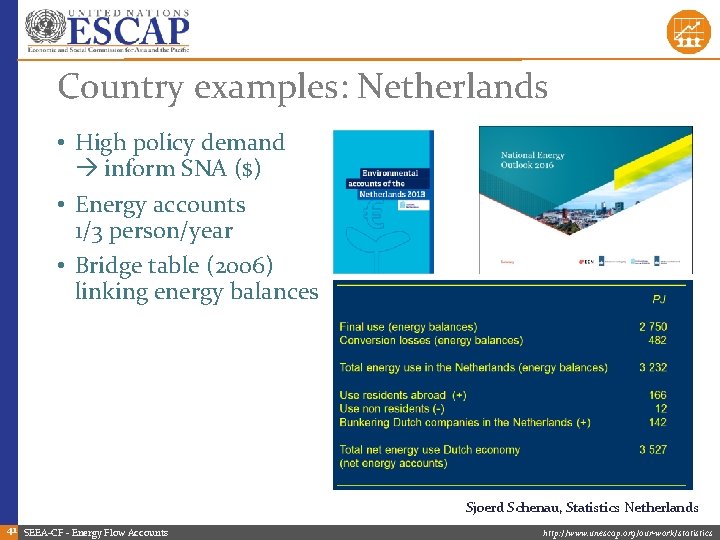
Country examples: Netherlands • High policy demand inform SNA ($) • Energy accounts 1/3 person/year • Bridge table (2006) linking energy balances Sjoerd Schenau, Statistics Netherlands 41 SEEA-CF - Energy Flow Accounts http: //www. unescap. org/our-work/statistics
Discussion • Which aspects are most relevant to begin with in your country (electricity, fossil fuels, efficiency, access)? • What are the main institutional challenges (data sharing, data access, expertise…)? 42 SEEA-CF - Energy Flow Accounts http: //www. unescap. org/our-work/statistics
References • International Recommendations on Energy Statistics (2016) http: //unstats. un. org/unsd/energy/ires/ • SEEA-Central Framework (2014) http: //unstats. un. org/unsd/envaccounting/seea. Rev/SEEA_CF_Final_en. pdf • SEEA-Energy (Draft) http: //unstats. un. org/unsd/envaccounting/seea. E/GC_Draft. pdf • Energy Statistics Compilers Manual http: //unstats. un. org/unsd/energy/ESCM. htm • IEA/Eurostat: Energy Statistics Manual http: //www. iea. org/publications/freepublications/publication/energystatistics-manual. html • Eurostat: Physical Energy Flow Accounts http: //ec. europa. eu/eurostat/web/environment/methodology • Standard International Energy Product Classification (SIEC) (2011) http: //unstats. un. org/unsd/class/intercop/expertgroup/2011/AC 234 -14. PDF 43 SEEA-CF - Energy Flow Accounts http: //www. unescap. org/our-work/statistics
Acknowledgements • Materials prepared by: • Michael Bordt • Regional Adviser on Environment Statistics ESCAP Statistics Division bordt@un. org • Rikke Munk Hansen • Chief, Economic and Environment Statistics Section ESCAP Statistics Division hansenrm@un. org • Materials adapted from: • Joe St. Lawrence (Statistics Canada; UNSD SEEA Training of Trainers Seminar; 7 -10 July 2015, Santiago) • Laura Binns (ABS; Regional Training Workshop on the SEEA; 26 -30 Sept. 2016; Putrajaya, Malaysia) • Ole Gravgård (Statistics Denmark; SEEA Training Seminar for the ECA; Addis Ababa 2 -5 Feb. 2015) • Sjoerd Schenau (Statistics Netherlands and Eurostat course on Environmental Taxes) • Sokol Vako (UNSD; Nov. 17, 2015; Regional Training Workshop on the SEEA; Shanghai) 44 SEEA-CF - Energy Flow Accounts http: //www. unescap. org/our-work/statistics
Thank you! 45 SEEA-CF - Energy Flow Accounts http: //www. unescap. org/our-work/statistics