
Overview of ELA and Math Model Content Frameworks

- Slides: 48
Overview of ELA and Math Model Content Frameworks
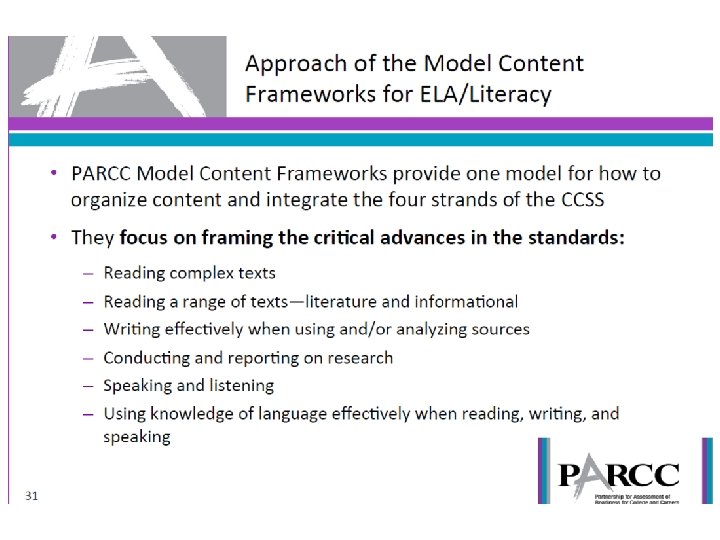
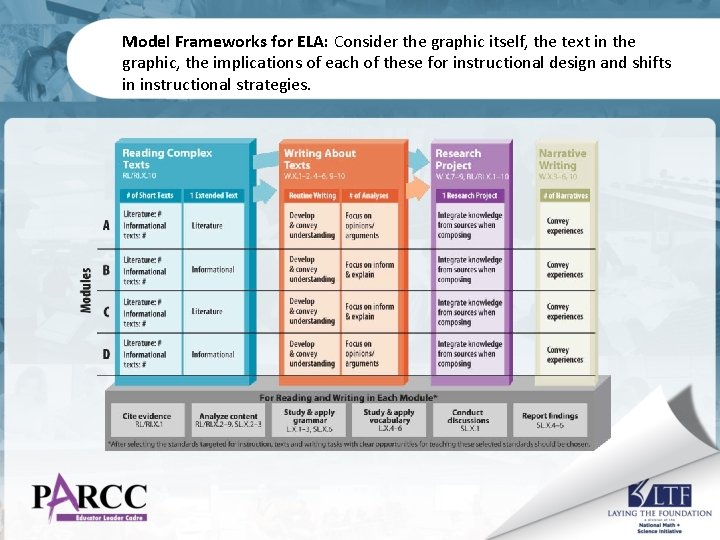
Model Frameworks for ELA: Consider the graphic itself, the text in the graphic, the implications of each of these for instructional design and shifts in instructional strategies.
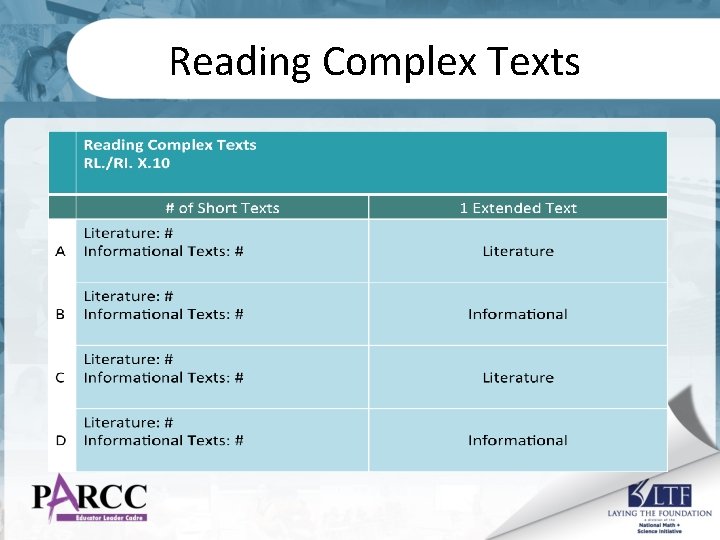
Reading Complex Texts
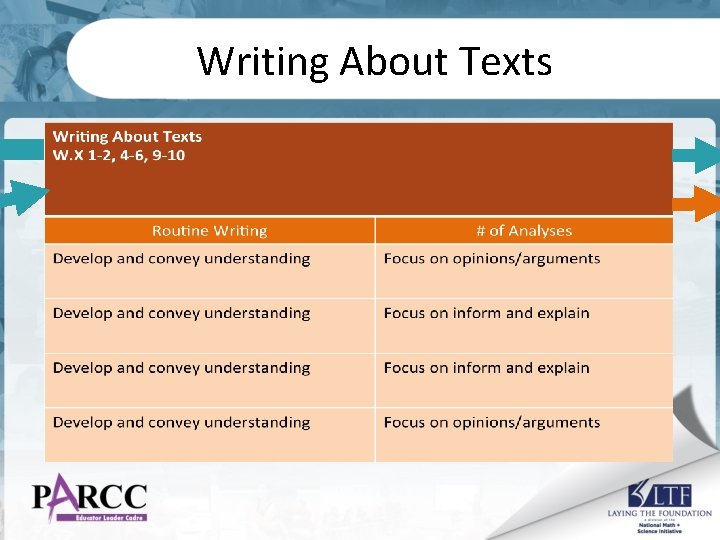
Writing About Texts
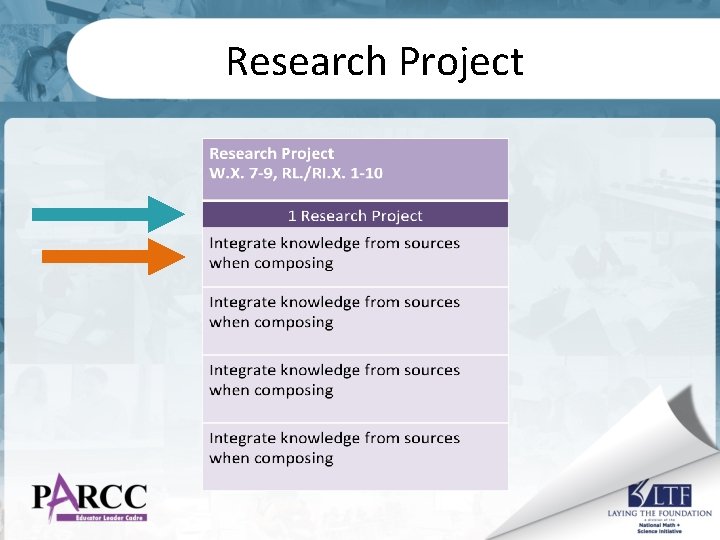
Research Project
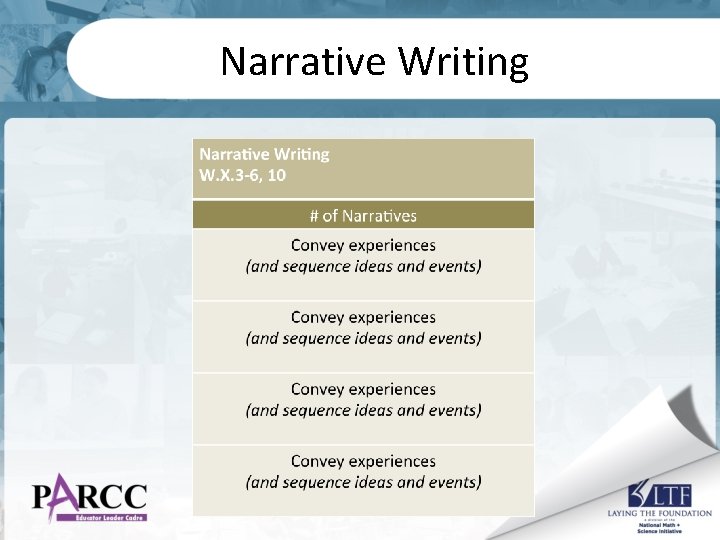
Narrative Writing
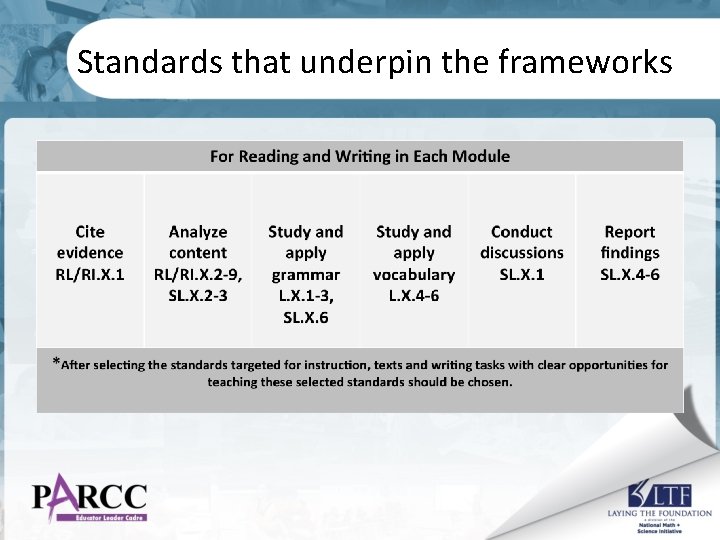
Standards that underpin the frameworks
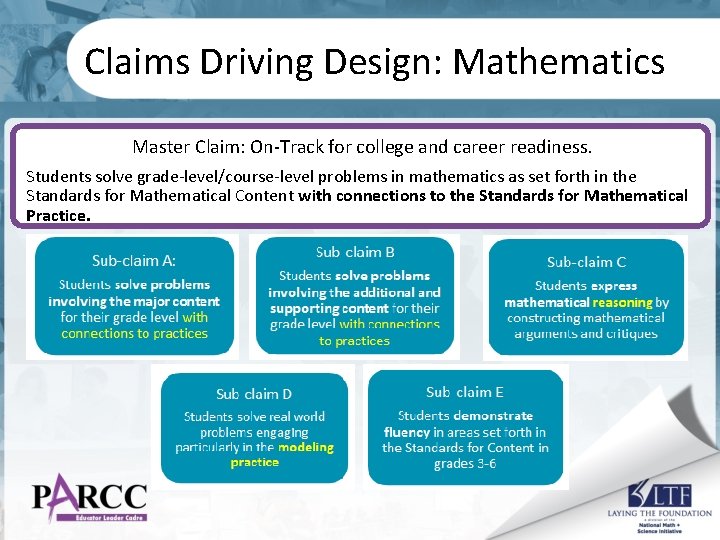
Claims Driving Design: Mathematics Master Claim: On-Track for college and career readiness. Students solve grade-level/course-level problems in mathematics as set forth in the Standards for Mathematical Content with connections to the Standards for Mathematical Practice.
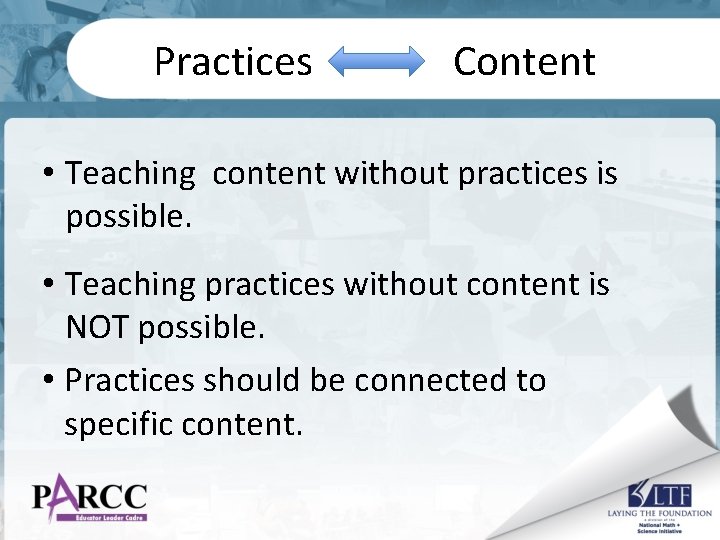
Practices Content • Teaching content without practices is possible. • Teaching practices without content is NOT possible. • Practices should be connected to specific content.
Big Idea!! The Practices will be well represented on the PARCC Assessment
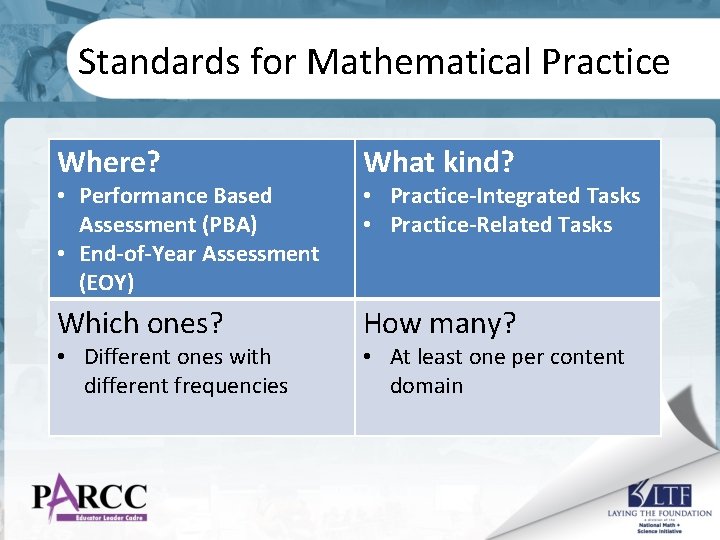
Standards for Mathematical Practice Where? What kind? Which ones? How many? • Performance Based Assessment (PBA) • End-of-Year Assessment (EOY) • Different ones with different frequencies • Practice-Integrated Tasks • Practice-Related Tasks • At least one per content domain
Sample Questions: PARCC Assessment August 2012 24
PARCC’s Fundamental Advance PARCC is designed to reward quality instruction aligned to the Standards, so the assessment is worthy of preparation rather than a distraction from good work. 25
PARCC’s Core Commitments to ELA/Literacy Assessment Quality 26 • Texts Worth Reading: The assessments will use authentic texts worthy of study instead of artificially produced or commissioned passages. • Questions Worth Answering: Sequences of questions that draw students into deeper encounters with texts will be the norm (as in an excellent classroom), rather than sets of random questions of varying quality. • Better Standards Demand Better Questions: Instead of reusing existing items, PARCC will develop custom items to the Standards. • Fidelity to the Standards (now in Teachers’ hands): PARCC evidences are rooted in the language of the Standards so that expectations remain the same in both instructional and assessment settings.
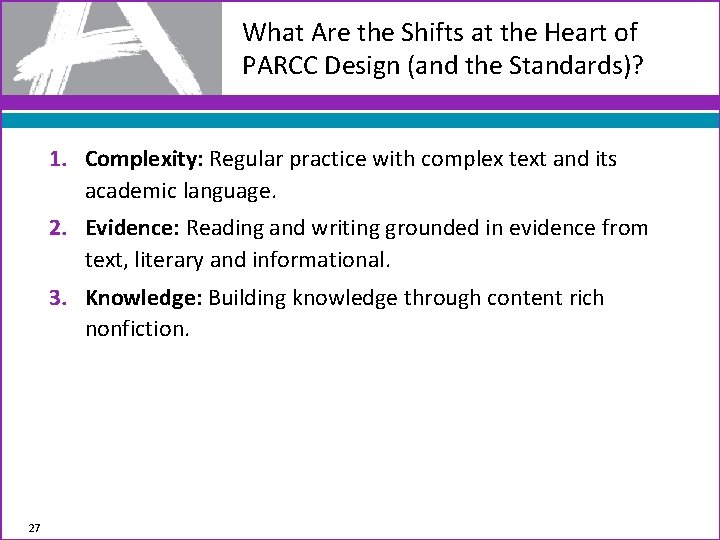
What Are the Shifts at the Heart of PARCC Design (and the Standards)? 1. Complexity: Regular practice with complex text and its academic language. 2. Evidence: Reading and writing grounded in evidence from text, literary and informational. 3. Knowledge: Building knowledge through content rich nonfiction. 27
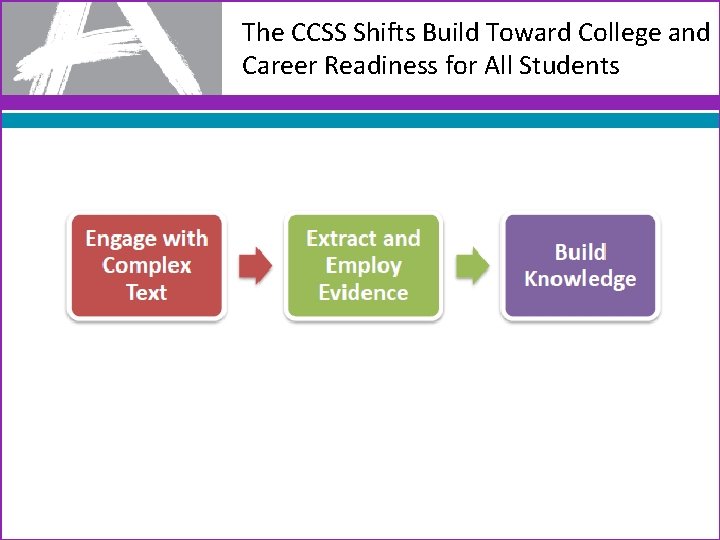
The CCSS Shifts Build Toward College and Career Readiness for All Students
Students’ Command of Evidence with Complex Texts is at the Core of Every Part of the Assessment! SO. . . Two standards are always in play—whether they be reading or writing items, selected-response or constructed-response items on any one of the four components of PARCC. They are: – Reading Standard One (Use of Evidence) – Reading Standard Ten (Complex Texts) 29
Three Innovative Item Types That Showcase Students’ Command of Evidence with Complex Texts • Evidence-Based Selected Response (EBSR)—Combines a traditional selected-response question with a second selected-response question that asks students to show evidence from the text that supports the answer they provided to the first question. Underscores the importance of Reading Anchor Standard 1 for implementation of the CCSS. • Technology-Enhanced Constructed Response (TECR)—Uses technology to capture student comprehension of texts in authentic ways that have been difficult to score by machine for large scale assessments (e. g. , drag and drop, cut and paste, shade text, move items to show relationships). • Range of Prose Constructed Responses (PCR)—Elicits evidence that students have understood a text or texts they have read and can communicate that understanding well both in terms of written expression and knowledge of language and conventions. There are four of these items of varying types on each annual performance-based assessment. 30
PARCC Summative Assessment with EBSR, TECR, and PCR Items 31
Questions Worth Answering? On the following pages there is one Evidence-Based Selected. Response Item, one Technology Enhanced Constructed. Response Item, and one Prose Constructed Response Item that challenge students’ command of evidence with complex texts. 32
Grade 6 Prose Constructed-Response Item In the passage, the author developed a strong character named Miyax. Think about Miyax and the details the author used to create that character. The passage ends with Miyax waiting for the black wolf to look at her. Write an original story to continue where the passage ended. In your story, be sure to use what you have learned about the character Miyax as you tell what happens to her next. 33
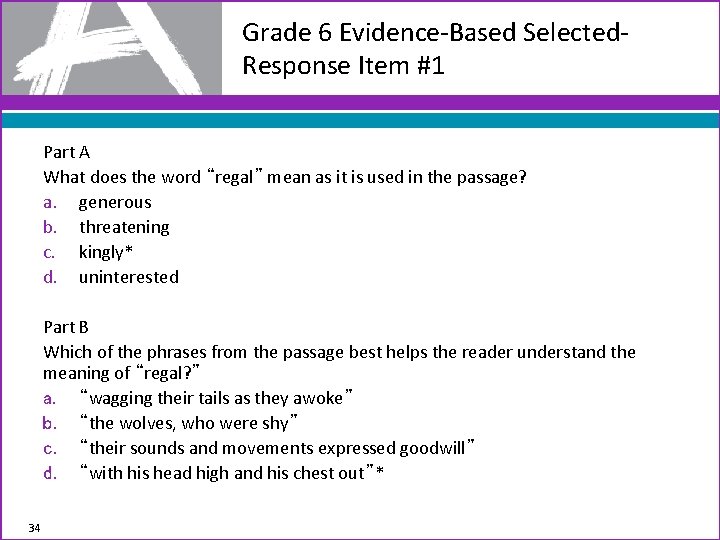
Grade 6 Evidence-Based Selected. Response Item #1 Part A What does the word “regal” mean as it is used in the passage? a. generous b. threatening c. kingly* d. uninterested Part B Which of the phrases from the passage best helps the reader understand the meaning of “regal? ” a. “wagging their tails as they awoke” b. “the wolves, who were shy” c. “their sounds and movements expressed goodwill” d. “with his head high and his chest out”* 34
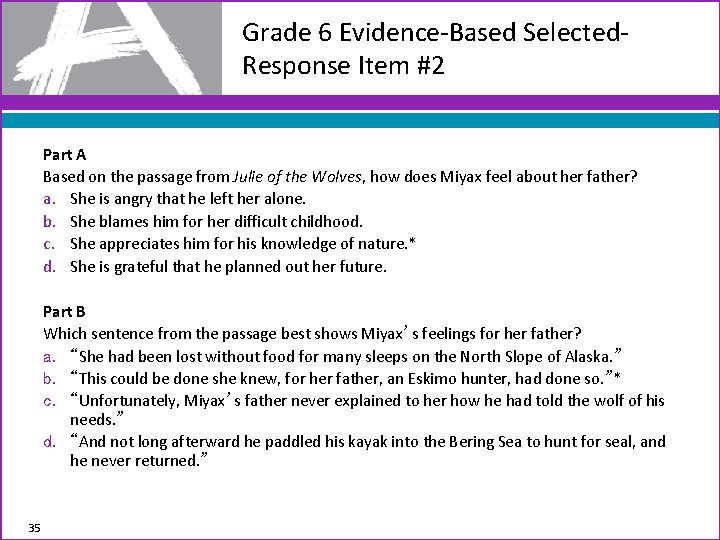
Grade 6 Evidence-Based Selected. Response Item #2 Part A Based on the passage from Julie of the Wolves, how does Miyax feel about her father? a. She is angry that he left her alone. b. She blames him for her difficult childhood. c. She appreciates him for his knowledge of nature. * d. She is grateful that he planned out her future. Part B Which sentence from the passage best shows Miyax’s feelings for her father? a. “She had been lost without food for many sleeps on the North Slope of Alaska. ” b. “This could be done she knew, for her father, an Eskimo hunter, had done so. ”* c. “Unfortunately, Miyax’s father never explained to her how he had told the wolf of his needs. ” d. “And not long afterward he paddled his kayak into the Bering Sea to hunt for seal, and he never returned. ” 35
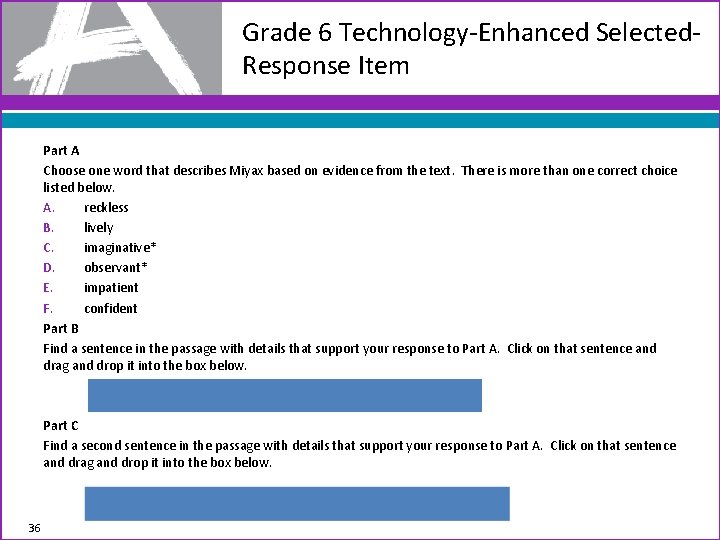
Grade 6 Technology-Enhanced Selected. Response Item Part A Choose one word that describes Miyax based on evidence from the text. There is more than one correct choice listed below. A. reckless B. lively C. imaginative* D. observant* E. impatient F. confident Part B Find a sentence in the passage with details that support your response to Part A. Click on that sentence and drag and drop it into the box below. Part C Find a second sentence in the passage with details that support your response to Part A. Click on that sentence and drag and drop it into the box below. 36
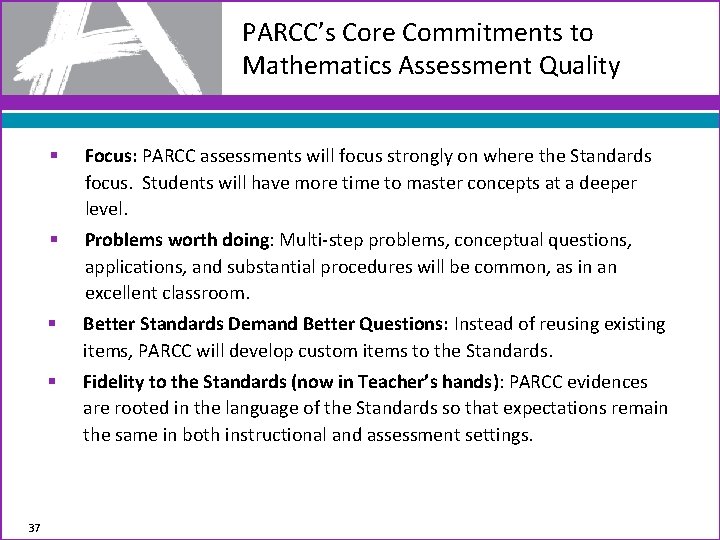
PARCC’s Core Commitments to Mathematics Assessment Quality 37 § Focus: PARCC assessments will focus strongly on where the Standards focus. Students will have more time to master concepts at a deeper level. § Problems worth doing: Multi-step problems, conceptual questions, applications, and substantial procedures will be common, as in an excellent classroom. § Better Standards Demand Better Questions: Instead of reusing existing items, PARCC will develop custom items to the Standards. § Fidelity to the Standards (now in Teacher’s hands): PARCC evidences are rooted in the language of the Standards so that expectations remain the same in both instructional and assessment settings.
What Are the Shifts in the Math Standards at the Heart of PARCC Design? 1. Focus: The PARCC Assessment will focus strongly where the Standards focus 2. Coherence: Think across grades and link to major topics within grades 3. Rigor: In major topics, pursue conceptual understanding, procedural skill and fluency, and application. 38
Advances in Assessment Demanded by the Shifts Shift #1 – Focus: The PARCC assessments will focus strongly where the Standards focus Advance: PARCC assessments will focus strongly where the Standards focus (70% or more on the major work in grades 3 -8). § Focus allows for a variety of problem types to get at concept in multiple ways. § Students will have more time to master concepts at a deeper level. 39
Advances in Assessment Demanded by the Shifts Shift #2 - Coherence: Think across grades, and link to major topics within grades Advance: The assessment design is informed by multi-grade progressions in the Standards and the Model Content Frameworks. § Key beginnings are stressed (e. g. , ratio concepts in grade 6), as are key endpoints and takeaway skills (e. g. , fluency with the multiplication table in grade 3). 40
Advances in Assessment Demanded by the Shifts Shift #2 - Coherence: Think across grades, and link to major topics within grades Advance: Integrative tasks draw on multiple standards to ensure students are making important connections. § The Standards are not treated as a checklist. 41
Advances in assessment demanded by the shifts Shift #3 - Rigor: In major topics, pursue conceptual understanding, procedural skill and fluency, and application Advance: PARCC assessments will reach the rigor in the Standards through innovations in technology and item design… 42
Sample Items Illustrating the Advances in Assessment The next section of this presentation is comprised of sample items that illustrate some of the advances called for by the three shifts. 43
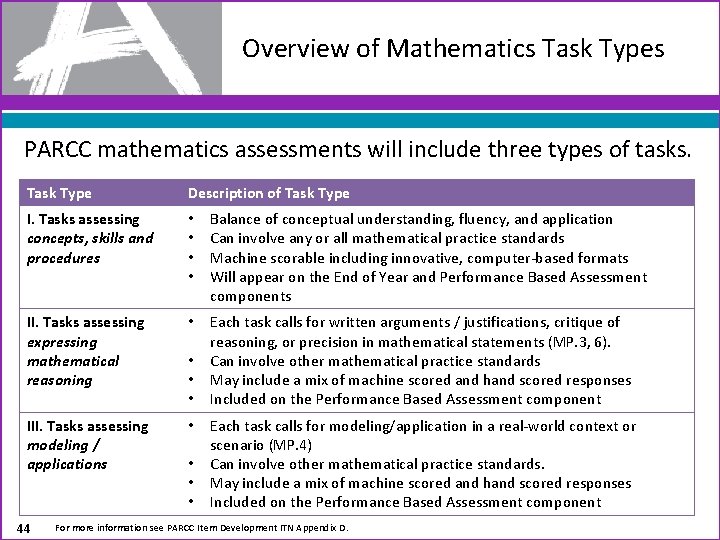
Overview of Mathematics Task Types PARCC mathematics assessments will include three types of tasks. Task Type Description of Task Type I. Tasks assessing concepts, skills and procedures • • Balance of conceptual understanding, fluency, and application Can involve any or all mathematical practice standards Machine scorable including innovative, computer-based formats Will appear on the End of Year and Performance Based Assessment components II. Tasks assessing expressing mathematical reasoning • Each task calls for written arguments / justifications, critique of reasoning, or precision in mathematical statements (MP. 3, 6). Can involve other mathematical practice standards May include a mix of machine scored and hand scored responses Included on the Performance Based Assessment component III. Tasks assessing modeling / applications • 44 • • • Each task calls for modeling/application in a real-world context or scenario (MP. 4) Can involve other mathematical practice standards. May include a mix of machine scored and hand scored responses Included on the Performance Based Assessment component For more information see PARCC Item Development ITN Appendix D.
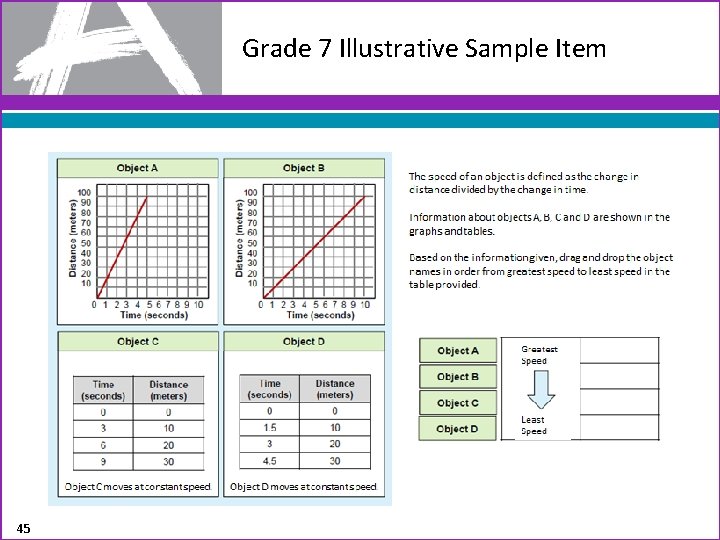
Grade 7 Illustrative Sample Item 45
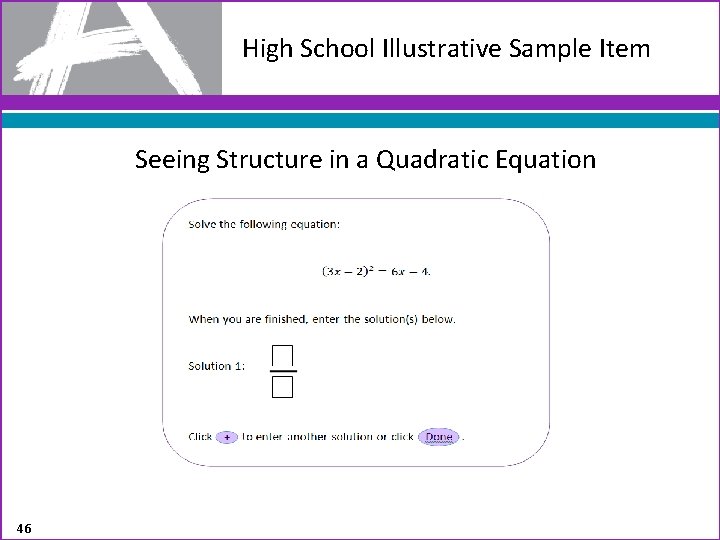
High School Illustrative Sample Item Seeing Structure in a Quadratic Equation 46
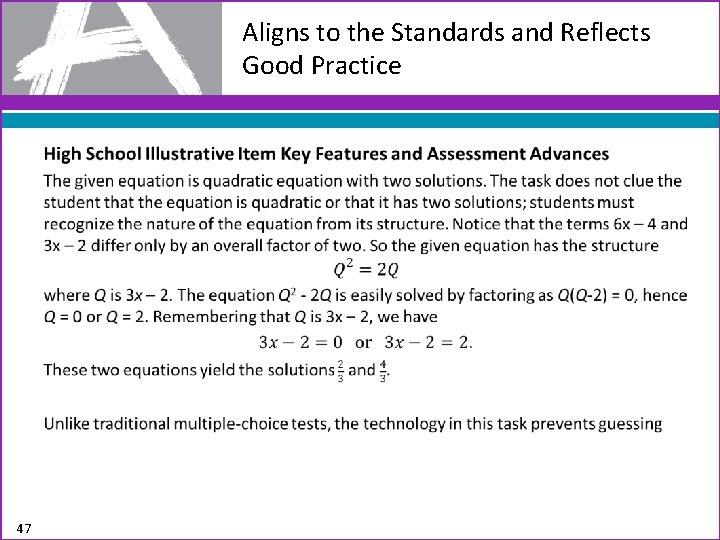
Aligns to the Standards and Reflects Good Practice • 47
PARCC Take-Aways Two Things to Tell Teachers Two Things to Start to Plan