
Overview of Developmental Disabilities CHATHAM TRADES INC CORE
Overview of Developmental Disabilities CHATHAM TRADES, INC. CORE COMPETENCY TRAINING
Definition �A severe, chronic disability caused by a physical and/or mental impairment. �Manifested before the person reaches age 22. �Likely to continue indefinitely. �Results in substantial functional limitations in three or more major life activities, e. g. : Self care, self direction, self sufficiency, learning, language, living independently.
Definition continued… �Reflects persons need for a combination of special treatment or other services that are lifelong or of extended duration and individually planned and coordinated.
Types of developmental disabilities �Intellectual Disability �Cerebral palsy �Epilepsy �Autism �A person may have more than one developmental disability. �In NC a person who receives a head injury after the age of 22 is considered developmentally disabled.
Causes of IDD �Before conception: Genetic conditions Disorder of brain formation Errors in metabolism Disorders of the nervous system
Causes, continued… �Prenatal (during pregnancy): Maternal infections Poor nutrition Drugs Radiation overexposure Anoxia (no oxygen to the fetus)
Causes, continued… �Perinatal (during the birth process): Low birth weight Anoxia (lack of oxygen) Injuries
Causes, continued… �Postnatal (after birth): Poisons (lead, mercury, carbon monoxide) Trauma (physical abuse, brain injury, accident) Infections/diseases (meningitis, encephalitis, chicken pox, whooping cough) Environmental deficiencies (poor nutrition, sensory and/or educational deprivation, poverty/cultural deprivation resulting in lack of learning day-to-day experiences. Parasites Intellectual Disability occurs in about 3% of the population.
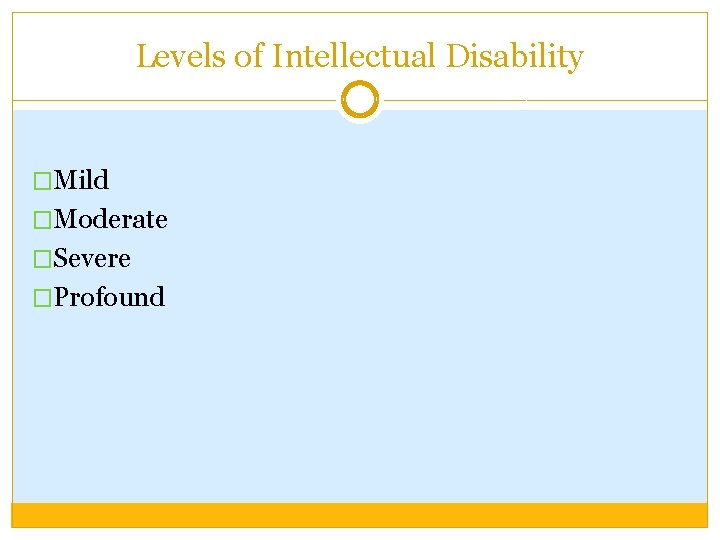
Levels of Intellectual Disability �Mild �Moderate �Severe �Profound
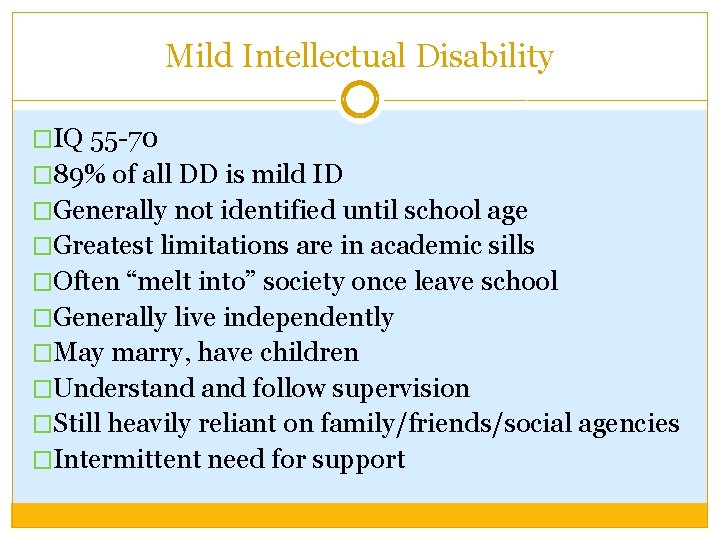
Mild Intellectual Disability �IQ 55 -70 � 89% of all DD is mild ID �Generally not identified until school age �Greatest limitations are in academic sills �Often “melt into” society once leave school �Generally live independently �May marry, have children �Understand follow supervision �Still heavily reliant on family/friends/social agencies �Intermittent need for support
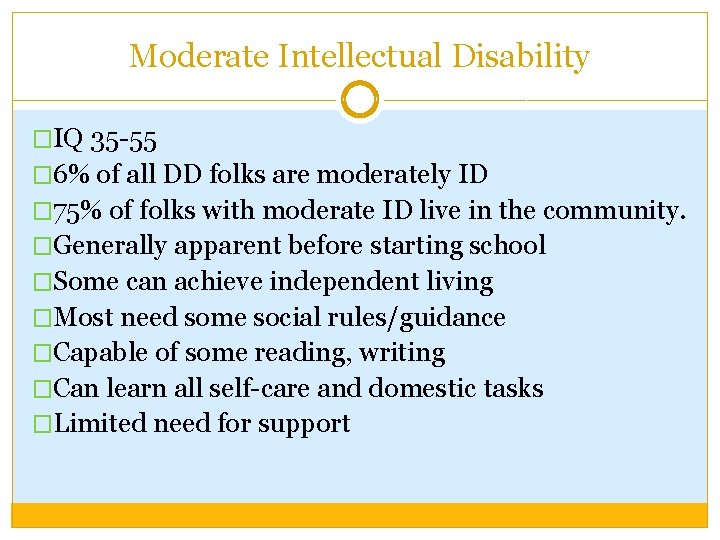
Moderate Intellectual Disability �IQ 35 -55 � 6% of all DD folks are moderately ID � 75% of folks with moderate ID live in the community. �Generally apparent before starting school �Some can achieve independent living �Most need some social rules/guidance �Capable of some reading, writing �Can learn all self-care and domestic tasks �Limited need for support
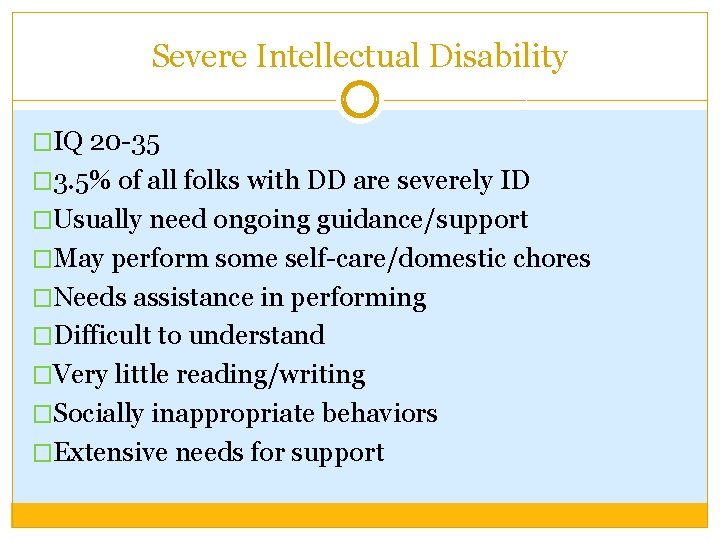
Severe Intellectual Disability �IQ 20 -35 � 3. 5% of all folks with DD are severely ID �Usually need ongoing guidance/support �May perform some self-care/domestic chores �Needs assistance in performing �Difficult to understand �Very little reading/writing �Socially inappropriate behaviors �Extensive needs for support
Profound Intellectual Disability �IQ below 25 � 1. 5 % of all people with DD are profoundly ID �Needs close guidance/supervision �Assistance in most all self-care, social, domestic activities. �Very limited or no expressive language �Poor social skills, little interaction with others �Pervasive need for supports (24 hours)
Communication Difficulties �Eagerness to please: � In seeking acceptance from authority figures, people with DD are particularly vulnerable to taking the blame for things done by others. � In seeking acceptance or approval, people with DD will engage in acts or make statements that are clearly not in their own best selfinterests.
Communication continued… �Concrete thinking patterns: If told, “that’s the way the cookie crumbles” a person with DD is not focused on the abstract notion of consequences, but is concretely focused on the cookie. If a word has both a concrete and abstract meaning the person will say yes, they understand (concrete meaning) when you were using the abstract meaning. Example: wave and waive
Communication continued… �Communication through mimicking: People with DD will listen for words, look into faces and copy moods and words in order to give the “right” response. People with DD learn to communicate by affirming the choice that is suggested last.
Communication continued… �Communication through protectors: People with DD learn to communicate through the voice of a protector. This need for a protector/friend may become acute as the person grows older and their friends stop speaking for them.
Communication through bluffing �Communication through bluffing: People with DD often try to mask their disability, by trying to pass for so-called “normal”. They may look serious and contemplative when you are speaking with them, but if you ask them a question about it, they will be unable to answer it.
Communication through pleasant facade �Communication through a Pleasant Façade: Smiling is one way to get their needs met or to get approval. People with DD do not know when smiling is appropriate or not. When people with DD are under pressure, they may smile thinking that will gain them approval. Doesn’t match feelings.
Problems with receptive/expressive language �Most common communication difficulty is in expressing themselves, because of intellectual deficits or physical inability that makes it difficult for them to be understood. �They may not be receptive to the ordinary flow of spoken language; required to be spoken to in a more slow and clear way. �They may not understand words that express abstract thoughts or that may have more than one meaning (e. g. , right/wrong or right/left).
Limited memory/impaired recall �Even if can verbalize effectively, their ability to recall events may be impaired. �If it’s not important to them, they are less likely to recall the information. �In one study, people with DD were asked to give directions to their homes. 55% gave directions which, although complete, proved inaccurate in significant ways.
Impulsivity/Short-Attention spans �Persons with DD are often impulsive and/or have poor impulse control. �This characteristic is related to difficulties with attention span and focus
Impaired Judgement �People with DD often have impaired judgement and in an attempt to communicate or fit in with those around them, they may unwittingly copy behaviors that are antisocial/inappropriate/dangerous.
Adaptive Behavior Deficits �Problems with self-care �Difficulty with receptive language (understanding) �Difficulty with expressive language (speaking) �Learning problems �Mobility problems �Problems with self-direction �Limited independent living skills �Economic dependence.
Adaptive behavior deficits continued… �Memory Logical reasoning �Attention Strategic thinking �Ability to control impulsivity �Moral development Foresight �Self-concept Ability to anticipate �Self-perception consequences �Suggestibility �Knowledge of basic information �General motivation
Techniques that facilitate learning �Provide simplified directions and concrete tasks. �Provide opportunities to practice each step in the assigned task. Use small steps. �Allow the individual an adequate amount of time to respond to a request. �Provide honest feedback. �Give positive reinforcement for the right actions.
Traits associated with DD �Rate of learning is slower Delayed response time Up to 10 seconds slower to interpret instructions and act Require more practice
Traits, continued… �Level of learning is lower: Reduced comprehension Difficulty with abstract concepts Difficulty with generalization of skills
Traits, continued… �Rate of forgetting is higher: If skills not practiced routinely, they will be forgotten. There is a certain amount of rigidity for some skills.
Traits, continued… �Transfer of learning is more difficult: Less incidental learning Difficulty spontaneously initiating activities/organizing Restricted coping and problem-solving skills Suggestibility Passivity, tendency to give up
Transitional services �Design and implementation of services for high school students to transition to the adult world. At Chatham trades, high school seniors can spend one semester of their senior year at Chatham Trades, learning work skills, etc.
Suggestions for interactions �Maintain eye contact with the person, even if they are using an interpreter. �Ask if assistance is needed, rather than assuming it is. �Use a normal tone of voice. �Speak in clear, simple terms. Not childish language. �If appropriate, sign or signal your intentions. �Say so if you cannot understand the person. Ask them to repeat, if necessary.
Suggestions continued… �Do not assume that a person with a disability has another one, too. �When speaking with a person in a wheelchair, sit directly across from them. If no chair is available, stand in front of them—do not kneel in front of them. �You can say “look” or “see” to a person who is blind and can say “let’s walk over there” to a person in a wheelchair. �An assistance animal is on duty. Petting is not okay, unless the person approves it.
Choosing words �CORRECT: Person with blindness �WRONG: Person afflicted with blindness. �CORRECT: Person with a physical disability �WRONG: Person confined to a wheelchair �CORRECT: Person who is unable to speak/hear �WRONG: Deaf/mute
Choosing words continued… �CORRECT: Person with… �WRONG: Afflicted with, stricken with, suffering from, a victim of… �Focus on getting to know the person, not the disability. Refer to the person first, not the disability.
- Slides: 35