
Overview of Delivery Approach Methodology Robin Todd Taimur
Overview of Delivery Approach Methodology Robin Todd – Taimur Khan Jhagra 7 th May 2018
Agenda • Section 1: Introducing Delivery • Section 2: Key Principles of Delivery • Section 3: What People Often Ask 28/11/2020 Mott Mac. Donald | Presentation 2
Section 1 Introducing Delivery 28/11/2020 Mott Mac. Donald | Presentation 3
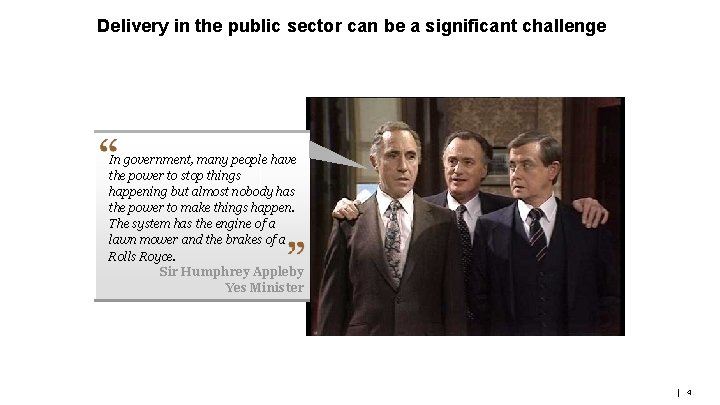
Delivery in the public sector can be a significant challenge In government, many people have the power to stop things happening but almost nobody has the power to make things happen. The system has the engine of a lawn mower and the brakes of a Rolls Royce. Sir Humphrey Appleby Yes Minister | 4
“I realised that the problems may not necessarily lie in the quality of policy making processes or policies themselves, but on the mechanisms in place for implementation, monitoring and evaluation. I noticed that much of the time we are bogged down by processes and bureaucratic inertia. ” President Jakaya Kikwete of Tanzania, opening remarks at the 12 th Forum of Commonwealth Heads of African Public Service, 13 th July 2015, Dar es Salaam 28/11/2020 Mott Mac. Donald | Presentation 5
Common Public Service Delivery Challenges • Lack of clarity as to the practical steps needed to turn national policy commitments into tangible outcomes. • Lack of joined up working at national level- policy priorities falling across or between Ministries with unclear accountability for results. • National level challenge to ensure quality of delivery when responsibility is devolved to local level. If results are poor in one local area it is still the national government which gets the blame for this! • Focus on process and procedures rather than outcomes- little sense of urgency to make a positive difference. • Lack of local level understanding of national commitments means that intended results are never realised. • Lack of understanding at the centre of government as to ‘what good looks like’ at institutional level (school, health centre etc. ) where services are delivered. 28/11/2020 Mott Mac. Donald | Presentation 6
Why adopt the ‘Delivery Approach’ in Education? • Assists politicians and senior civil servants to focus on achieving high priority political commitments. • Rapid achievement of specific targets (e. g. teacher attendance, school construction or delivery of capitation grants) can play an important role in shifting the public narrative on education. • Application of Delivery Approach tools and techniques will identify blockages and issues in the education system. ‘Unblocking’ these issues can often have wider benefits beyond the specific targets being addressed. • Provides a tangible example that change is possible. This experience can be used to challenge other policy areas where progress has been slow and reforms generally ineffective. 28/11/2020 Mott Mac. Donald | Presentation 7
What is the ‘Delivery Approach’? • Growing interest across Governments in looking beyond the formulation of best practice policies and focusing on implementation and ‘getting things done’. • The Delivery Approach encompasses the set-up and operations of Centre of Government Delivery Units (at either Presidential, Prime Ministerial or Ministerial level) as well as the application of a set of principles initially popularised in the early 2000 s by the UK Government’s Prime Ministerial Delivery Unit (PMDU). • The World Bank under the leadership of President Jim Yong Kim has played a key role in advancing thinking on the Delivery Approach or what the Bank terms the ‘science of delivery’. • Dan Hymowitz from the Africa Governance Initiative (AGI) quite rightly points out that achieving results through the Delivery Approach is as much of an ‘art’ as it is a ‘science’, requiring a shrewd understanding of politics and incentives. 28/11/2020 Mott Mac. Donald | Presentation 8
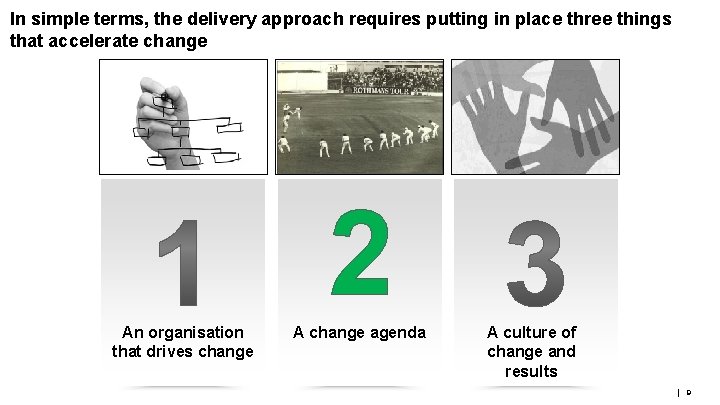
In simple terms, the delivery approach requires putting in place three things that accelerate change 2 An organisation that drives change A change agenda A culture of change and results | 9
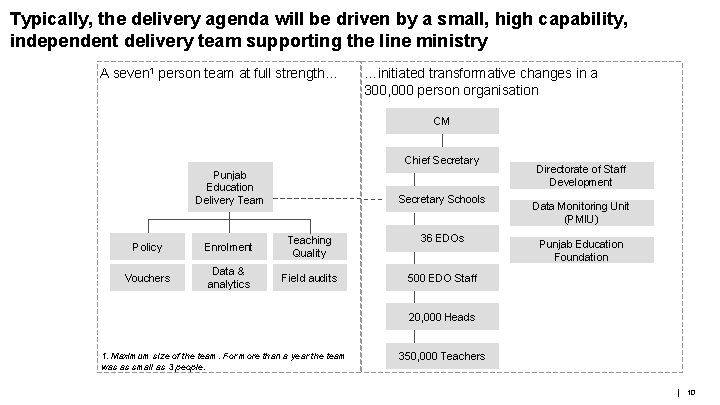
Typically, the delivery agenda will be driven by a small, high capability, independent delivery team supporting the line ministry A seven 1 person team at full strength… …initiated transformative changes in a 300, 000 person organisation CM Chief Secretary Punjab Education Delivery Team Secretary Schools Policy Enrolment Teaching Quality 36 EDOs Vouchers Data & analytics Field audits 500 EDO Staff Directorate of Staff Development Data Monitoring Unit (PMIU) Punjab Education Foundation 20, 000 Heads 1. Maximum size of the team. For more than a year the team was as small as 3 people. 350, 000 Teachers | 10
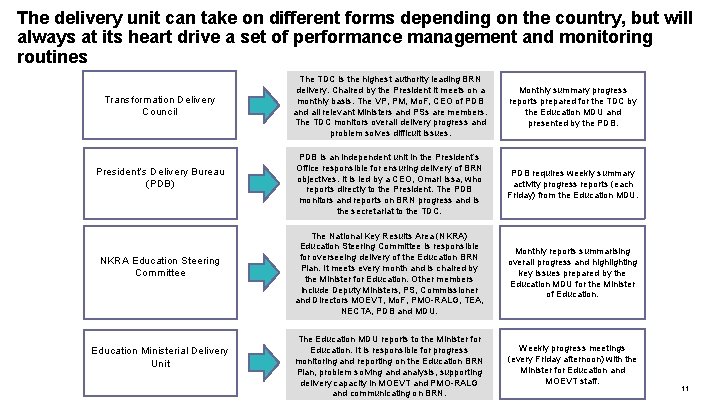
The delivery unit can take on different forms depending on the country, but will always at its heart drive a set of performance management and monitoring routines Transformation Delivery Council President’s Delivery Bureau (PDB) NKRA Education Steering Committee Education Ministerial Delivery Unit The TDC is the highest authority leading BRN delivery. Chaired by the President it meets on a monthly basis. The VP, PM, Mo. F, CEO of PDB and all relevant Ministers and PSs are members. The TDC monitors overall delivery progress and problem solves difficult issues. Monthly summary progress reports prepared for the TDC by the Education MDU and presented by the PDB is an independent unit in the President’s Office responsible for ensuring delivery of BRN objectives. It is led by a CEO, Omari Issa, who reports directly to the President. The PDB monitors and reports on BRN progress and is the secretariat to the TDC. PDB requires weekly summary activity progress reports (each Friday) from the Education MDU. The National Key Results Area (NKRA) Education Steering Committee is responsible for overseeing delivery of the Education BRN Plan. It meets every month and is chaired by the Minister for Education. Other members include Deputy Ministers, PS, Commissioner and Directors MOEVT, Mo. F, PMO-RALG, TEA, NECTA, PDB and MDU. The Education MDU reports to the Minister for Education. It is responsible for progress monitoring and reporting on the Education BRN Plan, problem solving and analysis, supporting delivery capacity in MOEVT and PMO-RALG and communicating on BRN. Monthly reports summarising overall progress and highlighting key issues prepared by the Education MDU for the Minister of Education. Weekly progress meetings (every Friday afternoon) with the Minister for Education and MOEVT staff. 11
![It [the Delivery Unit] was an innovation that was much resisted , but utterly](http://slidetodoc.com/presentation_image_h/b80741b88c3284e349fc4e8d10c94d42/image-12.jpg "It [the Delivery Unit] was an innovation that was much resisted , but utterly")
It [the Delivery Unit] was an innovation that was much resisted , but utterly invaluable and proved its worth time and time again. It was a relatively small organisation, staffed by civil servants but also outsiders from Mc. Kinsey, Bain and other private sector companies, whose job was to track the delivery of key government priorities. It would focus like a laser on an issue, draw up a plan to resolve it working with the department concerned, and then performancemanage it to solution. It would get first-class data which it would use for stocktakes that I took personally with the minister, their key staff and mine, every month or so. ” Tony Blair, UK Prime Minister from 1997 to 2007, writing in his autobiography ‘A Journey’ in 2010 28/11/2020 Mott Mac. Donald | Presentation 12
Section 2 Principles of successful delivery 28/11/2020 Mott Mac. Donald | Presentation 13
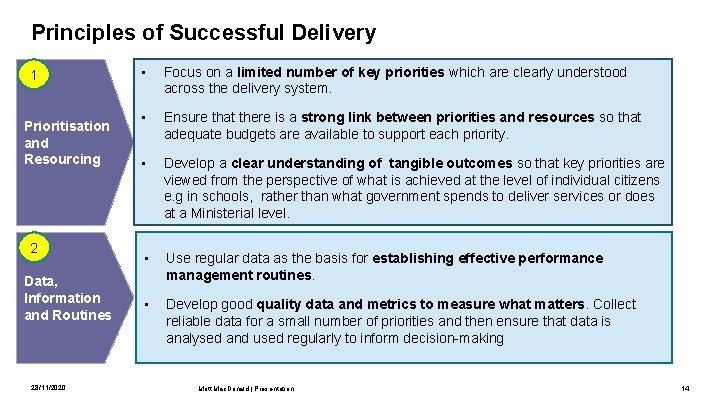
Principles of Successful Delivery 1 Prioritisation and Resourcing 2 Data, Information and Routines 28/11/2020 • Focus on a limited number of key priorities which are clearly understood across the delivery system. • Ensure that there is a strong link between priorities and resources so that adequate budgets are available to support each priority. • Develop a clear understanding of tangible outcomes so that key priorities are viewed from the perspective of what is achieved at the level of individual citizens e. g in schools, rather than what government spends to deliver services or does at a Ministerial level. • Use regular data as the basis for establishing effective performance management routines. • Develop good quality data and metrics to measure what matters. Collect reliable data for a small number of priorities and then ensure that data is analysed and used regularly to inform decision-making Mott Mac. Donald | Presentation 14

Principles of Successful Delivery (continued) 3 Analysis and Understanding of Delivery issues 4 Communication, Accountability and Culture Change 28/11/2020 • Stakeholders are actively engaged in analysing delivery issues and owning outcomes. • Clear understanding of delivery systems to identify the drivers of successful outcomes and the motivations and perceptions of actors throughout the system • Understand involve front-line workers in analysing problems and developing solutions • Develop an effective support and challenge function at national and local levels. • Develop an effective communications strategy to assist in rapidly engendering change and reform to ‘turn around’ a perceived decline or deficit in standards of service delivery Ensure accountability for performance throughout the delivery system. Strike the right balance between planning and delivery, recognising which areas can achieve rapid results and others where it may take a longer time. • • Mott Mac. Donald | Presentation 15

Done right, following 8 principles could actually transform public sector delivery
1. Focus ruthlessly. Don’t be afraid not to touch some of the biggest problems, such as curriculum or textbooks, at the start. 2. Don’t worry too much about strategy and sustainability. Plan quickly. Define stretch targets. Implement. In Punjab, the initial planning phase took only 6 -8 weeks. 3. Monitor with independent, real time data. But like the private sector, not a government official. With only 1, 000 low cost tablets, 50, 000 schools were monitored every month. 4. Review progress. Almost 50 stocktakes with the Chief Minister in Punjab underpinned reform.
5. Ignore traditional advice (sometimes). There is 70 years of empirical evidence in Pakistan to prove it. 6. Instead, innovate to overcome constraints. A tablet based assessment testing 300, 000 grade 3 students every month as a proxy means of behavioral change, mitigating the lack of accountability that teachers face. 7. Let capability trump experience. Almost all of the reform team were simply fresh out of college graduates naïve enough to actually think they could change what hadn’t for 70 years. 8. Above all, be resilient.
Monitoring Progress and Results • Agree upon a small number of key metrics. • Ensure these metrics are understood across the delivery system. • Decide upon the frequency for measuring each metric (weekly/monthly/quarterly/annually). • Frequency will depend upon the nature of the metric. • Develop a simple data collection mechanism with as ‘short’ a delivery chain as possible. Technology can play an important role in shortening delivery chains but it is not essential- a well developed system is more important. • Ensure that data is analysed, discussed and acted upon. Two things that can help here are : i. ) appropriate structures and forums for considering data and ii. ) visualisation 28/11/2020 Mott Mac. Donald | Presentation 19
Monitoring Progress and Results (2) • Feedback is a critical step in establishing effective routines. There are too many cases of local and district officials who submit data and reports every month but who NEVER see any evidence that these are used. • Providing feedback may be time consuming but it is essential for encouraging participation across the delivery and reporting system. • How data is used (whether or not it is ‘high stakes’ for example) will influence those collecting the data. Consideration needs to be given on incentives and checks & balances in the system. • Data integrity is important but don’t let concerns about this stop you from establishing systems. Establish systems first and then take steps to improve data integrity and quality through experience. 28/11/2020 Mott Mac. Donald | Presentation 20
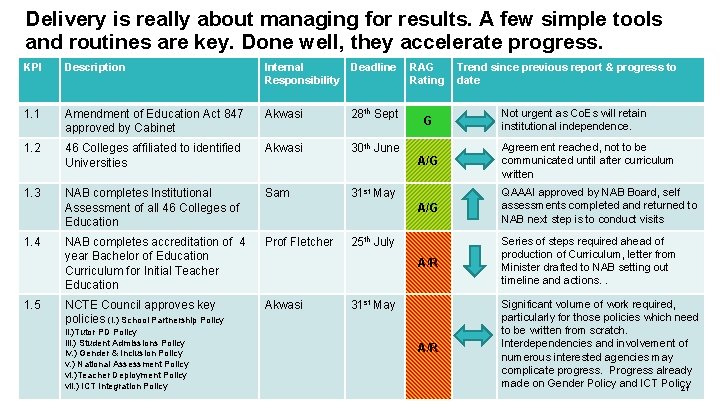
Delivery is really about managing for results. A few simple tools and routines are key. Done well, they accelerate progress. KPI Description Internal Deadline Responsibility 1. 1 Amendment of Education Act 847 approved by Cabinet Akwasi 28 th Sept 1. 2 46 Colleges affiliated to identified Universities Akwasi 30 th June 1. 3 NAB completes Institutional Assessment of all 46 Colleges of Education Sam 31 st May NAB completes accreditation of 4 year Bachelor of Education Curriculum for Initial Teacher Education Prof Fletcher NCTE Council approves key policies (i. ) School Partnership Policy Akwasi 1. 4 1. 5 ii. )Tutor PD Policy iii. ) Student Admissions Policy iv. ) Gender & Inclusion Policy v. ) National Assessment Policy vi. )Teacher Deployment Policy vii. ) ICT Integration Policy RAG Rating G Trend since previous report & progress to date Not urgent as Co. Es will retain institutional independence. A/G Agreement reached, not to be communicated until after curriculum written A/G QAAAI approved by NAB Board, self assessments completed and returned to NAB next step is to conduct visits A/R Series of steps required ahead of production of Curriculum, letter from Minister drafted to NAB setting out timeline and actions. . A/R Significant volume of work required, particularly for those policies which need to be written from scratch. Interdependencies and involvement of numerous interested agencies may complicate progress. Progress already made on Gender Policy and ICT Policy 21 25 th July 31 st May
6. Establish effective performance management tools and routines Heat maps can help to management performance on key indicators EXAMPLE Success | 22
6. Establish effective performance management tools and routines …as well as to highlight and act against failure EXAMPLE Failure | 23
The delivery approach has been used to reform education in a number of countries • • 28/11/2020 United Kingdom Malaysia Pakistan Africa Mott Mac. Donald | Presentation 24
Section 3 What people often ask 28/11/2020 Mott Mac. Donald | Presentation | 25
What are the potential drawbacks of the Delivery Approach? • Is the Unit actually an example of ‘Isomorphic mimicry’ or a ‘Potemkin village’? • Creation of parallel structures, systems and processes. • A preoccupation with structure over substance. • Perverse incentives and gaming. • Focusing on the easily measurable rather than the genuinely important. • Does focusing on short-term changes run the risk of overlooking more substantive issues which would take longer to address? 28/11/2020 Mott Mac. Donald | Presentation 26
What are the characteristics of a good Delivery Unit (1)? 1. Units develop performance management routines focusing on government’s top priorities and support interventions where performance is off-track. 2. Successful Units tend to be small and act as an extension of senior leadership (generally the Prime Minister, President or relevant Minister). 3. For a Delivery Unit to succeed there has to be a real willingness from the very top of government to change behaviour and improve outcomes. 4. In order to be most effective Units should have a direct line of communication to senior leadership and be located outside the system’s line management hierarchy. 5. The Unit’s role is to reflect the delegated authority of senior leader(s) and ensure that the delivery system focuses on successful implementation of priority outcomes. The Delivery Unit does not itself deliver, instead it plays a role in supporting the system to deliver. It requires sufficient analytical capacity to assist in ‘unblocking’ delivery obstacles. 28/11/2020 Mott Mac. Donald | Presentation 27
Characteristics of a Delivery Unit (2) Units can be most effective when they employ staff with a mixture of civil service, private sector and front-line delivery experience. The most successful Units tend to recruit staff on the basis of 5 core competencies: i. Problem solving ii. Data analysis iii. Relationship management iv. Ability to provide feedback and coaching v. 28/11/2020 Can-do attitude and a practical, delivery-focused mind-set Mott Mac. Donald | Presentation 28
Do I really need a Delivery Unit? Key questions to consider include (adapted from World Bank, 2014): i. Do the most senior members of Government genuinely prioritise service delivery? If Yes then this is a solid starting point for considering a Delivery Unit. ii. Does the centre of Government have an existing and effective mechanism for monitoring and performance managing results? If Yes then a Delivery Unit may not be necessary- note though that Delivery Units do much more than ‘monitor’, they also ‘problem solve’ and ‘performance manage’. iii. Does the Government have a clear set of delivery priorities? If No then a Delivery Unit may not be appropriate as it will not by itself provide clarity or prioritisation. iv. Is the Centre of Government using data to regularly analyse performance and take action to improve results? If No then a Delivery Unit can add considerable value in building productive performance management routines. v. Do officials at the centre of Government understand what is required to deliver positive results in schools? Do they have sufficient understanding of what motivates teachers? If No then a Delivery Unit may help to build this understanding and create a linkage between policy makers and front-line professionals. 28/11/2020 Mott Mac. Donald | Presentation 29
How would the delivery approach dovetail with an education sector plan? • My country already has an Education Sector Plan (ESP) so why should I be interested in the Delivery Approach? • ESPs are comprehensive medium-term planning documents which are costed and linked to planning processes. By their very nature they are often comprehensive and incremental. • The Delivery Approach focuses on a small number of key priorities and operatives to a short-term timescale with a very explicit focus on transformational change. • There are potentially strong linkages and complementarities between the Delivery Approach and ESPs. The ESP is an overall framework for education improvement whereas the Delivery Approach is a specific set of tools and approach which can be used to deliver results within this framework. • ESPs can therefore provide the ‘frame’ and ‘context’ within which the Delivery Approach can be applied to a specific prioritised aspect of the ESP. 28/11/2020 Mott Mac. Donald | Presentation 30
A Brief Conclusion on the Delivery Approach • • • The Delivery Approach can be successful in bringing about rapid improvements in easily measurable and understood outputs or targets which measure the availability of inputs e. g. regularity of school funding, increasing teacher attendance, constructing new buildings and producing and distributing lesson plans. The Delivery Approach with its establishment of regular performance monitoring regimes with timely and comparable data and consequences for performance against targets lends itself well to bringing about rapid improvements in easily measurable and understood outputs- particularly where the main constraint to achieving results has been a prior lack of concerted political will, exposure and motivation rather than technical complexity. In short a Delivery Unit may be an appropriate intervention to improve an education system or a specific issue from ‘poor’ to ‘adequate’. A different set of interventions may be required to bring about transformational change across an education system as a whole. 28/11/2020 Mott Mac. Donald | Presentation 31

Back up Case studies 28/11/2020 Mott Mac. Donald | Presentation 32
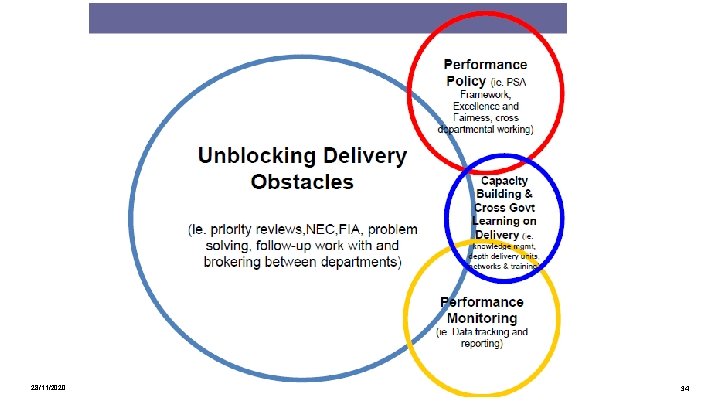
International Examples- the UK • Prime Minister’s Delivery Unit (PMDU) established by Tony Blair in 2001. Led by Sir Michael Barber (2001 -5), Ian Watmore (2005 -7) and Ray Shostak (2007 -10). • Small unit (never more than 40 staff) reporting directly to the PM. Focused on a small number of key outcomes which were a real priority for the PM and his Government, including education and skills. • Worked across Central Government to establish joint performance measurement and accountability structures- shifting focus on to delivery of results as well as formulation of policy. • Conducted short (eight week) and confidential problem solving reviews with government departments to understand address key delivery challenges. • Moved beyond simple target setting and evolved greater focus on understanding delivery systems and the levers (hard and soft) used to deliver outcomes. 28/11/2020 Mott Mac. Donald | Presentation 33
28/11/2020 Mott Mac. Donald | Presentation 34
The UK- Barriers and Outcomes The main barriers to delivery in the UK education system were: 1. Focus on process rather than outcomes. 2. Lack of clarity over responsibility and accountability for results between national government and Local Authorities. 3. Inconsistent performance across and within Local Authorities. Some of the key outcomes achieved through application of the Delivery Approach included: i. Significant improvement in performance of London secondary schools- from the worst performing region in the country to the best performing between 2003 and 2010. ii. Improvements in educational attainment of the poorest and most disadvantaged pupils at primary and secondary levels. iii. Dramatic increase in the number of people taking Apprenticeships. 28/11/2020 Mott Mac. Donald | Presentation 35
International Examples- Malaysia • Performance Management & Delivery Unit (PEMANDU) established in 2009, responsible for overseeing Government Transformation Programme and Economic Transformation Programme. • Led by high-profile appointee from private sector (Idris Jala) who introduced ‘Delivery Labs’ as a means of bringing key stakeholders together to work intensively on detailed practical solutions to delivery issues. • Held Open Days to publicise plans and invite critical comments from members of the public, the initial round of Open Days involved more than 20, 000 participants. • Introduction of ‘ 3 Feet Plans’ which are extremely detailed delivery plans monitored by PEMANDU on a weekly basis. • ‘Malaysia has a centralised education system which has proved conducive for a detailed ‘command control’ target setting approach. 28/11/2020 Mott Mac. Donald | Presentation 36
Malaysia- Barriers and Outcomes The main barriers to delivery in the Malaysian education system were: 1. 2. 3. 4. Focus on process and procedures rather than results. Analysis and use of performance data. Lack of clarity and accountability for results. Inadequate link between resourcing and priority areas. Some of the key outcomes achieved through application of the Delivery Approach included: i. Dramatic success in expanding access to pre-primary education. ii. Improvements in important aspects of school performance at primary and secondary levels. iii. Increased public understanding of education priorities and strategies for their achievement. 28/11/2020 Mott Mac. Donald | Presentation 37
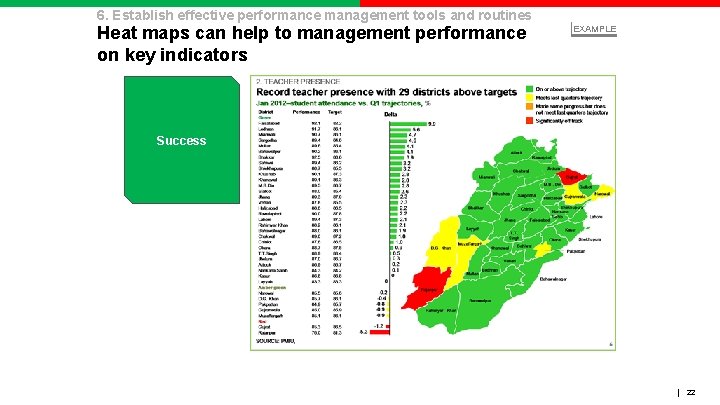
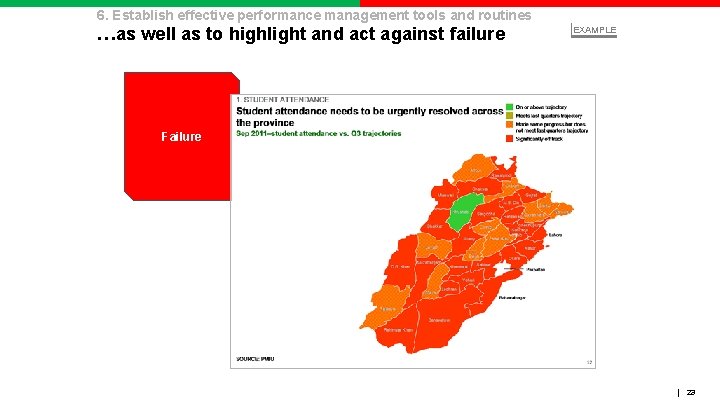
International Examples- Pakistan (Punjab) • • The Punjab Education Reform Roadmap started in late 2010. It was driven by the Chief Minister of Punjab who worked closely with Sir Michael Barber (DFID’s Special Representative on Education in Pakistan and former Head of the UK’s PMDU). From 2011 through until 2013 the Roadmap focused exclusively on four key target areas: teacher attendance, student attendance, provision of school facilities and education official monitoring visits to schools. The Roadmap established a real-time performance monitoring regime with ‘heat map’ visual summaries of progress against the key targets (disaggregated across the 36 Districts) being used in bi-monthly stocktakes chaired by the Chief Minister. Additional targets have now been added with a greater emphasis on education quality and learning outcomes. 28/11/2020 Mott Mac. Donald | Presentation 38
Punjab- Barriers and Outcomes The main barriers to delivery in Punjab’s education system were: 1. 2. 3. 4. Focus on process rather than results. Absence of regular and reliable performance data. Lack of accountability for results. Inadequate prioritisation of available resources on specific objectives. Some of the key outcomes achieved through application of the Delivery Approach included: i. Highly significant increase in school attendance- by 2014 around one and a half million additional primary-age children had enrolled in school since 2011 ii. Highly significant increase in teacher attendance- by 2014 more than 35, 00 extra teachers were present at school every day compared with 2011. iii. Improvements in provision of school infrastructure and facilities. 28/11/2020 Mott Mac. Donald | Presentation 39
- Slides: 39