
Overview of Continuous WaterQuality Monitoring Purpose of Monitoring

- Slides: 37
Overview of Continuous Water-Quality Monitoring
Purpose of Monitoring n Define the objectives of the water quality monitoring project 1. 2. 3. 4. Environmental impacts of effluent Contaminant alerts Plume tracking Trends
How will data be used ? n Investigate variations in water quality 1. 2. 3. 4. 5. Event Diurnal Monthly Seasonal Annual Evaluate loads (requires flows) n Regulations (daily mean, max, min) n Threshold warnings n Development of surrogate relations n
Design of Monitoring Plan n Data requirements 1. Period and duration 1. 2. 3. 2. Frequency of data collection 1. 2. 3. Seasonal Short term Long-term Continuous or discrete 15 minute, hourly, daily, monthly, etc… Sensor selection
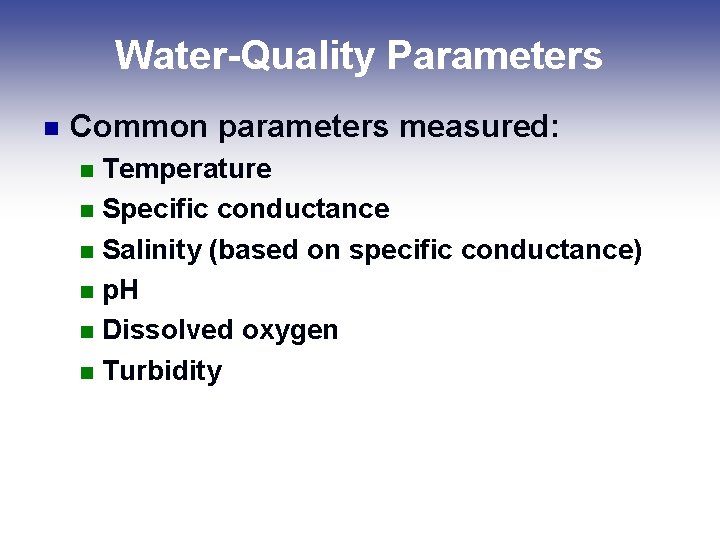
Water-Quality Parameters n Common parameters measured: Temperature n Specific conductance n Salinity (based on specific conductance) n p. H n Dissolved oxygen n Turbidity n
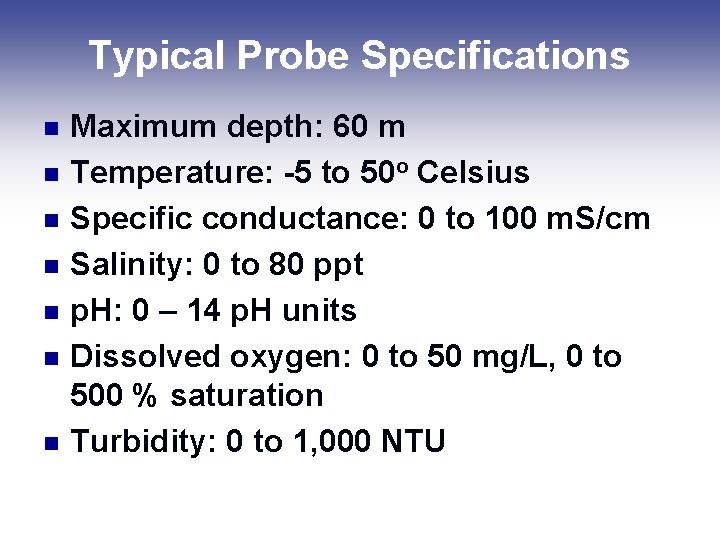
Typical Probe Specifications n n n n Maximum depth: 60 m Temperature: -5 to 50 o Celsius Specific conductance: 0 to 100 m. S/cm Salinity: 0 to 80 ppt p. H: 0 – 14 p. H units Dissolved oxygen: 0 to 50 mg/L, 0 to 500 % saturation Turbidity: 0 to 1, 000 NTU
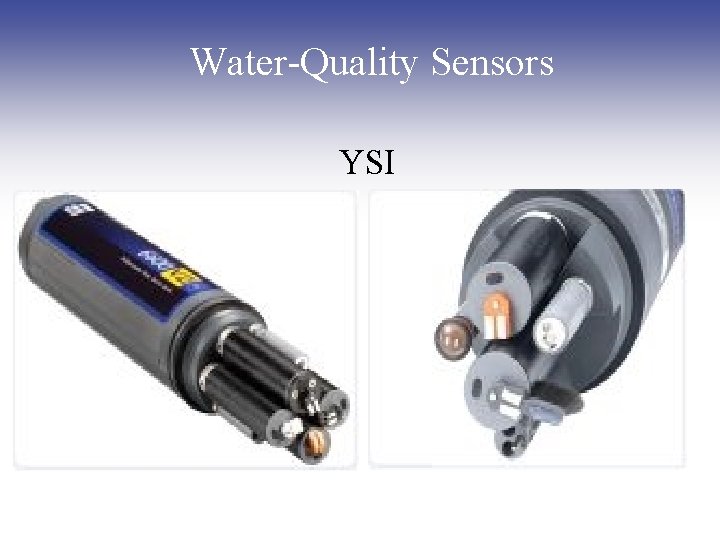
Water-Quality Sensors YSI
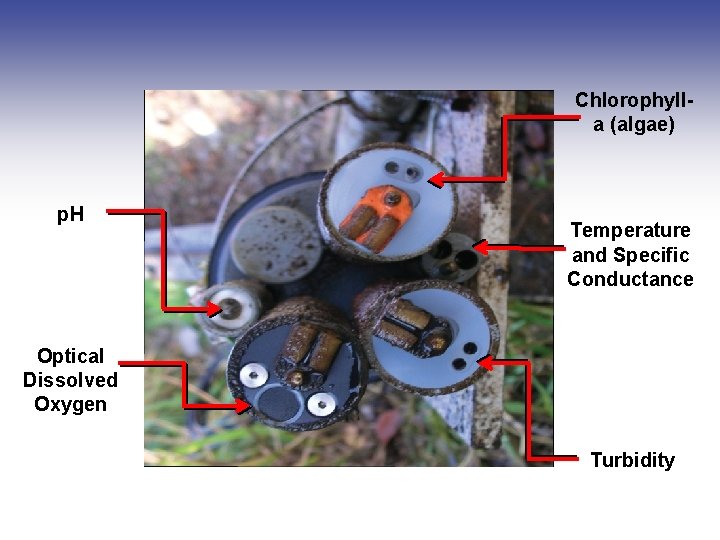
Chlorophylla (algae) p. H Temperature and Specific Conductance Optical Dissolved Oxygen Turbidity
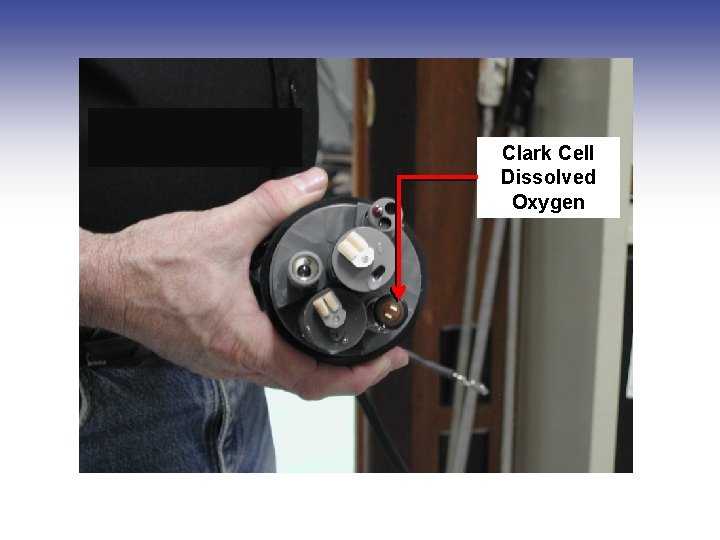
Clark Cell Dissolved Oxygen
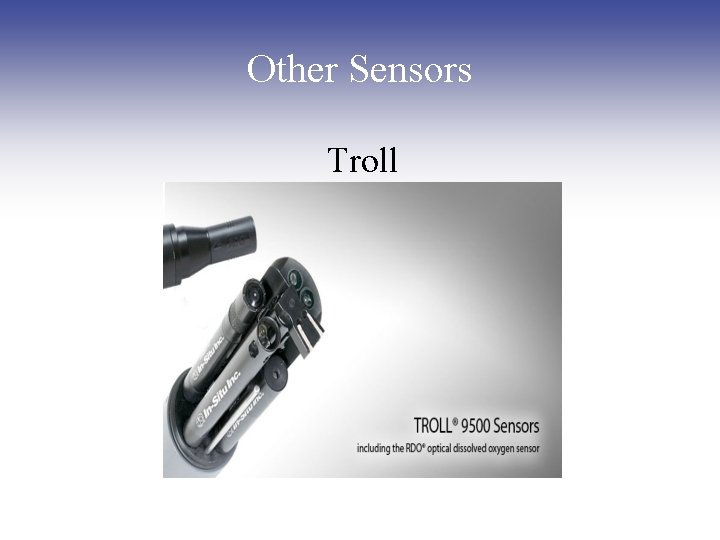
Other Sensors Troll
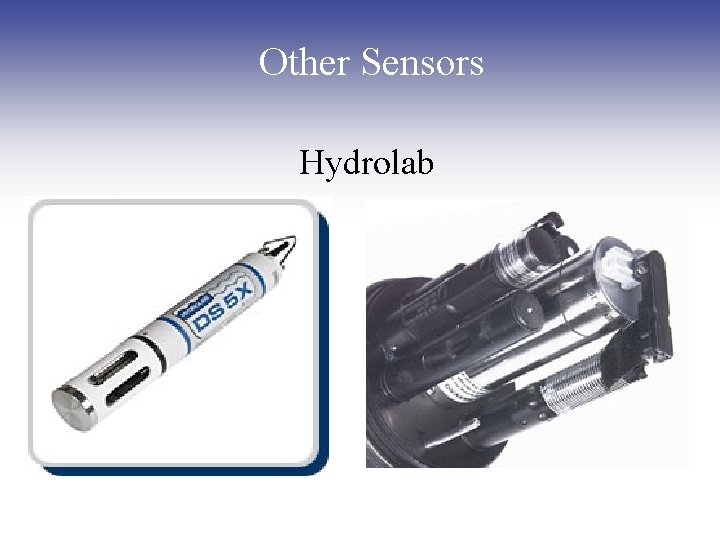
Other Sensors Hydrolab
Temperature n n Thermistor Resistance changes with temperature Resistance converted to temperature using algorithm Common unit: degrees Celsius
Specific Conductance n n n Measure of the water’s ability to conduct electrical current Electrodes must be submerged in water Approximate measure of the amount of dissolved solids or ions in water Specific conductance is conductance “normalized” to 25 degrees C Common unit: u. S/cm (micro. Siemens per centimeter), also umhos/cm (same units)
Salinity n n Not measured directly Computed parameter based on conductivity and temperature Essentially measuring the amount of chloride in water Common unit: ppt (parts per thousand)
p. H n n n Measure of acid/base characteristics p. H 7. 0 = neutral p. H > 7. 0 = alkaline/basic p. H < 7. 0 = acidic Measures differential of hydrogen ions (H+) inside/outside of electrode Common unit: standard p. H units
Dissolved Oxygen n 2 major types Rapid pulse Clark cell n Optical n n Common units: mg/L and % saturation
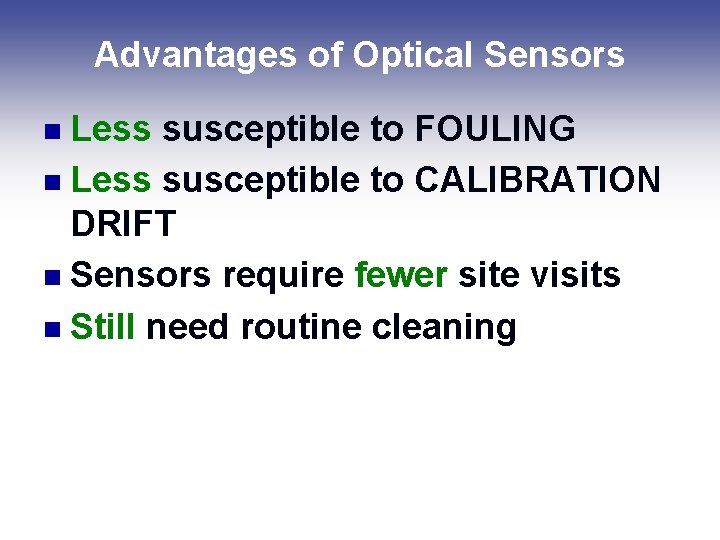
Advantages of Optical Sensors Less susceptible to FOULING n Less susceptible to CALIBRATION DRIFT n Sensors require fewer site visits n Still need routine cleaning n
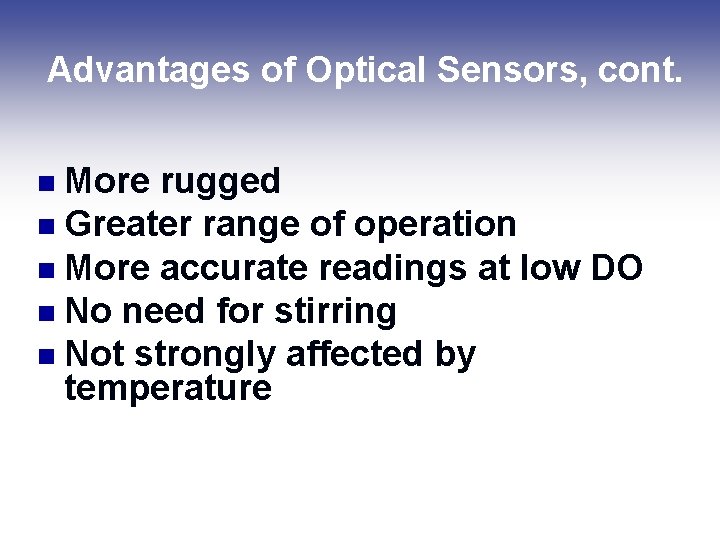
Advantages of Optical Sensors, cont. More rugged n Greater range of operation n More accurate readings at low DO n No need for stirring n Not strongly affected by temperature n
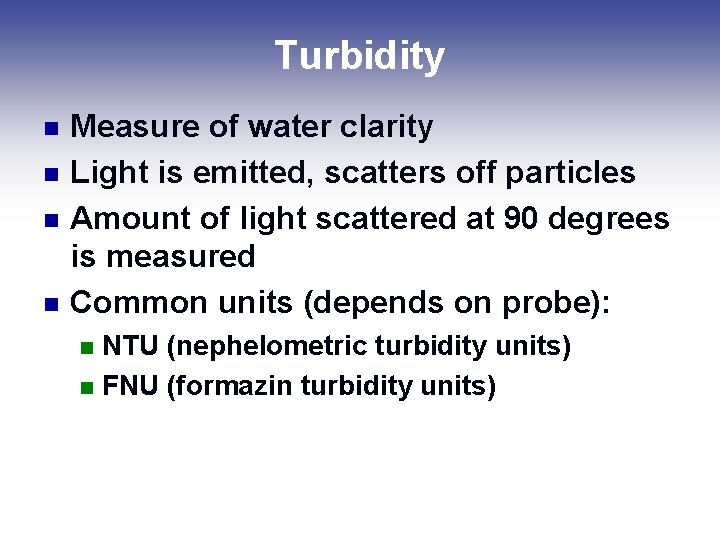
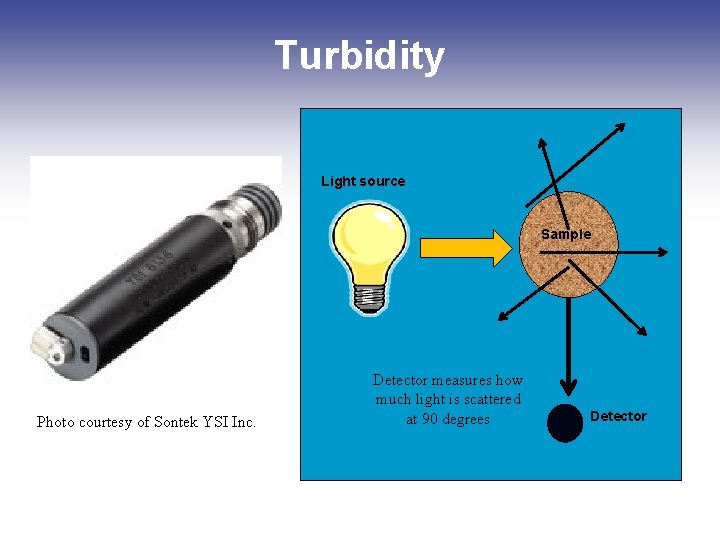
Turbidity n n Measure of water clarity Light is emitted, scatters off particles Amount of light scattered at 90 degrees is measured Common units (depends on probe): NTU (nephelometric turbidity units) n FNU (formazin turbidity units) n
Turbidity Light source Sample Photo courtesy of Sontek YSI Inc. Detector measures how much light is scattered at 90 degrees Detector
Design of Monitoring Plan n Installation type 1. Flow through 2. In situ 1. 2. internal logger and power external logger and power
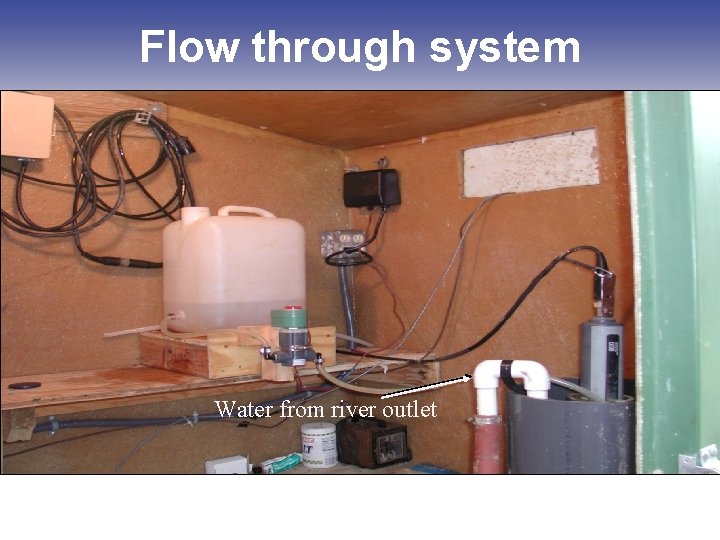
Flow through system Water from river outlet
Flow through n Advantages 1. 2. 3. n Secure Reduced fouling Real-time data access Disadvantages 1. 2. 3. Requires AC electric service More maintenance Results can be less accurate (turbidity)
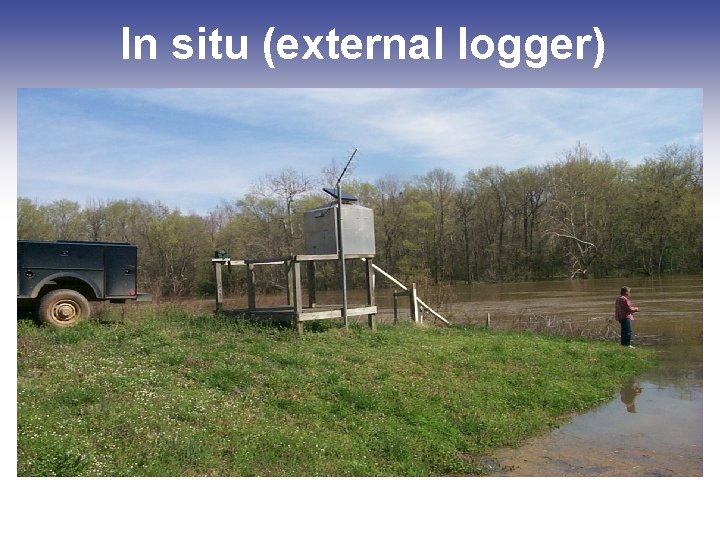
In situ (external logger)
In situ (external logger) n Advantages 1. 2. 3. 4. n Data are secure Real-time data access Instream monitoring often yields more accurate results No AC requirement permits remote sites Disadvantages 1. 2. Sonde and probes are vulnerable to vandalism and loss Probes are subject to fouling and damage from debris
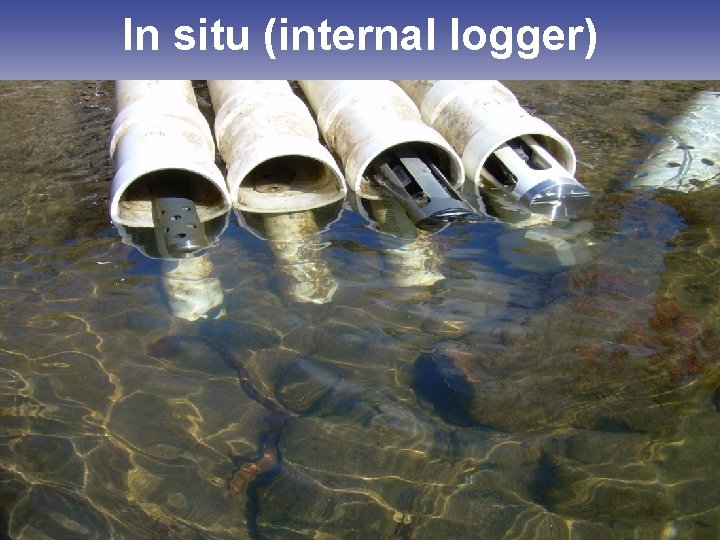
In situ (internal logger)
In situ (internal logger) n Advantages 1. 2. 3. n Remote locations possible Instream monitoring often yields more accurate results Less maintenance Disadvantages 1. 2. 3. Telemetry not an option Sonde, probes, and data are vulnerable to vandalism and loss Probes are subject to fouling and damage from debris
Continuous Water Quality Monitoring Advantages n n n Needed in rapidly changing systems Provides better understanding of interaction between constituents Provides better understanding of transport processes Disadvantages n n n Equipment costs are greater Operation and maintenance costs are greater Vulnerable to damage and/or loss
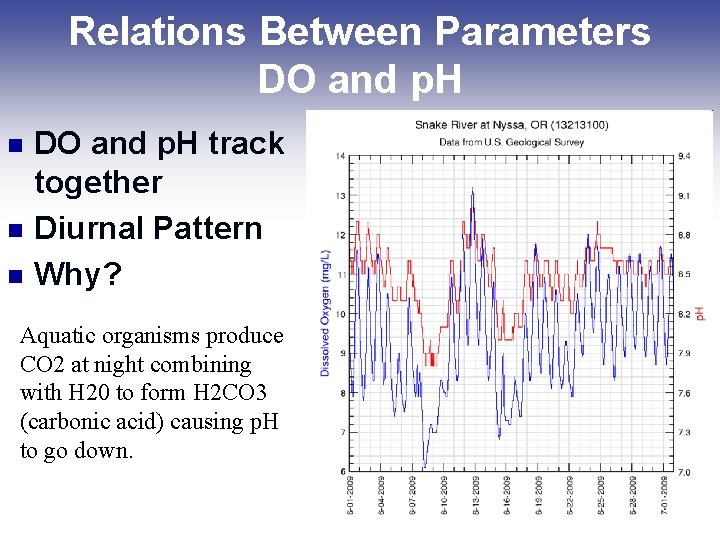
Relations Between Parameters DO and p. H n n n DO and p. H track together Diurnal Pattern Why? Aquatic organisms produce CO 2 at night combining with H 20 to form H 2 CO 3 (carbonic acid) causing p. H to go down.
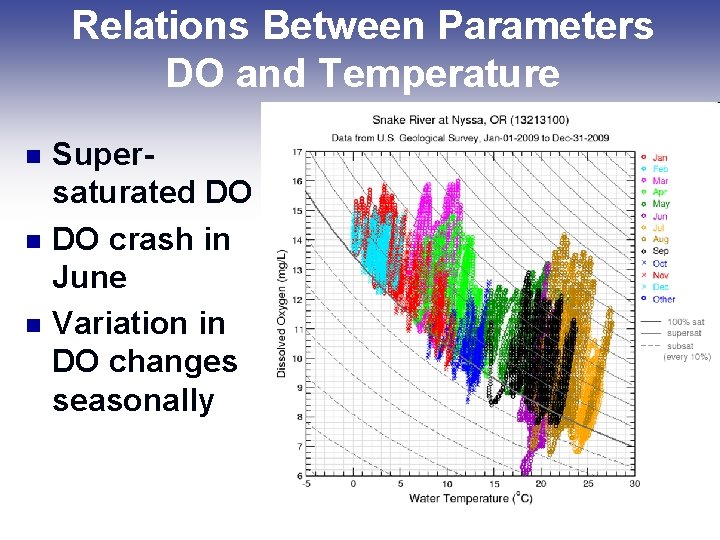
Relations Between Parameters DO and Temperature n n n Supersaturated DO DO crash in June Variation in DO changes seasonally
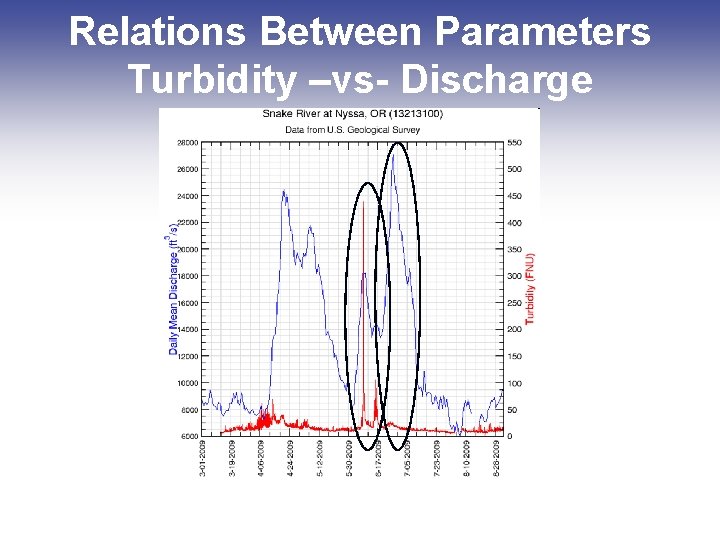
Relations Between Parameters Turbidity –vs- Discharge
Discrete vs Continuous Monitoring
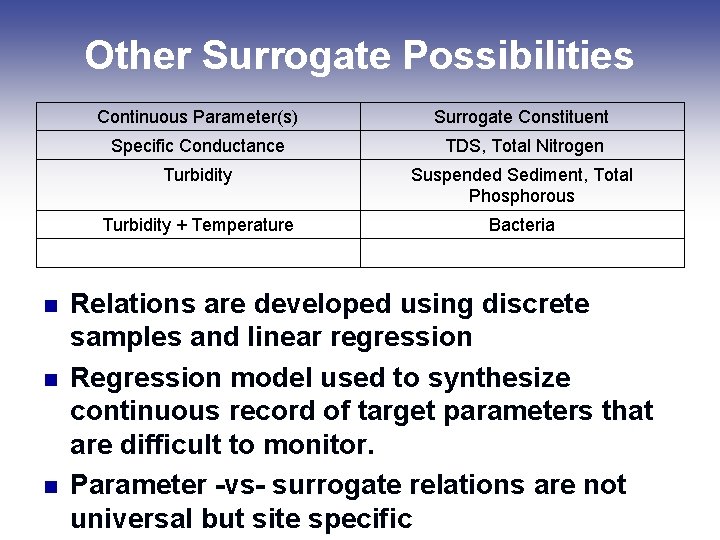
Other Surrogate Possibilities n n n Continuous Parameter(s) Surrogate Constituent Specific Conductance TDS, Total Nitrogen Turbidity Suspended Sediment, Total Phosphorous Turbidity + Temperature Bacteria Relations are developed using discrete samples and linear regression Regression model used to synthesize continuous record of target parameters that are difficult to monitor. Parameter -vs- surrogate relations are not universal but site specific
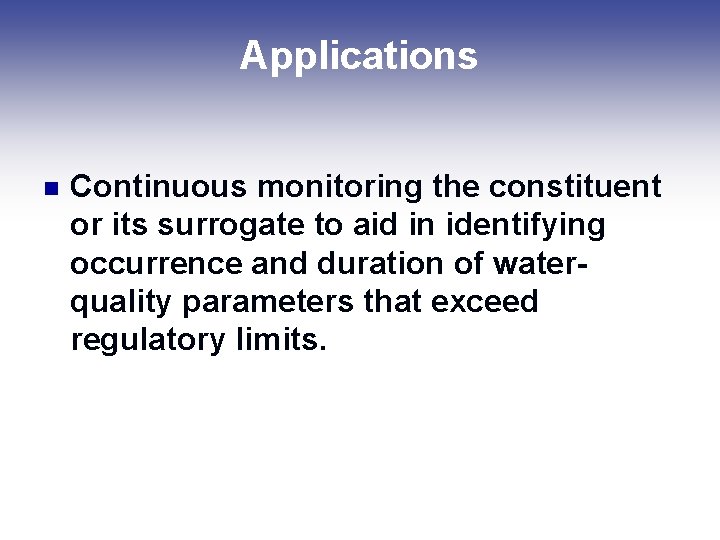
Applications n Continuous monitoring the constituent or its surrogate to aid in identifying occurrence and duration of waterquality parameters that exceed regulatory limits.
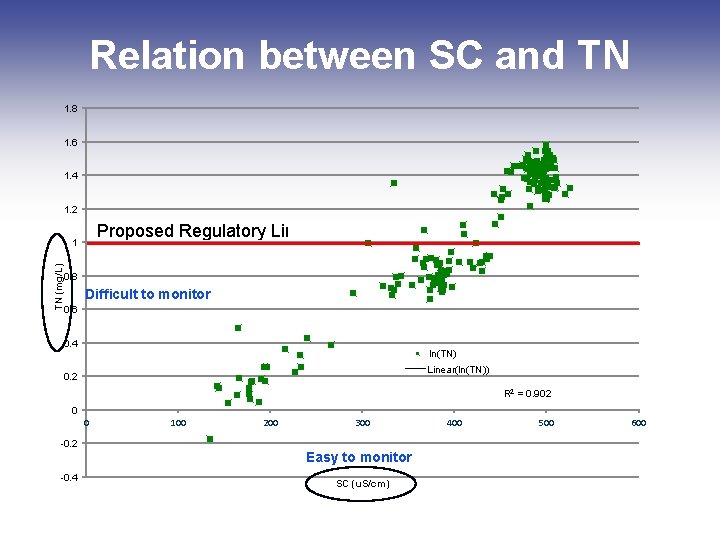
Relation between SC and TN 1. 8 1. 6 1. 4 1. 2 Proposed Regulatory Limit = 1. 0 mg/L TN (mg/L) 1 0. 8 Difficult to monitor 0. 6 0. 4 ln(TN) Linear(ln(TN)) 0. 2 R 2 = 0. 902 0 0 -0. 2 -0. 4 100 200 300 Easy to monitor SC (u. S/cm) 400 500 600
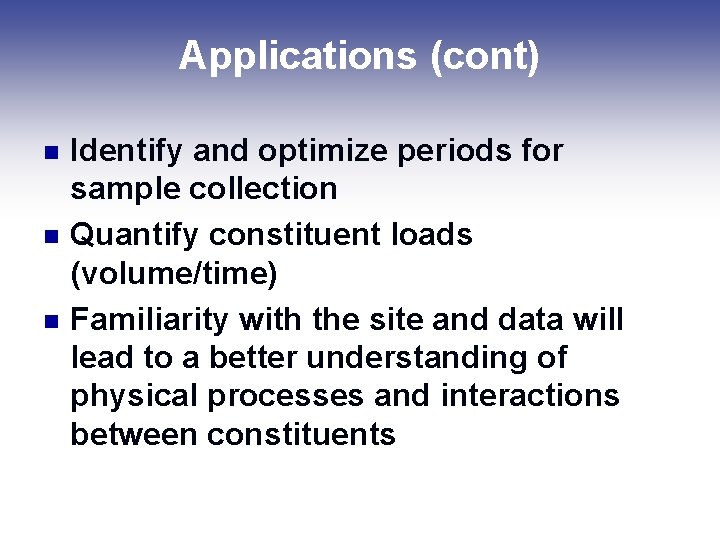
Applications (cont) n n n Identify and optimize periods for sample collection Quantify constituent loads (volume/time) Familiarity with the site and data will lead to a better understanding of physical processes and interactions between constituents
Questions?