
Overview of Computer Organization Thorne Edition 2 Section
- Slides: 10
Overview of Computer Organization Thorne, Edition 2 : Section 1. 1, 1. 2, 2. 1 (Irvine, Edition VI : Section 1. 1, 1. 2) Based on Course Notes (Fall 06) Prepared by Pearce/Schramm/Wainer SYSC 3006 1
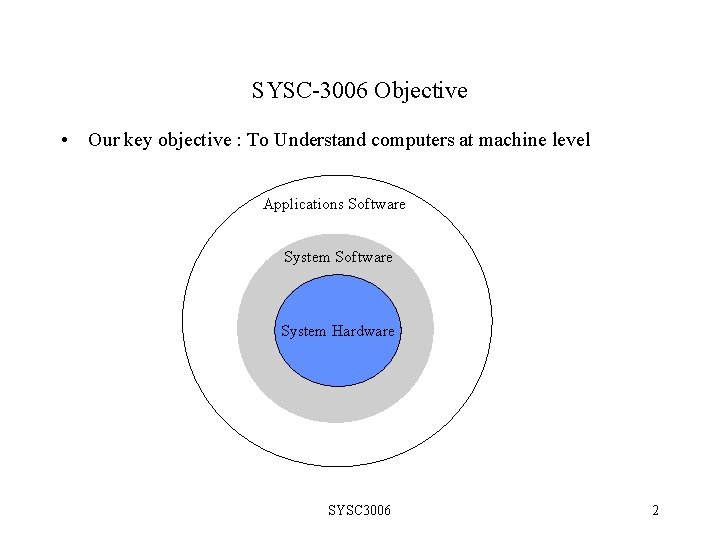
SYSC-3006 Objective • Our key objective : To Understand computers at machine level Applications Software System Hardware SYSC 3006 2
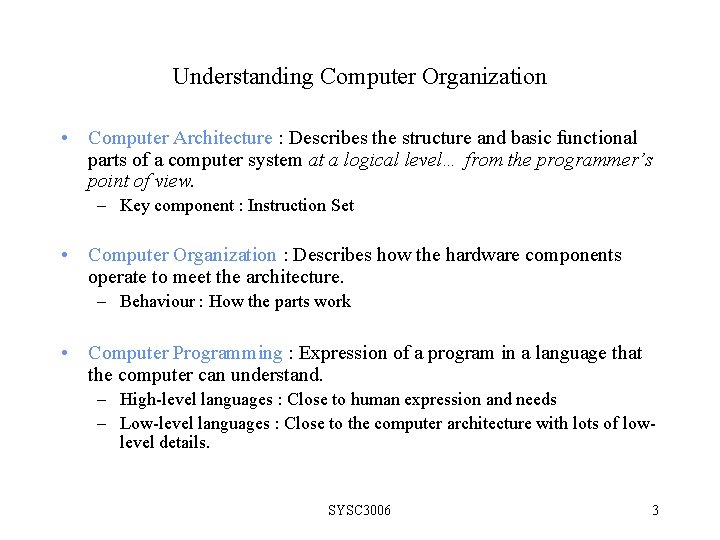
Understanding Computer Organization • Computer Architecture : Describes the structure and basic functional parts of a computer system at a logical level… from the programmer’s point of view. – Key component : Instruction Set • Computer Organization : Describes how the hardware components operate to meet the architecture. – Behaviour : How the parts work • Computer Programming : Expression of a program in a language that the computer can understand. – High-level languages : Close to human expression and needs – Low-level languages : Close to the computer architecture with lots of lowlevel details. SYSC 3006 3
Computers are Complex Systems • Problem – How can we understand programming at a machine level ? • How do the millions of transistors in a computer support a program ? • Solution : The Programmer’s Model – It is an abstract model appropriate for explaining software at the machine level • No transistor details! • It is widely used in practice • It models computer as a state-based system (Later) SYSC 3006 4
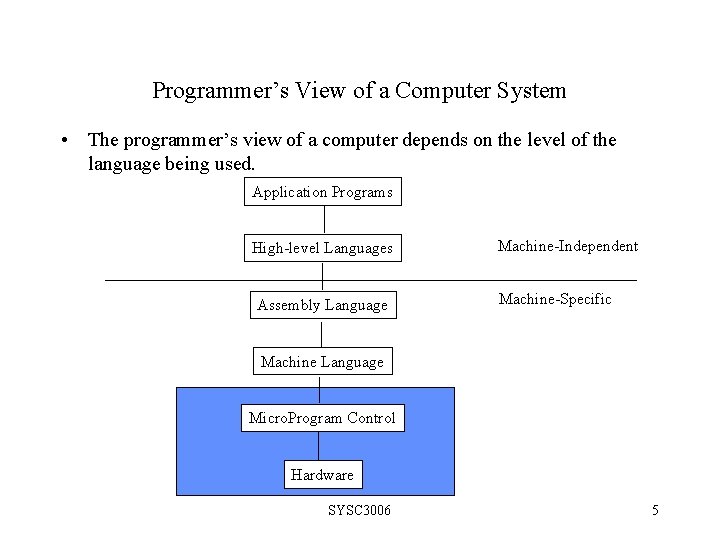
Programmer’s View of a Computer System • The programmer’s view of a computer depends on the level of the language being used. Application Programs High-level Languages Assembly Language Machine-Independent Machine-Specific Machine Language Micro. Program Control Hardware SYSC 3006 5
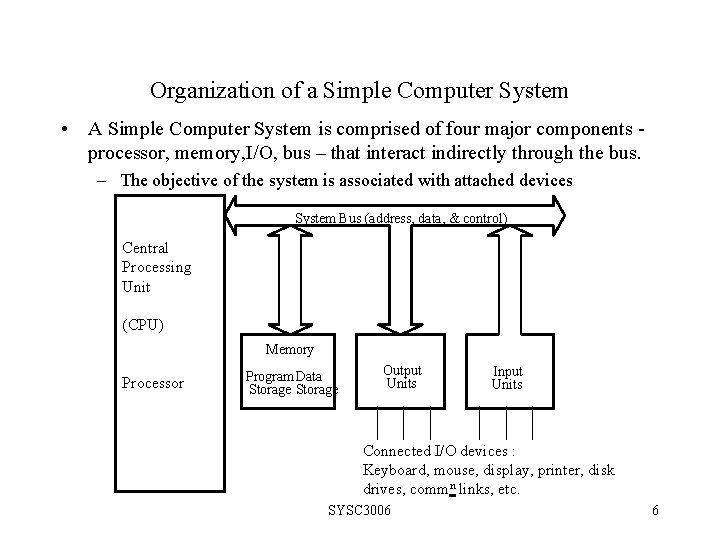
Organization of a Simple Computer System • A Simple Computer System is comprised of four major components processor, memory, I/O, bus – that interact indirectly through the bus. – The objective of the system is associated with attached devices System Bus (address, data, & control) Central Processing Unit (CPU) Memory Processor Program Data Storage Output Units Input Units Connected I/O devices : Keyboard, mouse, display, printer, disk drives, commn links, etc. SYSC 3006 6
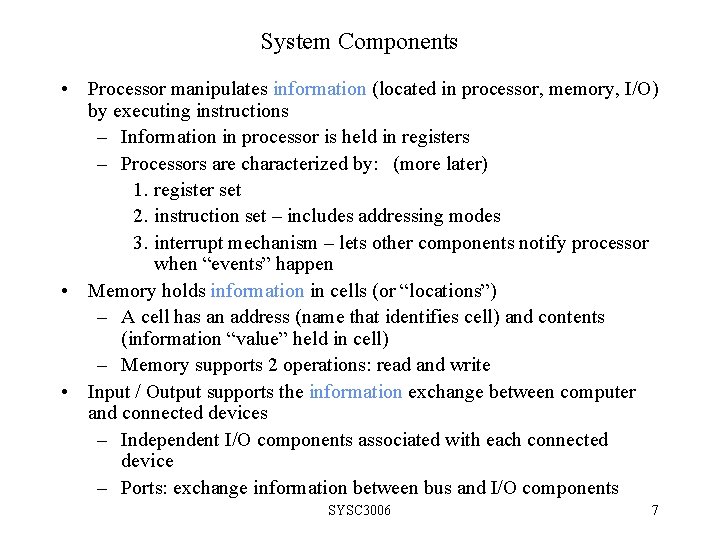
System Components • Processor manipulates information (located in processor, memory, I/O) by executing instructions – Information in processor is held in registers – Processors are characterized by: (more later) 1. register set 2. instruction set – includes addressing modes 3. interrupt mechanism – lets other components notify processor when “events” happen • Memory holds information in cells (or “locations”) – A cell has an address (name that identifies cell) and contents (information “value” held in cell) – Memory supports 2 operations: read and write • Input / Output supports the information exchange between computer and connected devices – Independent I/O components associated with each connected device – Ports: exchange information between bus and I/O components SYSC 3006 7
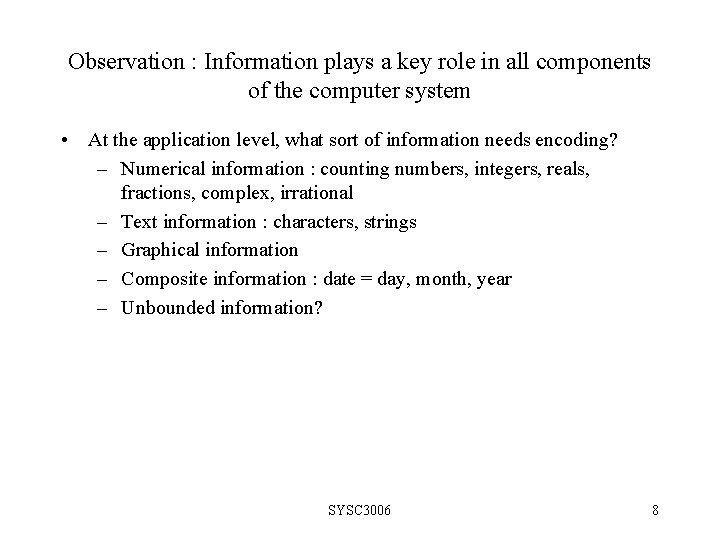
Observation : Information plays a key role in all components of the computer system • At the application level, what sort of information needs encoding? – Numerical information : counting numbers, integers, reals, fractions, complex, irrational – Text information : characters, strings – Graphical information – Composite information : date = day, month, year – Unbounded information? SYSC 3006 8
Observation : Information plays a key role in all components of the computer system • What are the hardware limitations of a computer in storing information? 1. A single transistor is switched between two states · on / off ; high / low ; 0 / 1 – All information must be encoded in 2 -state values! – one BInary digi. T = one bit = one 2 -state value of either 0 or 1 2. Registers, cells and ports are built using fixed numbers of transistors • Byte = values that are 8 -bits wide • Information is are encoded in a fixed number of bits and therefore has a finite limitation of the range of values. For n-bit width 2 n different value SYSC 3006 9
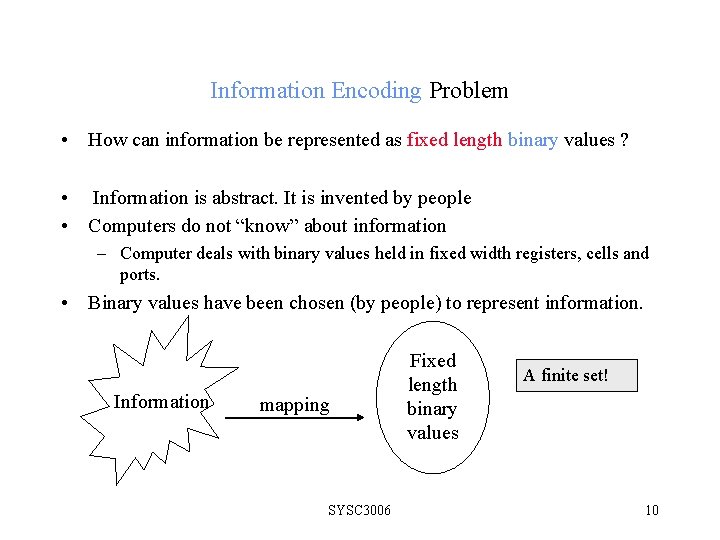
Information Encoding Problem • How can information be represented as fixed length binary values ? • Information is abstract. It is invented by people • Computers do not “know” about information – Computer deals with binary values held in fixed width registers, cells and ports. • Binary values have been chosen (by people) to represent information. Information mapping SYSC 3006 Fixed length binary values A finite set! 10