
Overview of Computer Organization Chapter 1 S Dandamudi

- Slides: 50
Overview of Computer Organization Chapter 1 S. Dandamudi 2003 Ó S. Dandamudi To be used with S. Dandamudi, “Fundamentals of Computer Organization and Design, ” Springer- Verlag, 2003.
Outline • Introduction • Processor * Basic Terminology and Notation Views of computer systems • User’s view • Programmer’s view * Advantages of high-level languages * Why program in assembly language? • Architect’s view • Implementer’s view 2003 * Execution cycle * Pipelining * RSIC and CISC • Memory * Basic memory operations * Design issues • • Input/Output Interconnection: The glue Historical Perspective Technological Advances Ó S. Dandamudi To be used with S. Dandamudi, “Fundamentals of Computer Organization and Design, ” Springer- Verlag, 2003. 2
Introduction • Some basic terms * * Computer architecture Computer organization Computer design Computer programming • Various views of computer systems * * 2003 User’s view Programmer’s view Architect’s view Implementer’s view Ó S. Dandamudi To be used with S. Dandamudi, “Fundamentals of Computer Organization and Design, ” Springer- Verlag, 2003. 3
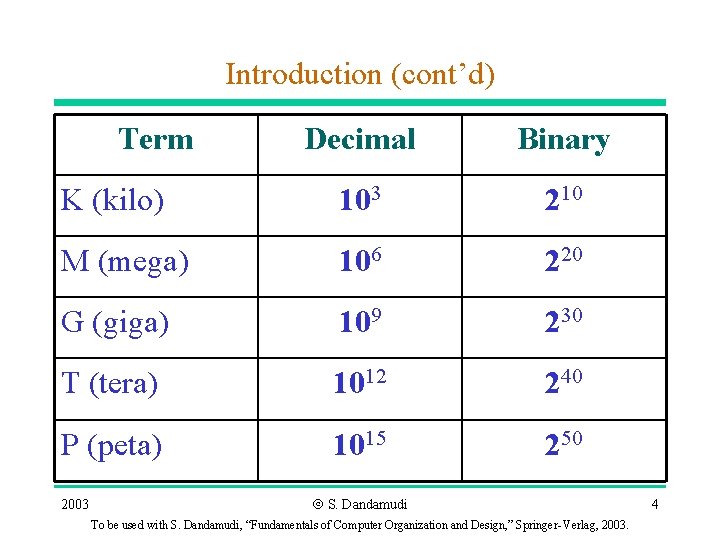
Introduction (cont’d) Term Decimal Binary K (kilo) 103 210 M (mega) 106 220 G (giga) 109 230 T (tera) 1012 240 P (peta) 1015 250 2003 Ó S. Dandamudi To be used with S. Dandamudi, “Fundamentals of Computer Organization and Design, ” Springer- Verlag, 2003. 4
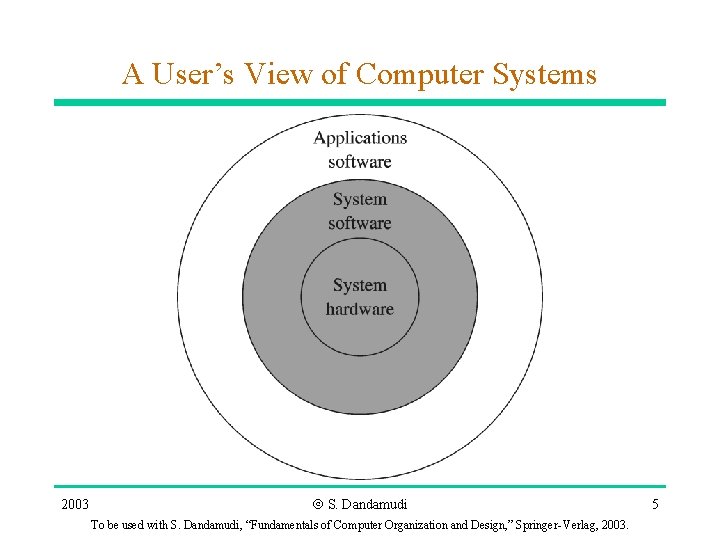
A User’s View of Computer Systems 2003 Ó S. Dandamudi To be used with S. Dandamudi, “Fundamentals of Computer Organization and Design, ” Springer- Verlag, 2003. 5
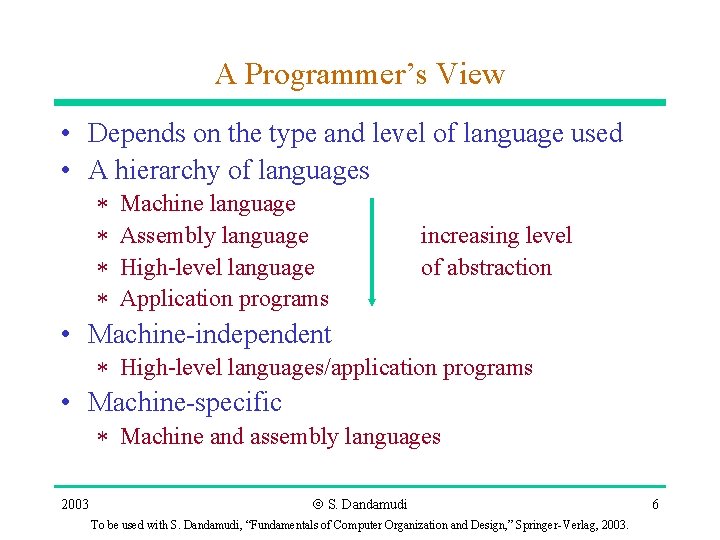
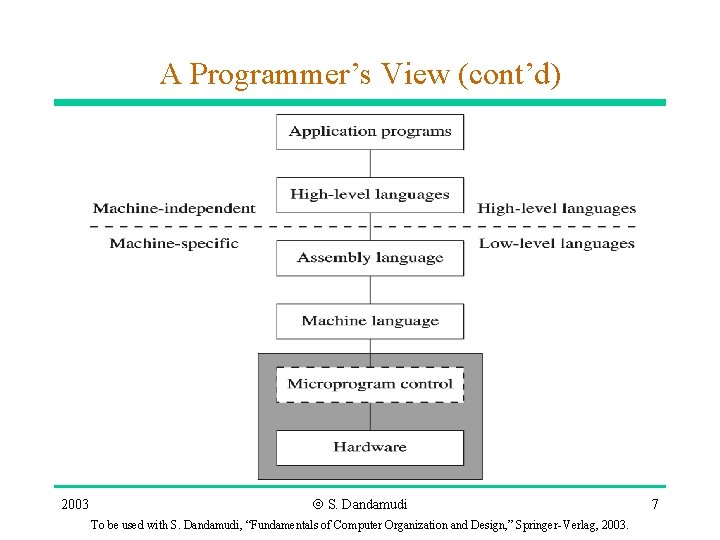
A Programmer’s View • Depends on the type and level of language used • A hierarchy of languages * * Machine language Assembly language High-level language Application programs increasing level of abstraction • Machine-independent * High-level languages/application programs • Machine-specific * Machine and assembly languages 2003 Ó S. Dandamudi To be used with S. Dandamudi, “Fundamentals of Computer Organization and Design, ” Springer- Verlag, 2003. 6
A Programmer’s View (cont’d) 2003 Ó S. Dandamudi To be used with S. Dandamudi, “Fundamentals of Computer Organization and Design, ” Springer- Verlag, 2003. 7
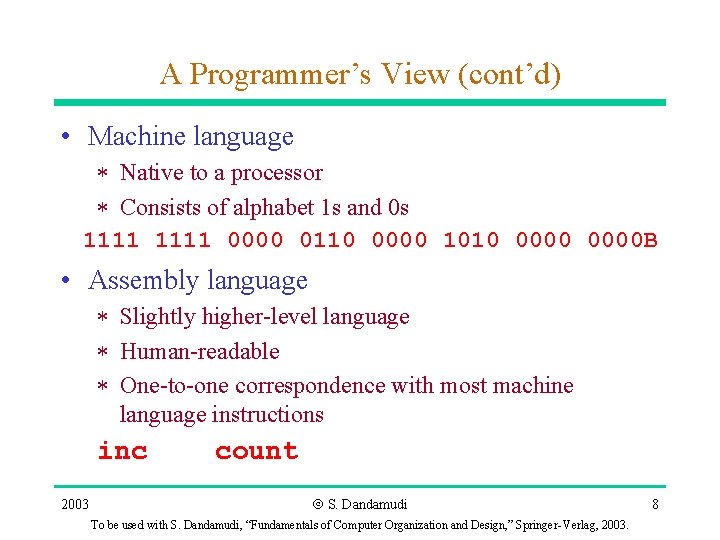
A Programmer’s View (cont’d) • Machine language * Native to a processor * Consists of alphabet 1 s and 0 s 1111 0000 0110 0000 1010 0000 B • Assembly language * Slightly higher-level language * Human-readable * One-to-one correspondence with most machine language instructions inc 2003 count Ó S. Dandamudi To be used with S. Dandamudi, “Fundamentals of Computer Organization and Design, ” Springer- Verlag, 2003. 8
A Programmer’s View (cont’d) • Readability of assembly language instructions is much better than the machine language instructions » Machine language instructions are a sequence of 1 s and 0 s Assembly Language 2003 Machine Language (in Hex) inc result FF 060 A 00 mov and add class_size, 45 mask, 128 marks, 10 C 7060 C 002 D 00 80260 E 0080 83060 F 000 A Ó S. Dandamudi To be used with S. Dandamudi, “Fundamentals of Computer Organization and Design, ” Springer- Verlag, 2003. 9
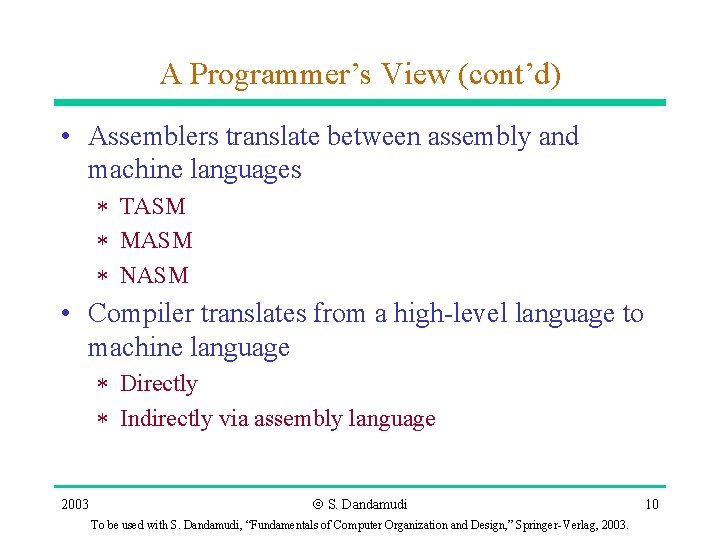
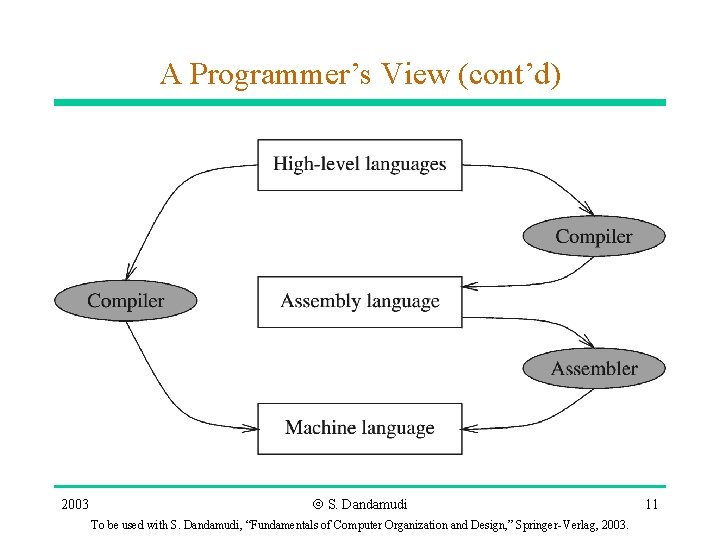
A Programmer’s View (cont’d) • Assemblers translate between assembly and machine languages * TASM * MASM * NASM • Compiler translates from a high-level language to machine language * Directly * Indirectly via assembly language 2003 Ó S. Dandamudi To be used with S. Dandamudi, “Fundamentals of Computer Organization and Design, ” Springer- Verlag, 2003. 10
A Programmer’s View (cont’d) 2003 Ó S. Dandamudi To be used with S. Dandamudi, “Fundamentals of Computer Organization and Design, ” Springer- Verlag, 2003. 11
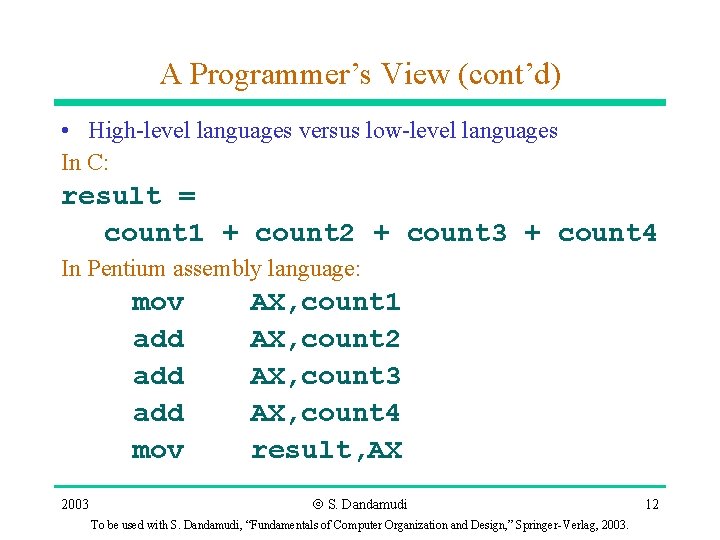
A Programmer’s View (cont’d) • High-level languages versus low-level languages In C: result = count 1 + count 2 + count 3 + count 4 In Pentium assembly language: mov add add mov 2003 AX, count 1 AX, count 2 AX, count 3 AX, count 4 result, AX Ó S. Dandamudi To be used with S. Dandamudi, “Fundamentals of Computer Organization and Design, ” Springer- Verlag, 2003. 12
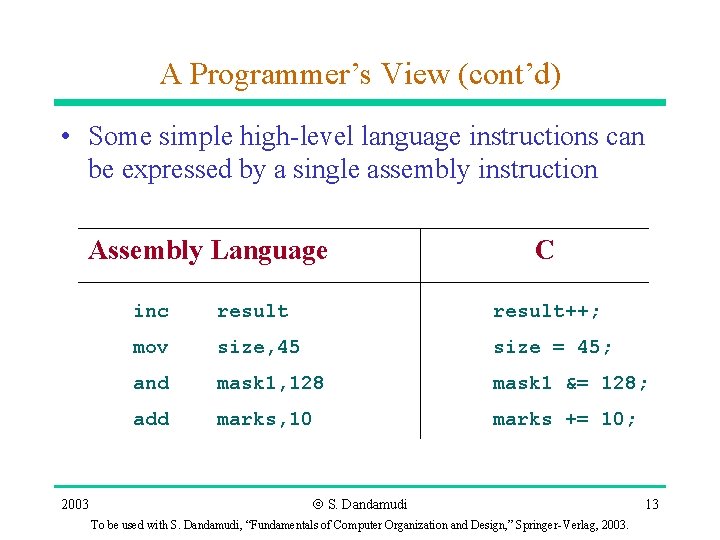
A Programmer’s View (cont’d) • Some simple high-level language instructions can be expressed by a single assembly instruction Assembly Language 2003 C inc result++; mov size, 45 size = 45; and mask 1, 128 mask 1 &= 128; add marks, 10 marks += 10; Ó S. Dandamudi To be used with S. Dandamudi, “Fundamentals of Computer Organization and Design, ” Springer- Verlag, 2003. 13
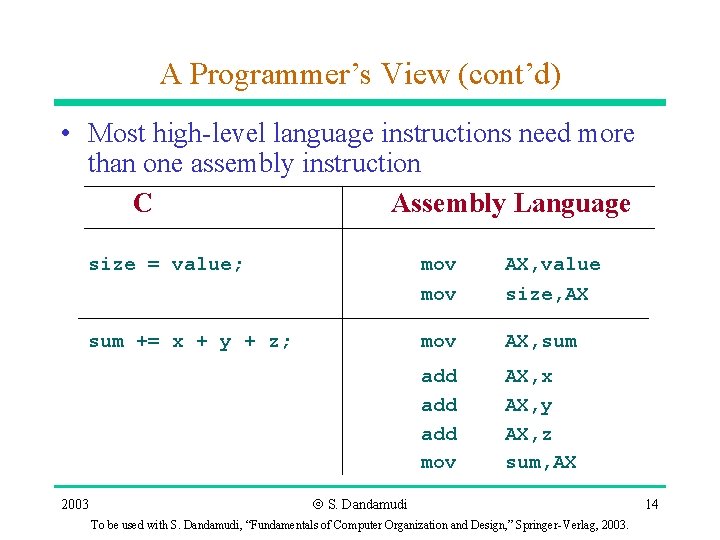
A Programmer’s View (cont’d) • Most high-level language instructions need more than one assembly instruction C Assembly Language size = value; sum += x + y + z; 2003 mov AX, value mov size, AX mov AX, sum add add mov AX, x AX, y AX, z sum, AX Ó S. Dandamudi To be used with S. Dandamudi, “Fundamentals of Computer Organization and Design, ” Springer- Verlag, 2003. 14
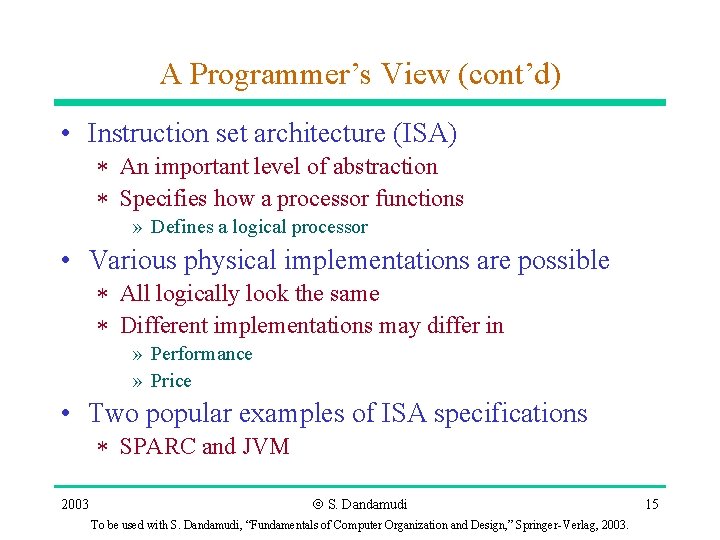
A Programmer’s View (cont’d) • Instruction set architecture (ISA) * An important level of abstraction * Specifies how a processor functions » Defines a logical processor • Various physical implementations are possible * All logically look the same * Different implementations may differ in » Performance » Price • Two popular examples of ISA specifications * SPARC and JVM 2003 Ó S. Dandamudi To be used with S. Dandamudi, “Fundamentals of Computer Organization and Design, ” Springer- Verlag, 2003. 15
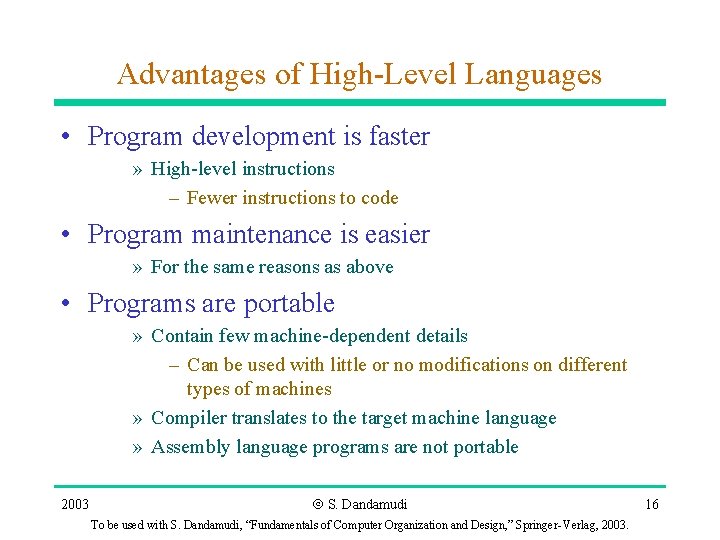
Advantages of High-Level Languages • Program development is faster » High-level instructions – Fewer instructions to code • Program maintenance is easier » For the same reasons as above • Programs are portable » Contain few machine-dependent details – Can be used with little or no modifications on different types of machines » Compiler translates to the target machine language » Assembly language programs are not portable 2003 Ó S. Dandamudi To be used with S. Dandamudi, “Fundamentals of Computer Organization and Design, ” Springer- Verlag, 2003. 16
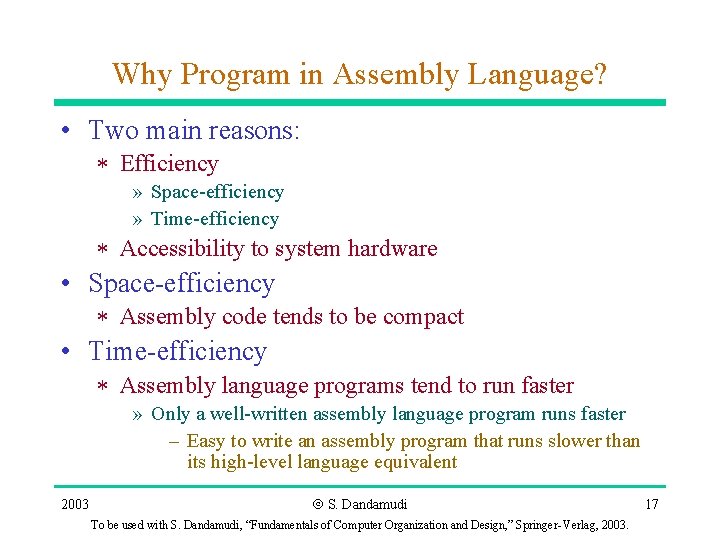
Why Program in Assembly Language? • Two main reasons: * Efficiency » Space-efficiency » Time-efficiency * Accessibility to system hardware • Space-efficiency * Assembly code tends to be compact • Time-efficiency * Assembly language programs tend to run faster » Only a well-written assembly language program runs faster – Easy to write an assembly program that runs slower than its high-level language equivalent 2003 Ó S. Dandamudi To be used with S. Dandamudi, “Fundamentals of Computer Organization and Design, ” Springer- Verlag, 2003. 17
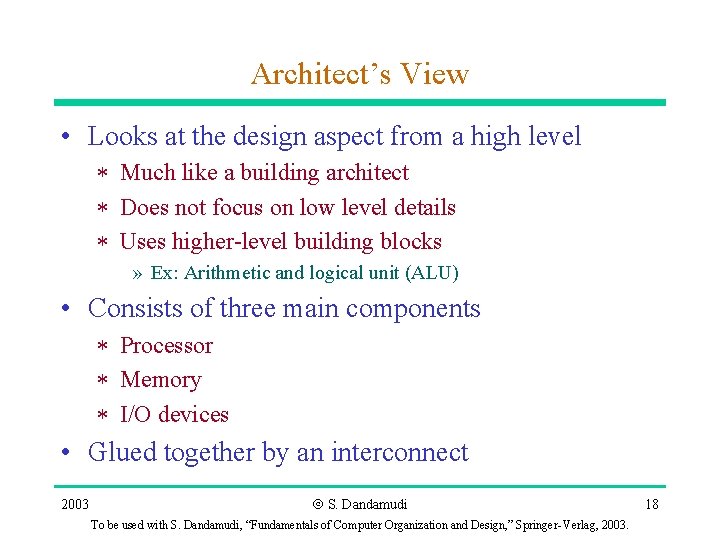
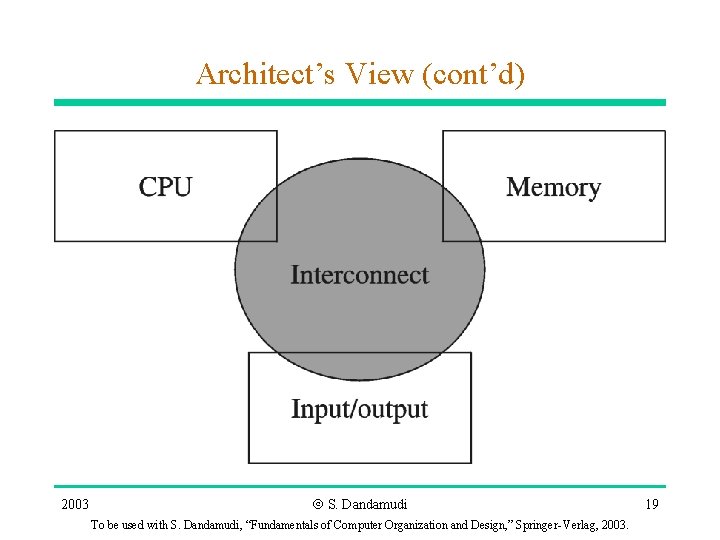
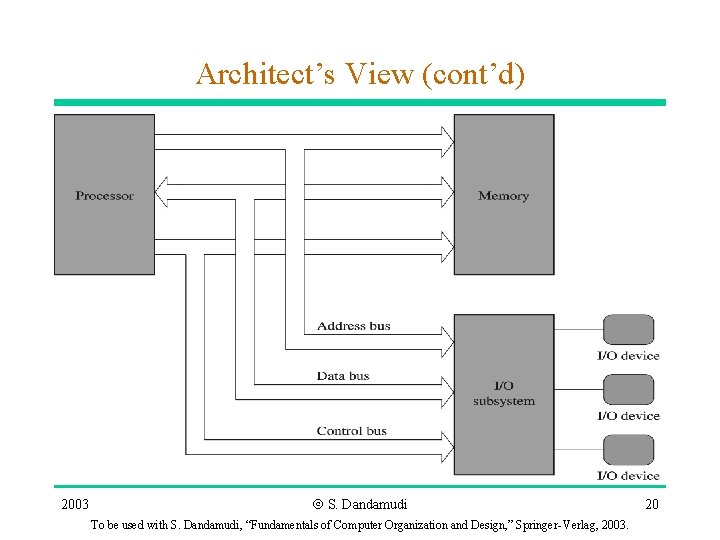
Architect’s View • Looks at the design aspect from a high level * Much like a building architect * Does not focus on low level details * Uses higher-level building blocks » Ex: Arithmetic and logical unit (ALU) • Consists of three main components * Processor * Memory * I/O devices • Glued together by an interconnect 2003 Ó S. Dandamudi To be used with S. Dandamudi, “Fundamentals of Computer Organization and Design, ” Springer- Verlag, 2003. 18
Architect’s View (cont’d) 2003 Ó S. Dandamudi To be used with S. Dandamudi, “Fundamentals of Computer Organization and Design, ” Springer- Verlag, 2003. 19
Architect’s View (cont’d) 2003 Ó S. Dandamudi To be used with S. Dandamudi, “Fundamentals of Computer Organization and Design, ” Springer- Verlag, 2003. 20
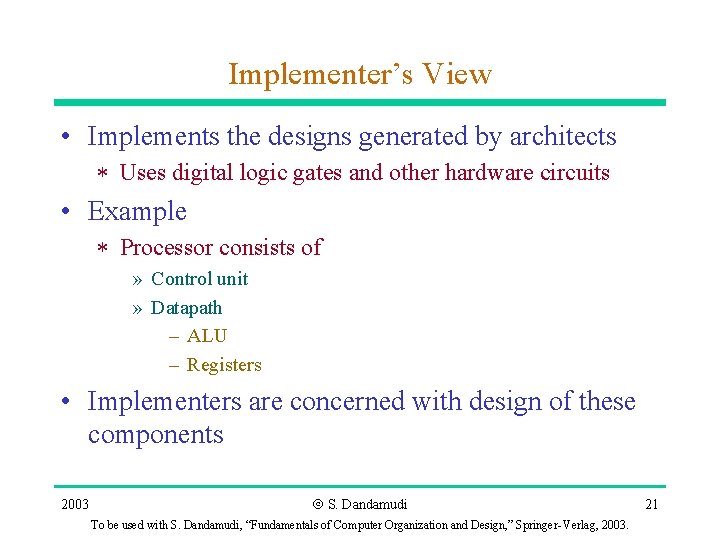
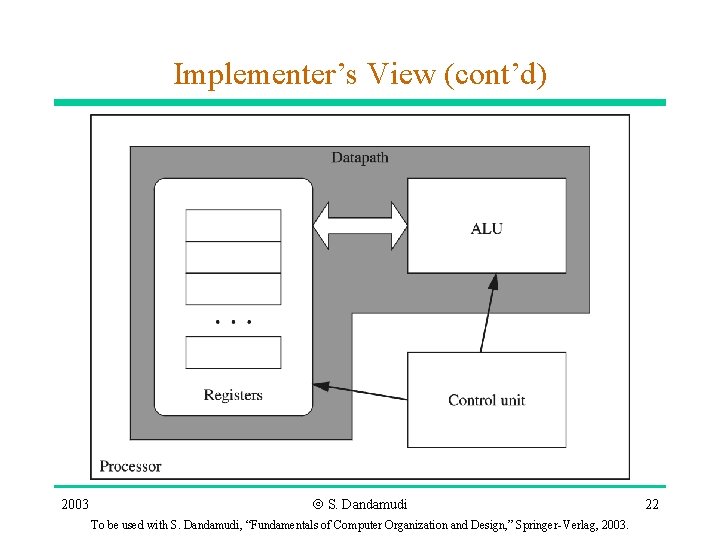
Implementer’s View • Implements the designs generated by architects * Uses digital logic gates and other hardware circuits • Example * Processor consists of » Control unit » Datapath – ALU – Registers • Implementers are concerned with design of these components 2003 Ó S. Dandamudi To be used with S. Dandamudi, “Fundamentals of Computer Organization and Design, ” Springer- Verlag, 2003. 21
Implementer’s View (cont’d) 2003 Ó S. Dandamudi To be used with S. Dandamudi, “Fundamentals of Computer Organization and Design, ” Springer- Verlag, 2003. 22
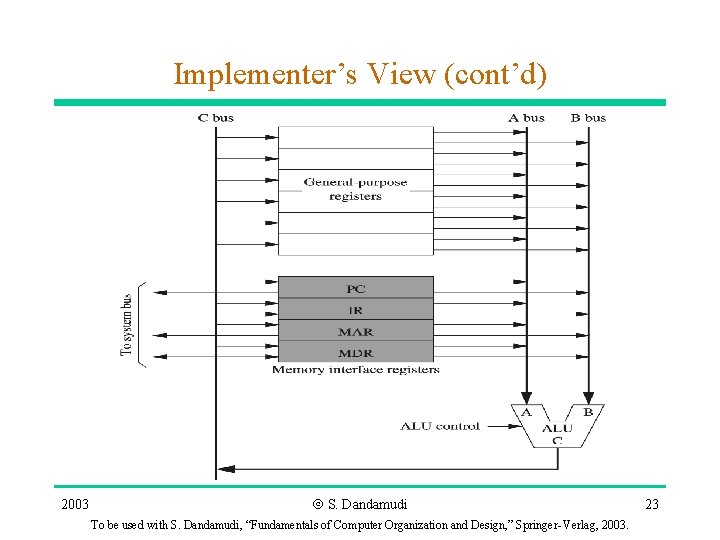
Implementer’s View (cont’d) 2003 Ó S. Dandamudi To be used with S. Dandamudi, “Fundamentals of Computer Organization and Design, ” Springer- Verlag, 2003. 23
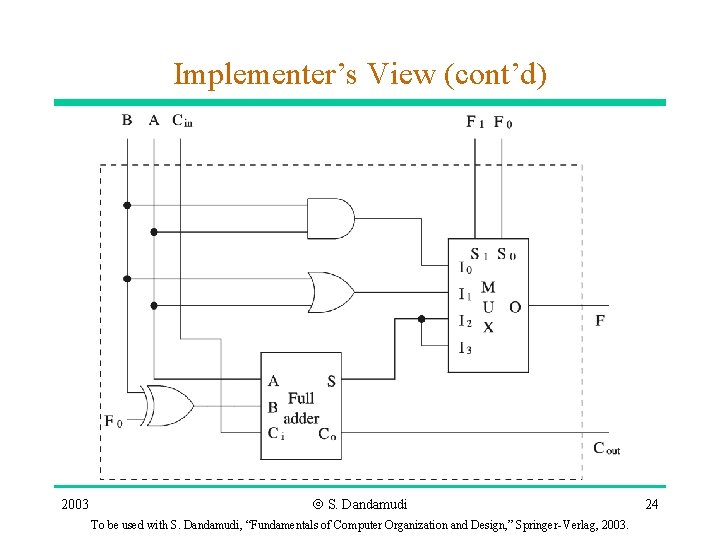
Implementer’s View (cont’d) 2003 Ó S. Dandamudi To be used with S. Dandamudi, “Fundamentals of Computer Organization and Design, ” Springer- Verlag, 2003. 24
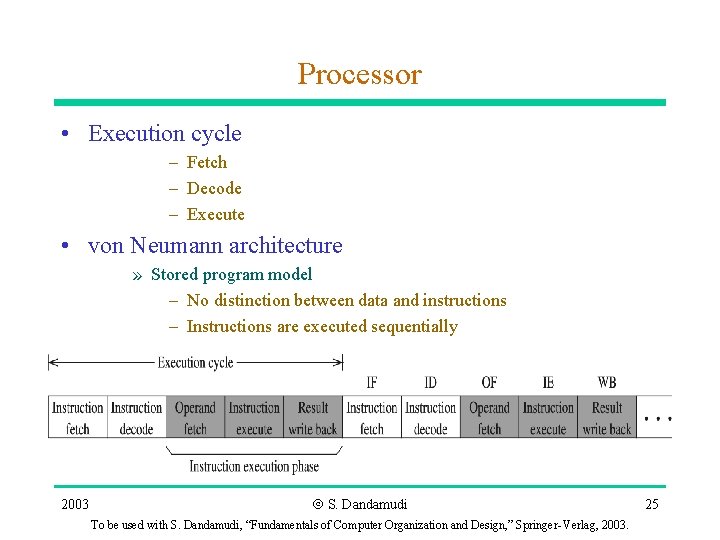
Processor • Execution cycle – Fetch – Decode – Execute • von Neumann architecture » Stored program model – No distinction between data and instructions – Instructions are executed sequentially 2003 Ó S. Dandamudi To be used with S. Dandamudi, “Fundamentals of Computer Organization and Design, ” Springer- Verlag, 2003. 25
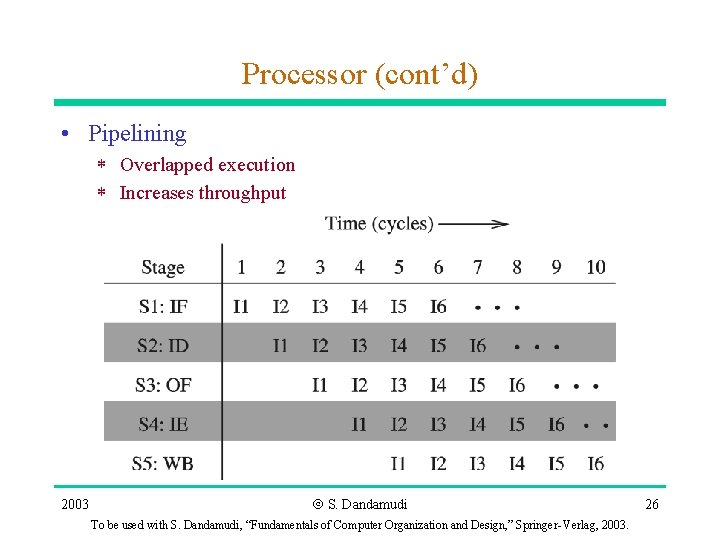
Processor (cont’d) • Pipelining * Overlapped execution * Increases throughput 2003 Ó S. Dandamudi To be used with S. Dandamudi, “Fundamentals of Computer Organization and Design, ” Springer- Verlag, 2003. 26
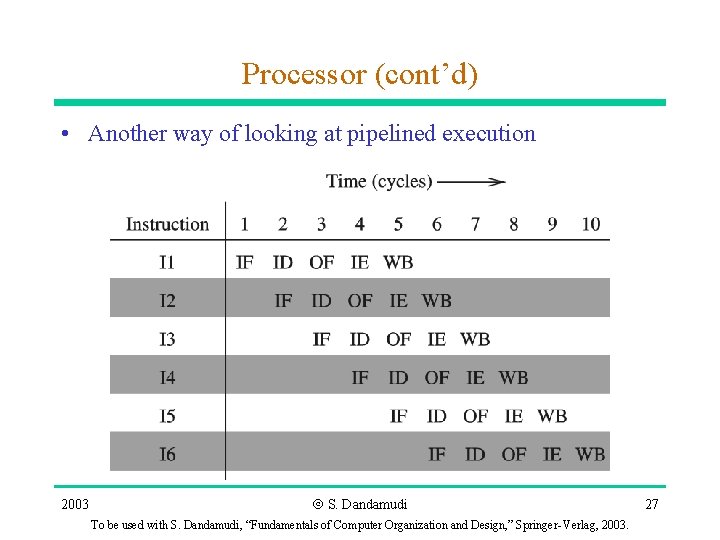
Processor (cont’d) • Another way of looking at pipelined execution 2003 Ó S. Dandamudi To be used with S. Dandamudi, “Fundamentals of Computer Organization and Design, ” Springer- Verlag, 2003. 27
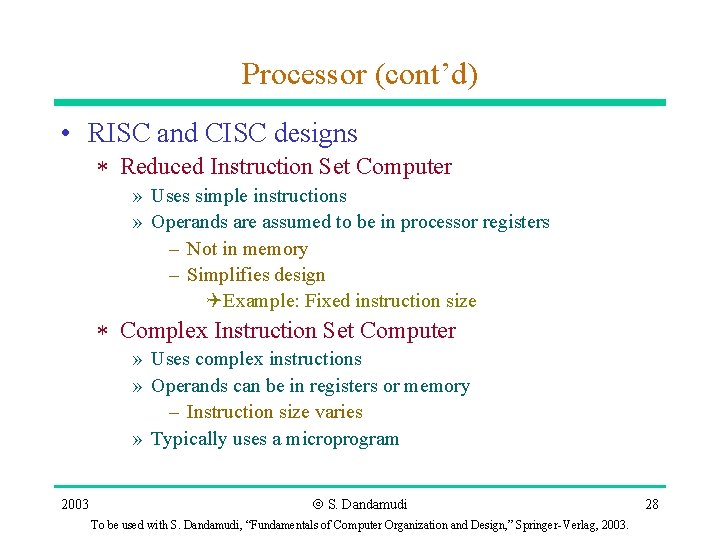
Processor (cont’d) • RISC and CISC designs * Reduced Instruction Set Computer » Uses simple instructions » Operands are assumed to be in processor registers – Not in memory – Simplifies design QExample: Fixed instruction size * Complex Instruction Set Computer » Uses complex instructions » Operands can be in registers or memory – Instruction size varies » Typically uses a microprogram 2003 Ó S. Dandamudi To be used with S. Dandamudi, “Fundamentals of Computer Organization and Design, ” Springer- Verlag, 2003. 28
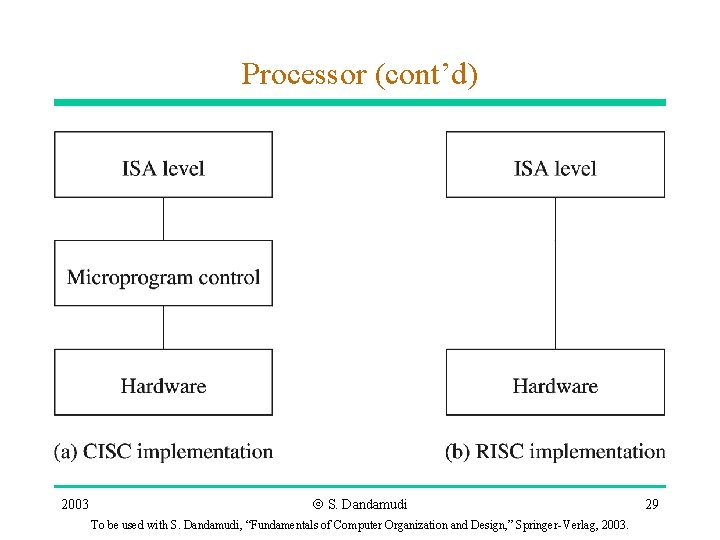
Processor (cont’d) 2003 Ó S. Dandamudi To be used with S. Dandamudi, “Fundamentals of Computer Organization and Design, ” Springer- Verlag, 2003. 29
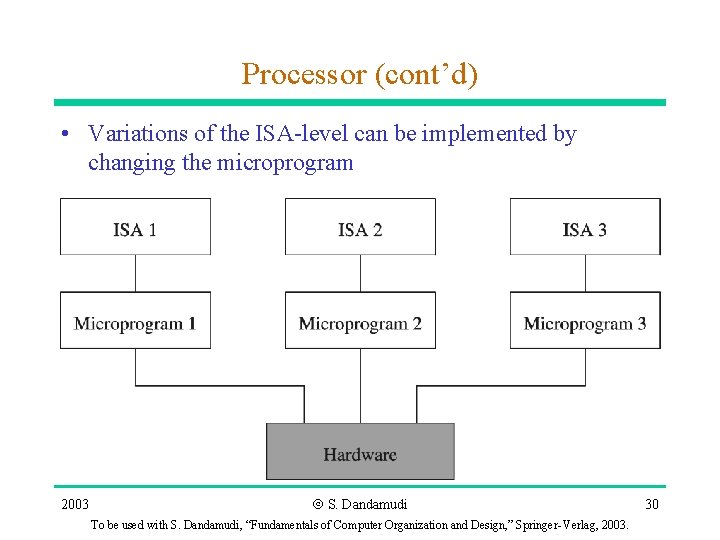
Processor (cont’d) • Variations of the ISA-level can be implemented by changing the microprogram 2003 Ó S. Dandamudi To be used with S. Dandamudi, “Fundamentals of Computer Organization and Design, ” Springer- Verlag, 2003. 30
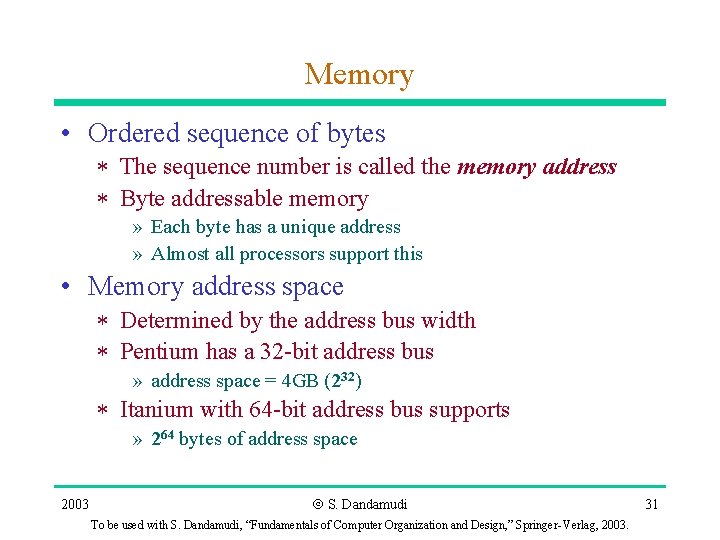
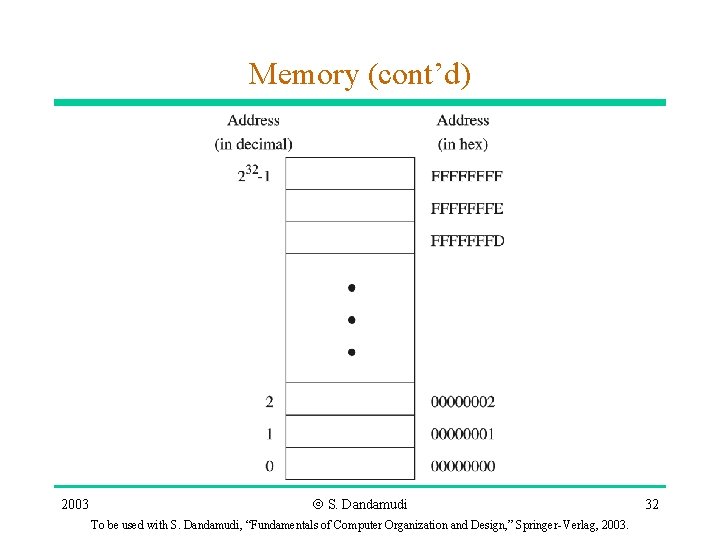
Memory • Ordered sequence of bytes * The sequence number is called the memory address * Byte addressable memory » Each byte has a unique address » Almost all processors support this • Memory address space * Determined by the address bus width * Pentium has a 32 -bit address bus » address space = 4 GB (232) * Itanium with 64 -bit address bus supports » 264 bytes of address space 2003 Ó S. Dandamudi To be used with S. Dandamudi, “Fundamentals of Computer Organization and Design, ” Springer- Verlag, 2003. 31
Memory (cont’d) 2003 Ó S. Dandamudi To be used with S. Dandamudi, “Fundamentals of Computer Organization and Design, ” Springer- Verlag, 2003. 32
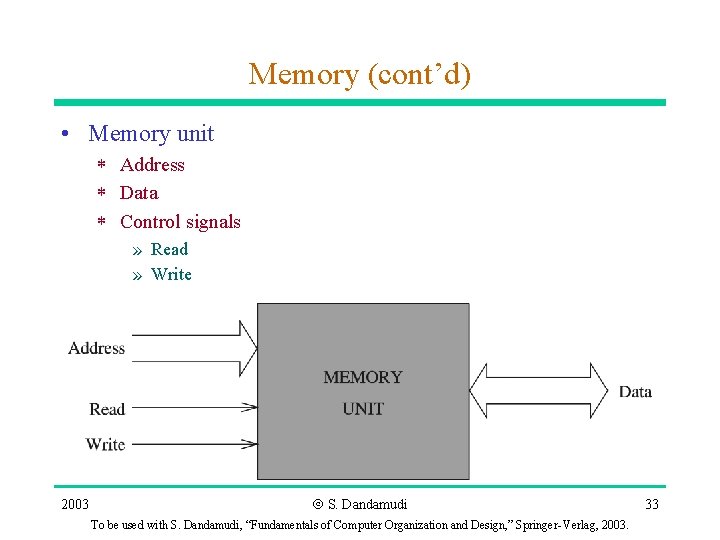
Memory (cont’d) • Memory unit * Address * Data * Control signals » Read » Write 2003 Ó S. Dandamudi To be used with S. Dandamudi, “Fundamentals of Computer Organization and Design, ” Springer- Verlag, 2003. 33
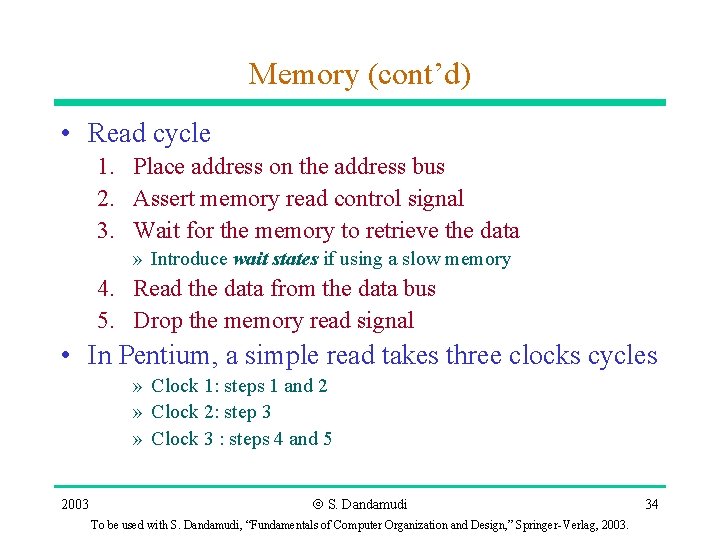
Memory (cont’d) • Read cycle 1. Place address on the address bus 2. Assert memory read control signal 3. Wait for the memory to retrieve the data » Introduce wait states if using a slow memory 4. Read the data from the data bus 5. Drop the memory read signal • In Pentium, a simple read takes three clocks cycles » Clock 1: steps 1 and 2 » Clock 2: step 3 » Clock 3 : steps 4 and 5 2003 Ó S. Dandamudi To be used with S. Dandamudi, “Fundamentals of Computer Organization and Design, ” Springer- Verlag, 2003. 34
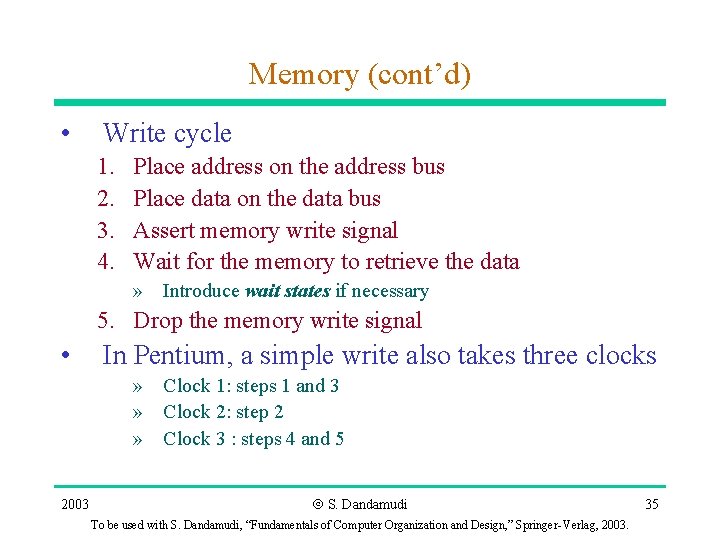
Memory (cont’d) • Write cycle 1. 2. 3. 4. Place address on the address bus Place data on the data bus Assert memory write signal Wait for the memory to retrieve the data » Introduce wait states if necessary 5. Drop the memory write signal • In Pentium, a simple write also takes three clocks » Clock 1: steps 1 and 3 » Clock 2: step 2 » Clock 3 : steps 4 and 5 2003 Ó S. Dandamudi To be used with S. Dandamudi, “Fundamentals of Computer Organization and Design, ” Springer- Verlag, 2003. 35
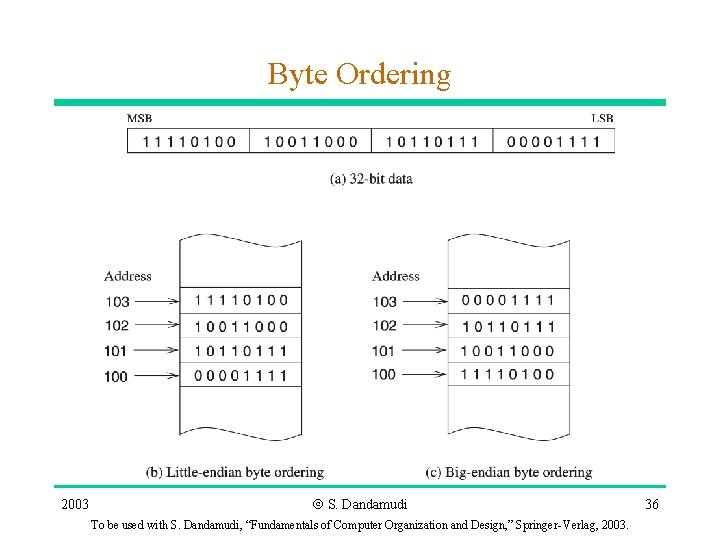
Byte Ordering 2003 Ó S. Dandamudi To be used with S. Dandamudi, “Fundamentals of Computer Organization and Design, ” Springer- Verlag, 2003. 36
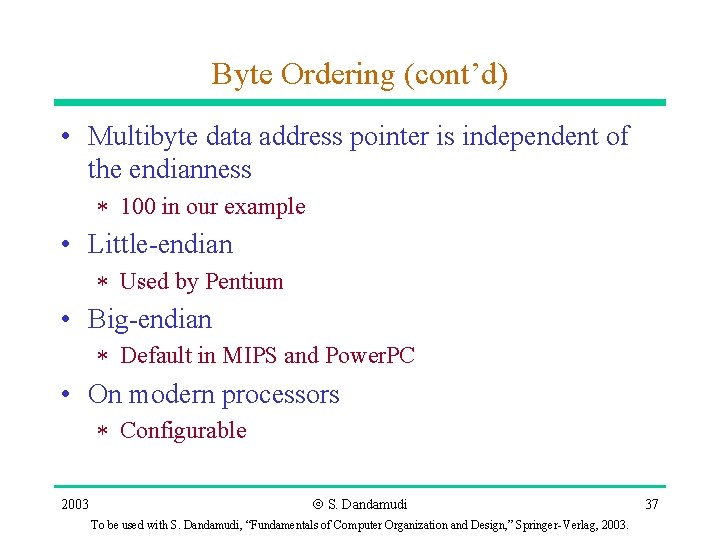
Byte Ordering (cont’d) • Multibyte data address pointer is independent of the endianness * 100 in our example • Little-endian * Used by Pentium • Big-endian * Default in MIPS and Power. PC • On modern processors * Configurable 2003 Ó S. Dandamudi To be used with S. Dandamudi, “Fundamentals of Computer Organization and Design, ” Springer- Verlag, 2003. 37
Design Issues • Slower memories Problem: Speed gap between processor and memory Solution: Cache memory – Use small amount of fast memory – Make the slow memory appear faster – Works due to “reference locality” • Size limitations * Limited amount of physical memory » Overlay technique – Programmer managed * Virtual memory » Automates overlay management » Some additional benefits 2003 Ó S. Dandamudi To be used with S. Dandamudi, “Fundamentals of Computer Organization and Design, ” Springer- Verlag, 2003. 38
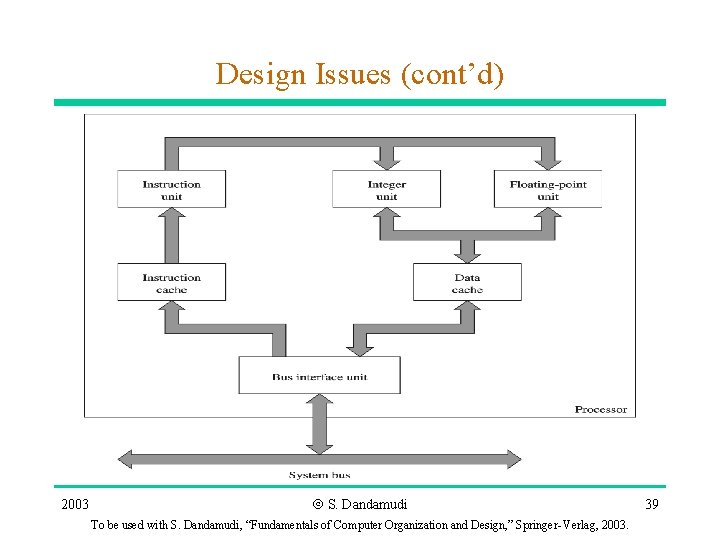
Design Issues (cont’d) 2003 Ó S. Dandamudi To be used with S. Dandamudi, “Fundamentals of Computer Organization and Design, ” Springer- Verlag, 2003. 39
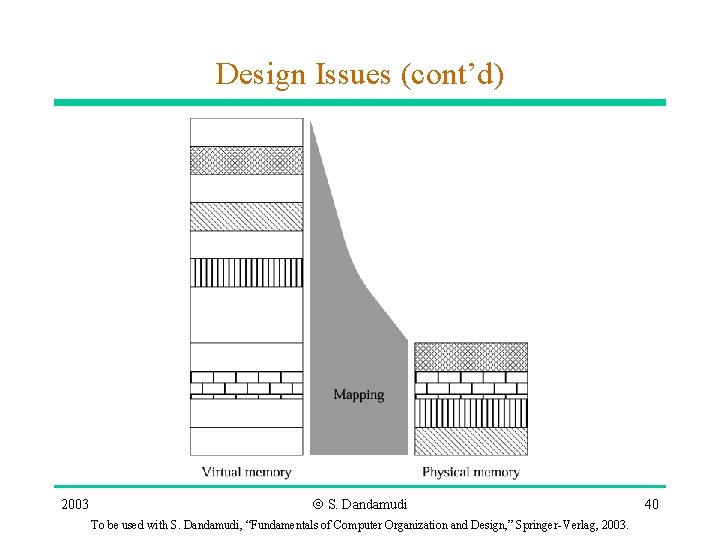
Design Issues (cont’d) 2003 Ó S. Dandamudi To be used with S. Dandamudi, “Fundamentals of Computer Organization and Design, ” Springer- Verlag, 2003. 40
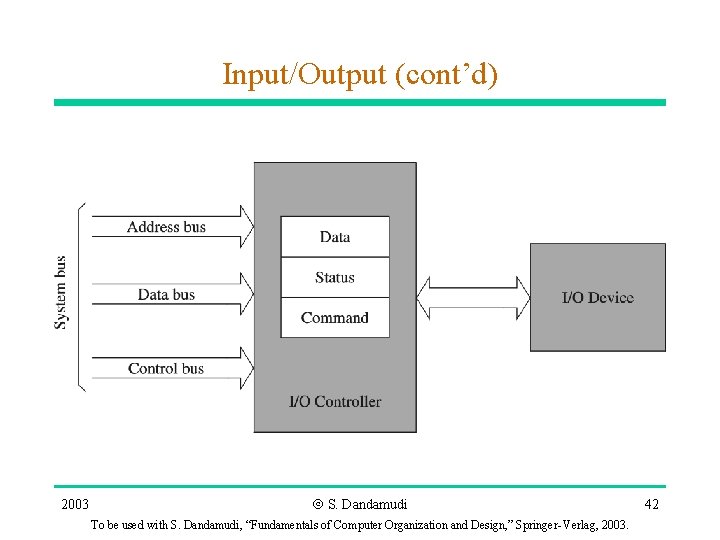
Input/Output • I/O devices are interfaced via an I/O controller * Takes care of low-level operations details • Several ways of mapping I/O * Memory-mapped I/O » Reading and writing similar to memory read/write » Uses same memory read and write signals » Most processors use this I/O mapping * Isolated I/O » Separate I/O address space » Separate I/O read and write signals are needed » Pentium supports isolated I/O – Also supports memory-mapped I/O 2003 Ó S. Dandamudi To be used with S. Dandamudi, “Fundamentals of Computer Organization and Design, ” Springer- Verlag, 2003. 41
Input/Output (cont’d) 2003 Ó S. Dandamudi To be used with S. Dandamudi, “Fundamentals of Computer Organization and Design, ” Springer- Verlag, 2003. 42
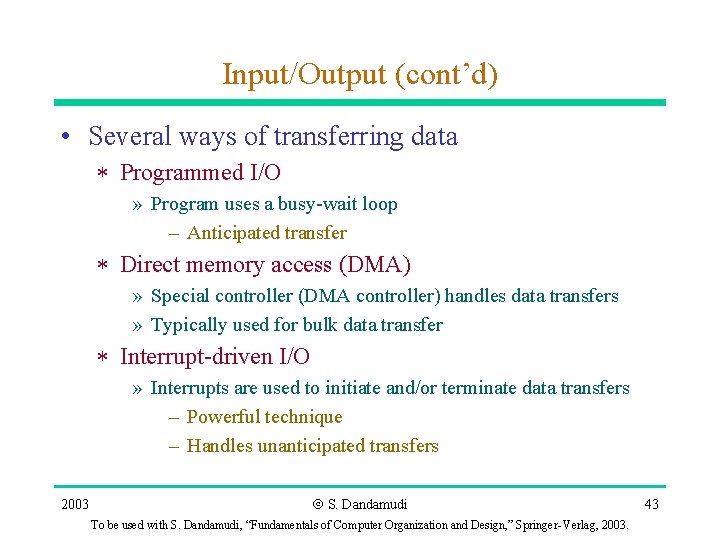
Input/Output (cont’d) • Several ways of transferring data * Programmed I/O » Program uses a busy-wait loop – Anticipated transfer * Direct memory access (DMA) » Special controller (DMA controller) handles data transfers » Typically used for bulk data transfer * Interrupt-driven I/O » Interrupts are used to initiate and/or terminate data transfers – Powerful technique – Handles unanticipated transfers 2003 Ó S. Dandamudi To be used with S. Dandamudi, “Fundamentals of Computer Organization and Design, ” Springer- Verlag, 2003. 43
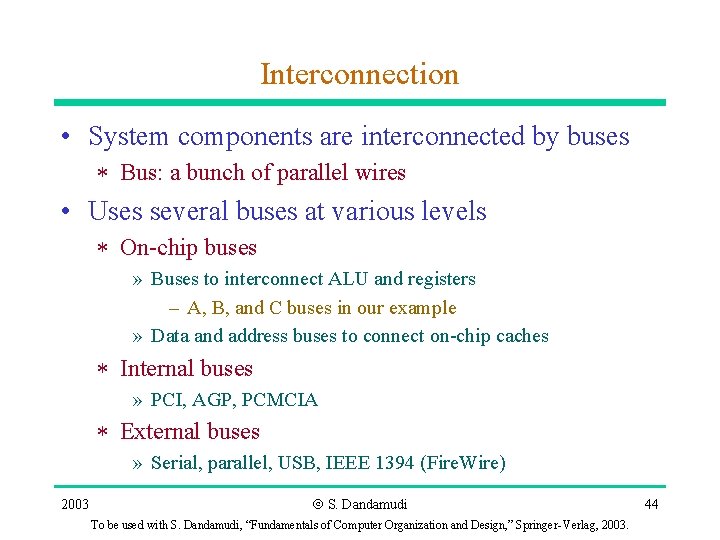
Interconnection • System components are interconnected by buses * Bus: a bunch of parallel wires • Uses several buses at various levels * On-chip buses » Buses to interconnect ALU and registers – A, B, and C buses in our example » Data and address buses to connect on-chip caches * Internal buses » PCI, AGP, PCMCIA * External buses » Serial, parallel, USB, IEEE 1394 (Fire. Wire) 2003 Ó S. Dandamudi To be used with S. Dandamudi, “Fundamentals of Computer Organization and Design, ” Springer- Verlag, 2003. 44
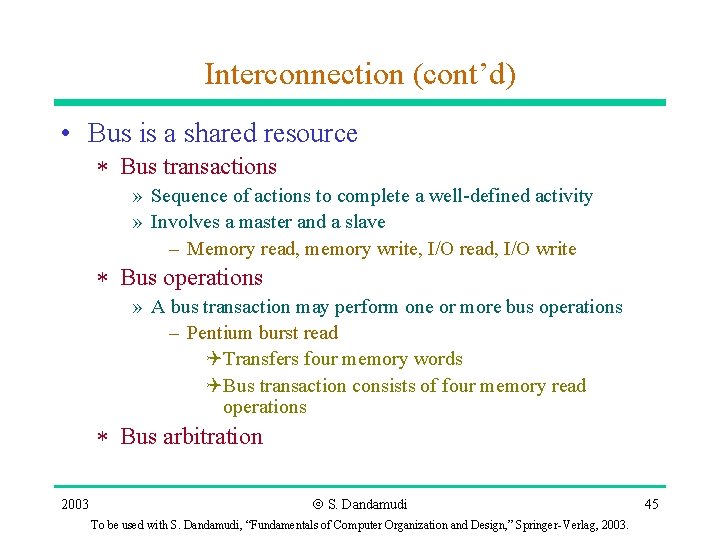
Interconnection (cont’d) • Bus is a shared resource * Bus transactions » Sequence of actions to complete a well-defined activity » Involves a master and a slave – Memory read, memory write, I/O read, I/O write * Bus operations » A bus transaction may perform one or more bus operations – Pentium burst read QTransfers four memory words QBus transaction consists of four memory read operations * Bus arbitration 2003 Ó S. Dandamudi To be used with S. Dandamudi, “Fundamentals of Computer Organization and Design, ” Springer- Verlag, 2003. 45
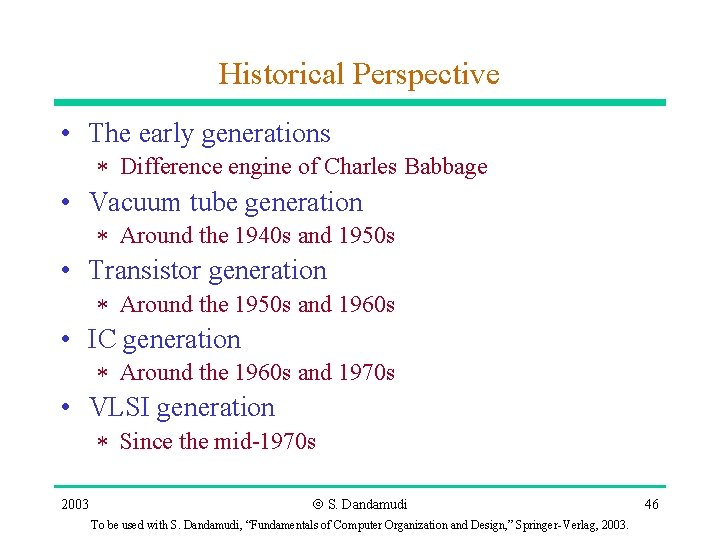
Historical Perspective • The early generations * Difference engine of Charles Babbage • Vacuum tube generation * Around the 1940 s and 1950 s • Transistor generation * Around the 1950 s and 1960 s • IC generation * Around the 1960 s and 1970 s • VLSI generation * Since the mid-1970 s 2003 Ó S. Dandamudi To be used with S. Dandamudi, “Fundamentals of Computer Organization and Design, ” Springer- Verlag, 2003. 46
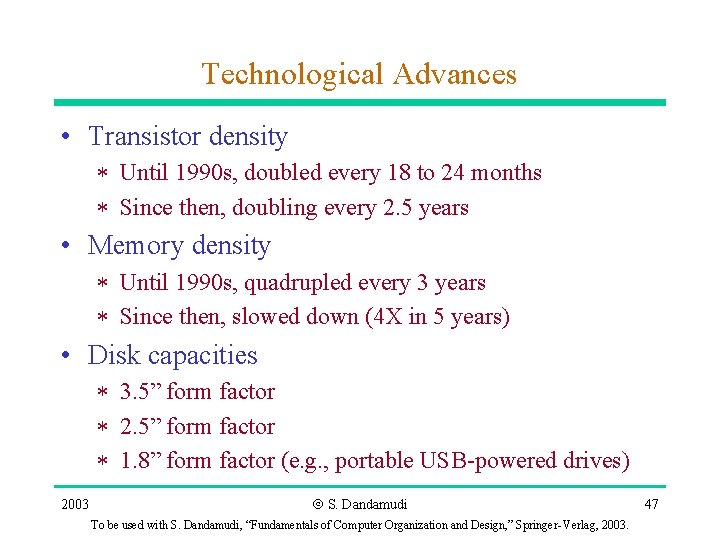
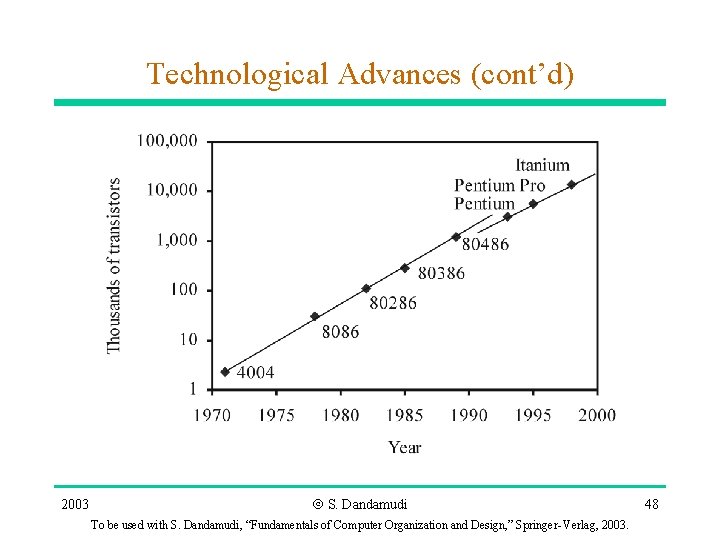
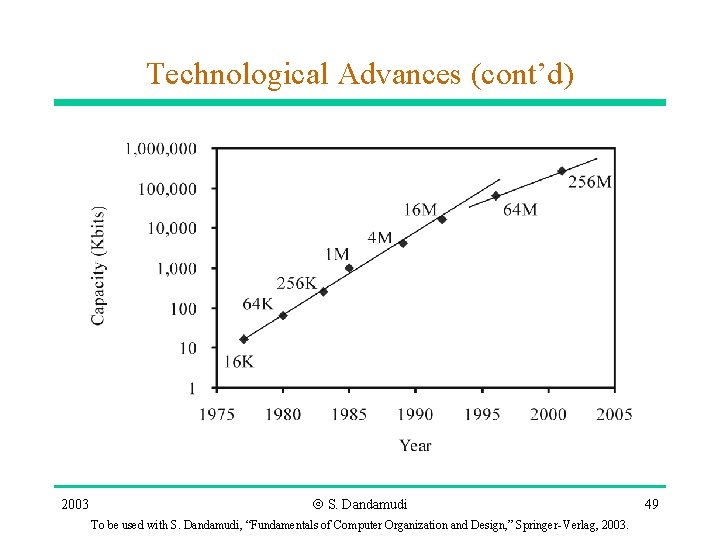
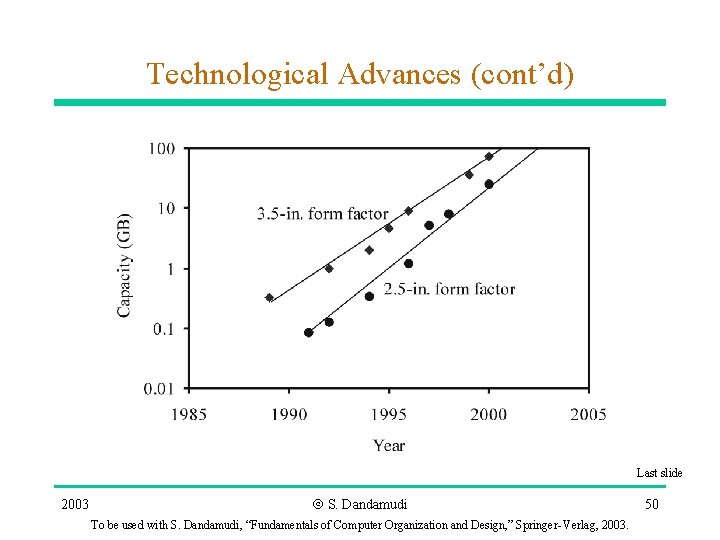
Technological Advances • Transistor density * Until 1990 s, doubled every 18 to 24 months * Since then, doubling every 2. 5 years • Memory density * Until 1990 s, quadrupled every 3 years * Since then, slowed down (4 X in 5 years) • Disk capacities * 3. 5” form factor * 2. 5” form factor * 1. 8” form factor (e. g. , portable USB-powered drives) 2003 Ó S. Dandamudi To be used with S. Dandamudi, “Fundamentals of Computer Organization and Design, ” Springer- Verlag, 2003. 47
Technological Advances (cont’d) 2003 Ó S. Dandamudi To be used with S. Dandamudi, “Fundamentals of Computer Organization and Design, ” Springer- Verlag, 2003. 48
Technological Advances (cont’d) 2003 Ó S. Dandamudi To be used with S. Dandamudi, “Fundamentals of Computer Organization and Design, ” Springer- Verlag, 2003. 49
Technological Advances (cont’d) Last slide 2003 Ó S. Dandamudi To be used with S. Dandamudi, “Fundamentals of Computer Organization and Design, ” Springer- Verlag, 2003. 50