
Overview of Cold Chain Logistics Household Specimen Collection

- Slides: 16
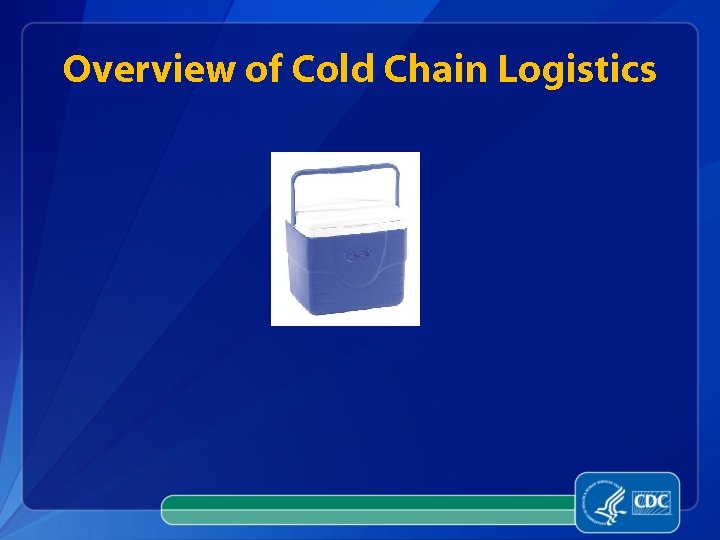
Overview of Cold Chain Logistics
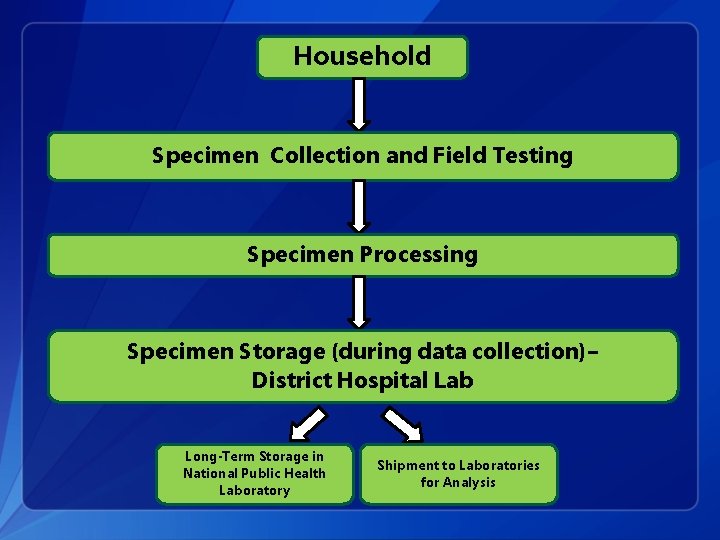
Household Specimen Collection and Field Testing Specimen Processing Specimen Storage (during data collection)– District Hospital Lab Long-Term Storage in National Public Health Laboratory Shipment to Laboratories for Analysis
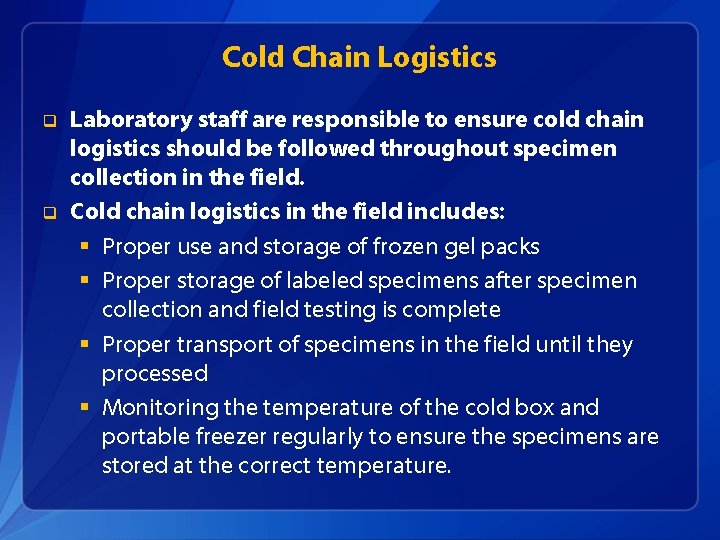
Cold Chain Logistics q q Laboratory staff are responsible to ensure cold chain logistics should be followed throughout specimen collection in the field. Cold chain logistics in the field includes: § Proper use and storage of frozen gel packs § Proper storage of labeled specimens after specimen collection and field testing is complete § Proper transport of specimens in the field until they processed § Monitoring the temperature of the cold box and portable freezer regularly to ensure the specimens are stored at the correct temperature.
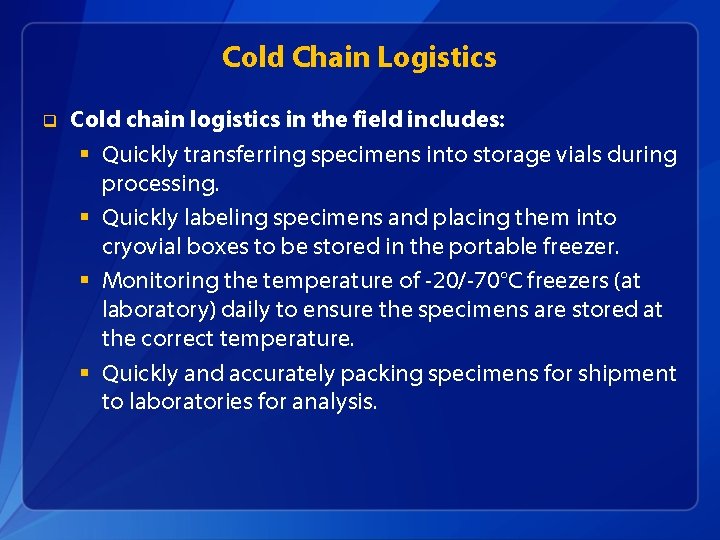
Cold Chain Logistics q Cold chain logistics in the field includes: § Quickly transferring specimens into storage vials during processing. § Quickly labeling specimens and placing them into cryovial boxes to be stored in the portable freezer. § Monitoring the temperature of -20/-70°C freezers (at laboratory) daily to ensure the specimens are stored at the correct temperature. § Quickly and accurately packing specimens for shipment to laboratories for analysis.
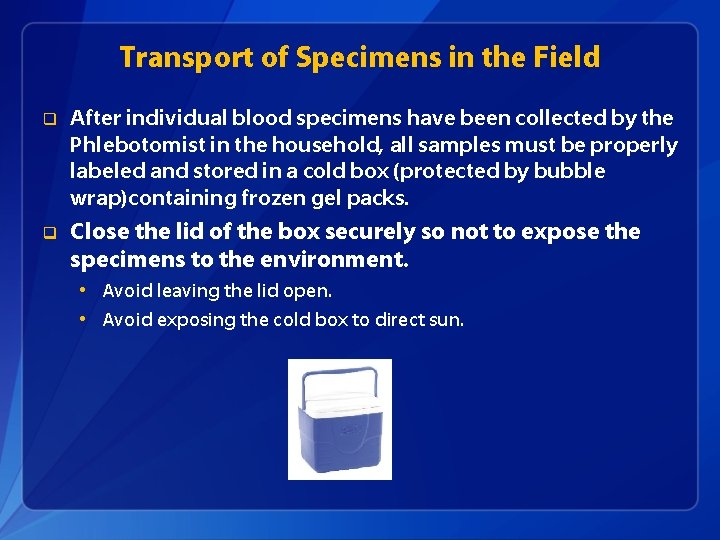
Transport of Specimens in the Field q After individual blood specimens have been collected by the Phlebotomist in the household, all samples must be properly labeled and stored in a cold box (protected by bubble wrap)containing frozen gel packs. q Close the lid of the box securely so not to expose the specimens to the environment. • Avoid leaving the lid open. • Avoid exposing the cold box to direct sun.
Transport of Specimens in the Field q q q A digital thermometer should be used to monitor the temperature inside the cold box during each day of specimen collection. The temperature should be monitored every time a specimen is collected. Specimens should be kept at a temperature <8°C. § If temperature is ~6°C, then the Phlebotomist should replace thawing gel packs with new frozen gel packs from the portable freezer. § If necessary, request a supervisor to assist with transferring new frozen gel packs from the portable freezer.
Cold Chain Logistics q Prior to specimen processing, the Laboratory Technician should replace the frozen gel packs with frozen gel packs (only in cases when they are thawing). q During the processing of specimens, the gel packs inside the cold box should be monitored to ensure they are kept frozen. q The Laboratory Technician should work quickly process all specimens to reduce the amount of time specimens are kept outside the freezer.
Cold Chain Logistics: Specimen Storage q After specimens are processed, they should be placed into the portable freezer until they are transferred to the laboratory for storage. q The temperature of the cold box and portable freezer should be monitored each time the lid is opened. q The temperature of the -20/-70°C freezers (at the laboratories ) should be monitored daily.
Cold Chain Logistics: Specimen Storage q Laboratory freezers should be plugged into a back-up generator and enough available fuel must be made available at all times. q The freezer should be located in a secure room or in an area with limited access. § The Laboratory Technicians, Supervisors, Field Managers, and Laboratory Coordinators should be the only individuals who have access to the specimens. q Frozen specimens should be kept frozen at all times.
Transport of Specimens in the Field q The Laboratory Technician should transfer all gel packs used for that day back to the portable freezer and refrozen at -20°C so that the gel packs will be frozen and ready for the next day. § The Laboratory Technician can also transfer thawing gel packs to the District Hospital Laboratory to be refrozen in a -20°C laboratory freezer.
Cold Chain Logistics: Transport of Specimens from Field Laboratories to the National Public Health Laboratory q q Specimens will be transported from the Field Laboratories to the National Public Health Laboratory at the end of the survey. Laboratory Technicians should work with the Laboratory Coordinators to ensure that the frozen specimens are packed well on frozen gel packs or dry ice for transport. § The specimens will need to be inventoried and box numbers assigned prior to transport. q Upon arrival to the National Public Health Laboratory, the condition of the specimens should checked and then immediately stored in a -86°C freezer.
Cold Chain Logistics: Shipment to Laboratories q When specimens in cyrovial boxes are packed to be shipped to laboratories for analysis, Laboratory Technicians should work quickly to ensure the specimens do not thaw while being packed.
Important Points for Laboratory Staff to Remember q Quickly place specimens inside the cold box after specimen collection and field testing. q Ensure the lid to the cold box is tightly closed and do not expose the cold box to direct sunlight. q Monitor the temperature of the cold box every time a specimen is collected and placed inside the cold box.
Important Points for Laboratory Staff to Remember q Replace thawing gel packs with frozen gel packs when the temperature is ~6°C. q Monitor gel packs and temperature of the cold box during specimen processing. q Quickly process specimens and store in a portable freezer. q Monitor temperature of the portable freezer.
Important Points for Laboratory Staff to Remember q Properly store and monitor specimens stored at the Field and National Public Health Laboratories. q Monitor the temperature of the -20/-70°C freezers on a daily basis. q At the end of each day, transfer gel packs used throughout the day to the -20°C portable freezer or transferred to the District Hospital Laboratory to ensure there will be enough frozen gel packs for the following day.
Questions? ?