
Overview of Clinical Chemistry Lecture 1 Dr Mazen










- Slides: 35
Overview of Clinical Chemistry Lecture 1 Dr. Mazen Alzaharna CC 2018/1
Definition • Clinical chemistry is the area of pathology that is generally concerned with analysis of bodily fluids. • Also known as: • Clinical biochemistry, • Chemical pathology, or • Medical biochemistry. Dr. Mazen Alzaharna CC 2018/1 2
Clinical chemistry 1 • Clinical chemistry is a science, a service, and an industry. • As a science: • Clinical chemistry links the knowledge of general chemistry, organic chemistry, and biochemistry with an understanding of human physiology. • As a service: • The clinical chemistry laboratory produces objective evidence from which medical decisions may be made. • As an industry: • Clinical laboratories are businesses which operate under the regulations and practices that guide commerce Dr. Mazen Alzaharna CC 2018/1 3
Clinical chemistry 2 • Clinical chemistry investigations are used extensively in medicine for a variety of purposes. • The results of most clinical biochemical investigations are expressed • quantitatively as a concentration, • in the case of enzyme measurements, as an activity. Dr. Mazen Alzaharna CC 2018/1 4
Clinical chemistry 3 • A central function of the clinical chemistry laboratory is to provide biochemical information for the management of patients. • Such information will be of value only if • it is accurate and relevant, • and if its significance is appreciated by the clinician • So that it can be used appropriately to guide clinical decision-making. Dr. Mazen Alzaharna CC 2018/1 5
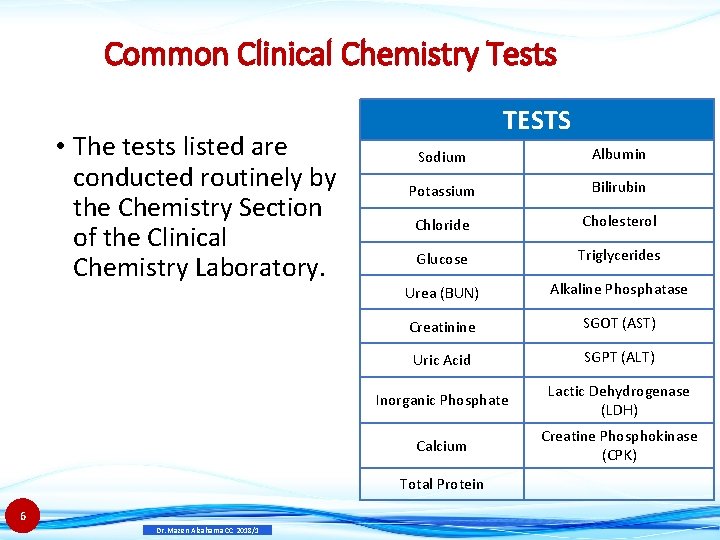
Common Clinical Chemistry Tests • The tests listed are conducted routinely by the Chemistry Section of the Clinical Chemistry Laboratory. TESTS Sodium Albumin Potassium Bilirubin Chloride Cholesterol Glucose Triglycerides Urea (BUN) Alkaline Phosphatase Creatinine SGOT (AST) Uric Acid SGPT (ALT) Inorganic Phosphate Lactic Dehydrogenase (LDH) Calcium Creatine Phosphokinase (CPK) Total Protein 6 Dr. Mazen Alzaharna CC 2018/1
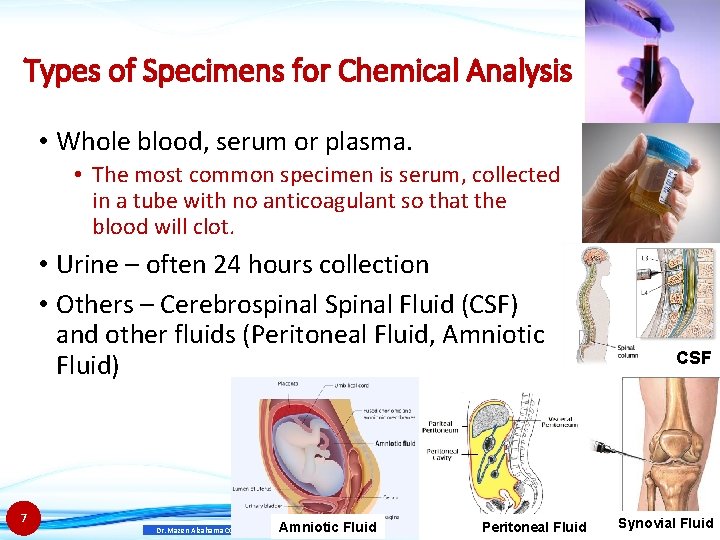
Types of Specimens for Chemical Analysis • Whole blood, serum or plasma. • The most common specimen is serum, collected in a tube with no anticoagulant so that the blood will clot. • Urine – often 24 hours collection • Others – Cerebrospinal Spinal Fluid (CSF) and other fluids (Peritoneal Fluid, Amniotic Fluid) 7 Dr. Mazen Alzaharna CC 2018/1 Amniotic Fluid Peritoneal Fluid CSF 7 Synovial Fluid
Clinical chemistry Test Results • Results from these tests provide valuable clinical information about: • Whether specific tissue has been damaged, • and how severely, • and about the functional status of a variety of organ systems. • Test results are interpreted with respect to reference range, which are, most typically, 95% confidence intervals of values found in clinically healthy populations. Dr. Mazen Alzaharna CC 2018/1 8
Clinical chemistry Test Results • Biochemical tests are used in diagnosis, prognosis, monitoring and Screening. • Biochemical marker analysis is one factor in the assessment of the patient. • Physicians also gather • history and symptoms of the complaint; • examination findings, such as blood pressure; • and testing by other health-care team members in ancillary fields, such as radiology. • The physician uses all data to assess the patient and implement a plan for treatment. Dr. Mazen Alzaharna CC 2018/1 9
Use of biochemical tests Screening Diagnosis Detection of subclinical disease Confirmation or rejection of clinical diagnosis Monitoring Prognosis Monitoring progression or response to treatment Information regarding the likely outcome of disease Dr. Mazen Alzaharna CC 2018/1 10
Screening • Biochemical tests are widely used to determine whether a condition is present sub-clinically. • The best-known example is screening of all newborn babies for phenylketonuria (PKU), which is carried out in many countries. Dr. Mazen Alzaharna CC 2018/1 11
Diagnosis • Medical diagnosis is based on the patient's history, if available, the clinical signs found on examination, and on the results of investigations. • Investigations may be selected to help either confirm or refute a diagnosis, and it is important that the clinician appreciates how useful the chosen test is for these purposes. • Making a diagnosis, even if incomplete, such as a diagnosis of hypoglycaemia without knowing its cause, may allow treatment to be initiated. Dr. Mazen Alzaharna CC 2018/1 12
Monitoring • A major use of biochemical tests is to follow the course of an illness and to monitor the effects of treatment. • To do this, there must be a suitable analyte, • for instance glycated haemoglobin in patients with diabetes mellitus. • Biochemical tests can also be used to detect complications of treatment, • such as hypokalaemia during treatment with diuretics, • and are extensively used to screen for possible drug toxicity, but also in some cases when a drug is in use. Dr. Mazen Alzaharna CC 2018/1 13
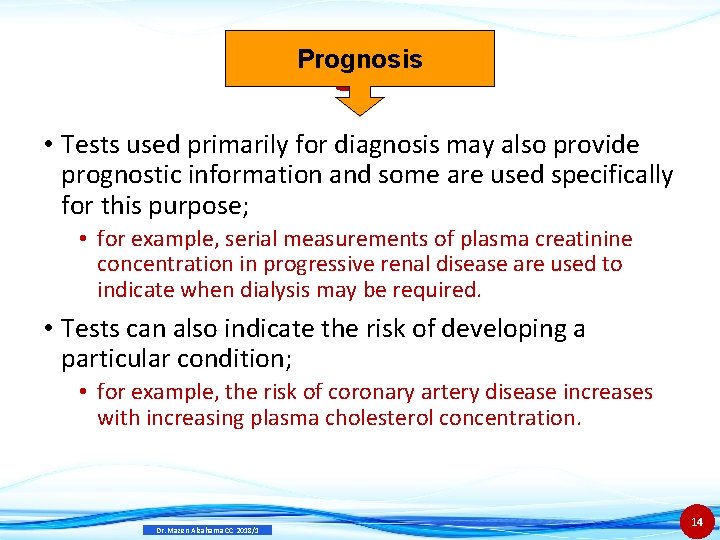
Prognosis • Tests used primarily for diagnosis may also provide prognostic information and some are used specifically for this purpose; • for example, serial measurements of plasma creatinine concentration in progressive renal disease are used to indicate when dialysis may be required. • Tests can also indicate the risk of developing a particular condition; • for example, the risk of coronary artery disease increases with increasing plasma cholesterol concentration. Dr. Mazen Alzaharna CC 2018/1 14
Categories of Biochemical Markers • Biochemical markers are used for assessment and diagnosis of disease: • • • carbohydrates, lipids, proteins, nucleic acids and the derivatives of these markers. • The assessment of inorganic chemicals, provide a measure of homeostasis in the body. • such as ions, minerals, and dissolved gases, Dr. Mazen Alzaharna CC 2018/1 15
Categories of Biochemical Markers • In addition to the measurement of these endogenous substances, the clinical chemistry laboratory provides measurement of chemicals that are exogenous to the body— • beneficial chemicals, • such as therapeutic drugs, • and harmful substances, • such as poisons. Dr. Mazen Alzaharna CC 2018/1 16
Carbohydrates • Carbohydrates are chemical substances that contain only carbon, hydrogen, and oxygen. • The simplest carbohydrates are monosaccharides, which usually contain 3 to 6 carbons. • Monosaccharides are the units that make up more complex carbohydrates. • Glucose, fructose, ribose, and galactose are common monosaccharides of living organisms. Dr. Mazen Alzaharna CC 2018/1 17
Carbohydrates as Biochemical Markers of Disease • The most common carbohydrate disorder in humans is diabetes mellitus. • This disease is caused by an inability to produce or to respond to the hormone insulin. • Laboratory tests of body fluids of individuals with this disease show increased concentrations of glucose. • The laboratory tests for ketones, acids, and glycosylated proteins provide measures of disease severity. Dr. Mazen Alzaharna CC 2018/1 18
Lipids • Lipids are, by definition, organic compounds that are poorly soluble in solutions such as water and soluble in organic solutions such as ether. • Only a limited number of lipids are clinically important. This group includes • • fatty acids, triglycerides, cholesterol, and phospholipids. Dr. Mazen Alzaharna CC 2018/1 19
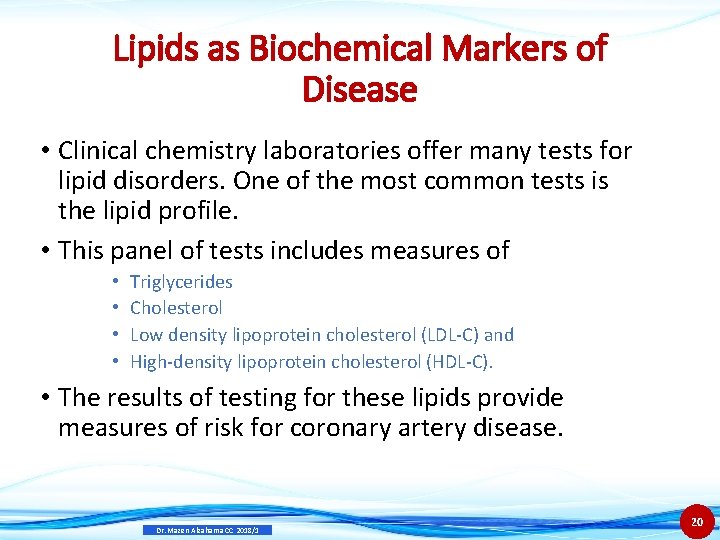
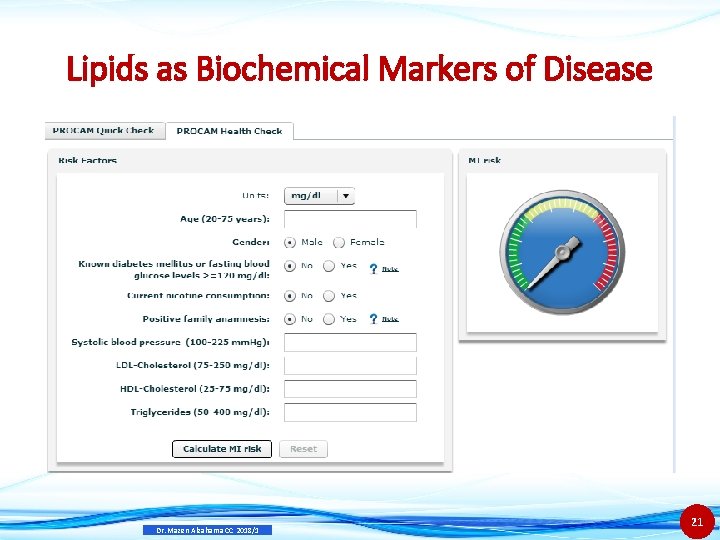
Lipids as Biochemical Markers of Disease • Clinical chemistry laboratories offer many tests for lipid disorders. One of the most common tests is the lipid profile. • This panel of tests includes measures of • • Triglycerides Cholesterol Low density lipoprotein cholesterol (LDL-C) and High-density lipoprotein cholesterol (HDL-C). • The results of testing for these lipids provide measures of risk for coronary artery disease. Dr. Mazen Alzaharna CC 2018/1 20
Lipids as Biochemical Markers of Disease Dr. Mazen Alzaharna CC 2018/1 21
Proteins and Amino Acids • The human body requires 20 amino acids as the building blocks of proteins. • Humans make some of these amino acids but must gain the rest, as essential nutrients, through the diet. • Plants and bacteria produce the essential amino acids and many others. Dr. Mazen Alzaharna CC 2018/1 22
Total Serum/Plasma Proteins and Plasma Albumin as Biochemical Markers of Disease • Plasma proteins have functions in many organ and tissue systems. • They are • • carrier molecules, receptor chemicals, immune response agents, and enzymes or catalytic proteins. • Total plasma protein is • a measure of nutrition, • the status of many organs and tissues that are involved in protein metabolism, • and the process of breakdown and excretion of protein metabolites. Dr. Mazen Alzaharna CC 2018/1 23
Total Serum/Plasma Proteins and Plasma Albumin as Biochemical Markers of Disease • The measurement of plasma protein fractions provides more specific evidence for diagnosis and assessment of disorders. • Because of its importance in maintaining osmotic pressure, the measure of albumin concentration is a reflection of this pressure. • As a transport protein, the measurement of albumin monitors the ability of the body to transport such diverse substances as bilirubin, fatty acids, and calcium through the blood. Dr. Mazen Alzaharna CC 2018/1 24
Enzymes • An enzyme is a protein catalyst that accelerates the speed of a chemical reaction by binding specifically to a substrate, forming a complex. • This complex lowers the activation energy in the reaction without the enzyme becoming consumed or without changing the equilibrium of the reaction. Dr. Mazen Alzaharna CC 2018/1 25
Enzymes as Biochemical Markers of Disease • Damage to tissue can release different types of enzymes based on their location. • For example, mild inflammation of the liver reversibly increases the permeability of the cell membrane and releases cytoplasmic enzymes such as lactate dehydrogenase (LD), alkaline phosphatase (ALP), and aspartate transaminase (AST). • Distribution of these enzymes within specific types of hepatic tissues varies. ALP is more concentrated in the biliary tree or canalicular tissues, while AST, ALT, and LD are found in parenchymal hepatic cells. Dr. Mazen Alzaharna CC 2018/1 26
The clinical chemistry laboratory and organ systems Cardiovascular Circulatory System • The clinical chemistry laboratory offers analysis of biochemicals for the assessment of • acute myocardial infarction, • congestive heart failure • and coronary artery disease. • The laboratory offers measurement of lipids as predictive factors for the development of heart disease. • Measurement of arterial blood gases helps assess the acidbase and oxygenation status of the patient. Dr. Mazen Alzaharna CC 2018/1 27
Respiratory Tract • The function of the respiratory tract is to transfer gases from the environment to tissue cells and from tissues cells to the environment. • The respiratory system also helps maintain the acid -base balance in the body. Dr. Mazen Alzaharna CC 2018/1 28
Respiratory Tract • Measurement of arterial blood gases helps assess the function of the respiratory system, as well as the circulatory system. • Blood oxygenation and p. H are dependent upon the uptake of oxygen by hemoglobin and removal of carbon dioxide from red blood cells. • The assessment of diseases such as chronic obstructive pulmonary disease is dependent upon the measurement of partial pressures of oxygen and carbon dioxide in arterial blood to monitor the function of the lungs. Dr. Mazen Alzaharna CC 2018/1 29
Liver • The clinical chemistry laboratory offers a lot of tests that provide information about specific diseases of the liver. • Measurement of the concentration of the enzyme alanine transaminase (ALT) provides information about hepatitis. • Measurement of the enzyme alkaline phosphatase (ALP) provides information about biliary tract disorders. • Analysis of the concentrations of proteins that are made in the liver provides information about the ability of the liver to perform this function. Dr. Mazen Alzaharna CC 2018/1 30
Renal System • The clinical chemistry laboratory offers many tests for different biochemical markers of renal function, including electrolytes, minerals, and protein metabolic waste products. • These biochemical markers are measured in serum, urine, and other body fluids. Dr. Mazen Alzaharna CC 2018/1 31
Digestive System • The clinical chemistry laboratory provides information about nutritional status, intestinal absorption, and function of the pancreas and other organs of the digestive tract. • The concentration of proteins of varying half-life helps establish the length of time of nutritional deficiency. • Analysis of gastric fluid assesses the ability of the stomach to secrete acid. • Measurement of serum concentrations of lipase and amylase monitors the exocrine function of the pancreas. Dr. Mazen Alzaharna CC 2018/1 32
Therapeutic drug monitoring • Involves the analysis, assessment and evaluation of circulating concentrations of drugs in serum, plasma, or whole blood. • Purpose is to ensure the medication dose is at therapeutic range and not toxic. • Medications dosage differ between each patient based on metabolic process. • Therapeutic range is narrow for some drugs • below range: drug not effective • above rang: drug toxic Dr. Mazen Alzaharna CC 2018/1 33
Toxicology Study of poisons. • • Clinical: the study of interrelationships between toxin exposure and disease states. (diagnosis & therapeutic intervention) Dr. Mazen Alzaharna CC 2018/1 34
Tumour Markers • A tumour marker is a biological substance synthesized and released by cancer cells or substances produced by the host in response to cancerous tissue. • It may be used to: • Detect the presence of a tumour • Monitor the progress of disease • Monitor the response to treatment Dr. Mazen Alzaharna CC 2018/1 35