
Overview of Class 6 Model standard algorithm for
- Slides: 9
Overview of Class #6 • Model standard algorithm for subtraction with bean-sticks; both interpretations • Discuss readings • Practice making assertions about children’s mathematical proficiency - Work in grade level groups to discuss children’s performance in the sessions - Share tentative generalizations about children of particular ages 1
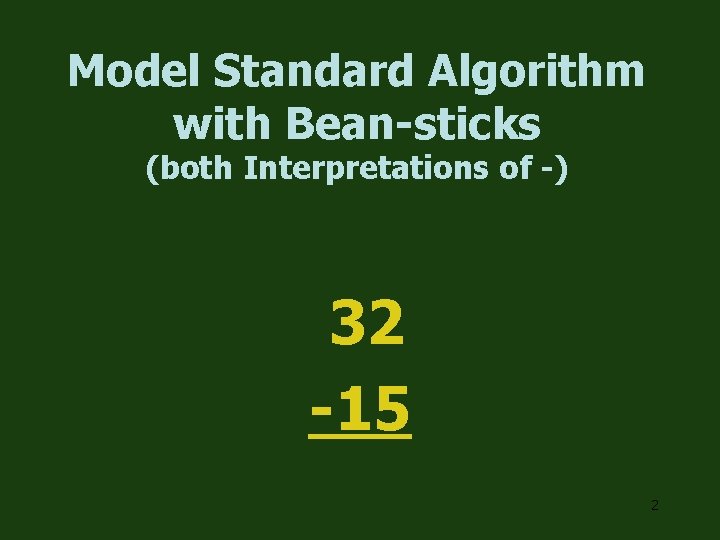
Model Standard Algorithm with Bean-sticks (both Interpretations of -) 32 -15 2
Readings Discussion Questions · What is each author trying to argue or convey? · How do these authors conceive of “computational fluency? ” · What do any of the authors have to say about the mathematical language used in talking about arithmetic algorithms? What are some ideas that you got from these articles about how to build students’ mathematical proficiency? 3
Making Assertions • Examine evidence repeatedly and look for patterns, seek examples that help you know about the student’s mathematical proficiency • Look for conflicting or other evidence that might lead you to modify your impression • Formulate clear, detailed statement about something about the child’s understanding, skill, strategies, reasoning, dispositions • Back up claim with specific examples to substantiate the claim 4
Video of Interview of Sami (age 5) Make claims about Sami’s mathematical proficiency, in the domain of counting numbers. 5
Grade Level Groups Describe your sessions • Take turns (divide time equally) • Make record of work in small group • Describe session with student, questions used • Share one assertion and evidence; get help, revise • Develop (as group) short list of patterns or variability among students at this level 6
Grade Level Groups K-1: Erin, Maria, Christy, Kate, Shannon 2: David, Katie, Sandra, Terry, John 3: Chris, Elisha, Melissa, Suzanne, Missy 4: Connie, Kim, Sarah, Andrea 5 -7: Christine, Jenna, Valerie, Rhonda 7
End-of-Class Check: Investigating a Student Error What did the student do, and what might she have been thinking? 8
Assignment 1. Van de Walle, J. (2004). Whole number place value development. Notes in NB 2. Reflection (in NB) on student analyses done in class 3. Write-up of ST Project, by Mon, 11/1. Submit student work & artifacts in class. Submit write-up electronically; filename format: Hy. B_STProj_518 hb. doc 9