
Overview of Class 10 Comments questions Multiplication concept

- Slides: 16
Overview of Class #10 • Comments, questions • Multiplication: concept of multiplication and its main interpretations and models; multiplication algorithm for computing multi-digit numbers • Dealing with two common student errors with multiplication computation (textbook teacher’s guide) • The teacher’s role in whole class teaching: enacting high expectations, working on significant mathematics (video from Mac. Dowell) • Wrapping up 1
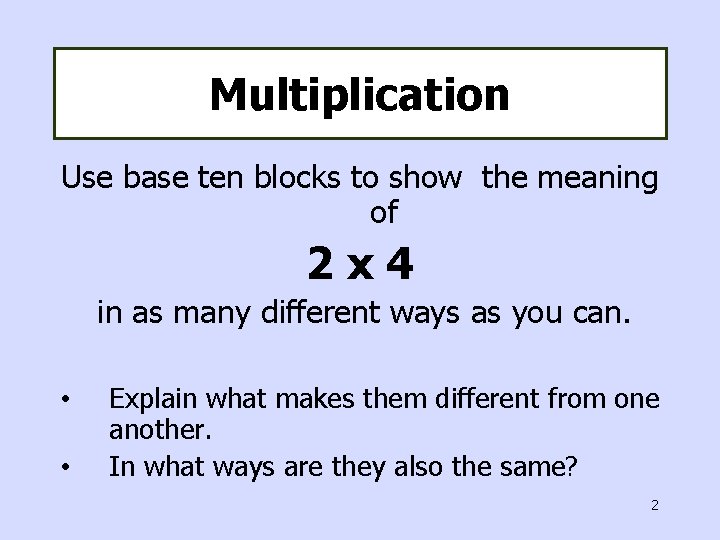
Multiplication Use base ten blocks to show the meaning of 2 x 4 in as many different ways as you can. • • Explain what makes them different from one another. In what ways are they also the same? 2
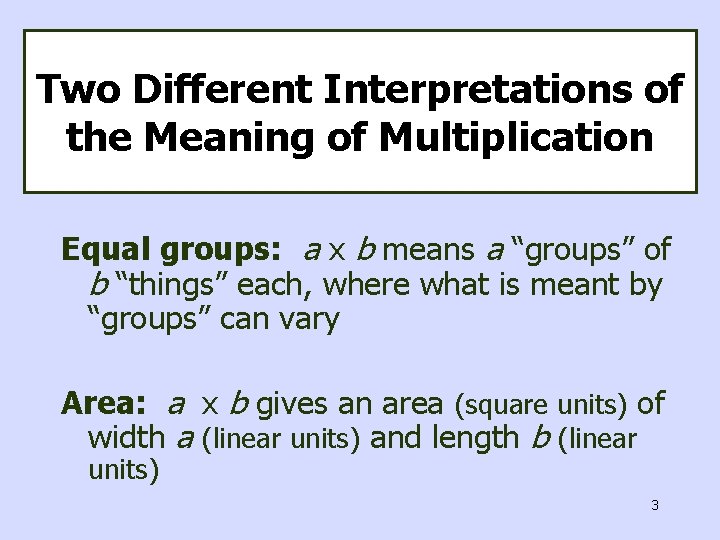
Two Different Interpretations of the Meaning of Multiplication Equal groups: a x b means a “groups” of b “things” each, where what is meant by “groups” can vary Area: a x b gives an area (square units) of width a (linear units) and length b (linear units) 3
Repeated addition as model for multiplication • Counting • Usually used to introduce multiplication as a short cut for adding • Convention in U. S. : in a x b, a represents “number of groups” and b represents “size of group” 4
Rectangular array as model for multiplication • Often used along with repeated addition to introduce multiplication • Similar to repeated addition, except that items are arranged in an orderly arrangement (“array”) • Counting model, even if objects border one another: 5
Area as model for multiplication • Continuous model • Convention in U. S. : in a x b, a represents width and b represents length • Two kinds of measure: – a and b are lengths (linear units) – a x b is an area (units of area) 6
Cartesian product as model for multiplication • Counting • Each member from the first set is matched with each member from the second set; this mapping produces a set of ordered pairs • Often taught without naming in elementary school – (combination problems such as “ 2 pairs of pants, 4 shirts, how many outfits”) 7
Models for Multiplication area groups 8
Multiplication Computation 9
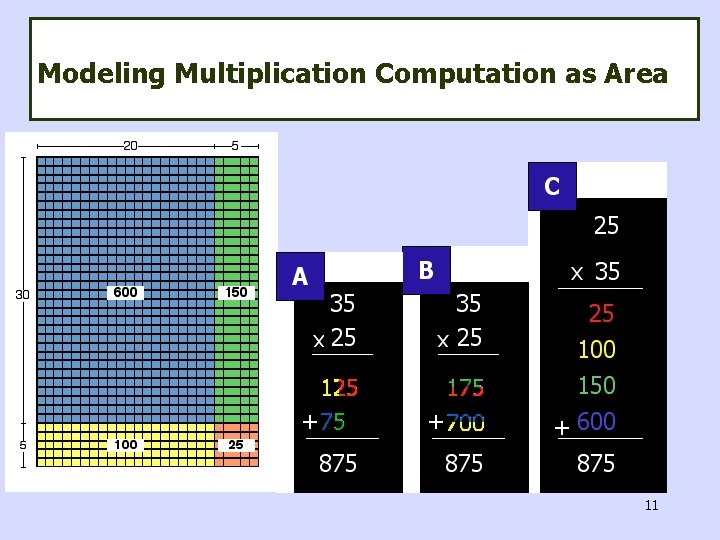
Modeling Multiplication Computation • Calculate the answer • Show as an area with base ten blocks • Explain the correspondence between the area and the written procedure 10
Modeling Multiplication Computation as Area 11
Three Common Student Errors 1 2 3 • What is the error? • What produces this error, and what does that show about the student’s understanding? • What does the textbook suggest you do to teach this? • How adequate are the book’s suggestions? How would you use and also change these suggestions, and why? 12
Reflection Did you have any new insights about multiplication, or teaching and learning multiplication? 13
Grade 4 Lesson on Place Value • One hour • Modeling numbers with base ten blocks; using place value to increase numbers by ones, tens, hundreds mentally; broken calculator problems • Clip we will watch: 25: 45 - 32: 30 • “What is ten more than 109? ” 14
Teaching the Whole Group While Leading a Whole-Class Discussion Attention to equity: Holding and enacting high expectations of students to learn significant mathematics 1. What specific types and difficulties of mathematical questions can you identify in this segment? 2. What methods of getting student participation can you name in this segment? 3. How does the teacher manage errors? 4. Other observations or critique 15
Wrapping Up • Assignment • Work on Project #2 16