
Overview of CLAS 12 Calibration Daniel S Carman
Overview of CLAS 12 Calibration Daniel S. Carman Jefferson Laboratory CLAS 12 Experiment Workshop February 23, 2016
CALCOM Role Oversight of CALibration and COMmissioning for CLAS 12 baseline and non-baseline detectors • Provide oversight to the development of subsystem calibration suites – With the software group, provide software templates for detector groups and common I/O tools – Work with subsystem groups to develop documentation, tutorials for calibration suites, and calibration tools – Help to find manpower and to ensure efficient use of resources by setting priorities for different work tasks • Develop detailed plans for commissioning with beam activities - CWB to verify Key Performance Parameters (KPP) -Daniel Full commissioning/engineering run before S. Carman CLAS 12 Experiment Workshop – February start 23, 2016 of RG-A production run 2

CLAS 12 Commissioning A comprehensive plan to commission the CLAS 12 spectrometer and its subsystems has been prepared (June 2014) § Three phases: – Quality assurance and system checkout – Commissioning without beam – Commissioning with beam § Detailed plan for each CLAS 12 subsystem based on input from detector groups – Procedures and tasks – Manpower and time – Software resources § Plans now being updated for final review – Task #1: CWB plan for KPP run – Task #2: Engineering run § KPP commissioning scheduled Feb. Daniel S. Carman CLAS 12 Experimentfor Workshop – February 23, 2016 3
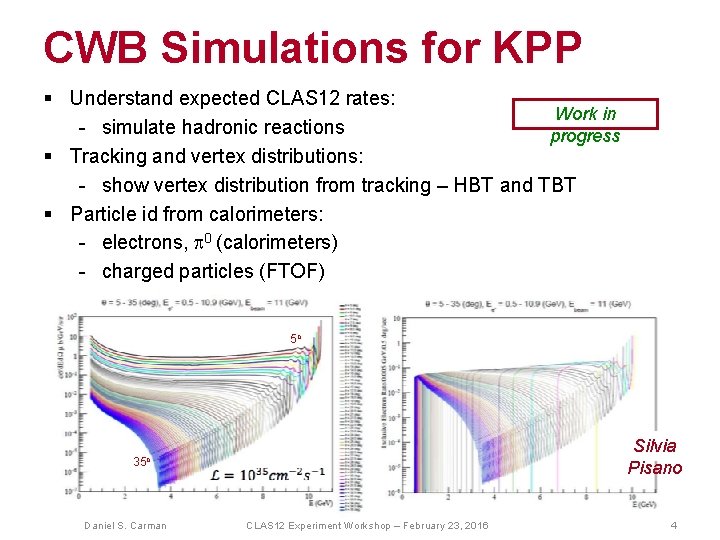
CWB Simulations for KPP § Understand expected CLAS 12 rates: Work in - simulate hadronic reactions progress § Tracking and vertex distributions: - show vertex distribution from tracking – HBT and TBT § Particle id from calorimeters: - electrons, p 0 (calorimeters) - charged particles (FTOF) 5 o Silvia Pisano 35 o Daniel S. Carman CLAS 12 Experiment Workshop – February 23, 2016 4
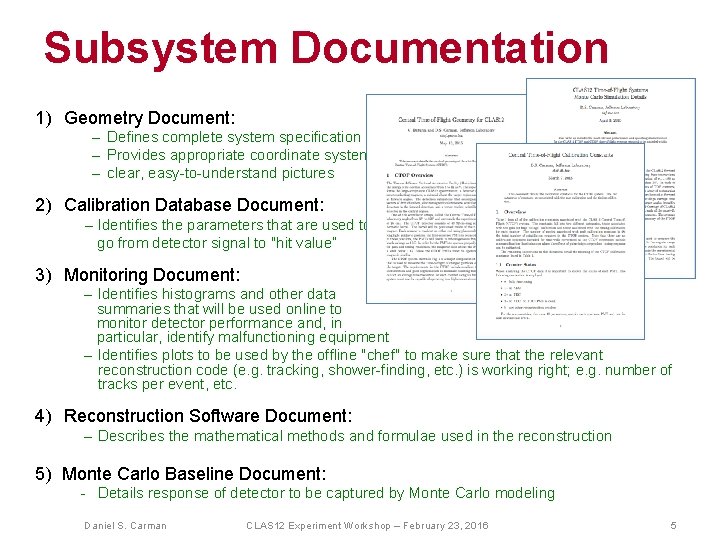
Subsystem Documentation 1) Geometry Document: – Defines complete system specification – Provides appropriate coordinate systems – clear, easy-to-understand pictures 2) Calibration Database Document: – Identifies the parameters that are used to go from detector signal to "hit value” 3) Monitoring Document: – Identifies histograms and other data summaries that will be used online to monitor detector performance and, in particular, identify malfunctioning equipment – Identifies plots to be used by the offline "chef" to make sure that the relevant reconstruction code (e. g. tracking, shower-finding, etc. ) is working right; e. g. number of tracks per event, etc. 4) Reconstruction Software Document: – Describes the mathematical methods and formulae used in the reconstruction 5) Monte Carlo Baseline Document: - Details response of detector to be captured by Monte Carlo modeling Daniel S. Carman CLAS 12 Experiment Workshop – February 23, 2016 5
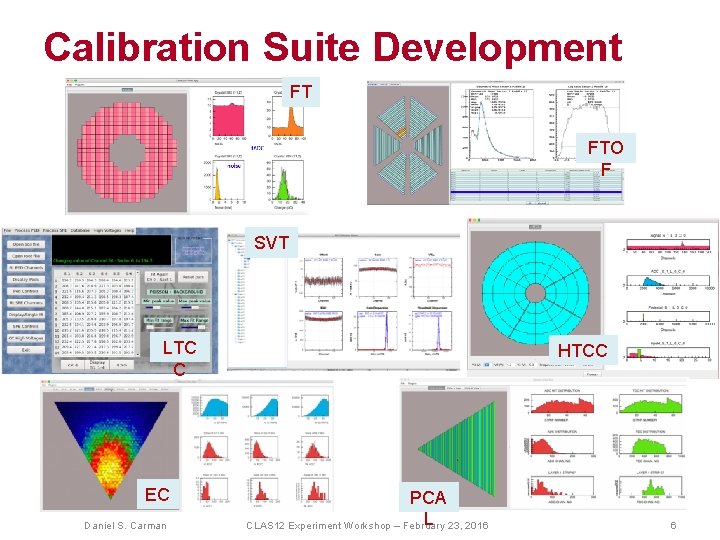
Calibration Suite Development FT FTO F SVT LTC C EC Daniel S. Carman HTCC PCA L 23, 2016 CLAS 12 Experiment Workshop – February 6

Calibration Progress Tracking § Tracking of calibration suite development: CND, CTOF, DC, EC/PCAL, FTOF, HTCC, LTCC, SVT, MM (updated monthly) Daniel S. Carman CLAS 12 Experiment Workshop – February 23, 2016 7
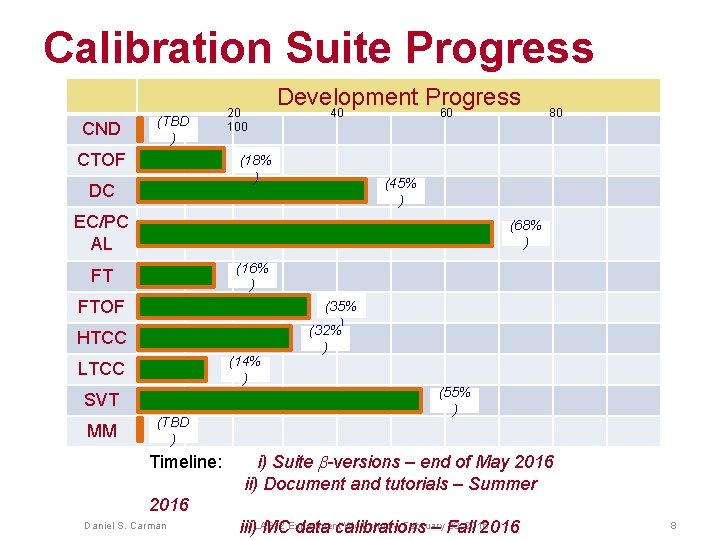
Calibration Suite Progress CND (TBD ) CTOF 20 100 Development Progress 40 60 (18% ) DC (45% ) EC/PC AL (68% ) (16% ) FT FTOF HTCC (14% ) LTCC SVT MM 80 (TBD ) Timeline: (35% ) (32% ) (55% ) i) Suite b-versions – end of May 2016 ii) Document and tutorials – Summer 2016 Daniel S. Carman CLAS 12 Workshop – February 23, 2016 iii) MCExperiment data calibrations – Fall 2016 8
Summary § The CALCOM group is overseeing the development of the commissioning and calibration schemes for the CLAS 12 detector and its subsystems. § The plans have been developed based on feedback from the external review from 2015, the parameters given to us by the 12 Ge. V project, and feedback from the subsystem experts and the collaboration. § A successful beam commissioning plan, which includes the development of robust and documented calibration suites, is essential for the success of the first run group experiments. § Said another way, a successful KPP commissioning period and a successful engineering run will go a long way toward ensuring success of the first run group experiment with CLAS 12. § The development of the calibration suites for each subsystem is being tracked and monitored through the weekly meetings of the https: //clasweb. jlab. org/wiki/index. php/CLAS 12_Calibration_and_Co CALCOM group. mmissioning Daniel S. Carman CLAS 12 Experiment Workshop – February 23, 2016 9
Key Performance Parameters Detector operational: events recorded with > 2 n. A electron beam with > 6 Ge. V beam energy (3 pass) 1. 2. 3. 4. 5. 6. 7. Detector running for ~one shift recording data from all subsystems Screenshots of beam status screens and accelerator Elog entries demonstrating the electron beam current and energy Plots showing relative timing (coincidence) of calorimeters, time-offlight and Cerenkov counters Event displays showing correlations of particle hits in Forward Detectors Event display showing correlations of particles detected in FD and hits in CTOF of Central Detector (CD) Plots of particle trajectories showing target position Particle identification plots using signals from calorimetry detectors (preliminary) Daniel S. Carman CLAS 12 Experiment Workshop – February 23, 2016 10
- Slides: 10