
Overview of Church Size Theory Understanding the basics
Overview of Church Size Theory Understanding the basics of Church Size Theory can help us see our own situation anew and better plan for the future. Copyright © 2012 Episcopal Church Foundation. All rights reserved. Church Size & Its Implications- 1
Questions to Get Us Started • What was the size of your formation (home) church? • How does that compare with our congregation? Church Size & Its Implications- 2
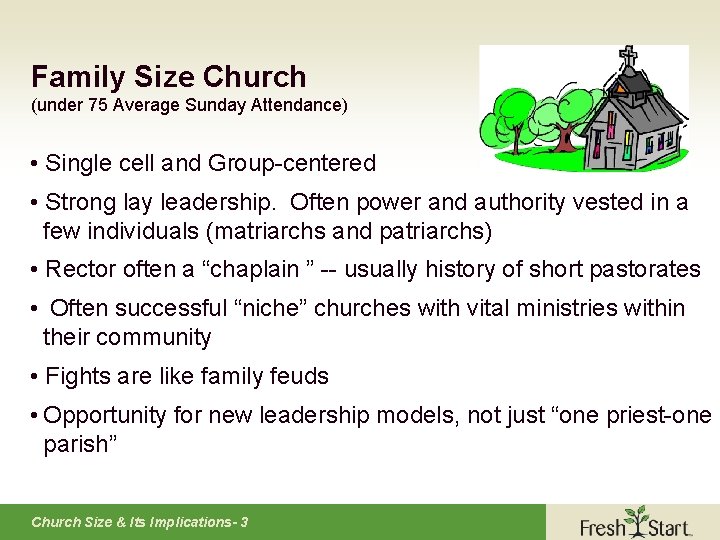
Family Size Church (under 75 Average Sunday Attendance) • Single cell and Group-centered • Strong lay leadership. Often power and authority vested in a few individuals (matriarchs and patriarchs) • Rector often a “chaplain ” -- usually history of short pastorates • Often successful “niche” churches with vital ministries within their community • Fights are like family feuds • Opportunity for new leadership models, not just “one priest-one parish” Church Size & Its Implications- 3
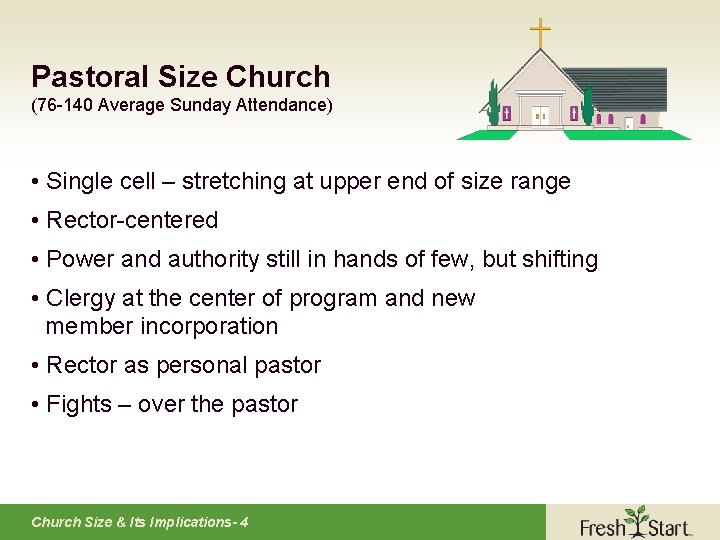
Pastoral Size Church (76 -140 Average Sunday Attendance) • Single cell – stretching at upper end of size range • Rector-centered • Power and authority still in hands of few, but shifting • Clergy at the center of program and new member incorporation • Rector as personal pastor • Fights – over the pastor Church Size & Its Implications- 4
Transitional Size Church (141 -224 Average Sunday Attendance) • Stretched cell • Rector-centered, but moving to group-centered • Power and authority shifting to subgroups; individuals outside of key family(ies) • Change & new member incorporation -- joint rector/lay group responsibility • Rector stretched – additional staff needs • Fights – over inclusion, information, attention of rector Church Size & Its Implications- 5
Program Size Church (225 -800 Average Sunday Attendance) • Multi-cell • Group-centered • Power and authority in committees; vestry shifts to oversight • New member incorporation through groups • Change driven from middle or top • Rector as administrator • Fights – over resources and priorities Church Size & Its Implications- 6
Resource Size Church (801+ Average Sunday Attendance) • Multi-cell • Rector-centered • Power and authority in staff • New member incorporation through groups • Change driven from top down • Rector as CEO • Fights – between program units and staff Church Size & Its Implications- 7
Some Further Caveats. . . • Research based on white, suburban congregations • Impact of culture • Size and behavior may differ • Influence of life cycle Church Size & Its Implications- 8
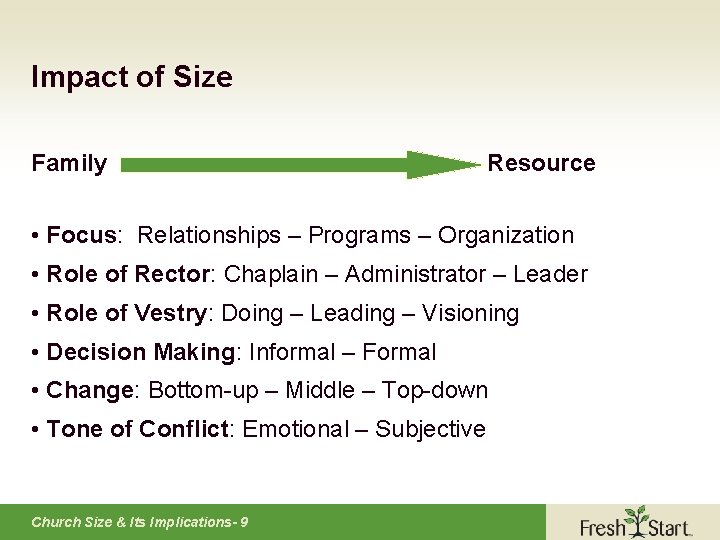
Impact of Size Family Resource • Focus: Relationships – Programs – Organization • Role of Rector: Chaplain – Administrator – Leader • Role of Vestry: Doing – Leading – Visioning • Decision Making: Informal – Formal • Change: Bottom-up – Middle – Top-down • Tone of Conflict: Emotional – Subjective Church Size & Its Implications- 9
True to type? What does it mean for us? • Where does our congregation seem true to its size type? • Where is it different and why? • When we think about our congregation’s future, what impact does our size play? What might we want to take into consideration? Church Size & Its Implications- 10
- Slides: 10