
Overview of Cellular Respiration KEY CONCEPT The overall
- Slides: 16
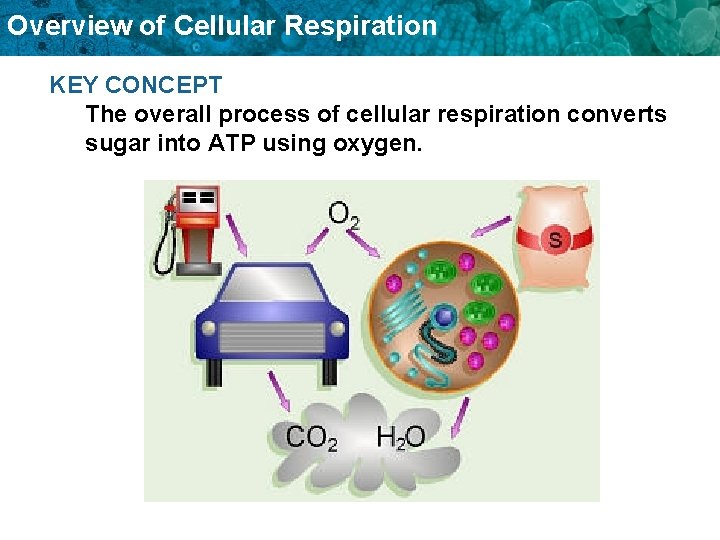
Overview of Cellular Respiration KEY CONCEPT The overall process of cellular respiration converts sugar into ATP using oxygen.
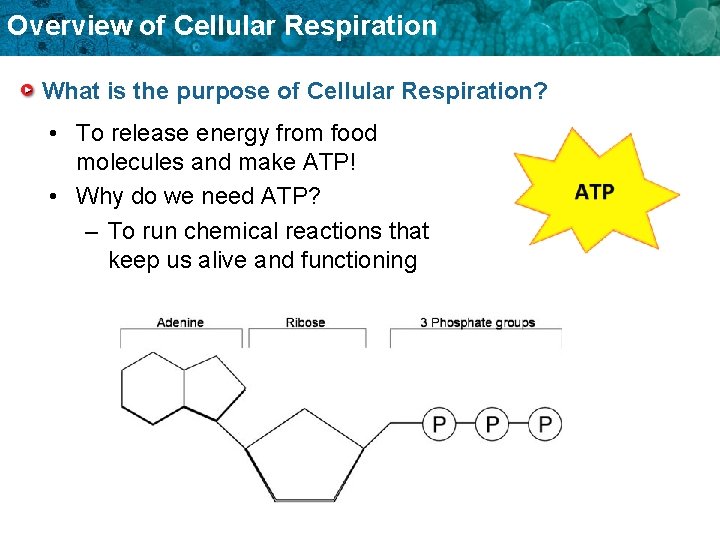
Overview of Cellular Respiration What is the purpose of Cellular Respiration? • To release energy from food molecules and make ATP! • Why do we need ATP? – To run chemical reactions that keep us alive and functioning
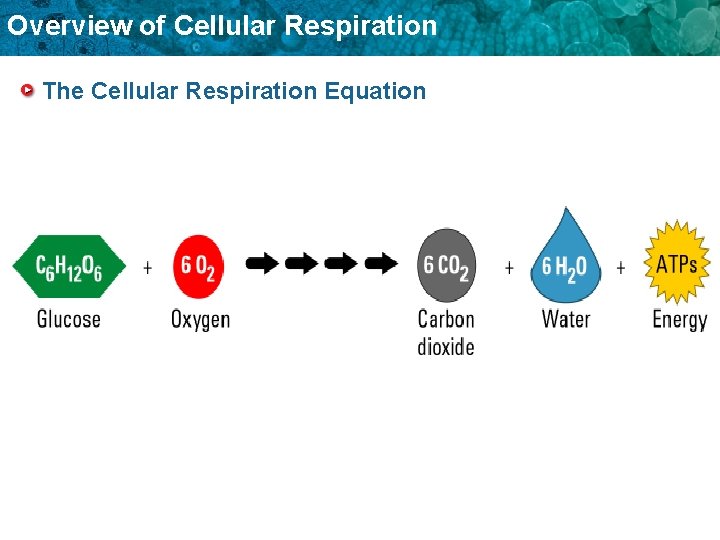
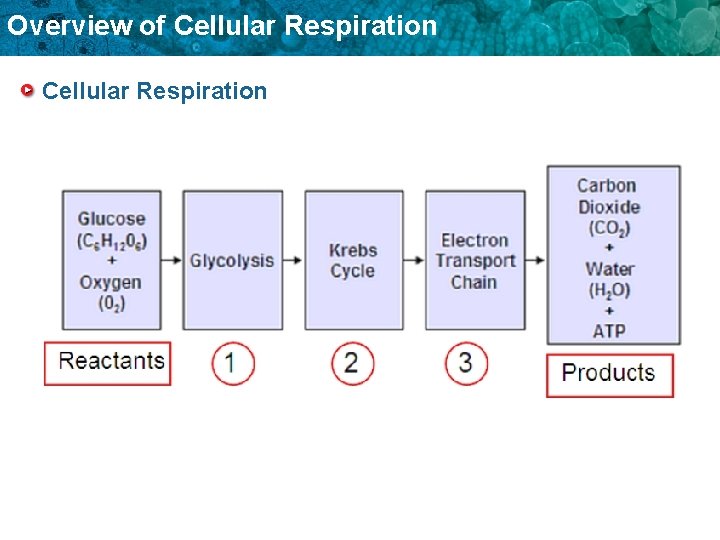
Overview of Cellular Respiration The Cellular Respiration Equation
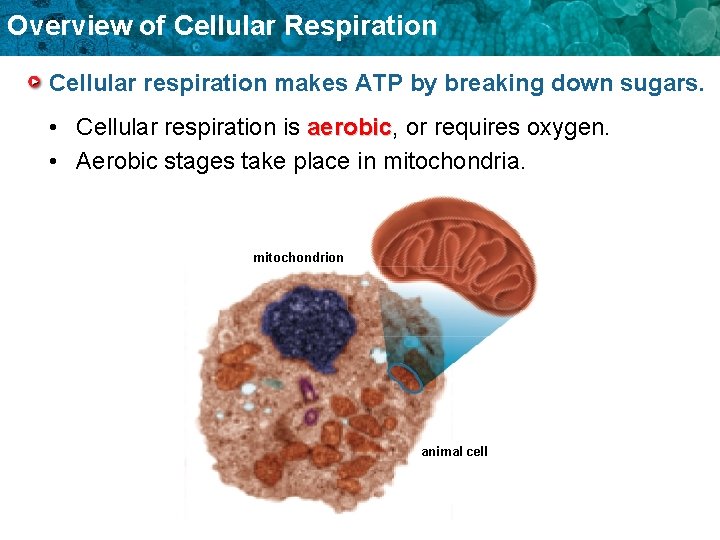
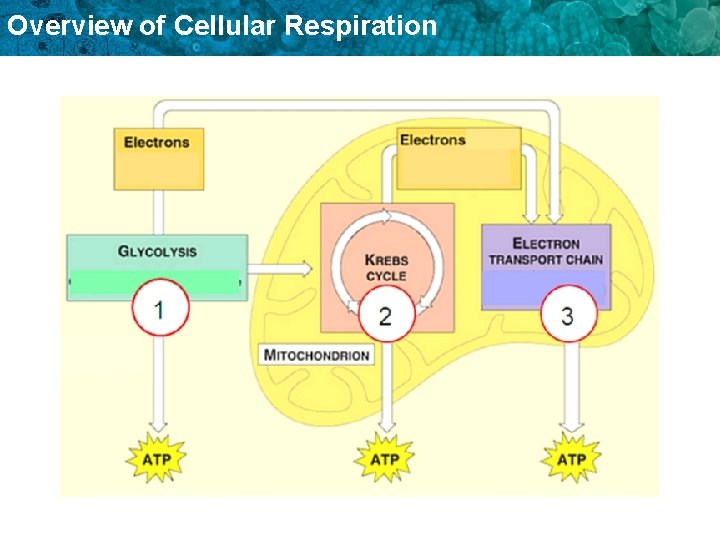
Overview of Cellular Respiration Cellular respiration makes ATP by breaking down sugars. • Cellular respiration is aerobic, aerobic or requires oxygen. • Aerobic stages take place in mitochondria. mitochondrion animal cell
Overview of Cellular Respiration
Overview of Cellular Respiration
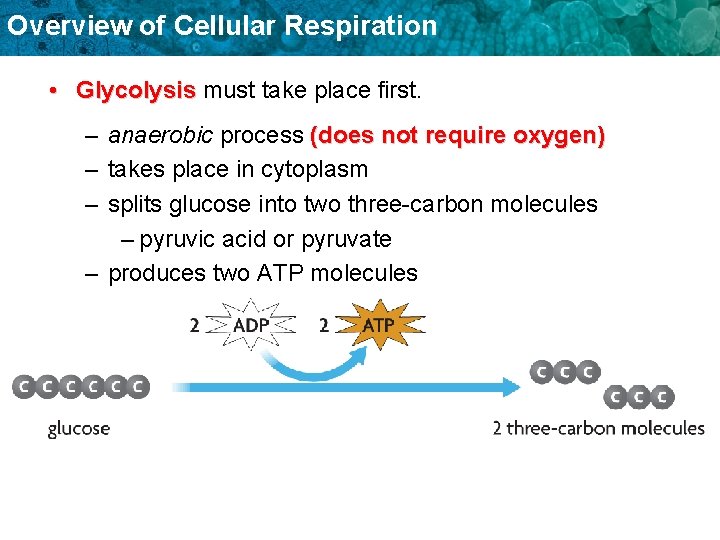
Overview of Cellular Respiration • Glycolysis must take place first. – anaerobic process (does not require oxygen) – takes place in cytoplasm – splits glucose into two three-carbon molecules – pyruvic acid or pyruvate – produces two ATP molecules
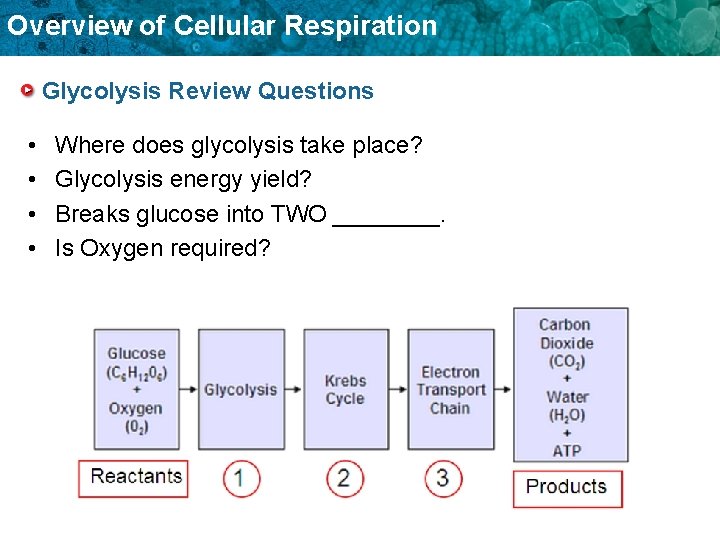
Overview of Cellular Respiration Glycolysis Review Questions • • Where does glycolysis take place? Glycolysis energy yield? Breaks glucose into TWO ____. Is Oxygen required?
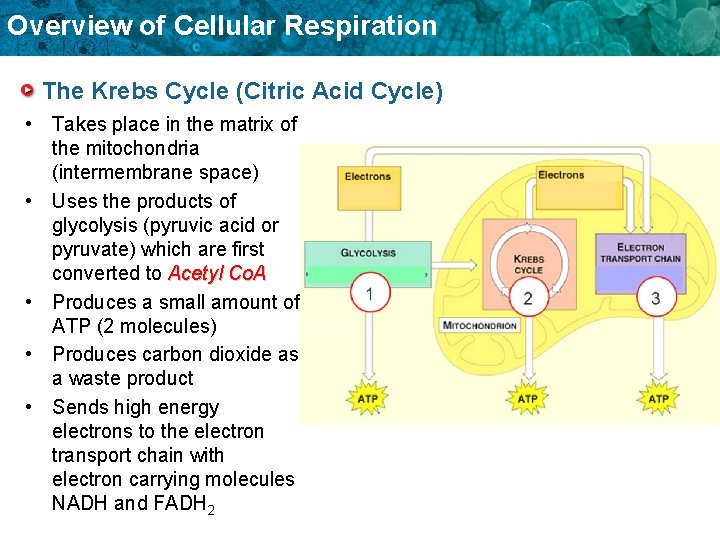
Overview of Cellular Respiration The Krebs Cycle (Citric Acid Cycle) • Takes place in the matrix of the mitochondria (intermembrane space) • Uses the products of glycolysis (pyruvic acid or pyruvate) which are first converted to Acetyl Co. A • Produces a small amount of ATP (2 molecules) • Produces carbon dioxide as a waste product • Sends high energy electrons to the electron transport chain with electron carrying molecules NADH and FADH 2
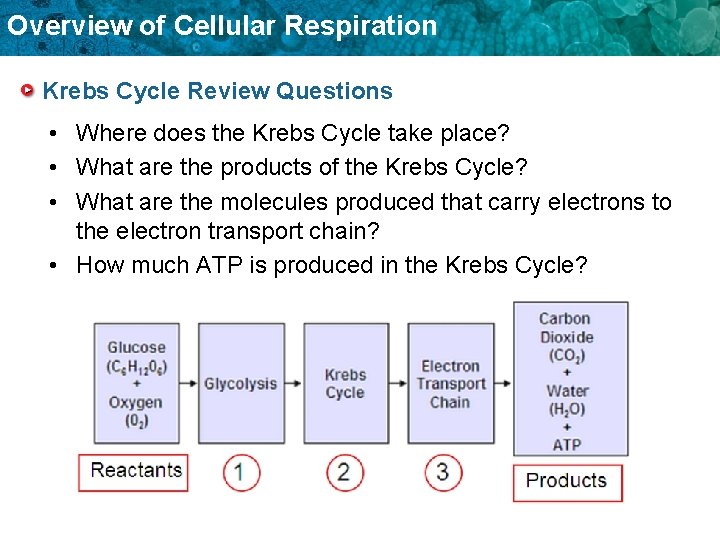
Overview of Cellular Respiration Krebs Cycle Review Questions • Where does the Krebs Cycle take place? • What are the products of the Krebs Cycle? • What are the molecules produced that carry electrons to the electron transport chain? • How much ATP is produced in the Krebs Cycle?
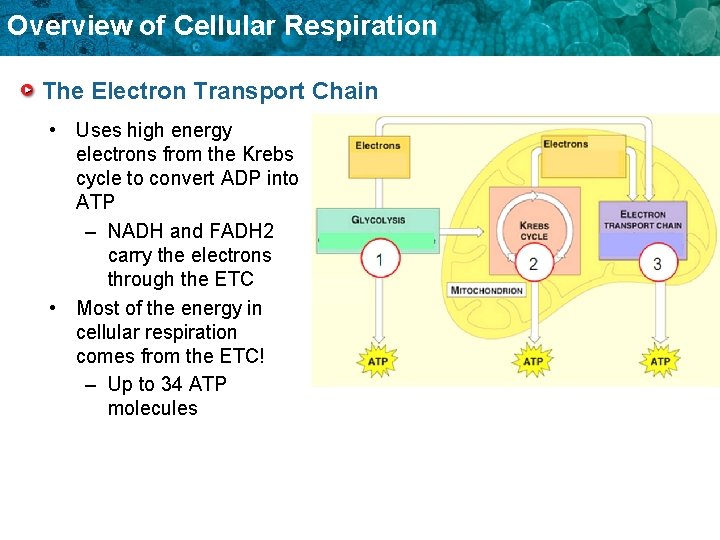
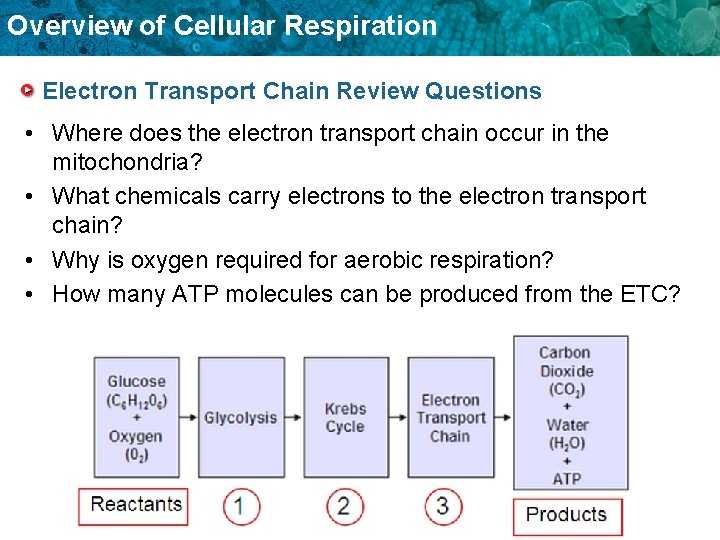
Overview of Cellular Respiration The Electron Transport Chain • Uses high energy electrons from the Krebs cycle to convert ADP into ATP – NADH and FADH 2 carry the electrons through the ETC • Most of the energy in cellular respiration comes from the ETC! – Up to 34 ATP molecules
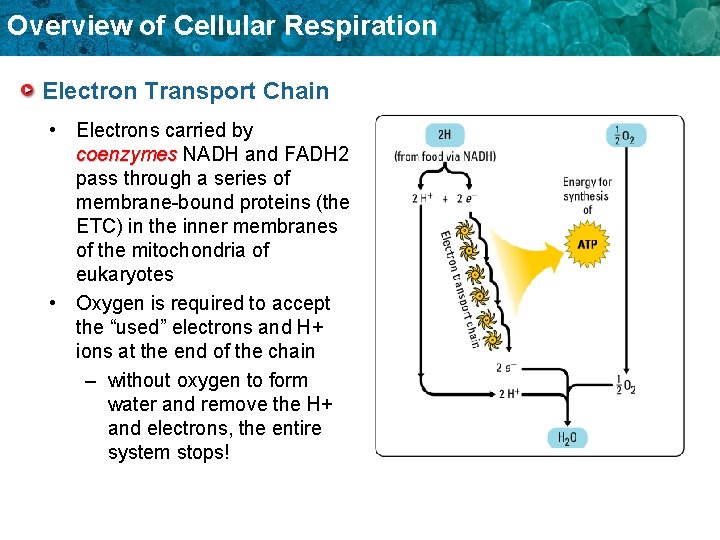
Overview of Cellular Respiration Electron Transport Chain • Electrons carried by coenzymes NADH and FADH 2 pass through a series of membrane-bound proteins (the ETC) in the inner membranes of the mitochondria of eukaryotes • Oxygen is required to accept the “used” electrons and H+ ions at the end of the chain – without oxygen to form water and remove the H+ and electrons, the entire system stops!
Overview of Cellular Respiration Electron Transport Chain Review Questions • Where does the electron transport chain occur in the mitochondria? • What chemicals carry electrons to the electron transport chain? • Why is oxygen required for aerobic respiration? • How many ATP molecules can be produced from the ETC?
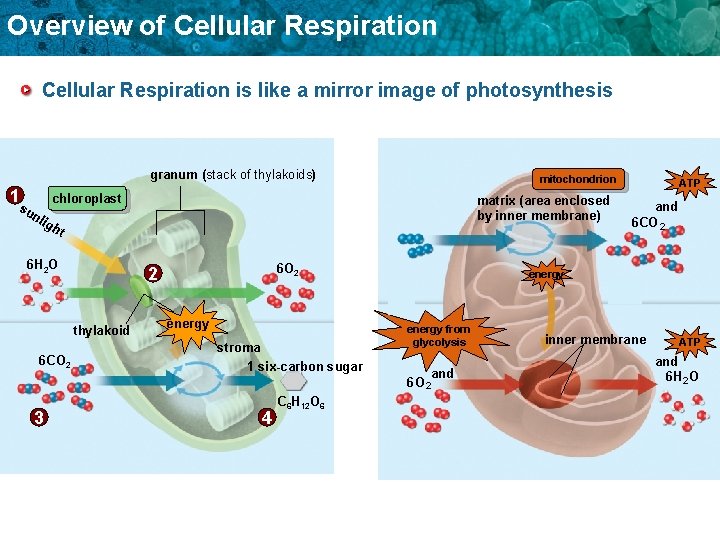
Overview of Cellular Respiration is like a mirror image of photosynthesis 1 granum (stack of thylakoids) 1 su chloroplast mitochondrion matrix (area enclosed by inner membrane) nli gh and 6 CO 2 t 6 H 2 O thylakoid 6 CO 2 6 O 2 2 energy 3 energy stroma 1 six-carbon sugar energy from glycolysis and 6 O 2 3 4 ATP 2 inner membrane ATP and 6 H 2 O C 6 H 12 O 6 4
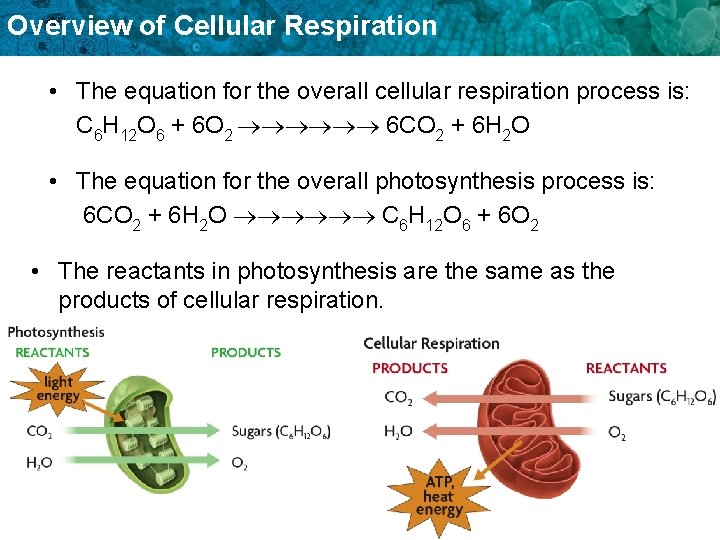
Overview of Cellular Respiration • The equation for the overall cellular respiration process is: C 6 H 12 O 6 + 6 O 2 6 CO 2 + 6 H 2 O • The equation for the overall photosynthesis process is: 6 CO 2 + 6 H 2 O C 6 H 12 O 6 + 6 O 2 • The reactants in photosynthesis are the same as the products of cellular respiration.
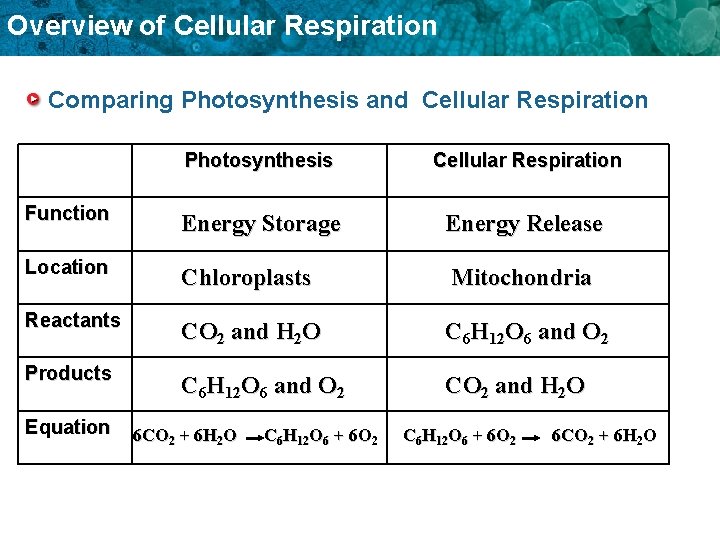
Overview of Cellular Respiration Comparing Photosynthesis and Cellular Respiration Photosynthesis Cellular Respiration Function Energy Storage Energy Release Location Chloroplasts Mitochondria Reactants CO 2 and H 2 O C 6 H 12 O 6 and O 2 Products C 6 H 12 O 6 and O 2 CO 2 and H 2 O Equation 6 CO 2 + 6 H 2 O C 6 H 12 O 6 + 6 O 2 6 CO 2 + 6 H 2 O