
Overview of CBT 445 Head Spine and Chest
Overview of CBT 445 Head, Spine and Chest Trauma Complete course available at www. emsonline. net Copyright 2009 Seattle/King County EMS
Introduction Head, Spine and Chest Trauma • Head, spine, chest have contain the most vital organs • You must determine SICK or NOT SICK, assess the extent of the injuries and stabilize so that no further injury occurs Copyright 2009 Seattle/King County EMS
Practical Skills To receive CBT or OTEP credit, you must perform the following practical skills: • Rapid trauma exam • Backboard • Control of major bleeding • Jaw thrust Copyright 2009 Seattle/King County EMS
Terms arachnoid — A delicate membrane that encloses the spinal cord and brain and lies between the pia mater and dura mater. brain herniation — A condition in which part of the brain is squeezed through an opening in the skull. cardiac tamponade — Accumulation of fluid in the pericardial space which reduces ventricular filling and causes shock. cerebral edema — Swelling of the brain. dura mater — The tough fibrous membrane covering the brain and the spinal cord and lining the inner surface of the skull. It is the outermost of the three meninges. Copyright 2009 Seattle/King County EMS
Terms, continued meninges — The membranes that cover the brain and spinal cord: the dura mater, the arachnoid mater and the pia mater. parasthesia — A pins and needles sensation in the arms or legs. paresis — Weakness petechiae — Small red or purple spots on the skin, caused by broken capillary blood vessels. pia mater — The fine vascular membrane that closely envelops the brain and spinal cord under the arachnoid and the dura mater. Copyright 2009 Seattle/King County EMS
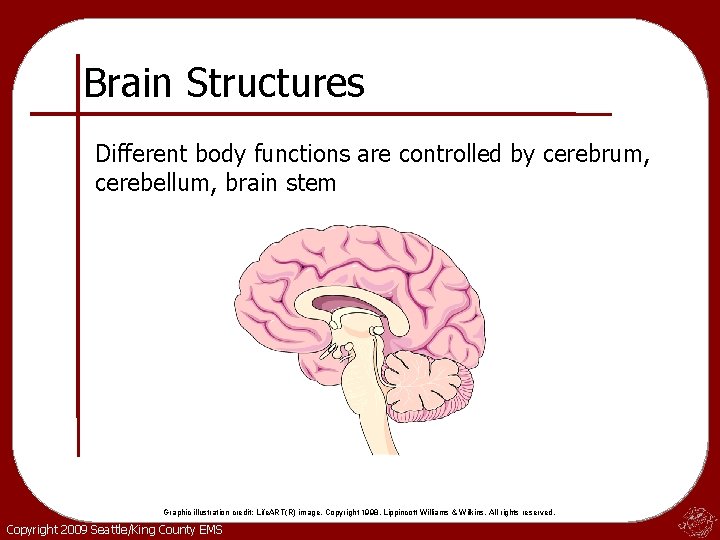
Brain Structures Different body functions are controlled by cerebrum, cerebellum, brain stem Graphic illustration credit: Life. ART(R) image, Copyright 1998, Lippincott Williams & Wilkins. All rights reserved. Copyright 2009 Seattle/King County EMS
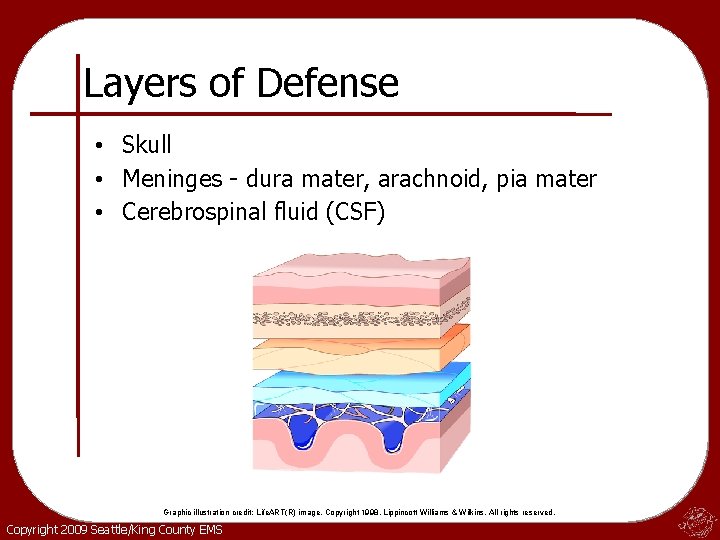
Layers of Defense • Skull • Meninges - dura mater, arachnoid, pia mater • Cerebrospinal fluid (CSF) Graphic illustration credit: Life. ART(R) image, Copyright 1998, Lippincott Williams & Wilkins. All rights reserved. Copyright 2009 Seattle/King County EMS
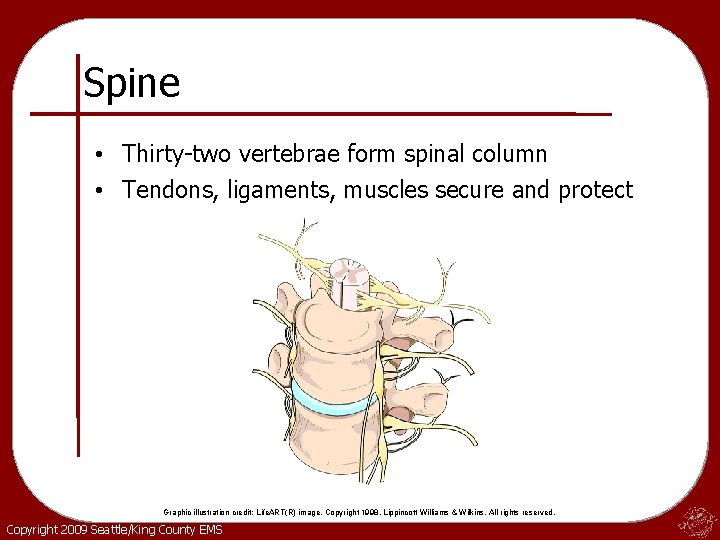
Spine • Thirty-two vertebrae form spinal column • Tendons, ligaments, muscles secure and protect Graphic illustration credit: Life. ART(R) image, Copyright 1998, Lippincott Williams & Wilkins. All rights reserved. Copyright 2009 Seattle/King County EMS
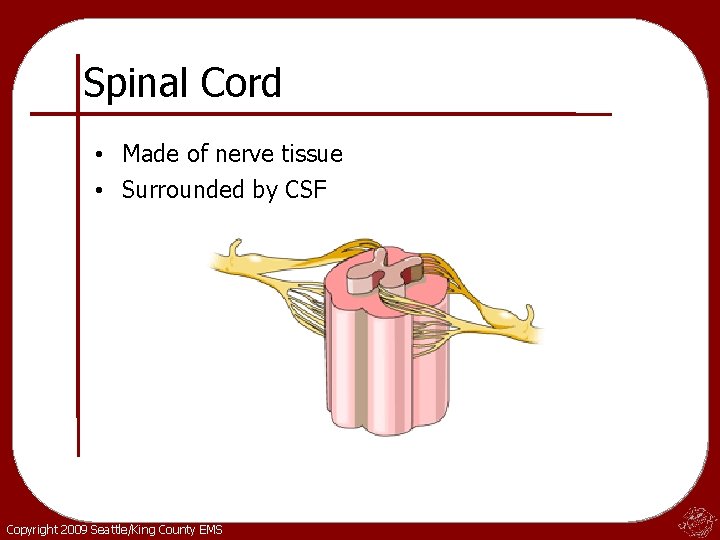
Spinal Cord • Made of nerve tissue • Surrounded by CSF Copyright 2009 Seattle/King County EMS
Nervous System Brain and spinal cord make up central nervous system Peripheral nervous system is made up of all nerves that project out of brain and spinal cord Copyright 2009 Seattle/King County EMS
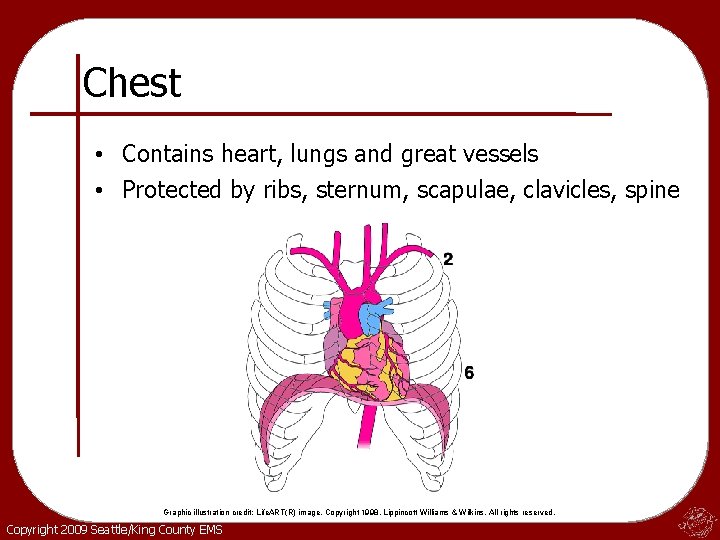
Chest • Contains heart, lungs and great vessels • Protected by ribs, sternum, scapulae, clavicles, spine Graphic illustration credit: Life. ART(R) image, Copyright 1998, Lippincott Williams & Wilkins. All rights reserved. Copyright 2009 Seattle/King County EMS
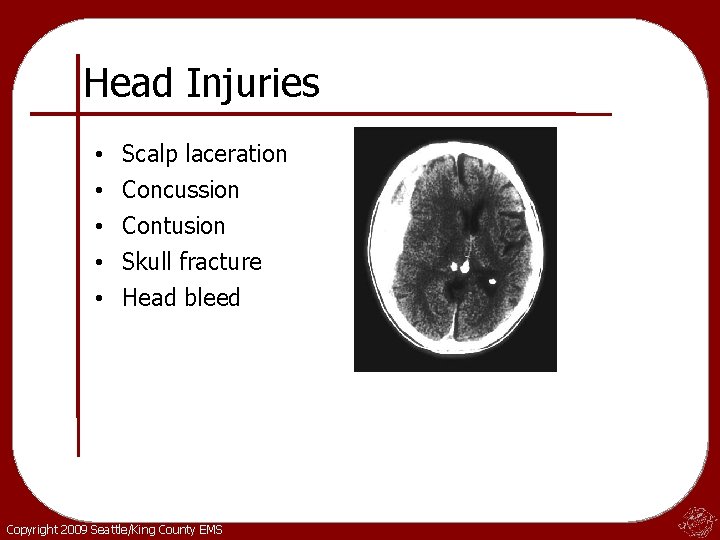
Head Injuries • • • Scalp laceration Concussion Contusion Skull fracture Head bleed Copyright 2009 Seattle/King County EMS
Cerebral Edema • Swelling of the brain • Early sign is unconsciousness • Late signs of cerebral edema and increased intracranial pressure (ICP): – – – Irrational or combative behavior Changing level of consciousness Abnormal respiratory pattern Unequal pupils Posturing Copyright 2009 Seattle/King County EMS
Level of Consciousness A change in level of consciousness is the single most important observation you can make in assessing the severity of brain injury. Copyright 2009 Seattle/King County EMS
Hypovolemic Shock If a head-injured patient shows signs of hypovolemic shock, assess for other internal injuries. Copyright 2009 Seattle/King County EMS
Care for a Head Injury Emergency care for potential internal head injury: • Protect airway • Provide oxygen and ventilatory assistance, if needed • Maintain neutral in-line, cervical stabilization and stabilize spine • Closely monitor vital signs and neurologic status • Control bleeding Copyright 2009 Seattle/King County EMS
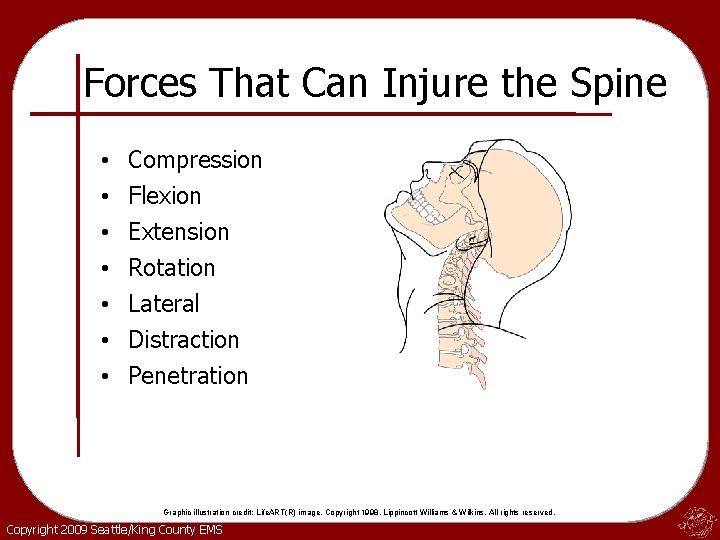
Forces That Can Injure the Spine • • Compression Flexion Extension Rotation Lateral Distraction Penetration Graphic illustration credit: Life. ART(R) image, Copyright 1998, Lippincott Williams & Wilkins. All rights reserved. Copyright 2009 Seattle/King County EMS
Symptoms of Spine Injury • • Weakness Numbness Tingling or paralysis in the extremities Pain along spine Copyright 2009 Seattle/King County EMS
Care for a Spine Injury • • • Open airway using jaw thrust Provide neutral, in-line cervical stabilization Provide oxygen Assist ventilation, if needed Immobilize spine using a backboard Copyright 2009 Seattle/King County EMS
Care for a Spine Injury, cont. • Keep backboard in a level position, if pt. is hypotensive* • Monitor vital signs • Monitor neurological status *There is little data to support the use of the Trendelenburg position when compare to a flat, level position. Therefore we recommend keeping a hypotensive, backboarded patient in a supine and level position. For non-backboarded patients, use the shock position (legs only elevated). Follow your local protocols. Copyright 2009 Seattle/King County EMS
When Not to Immobilize Immobilization may be unnecessary if ALL apply: • • No significant MOI No back or neck pain with or without movement No pain or tenderness of back or neck on exam No altered LOC No history of loss of consciousness No recent alcohol or drug use Patient is reliable historian Copyright 2009 Seattle/King County EMS
Helmet Removal • Leave football helmet and shoulder pads on if it stabilizes head and does not impair breathing or airway • If you need to remove: – Manually stabilize neck and head and remove face guard – Remove chinstrap and have one rescuer stabilize head while another removes helmet • Remove motorcycle and bicycle helmets Copyright 2009 Seattle/King County EMS
Chest Trauma • • Pneumothorax Hemothorax Tension pneumothorax Flail chest Traumatic asphyxia Myocardial contusion Cardiac tamponade Lacerations of great vessels (e. g. , aortic tear) Copyright 2009 Seattle/King County EMS
Care for a Chest Injury • • • Ensure ABC’s Administer high flow oxygen via NRB Assist ventilations, if needed Anticipate cardiac arrest Treat for shock Copyright 2009 Seattle/King County EMS
Summary Structures of the brain are cerebrum, cerebellum, brain stem Signs of cerebral edema and increasing ICP: • • • Irrational or combative behavior Changing LOC Abnormal respiratory pattern Unequal pupils Posturing Copyright 2009 Seattle/King County EMS
Summary, continued Emergency care for a potential internal head injury: • Protect airway • Provide oxygen and ventilatory assistance • Maintain neutral in-line, cervical stabilization and stabilize spine • Monitor vital signs and neurological status • Control bleeding Major symptoms for spine injury are weakness, numbness, tingling, impaired sensation or paralysis in the extremities, pain in the spinal area. Copyright 2009 Seattle/King County EMS
Summary, continued You may not need to immobilize the spine if ALL these criteria are met: • • No significant MOI No back or neck pain with or without movement No pain or tenderness of back or neck on exam No altered LOC No history of loss of consciousness No recent alcohol or drug use Patient is a reliable historian Copyright 2009 Seattle/King County EMS
Summary, continued Care for spine injury: • Manually stabilize the head and aligning neck in a neutral, in-line position • Apply cervical collar • Carefully move patient and place on a backboard and secure Assessment and treatment of the ABC’s is your highest priority for a suspected spine injury Copyright 2009 Seattle/King County EMS
Summary, continued Signs of an internal chest injury • Localized pain and tenderness • Possible dyspnea Care for a chest injury may require: • • • Ensure ABC’s High flow oxygen via NRB Assist ventilations, if needed Anticipate cardiac arrest Treat for shock Copyright 2009 Seattle/King County EMS
- Slides: 29