
Overview of Canadian Law System Types of Law
- Slides: 14
Overview of Canadian Law System Types of Law Process of Legislation Agents of Influence in Canada
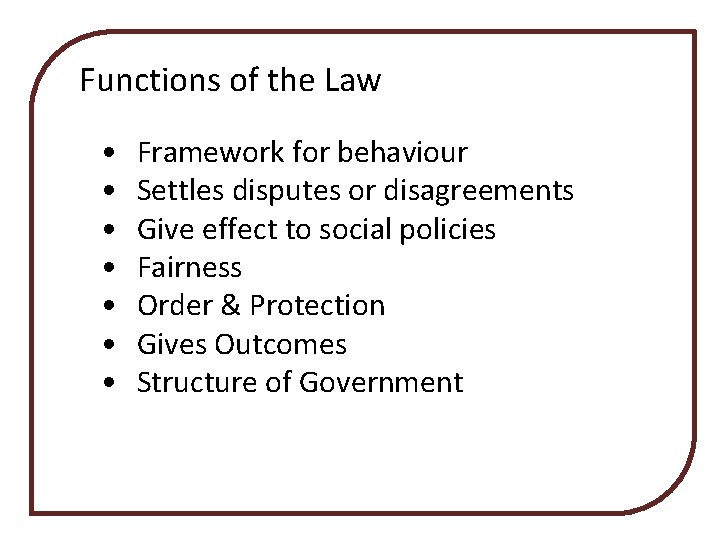
Functions of the Law • • Framework for behaviour Settles disputes or disagreements Give effect to social policies Fairness Order & Protection Gives Outcomes Structure of Government
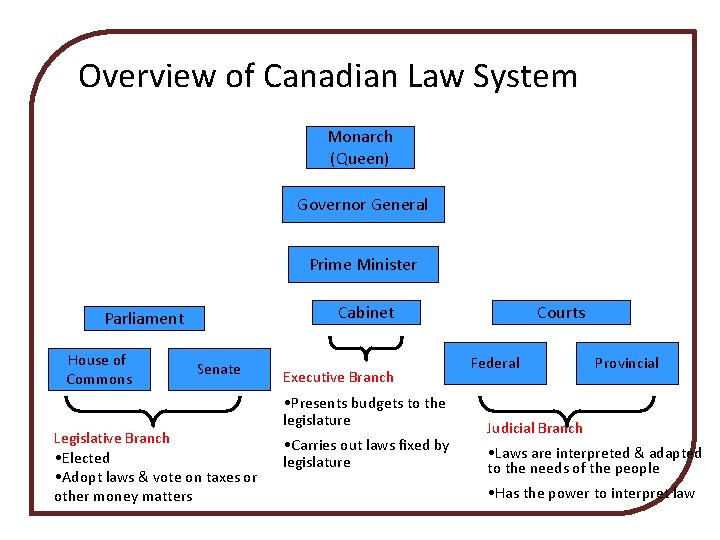
Overview of Canadian Law System Monarch (Queen) Governor General Prime Minister Cabinet Parliament House of Commons Senate Legislative Branch • Elected • Adopt laws & vote on taxes or other money matters Executive Branch • Presents budgets to the legislature • Carries out laws fixed by legislature Courts Federal Provincial Judicial Branch • Laws are interpreted & adapted to the needs of the people • Has the power to interpret law
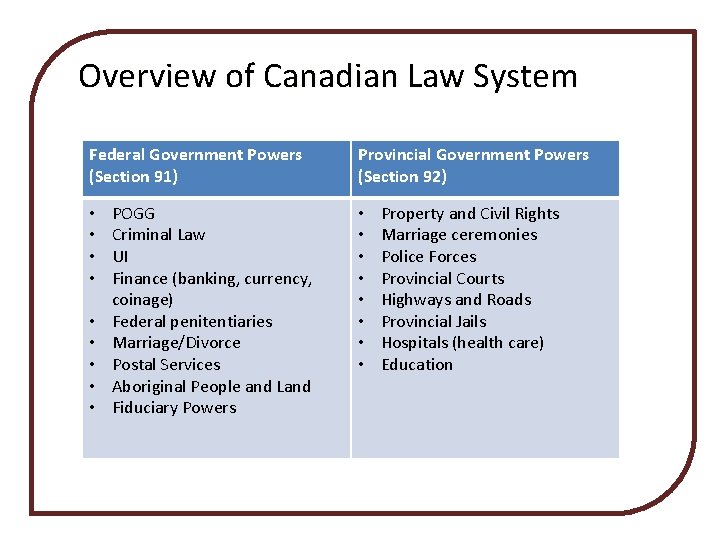
Overview of Canadian Law System Federal Government Powers (Section 91) • • • POGG Criminal Law UI Finance (banking, currency, coinage) Federal penitentiaries Marriage/Divorce Postal Services Aboriginal People and Land Fiduciary Powers Provincial Government Powers (Section 92) • • Property and Civil Rights Marriage ceremonies Police Forces Provincial Courts Highways and Roads Provincial Jails Hospitals (health care) Education
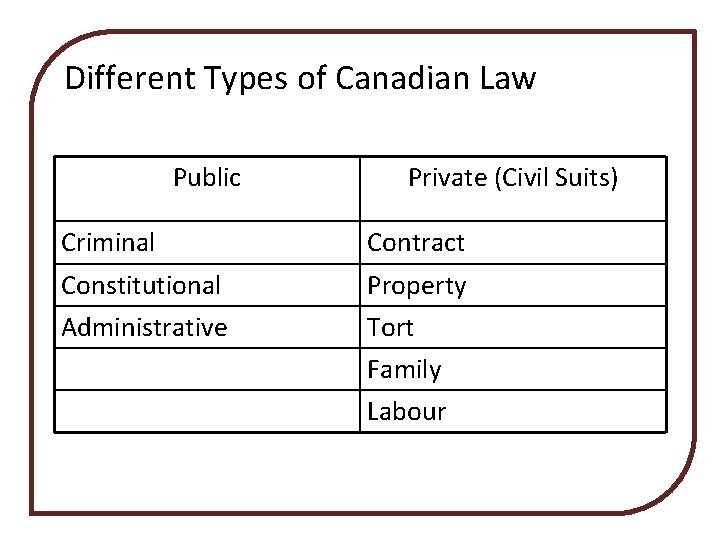
Different Types of Canadian Law Public Private (Civil Suits) Criminal Contract Constitutional Administrative Property Tort Family Labour
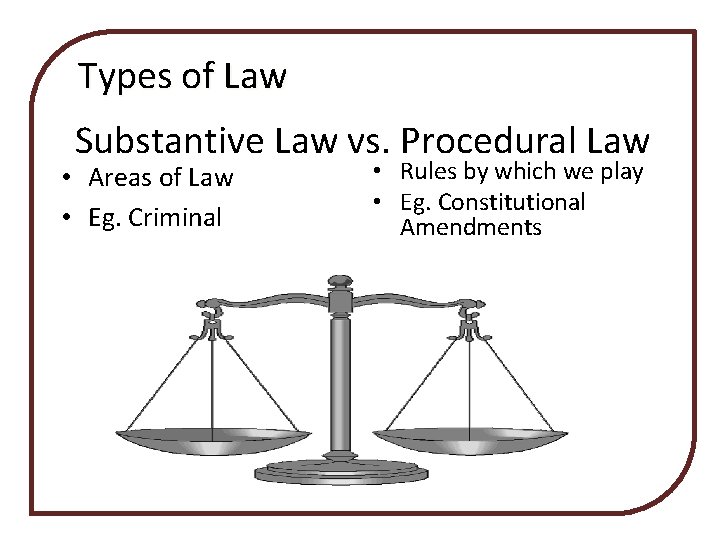
Types of Law Substantive Law vs. Procedural Law • Areas of Law • Eg. Criminal • Rules by which we play • Eg. Constitutional Amendments
Process of Legislation From Idea to Legislation: The 8 Step Process of Making a Law in Canada
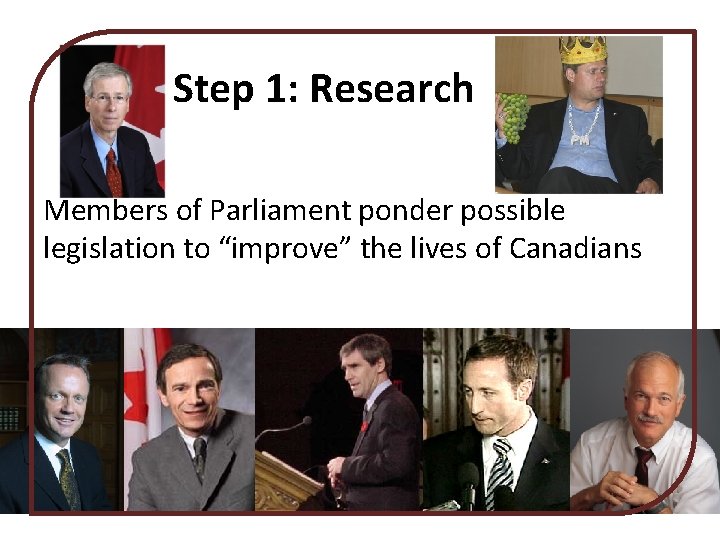
Step 1: Research Members of Parliament ponder possible legislation to “improve” the lives of Canadians
Step 2: Write a Bill Write Me! • A bill is the formal layout of Canadian Federal Legislation.
Step 3: First Reading Cabinet Minister proposes bill and reason for legislation Step 4: Second Reading The bill is debated and sent to one of 12 committees to be reviewed Step 5: Committee The bill is reviewed in one of twelve committees and changes are made Step 6: Third Reading The bill is presented again, voted on, and if it passes it goes to the senate
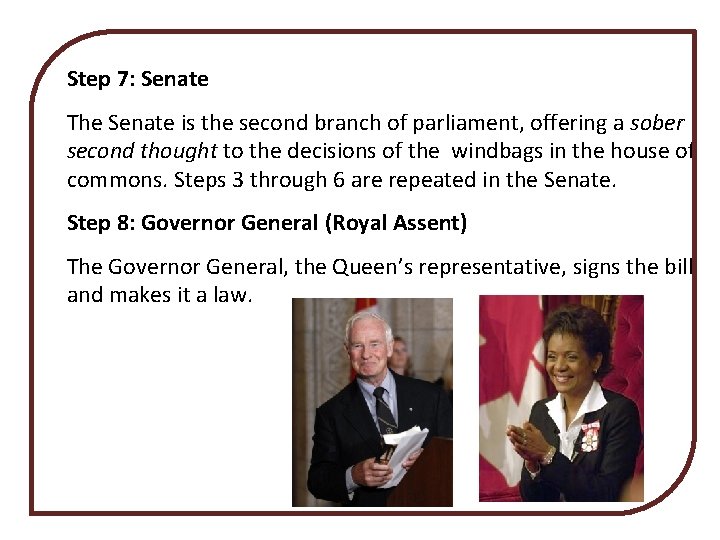
Step 7: Senate The Senate is the second branch of parliament, offering a sober second thought to the decisions of the windbags in the house of commons. Steps 3 through 6 are repeated in the Senate. Step 8: Governor General (Royal Assent) The Governor General, the Queen’s representative, signs the bill and makes it a law.
Agents of Influence • • • Canadian Charter of Rights and Freedoms Politicians/Political Parties Bureaucracy Lobbyists/Activists Citizen Groups (NGO) Judges
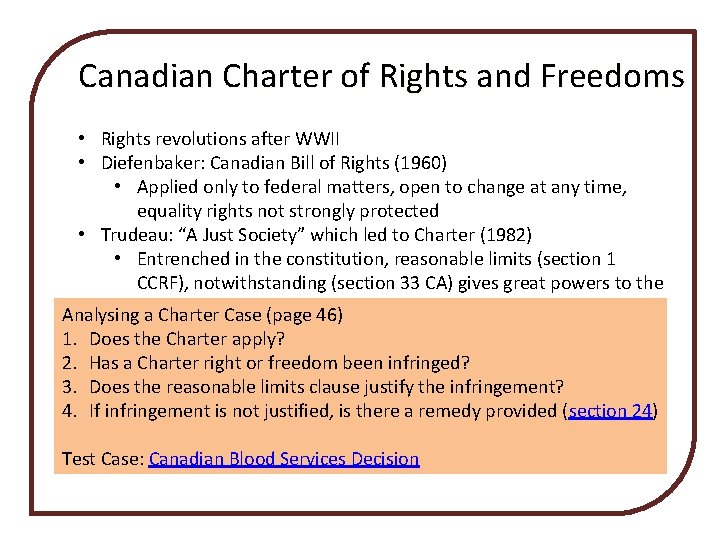
Canadian Charter of Rights and Freedoms • Rights revolutions after WWII • Diefenbaker: Canadian Bill of Rights (1960) • Applied only to federal matters, open to change at any time, equality rights not strongly protected • Trudeau: “A Just Society” which led to Charter (1982) • Entrenched in the constitution, reasonable limits (section 1 CCRF), notwithstanding (section 33 CA) gives great powers to the limits power government by protecting individual Analysing. Courts, a Charter Case (pageof 46) rights 1. Does the Charter apply? come to ultrabeen viresinfringed? vs. intra vires. 2. Has • a Often Charter rightdown or freedom • the Private legal matters common law or human 3. Does reasonable limits tried clauseunder justifyexisting the infringement? rights legislation. 4. If infringement is not justified, is there a remedy provided (section 24) Test Case: Canadian Blood Services Decision
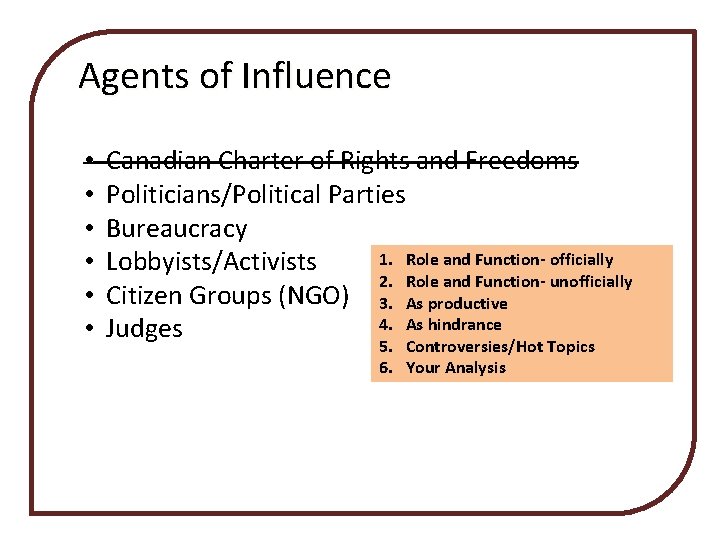
Agents of Influence • • • Canadian Charter of Rights and Freedoms Politicians/Political Parties Bureaucracy 1. Role and Function- officially Lobbyists/Activists 2. Role and Function- unofficially Citizen Groups (NGO) 3. As productive 4. As hindrance Judges 5. Controversies/Hot Topics 6. Your Analysis