
OVERVIEW OF BUSINESS OWNERSHIP and OTHER LEGAL ISSUES
OVERVIEW OF BUSINESS OWNERSHIP and OTHER LEGAL ISSUES Mr. Sherpinsky Council Rock School District Accelerated Business Law
Objectives Understand the different forms of business ownership Summarize the advantages and disadvantages of each type of business ownership Evaluate the differences related to taxation, formation, dissolving, owner liability, and managerial control.
THREE BASIC FORMS OF BUSINESS OWNERSHIP • Sole proprietorship • Partnership • Corporation Your choice depends on your needs & goals
SOLE PROPRIETORSHIP • A business owned and operated by one person; the business and the owner are one and the same in the eyes of the law • Approximately 76 percent of all businesses in the U. S. are sole proprietorships.
ADVANTAGES OF SOLE PROPRIETORSHIPS • Easy and inexpensive to create. • Owner makes all business decisions. • Owner receives all profits. • Least regulated form of business ownership. • Business itself pays no taxes.
DISADVANTAGES OF SOLE PROPRIETORSHIPS • Owner has unlimited liability for all debts and actions of the business. • Unlimited liability: The debts of the business may be paid from the personal assets of the owner. • Difficult to raise capital. • Sole proprietorship is limited by his/her skills and abilities. • The death of the owner automatically dissolves the business.
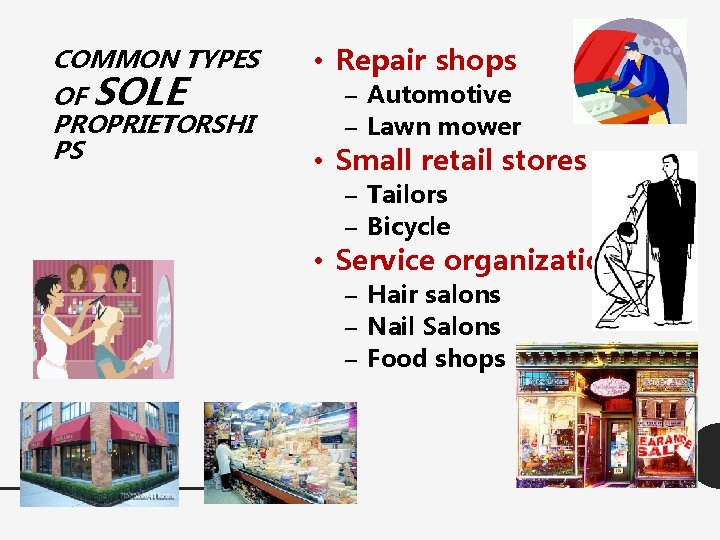
COMMON TYPES OF SOLE PROPRIETORSHI PS • Repair shops – Automotive – Lawn mower • Small retail stores – Tailors – Bicycle • Service organizations – Hair salons – Nail Salons – Food shops
CREATION • Usually a few formal AND OPERATIO N requirements to establish a sole proprietorship – May require: • Licenses to legally operate as business – Having employees requires having an EIN: Employee Identification Number • Occupational licenses • Certain types of liability insurance – Some states require formal filing to begin operations or
Review What You’ve Learned What is a sole proprietorship? A form of business that is owned and operated by one person How does a sole proprietorship begin? A person needs only to begin the operation of the business
Review What You’ve Learned Name the advantages of a sole proprietorship? § Ease of creation § Total control § Retention of profits § Freedom from excessive governmental control
Review What You’ve Learned Name the disadvantages of a sole proprietorship? § Limited capital § Unlimited liability § Limited human resources § Limited lifetime

FICTITIOUS NAMES Registration with STATE! • A person who goes into business can choose to operate under his or her own name or can make up a name – If the Sole Proprietor uses anything but his or her own name, the law calls the made-up name a fictitious name. • Must not be a name already in use anywhere in the state and can not
FICTITIOUS NAMES Registration with STATE! • Search Your Own Name – Look up business names you may potentially choose – Look up business names you think you would use for yourself – Look up small variations for potential names – Print. Screen out of the personal named businesses. – Report your findings.
PARTNERSHIP A form of business ownership in which two or more people share the assets, liabilities, and EXTRA CREDIT KNOWLEDGE: profits. Formed under new law called Revised Uniform Partnership Act (RUPA) or UPA: Uniform Partnership Act. Both laws emphasize a partnership with at least 2 or more partners and must be in business to make money.
ADVANTAGES OF PARTNERSHIPS § § § § Easy to establish Complementary skills (2 Heads better than 1) Division of profits and losses Larger pool of capital (2 persons) Ability to attract limited partners Little governmental regulation Flexibility and Taxation
DISADVANTAGES OF PARTNERSHIPS • Partnerships may lead to disagreements • Some entrepreneurs are not willing to share responsibilities and profits • Some entrepreneurs fear being held legally liable for the error of their partners • Each owner has unlimited liability • Torts Liability (Joint & several)
TYPES OF PARTNERSHIPS • General partnership: A partnership in which all partners have unlimited personal liability and take full responsibility for the management of the business. • Limited partnership: A partnership in which thepartners’ liability is limited to their investment

TYPES OF PARTNERSHIPS • Joint venture: A partnership in which two companies join to complete a specific project. The partnership ends after a specified period of time. • Strategic alliance: A partnership in which two businesses work together for mutual benefit.

TYPES OF PARTNERSHIPS • Secret: Active, Unknown relationship, unlimited liability • Silent: Not Active, Known relationship, unlimited liability • Dormant: Not Active, unknown relationship, unlimited liability
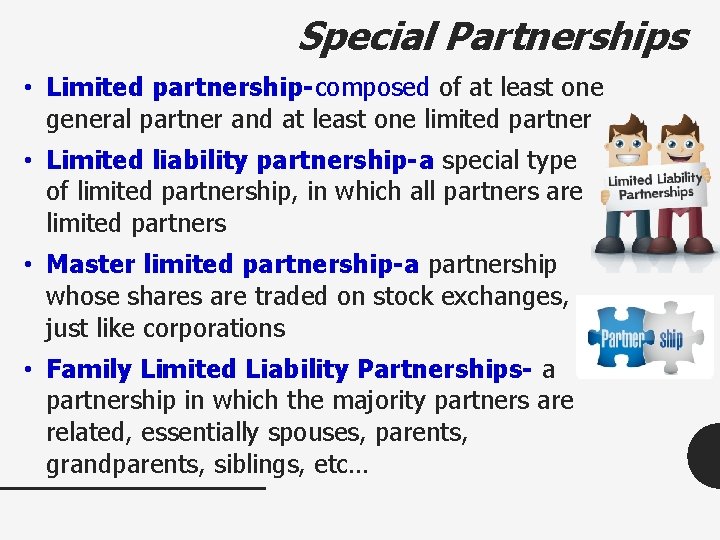
Special Partnerships • Limited partnership-composed of at least one general partner and at least one limited partner • Limited liability partnership-a special type of limited partnership, in which all partners are limited partners • Master limited partnership-a partnership whose shares are traded on stock exchanges, just like corporations • Family Limited Liability Partnerships- a partnership in which the majority partners are related, essentially spouses, parents, grandparents, siblings, etc…
DUTIES OF PARTNERSHIPS Partnership Duties • Loyalty 1 ST Duty is fiduciary relationship based on trust • • MUST: disclose property, profits, benefits to others Obedience • Written articles of partnership • • MUST: be followed and all decisions must be executed Duty of Care • Work in the best interest of partnership • • MUST: Use all talents for the partnership
Legal Activity: The Case of the Talkative Silent Partner • Bill Douglas was a silent partner with Gale Griffin and Bridget Mayfield in a firm known as Titan Industries. When Griffin and Mayfield decide to hire Larry Cedco as the new general manager, Douglas objects, demanding that he be given a chance to vote on the new GM. Question: is Douglas within his rights her? Explain your answer.

Forming a Two Ways: Partnership 1. By agreement – Requires the valid assent of all parties • Express (in writing) • But can be oral – Lasting more than 1 year • (MUST BE IN WRITING) – EXTRA CREDIT KNOWLEDGE: Partnership by Estoppel: Occurs when someone says or does something that leads a 3 rd party to believe a partnership exists. KNOWN AS the “Articles of partnership” • 2. Proof of Existence (Conduct) – Shared profits – Shared expenses – Shared banking – Shared management
PARTNERSHIP PROPERTY Limitations a) Important to distinguish between property of partnership and individual partners. b) Property contributed to partnership becomes partnership property Property Rights of the Partners a) Certain rights exist: I. III. Right to use/control the property Right to manage the firm Right to share in profits
FORMING A GENERAL PARTNERSHIP Statute of Frauds: Requirements a) Under the Statue of Frauds, if a partnership is to last more than a year or if the partnership is formed to sell, buy, or lease real property, property it must be evidenced in writing Dissolving a Partnership a) Legal detachment: detachment change in the relationship when partner stops being associated with business b) Doesn’t necessarily bring end to business
DISSOLVING A PARTNERSHIP Effects of Dissolution a) b) c) Other partners may wish to continue If so, new agreement needed Public notice given to relieve retiring partners from liability for any new debts or actions Distribution of Assets a) Paid in this order: i. Money owed to creditors ii. Money lent to partners to the firm iii. Original money paid by partners iv. Surplus owed to partner
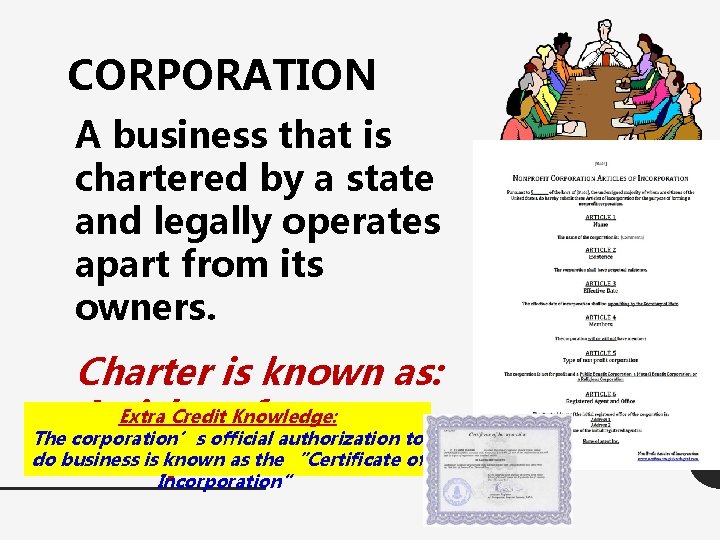
CORPORATION A business that is chartered by a state and legally operates apart from its owners. Charter is known as: Extra Creditof Knowledge: Articles The corporation’s official authorization to do business is known as the “Certificate of Incorporation”
TYPES OF CORPORATIONS • C-corporation: The most common form of corporation. It protects the entrepreneur from being personally sued for the actions and debts of the corporation. • Subchapter S corporation: A corporation that is taxed like a sole proprietorship or partnership. EXTRA CREDIT KNOWLEDGE: • Nonprofit corporation : Legal A legally formedentities corporation is a “de jure” corporation. that make corporation does not exist in laws money for reasons. Aother thanthat the but doers exist in fact is called a
ADVANTAGES OF CORPORATIONS • Can raise money by issuing shares of stock. • Offers owners limited liability. • Limited liability: Owners are liable only up to the amount of their investments. • People can easily enter or leave the business by buying or selling their shares of stock. • The business can hire experts to professionally manage each aspect of the
DISADVANTAGES OF • CORPORATIONS Legal assistance is needed to start a corporation. • Start-up is costly. • Corporations are subject to more government regulations than partnerships or sole proprietorships. • A lot of paperwork is involved in running a corporation. • Income is taxed twice.
Alternate approaches to starting a business • Buy an existing business. • Enter a family business • Own a franchise business
Forming a Corporation • Corporate Promoters: someone who helps organize a new corporation. • The name of a corporation must include the word “Corporation, Incorporated, or Company”.
ADVANTAGES OF BUYING AN EXISTING BUSINESS • Existing businesses already have customers, suppliers, and procedures. • Seller of the business may be willing to train the new owner. • There are existing financial records.
DISADVANTAGES OF BUYING AN EXISTING BUSINESS • Business may be for sale because it is not making a profit. • Problems may be inherited with the purchase of an existing business. • Many entrepreneurs may not have the capital needed to purchase an
ADVANTAGES TO ENTERING A FAMILY BUSINESS • There is a certain sense of pride and accomplishment that comes from being part of a family endeavor. • A business can remain in the family for generations. • Some people enjoy working with relatives. • The efforts of running a family business gives one the benefit of knowing that their efforts are
DISADVANTAGES TO ENTERING A FAMILY BUSINESS • Senior management positions are often held by family members who may not be the best qualified. • It may be difficult to retain qualified employees who are not members of the family. • Family politics may affect decisions regarding the business. • It is often difficult to separate business life and private life in family-run businesses. • It is often difficult to set policies and
OWN A FRANCHISE BUSINESS Franchise: A legal agreement that gives an individual the right to market a company’s products or services in a particular area. Franchisee: A person who purchases a franchise agreement. Franchisor: The person or company who sells a franchise. Initial franchise fee: The fee the franchise owner pays in return for the right to run the business.
ADVANTAGES OF PURCHASING A FRANCHISE BUSINESS üAn established product or service is being provided. üFranchisors often offer management, technical, and other assistance. üEquipment and supplies may be less expensive. üA guarantee of consistency attracts customers.

DISADVANTAGES OF PURCHASING A FRANCHISE BUSINESS üThe cost of franchises may be high, which can reduce profits. üFranchise owners are limited in the decisions they can make regarding the business. üThe performance of other franchises impact on the franchisee. üThe franchise agreement may be terminated by the
YOU MUST COMPLETE QUIZ ONLINE by Next Class QUIA
- Slides: 40