
Overview of Australian Bureau of Meteorology Satellite Activities
Overview of Australian Bureau of Meteorology Satellite Activities Country Report for Australia APSDEU-7, 20 -22 September 2006, Honolulu, Hawaii 1
Services provided by the Australian Bureau of Meteorology uweather forecasts and warnings (and tsunamis) uclimate and hydrological information uin support of aviation, shipping, defence, industry and the general public, to enhance economic and social well-being APSDEU-7, 20 -22 September 2006, Honolulu, Hawaii 2
Main Activities ABo. M u Local reception of satellite data l e. g. NOAA, GOES-9, FY-1 D, FY-2 C, MODIS. u Indirect reception of satellite data l e. g. GOES, Meteosat, ERS-2, DMSP, ENVISAT, Quikscat. u Ranging of geostationary satellites u Archive of meteorological data u product generation and development u National and international activities (e. g. APSDEU, WMO, MOUs, APSATS, APRSAF, GEOSS) u education and training (led by BMTC) u Ensure national & international user access to real time satellite data and products APSDEU-7, 20 -22 September 2006, Honolulu, Hawaii 3
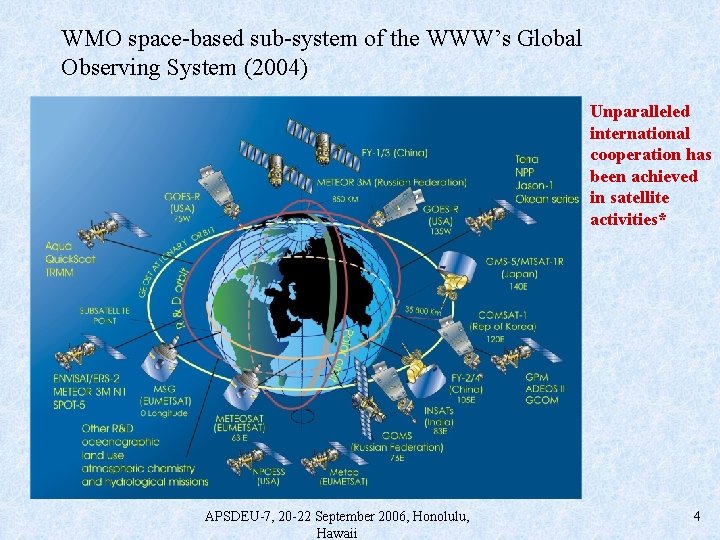
WMO space-based sub-system of the WWW’s Global Observing System (2004) Unparalleled international cooperation has been achieved in satellite activities* APSDEU-7, 20 -22 September 2006, Honolulu, Hawaii 4
Local ground stations u Rationale for local reception: l timeliness; l full resolution; l low cost, relatively low maintenance; l backup to Melbourne Head Office (security of access to data). u Ranging geo satellites - TARS - MOU with China APSDEU-7, 20 -22 September 2006, Honolulu, Hawaii 5
Locally received satellite data u. MTSAT-1 R/FY-2 C: Melbourne HO & Crib Pt (near Melbourne) u. NOAA: Crib Pt (2), Darwin, Perth, Casey (Antarctica), Alice Springs, Davis coming u. FY-1 D: Melbourne, Darwin, Casey u. MODIS: Hobart, Perth, (Alice Springs from ACRES); AIRS Melbourne u. Hobart, Alice Springs, Perth - consortia u. MTSAT-1 R, FY-2 C - Perth, Darwin, Brisbane & Sydney, plus Melbourne APSDEU-7, 20 -22 September 2006, Honolulu, Hawaii 6
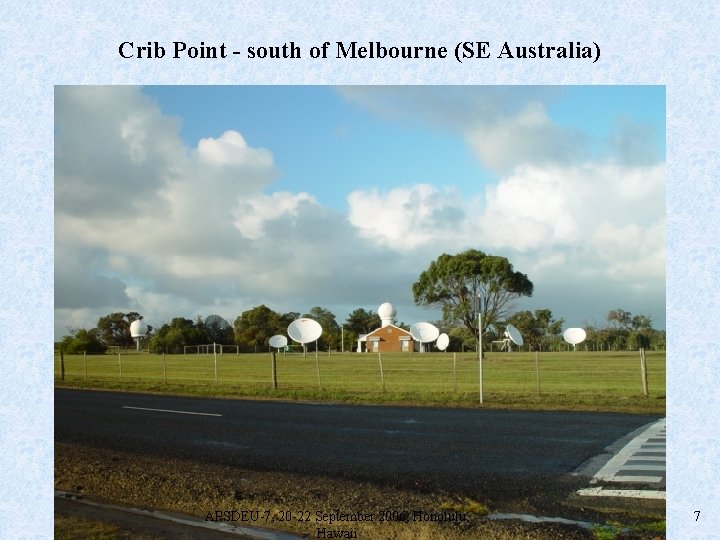
Crib Point - south of Melbourne (SE Australia) APSDEU-7, 20 -22 September 2006, Honolulu, Hawaii 7
MTSAT-1 R and FY-2 C applications u. Multiband imagery usolar radiation u. Atmospheric Motion Vectors uvolcanic ash detection uassimilation of radiances into NWP models u. Data Collection Platforms APSDEU-7, 20 -22 September 2006, Honolulu, Hawaii 8
APSDEU-7, 20 -22 September 2006, Honolulu, Hawaii 9

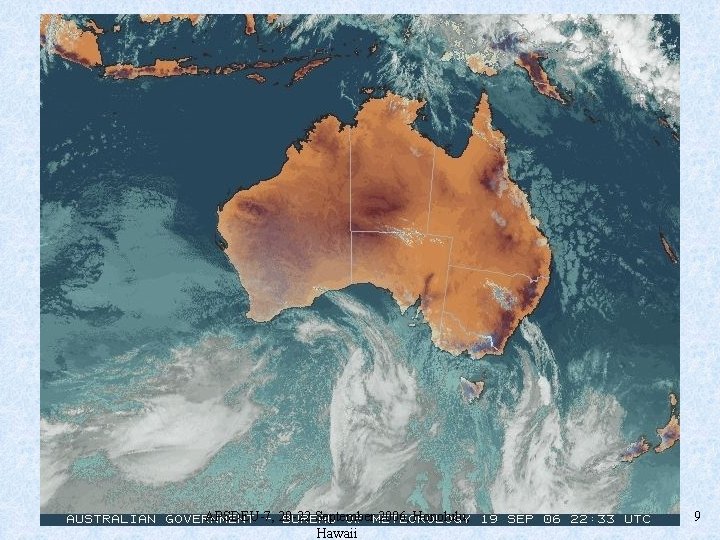
Example of output from the Bureau's solar radiation model using MTSAT-1 R visible observations and ancillary data APSDEU-7, 20 -22 September 2006, Honolulu, Hawaii 10
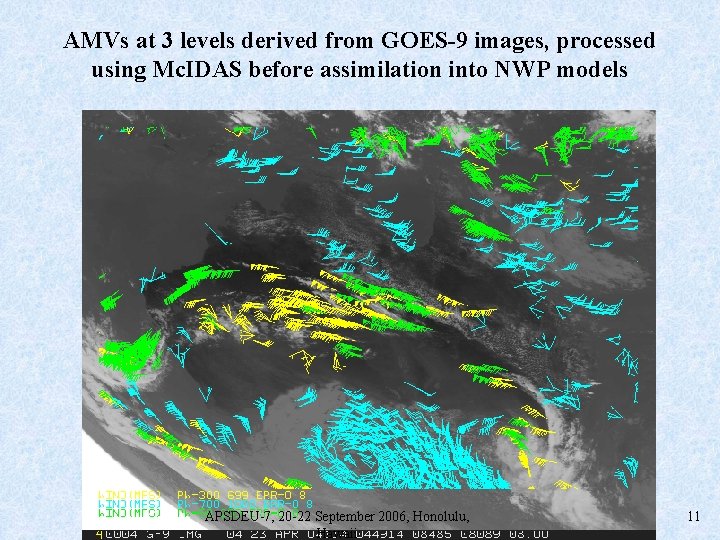
AMVs at 3 levels derived from GOES-9 images, processed using Mc. IDAS before assimilation into NWP models APSDEU-7, 20 -22 September 2006, Honolulu, Hawaii 11
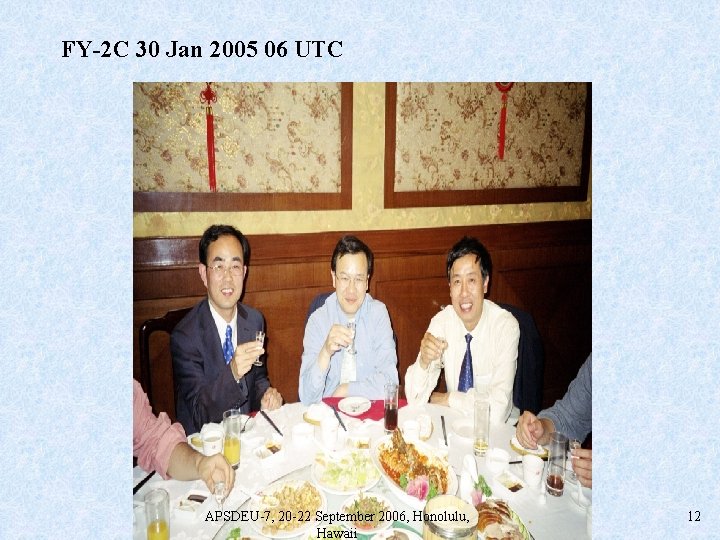
FY-2 C 30 Jan 2005 06 UTC APSDEU-7, 20 -22 September 2006, Honolulu, Hawaii 12
MTSAT-1 R 0333 UTC, 9 May 2005 colourenhanced composite with Vis, IR: Hi. RID APSDEU-7, 20 -22 September 2006, Honolulu, Hawaii 13
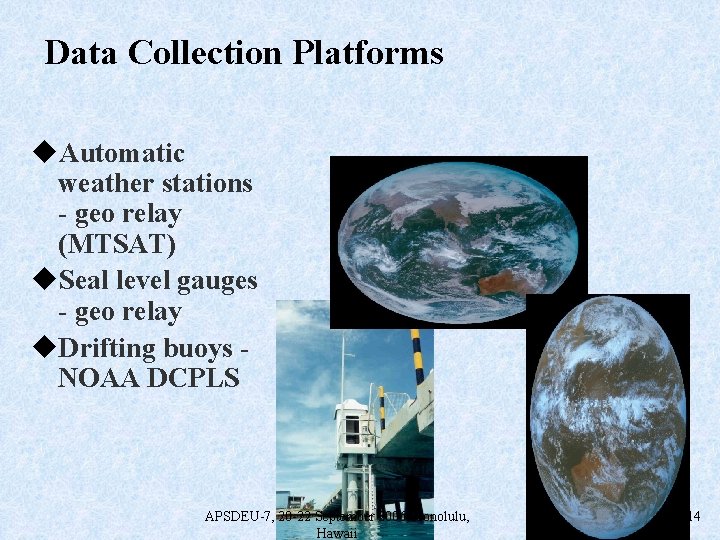
Data Collection Platforms u. Automatic weather stations - geo relay (MTSAT) u. Seal level gauges - geo relay u. Drifting buoys NOAA DCPLS APSDEU-7, 20 -22 September 2006, Honolulu, Hawaii 14
Polar orbiter applications u ATOVS retrievals u Sea Surface Temperatures u Normalised Difference Vegetation Indices u Grassland Curing Indices u sea ice monitoring u low cloud/fog detection u bushfire monitoring (hotspots, smoke) u volcanic ash detection u multichannel composites u GPS estimates of Total Precipitable Water – joint project with Melbourne University – to improve NWP models. APSDEU-7, 20 -22 September 2006, Honolulu, Hawaii 15
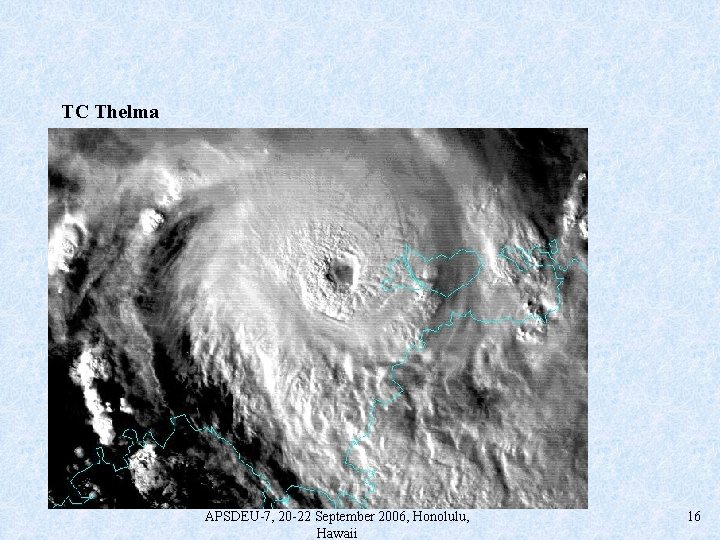
TC Thelma APSDEU-7, 20 -22 September 2006, Honolulu, Hawaii 16
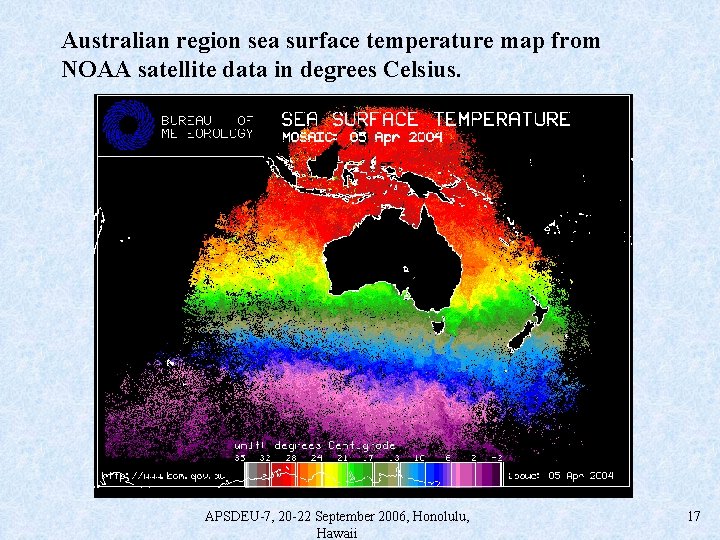
Australian region sea surface temperature map from NOAA satellite data in degrees Celsius. APSDEU-7, 20 -22 September 2006, Honolulu, Hawaii 17
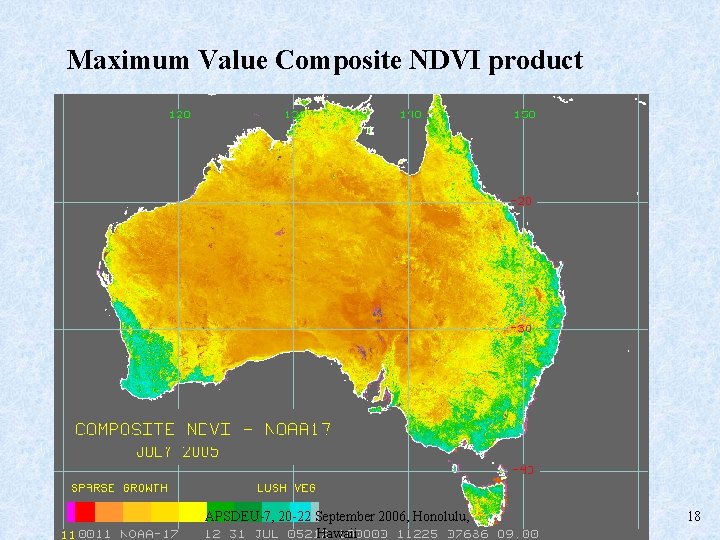
Maximum Value Composite NDVI product APSDEU-7, 20 -22 September 2006, Honolulu, Hawaii 18
FY-1 D APSDEU-7, 20 -22 September 2006, Honolulu, Hawaii 19
Indirectly received satellite data u Meteosat & GOES from SSEC, UKMO, Eumetsat u NOAA from SSEC University of Wisconsin u INSAT from Internet u scatterometer e. g. from GTS or Quik. SCAT from NOAA/NESDIS u ERS altimeter in BUFR from GTS u ENVISAT RA and AATSR ftp from ESA u SSM/I DMSP from NOAA/NESDIS u ATOVS (SATEMs) from NOAA/NESDIS & UKMO u SATOB AMVs and SSTs APSDEU-7, 20 -22 September 2006, Honolulu, Hawaii 20
Quik. SCAT: Wind barbs (in knots), colour-coded via wind speed: 0 - black, 5 - blue, 10 - light blue, 15 - cyan, 20 - aqua, 25 - green, 30 lime green, 35 - yellow, 40 - orange, 45 - red, >50 brown. APSDEU-7, 20 -22 September 2006, Honolulu, Hawaii 21
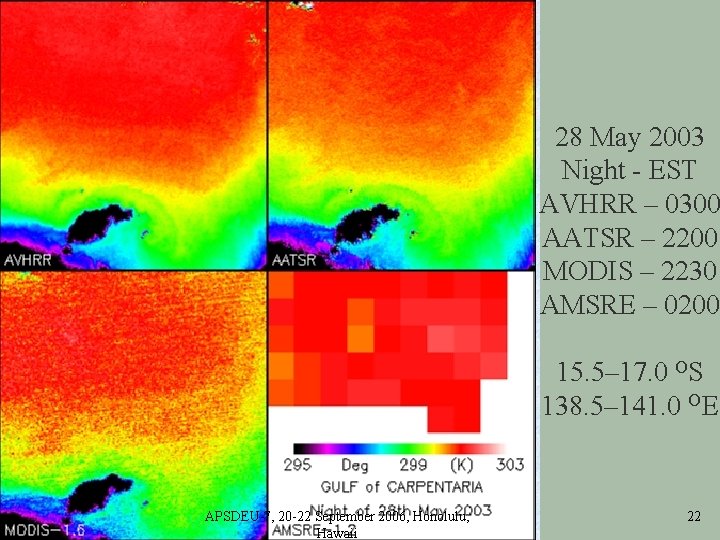
28 May 2003 Night - EST AVHRR – 0300 AATSR – 2200 MODIS – 2230 AMSRE – 0200 15. 5– 17. 0 OS 138. 5– 141. 0 OE APSDEU-7, 20 -22 September 2006, Honolulu, Hawaii 22
Current Sp. BOS (Space-based Observations Section) activities u. Geo satellite systems – MTSAT-1 R HRIT; upgrade ingest/computer hardware – Brisbane DR; Perth, Darwin FY-2 C/D – C-TARS u. Polar orbiter network – upgrade ingest/computer hardware – METOP APSDEU-7, 20 -22 September 2006, Honolulu, Hawaii 23
Sp. BOS current activities u. Core processing, archive & applications – – – – – maintain operational satellite processing systems + archive intercalibration system to improve quality AMVs geo hotspots with NOAA 15 yr solar exposure climatology - NCC& BRS GCI and SSTs with CAPS (software system) IMOS SST activities GPS water vapour RARS satellite data exchange APSATS-2006 u. X-band – 3 new ground stns; products APSDEU-7, 20 -22 September 2006, Honolulu, Hawaii 24
Future Plans for Bureau satellite activities u further direct reception; u further access to non-local RT products (GTS, Internet); u Major Government injection of funds for satellite oceanography activities Bluelink, Marine Observing Systems u further education & training and promotion to improve utilisation, with Bureau's Training Centre; u quality and performance measurement; u X-band data management and new ground stations (Crib Pt, Darwin, Antarctica) u MODIS workshops and software exchange/stds u enhanced data assimilation into NWP models, especially regional/mesoscale e. g. ATOVS, AIRS u establishment of RT time data dissemination i. e. RARS u IGDDS, WIS, GEOSS contributions APSDEU-7, 20 -22 September 2006, Honolulu, Hawaii 25
NOAA HRPT station upgrade u. Upgraded stations (new antenna and mount): 2 at Melbourne Crib Pt, Darwin, Perth - new computer systems and ingest cards next 12 months at all stations including Casey and Alice Springs; Metop capability being added u. New station at Davis Antarctica - installation this summer (by end April 2007) u. Stations in network by early 2007: total seven comprising Melbourne Crib Pt (2), Darwin, Perth, Alice Springs; Casey and Davis in Antarctica APSDEU-7, 20 -22 September 2006, Honolulu, Hawaii 26
National X-band Satellite Station Network (NSSN) APSDEU-7, 20 -22 September 2006, Honolulu, Hawaii 27
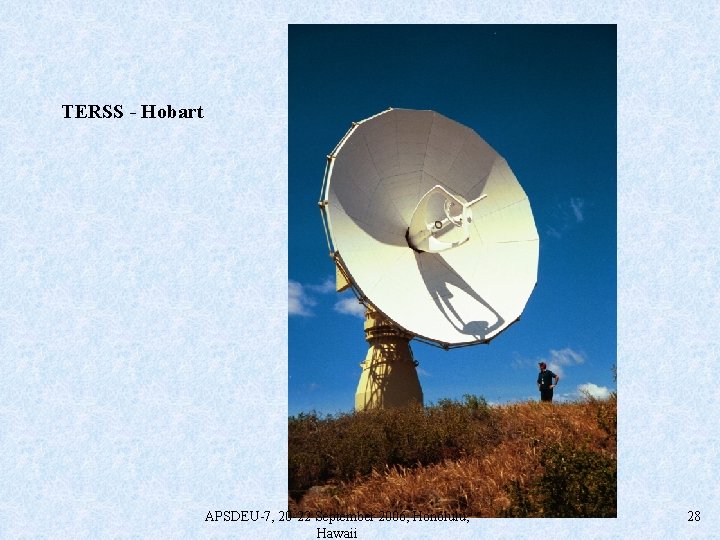
TERSS - Hobart APSDEU-7, 20 -22 September 2006, Honolulu, Hawaii 28
Major X-band project (AUS $5 M) uend to end approach - ingest processing, archive, data management, products, education and training, integration of data with other systems e. g. NWP, visualisation unew X-band stations Darwin, Melbourne and Casey. APSDEU-7, 20 -22 September 2006, Honolulu, Hawaii 29
X-band Milestones u. WASTAC Perth X-band products Dec 2006 u. Darwin and Melbourne operational - mid 2007 u. Casey, Antarctica opnl - summer 2007/08 umicrowave links early-mid 2007 u. Darwin/Crib Pt products mid-late 2007 incl NWP u. Aust Govt funded - Townsville upgrade to Xband - 2007 APSDEU-7, 20 -22 September 2006, Honolulu, Hawaii 30
National network u. Alice Springs - 2 stations - GA u. Perth - WASTAC-X Consortium u. Hobart - TERSS Consortium u. Bureau planned: l l l Darwin - mid 2007 Crib Point near Melbourne - mid-2007 Casey, Antarctica - summer 2007/08 upossible NCRIS IMOS funded - Townsville upgrade to X-band APSDEU-7, 20 -22 September 2006, Honolulu, Hawaii 31
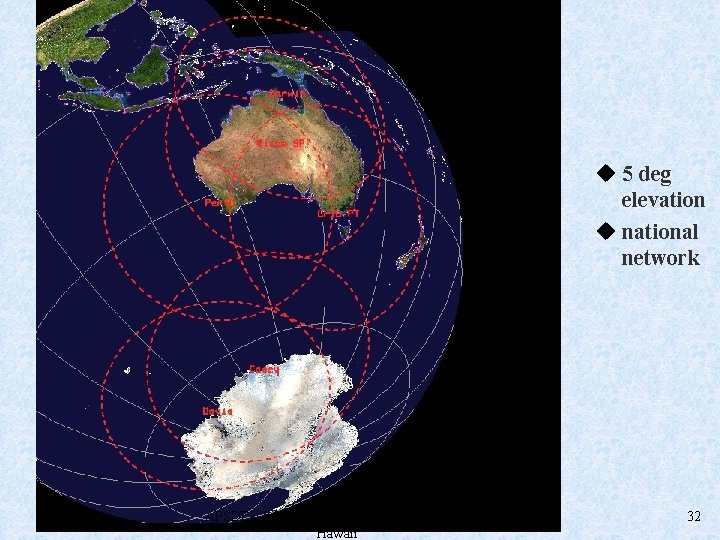
u 5 deg elevation u national network APSDEU-7, 20 -22 September 2006, Honolulu, Hawaii 32
Australian AVHRR and MODIS developments u coordinated reception networks, processing and dissemination u major Australian agencies coordinate to develop standardised data processing systems for AVHRR, MODIS for use in Australian ground stations; u Common AVHRR Processing System (CAPS) and IMAPP, Sea. DAS now in use at ground stations in Australia; APSDEU-7, 20 -22 September 2006, Honolulu, Hawaii 33
Bureau Composite Observing System u X-band or advanced satellite system use is part of a larger major Bureau activity, namely a Bureau Composite Observing System u greater importance attached to integrated or composite observing systems e. g. satellite soundings complementing upper air networks; u satellite data to play a greater role e. g. increased accuracy allows for compensation of any reductions in conventional networks u Bureau is heavily investing in new NWP assimilation systems which have a voracious appetite for satellite data especially ATOVS data, hence growing importance is attached to RARS data. APSDEU-7, 20 -22 September 2006, Honolulu, Hawaii 34
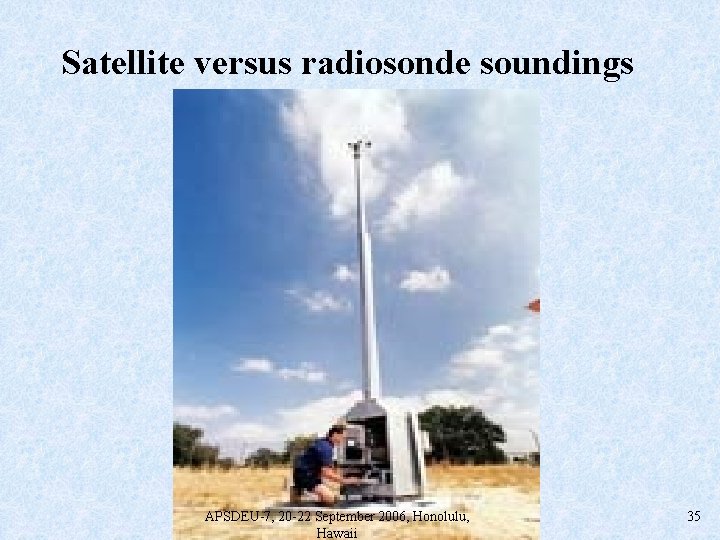
Satellite versus radiosonde soundings APSDEU-7, 20 -22 September 2006, Honolulu, Hawaii 35
Australia: current capabilities for RARS u Data Acquisition l soon seven HRPT stations l by early 2008 five X-band stations - two part owned ABo. M u Reception: all NOAAs, FY-1 d for HRPT stations, plus all Terra and Aqua overpasses u Roughly 15 passes per day per station u Distribution: WAN across Australia, plus optical fibre within Head Office, plus Internet; GTS APSDEU-7, 20 -22 September 2006, Honolulu, Hawaii 36
ABo. M areas involved with RARS u. OEB (satellite area) u. CCSB (web, comms, servers, GTS, data management) u. WOSPB (services) u. International affairs u. Executive APSDEU-7, 20 -22 September 2006, Honolulu, Hawaii 37
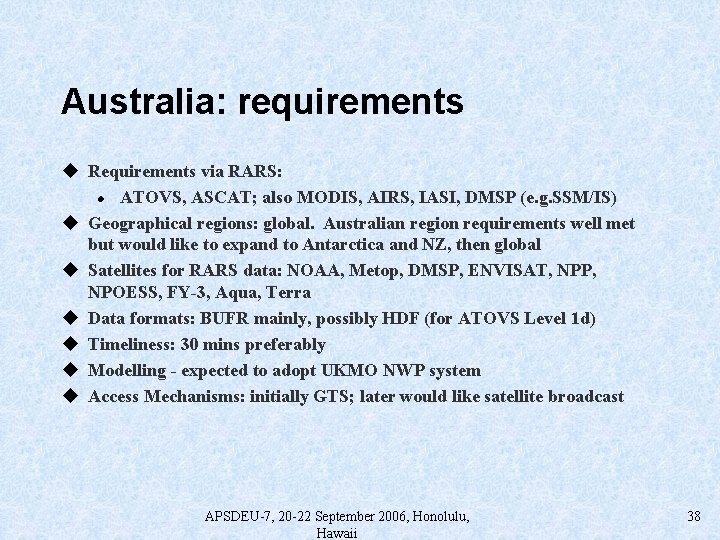
Australia: requirements u Requirements via RARS: l ATOVS, ASCAT; also MODIS, AIRS, IASI, DMSP (e. g. SSM/IS) u Geographical regions: global. Australian region requirements well met but would like to expand to Antarctica and NZ, then global u Satellites for RARS data: NOAA, Metop, DMSP, ENVISAT, NPP, NPOESS, FY-3, Aqua, Terra u Data formats: BUFR mainly, possibly HDF (for ATOVS Level 1 d) u Timeliness: 30 mins preferably u Modelling - expected to adopt UKMO NWP system u Access Mechanisms: initially GTS; later would like satellite broadcast APSDEU-7, 20 -22 September 2006, Honolulu, Hawaii 38
APSDEU-7, 20 -22 September 2006, Honolulu, Hawaii 39
APSDEU-7, 20 -22 September 2006, Honolulu, Hawaii 40
APSDEU-7, 20 -22 September 2006, Honolulu, Hawaii 41
APSDEU-7, 20 -22 September 2006, Honolulu, Hawaii 42
APSDEU-7, 20 -22 September 2006, Honolulu, Hawaii 43
APSDEU-7, 20 -22 September 2006, Honolulu, Hawaii 44
APSDEU-7, 20 -22 September 2006, Honolulu, Hawaii 45
APSDEU-7, 20 -22 September 2006, Honolulu, Hawaii 46
APSDEU-7, 20 -22 September 2006, Honolulu, Hawaii 47
APSDEU-7, 20 -22 September 2006, Honolulu, Hawaii 48
APSDEU-7, 20 -22 September 2006, Honolulu, Hawaii 49
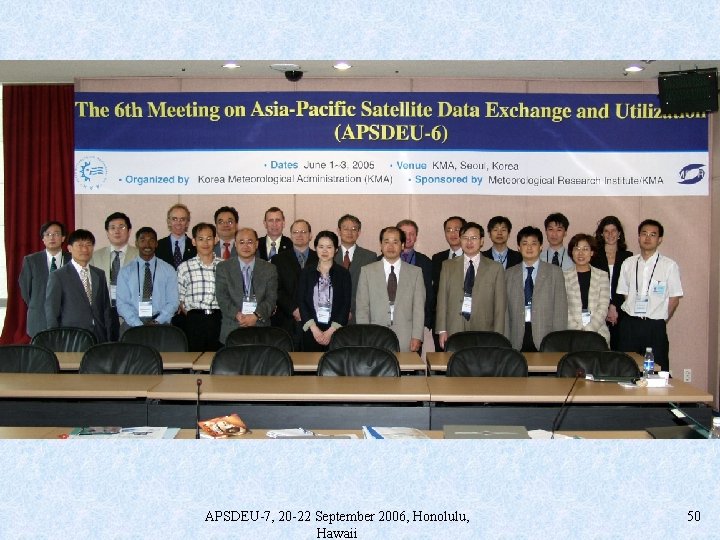
APSDEU-7, 20 -22 September 2006, Honolulu, Hawaii 50
- Slides: 50