
Overview of ATP Production Presented by Professor Steven
Overview of ATP Production Presented by: Professor Steven P. Dion – Salem State College Sport, Fitness & Leisure Studies Dept. ATP Production - Dion
ATP Production n Before cells can use the energy of sunlight or energy /calories stored in carbohydrates, they must transfer the energy to molecules of ATP. – ATP is composed of adenine, ribose, and three phosphate groups. – ATP transfers energy to many different chemical reactions; almost all metabolic pathways directly or indirectly run on energy supplied by ATP Production - Dion 2

ATP Production – ATP can donate a phosphate group (phosphorylation) to another molecule, which then becomes primed and energized for specific reactions. (ready to be used for energy) ATP Production - Dion 3
ATP Production n In human cells, cellular respiration releases energy from energy-rich organic molecules and changes ADP into ATP. – Aerobic respiration is the main ATP-producing pathway – Anaerobic respiration produces much less ATP (because no oxygen is involved) and can only be used for short periods of time, such as in vigorous muscle exercise. ATP Production - Dion 4
Aerobic Respiration n Initial Breakdown of Glucose – Glycolysis reactions occur in the cytoplasm (liquid stuff outside the nucleus) and results in the breakdown of glucose to pyruvate; small amounts of ATP are generated. – Glucose is first phosphorylated in energyrequiring steps then split to form two molecules of PGAL. ATP Production - Dion 5

Aerobic Respiration – By substrate-level phosphorylation, four ATP are produced; but because two ATP were used previously, there is a net gain of only two ATP. – Enzymes remove H+ and electrons from PGAL to change NAD to NADH (which is used later in oxidative phosphorylation). n The end products of glycolysis are: two pyruvates, two ATP (net gain), and two NADH for each glucose molecule degraded. ATP Production - Dion 6
The Krebs Cycle and Preparatory Steps Krebs cycle (occurring in the mitochondria) degrades pyruvate to carbon dioxide, water, ATP, H+ ions, and electrons. n Pyruvate (produced in the cytoplasm) enters the mitochondria and is converted to acetyl. Co. A, which then joins oxaloacetate already present from a previous "turn" of the cycle. n ATP Production - Dion 7
n Krebs cycle serves three functions: – H+ and e– are transferred to NAD+ and FAD. – Two molecules of ATP are produced by substrate-level phosphorylation. – Most of the molecules are recycled to conserve oxaloacetate for continuous processing of acetyl-Co. A. ATP Production - Dion 8
n The final stage of aerobic respiration occurs in the electron systems embedded in the inner membrane of the mitochondrion. – Oxidation phosphorylation (which takes place on the cristae of the mitochondria) processes the H+ ions and electrons to generate high yields of ATP. – NADH and FADH 2 give up their electrons to transport (enzyme) systems embedded in the mitochondrial inner membrane. ATP Production - Dion 9
– The actual ATP synthesis is accomplished when H ions that have been pumped out of the inner mitochondrial compartment flow back through a channel protein called ATP synthase. ATP Production - Dion 10
n Oxygen joins with the "spent" electrons and H+ to yield water. – The production of ATP is completely dependent on the supply of oxygen that withdraws the electrons at the end of the transport systems. ATP Production - Dion 11
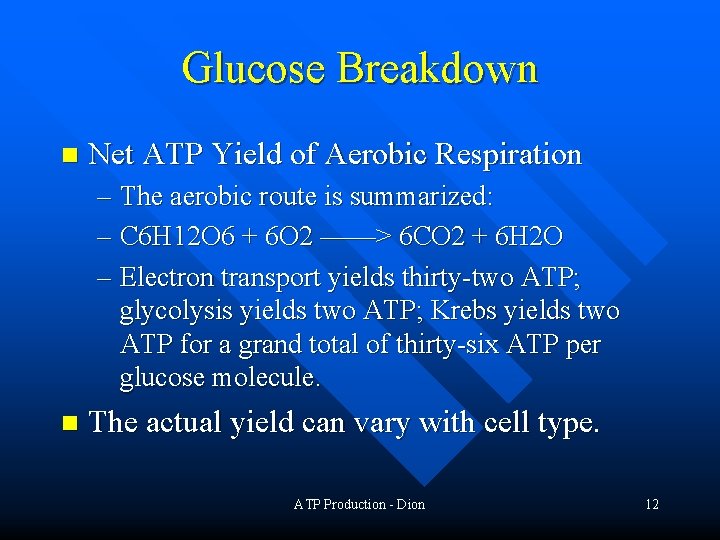
Glucose Breakdown n Net ATP Yield of Aerobic Respiration – The aerobic route is summarized: – C 6 H 12 O 6 + 6 O 2 ——> 6 CO 2 + 6 H 2 O – Electron transport yields thirty-two ATP; glycolysis yields two ATP; Krebs yields two ATP for a grand total of thirty-six ATP per glucose molecule. n The actual yield can vary with cell type. ATP Production - Dion 12

ATP From Anaerobic Pathways Anaerobic pathways operate when oxygen is absent (or limited); pyruvate from glycolysis is metabolized to produce molecules other than acetyl-Co. A. n In lactate fermentation, glycolysis produces two pyruvate, two NADH molecules, two ATP molecules, and two lactate, which tend to build up and cause temporary muscle cramps. n ATP Production - Dion 13
The ADP/ATP Cycle The ADP/ATP cycle is a method for renewing the supply of ATP that is constantly being used up in the cell. n Energy input couples inorganic phosphate to ADP to form energized ATP. n ATP Production - Dion 14
Alternative Energy Sources n Carbohydrates n Lipids n Proteins ATP Production - Dion 15
Alternative Energy Sources n Carbohydrates are the body’s first source of energy. – Excess carbohydrate intake is stored as glycogen in liver and muscle for future use. – Free glucose is used until it runs low; then glycogen reserves are tapped. ATP Production - Dion 16
Energy From Fats n Lipids are used when carbohydrate supplies run low. – Excess fats are stored away in cells of adipose tissue. – Fats are digested into glycerol (which enters glycolysis) and fatty acids, which enter the Krebs cycle. – Because fatty acids have many more carbon and hydrogen atoms, they are degraded more slowly and yield greater amounts of ATP Production - Dion 17
Energy From Proteins n Proteins are used as the last resort for supplying energy for the body. – Amino acids are released by digestion and travel in the blood. – After the amino group is removed, the amino acid remnant is fed into the Krebs cycle. ATP Production - Dion 18
- Slides: 18