
OVERVIEW OF AQUACULTURE IN UGANDA THE UGANDA FISHERIES
- Slides: 41
OVERVIEW OF AQUACULTURE IN UGANDA THE UGANDA FISHERIES & AQUACULTURE CONFERENCE “Championing Women & Youth innovations in transforming the Fisheries sector” 6 -7 th April 2016, KAJJANSI DEPT. OF AQUACULTURE MENAGEMENT &DEVELOPMENT-DFR -MAAIF ENTEBBE BY Alio Andrew Asst. Commissioner Aquaculture
Presentation outline Background Introduction Importance of Fisheries Vision for Aquaculture Potential for fish farming Challenges Recommendations Interventions for Aquaculture development in Uganda Current developments
Background Fish farming was introduced in the early 1950 s as a subsistence activity to provide a cheap source of protein to rural communities. Capture fisheries stocks are very fast declining Hence need to support fish farming in order to supplement and fill the gap created by capture fisheries.
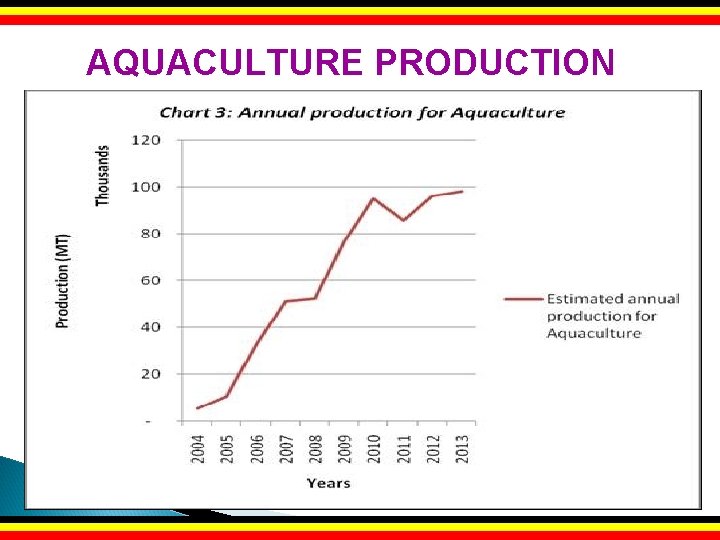
Background cont. Aquaculture is one of the world’s fastest growing food production sectors, bringing with it great potential for food supply hence food security, poverty alleviation and enhanced trade and economic benefits. Aquaculture production has grown steadily, from approximately 285 tonnes in 1999 to an estimated 10, 000 tonnes in 2005
Introduction Aquaculture is practiced in almost all districts (although concentrated in the central region). At present a total of about 25, 169 ponds 13, 900 farmers involved in the production of fish through aquaculture countrywide, Current production is estimated at about 90, 000100, 000 tons(2010) However, many of which are small scale with very few large scale intensive or semi- intensive farms of generally low input and out production. The ponds’ sizes average between 200 and 3000 square meters
Importance of fisheries GDP Contribution: 12. 6% Agricultural GDP and 2. 5% National GDP Livelihood support Provides for 2. 8 million Employment : Provides up to 1. 2 million jobs in formal and informal employment Forex exchange: Both regional & export US$200, 000. Food security Fish consumption estimated at US$700 M annually
The fisheries sector -Cont ◦ Fish remains one of the leading animal protein provider for rural communities in Uganda. Fish consumption in Uganda stands at 8. 3 kg/capita ◦ Above that of the sub Saharan Average of 6. 6 Kg per capita but only about half of the world average = 17 Kg per capita
The Aquaculture sub-sector Aquaculture in Uganda has been growing at an annual rate of 300% over the last 10 years. ◦ production has risen from 285 tonnes in 1999 to over 90, 000 tonnes in 2010. ◦ Current production is estimated at 100, 000 tonnes/year ◦ Reason: Entry of commercial aquaculture producers Adoption of new technologies (farm management) A restocking and stocking of communal water bodies reservoir aquaculture > 55 dams stocked with catfish and tilapia since 2002 has contributed greatly to the increase in Aquaculture production.
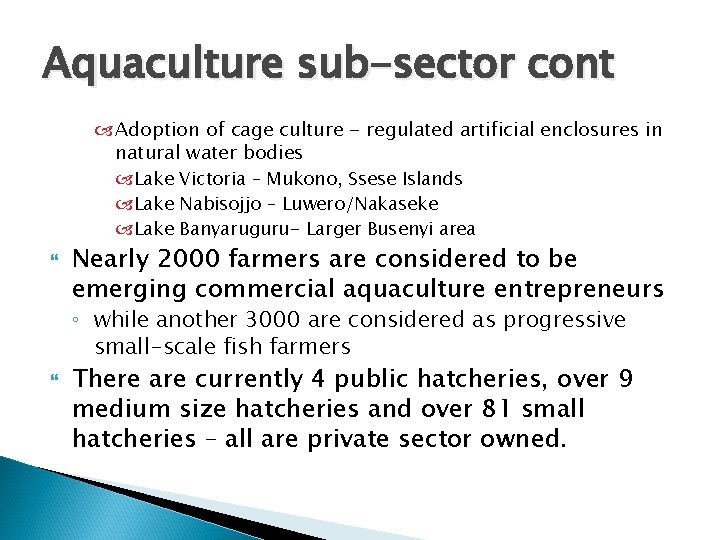
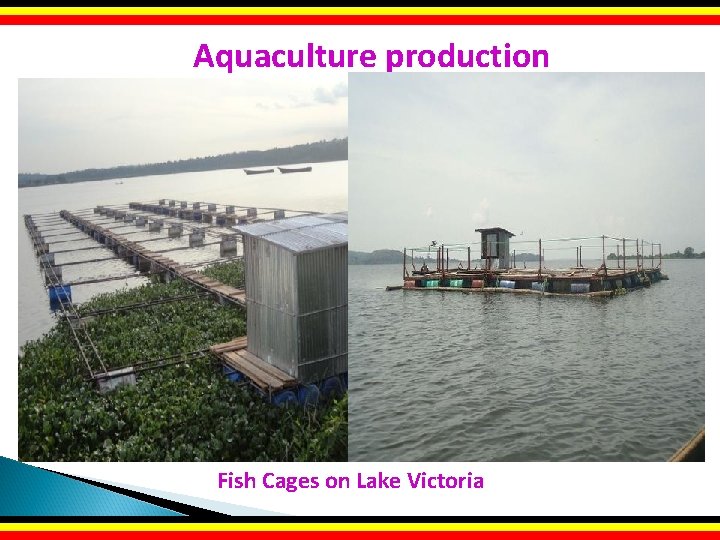
Aquaculture sub-sector cont Adoption of cage culture - regulated artificial enclosures in natural water bodies Lake Victoria – Mukono, Ssese Islands Lake Nabisojjo – Luwero/Nakaseke Lake Banyaruguru- Larger Busenyi area Nearly 2000 farmers are considered to be emerging commercial aquaculture entrepreneurs ◦ while another 3000 are considered as progressive small-scale fish farmers There are currently 4 public hatcheries, over 9 medium size hatcheries and over 81 small hatcheries – all are private sector owned.
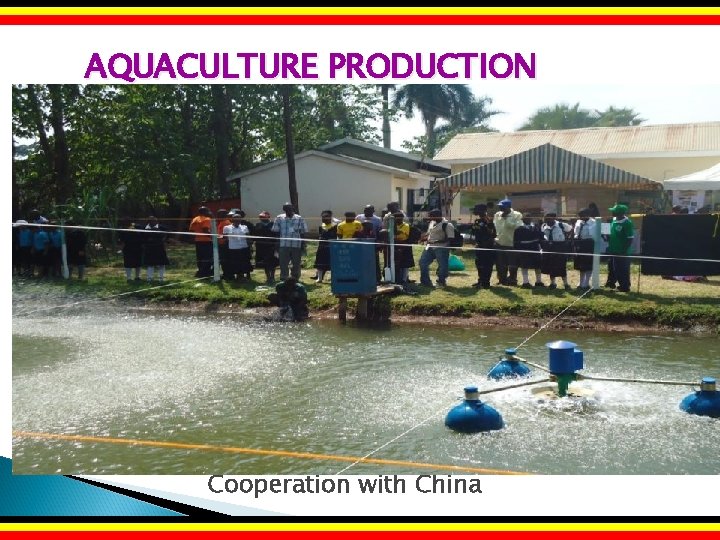
AQUACULTURE PRODUCTION
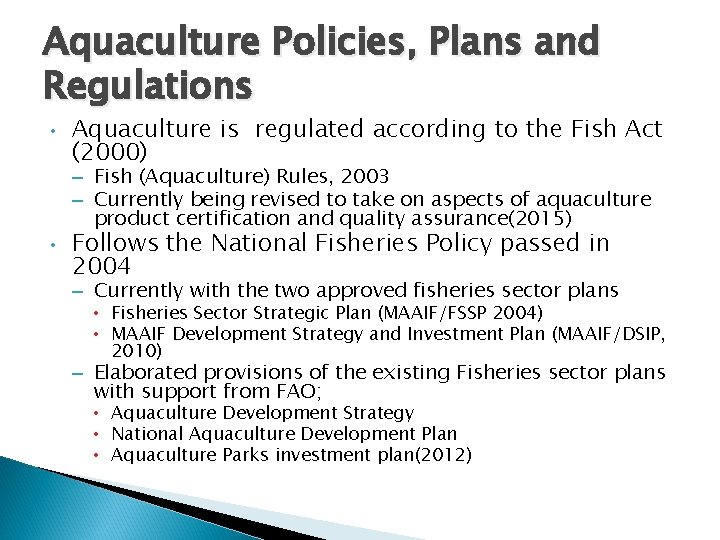
Aquaculture Policies, Plans and Regulations • Aquaculture is regulated according to the Fish Act (2000) – Fish (Aquaculture) Rules, 2003 – Currently being revised to take on aspects of aquaculture product certification and quality assurance(2015) • Follows the National Fisheries Policy passed in 2004 – Currently with the two approved fisheries sector plans • Fisheries Sector Strategic Plan (MAAIF/FSSP 2004) • MAAIF Development Strategy and Investment Plan (MAAIF/DSIP, 2010) – Elaborated provisions of the existing Fisheries sector plans with support from FAO; • Aquaculture Development Strategy • National Aquaculture Development Plan • Aquaculture Parks investment plan(2012)
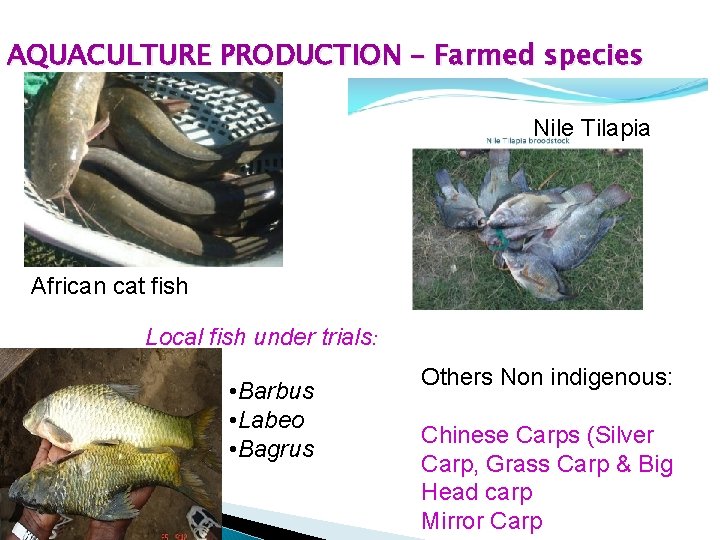
AQUACULTURE PRODUCTION – Farmed species Nile Tilapia African cat fish Local fish under trials: • Barbus • Labeo • Bagrus Others Non indigenous: Chinese Carps (Silver Carp, Grass Carp & Big Head carp Mirror Carp
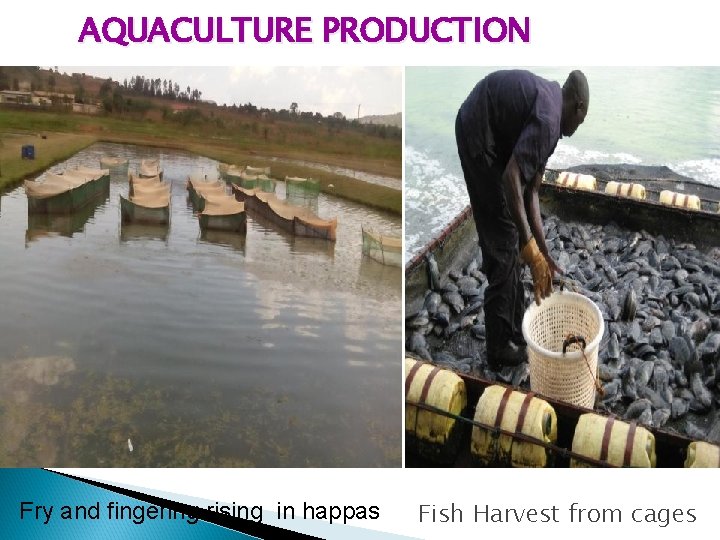
AQUACULTURE PRODUCTION Fry and fingering rising in happas Fish Harvest from cages
Aquaculture production Fish Cages on Lake Victoria
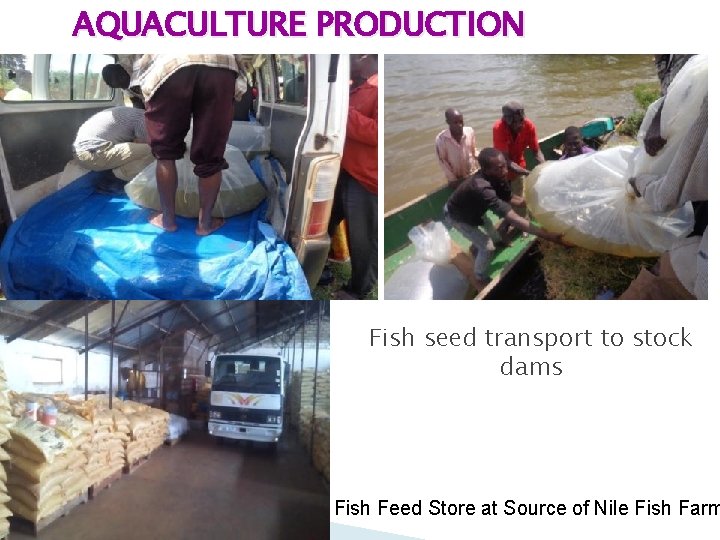
AQUACULTURE PRODUCTION Fish seed transport to stock dams Fish Feed Store at Source of Nile Fish Farm
Cont… Various development programs, supported by FAO, EU, USAID, ADB, WFP, Chinese govt. etc have made valuable contributions and support to the growth of the sector in recent years.
AQUACULTURE PRODUCTION Cooperation with China
Potential for fish farming • Suitable climate (T 15 -310 C and rainfall 735 -1863 mm/yr, water and soil. • Fresh water resources covering 18% of surface area in rivers, springs, wells, swamps wetlands and about 165 lakes.
Potential for fish farming cont. • Rich feed raw material e. g protein sources, agro-products and rich organic fertilizer. • Presence of industrial processing plants/factories • Ready and available market, locally, regionally and internationally.
Vision for Aquaculture. • Increased aquaculture fish production to meet the demand of increasing domestic consumption and export in healthy ecosystems and use of modern aquaculture technologies; • A fully developed and productive aquaculture systems for various agro-ecological zones and for different farmed fish species, integrated into agrofarming systems. • Self sufficiency and increased trade in fish and fish products within the country and a sustainable basket of exports of fish, fish products and other aquatic products foreign exchange earnings.
Challenges • Small farms. Aquaculture is practiced based on small scattered unproductive pond based systems - cannot attract a good service and input supply support system. • Inadequate of funds and under funded aquaculture services(Expertise Nature/training and availability and access ◦ Inadequate staffing
Challenges cont. • Regulatory Limitations esp. water/land access • In adequate supply of quality seeds and broodstock esp. Tilapia sps. (Supply/availability, ) • Expensive fish feed - Lack of locally (own farm) produced commercial feeds (Technology, Capital, cost, ingredients) Lack of technical knowledge and skills
Challenges cont. • High capital investment costs and lack and access to credit facilities • Predators and fish diseases • Limited high value species for culture. • Lack of organized market
Cont… Adequate data and information on aquaculture activities Land water related issues
Recommendations Remove obstacles from related statutory documents Promote other aquaculture production systems (cage culture, pen culture, paddyfish culture in rice fields, in-door running water systems and culture based fisheries) and species and production technologies Enact good policies on seed, feed and use of common resources such as water.
Recommendations cont. Good management: Good pond construction, controlled stocking (size, quality and density, scientific feeding (quality, quantity and timing), fertilization/manuring, water quality management, disease prevention and treatment. Strengthen research, technology development for genetic improvement of farmed species and information dissemination
Recommendations cont. Improvement of marketing infrastructure. (cooperatives, collection centers, live fish markets) Exchange visits and tours Financial support(Grants schemes, bank lending-interest rates, equity funding etc. )
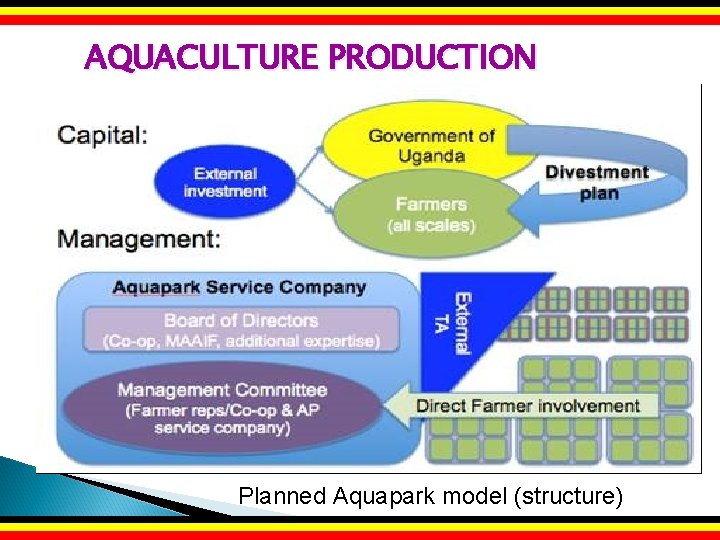
Proposed Interventions for Aquaculture development Identify, map all potential zones and suitable sites for aquaculture development Establishment of Aquaculture Parks in all high potential zones/ areas for aquaculture as a rural aquaculture development strategy
AQUACULTURE PRODUCTION Planned Aquapark model (structure)
Interventions for Aquaculture cont. Production systems Adoption of cage culture in lakes, minor lakes, communal water reservoirs and temporal water bodies to tap the enormous potential for fish production. Diversification of fish culture systems through capital incentives to intensive fish farming systems including tank based culture, Recirculating Aquaculture Systems and others
Cont. . Promote quality fish seeds ◦ Rehabilitate the 4 public hatcheries ◦ Support private seed producers ◦ Enforce Certifificatio of seed producers
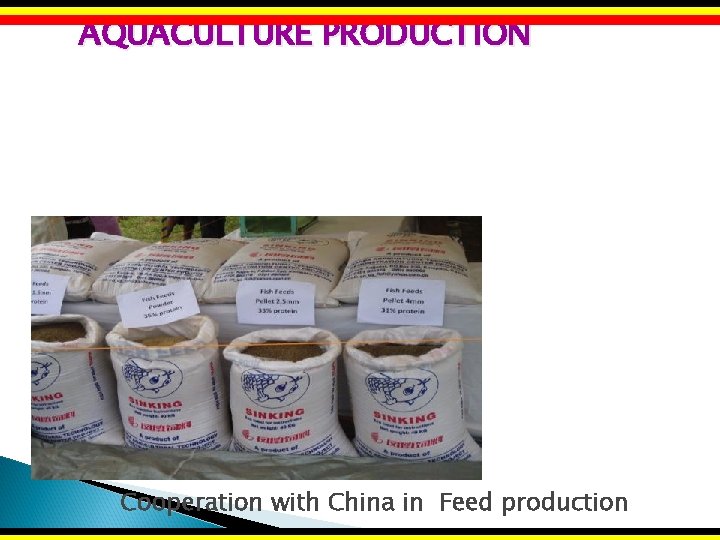
Cont. . Promote quality fish feeds ◦ Support public private partnerships in feed production through individuals and cooperatives ◦ Enforce Certification of fish feeds
AQUACULTURE PRODUCTION Cooperation with China in Feed production
cont. Develop commercial culture of local fish species of such as Nile perch, Ssemutundu, Kajjansi Carp (Ningu), Uganda Carp, Labeo victorianus (Kisinja) and introduce high value aquaculture species e. g shrimps, eels for export market. Increased Public Private Partnership (PPP) in development of Fish Feeds/seeds Industry and Aquaculture Inputs Supply.
Cont. Support model Progressive Smallscale Fish Farms and Model Commercial Fish Farms. Consideration under the special tax regimes and financial support from public sector for aquaculture inputs and implements
Current Developments ◦ Development of Aquaculture strategy, plan(Require Review) and TCP Proposal supported by FAO. ◦ Approval of export of aquaculture products to EU Market. ◦ Study undertaken on Commercialization of Aquaculture and feasibility, design and costing of Aquaparks by EU ◦ Aquaculture Park policy supported by UIA
Current Developments ◦ Establishment of aquaculture data bank and updating and information dissemination. ◦ Promote Establishment of farmer organizations/associations for easy access to information – e. g marketing, financial support, extension ◦ Development of SOPs and Guidelines e. g Service providers, seed feed, cage guidelines. ◦ Promote Value addition of farmed fish
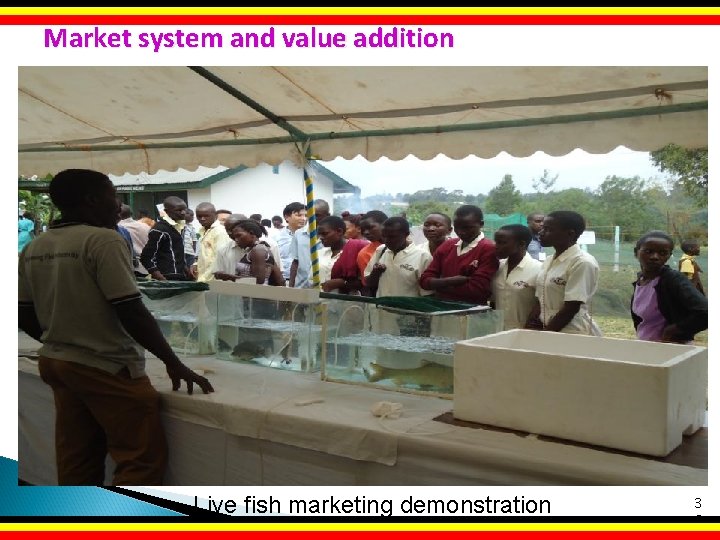
Market system and value addition Live fish marketing demonstration 11/2/2020 3 8
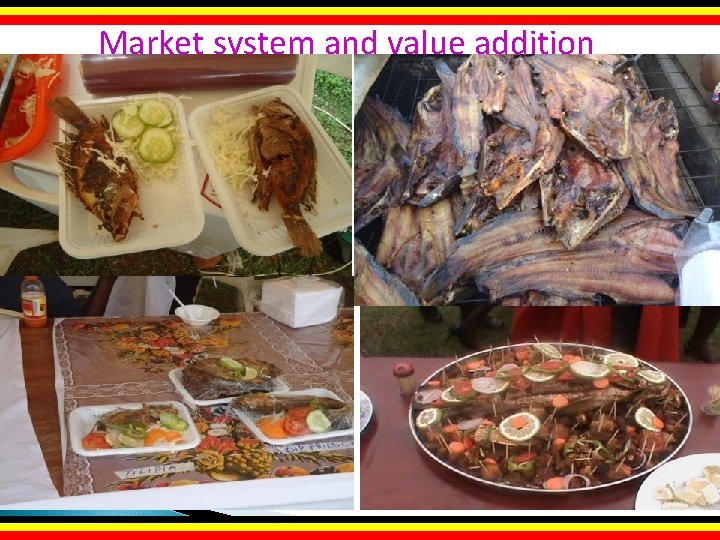
Market system and value addition
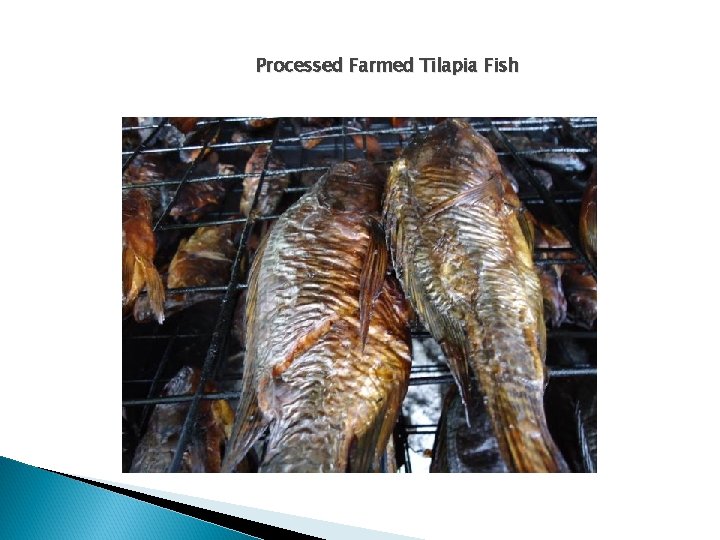
Processed Farmed Tilapia Fish
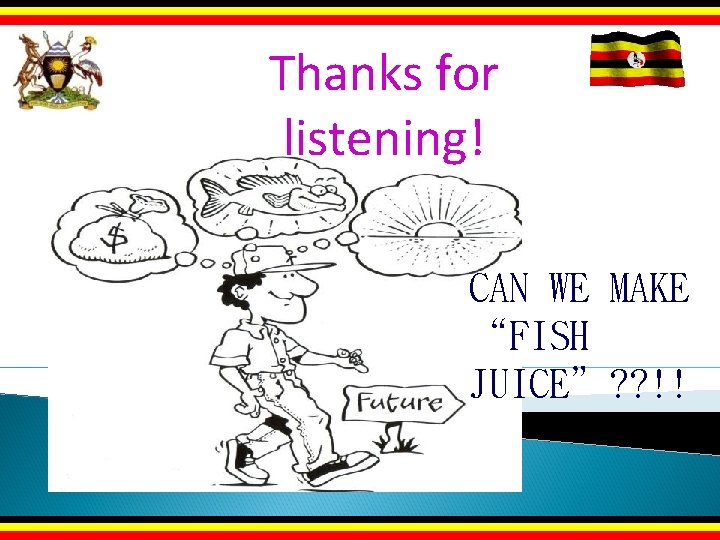
Thanks for listening! CAN WE MAKE “FISH JUICE”? ? !!