
Overview of Animal Behavior Section 20 4 Introduction
Overview of Animal Behavior Section 20. 4
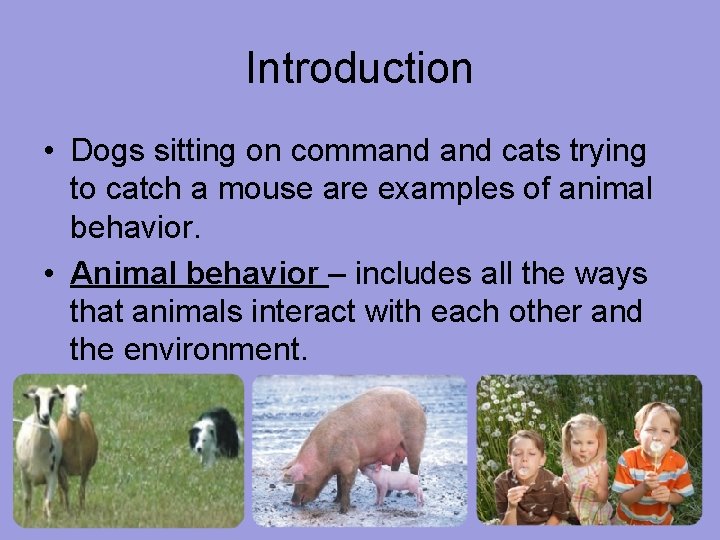
Introduction • Dogs sitting on command cats trying to catch a mouse are examples of animal behavior. • Animal behavior – includes all the ways that animals interact with each other and the environment.
Studying Animal Behavior • Ethology – branch of biology that studies animal behavior. • They usually try to answer four questions: 1. What causes the behavior? 2. How does the behavior develop? 3. Why did the behavior evolve? 4. How did the behavior evolve?
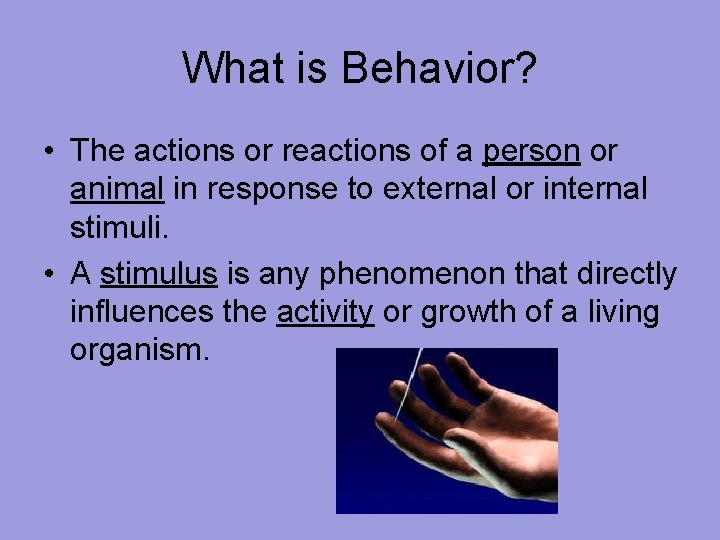
What is Behavior? • The actions or reactions of a person or animal in response to external or internal stimuli. • A stimulus is any phenomenon that directly influences the activity or growth of a living organism.
Evolution of Animal Behavior • Depending on whether behaviors are controlled by genes, they may evolve through natural selection. • If the behavior increases fitness, it may become more common. • If the behavior decreases fitness, it will most likely be less common.
Nature vs. Nurture • Some behaviors are controlled completely by genes. • Others are due to experiences and environment. • Nature-nurture debate – debate over the extent to which genes (nature) or experiences in a given environment (nurture) control traits such as animal behaviors.
Innate Behaviors • Innate behavior – behaviors controlled by genes with little environmental influence • An innate behavior is a simple behavior that is inherited by an animal. • An animal can perform the behavior correctly the first time it is attempted. • There are two categories of innate behaviors: – Reflexes – Instincts
Reflexes • A reflex is a specific reaction of one specific body part in response to a stimulus. • Examples: – Pulling hand away from hot pan – Jumping when door slams – Closing/squinting eyes when light is bright – Flinching if something is coming at you
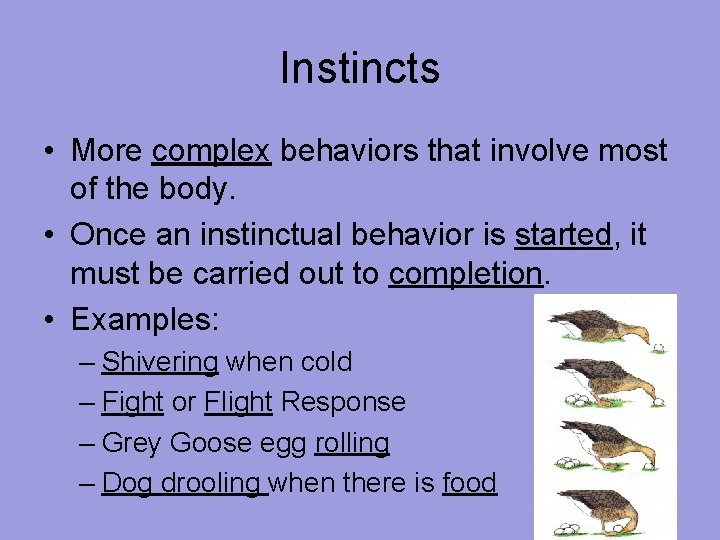
Instincts • More complex behaviors that involve most of the body. • Once an instinctual behavior is started, it must be carried out to completion. • Examples: – Shivering when cold – Fight or Flight Response – Grey Goose egg rolling – Dog drooling when there is food
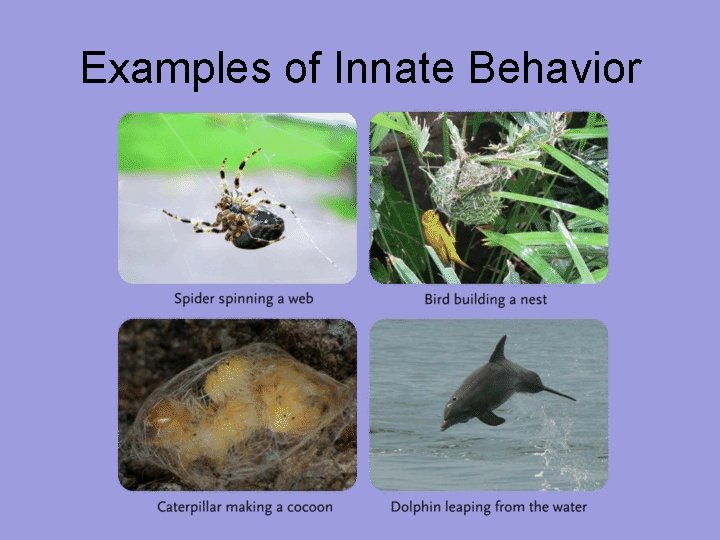
Examples of Innate Behavior
Significance of Innate Behavior • Innate behaviors are predictable. • All members of the same species perform these behaviors the same. • These include basic life functions such as finding food or caring for offspring.
Learned Behaviors • Learning – a change in behavior that occurs as a result of experience. • Learned behaviors are more flexible. • There are several types of learned behaviors: – Imprinting – Habituation – Classical Conditioning – Operant Conditioning – Insight
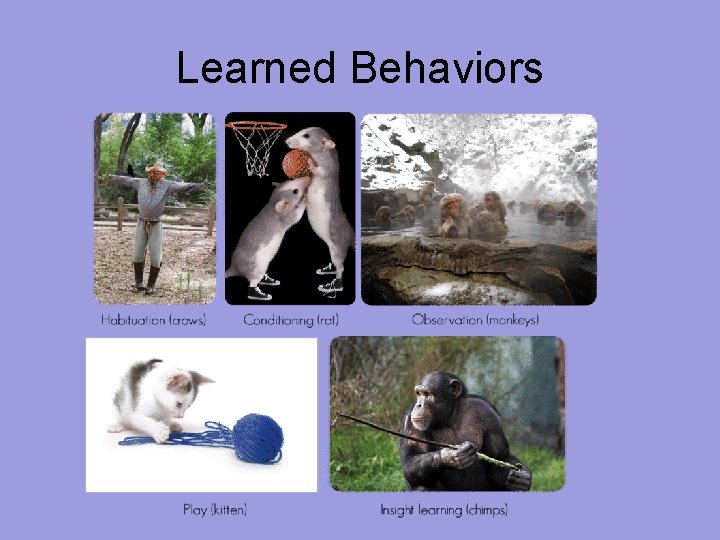
Learned Behaviors
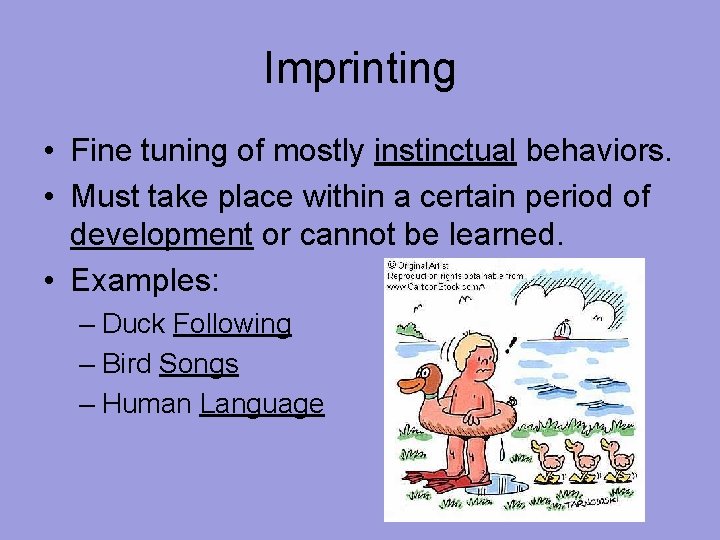
Imprinting • Fine tuning of mostly instinctual behaviors. • Must take place within a certain period of development or cannot be learned. • Examples: – Duck Following – Bird Songs – Human Language
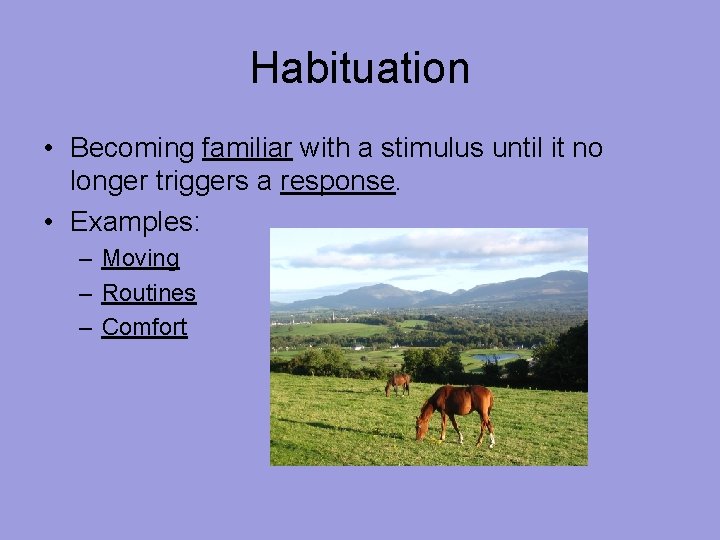
Habituation • Becoming familiar with a stimulus until it no longer triggers a response. • Examples: – Moving – Routines – Comfort
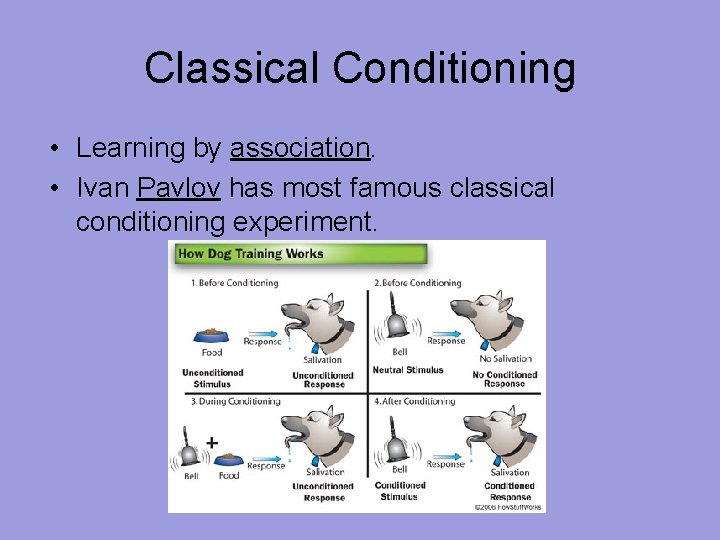
Classical Conditioning • Learning by association. • Ivan Pavlov has most famous classical conditioning experiment.
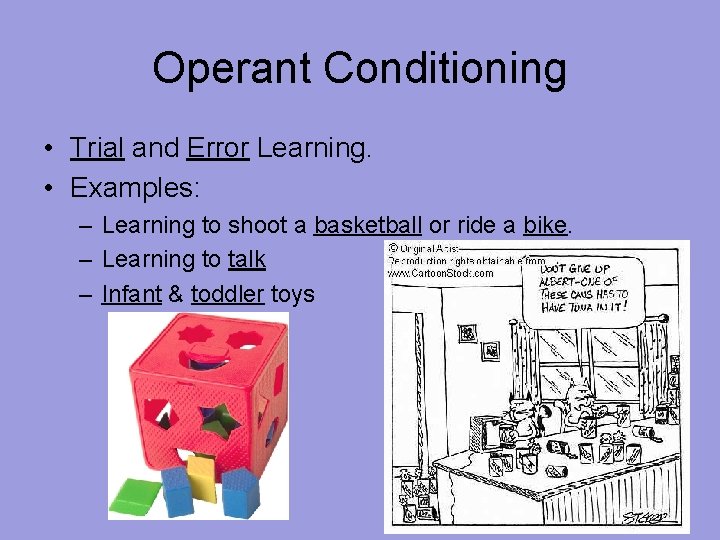
Operant Conditioning • Trial and Error Learning. • Examples: – Learning to shoot a basketball or ride a bike. – Learning to talk – Infant & toddler toys
Video
Overview of Animal Behavior: Part 2 Section 20. 4
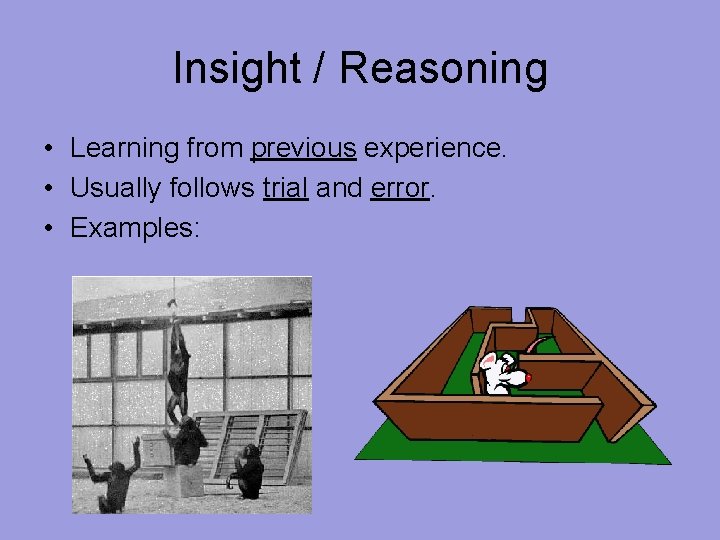
Insight / Reasoning • Learning from previous experience. • Usually follows trial and error. • Examples:
Social Behavior and Cooperation • Society – when animals live together in a close-knit group with other members of their species. • Social animals – animals that live in a society. • Cooperation – animals live and work together for the good of the group. • This allows the group to do things that a single animal couldn’t do.
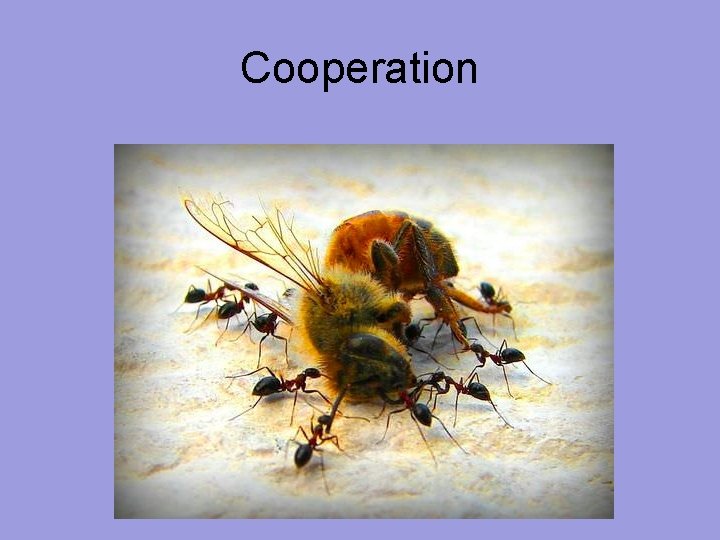
Cooperation
Communication • For organisms to cooperate, they need to communicate. • Language is the most complicated form of communication. • Language combines sounds, symbols and gestures according to sets of rules for syntax. • Other animals use systems to communicate, but humans are the only ones that effectively use language.
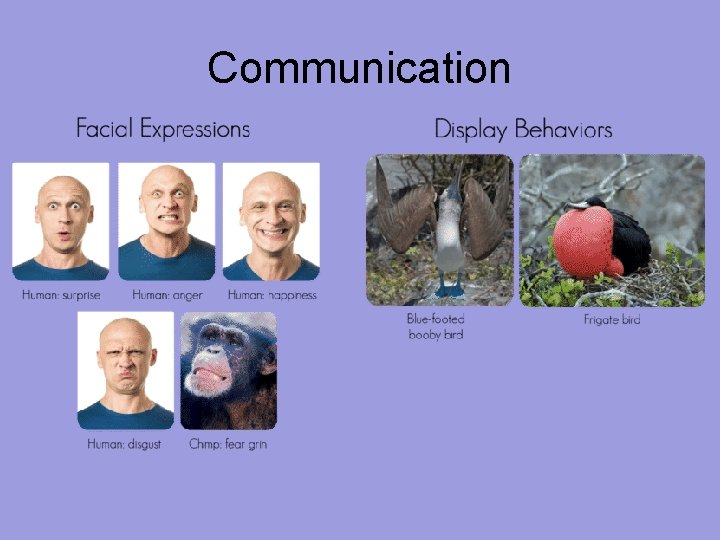
Communication
Cyclic Behaviors • Some animals have behaviors that cycle daily, weekly, monthly or yearly. • Migration movement from one area to another and back – Usually for feeding and/or breeding • Circadian Rhythms daily sleep and wake cycles affected by sunlight (24 hour cycle) – Seasonal affective disorder • Hibernation – shutting down body systems in response to cold to conserve energy with lack of food.
Aggression • Aggression – behavior that is intended to cause harm or pain. • Can be violent or just a display. • Example: Gorillas
Competition • Animals have developed behaviors as a result of competition: – Territoriality – Aggression – Jealousy – “selfish gene” • There are two types of competition: – Intraspecific Competition – between members of the same species – Interspecific Competition – between member of different species
Mating & Courtship • Most social behaviors revolve around finding a mate with the “best” genes to create the most “fit” children. • The male must impress the female because she has more vested in producing the offspring.
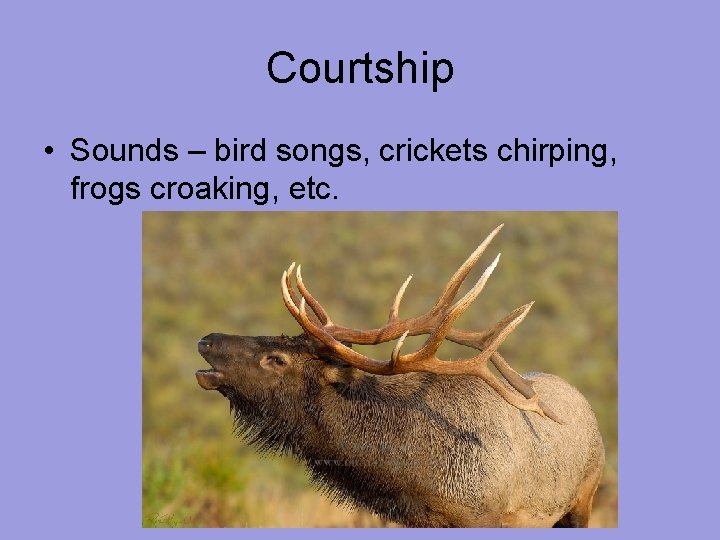
Courtship • Sounds – bird songs, crickets chirping, frogs croaking, etc.
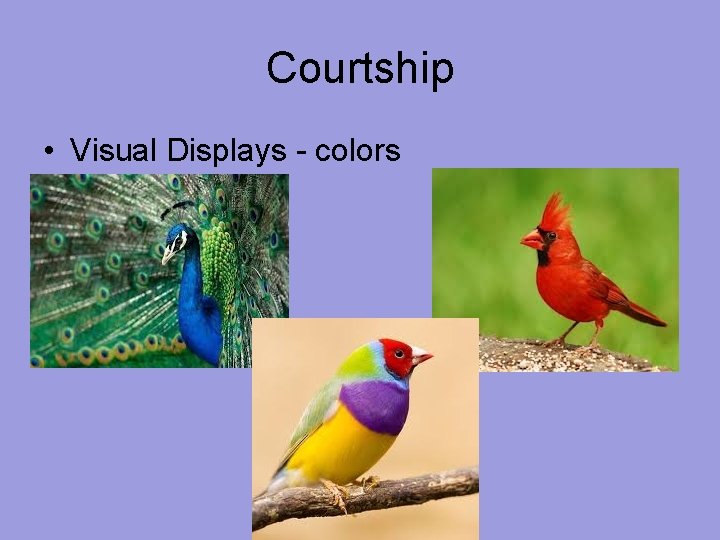
Courtship • Visual Displays - colors
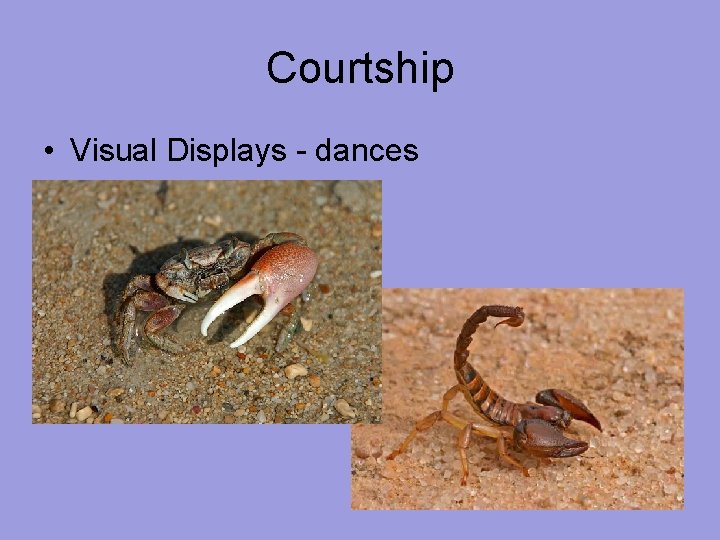
Courtship • Visual Displays - dances
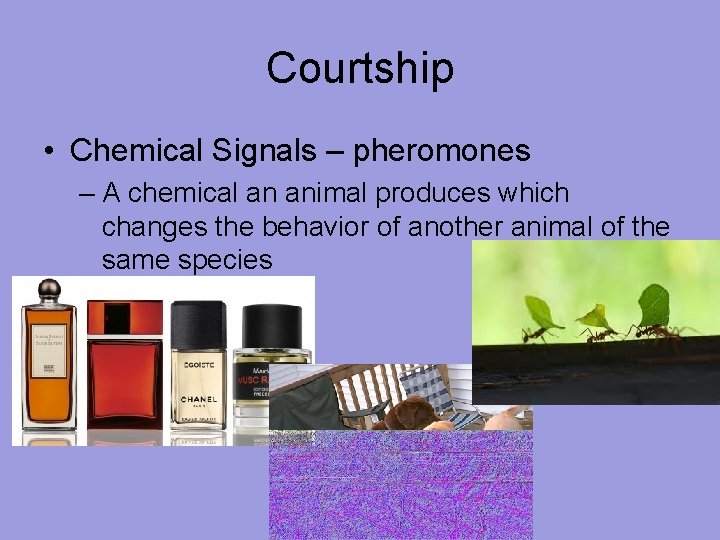
Courtship • Chemical Signals – pheromones – A chemical an animal produces which changes the behavior of another animal of the same species

Parental Care • In some species parents provide no care to their offspring. – Examples: fish, reptiles, amphibians • Most often the mother provides the care. • In some species both parents or just the father may be involved. • Generally longest for mammals.
- Slides: 33