
Overview of An Advanced Earth Science Mission Concept
- Slides: 18
Overview of An Advanced Earth Science Mission Concept Study for a GLOBAL WIND OBSERVING SOUNDER A study carried out by GSFC and La. RC for NASA HQ in cooperation with NOAA Program Scientist: NASA/HQ Ramesh Kakar Program Executive: NASA/HQ Steve Neeck Study Leads: GSFC/Jaya Bajpayee, Harry Shaw Science Lead: GSFC/Bruce Gentry La. RC Leads: Michael Kavaya, Upendra Singh Goddard Space Flight Center
Reason for this Study Ø In August 2006, NASA HQ SMD/Earth Science Division requested that GSFC, JPL, and La. RC study a number of mission concepts, including a Global Winds Mission Ø The Mission Concepts identified were anticipated to be among those recommended in the NAS Decadal Survey released January 2007 Ø The Mission Concept Studies provide HQ with advanced planning information to respond to the NAS recommendations and to help prepare the Science Mission Plan requested by Congress. Goddard Space Flight Center
Earth Science Advanced Mission Studies Ø The objective of the study was to assess the feasibility of Global Wind Mission and conduct a instrument and mission concept definition study. Ø The study results are not considered in any way a proposal and will be used by NASA HQ for internal planning purposes. Ø The study was directed by the NASA HQ Earth Science Division and the study team was tasked to define: Science requirements Instrument and mission concepts Cost vs. performance Ø The deliverables for the study included: Goddard Space Flight Center A final report detailing the instrument and mission concepts, trades explored and life cycle mission costs and schedule including basis of estimate. A follow-on task plan including recommended technology and research investments
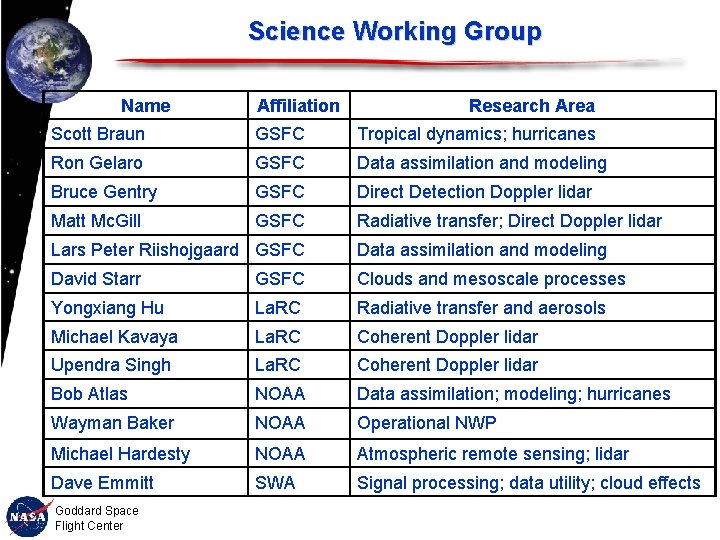
Science Working Group Name Affiliation Research Area Scott Braun GSFC Tropical dynamics; hurricanes Ron Gelaro GSFC Data assimilation and modeling Bruce Gentry GSFC Direct Detection Doppler lidar Matt Mc. Gill GSFC Radiative transfer; Direct Doppler lidar Lars Peter Riishojgaard GSFC Data assimilation and modeling David Starr GSFC Clouds and mesoscale processes Yongxiang Hu La. RC Radiative transfer and aerosols Michael Kavaya La. RC Coherent Doppler lidar Upendra Singh La. RC Coherent Doppler lidar Bob Atlas NOAA Data assimilation; modeling; hurricanes Wayman Baker NOAA Operational NWP Michael Hardesty NOAA Atmospheric remote sensing; lidar Dave Emmitt SWA Signal processing; data utility; cloud effects Goddard Space Flight Center
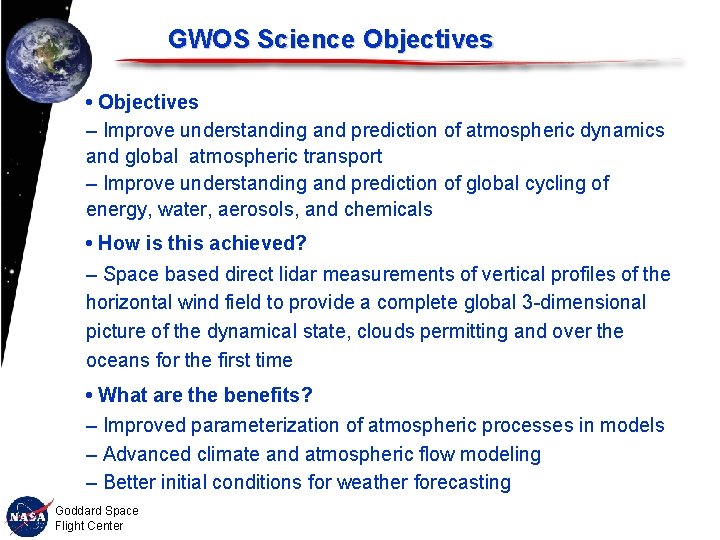
GWOS Science Objectives • Objectives – Improve understanding and prediction of atmospheric dynamics and global atmospheric transport – Improve understanding and prediction of global cycling of energy, water, aerosols, and chemicals • How is this achieved? – Space based direct lidar measurements of vertical profiles of the horizontal wind field to provide a complete global 3 -dimensional picture of the dynamical state, clouds permitting and over the oceans for the first time • What are the benefits? – Improved parameterization of atmospheric processes in models – Advanced climate and atmospheric flow modeling – Better initial conditions for weather forecasting Goddard Space Flight Center
GWOS Mission Requirements 2 1. 33 Goddard Space Flight Center
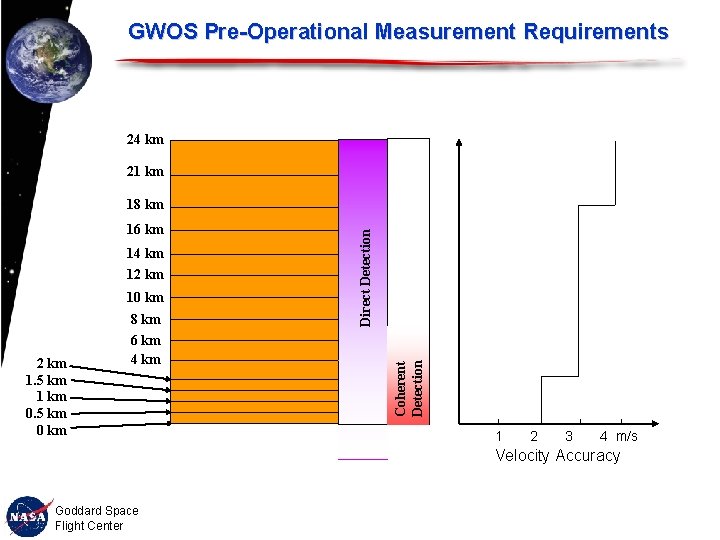
GWOS Pre-Operational Measurement Requirements 24 km 21 km 14 km 12 km 10 km 2 km 1. 5 km 1 km 0. 5 km 0 km 8 km 6 km 4 km Coherent Detection 16 km Direct Detection 18 km 1 2 3 4 m/s Velocity Accuracy Goddard Space Flight Center
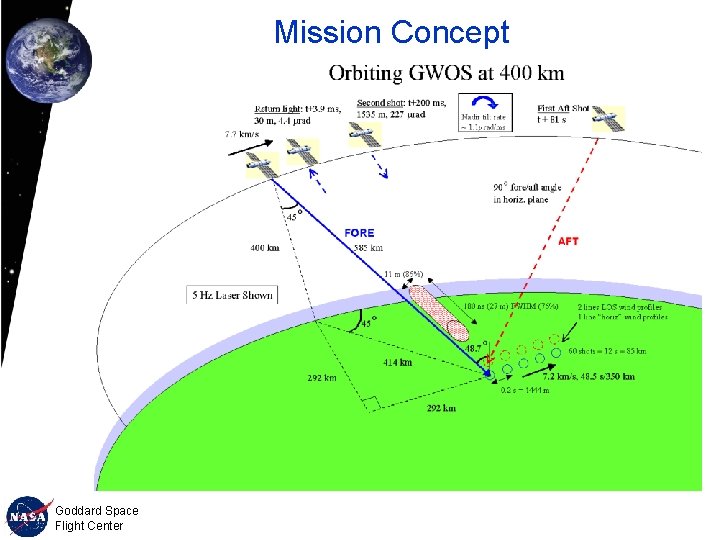
Mission Concept Goddard Space Flight Center
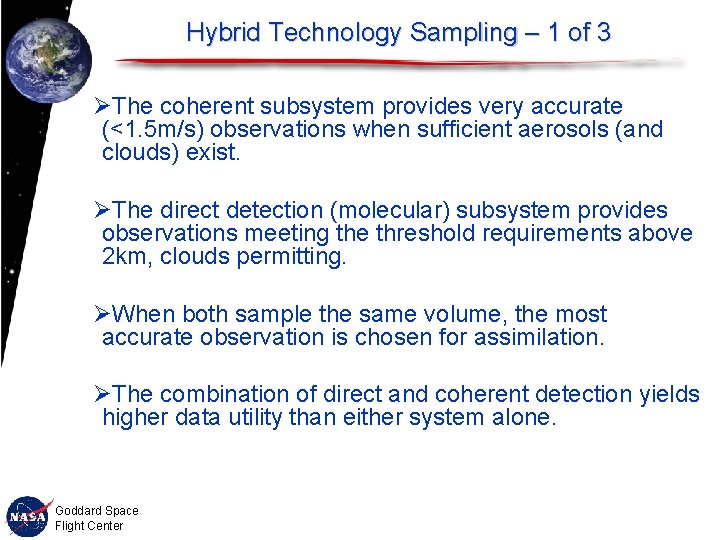
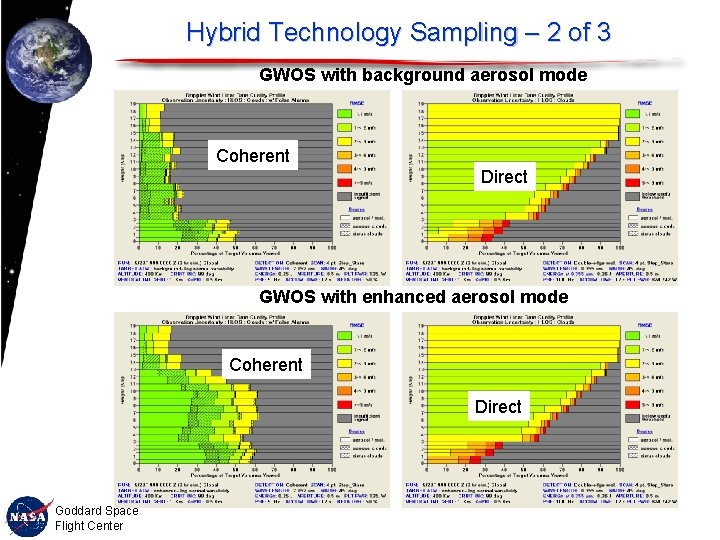
Hybrid Technology Sampling – 1 of 3 ØThe coherent subsystem provides very accurate (<1. 5 m/s) observations when sufficient aerosols (and clouds) exist. ØThe direct detection (molecular) subsystem provides observations meeting the threshold requirements above 2 km, clouds permitting. ØWhen both sample the same volume, the most accurate observation is chosen for assimilation. ØThe combination of direct and coherent detection yields higher data utility than either system alone. Goddard Space Flight Center
Hybrid Technology Sampling – 2 of 3 GWOS with background aerosol mode Coherent Direct GWOS with enhanced aerosol mode Coherent Direct Goddard Space Flight Center
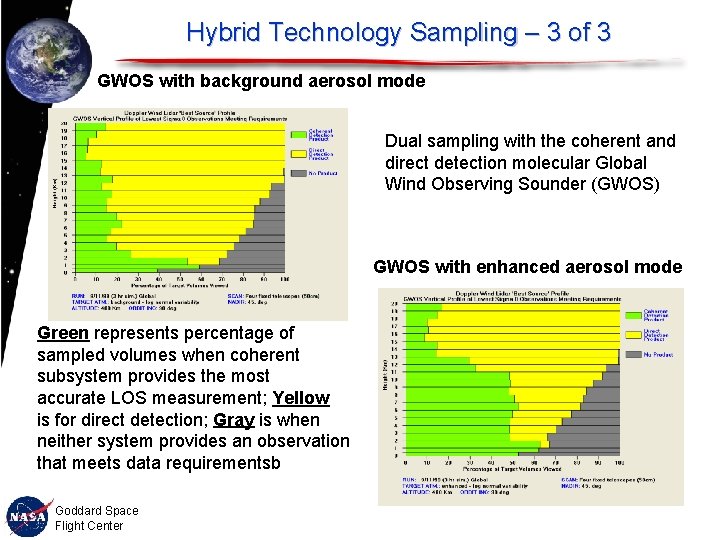
Hybrid Technology Sampling – 3 of 3 GWOS with background aerosol mode Dual sampling with the coherent and direct detection molecular Global Wind Observing Sounder (GWOS) GWOS with enhanced aerosol mode Green represents percentage of sampled volumes when coherent subsystem provides the most accurate LOS measurement; Yellow is for direct detection; Gray is when neither system provides an observation that meets data requirementsb Goddard Space Flight Center
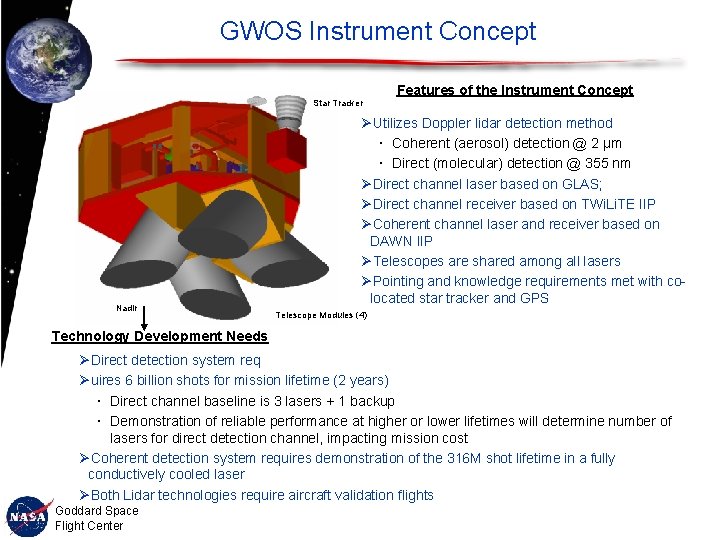
GWOS Instrument Concept Star Tracker Nadir Features of the Instrument Concept ØUtilizes Doppler lidar detection method Coherent (aerosol) detection @ 2 µm Direct (molecular) detection @ 355 nm ØDirect channel laser based on GLAS; ØDirect channel receiver based on TWi. Li. TE IIP ØCoherent channel laser and receiver based on DAWN IIP ØTelescopes are shared among all lasers ØPointing and knowledge requirements met with colocated star tracker and GPS Telescope Modules (4) Technology Development Needs ØDirect detection system req Øuires 6 billion shots for mission lifetime (2 years) Direct channel baseline is 3 lasers + 1 backup Demonstration of reliable performance at higher or lower lifetimes will determine number of lasers for direct detection channel, impacting mission cost ØCoherent detection system requires demonstration of the 316 M shot lifetime in a fully conductively cooled laser ØBoth Lidar technologies require aircraft validation flights Goddard Space Flight Center
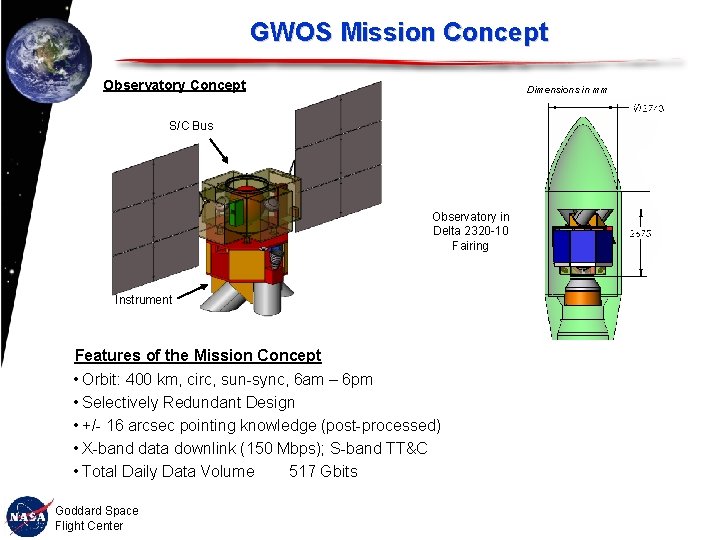
GWOS Mission Concept Observatory Concept Dimensions in mm S/C Bus Observatory in Delta 2320 -10 Fairing Instrument Features of the Mission Concept • Orbit: 400 km, circ, sun-sync, 6 am – 6 pm • Selectively Redundant Design • +/- 16 arcsec pointing knowledge (post-processed) • X-band data downlink (150 Mbps); S-band TT&C • Total Daily Data Volume 517 Gbits Goddard Space Flight Center
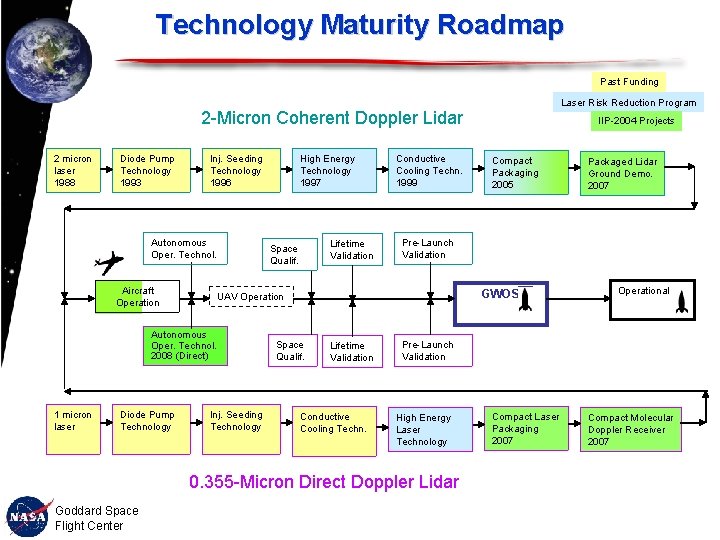
Technology Maturity Roadmap Past Funding Laser Risk Reduction Program 2 -Micron Coherent Doppler Lidar 2 micron laser 1988 Diode Pump Technology 1993 Autonomous Oper. Technol. Aircraft Operation Diode Pump Technology Lifetime Validation Space Qualif. Conductive Cooling Techn. 1999 Inj. Seeding Technology GWOS Space Qualif. Lifetime Validation Conductive Cooling Techn. Packaged Lidar Ground Demo. 2007 Operational Pre-Launch Validation High Energy Laser Technology 0. 355 -Micron Direct Doppler Lidar Goddard Space Flight Center Compact Packaging 2005 Pre-Launch Validation UAV Operation Autonomous Oper. Technol. 2008 (Direct) 1 micron laser High Energy Technology 1997 Inj. Seeding Technology 1996 IIP-2004 Projects Compact Laser Packaging 2007 Compact Molecular Doppler Receiver 2007
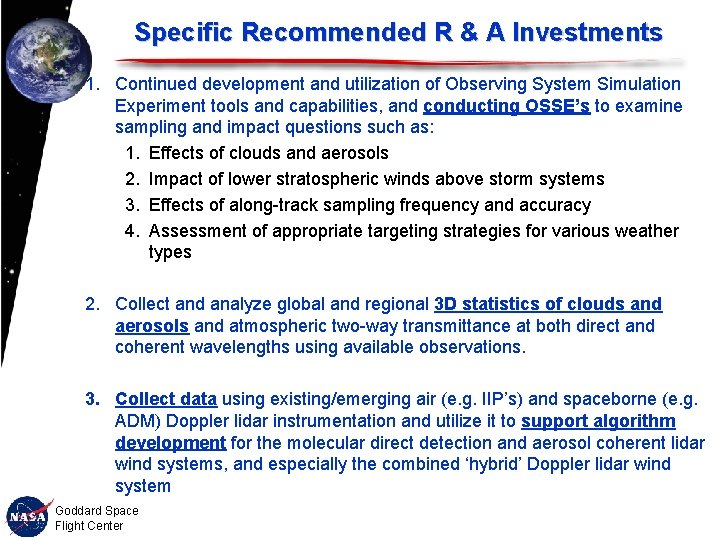
Specific Recommended R & A Investments 1. Continued development and utilization of Observing System Simulation Experiment tools and capabilities, and conducting OSSE’s to examine sampling and impact questions such as: 1. Effects of clouds and aerosols 2. Impact of lower stratospheric winds above storm systems 3. Effects of along-track sampling frequency and accuracy 4. Assessment of appropriate targeting strategies for various weather types 2. Collect and analyze global and regional 3 D statistics of clouds and aerosols and atmospheric two-way transmittance at both direct and coherent wavelengths using available observations. 3. Collect data using existing/emerging air (e. g. IIP’s) and spaceborne (e. g. ADM) Doppler lidar instrumentation and utilize it to support algorithm development for the molecular direct detection and aerosol coherent lidar wind systems, and especially the combined ‘hybrid’ Doppler lidar wind system Goddard Space Flight Center
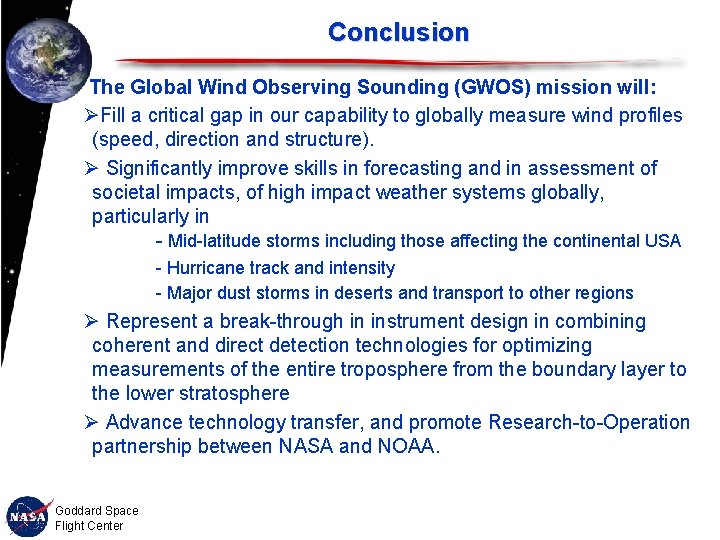
Conclusion The Global Wind Observing Sounding (GWOS) mission will: ØFill a critical gap in our capability to globally measure wind profiles (speed, direction and structure). Ø Significantly improve skills in forecasting and in assessment of societal impacts, of high impact weather systems globally, particularly in - Mid-latitude storms including those affecting the continental USA - Hurricane track and intensity - Major dust storms in deserts and transport to other regions Ø Represent a break-through in instrument design in combining coherent and direct detection technologies for optimizing measurements of the entire troposphere from the boundary layer to the lower stratosphere Ø Advance technology transfer, and promote Research-to-Operation partnership between NASA and NOAA. Goddard Space Flight Center
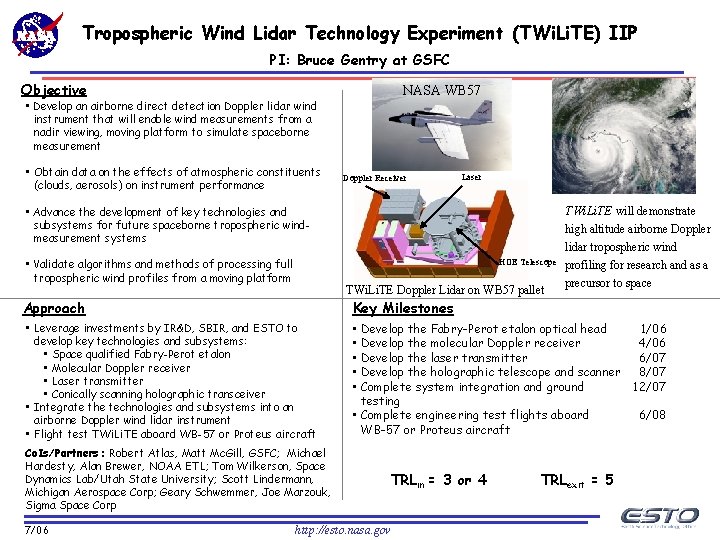
Tropospheric Wind Lidar Technology Experiment (TWi. Li. TE) IIP PI: Bruce Gentry at GSFC Objective NASA WB 57 • Develop an airborne direct detection Doppler lidar wind instrument that will enable wind measurements from a nadir viewing, moving platform to simulate spaceborne measurement • Obtain data on the effects of atmospheric constituents (clouds, aerosols) on instrument performance Doppler Receiver Laser • Advance the development of key technologies and subsystems for future spaceborne tropospheric windmeasurement systems • Validate algorithms and methods of processing full tropospheric wind profiles from a moving platform TWi. Li. TE will demonstrate high altitude airborne Doppler lidar tropospheric wind HOE Telescope TWi. Li. TE Doppler Lidar on WB 57 pallet Approach Key Milestones • Leverage investments by IR&D, SBIR, and ESTO to develop key technologies and subsystems: • Space qualified Fabry-Perot etalon • Molecular Doppler receiver • Laser transmitter • Conically scanning holographic transceiver • Integrate the technologies and subsystems into an airborne Doppler wind lidar instrument • Flight test TWi. Li. TE aboard WB-57 or Proteus aircraft • • • Co. Is/Partners: Robert Atlas, Matt Mc. Gill, GSFC; Michael Hardesty, Alan Brewer, NOAA ETL; Tom Wilkerson, Space Dynamics Lab/Utah State University; Scott Lindermann, Michigan Aerospace Corp; Geary Schwemmer, Joe Marzouk, Sigma Space Corp 7/06 profiling for research and as a precursor to space Develop the Fabry-Perot etalon optical head Develop the molecular Doppler receiver Develop the laser transmitter Develop the holographic telescope and scanner Complete system integration and ground testing • Complete engineering test flights aboard WB-57 or Proteus aircraft TRLin = 3 or 4 http: //esto. nasa. gov TRLexit = 5 1/06 4/06 6/07 8/07 12/07 6/08
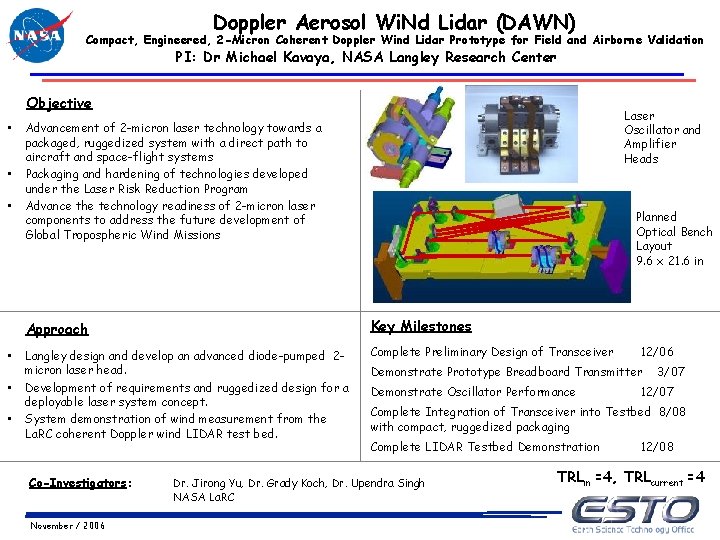
Doppler Aerosol Wi. Nd Lidar (DAWN) Compact, Engineered, 2 -Micron Coherent Doppler Wind Lidar Prototype for Field and Airborne Validation PI: Dr Michael Kavaya, NASA Langley Research Center Objective • • • Laser Oscillator and Amplifier Heads Advancement of 2 -micron laser technology towards a packaged, ruggedized system with a direct path to aircraft and space-flight systems Packaging and hardening of technologies developed under the Laser Risk Reduction Program Advance the technology readiness of 2 -micron laser components to address the future development of Global Tropospheric Wind Missions Planned Optical Bench Layout 9. 6 x 21. 6 in Approach Key Milestones Langley design and develop an advanced diode-pumped 2 micron laser head. Development of requirements and ruggedized design for a deployable laser system concept. System demonstration of wind measurement from the La. RC coherent Doppler wind LIDAR test bed. Complete Preliminary Design of Transceiver Co-Investigators: November / 2006 12/06 Demonstrate Prototype Breadboard Transmitter Demonstrate Oscillator Performance 3/07 12/07 Complete Integration of Transceiver into Testbed 8/08 with compact, ruggedized packaging Complete LIDAR Testbed Demonstration Dr. Jirong Yu, Dr. Grady Koch, Dr. Upendra Singh NASA La. RC 12/08 TRLin =4, TRLcurrent =4