
Overview of advanced cathodes for High Brightness Beams
Overview of advanced cathodes for High Brightness Beams L. Cultrera (INFN-LNF) Workshop on the physics and application of high brightness electron beams Maui, Hawaii November 16 -19, 2009

Cathodes Photocathodes Metals Coated Thermionic CNT Ce. B 6 Semiconductors Spindt Pure Field Emitter PEA Si nano NEA Ba. O Cu Cu-Cs. Br Mg Cu-Mg. F 2 Pb Cu-Cs Y W-Cs K 2 Cs. Sb Cs 2 Te Cs: Ga. As Cs: Ga. N Cs: Ga. As. P SEY Diamond Window NOT EXAUSTIVE LIST!
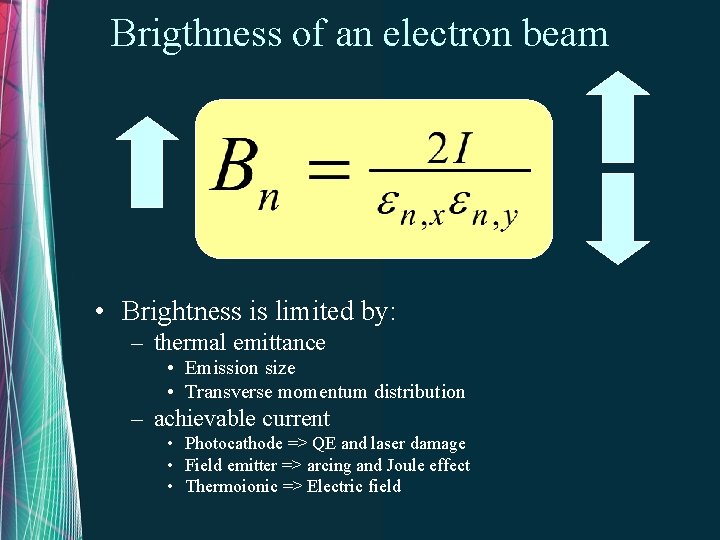
Brigthness of an electron beam • Brightness is limited by: – thermal emittance • Emission size • Transverse momentum distribution – achievable current • Photocathode => QE and laser damage • Field emitter => arcing and Joule effect • Thermoionic => Electric field
Metallic photocathodes • Prompt time response makes them suitable for: – Very short electron bunches – Temporal pulse shaped profile • Relative insensitivity to contamination: – Preparation – Handling – Vacuum requirements – Operational lifetime
QE and thermal emittance • “QE is a measure of the longitudinal momentum distribution” • “Thermal emission is by definition a measure of the transverse momentum of the electrons that are emitted” • “Longitudinal momentum determine which electrons are emitted and thus which electrons’ transverse momentum contribute to the emittance” D. H. Dowell and J. F. Schmerge, Phys. Rev. ST Accel. Beams, 12, 074201 (2009)
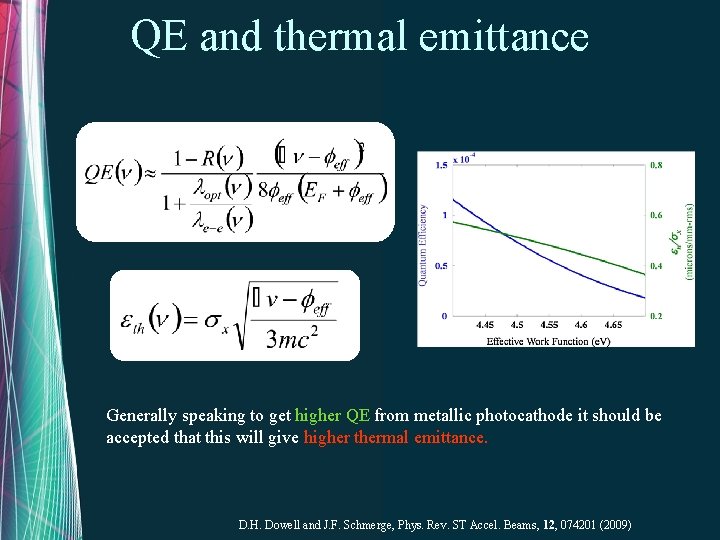
QE and thermal emittance Generally speaking to get higher QE from metallic photocathode it should be accepted that this will give higher thermal emittance. D. H. Dowell and J. F. Schmerge, Phys. Rev. ST Accel. Beams, 12, 074201 (2009)
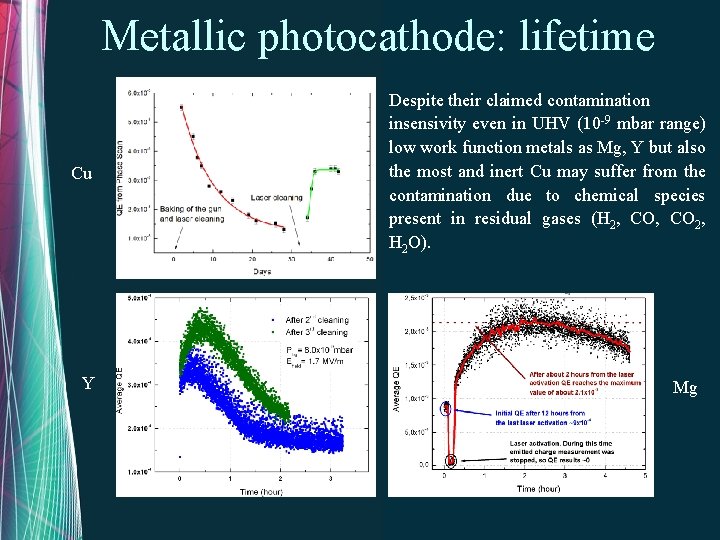
Metallic photocathode: lifetime Background Pressures w/o RF ~ 5 x 10 -10 mbar with RF ~ 2 x 10 -9 mbar Cu Y Despite their claimed contamination insensivity even in UHV (10 -9 mbar range) low work function metals as Mg, Y but also the most and inert Cu may suffer from the contamination due to chemical species present in residual gases (H 2, CO 2, H 2 O). Mg
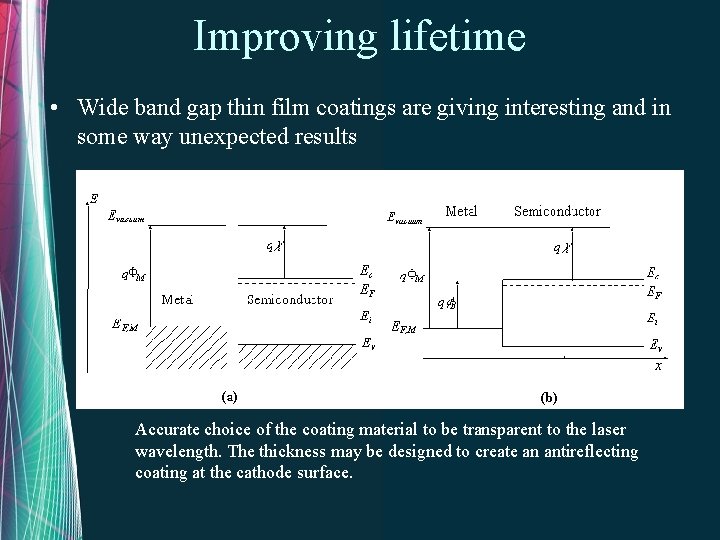
Improving lifetime • Wide band gap thin film coatings are giving interesting and in some way unexpected results Accurate choice of the coating material to be transparent to the laser wavelength. The thickness may be designed to create an antireflecting coating at the cathode surface.
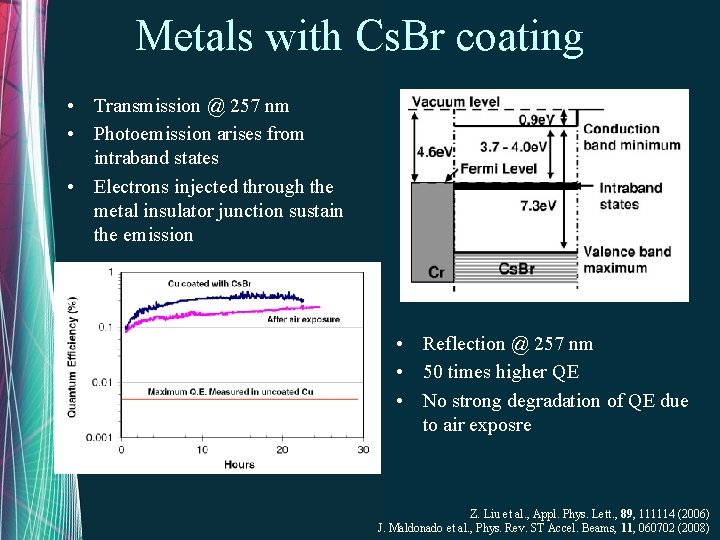
Metals with Cs. Br coating • Transmission @ 257 nm • Photoemission arises from intraband states • Electrons injected through the metal insulator junction sustain the emission • Reflection @ 257 nm • 50 times higher QE • No strong degradation of QE due to air exposre Z. Liu et al. , Appl. Phys. Lett. , 89, 111114 (2006) J. Maldonado et al. , Phys. Rev. ST Accel. Beams, 11, 060702 (2008)
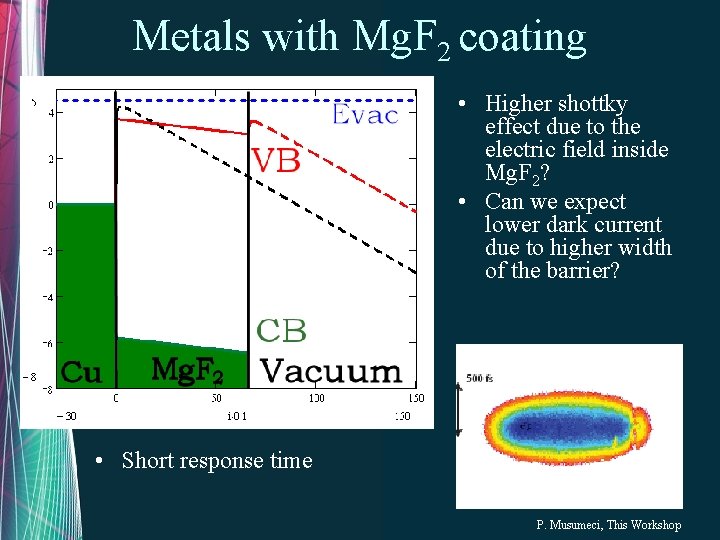
Metals with Mg. F 2 coating • Higher shottky effect due to the electric field inside Mg. F 2? • Can we expect lower dark current due to higher width of the barrier? • Short response time P. Musumeci, This Workshop
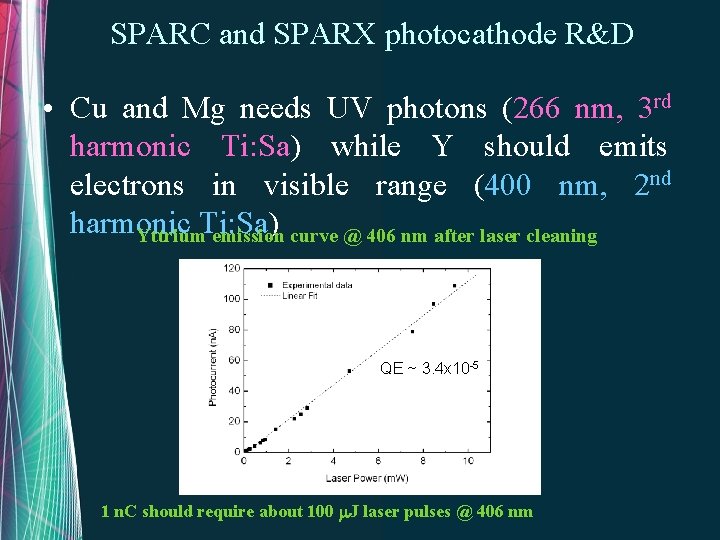
SPARC and SPARX photocathode R&D • Cu and Mg needs UV photons (266 nm, 3 rd harmonic Ti: Sa) while Y should emits electrons in visible range (400 nm, 2 nd harmonic Yttrium. Ti: Sa) emission curve @ 406 nm after laser cleaning QE ~ 3. 4 x 10 -5 1 n. C should require about 100 m. J laser pulses @ 406 nm
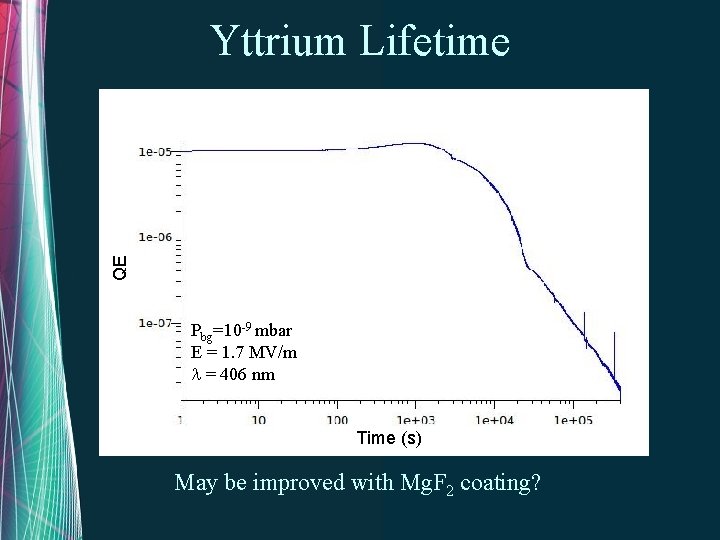
QE Yttrium Lifetime Pbg=10 -9 mbar E = 1. 7 MV/m l = 406 nm Time (s) May be improved with Mg. F 2 coating?
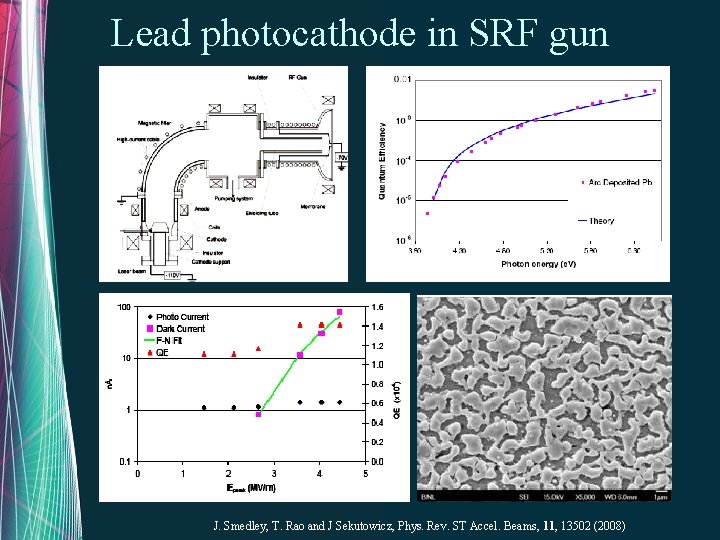
Lead photocathode in SRF gun J. Smedley, T. Rao and J Sekutowicz, Phys. Rev. ST Accel. Beams, 11, 13502 (2008)
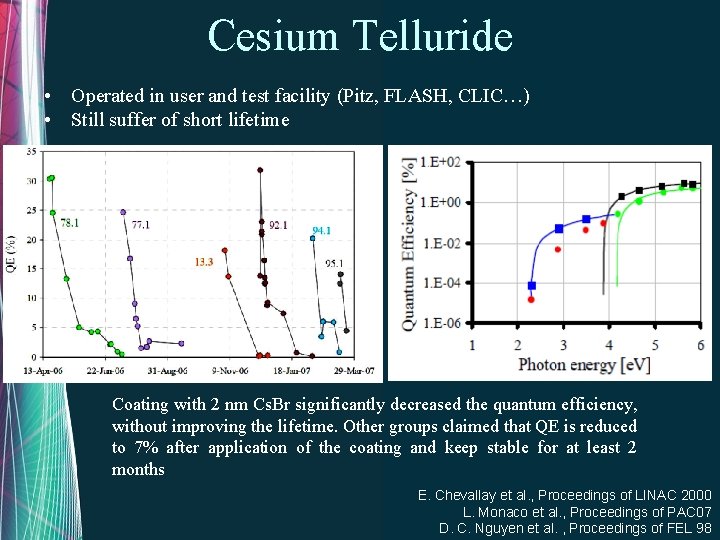
Cesium Telluride • Operated in user and test facility (Pitz, FLASH, CLIC…) • Still suffer of short lifetime Coating with 2 nm Cs. Br significantly decreased the quantum efficiency, without improving the lifetime. Other groups claimed that QE is reduced to 7% after application of the coating and keep stable for at least 2 months E. Chevallay et al. , Proceedings of LINAC 2000 L. Monaco et al. , Proceedings of PAC 07 D. C. Nguyen et al. , Proceedings of FEL 98

KCs. Sb with protective coating • Loosing efficiency by means of protective layer increases the stability versus reactive gases E. Shefer et al, Nucl. Instr. Met. A, 433, 502 (1999)
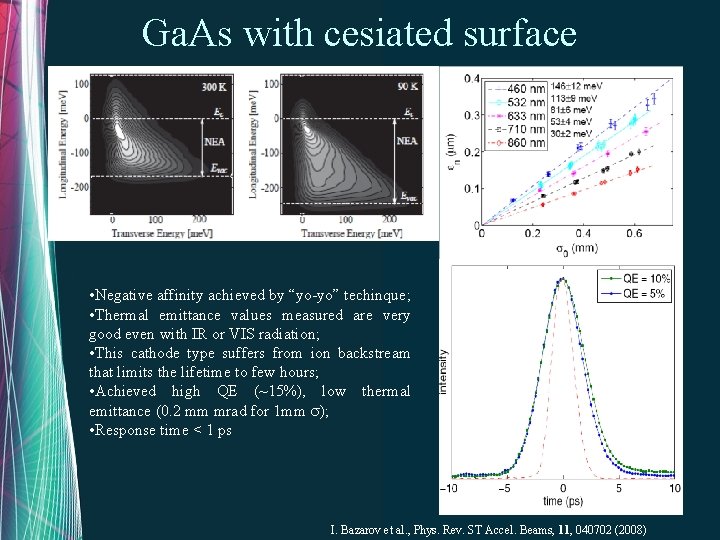
Ga. As with cesiated surface • Negative affinity achieved by “yo-yo” techinque; • Thermal emittance values measured are very good even with IR or VIS radiation; • This cathode type suffers from ion backstream that limits the lifetime to few hours; • Achieved high QE (~15%), low thermal emittance (0. 2 mm mrad for 1 mm s); • Response time < 1 ps I. Bazarov et al. , Phys. Rev. ST Accel. Beams, 11, 040702 (2008)
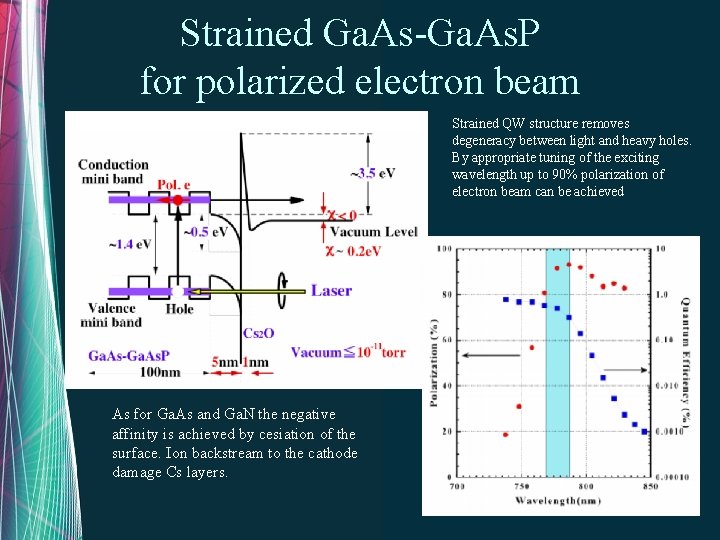
Strained Ga. As-Ga. As. P for polarized electron beam Strained QW structure removes degeneracy between light and heavy holes. By appropriate tuning of the exciting wavelength up to 90% polarization of electron beam can be achieved As for Ga. As and Ga. N the negative affinity is achieved by cesiation of the surface. Ion backstream to the cathode damage Cs layers.
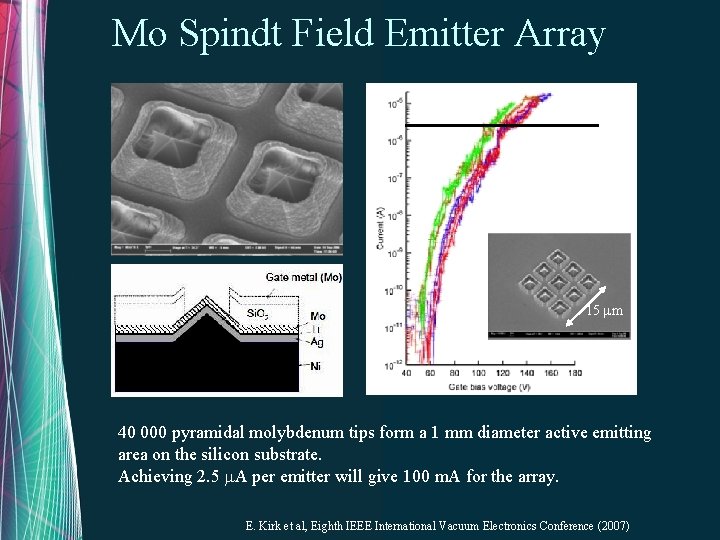
Mo Spindt Field Emitter Array 15 mm 40 000 pyramidal molybdenum tips form a 1 mm diameter active emitting area on the silicon substrate. Achieving 2. 5 m. A per emitter will give 100 m. A for the array. E. Kirk et al, Eighth IEEE International Vacuum Electronics Conference (2007)
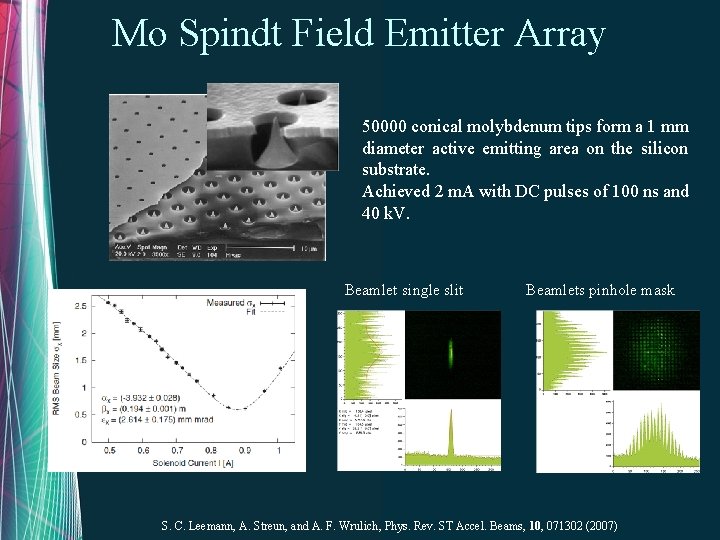
Mo Spindt Field Emitter Array 50000 conical molybdenum tips form a 1 mm diameter active emitting area on the silicon substrate. Achieved 2 m. A with DC pulses of 100 ns and 40 k. V. Beamlet single slit Beamlets pinhole mask S. C. Leemann, A. Streun, and A. F. Wrulich, Phys. Rev. ST Accel. Beams, 10, 071302 (2007)
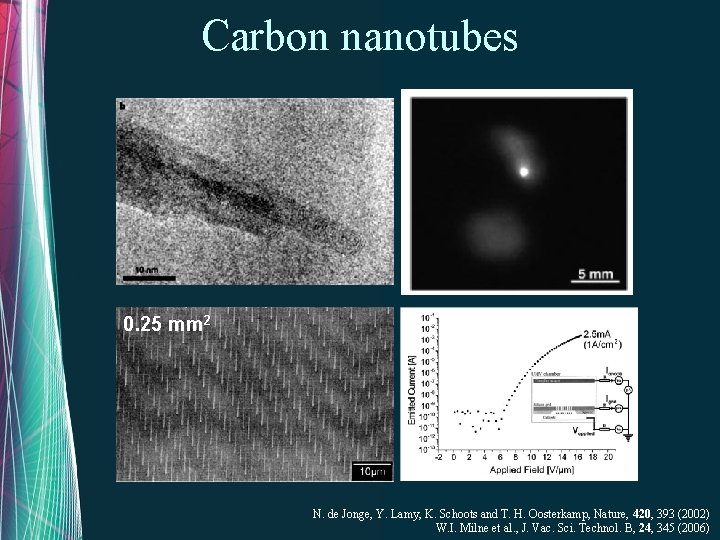
Carbon nanotubes 0. 25 mm 2 N. de Jonge, Y. Lamy, K. Schoots and T. H. Oosterkamp, Nature, 420, 393 (2002) W. I. Milne et al. , J. Vac. Sci. Technol. B, 24, 345 (2006)
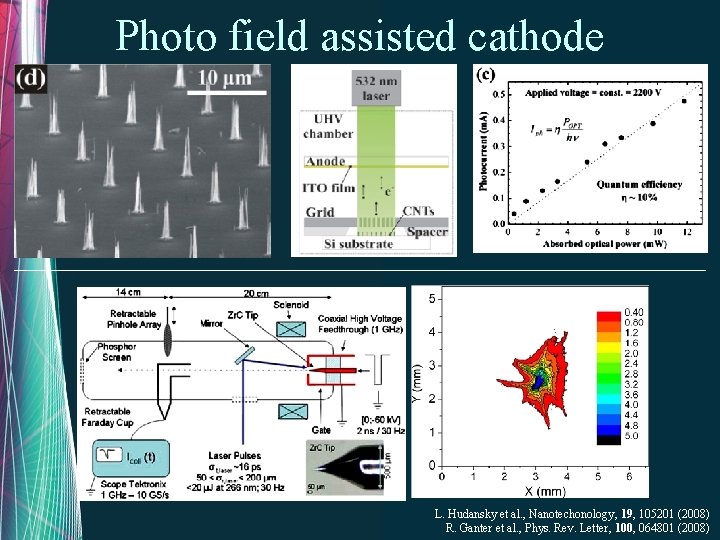
Photo field assisted cathode L. Hudansky et al. , Nanotechonology, 19, 105201 (2008) R. Ganter et al. , Phys. Rev. Letter, 100, 064801 (2008)
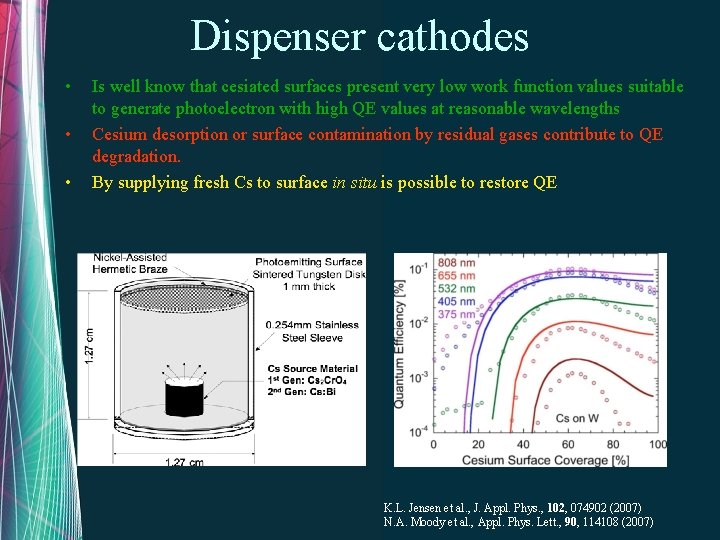
Dispenser cathodes • • • Is well know that cesiated surfaces present very low work function values suitable to generate photoelectron with high QE values at reasonable wavelengths Cesium desorption or surface contamination by residual gases contribute to QE degradation. By supplying fresh Cs to surface in situ is possible to restore QE K. L. Jensen et al. , J. Appl. Phys. , 102, 074902 (2007) N. A. Moody et al. , Appl. Phys. Lett. , 90, 114108 (2007)
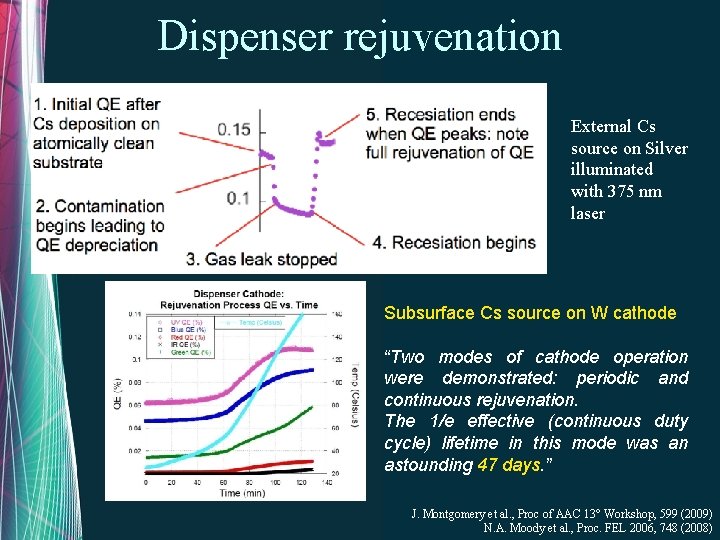
Dispenser rejuvenation External Cs source on Silver illuminated with 375 nm laser Subsurface Cs source on W cathode “Two modes of cathode operation were demonstrated: periodic and continuous rejuvenation. The 1/e effective (continuous duty cycle) lifetime in this mode was an astounding 47 days. ” J. Montgomery et al. , Proc of AAC 13° Workshop, 599 (2009) N. A. Moody et al. , Proc. FEL 2006, 748 (2008)
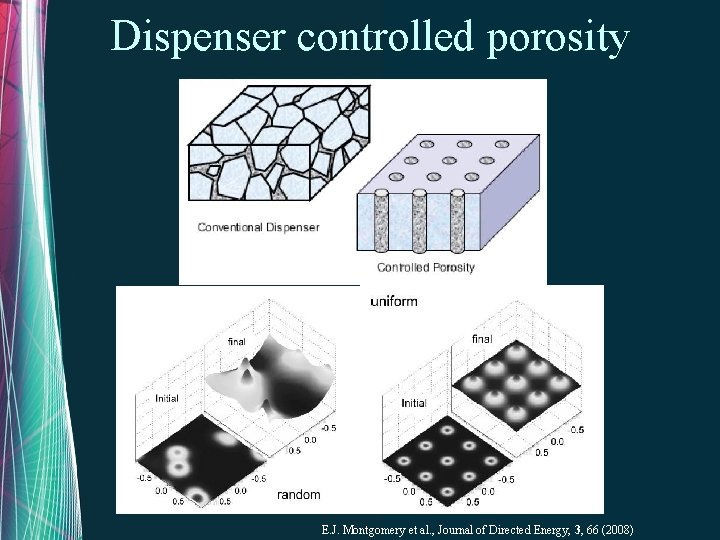
Dispenser controlled porosity E. J. Montgomery et al. , Journal of Directed Energy, 3, 66 (2008)
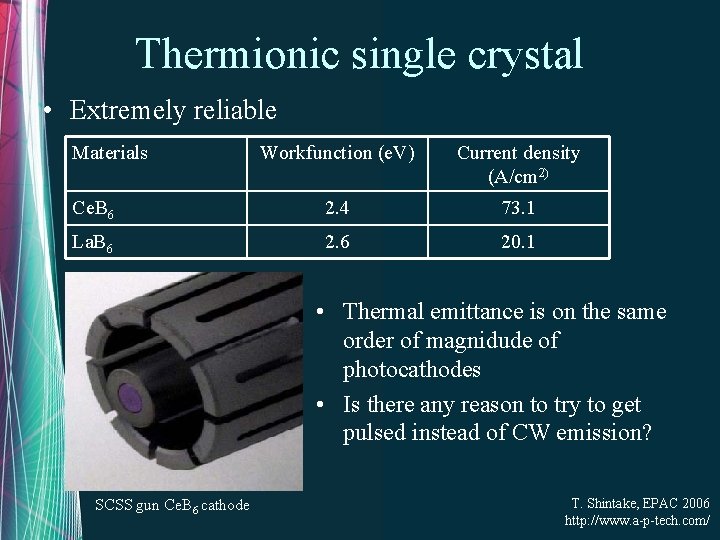
Thermionic single crystal • Extremely reliable Materials Workfunction (e. V) Current density (A/cm 2) Ce. B 6 2. 4 73. 1 La. B 6 20. 1 • Thermal emittance is on the same order of magnidude of photocathodes • Is there any reason to try to get pulsed instead of CW emission? SCSS gun Ce. B 6 cathode T. Shintake, EPAC 2006 http: //www. a-p-tech. com/
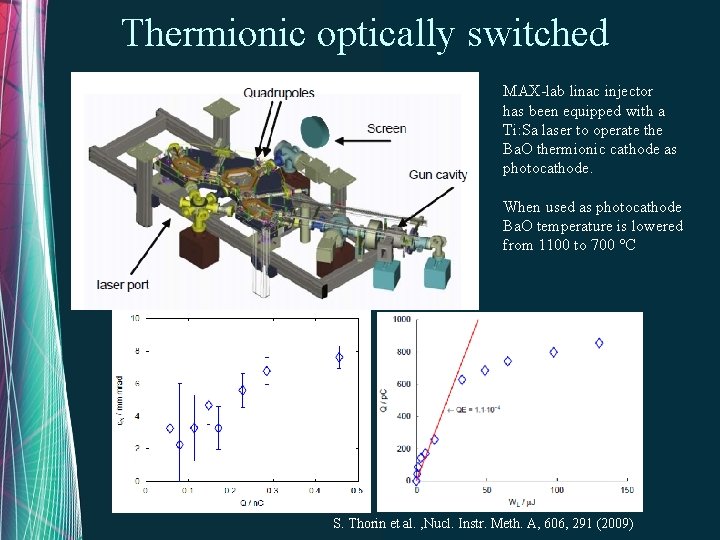
Thermionic optically switched MAX-lab linac injector has been equipped with a Ti: Sa laser to operate the Ba. O thermionic cathode as photocathode. When used as photocathode Ba. O temperature is lowered from 1100 to 700 °C S. Thorin et al. , Nucl. Instr. Meth. A, 606, 291 (2009)
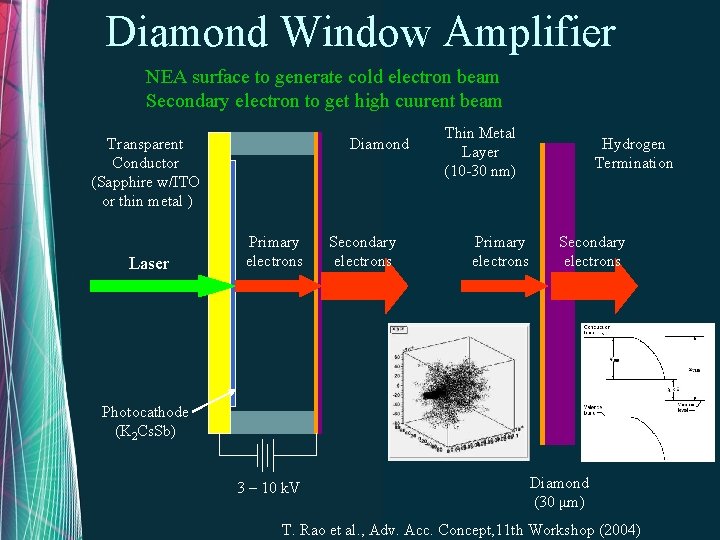
Diamond Window Amplifier NEA surface to generate cold electron beam Secondary electron to get high cuurent beam Transparent Conductor (Sapphire w/ITO or thin metal ) Laser Diamond Primary electrons Secondary electrons Thin Metal Layer (10 -30 nm) Primary electrons Hydrogen Termination Secondary electrons Photocathode (K 2 Cs. Sb) 3 – 10 k. V Diamond (30 μm) T. Rao et al. , Adv. Acc. Concept, 11 th Workshop (2004)
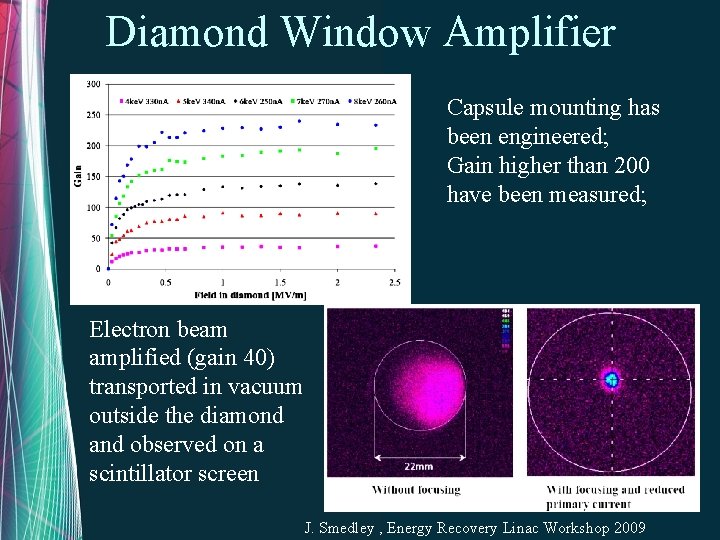
Diamond Window Amplifier Capsule mounting has been engineered; Gain higher than 200 have been measured; Electron beam amplified (gain 40) transported in vacuum outside the diamond and observed on a scintillator screen J. Smedley , Energy Recovery Linac Workshop 2009
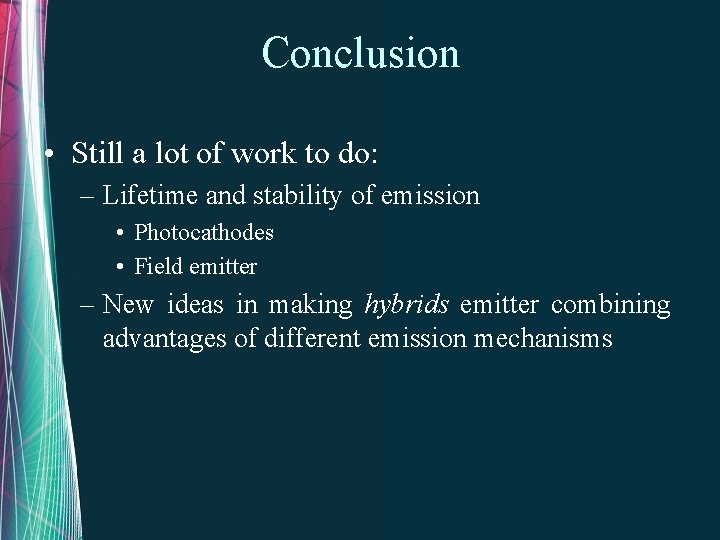
Conclusion • Still a lot of work to do: – Lifetime and stability of emission • Photocathodes • Field emitter – New ideas in making hybrids emitter combining advantages of different emission mechanisms

Thank you for the attention!
- Slides: 30